How we make this list: we compare pricing pages, product documentation and public user reviews. Rankite is independent; if a vendor ever pays for a featured spot, that listing is clearly labeled Partner.
Key takeaways
- Shopify remains the best all-round ecommerce platform for most small businesses, starting at $29 per month billed annually for the Basic plan.
- WooCommerce is free and open-source, making it the best platform for WordPress users who want full ownership, though hosting and extensions cost extra.
- BigCommerce, Wix, Squarespace, and Ecwid all start under $40 per month, and Ecwid, Square Online, Shift4Shop, and WooCommerce all offer genuinely free ways to start selling.
- Adobe Commerce is quote-only and built for enterprise; everyone else on this list publishes pricing.
- Watch transaction fees, not just subscriptions: platform fees and payment processing can add 3 to 5 percent to every order.
Quick comparison
| Tool | Best for | Starting price | Free plan |
|---|
 Shopify Shopify | Most small businesses | $29/month (Basic, billed annually) | Free trial |
 BigCommerce BigCommerce | Growing stores avoiding transaction fees | $39/month (Core) | Free trial (15 days) |
 WooCommerce WooCommerce | WordPress users wanting full control | Free (open-source plugin; hosting extra) | Yes |
 Wix Wix | Design-first small stores | $29/month (Core, billed annually) | Yes (free plan; no ecommerce) |
 Squarespace Squarespace | Beautiful stores for creatives | $19/month (Basic, billed annually) | Free trial (14 days) |
 Adobe Commerce Adobe Commerce | Enterprise B2B and B2C | See website | No |
 Ecwid Ecwid | Adding a store to an existing site | $5/month (Starter, billed annually) | Yes |
 Square Online Square Online | Local sellers already using Square | See website | Yes |
 Shift4Shop Shift4Shop | US sellers wanting no platform fees | See website | Yes (free with Shift4 payments) |
 Sellfy Sellfy | Creators selling digital products | From $22/month (Starter, billed annually) | Free trial (14 days) |
Is your product missing or out of date?
We review this list regularly. Vendors can request a listing, send updated pricing or ask about featured placement.
Starting price$29/month (Basic, billed annually)
Free planFree trial

Shopify is the default recommendation for a reason. The Basic plan at $29 per month billed annually ($39 month to month) includes unlimited products, a full online store, discount codes, gift cards, abandoned checkout recovery, and shipping label discounts up to 87 percent. The checkout is genuinely excellent, and every plan includes the same conversion-optimized flow that big brands use.
The ecosystem is the moat. If Shopify does not do something natively, an app does, from subscriptions to wholesale to advanced loyalty. That flexibility has a cost: it is easy to end up paying $100 a month in apps on top of the subscription. And if you use a third-party payment gateway instead of Shopify Payments, Shopify adds a 2% transaction fee on Basic. For most small businesses selling online, though, no platform gets you from zero to a professional store faster.
What we like- Best-converting checkout in the industry
- 8,000+ app ecosystem for any feature gap
- Sells on social, marketplaces, and in person from one dashboard
Watch out for- Monthly costs climb as paid apps stack up
- 2% third-party transaction fee unless you use Shopify Payments
Starting price$39/month (Core)
Free planFree trial (15 days)

BigCommerce positions itself as the platform you do not outgrow. Core costs $39 per month, and unlike Shopify, BigCommerce charges zero transaction fees no matter which payment gateway you use. More features ship natively, things like customer groups, faceted search, and multi-currency, so you buy fewer apps. A 15-day free trial needs no credit card.
The catch is the growth model. Plans are tied to your trailing twelve-month sales volume: cross $50,000 a year on Core and you are moved to Growth at $105 per month. That is fair in principle, but the forced upgrade can sting if a single good month pushes you over. For stores doing serious volume that resent paying both a subscription and transaction fees, BigCommerce's math often wins over Shopify's.
What we like- No platform transaction fees on any plan
- Strong built-in features reduce app spending
- Multi-storefront and B2B tools included at higher tiers
Watch out for- Plan upgrades trigger automatically as sales grow
- Theme selection is smaller than Shopify's
Starting priceFree (open-source plugin; hosting extra)
Free planYes
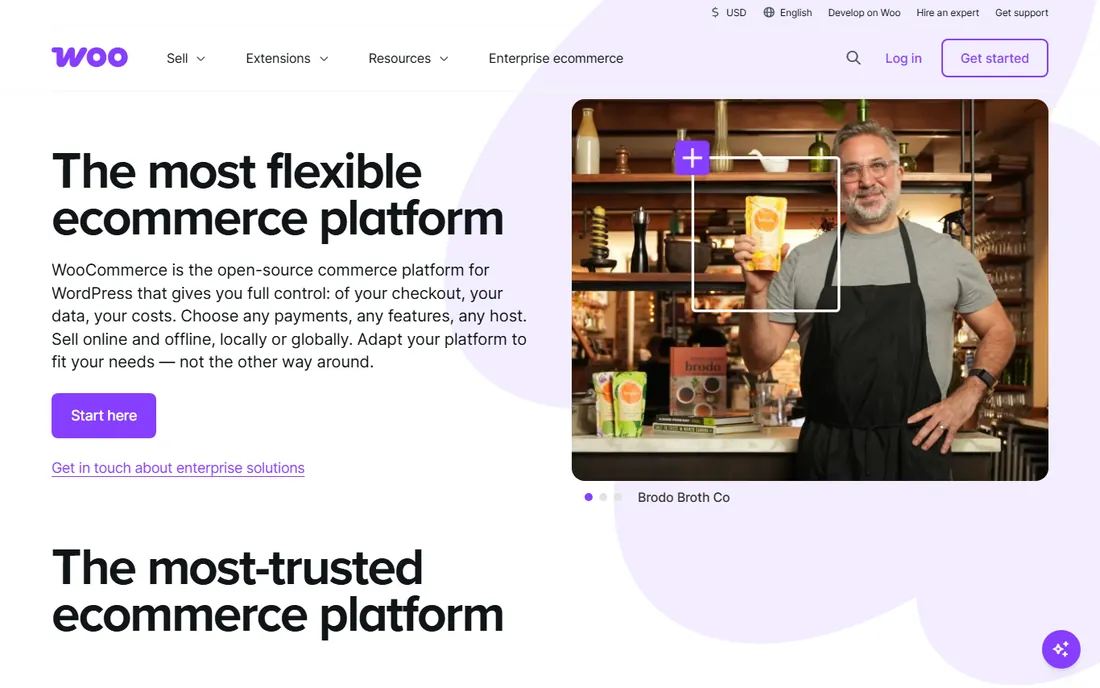
WooCommerce turns any WordPress site into a store for free. The plugin itself costs nothing and takes no cut of your sales. You get product management, coupons, tax and shipping configuration, and a checkout you can customize down to the code. For content-driven businesses already on WordPress, adding commerce without leaving the platform is a huge win, and the SEO tooling is the best in the business.
Freedom has a price in responsibility. You choose the hosting, keep everything updated, and handle security. A lean store runs $15 to $50 a month for hosting and a domain; premium extensions for subscriptions, bookings, or advanced shipping run $29 to $299 a year each. If you have technical help or a managed WordPress host, WooCommerce is unbeatable value. If the phrase "plugin conflict" makes you nervous, pick a hosted platform instead.
What we like- Completely free core software with no revenue share
- Total ownership of your data, code, and design
- Massive plugin ecosystem for any feature
Watch out for- You handle hosting, security, and updates yourself
- Costs from hosting and premium extensions add up
Starting price$29/month (Core, billed annually)
Free planYes (free plan; no ecommerce)
Wix is the best ecommerce platform for owners who care deeply about how their store looks and want to build it themselves. The Core plan at $29 per month billed annually includes basic ecommerce: online payments, product catalogs, and the full drag-and-drop editor with hundreds of store templates. Business at $36 adds advanced ecommerce features like subscriptions and automated sales tax.
Everything lives in one dashboard: hosting, a free domain for the first year, email marketing, and AI tools for product descriptions and images. Wix charges no platform transaction fee, just your payment processor's rate. The limits show at scale: stores with thousands of SKUs or complex B2B needs will feel constrained, and the free plan does not allow selling at all. For boutiques, makers, and service businesses adding a shop, Wix hits a sweet spot of beauty and simplicity.
What we like- Easiest drag-and-drop designer in ecommerce
- Ecommerce plans include hosting, domain, and marketing tools
- No platform transaction fees
Watch out for- Ecommerce starts at the $29 Core plan
- Less scalable for large catalogs than Shopify or BigCommerce
Starting price$19/month (Basic, billed annually)
Free planFree trial (14 days)

Squarespace made its name on design, and its commerce offering carries that DNA. Every plan can sell unlimited physical and digital products. Basic at $19 per month billed annually is the cheapest starting price on this list, though it adds a 2% transaction fee on store sales. Core at $29 removes that fee and adds professional shipping and tax tools, plus lower fees on courses and memberships.
Where Squarespace stands out is selling expertise: online courses, memberships, video content, and appointment scheduling integrate naturally with the store. Creators, photographers, designers, and consultants get a portfolio and a shop in one coherent site. The trade-offs are a smaller extension marketplace and less depth for complex retail operations. If your brand is the product, Squarespace makes it look its best.
What we like- Gorgeous templates that make products look premium
- Selling built into every plan
- Strong tools for digital products, courses, and memberships
Watch out for- 2% transaction fee on the Basic plan
- Smaller app marketplace than Shopify or WooCommerce
Starting priceSee website
Free planNo
Adobe Commerce, formerly Magento, is the heavyweight of this list. It handles the scenarios that break simpler platforms: massive catalogs, complex B2B pricing and quoting, multiple storefronts and brands from one backend, and deep ERP integrations. The open-source Magento codebase still exists for developers, but Adobe Commerce as a managed product is aimed squarely at mid-market and enterprise merchants.
Everything about it is enterprise-grade, including the cost and complexity. Pricing is quote-based and typically runs into five or six figures annually, and you will need developers or an agency to implement and maintain it. This is not a tool a small business should consider. But if you are doing millions in online revenue with requirements no SaaS platform can meet, Adobe Commerce is the platform those projects are built on.
What we like- Extreme customization for complex catalogs and B2B workflows
- Strong multi-store and international capabilities
- Huge partner and developer ecosystem
Watch out for- Quote-only pricing with enterprise budgets
- Requires developers to build and maintain
Starting price$5/month (Starter, billed annually)
Free planYes
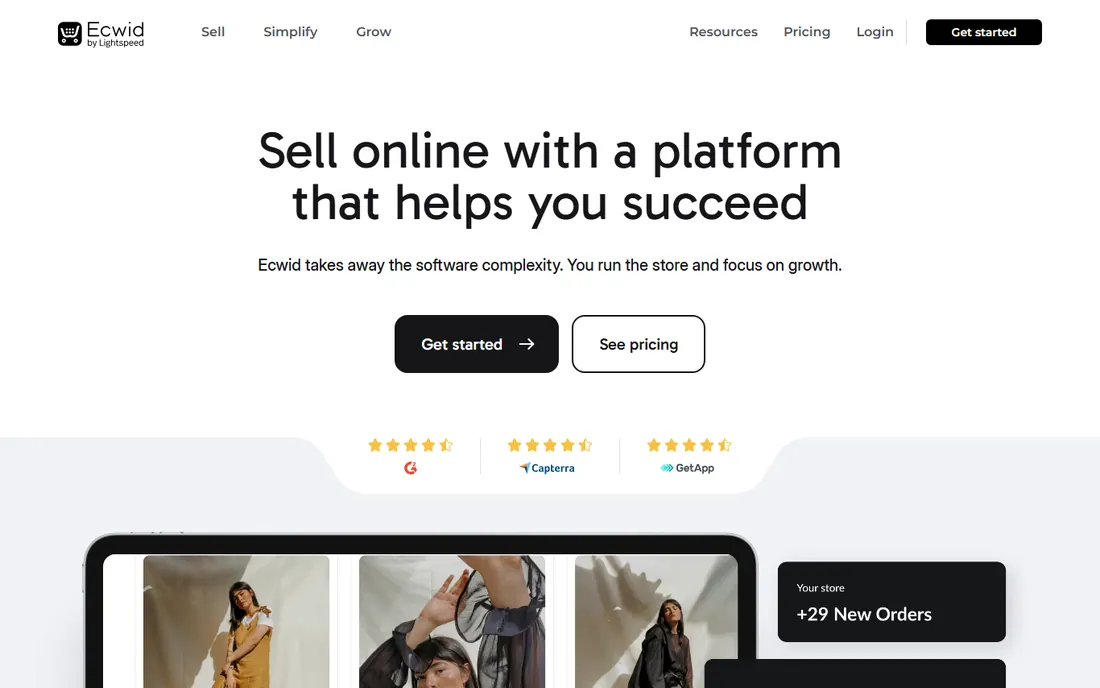
Ecwid takes a different approach: instead of replacing your website, it adds commerce to it. Paste a snippet into WordPress, Wix, Squarespace, or any site and you have a working store with products, checkout, and order management. The free plan covers up to 10 products, and paid plans start at just $5 per month billed annually for Starter, rising to $29 for Venture with social selling and discount coupons.
Ecwid charges zero transaction fees on every plan, which keeps the math clean. The product search and filtering are solid, and it syncs inventory across every site where the store is embedded. As a primary storefront builder it is less polished than Shopify or Wix, and the Instant Site templates are basic. But for businesses with an existing site that just need to start selling, or sellers who want one catalog across multiple sites, Ecwid is the pragmatic choice.
What we like- Drops a store into any existing website in minutes
- No transaction fees from Ecwid on any plan
- Generous free plan for tiny catalogs
Watch out for- Standalone storefront design is simpler than rivals
- Advanced features need higher tiers
Starting priceSee website
Free planYes
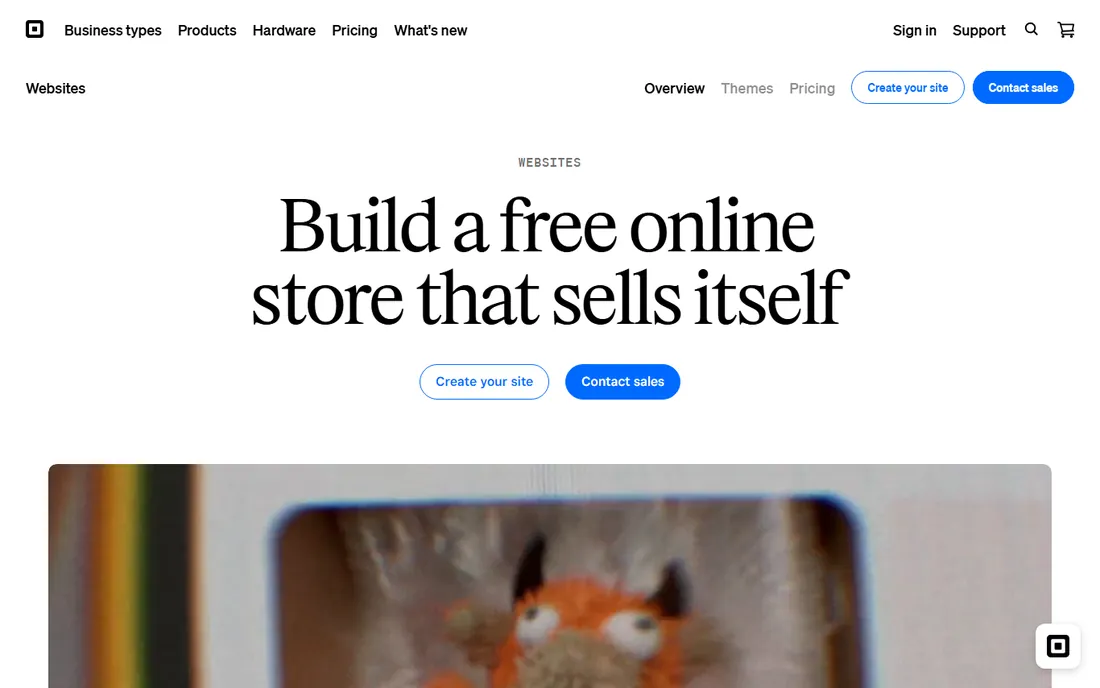
If your business already runs on Square for in-person sales, Square Online is the obvious web companion. The free plan includes unlimited products, a working store, and payment processing; you pay only the per-transaction processing fee. Inventory, customers, and orders stay in sync between your counter and your website with no double entry. Restaurants and local retailers get pickup and delivery ordering, QR code ordering, and loyalty tools that plug straight into the Square ecosystem.
Square has reshuffled its pricing several times, so confirm the current paid tiers on their site before budgeting; third-party sources disagree on the exact Plus plan price. The free plan's online processing rate is also higher than what dedicated ecommerce platforms negotiate. But for omnichannel sellers who live in Square's world, the integration eliminates an entire category of operational headache.
What we like- Free plan with unlimited products is genuinely usable
- Inventory syncs with Square POS automatically
- Pickup, delivery, and QR ordering built in
Watch out for- Paid plan pricing varies by region and has changed often
- Online processing fees are higher than some rivals
Starting priceSee website
Free planYes (free with Shift4 payments)

Shift4Shop, formerly 3dcart, has one of the most aggressive pricing plays in ecommerce: US merchants who process payments through Shift4 get the entire platform free, with unlimited products, all features, and no platform transaction fees. Paid tiers exist for merchants using other gateways, but the headline offer is a complete store for the cost of payment processing alone.
The platform itself is mature and capable, with strong native SEO controls, built-in email marketing, a CRM, and B2B pricing features that Shopify charges apps for. The downsides are real: the admin interface looks its age, there is no mobile app for store management, and the free plan's payment and location conditions exclude many sellers. But for a US-based store owner comfortable processing with Shift4, it is an extraordinary amount of software for zero subscription.
What we like- Full-featured platform free for US merchants processing with Shift4
- No transaction fees from the platform
- Strong built-in SEO and marketing tools
Watch out for- Free plan requires Shift4 payment processing and US eligibility
- Interface feels dated next to Shopify
Starting priceFrom $22/month (Starter, billed annually)
Free planFree trial (14 days)
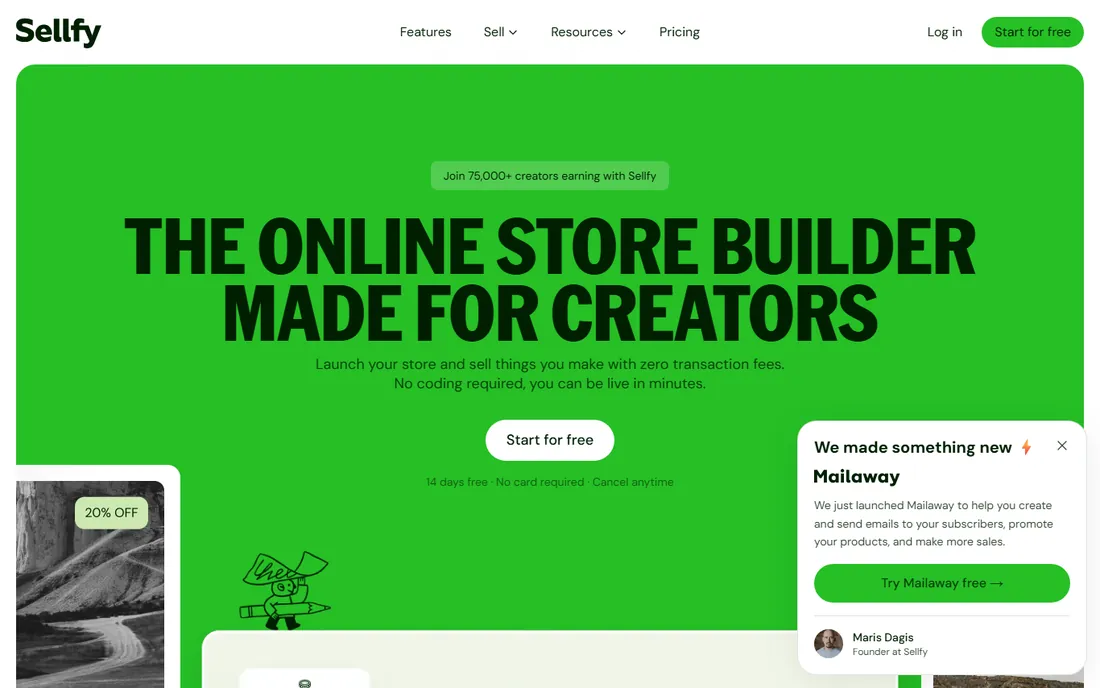
Sellfy is ecommerce stripped down for creators. Upload digital products, set up subscriptions, or add print-on-demand merch, and start selling from a hosted storefront or embedded buy buttons, no website needed. Pricing starts at $22 per month billed annually for Starter ($29 month to month), with zero transaction fees from Sellfy on every plan; you pay only Stripe or PayPal processing.
The catch is the revenue caps. Starter covers up to $10,000 in annual sales, Business ($59 annual) up to $50,000, and Premium ($119 annual) up to $200,000, with a 2% overage fee if you exceed your tier without upgrading. That structure rewards sellers who fill a tier and penalizes those at the bottom of the next one. For creators selling ebooks, templates, music, or courses who want simplicity and 0% platform fees, Sellfy is purpose-built. Physical-goods retailers should look elsewhere.
What we like- Zero platform transaction fees on all plans
- Built for digital downloads, subscriptions, and merch
- Simple setup with no website required
Watch out for- Plans cap annual sales volume, forcing upgrades
- No free plan, only a 14-day trial
This is the fundamental fork in ecommerce software. Hosted platforms like Shopify, BigCommerce, Wix, and Squarespace bundle hosting, security, updates, and support into the subscription. You pay monthly, and in exchange you never think about servers, patches, or PCI compliance. For most small businesses, that trade is worth it: your time goes to selling, not sysadmin work.
Open source, meaning WooCommerce in practice, flips the deal. The software is free and you own everything, but you own the maintenance too. That suits businesses with technical resources, unusual requirements, or a philosophical preference for no vendor lock-in. A middle path exists: Ecwid and Square Online let you add commerce to what you already have without committing to either extreme. Choose based on who will maintain the store, not just the sticker price.
How we chose these ten
We started with the ecommerce platforms that dominate buyer shortlists and review sites, then added options that serve specific sellers well: creators, local retailers, and WordPress users. Every product above exists today, accepts new customers, and is built for selling online. We verified each starting price on the vendor's own pricing page on October 13, 2026. Where pricing was quote-based or inconsistent across the vendor's own pages, we wrote "See website" rather than guessing.
We read product documentation, feature lists, and app marketplaces to confirm what each plan includes, and we read public reviews on G2, Capterra, and Reddit for the recurring praise and complaints. We did not invent ratings, user counts, awards, or customer names, and we made no claims of hands-on testing. The "best for" labels reflect where each platform's pricing, features, and limitations fit most naturally for US small and mid-size businesses.
Total cost goes beyond the monthly subscription. Add the payment processing rate, usually around 2.9% plus 30 cents per online transaction, plus any platform transaction fee: Shopify adds up to 2% if you skip Shopify Payments, and Squarespace Basic takes 2%. Then budget for apps or extensions, which commonly add $20 to $100 a month on Shopify and $29 to $299 a year per extension on WooCommerce.
Next, test the things that drive revenue. Site search quality matters enormously for stores with large catalogs; if built-in search is weak, dedicated ecommerce search tools exist as add-ons. Check the checkout on your phone, confirm the platform handles the taxes and shipping rules for where you sell, and verify it integrates with your accounting and email tools. Finally, read the terms on plan upgrades tied to sales volume, like BigCommerce's automatic tier moves and Sellfy's revenue caps, so growth never surprises you.
Frequently asked questions
What is the best ecommerce software for small businesses?
Shopify is the safest all-round pick for most small businesses. WooCommerce is best if you already use WordPress and want full control. Wix and Squarespace suit design-focused stores, BigCommerce suits growing stores that want no transaction fees, and Square Online suits local sellers already using Square.
How much does ecommerce software cost?
Most hosted platforms cost $19 to $39 per month for entry plans when billed annually. On top of the subscription, expect payment processing around 2.9% plus 30 cents per transaction, possible platform transaction fees, and app or extension costs. WooCommerce software is free, but hosting and extensions typically run $15 to $50+ per month.
What is the best free ecommerce software?
WooCommerce is free and open-source, though you pay for hosting. Square Online, Ecwid, and Shift4Shop (for US sellers using Shift4 payments) all offer genuinely free plans with real selling features. Wix has a free plan but does not allow ecommerce on it.
Which ecommerce platform has no transaction fees?
BigCommerce, Ecwid, Sellfy, and Shift4Shop charge no platform transaction fees on any plan. Wix also charges none. Shopify and Squarespace waive them only on higher tiers or with their own payment systems. Note that card processing fees from Stripe, PayPal, or Square still apply everywhere.
Can I sell digital products with these platforms?
Yes. Sellfy is built specifically for digital downloads, subscriptions, and merch. Shopify, WooCommerce, BigCommerce, Wix, Squarespace, and Ecwid all support digital products, with file delivery after purchase. Squarespace additionally handles courses and memberships well.
Should I choose Shopify or WooCommerce?
Choose Shopify if you want a managed platform with hosting, security, and support handled for you, and you are comfortable paying monthly plus apps. Choose WooCommerce if you already run WordPress, want full ownership of your store and data, and have the technical resources to manage hosting and updates.
Sources we checked (14)
- https://www.shopify.com/pricing
- https://www.bigcommerce.com/pricing/
- https://woocommerce.com/
- https://www.wix.com/ecommerce/website
- https://www.squarespace.com/pricing
- https://business.adobe.com/products/magento/magento-commerce.html
- https://www.ecwid.com/pricing
- https://squareup.com/us/en/online-store
- https://www.shift4shop.com/
- https://sellfy.com/pricing/
- https://www.g2.com/products/shift4shop/pricing
- https://www.g2.com/products/sellfy/pricing
- https://dodopayments.com/blogs/sellfy-alternatives
- https://reverbico.com/blog/wix-vs-squarespace/
Is your product missing or out of date?
We review this list regularly. Vendors can request a listing, send updated pricing or ask about featured placement.

Shihab Mia · Founder, Rankite
Shihab has spent more than a decade helping SaaS and e-commerce brands grow through search. He writes Rankite's software buying guides from pricing pages, documentation and public user reviews. More about Shihab.