How we make this list: we compare pricing pages, product documentation and public user reviews. Rankite is independent; if a vendor ever pays for a featured spot, that listing is clearly labeled Partner.
Key takeaways
- BlackLine and Trintech own the enterprise financial close, while FloQast is the friendlier pick for teams that live in Excel and want structure without a long implementation.
- Tipalti is the clear choice when accounts payable spans many countries and currencies, with tax compliance built into the payment flow.
- Ramp and Airbase collapse cards, bill pay and procurement into one approval chain; Ramp's core platform is free, Airbase now sells through Paylocity.
- HighRadius, Vic.ai and Stampli bring AI into specific AP jobs like cash application, invoice coding and approval collaboration.
- Almost every enterprise vendor prices by quote, so budget for a sales cycle and ask for per-entity and per-transaction fees up front.
Quick comparison
| Tool | Best for | Starting price | Free plan |
|---|
 BlackLine BlackLine | Enterprise financial close management | See website | No |
 FloQast FloQast | Close checklists for accounting teams | See website | No |
 Tipalti Tipalti | Global AP and mass payments | $99 per month | No |
 Ramp Ramp | Free corporate cards plus bill pay | $0 (core platform free) | Yes |
 Airbase Airbase | Unified spend, AP and procurement | See website | No |
 HighRadius HighRadius | Autonomous finance and AR automation | See website | No |
 AvidXchange AvidXchange | Mid-market AP automation | See website | No |
 Stampli Stampli | Collaborative invoice approvals | See website | No |
 Vic.ai Vic.ai | AI invoice processing for AP | See website | No |
 Trintech Trintech | Close and reconciliation at scale | See website | No |
Is your product missing or out of date?
We review this list regularly. Vendors can request a listing, send updated pricing or ask about featured placement.
Starting priceSee website
Free planNo
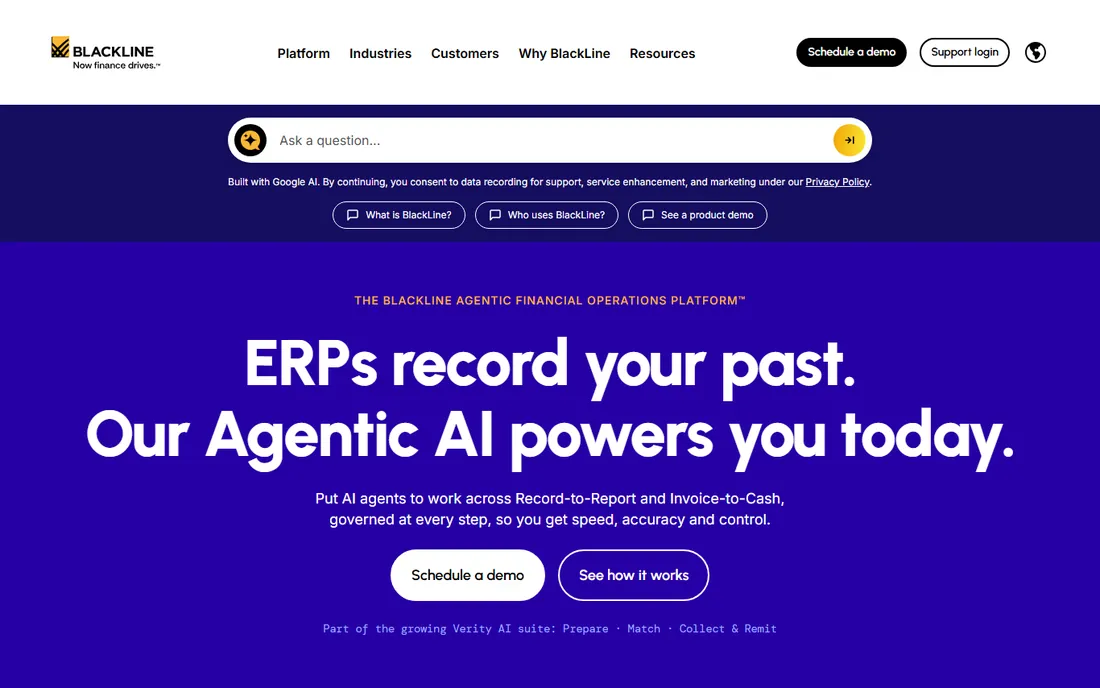
BlackLine is the name most enterprise controllers already know. The platform covers the whole close: balance sheet reconciliations, journal entries, task management, variance analysis and compliance controls, all tied to your ERP. For large companies running multi-entity closes across regions, it replaces the spreadsheet checklists and email chains that make month-end drag into week two.
The honest catch is the buying process. Pricing is quote-only, implementations are measured in months rather than weeks, and the platform assumes a finance team big enough to administer it. Smaller companies often find it oversized. BlackLine fits enterprises that need a controlled, auditable close and have the staff to run the system properly.
What we like- Deepest close management feature set in the market
- Strong reconciliation and journal entry automation
- Proven at very large, multi-entity companies
Watch out for- Quote-only pricing with enterprise sales cycles
- Implementation can take months
- More platform than smaller finance teams need
Starting priceSee website
Free planNo
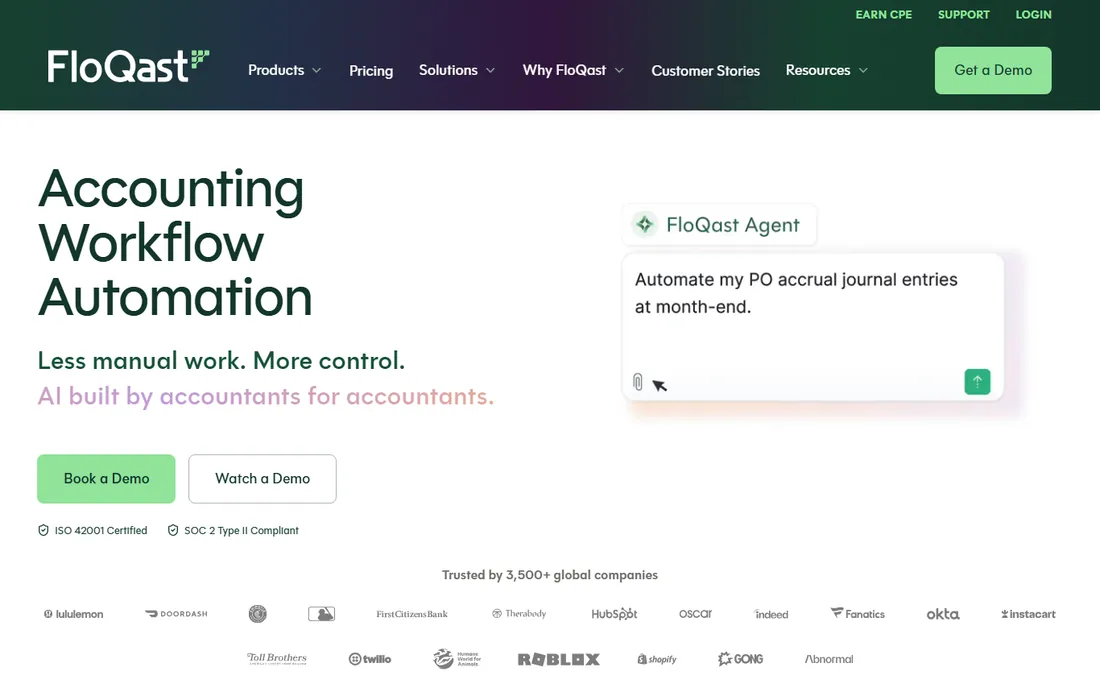
FloQast started with a narrower promise than BlackLine and kept it. Instead of rebuilding the close, it organizes it: checklists, task assignments, document requests and reconciliations that plug into the ERP and the spreadsheets accountants already use. Teams that live in Excel find the learning curve short, and month-end becomes visible to everyone involved.
The trade-off is scope. FloQast does the close workflow extremely well but does not stretch as far into transaction matching or intercompany accounting as the bigger suites. Pricing is also quote-based, so you still go through sales. FloQast fits mid-size to large accounting teams that want a faster, less disruptive close without re-platforming their finance stack.
What we like- Built by accountants with a familiar checklist workflow
- Tight Excel and ERP integrations
- Faster to deploy than legacy close platforms
Watch out for- Quote-only pricing
- Less depth than BlackLine for very complex reconciliations
- Best suited to teams already organized around the close
Starting price$99 per month
Free planNo
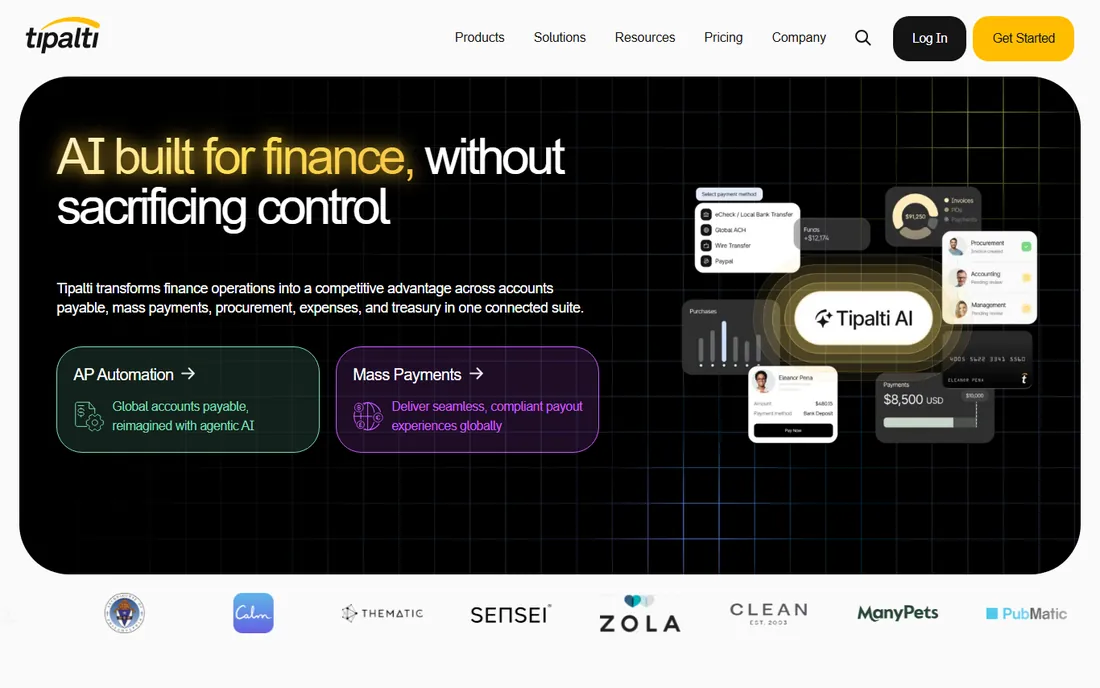
The messiest part of AP is rarely the invoice. It is paying people in 190 countries while collecting W-9s, validating tax IDs and filing 1099s. Tipalti automates that whole chain: supplier self-onboarding, invoice processing with AI scanning, approval routing, global payments and tax compliance in one system. The $99 per month AP Starter plan is one of the few published entry prices in this category.
The catch is that the subscription is only the start. Per-transaction fees, FX spreads, extra entities and implementation sit on top, so model your real volume before celebrating the headline price. Tipalti fits mid-market and enterprise finance teams whose payables cross borders and whose tax paperwork currently eats staff time.
What we like- Pays suppliers in 190+ countries with tax forms built in
- Unlimited users on listed plans
- AI invoice scanning and approval workflows included
Watch out for- Transaction and FX fees stack on top of the subscription
- Implementation can run into the thousands
- Entry plan is AP-lite rather than full global
Starting price$0 (core platform free)
Free planYes
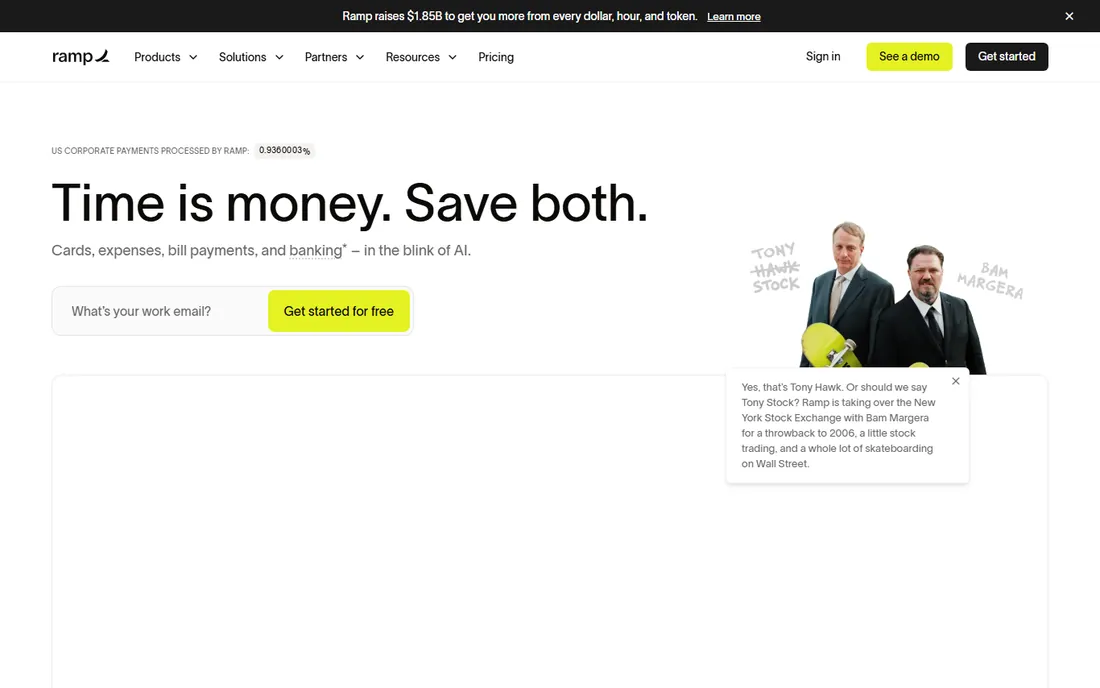
Ramp entered through the corporate card and stayed for everything around it. The pitch is simple: issue cards with built-in limits, automate expense reports, pay bills and manage procurement requests in one approval flow, with the core platform free. For companies that already put significant spend on cards, the economics are hard to beat because the subscription line item is zero.
The limitation is fit. Ramp's AP automation is genuinely useful but shallower than purpose-built tools like Tipalti or AvidXchange, especially for complex invoice matching or global tax work. Companies that process invoices but rarely use cards get less of the value. Ramp fits card-first companies that want spend control and bill pay without another subscription.
What we like- Core platform free, funded by card interchange
- Bill pay, expense management and procurement in one place
- Strong automation for receipt collection
Watch out for- Best value requires routing spend through Ramp cards
- Advanced features need the paid Ramp Plus tier
- Newer vendor with less AP depth than specialists
Starting priceSee website
Free planNo
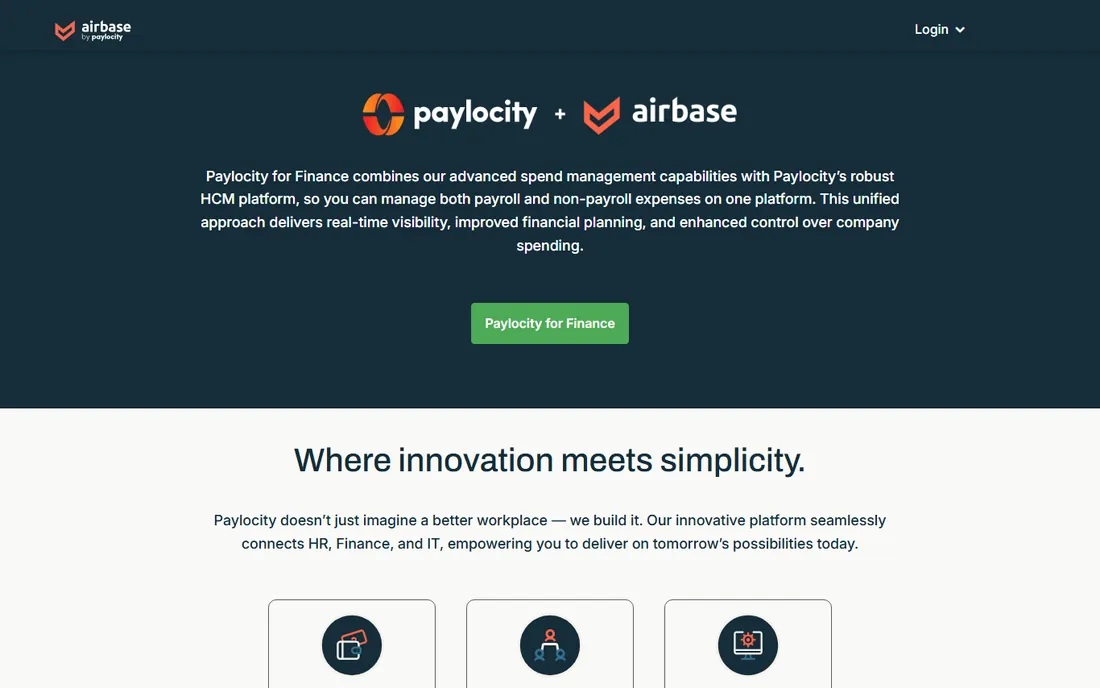
Airbase argues that cards, bill pay and procurement should never have been separate products. Its platform runs all three through one approval chain with real-time accounting sync, which gives finance teams cleaner books than stitching together a card tool and an AP tool. The bill pay and guided procurement depth genuinely exceeds what card-first competitors offer.
The catch is commercial, not technical. Paylocity acquired Airbase, and published pricing disappeared; the pricing page now routes to a quote request, likely bundled with Paylocity's HCM suite. Ask directly whether Airbase can be bought standalone and on what terms before investing time in a demo. Airbase fits mid-market companies, especially Paylocity customers, that want one system for all company spend.
What we like- Cards, bill pay and procurement share one approval framework
- Deeper AP and procurement than card-first rivals
- Strong ERP integrations
Watch out for- No published pricing since the Paylocity acquisition
- Buying now means a sales process
- Standalone purchase terms are unclear
Starting priceSee website
Free planNo
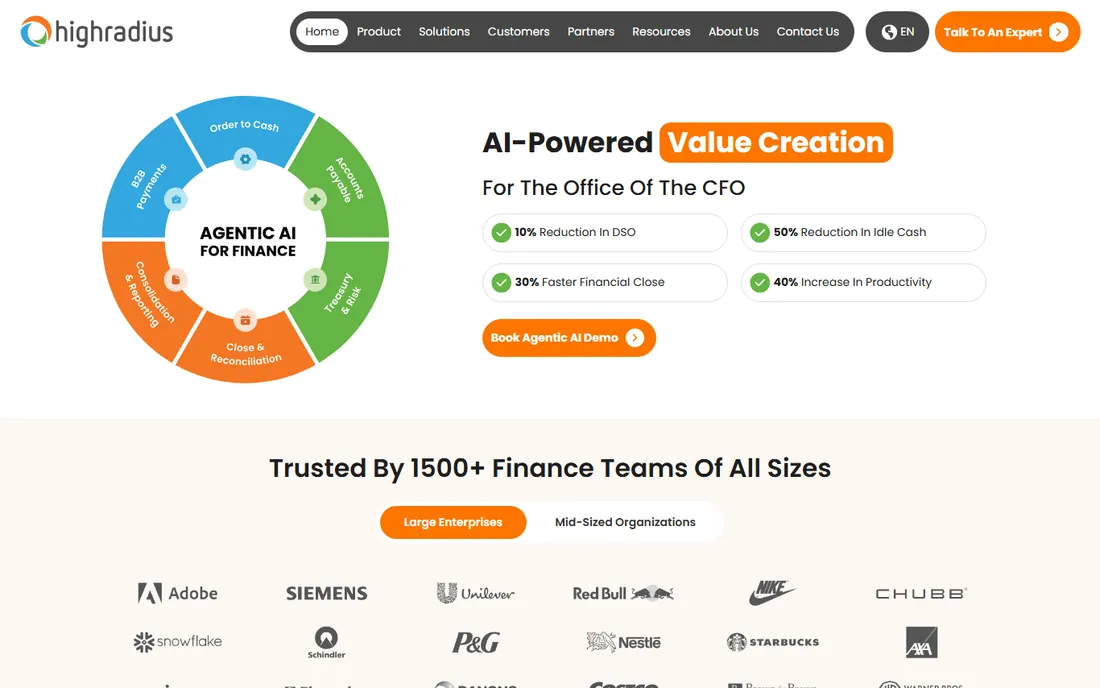
HighRadius sells autonomy, not just automation. Its platform targets the receivables side that most tools on this list ignore: AI-powered cash application that matches payments to invoices, automated collections with prioritized worklists, and credit management. For enterprises with thousands of customers and messy remittances, the match rates translate directly into fewer days of sales outstanding.
The catch is that this is enterprise software in the full sense: quoted pricing, long sales cycles and implementations that need internal project management. Companies whose AR is simple will not see the return. HighRadius fits large enterprises where receivables complexity is a real cost center.
What we like- Strong AI for cash application and collections
- Covers the full order-to-cash cycle
- Proven at very large enterprises
Watch out for- Quote-only enterprise pricing
- Implementation is a real project
- Overkill for companies without AR complexity
Starting priceSee website
Free planNo
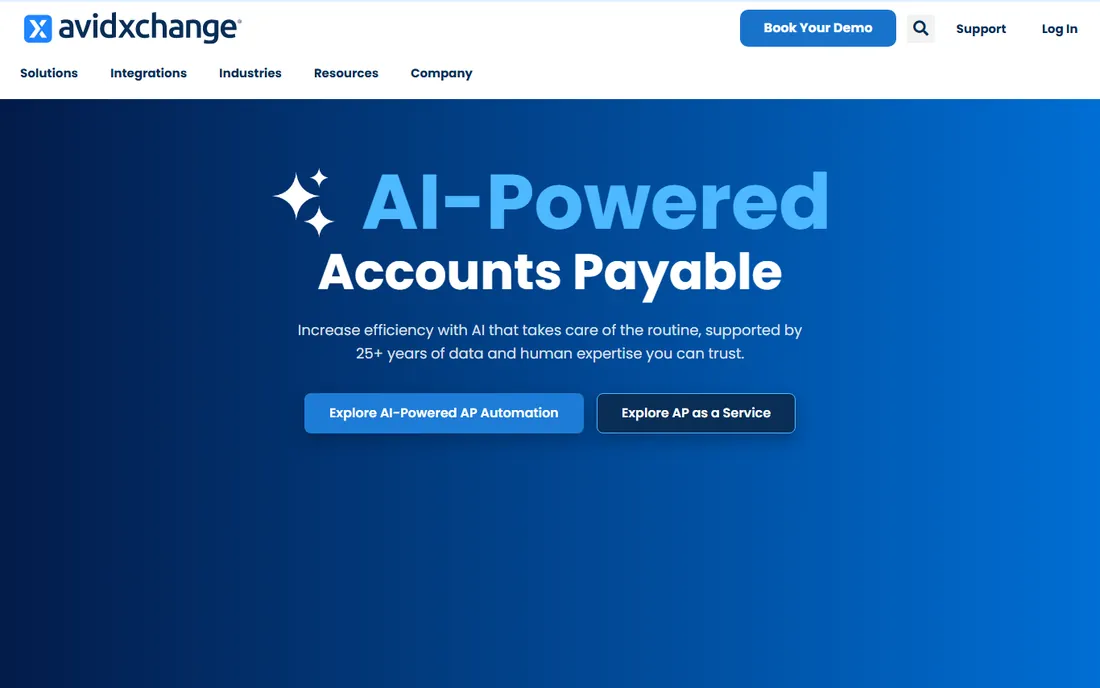
Mid-market AP has a long tail of paper checks, and AvidXchange built a business on it. The platform automates invoice capture, approval routing and payments for companies processing hundreds or thousands of invoices a month, supporting ACH, virtual cards and good old checks for suppliers that still want them. Its supplier network means many vendors are already set up to receive payments.
The downside is modernization. The interface feels older than cloud-native rivals, and pricing is quote-based with processing fees on top of the platform cost. AvidXchange fits mid-market companies, especially in real estate, construction and healthcare, that need dependable AP automation without enterprise complexity.
What we like- Purpose-built for mid-market AP workflows
- Handles paper checks alongside electronic payments
- Large supplier network speeds onboarding
Watch out for- Quote-only pricing
- Interface lags newer competitors
- Payment processing fees apply on top
Starting priceSee website
Free planNo
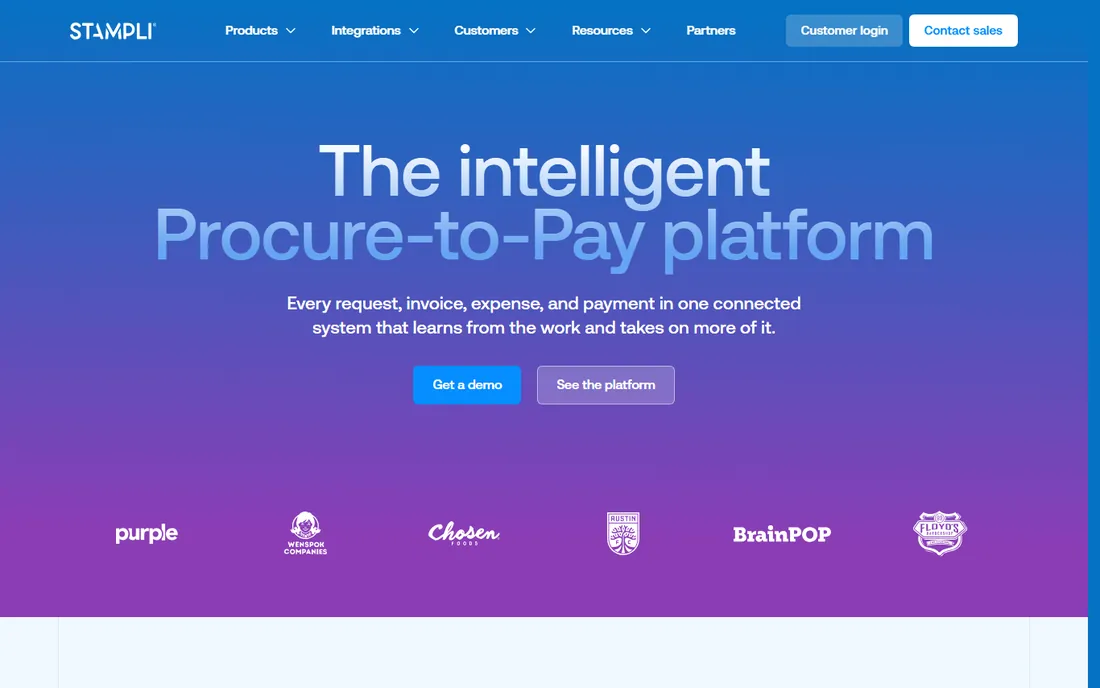
Stampli's bet is that invoices get approved faster when the conversation happens on the invoice itself. Every invoice becomes a collaboration thread where approvers ask questions, attach documents and resolve exceptions, with an AI assistant that learns how your team codes recurring bills. It layers onto your existing ERP rather than replacing it, which keeps implementation lighter than a full suite.
The limitation is that Stampli is strongest at the approval workflow and thinner on the payments side than full AP platforms. Pricing is also quote-based. Stampli fits finance teams whose bottleneck is chasing approvers and answering "what is this charge" emails, rather than the payment mechanics.
What we like- Invoice-centric collaboration speeds up approvals
- AI assistant learns coding patterns
- Deploys on top of your existing ERP without re-platforming
Watch out for- Quote-only pricing
- Approval workflow is the strength, payments are thinner
- Needs ERP integration to deliver full value
#9
Vic.ai
Best for: AI invoice processing for AP
Visit vic.ai
Starting priceSee website
Free planNo
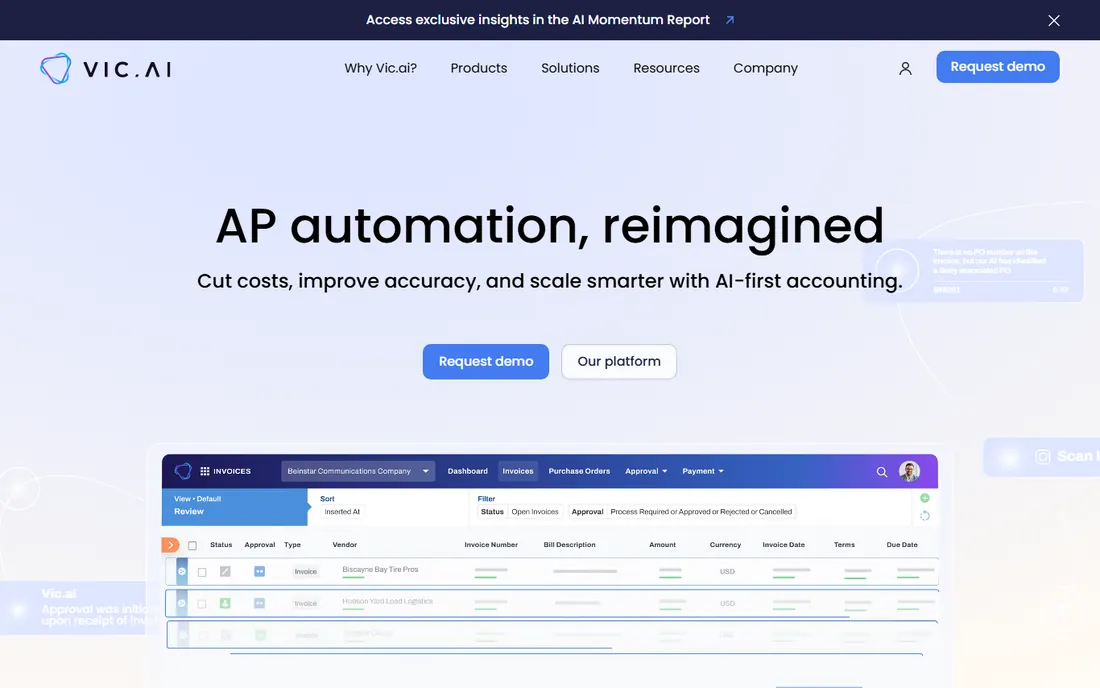
Vic.ai is the youngest company here, and the most AI-first in its pitch. The platform ingests invoices, extracts and codes them with machine learning, routes them for approval and pushes them to your ERP, aiming for a touchless AP process. The interface is modern and built around how accountants actually review exceptions rather than around legacy workflows.
The catch is maturity. As a newer vendor it has fewer reference customers than Tipalti or AvidXchange, and its scope is invoice processing rather than the full payables cycle including global payments. Pricing is quote-based. Vic.ai fits companies that want to pilot AI-driven AP processing and are comfortable with a newer vendor.
What we like- AI-first invoice data extraction and coding
- Autonomous approval routing
- Modern interface built for accountants
Watch out for- Quote-only pricing
- Younger company with a smaller customer base
- Narrower scope than full AP suites
Starting priceSee website
Free planNo
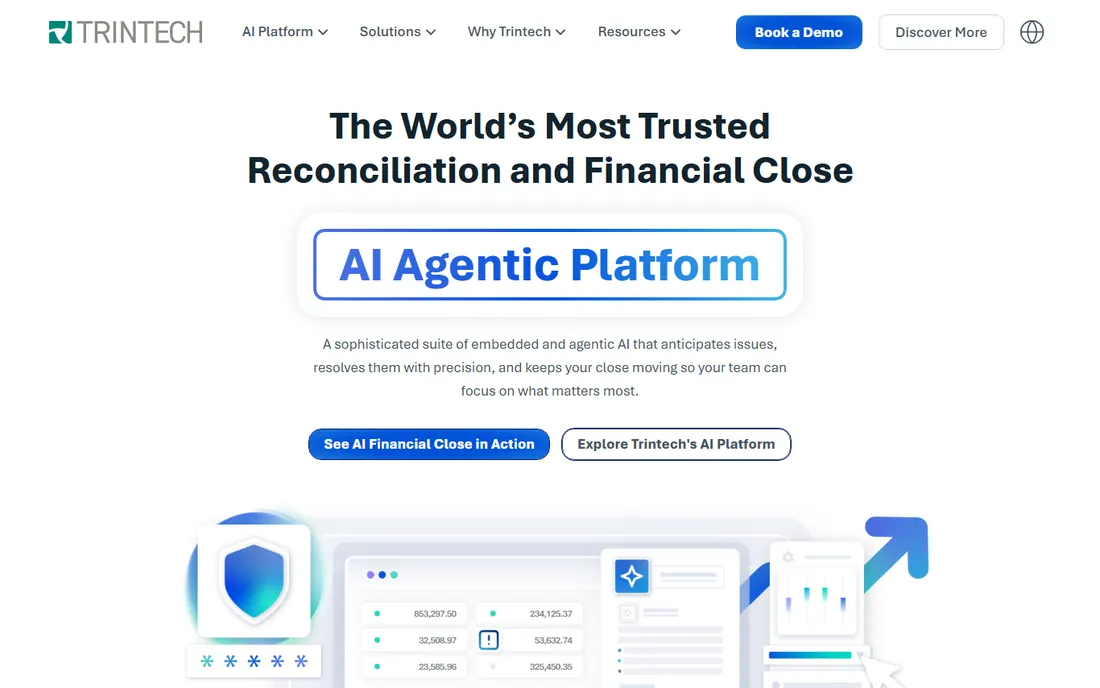
Trintech is BlackLine's oldest rival in close management. Its Cadency platform covers reconciliations, journal entries, close task management and compliance, with particular strength in financial services where reconciliation volumes are enormous. The Adra line serves mid-market teams that need reconciliation automation without the full enterprise suite.
The downside mirrors BlackLine: quoted pricing, enterprise sales cycles and a product lineup that takes effort to navigate. Trintech fits large enterprises, especially banks and insurers, that need industrial-strength reconciliation and a vendor with decades in the space.
What we like- Long track record in reconciliation automation
- Cadency suite covers close, journals and compliance
- Strong for financial services
Watch out for- Quote-only enterprise pricing
- Product lineup is complex to navigate
- Implementation needs experienced partners
How we chose
We did not run hands-on tests for this guide. We compared vendor pricing pages, product documentation, public reviews on G2 and Capterra, and analyst coverage, and we verified that each product is available today and fits enterprise in-house finance automation: close management, AP automation or spend control. We excluded tools built for accounting firms and bookkeeping practices, since those serve a different buyer. Published prices are shown where vendors publish them; most enterprise vendors in this category price by quote.
How to evaluate finance automation for an enterprise
Start with the process, not the product. Map where your close or AP actually loses time: is it reconciliations, chasing approvers, coding invoices, paying international suppliers or consolidating entities? Each tool on this list is strongest at one or two of those jobs, and buying the wrong strength is the most expensive mistake.
Count the real cost, not the subscription
Enterprise finance software is rarely sold at the listed number. Ask for per-entity fees, per-transaction charges, implementation costs and annual uplift caps before you compare. Tipalti's $99 plan and Ramp's free tier are the only transparent entry points here; everything else is negotiated. Get the fee schedule in writing, including what happens when invoice volume grows 30 percent.
Check the ERP integration depth
Every vendor claims ERP integration, but depth varies enormously. Ask whether the integration is a real-time sync or a batch file drop, how it handles multi-entity charts of accounts, and who maintains the connector when your ERP upgrades. A shallow integration turns your automation into a reconciliation project of its own.
Plan the implementation honestly
Close management platforms like BlackLine and Trintech can take three to six months to implement properly. AP tools like Tipalti and Stampli are faster but still need workflow design and supplier onboarding. Assign an internal owner with real authority, because stalled implementations are the number one reason finance automation projects fail.
Common mistakes buyers make
The most common mistake is automating a broken process. If your approval policy is unclear or your chart of accounts is a mess, software will execute the mess faster. Clean up the workflow on paper first, then choose the tool.
The second mistake is buying for the demo. Every vendor's demo shows the happy path with clean data. Ask for a pilot with your own invoices, your own entities and your own messiest month-end, and measure the time saved. The third mistake is ignoring the supplier side: AP automation only works if vendors adopt the portal or payment method, so ask each vendor for adoption rates, not just feature lists.
Frequently asked questions
What is the difference between close management and AP automation?
Close management software organizes the month-end close: reconciliations, journal entries, task checklists and sign-offs. AP automation handles the payables cycle: invoice capture, coding, approvals and payments. BlackLine, FloQast and Trintech are close tools; Tipalti, AvidXchange, Stampli and Vic.ai are AP tools; Ramp and Airbase span spend and AP.
How much does enterprise accounting automation cost?
It varies widely. Ramp's core platform is free and Tipalti starts at $99 per month, but most enterprise vendors price by quote based on entities, users and transaction volume. Expect mid-market AP tools to run into the low thousands per month and enterprise close platforms to run well into five or six figures annually including implementation.
Do these tools replace our ERP?
No. Every tool on this list is designed to work with your ERP, not replace it. They automate the workflows around the general ledger: approvals, reconciliations, payments and close tasks. The ERP remains the system of record.
How long does implementation take?
AP automation tools typically take four to twelve weeks depending on supplier onboarding complexity. Close management platforms take longer, often three to six months, because they touch reconciliations, controls and audit workflows across entities. Ask each vendor for a phased timeline tied to your close calendar.
Can these tools handle multiple entities and currencies?
The enterprise-grade ones can. BlackLine, Trintech, Tipalti and HighRadius are built for multi-entity, multi-currency operations. Simpler tools may support multiple entities only on higher tiers or with limitations, so verify this explicitly if you operate across borders.
Is AI in these tools real or marketing?
Both, depending on the vendor. Invoice data extraction, coding suggestions and cash application matching are genuinely machine-learning driven and improve with your data. Broader claims about "autonomous finance" usually mean specific workflows are automated, not the finance function. Ask what the AI does without human review and what still needs approval.
Sources we checked (6)
- https://www.rho.co/blog/best-ap-automation-tools-for-startups
- https://tipalti.com/resources/learn/tipalti-vs-ramp/
- https://kurums.com/best-ap-automation-software-2026-comparison/
- https://findstack.com/products/airbase/reviews?page=88
- https://www.airwallex.com/en-us/blog/best-spend-management-software
- https://www.rho.co/blog/airbase-vs-brex
Is your product missing or out of date?
We review this list regularly. Vendors can request a listing, send updated pricing or ask about featured placement.

Shihab Mia · Founder, Rankite
Shihab has spent more than a decade helping SaaS and e-commerce brands grow through search. He writes Rankite's software buying guides from pricing pages, documentation and public user reviews. More about Shihab.