How we make this list: we compare pricing pages, product documentation and public user reviews. Rankite is independent; if a vendor ever pays for a featured spot, that listing is clearly labeled Partner.
Key takeaways
- ABBYY and Hyperscience are the enterprise IDP leaders. Both are quote-based, so expect five-figure annual commitments and budget for implementation help.
- Nanonets and Docsumo target the mid-market with AI-first extraction. Nanonets offers a free tier; Docsumo's paid plans are now custom-quoted on its own pricing page.
- AWS Textract is the developer's choice at $0.0015 per page for basic OCR, with a free tier. You build the workflow around it; AWS provides the extraction engine.
- Docparser is the small-business pick at $32.50 per month on annual billing, with template-based parsing that non-technical staff can configure in an afternoon.
Quick comparison
| Tool | Best for | Starting price | Free plan |
|---|
 ABBYY ABBYY | Enterprises needing proven, analyst-recognized IDP | See website | Free trial |
 Hyperscience Hyperscience | Regulated enterprises needing high accuracy | See website | Free trial |
 UiPath UiPath | Companies already running UiPath automation | See website | Free trial |
 Nanonets Nanonets | Mid-market teams wanting AI extraction with a free tier | See website | Yes |
 Docsumo Docsumo | Lending, insurance, and AP teams processing document sets | See website | Free trial (14 days) |
 AWS Textract AWS Textract | Developers building custom extraction pipelines | $0.0015 per page | Yes |
 Docparser Docparser | Small teams needing simple template-based parsing | $32.50 per month (billed annually) | Free trial (14 days) |
Is your product missing or out of date?
We review this list regularly. Vendors can request a listing, send updated pricing or ask about featured placement.
#1
ABBYY
Best for: Enterprises needing proven, analyst-recognized IDP
Visit abbyy.com
Starting priceSee website
Free planFree trial
ABBYY has been extracting data from documents since 1989, and the analyst firms still rank it as an IDP leader in 2026, including the Gartner Magic Quadrant and IDC MarketScape. The Vantage platform ships pre-trained AI skills for invoices, receipts, purchase orders, and identity documents, so common types work without training. For unusual layouts, the low-code skill builder lets operations staff teach the system rather than waiting on data scientists.
The trade is enterprise packaging. Pricing is quote-based with meaningful minimums, and while the skills are pre-trained, rolling out across departments usually involves implementation help. ABBYY offers a trial so you can test extraction on your own documents first. This is the safe choice for large companies where the IDP decision goes through procurement and security review; it is overkill for a team processing a few hundred pages a month.
What we like- Leader in Gartner and IDC IDP assessments for 2026
- Pre-trained document skills for common types
- 35+ years of OCR expertise
Watch out for- Quote-based pricing with enterprise minimums
- Implementation typically needs partner or professional services help
Starting priceSee website
Free planFree trial
Hyperscience's headline number is 99.5% accuracy, and its federal credentials back up the enterprise pitch: FedRAMP High authorization plus leadership positions across six analyst assessments. The platform reads structured and unstructured documents, including handwriting that defeats most competitors, and routes low-confidence results to human reviewers with full context. Government agencies and large financial institutions are the reference customers.
Like ABBYY, it is quote-based with annual minimums that put it firmly in enterprise territory. Engagement typically starts with a demo and a scoped pilot rather than self-serve signup. For regulated industries where accuracy and compliance documentation matter more than price, it belongs on the shortlist. For everyone else, the mid-market tools below deliver most of the value at a fraction of the commitment.
What we like- Claims 99.5% accuracy
- FedRAMP High authorized
- Strong handwriting recognition
Watch out for- Quote-based with high minimums
- Best suited to large, complex deployments
Starting priceSee website
Free planFree trial
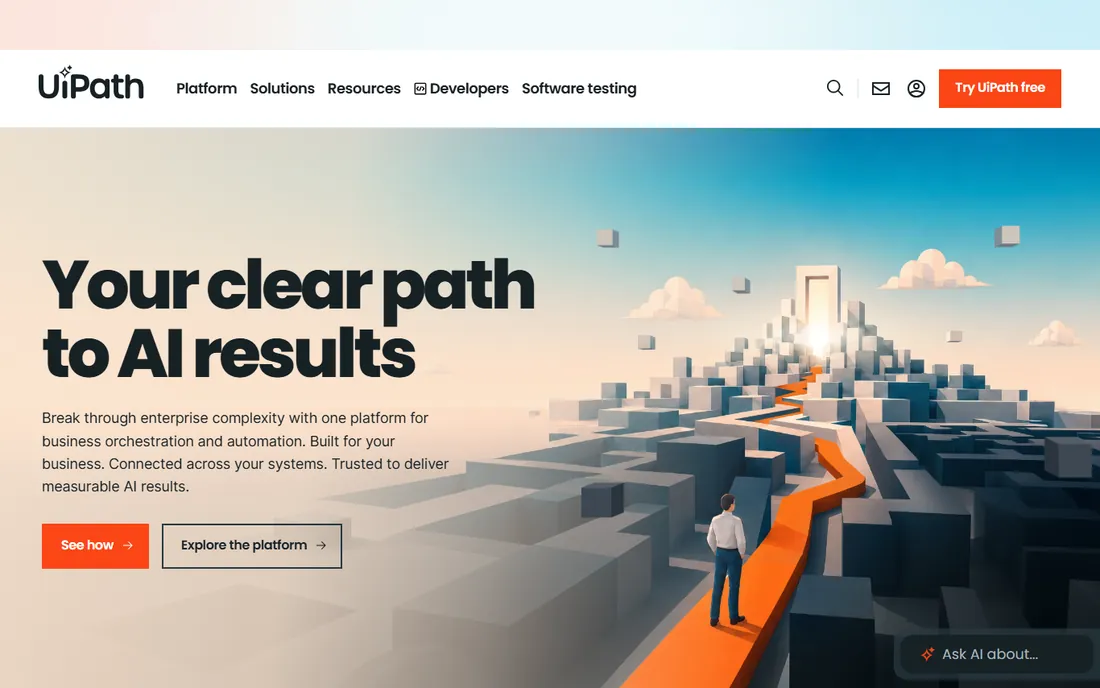
If your company already runs UiPath robots, Document Understanding (now part of the UiPath IXP offering) is the obvious IDP choice. Extraction feeds directly into automations: read the invoice, validate it, post it to the ERP, and handle exceptions, all inside one orchestrated workflow with a full audit trail. The metering is granular, with AI units consumed per page depending on the extractor used, and simple classifiers cost nothing.
The catch is that the value concentrates inside the UiPath ecosystem. Standalone, the pricing is consumption-based and difficult to forecast without running your actual volume through it. Companies without UiPath should compare the total platform cost against a dedicated IDP tool. For existing UiPath customers automating finance or operations, though, it turns document extraction from a separate project into a native capability.
What we like- Document Understanding plugs directly into UiPath robots and orchestrator
- Consumption-based AI units scale with volume
- Strong governance and audit trail
Watch out for- Pricing is consumption-based and hard to predict
- Makes most sense inside an existing UiPath deployment
#4
Nanonets
Best for: Mid-market teams wanting AI extraction with a free tier
Visit nanonets.com
Starting priceSee website
Free planYes
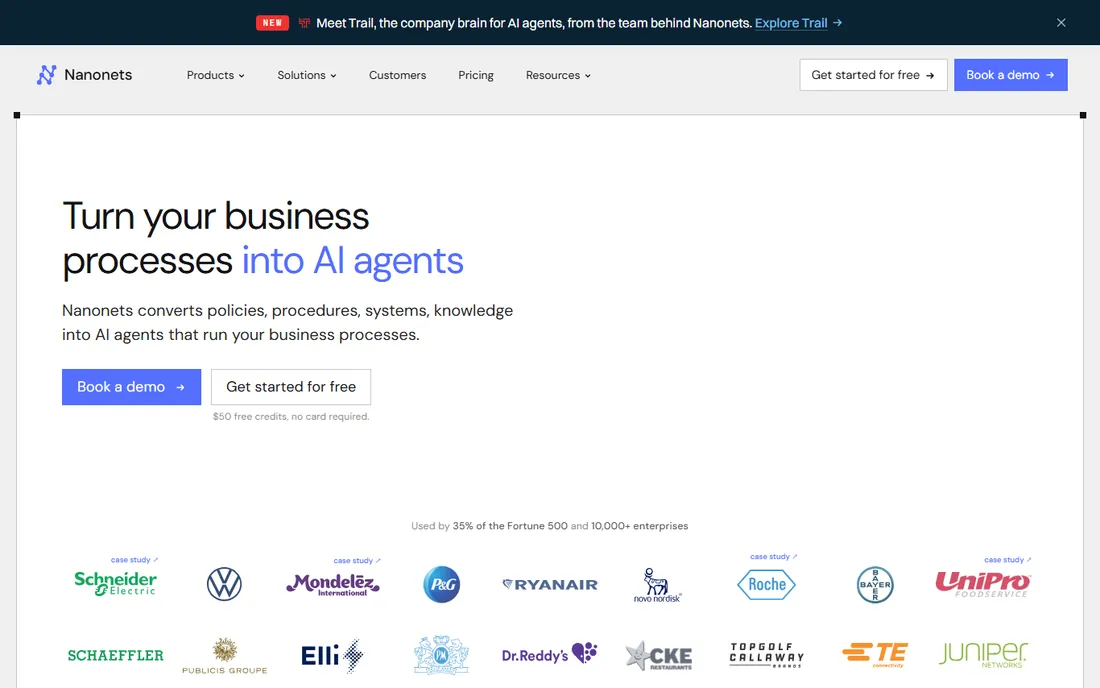
Nanonets now positions itself as an AI agent platform for enterprise data processing, but document extraction remains the core: the system reads invoices, POs, claims, and contracts visually, without templates, so vendor format changes do not break it. Corrections feed back into the models, and human-in-the-loop review handles edge cases through Slack, Teams, or email. Compliance coverage includes SOC 2, GDPR, and HIPAA.
The free tier makes it the easiest tool here to evaluate on real documents. Paid pricing is quote-based on the current site, which is a step back in transparency from earlier published tiers. The agentic repositioning means marketing talks about context graphs and autonomous workflows more than extraction accuracy; look past the messaging to the extraction benchmarks. For mid-market teams that want modern AI extraction without enterprise procurement, it is a strong starting point.
What we like- Free tier for getting started
- No-template extraction that handles layout changes
- SOC 2, GDPR, and HIPAA compliance
Watch out for- Recent pivot to "AI agents" messaging can confuse buyers
- Enterprise features require sales conversation
#5
Docsumo
Best for: Lending, insurance, and AP teams processing document sets
Visit docsumo.com
Starting priceSee website
Free planFree trial (14 days)
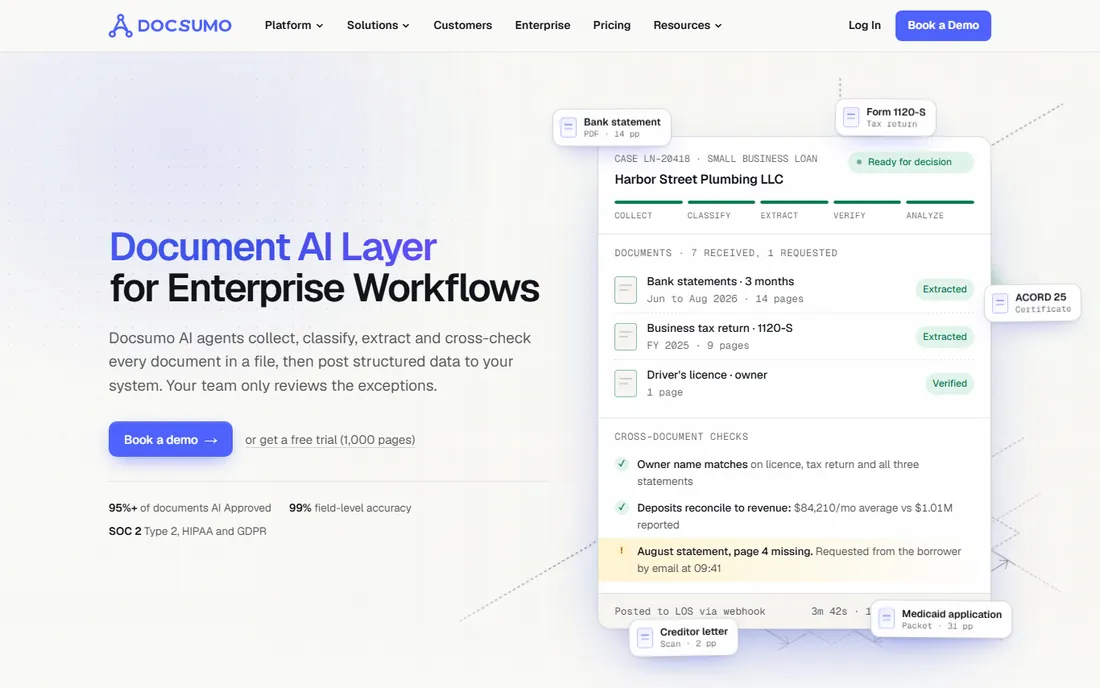
Docsumo built its name on lending documents: bank statements, pay stubs, tax returns, and IDs. The differentiator is case-level processing; instead of extracting one document at a time, it groups every document in a loan or claim application, cross-checks fields across them (does the name match, are months consecutive), and flags only the failures for human review. The company claims 99% field-level accuracy with over 95% of documents auto-approved.
Pricing changed in 2026: the current site lists a free 14-day trial with 1,000 pages, then custom-quoted Business and Enterprise plans. That makes budgeting harder than before. The product is deepest in financial document types; if your documents are invoices and bank statements, it shines, while exotic layouts may need more validation. For lending, insurance, and AP teams, the case-based approach maps to how reviewers actually work.
What we like- Purpose-built for multi-document cases (loans, claims)
- 99% field-level accuracy claim
- Cross-document validation catches inconsistencies
Watch out for- Paid plans are now custom-quoted
- Strongest in financial document types, less proven elsewhere
Starting price$32.50 per month (billed annually)
Free planFree trial (14 days)
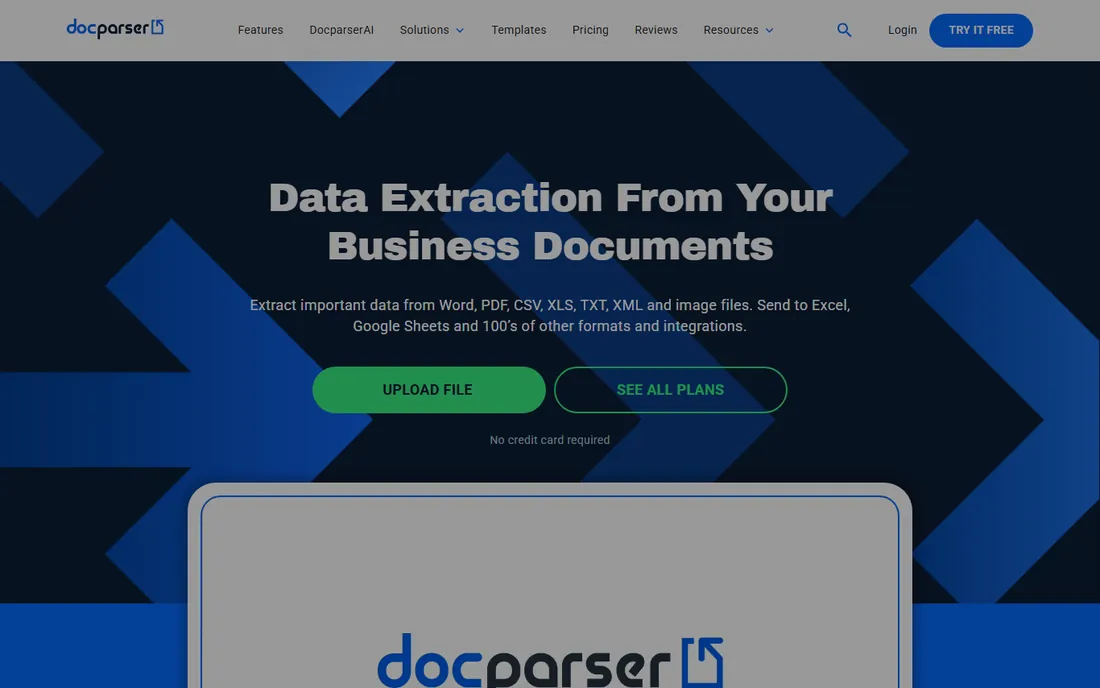
Docparser is the tool for teams that need extraction without a data science project. You define parsing rules visually (point at the invoice total, name the field), and the system applies them to incoming documents from email, cloud storage, or API. The newer DocparserAI engine adds AI-powered parsing for variable layouts. Pricing starts at $32.50 per month on annual billing ($39 monthly) for 100 parsing credits, with a 14-day trial that needs no credit card.
The limitation is architectural: template-based parsing works beautifully until a vendor redesigns their invoice, at which point someone updates the rule. For stable, recurring document types (monthly supplier invoices, standard forms), that maintenance is trivial. For hundreds of unpredictable layouts, an AI-native tool will cope better. If your volume is modest and your documents are consistent, this is the fastest path from inbox to spreadsheet.
What we like- Cheapest entry point here
- Non-technical setup with visual rule builder
- Generous integrations via Zapier, API, and webhooks
Watch out for- Template-based approach needs maintenance when layouts change
- Less AI depth than Nanonets or Docsumo
How we chose
We did not run live extraction benchmarks across these platforms, and you should discount anyone who claims head-to-head accuracy testing without publishing the methodology. Instead we worked from primary sources: vendor documentation and pricing pages, the platforms' published accuracy claims (treated as vendor figures, not independent results), analyst assessments from Gartner, IDC, and Forrester, and practitioner reviews on G2, Capterra, and Reddit. We verified every product is sold today under its current name, excluded Rossum after its May 2026 acquisition by Coupa, and confirmed pricing is current as of October 2026. Where vendors moved to quote-based pricing, we say so instead of repeating third-party estimates.
What to evaluate before you buy
Accuracy claims deserve skepticism until tested on your documents. Every vendor publishes an impressive percentage; none of them processed your vendor's invoices. Run the trial on 50 to 100 of your real documents, including the ugly scans and the odd layouts, and measure the straight-through rate (documents needing zero human touch). That number, not the marketing claim, determines your ROI.
Next, check the exception workflow. No extractor hits 100%, so the review interface is where your team will live. Can non-technical staff correct fields quickly? Do corrections improve the model? Then confirm document variety: some tools excel at invoices but struggle with contracts or handwriting. Finally, verify integration and data handling. You need clean output into your ERP or system of record, plus answers on data residency and retention, especially for financial or personal documents.
How IDP pricing actually works
This category uses three pricing models, and mixing them up causes budget surprises. Per-page pricing (AWS Textract) charges for each page processed, with rates varying by feature; simple OCR is fractions of a cent, while forms and tables cost more. Subscription tiers (Docparser, formerly Nanonets and Docsumo) bundle a page or credit allowance per month. Enterprise quote-based pricing (ABBYY, Hyperscience, UiPath consumption) ties cost to volume, features, and support.
The trap is underestimating volume. Count your pages per month honestly, including multi-page documents, then add 20% for growth and reprocessing. A tool that looks cheap at 1,000 pages can outrun an enterprise platform at 100,000. Also ask what counts as a "page" or "credit": some vendors charge per document regardless of length, others per page, and duplex scans can double-count. Get the metering definition in writing before you sign.
Frequently asked questions
What is intelligent document processing (IDP)?
IDP uses AI to classify documents, extract data from them, and validate the results, turning invoices, contracts, forms, and receipts into structured data without manual keying. Traditional OCR only reads text; IDP understands what the text means (this number is the total, that date is the due date) and routes low-confidence results for human review.
How accurate is AI document extraction?
Vendors claim 95% to 99.5% field-level accuracy, but treat those as best-case figures on clean documents. Real-world accuracy depends on scan quality, layout variety, and document type. The number that matters is your straight-through processing rate on your own documents during a trial; measure it before you commit.
How much does IDP software cost?
It ranges from $0.0015 per page (AWS Textract) to $32.50 per month (Docparser) to quote-based enterprise platforms (ABBYY, Hyperscience) with five-figure annual minimums. Mid-market tools historically clustered around $500 per month. Price your actual monthly page volume, not the headline rate.
Do I need templates for each document type?
It depends on the tool. Template-based tools (Docparser) need rules per layout but give you precise control. AI-native tools (Nanonets, Docsumo, Hyperscience) handle new layouts without templates by learning from examples. If your vendors constantly change formats, prefer AI-native; if your documents are stable, templates are fine and cheaper.
What is the difference between OCR and IDP?
OCR converts images of text into machine-readable text. IDP adds classification (what kind of document is this), extraction (which fields matter), validation (does this data make sense), and integration (send it to the ERP). OCR is a component; IDP is the workflow around it.
Can IDP handle handwriting?
Partially. Printed text extraction is mature; handwriting remains harder, though Hyperscience and AWS Textract both claim handwriting support. Accuracy drops on cursive and degraded scans. If handwriting is central to your use case, test it specifically during the trial with your worst examples, not the vendor's demo set.
Sources we checked (10)
- https://www.abbyy.com/
- https://hyperscience.com/
- https://www.uipath.com
- https://nanonets.com/
- https://www.docsumo.com/
- https://aws.amazon.com/textract/
- https://aws.amazon.com/textract/pricing/
- https://docparser.com/
- https://github.com/ishandutta2007/awesome-intelligent-document-processing/blob/HEAD/README.md
- https://www.docsumo.com/blog/the-best-intelligent-document-processing-software?46b99e40_page=16
Is your product missing or out of date?
We review this list regularly. Vendors can request a listing, send updated pricing or ask about featured placement.

Shihab Mia · Founder, Rankite
Shihab has spent more than a decade helping SaaS and e-commerce brands grow through search. He writes Rankite's software buying guides from pricing pages, documentation and public user reviews. More about Shihab.