How we make this list: we compare pricing pages, product documentation and public user reviews. Rankite is independent; if a vendor ever pays for a featured spot, that listing is clearly labeled Partner.
Key takeaways
- Fivetran ($0 Free tier up to 500K MAR/month) and Airbyte (open-source self-hosted) are the two safe defaults for teams that want managed ELT without building pipelines by hand.
- Estuary ($0.50 per GB) and Coupler.io (from $24/month) are the cheapest ways to start: one for real-time data movement, one for no-code reporting pipelines.
- Rivery (from $0.75 per credit) and Skyvia (from $99/month) sit in the middle: visual pipeline builders with published usage-based pricing.
- Matillion, Hevo Data, Integrate.io and Azure Data Factory publish no simple starting price: budget them as custom or usage-metered buys.
Quick comparison
| Tool | Best for | Starting price | Free plan |
|---|
 Fivetran Fivetran | Teams that want fully managed ELT with minimal maintenance | See website (usage-based, billed per million MAR) | Yes (Free plan up to 500,000 MAR/month) |
 Airbyte Airbyte | Teams that want open-source flexibility with a managed cloud option | See website (credit-based Cloud pricing) | Free trial (open-source self-hosted version is free) |
 Matillion Matillion | Data teams standardized on Snowflake, Databricks, BigQuery or Redshift | See website (credit-based Data Productivity Cloud) | Free trial |
 Hevo Data Hevo Data | Analytics teams that want no-code pipelines running in minutes | See website | Free trial |
 Rivery Rivery | Teams wanting ELT plus reverse ETL and orchestration in one platform | From $0.75 per credit (usage-based) | Free trial |
 Estuary Estuary | Teams needing real-time CDC and streaming without Kafka complexity | $0.50 per GB of data moved (usage-based) | Yes (Developer tier free up to 10 GB/month) |
 Skyvia Skyvia | Business users needing integration, backup and live data access together | From $99/month (Data Integration) | Yes (free plan with 10,000 records/month) |
 Coupler.io Coupler.io | Business teams automating reports, dashboards and spreadsheet data flows | From $24/month (billed annually) | Yes (free plan available) |
 Integrate.io Integrate.io | Ops and analytics teams wanting predictable fixed-fee pipeline costs | See website (fixed-fee pricing) | Free trial |
 Azure Data Factory Azure Data Factory | Microsoft shops running ETL at enterprise scale or modernizing SSIS | See website (pay-as-you-go) | Free trial (via Azure free account) |
Is your product missing or out of date?
We review this list regularly. Vendors can request a listing, send updated pricing or ask about featured placement.
The best data integration software
Here is the blunt version: most teams do not need the most powerful data integration tool. They need the one whose pricing they can predict and whose connectors cover the five systems that actually matter to their business. The ten tools below cover the real market, from free open-source options to enterprise platforms, with the honest trade-off for each.
#1
Fivetran
Best for: Teams that want fully managed ELT with minimal maintenance
Visit fivetran.com
Starting priceSee website (usage-based, billed per million MAR)
Free planYes (Free plan up to 500,000 MAR/month)
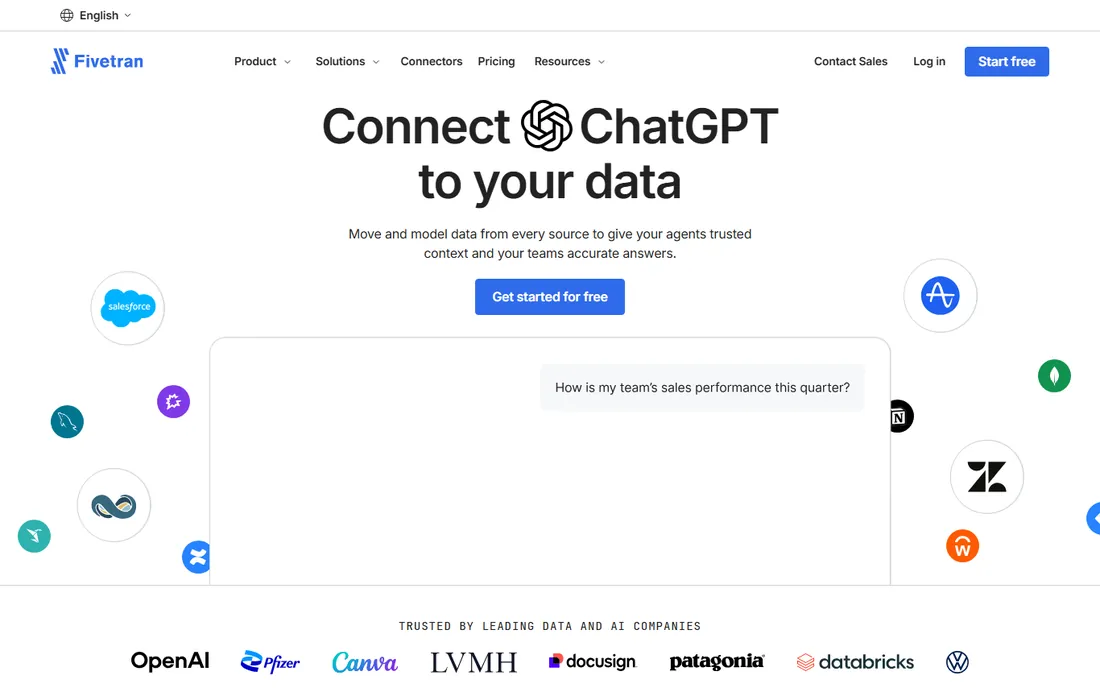
Fivetran is the default choice for teams that want to stop thinking about pipelines. You connect a source, pick a destination warehouse, and Fivetran handles extraction, loading, schema drift and re-syncs. The connector library is the deepest in the business, covering SaaS apps, databases, ERPs, files and event streams. Transformations run as SQL models inside your warehouse, so your dbt or SQL-based workflow stays intact.
The honest catch is the bill. Pricing is based on Monthly Active Rows per connector, and costs scale with data change volume rather than with anything you can easily cap. Annual contracts start at a $12,000 minimum spend, so Fivetran is really an annual-budget conversation for serious use. The Free plan (500,000 MAR per month) is genuinely useful for evaluation and tiny workloads. If your finance team needs a fixed number, look at the fixed-fee vendors on this list instead.
What we like- Fully managed connectors that adapt to schema and API changes automatically
- 900-plus sources and destinations including enterprise databases on higher plans
- Free plan covers low volumes with Standard features
Watch out for- Usage-based MAR pricing is hard to forecast as connector count grows
- Enterprise database connectors and 1-minute syncs require Enterprise or Business Critical plans
#2
Airbyte
Best for: Teams that want open-source flexibility with a managed cloud option
Visit airbyte.com
Starting priceSee website (credit-based Cloud pricing)
Free planFree trial (open-source self-hosted version is free)
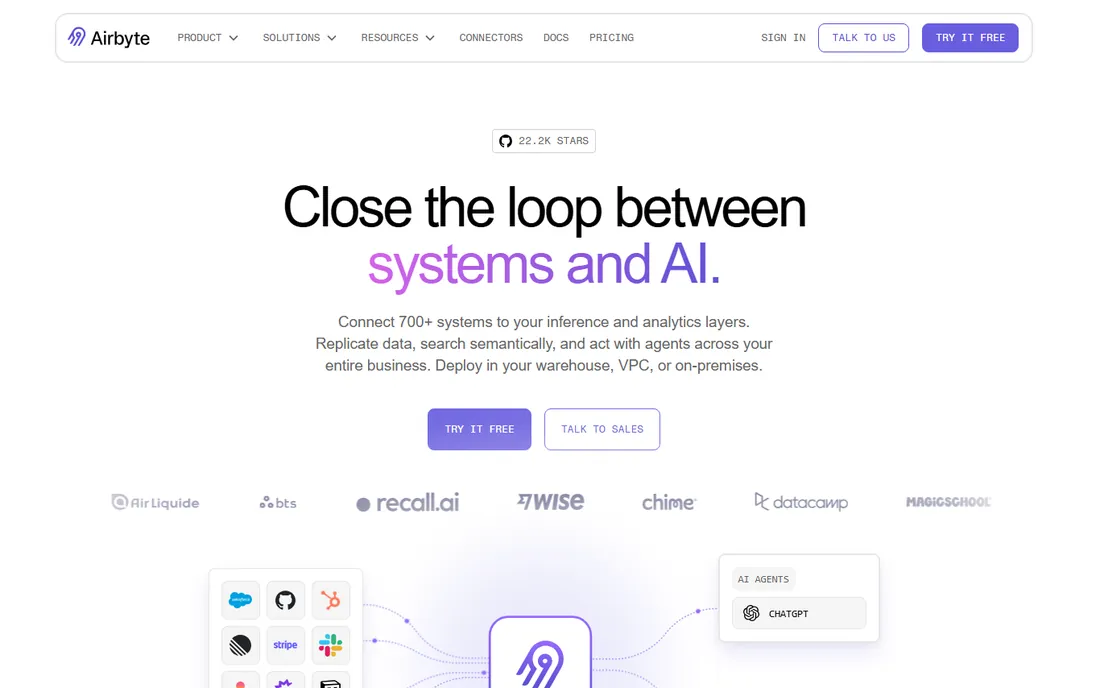
Airbyte built its name on the opposite bet from Fivetran: the connector framework is open source, and thousands of engineers have contributed connectors because of it. If your team is comfortable running infrastructure, the self-hosted version costs nothing in software fees. If not, Airbyte Cloud is the managed version with the same connectors, billed on processing capacity (credits) rather than data volume, which some teams find easier to predict than row-based pricing.
The trade-off is operational. Self-hosted Airbyte is a real deployment you maintain: upgrades, scaling, monitoring and connector quirks are yours. The managed cloud removes that work but puts you on capacity billing where an always-on setup keeps spending even when data is quiet. Data sovereignty is the quiet strength here: the hybrid model runs the data plane in your VPC while Airbyte runs only the control plane.
What we like- Open-source core you can self-host, so no vendor lock-in on the engine
- 700-plus connectors with a large community building more
- Hybrid deployment keeps the data plane inside your own environment
Watch out for- Self-hosting means you own the infrastructure, monitoring and upgrades
- Cloud pricing is credit-based, which needs its own cost modeling
#3
Matillion
Best for: Data teams standardized on Snowflake, Databricks, BigQuery or Redshift
Visit matillion.com
Starting priceSee website (credit-based Data Productivity Cloud)
Free planFree trial
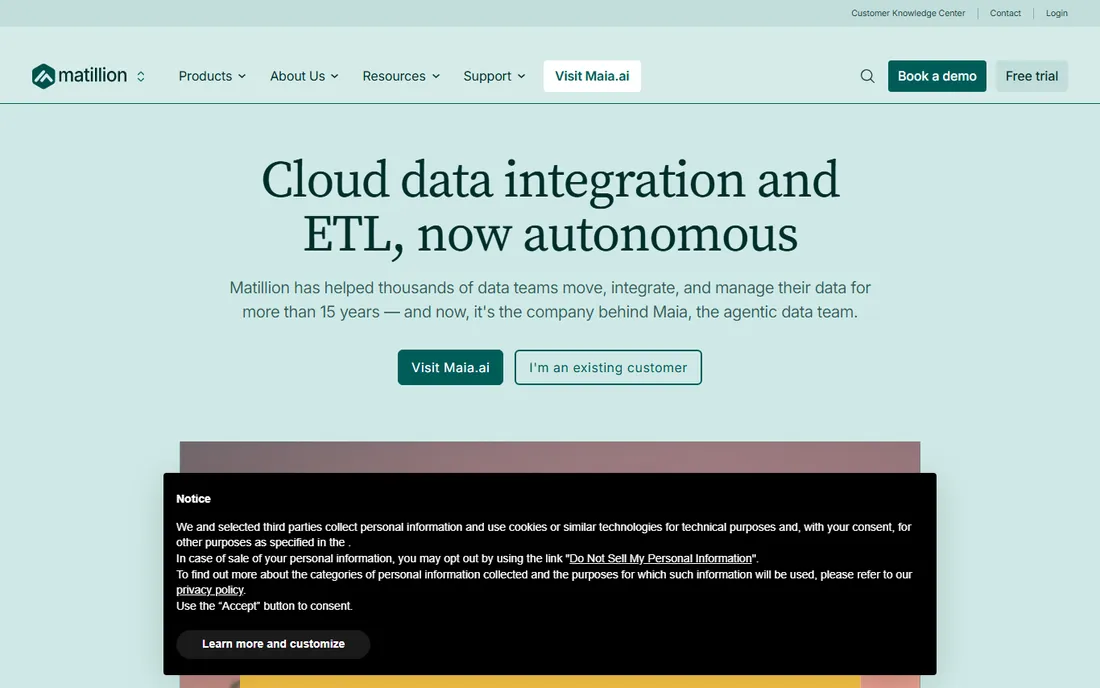
Matillion is the ELT platform for teams that already picked their warehouse. The Data Productivity Cloud (now called Maia Foundation) gives you a visual designer for extraction, loading and transformation pipelines that push compute down into Snowflake, Databricks, BigQuery or Redshift. Orchestration, scheduling and versioning are built in, and the company has added AI-assisted pipeline building on top.
The honest catch is fit. If your destination is one of the big four warehouses, Matillion is purpose-built and efficient. If you need to land data in Postgres, files, or operational systems, it is not the right tool. Pricing is credit-based with no published starting figure, which means small teams often find the sales-led process heavier than the self-serve tools on this list. This is a data-team tool, not a business-user tool.
What we like- Drag-and-drop pipeline designer purpose-built for the big four cloud warehouses
- Orchestration, scheduling and transformation in one platform
- Long track record (founded 2011) with enterprise support options
Watch out for- No published starting price, so budgeting starts with a sales conversation
- Cloud-warehouse-centric, a poor fit if your stack is not on one of the four supported platforms
#4
Hevo Data
Best for: Analytics teams that want no-code pipelines running in minutes
Visit hevodata.com
Starting priceSee website
Free planFree trial
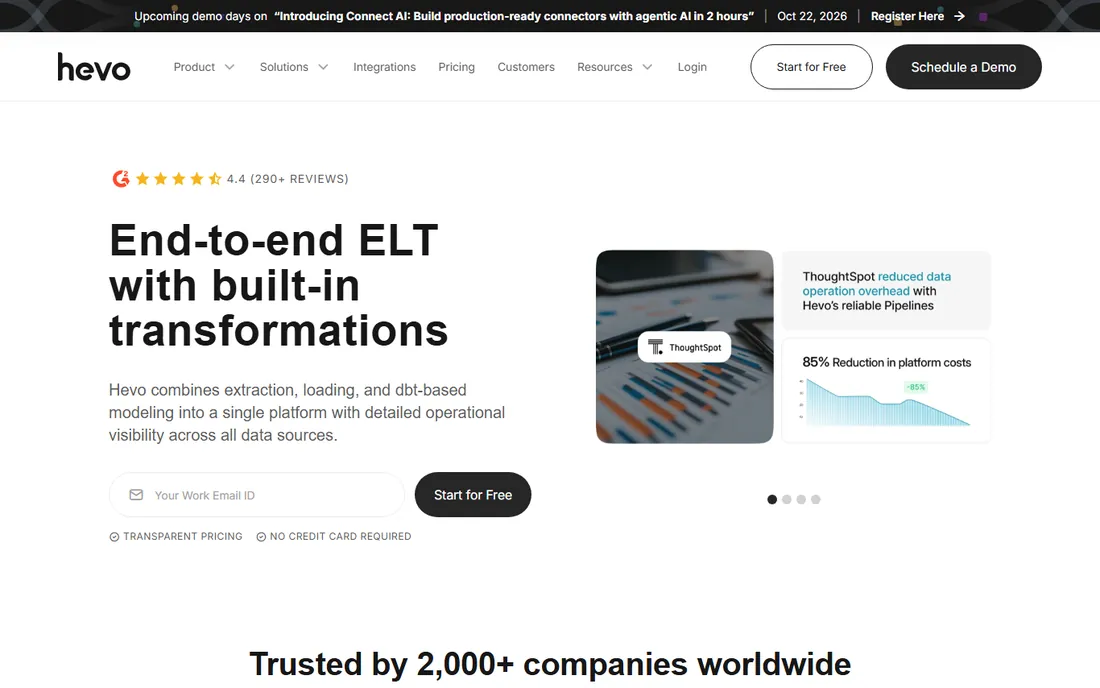
Hevo Data pitches simplicity: connect a source and a warehouse in a few clicks, with no code required. That positioning lands with analytics teams and smaller companies that have data to move but no data engineering team. The platform handles schema changes automatically, recovers failed records on its own, and includes pipeline monitoring with alerts, which covers the operational basics.
The catch is transparency. Hevo publishes no prices, so you cannot do the comparison math without talking to sales. The connector count (150-plus) is solid for mainstream SaaS and databases but thinner than the leaders for unusual sources. If your source list is mainstream and your team is non-technical, Hevo is worth a trial. If you need published pricing or an exotic connector, shortlist elsewhere.
What we like- No-code pipeline setup aimed at analytics and business users, not just engineers
- 150-plus integrations across databases, SaaS apps and warehouses
- Automatic schema drift handling with monitoring and alerts
Watch out for- No published pricing, so every serious evaluation goes through sales
- Smaller connector library than Fivetran or Airbyte
#5
Rivery
Best for: Teams wanting ELT plus reverse ETL and orchestration in one platform
Visit rivery.io
Starting priceFrom $0.75 per credit (usage-based)
Free planFree trial
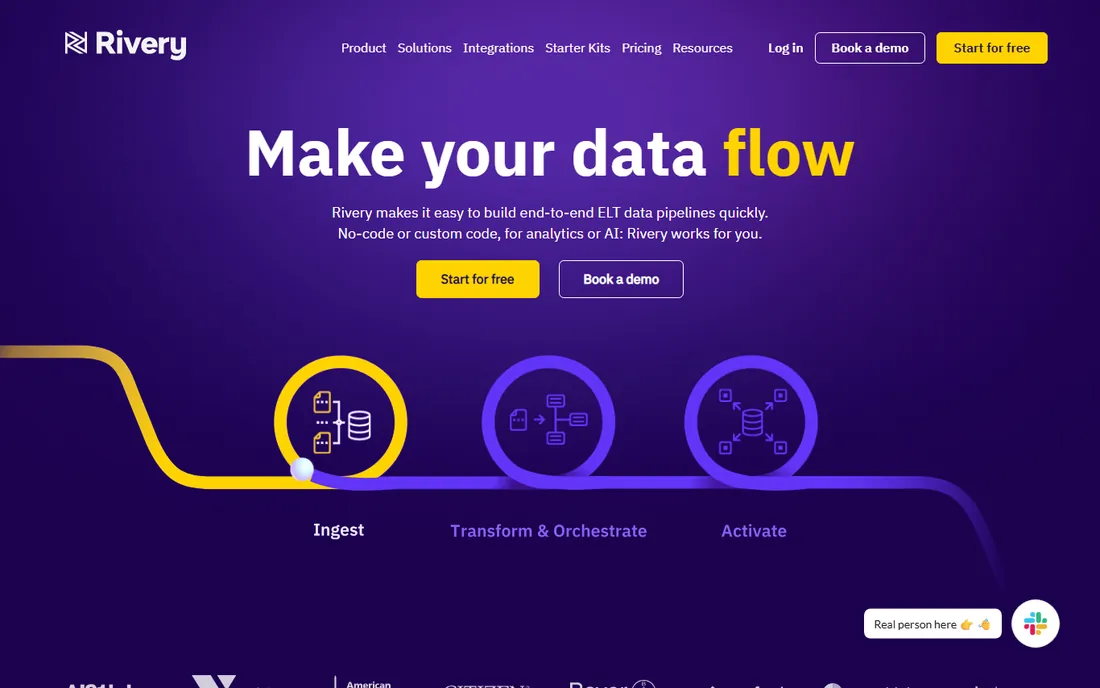
Rivery is the all-in-one play: one platform for ingestion, transformation, orchestration and reverse ETL (pushing warehouse data back into operational tools). The 200-plus managed connectors need no code or API maintenance, and the custom connector builder covers any REST API your business depends on. Pricing is published and credit-based, starting at $0.75 per credit, with database sources billed by volume moved and API sources by execution.
The honest catch is that credits are still a meter you have to learn. The model is transparent, but forecasting spend means understanding how your sources consume credits, which takes a billing cycle or two to get right. Rivery is SaaS-only, so teams with data-residency requirements that demand self-hosting should look at Airbyte or Estuary instead. Support quality is the standout in reviews: engineering-led, around the clock, and consistently top-rated in the category.
What we like- End-to-end platform covering ingestion, transformation, orchestration and reverse ETL
- 200-plus fully managed connectors with custom REST API connector builder
- Published per-credit pricing starting at $0.75
Watch out for- Credit-based pricing still requires usage modeling to forecast
- Public cloud SaaS, with no self-hosted option for regulated environments
#6
Estuary
Best for: Teams needing real-time CDC and streaming without Kafka complexity
Visit estuary.dev
Starting price$0.50 per GB of data moved (usage-based)
Free planYes (Developer tier free up to 10 GB/month)
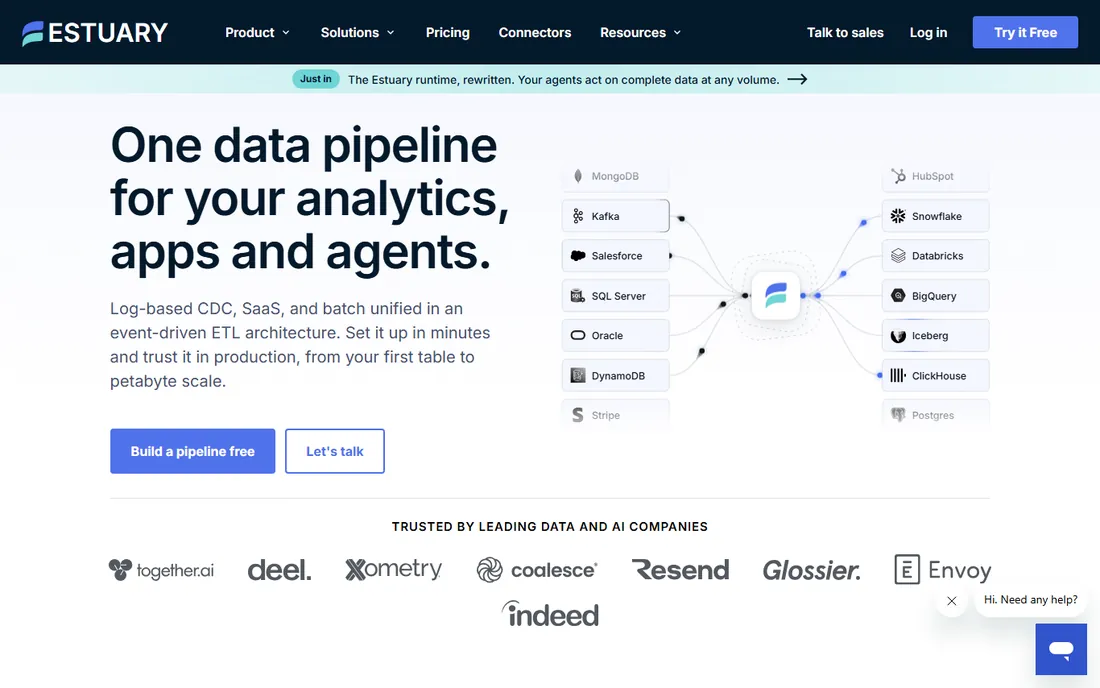
Estuary is the modern answer to real-time data movement. Instead of batch-only syncs, it captures database changes as they happen (CDC), streams them through durable collections, and delivers to warehouses, lakes, operational systems or AI destinations on schedules from real-time to hourly. The pricing is refreshingly simple: $0.50 per GB sourced or delivered, with a free Developer tier up to 10 GB per month.
The catch is maturity of breadth. The connector library (150-plus) covers the important databases and SaaS apps but not the long tail. Teams that want point-and-click visual transformations will miss them: Estuary expects SQL or TypeScript, with dbt integration for warehouse-side work. For teams that need fresh data for AI features, fraud detection or operational dashboards, it is one of the strongest values on this list.
What we like- Log-based CDC with real-time streaming and batch in one architecture
- Straightforward $0.50/GB pricing with a genuinely free Developer tier
- Bring-your-own-cloud deployment for data control
Watch out for- 150-plus connectors, smaller than the biggest libraries
- Transformations lean on SQL and TypeScript rather than a visual designer
#7
Skyvia
Best for: Business users needing integration, backup and live data access together
Visit skyvia.com
Starting priceFrom $99/month (Data Integration)
Free planYes (free plan with 10,000 records/month)
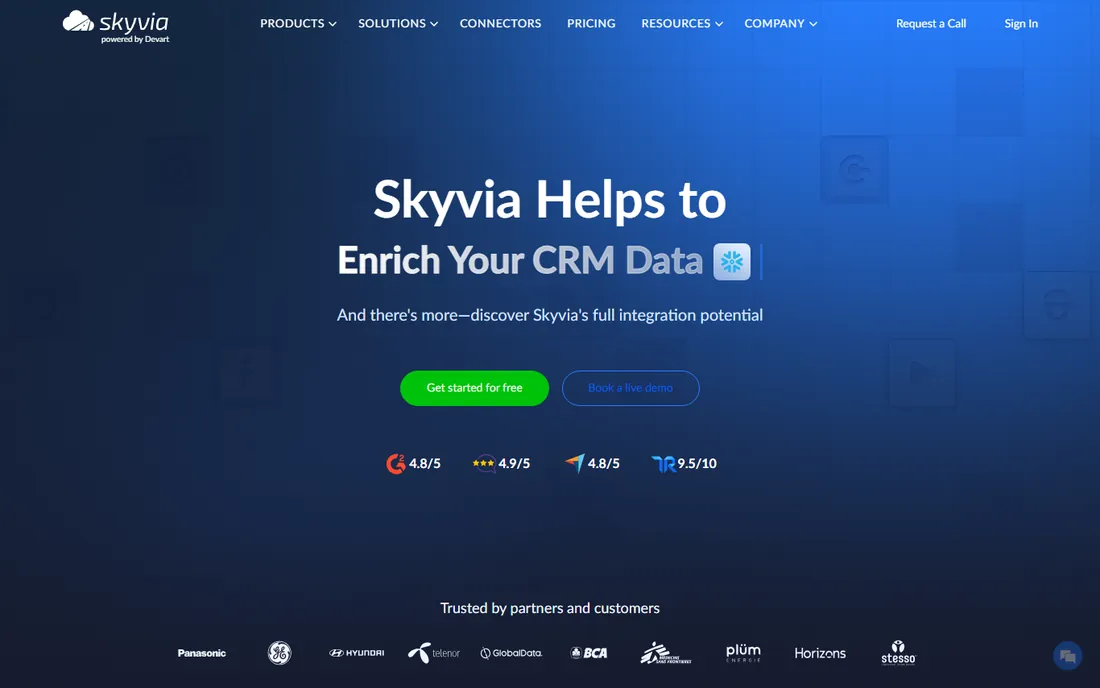
Skyvia is the Swiss-army option for smaller operations. Beyond ETL/ELT pipelines, it handles cloud backup of SaaS data, live OData-style data access without moving data, automation workflows and browser-based SQL querying. The no-code designer is genuinely approachable: a marketing ops person can build a sync without engineering help. Paid Data Integration plans start at $99 per month.
The honest catch is depth. With 200-plus connectors and tiered scheduling, Skyvia covers mainstream needs well but is not the tool for high-volume or exotic-source pipelines. Sync frequency improves as you pay more, so near-real-time needs get expensive. For a small business that wants one subscription covering integration, backup and ad-hoc data access, the bundle math works. For a data team building a warehouse-first stack, pick a specialist.
What we like- One platform for data integration, backup, automation, querying and live data access
- No-code setup usable by business users
- Free plan with 10,000 records per month
Watch out for- 200-plus connectors, fewer than the ELT specialists
- Scheduling frequency and advanced ETL features are gated by pricing tier
#8
Coupler.io
Best for: Business teams automating reports, dashboards and spreadsheet data flows
Visit coupler.io
Starting priceFrom $24/month (billed annually)
Free planYes (free plan available)
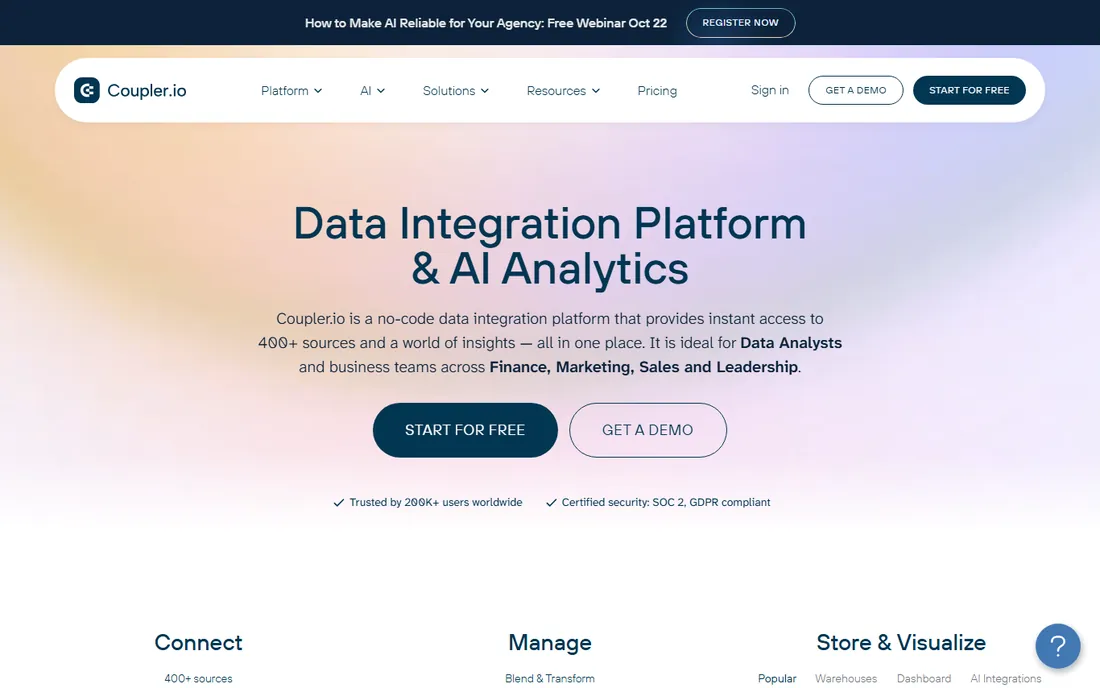
Coupler.io is data integration for people who live in spreadsheets and dashboards. It pulls data from 400-plus business apps into Google Sheets, Excel, Looker Studio, Power BI, Tableau or BigQuery, with a no-code transformation editor and scheduled refreshes. Pricing is per connected data source account starting at $24 per month annually, which makes it one of the cheapest entries on this list, and a free plan exists for tiny setups.
The catch is scope. Coupler.io is built for reporting pipelines: marketing spend, sales activity, finance metrics flowing into dashboards. It is not a replacement for Fivetran or Airbyte when you need database replication, CDC or warehouse-scale ELT. If your goal is automated reporting without a data engineer, it is excellent value. If your goal is a central warehouse, it is the wrong category.
What we like- 400-plus sources with destinations from Google Sheets to BigQuery and Power BI
- Account-based pricing (pay per connected source, not per user or row)
- Ready-made dashboard templates for marketing, sales and finance
Watch out for- Built for reporting data flows, not heavy warehouse ELT at scale
- Refresh frequency and AI features are tiered by plan
#9
Integrate.io
Best for: Ops and analytics teams wanting predictable fixed-fee pipeline costs
Visit integrate.io
Starting priceSee website (fixed-fee pricing)
Free planFree trial
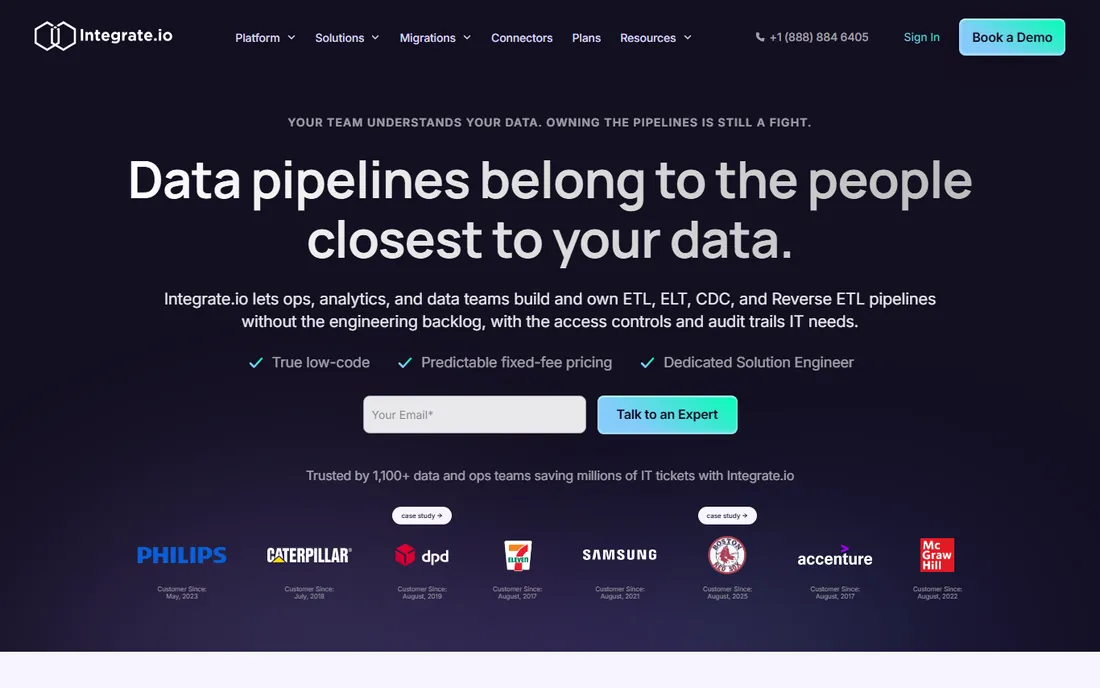
Integrate.io sells the opposite of usage metering: one fixed fee regardless of data volume, pipelines or connectors. For teams burned by surprise MAR or credit bills, that predictability is the whole pitch. The low-code platform covers ETL, ELT, CDC and reverse ETL, with a visual builder plus SQL and Python where needed, and every engagement includes a dedicated solution engineer.
The honest catch is that "fixed fee" still means talking to sales to learn the number. The platform is less famous than Fivetran or Airbyte, which matters in companies where procurement wants a Gartner-quoted shortlist. But the model is genuinely different: if your data volumes grow 10x and your bill does not move, that is worth a conversation for any finance-conscious team.
What we like- Fixed-fee pricing decoupled from rows, syncs and connectors, so budgets stay predictable
- Low-code builder covering ETL, ELT, CDC and reverse ETL
- Dedicated solution engineer and 24/7 support
Watch out for- No published price, so the fixed fee is still a sales conversation
- Less known than the category leaders, which can slow procurement
#10
Azure Data Factory
Best for: Microsoft shops running ETL at enterprise scale or modernizing SSIS
Visit azure.microsoft.com
Starting priceSee website (pay-as-you-go)
Free planFree trial (via Azure free account)
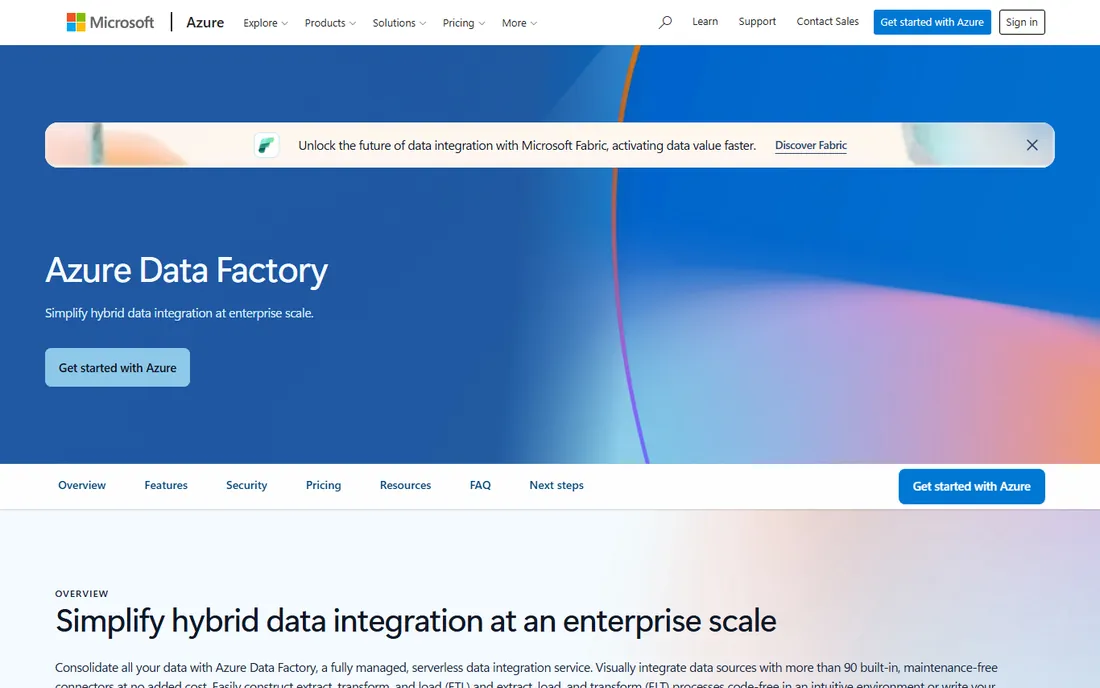
Azure Data Factory is the enterprise Microsoft answer to data integration. It is a fully managed, serverless service for building ETL and ELT pipelines with a visual designer, 90-plus maintenance-free connectors, and native execution of legacy SSIS packages for teams modernizing off SQL Server. If your company already lives in Azure, it slots into Synapse Analytics, Databricks and the rest of the stack with single-sign-on and unified billing.
The catch is the obvious one: it only makes sense inside Azure. Pricing is pay-as-you-go across pipeline activities, data movement and integration runtime hours, which is flexible but demands monitoring to avoid drift. This is not a tool a 20-person SaaS company picks; it is the tool a Microsoft enterprise standardizes on. Evaluate it when Azure is already your cloud, not before.
What we like- 90-plus built-in connectors with serverless, fully managed compute
- Native path for migrating SQL Server Integration Services packages to the cloud
- Deep integration with the Azure data stack (Synapse, Databricks, SQL)
Watch out for- Azure-only, useless outside the Microsoft ecosystem
- Pay-as-you-go metering across activities, data movement and compute needs active cost management
ELT vs ETL: which one do you actually need
Nearly every tool on this list defaults to ELT: extract data from sources, load it raw into your warehouse or lake, then transform it there with SQL. ETL (transform before loading) is the older pattern, where a dedicated engine cleans and reshapes data in flight. For most buyers in 2026, ELT is the right default because cloud warehouses are cheap compute and transforming in the warehouse keeps one copy of the logic in SQL your analysts already know.
Choose ETL-style processing when the destination cannot do the work: operational databases, SaaS apps receiving reverse-ETL writes, or compliance rules that forbid landing raw PII in a warehouse. Tools like Matillion, Integrate.io and Azure Data Factory handle both patterns well. Fivetran, Airbyte, Hevo, Rivery and Estuary are ELT-first: they move data reliably and expect transformations to happen downstream. If someone tells you ETL is dead, they are selling an ELT tool. Match the pattern to your destination, not to the marketing.
How to read data integration pricing without getting burned
Every vendor on this list prices differently, and that is deliberate. Fivetran charges per million Monthly Active Rows per connector. Airbyte and Matillion charge credits for processing capacity. Rivery charges credits per data moved. Estuary charges per gigabyte. Skyvia and Coupler.io charge flat monthly tiers by records or connected accounts. Integrate.io charges one fixed fee. Azure bills per activity run and compute hour.
Before you sign anything, model one month of your actual usage on each finalist. List your sources, estimate rows or gigabytes changed per month, and note your required sync frequency: 15-minute syncs cost more than daily everywhere. Ask what happens on a re-sync or historical backfill, because some vendors meter those and some do not. And check the minimums: annual contracts with five-figure minimums are normal at the enterprise end of this list. The cheapest tool for 1 GB a month is rarely the cheapest at 1 TB.
Frequently asked questions
How much does data integration software cost?
It ranges from free to five figures a year. Coupler.io starts at $24/month and Estuary at $0.50/GB for small volumes. Mid-market usage-based tools like Rivery start around $0.75 per credit and Fivetran around $500 per million MAR. Enterprise annual contracts commonly start at $12,000 per year. Your data change volume decides the bill more than the vendor does.
What is the difference between ETL and ELT?
ETL transforms data before loading it into the destination; ELT loads raw data first and transforms it inside the warehouse with SQL. ELT dominates modern stacks because cloud warehouses made in-warehouse transformation cheap. Pick ETL when the destination cannot transform (operational systems) or compliance forbids landing raw data.
Do I need a data warehouse to use these tools?
For the ELT specialists (Fivetran, Airbyte, Matillion, Hevo, Rivery, Estuary), yes: they move data into a warehouse, lake or database. Coupler.io and Skyvia are the exceptions that shine without one, delivering into spreadsheets, dashboards and BI tools directly. Azure Data Factory assumes the Azure data stack.
Open source or managed: which is better?
Self-hosted Airbyte costs nothing in license fees but you own the servers, upgrades and on-call. Managed tools cost money but remove operations entirely. The break-even is team time: if you have data engineers with spare capacity, open source saves cash. If pipelines are not your core work, pay for managed and get the hours back.
How long does it take to set up a data pipeline?
With a managed ELT tool and a mainstream source, a first pipeline can run the same day: authenticate, pick tables, choose a destination. Custom sources, CDC setup, transformation logic and production hardening take days to weeks. Budget more time for the data modeling than for the tool setup.
Is my data secure with these tools?
All ten vendors offer SOC 2 compliance and encryption in transit and at rest; several add HIPAA, GDPR and SSO. The bigger question is architecture: Airbyte and Estuary offer hybrid or bring-your-own-cloud deployment so raw data never leaves your environment. If your data cannot leave your VPC, shortlist those deployment models first.
How we chose
We started with the searches buyers actually run: data integration software, ETL tools, ELT tools and data pipeline software. For each candidate we opened the vendor homepage, confirmed the official URL, and checked the vendor's own pricing page or pricing documentation for plan and free-tier facts. We compared connector counts, pricing models, deployment options and team-size fit, and checked public reviews on G2 and Capterra and practitioner discussion on Reddit for the honest weaknesses. Where a price could not be verified on the vendor's own page, we wrote "See website" instead of guessing.
Sources we checked (13)
- https://www.fivetran.com/
- https://fivetran.com/docs/core-concepts/usage-based-pricing/billing-and-plans
- https://airbyte.com
- https://matillion.com/
- https://hevodata.com/
- https://rivery.io
- https://estuary.dev/
- https://skyvia.com/
- https://coupler.io/
- https://integrate.io/
- https://azure.microsoft.com/en-gb/products/data-factory
- https://www.g2.com/categories/data-integration
- https://www.capterra.com/data-integration-software/
Is your product missing or out of date?
We review this list regularly. Vendors can request a listing, send updated pricing or ask about featured placement.

Shihab Mia · Founder, Rankite
Shihab has spent more than a decade helping SaaS and e-commerce brands grow through search. He writes Rankite's software buying guides from pricing pages, documentation and public user reviews. More about Shihab.