How we make this list: we compare pricing pages, product documentation and public user reviews. Rankite is independent; if a vendor ever pays for a featured spot, that listing is clearly labeled Partner.
Key takeaways
- Business continuity software is quote-based across the board: none of these seven publish prices, so plan for demos and custom proposals.
- Riskonnect and Fusion Risk Management target large enterprises with integrated risk programs; LogicManager and Resolver fit mid-size companies standardizing on one risk platform.
- Preparis (now Mitratech Preparis) suits organizations that want continuity planning plus emergency notification in one suite.
- Onspring and Noggin appeal to buyers who want configurable, no-code platforms rather than rigid out-of-the-box modules.
How we chose
We started with the platforms continuity planners actually evaluate: business continuity software, BCM software and resilience platforms. Castellan appeared on early shortlists but now redirects into Riskonnect after its acquisition, so we replaced it rather than list a product that no longer exists independently. For each remaining candidate we checked the vendor's own site for product scope, business impact analysis, plan management, exercising and notification features, and deployment fit. None publish prices, so we wrote "See website" throughout rather than repeating third-party estimates.
Quick comparison
| Tool | Best for | Starting price | Free plan |
|---|
 Riskonnect Riskonnect | Large enterprises unifying risk management and business continuity | See website (custom quote; no public prices) | No (demo only) |
 Fusion Risk Management Fusion Risk Management | Enterprises running scenario-based resilience programs | See website (custom quote; no public prices) | No (demo only) |
 LogicManager LogicManager | Mid-size companies building a standardized risk program | See website (custom quote; fixed-price model, no public numbers) | No (demo only) |
 Preparis Preparis | Organizations that want continuity planning plus emergency notification in one suite | See website (custom quote; no public prices) | No (demo only) |
 Onspring Onspring | Teams that want no-code, configurable GRC including business continuity | See website (custom quote; no public prices) | No (demo only) |
 Noggin Noggin | Operations teams that need incident response plus continuity planning | See website (custom quote; no public prices) | No (demo only) |
 Resolver Resolver | Mid-to-large firms consolidating risk, security and business continuity | See website (custom quote; no public prices) | No (demo only) |
Is your product missing or out of date?
We review this list regularly. Vendors can request a listing, send updated pricing or ask about featured placement.
The best business continuity software
Here is the blunt version: most companies buy business continuity software after something goes wrong, and most of them buy too much of it. A 200-person company does not need the same platform as a bank with forty data centers. What you actually need is business impact analysis that identifies what matters, plans people can find during an incident, a way to test those plans, and a way to reach people when it happens. These seven platforms cover that spectrum, from enterprise suites to configurable builders.
#1
Riskonnect
Best for: Large enterprises unifying risk management and business continuity
Visit riskonnect.com
Starting priceSee website (custom quote; no public prices)
Free planNo (demo only)
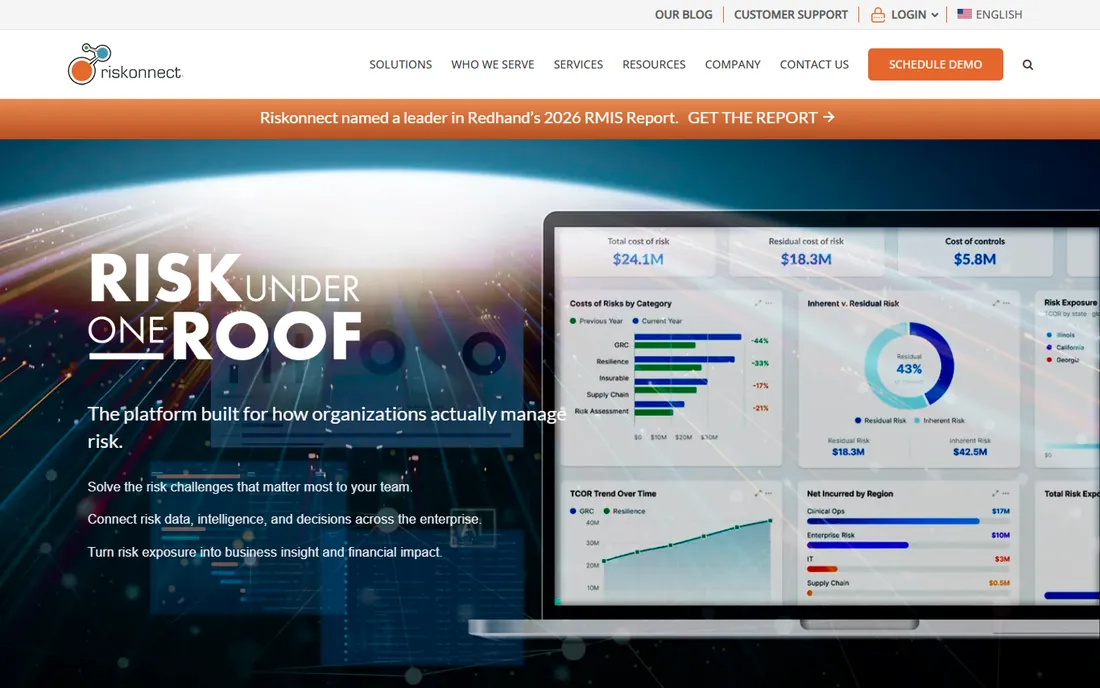
Riskonnect is the consolidation play. The platform combines enterprise risk, compliance and business continuity in one system, and its acquisition of Castellan folded an established continuity product into the suite. For large organizations already managing operational risk on one platform, adding continuity in the same system removes the integration work that multi-vendor setups create.
The tradeoff is everything that comes with enterprise software. Pricing is custom, implementations run on project timelines, and the feature depth assumes dedicated risk staff. Mid-size companies will find simpler tools faster to deploy. Riskonnect fits the enterprise that wants one risk platform and has the team to run it.
What we like- Integrated risk management suite with a dedicated business continuity module
- Strong in highly regulated industries
- Absorbs Castellan's continuity customer base after the acquisition
Watch out for- Enterprise pricing and implementation timelines
- Complexity that smaller teams will not use
- Sales-led buying process
#2
Fusion Risk Management
Best for: Enterprises running scenario-based resilience programs
Visit fusionrm.com
Starting priceSee website (custom quote; no public prices)
Free planNo (demo only)
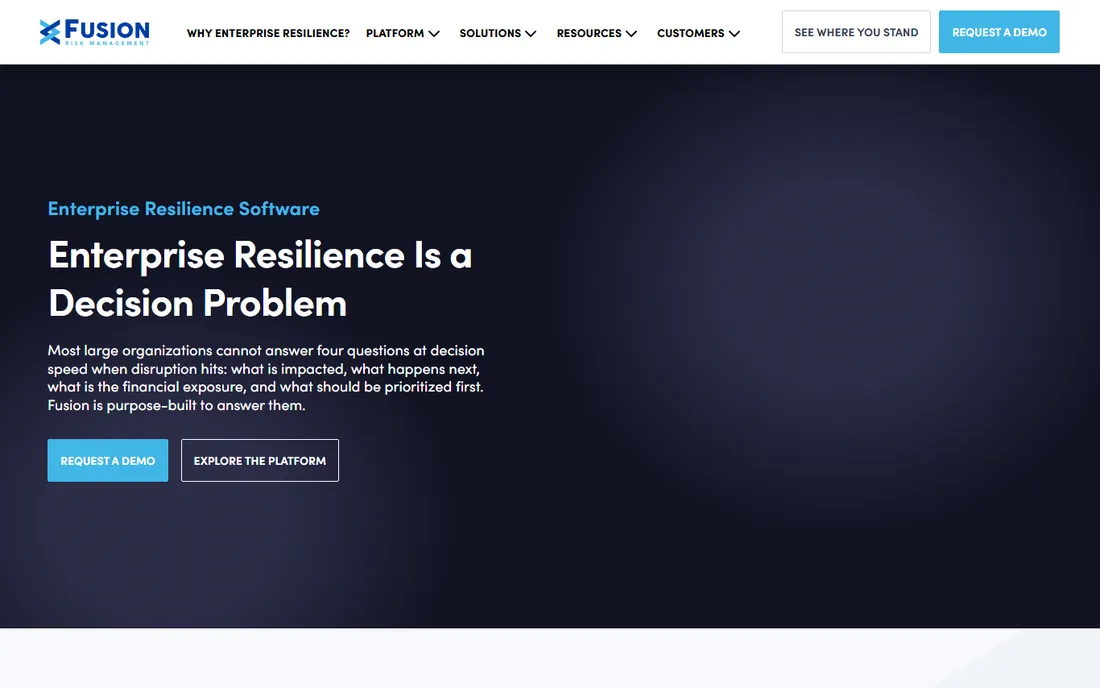
Fusion's identity is operational resilience through testing. Where many tools store plans and schedule tabletop exercises, Fusion emphasizes scenario modeling: what happens to critical processes under specific disruption scenarios, and where the recovery gaps are. Banks and insurers with regulatory resilience obligations are the core audience, and the platform speaks their language.
That focus defines the buyer. If your regulator asks about severe-but-plausible scenarios, Fusion is built for that conversation. If you need plans, contact lists and an annual exercise for a mid-size company, it is more platform than the job requires. Evaluate Fusion when resilience is a regulatory requirement, not just good practice.
What we like- Scenario testing and simulation depth is a genuine differentiator
- Strong footprint in banking and other regulated sectors
- Continuity, crisis and third-party risk in one program view
Watch out for- Built for enterprises, with pricing and process to match
- Smaller organizations will find it heavy
- Demo-led sales cycle
Starting priceSee website (custom quote; fixed-price model, no public numbers)
Free planNo (demo only)
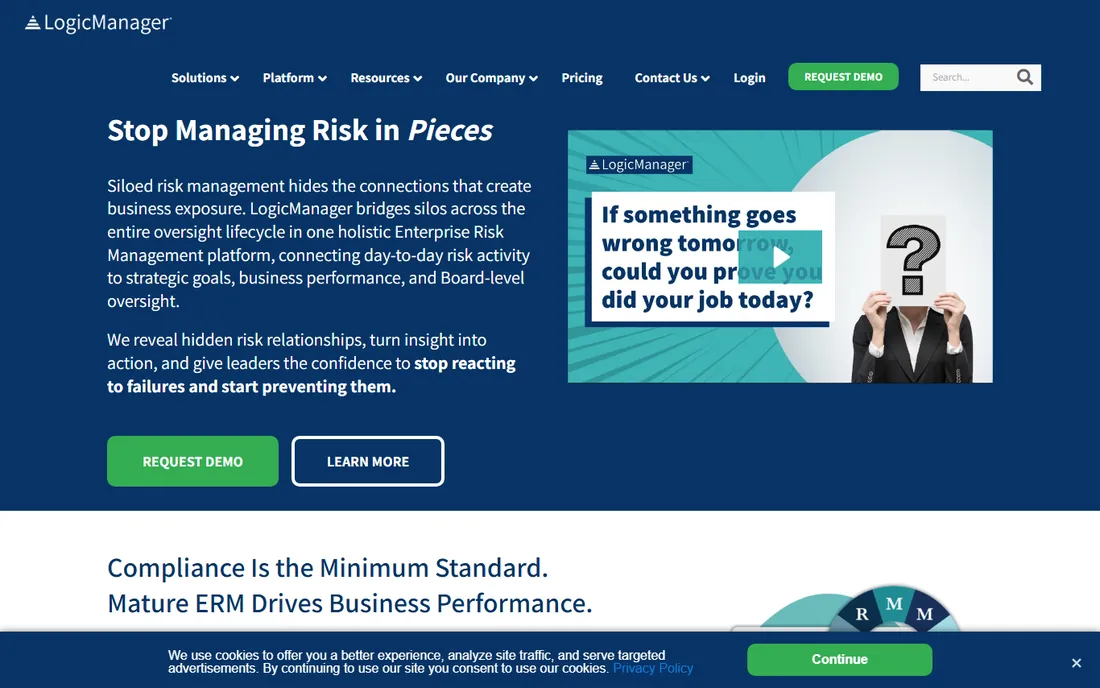
LogicManager sells structure. The platform organizes risk, compliance and continuity around a common taxonomy, so the business impact analysis, risk assessments and control data all speak the same language. The vendor emphasizes a fixed-price model rather than per-module pricing, which appeals to buyers tired of GRC vendors that monetize every add-on.
The consideration is scope. LogicManager is a GRC platform with continuity inside it, not a continuity specialist. Buyers who need the broader program, risk plus compliance plus continuity, get the most value. Buyers who need only continuity planning may find the platform wider than necessary. Ask for the fixed-price quote early and compare it against the modular quotes from competitors.
What we like- Fixed-price model avoids the per-module upsell common in GRC
- Risk maturity framework guides program building
- Taxonomy-based approach keeps risk data consistent
Watch out for- No public pricing to benchmark against
- GRC breadth means continuity is one module among many
- Best value comes with committed multi-year use
#4
Preparis
Best for: Organizations that want continuity planning plus emergency notification in one suite
Visit preparis.com
Starting priceSee website (custom quote; no public prices)
Free planNo (demo only)
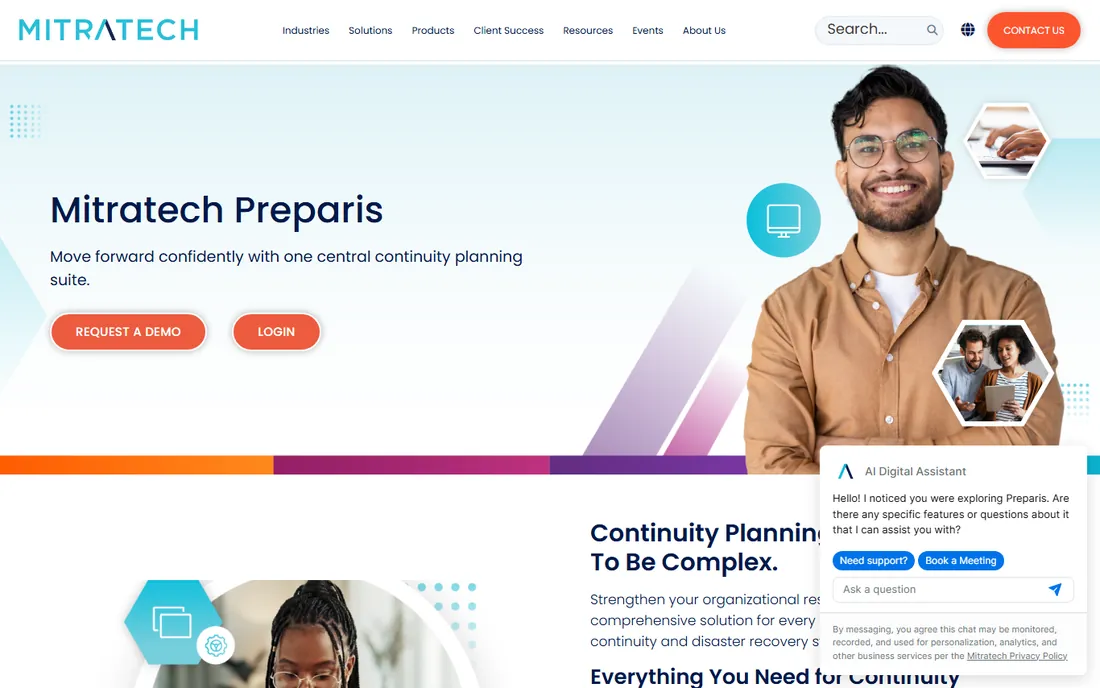
Preparis, now operating as Mitratech Preparis after its acquisition, bundles the full continuity lifecycle: build plans in the Planner, send alerts through the notification module, coordinate response in the Incident Manager, and manage IT recovery strategies in the fourth module. The emergency notification depth, SMS, voice, push, WhatsApp and desktop alerts with multilingual templates, means many buyers can retire a separate mass-notification tool.
The acquisition is the thing to diligence. Mitratech ownership brings resources and a broader GRC portfolio, but buyers should ask how the product roadmap and support structure look post-acquisition. For organizations that want planning and alerting from one vendor without enterprise-suite complexity, Preparis remains a practical shortlist candidate.
What we like- Four connected modules: planner, alerts, incident manager and IT disaster recovery
- Emergency notification with multilingual templates built in
- Guided workflows suit teams new to formal BCM
Watch out for- Now part of Mitratech, so evaluate the combined roadmap
- Enterprise sales process
- Notification costs may scale with message volume
#5
Onspring
Best for: Teams that want no-code, configurable GRC including business continuity
Visit onspring.com
Starting priceSee website (custom quote; no public prices)
Free planNo (demo only)
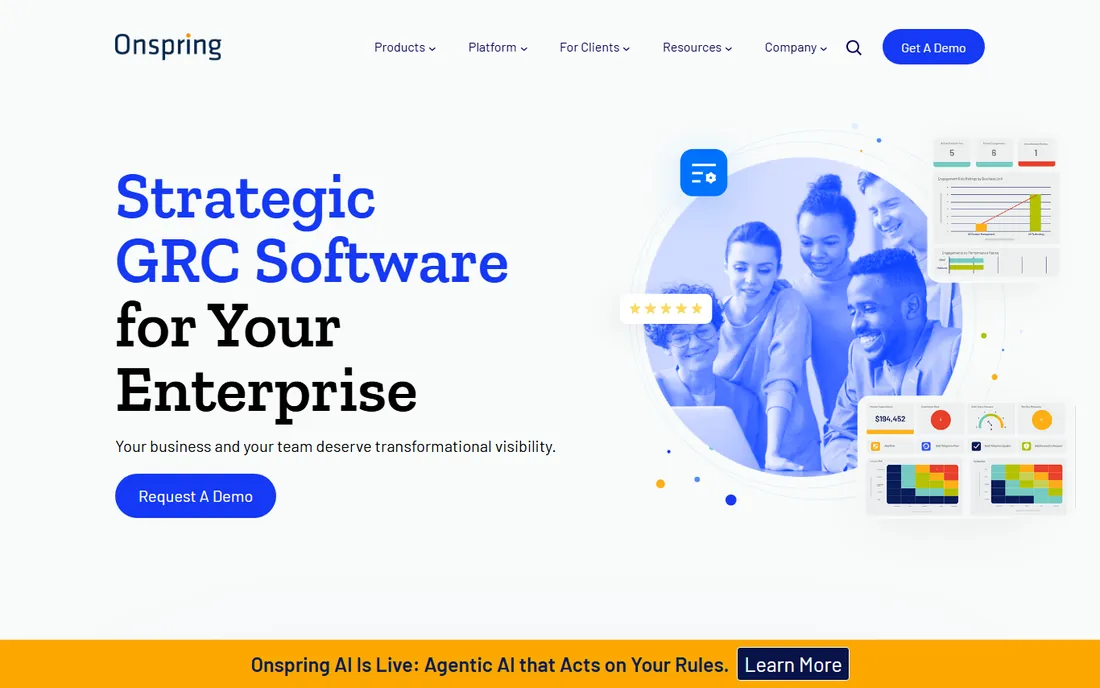
Onspring takes the opposite approach to the rigid suites: a no-code GRC platform your team configures to match how you actually work. Business continuity becomes a set of workflows, forms and dashboards built on the platform rather than a fixed module you adapt to. For organizations with unusual processes or multiple frameworks to satisfy, that configurability is the point.
The honest cost is design effort. A configurable platform is only as good as the thinking behind the configuration, so buyers need someone internal who owns the design. Out-of-the-box depth will trail purpose-built continuity tools on day one. Onspring fits teams that know what they want and prefer building it to adapting to someone else's template.
What we like- No-code configuration lets teams build continuity workflows without developers
- GRC breadth covers risk, audit and compliance alongside BCM
- Faster deployment than traditional GRC suites
Watch out for- Flexibility requires internal effort to design well
- No public pricing
- Continuity depth depends on how the instance is configured
#6
Noggin
Best for: Operations teams that need incident response plus continuity planning
Visit noggin.io
Starting priceSee website (custom quote; no public prices)
Free planNo (demo only)
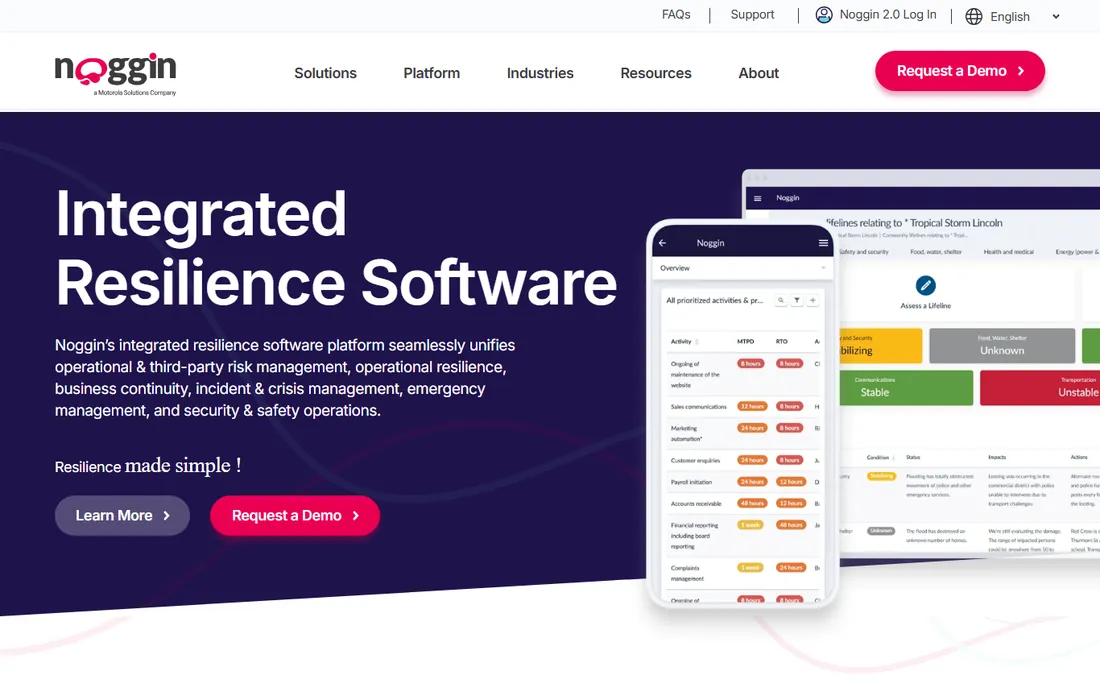
Noggin blends two disciplines that are usually sold separately: critical event management for the response, and business continuity for the planning. The platform's template library, hundreds of pre-built plans, checklists and workflows based on industry practice, shortens the path from purchase to working program. Standards alignment covers ISO 22301 business continuity alongside crisis, emergency and risk management standards.
Two things to check. First, the Motorola Solutions acquisition: the product continues under its brand, but enterprise buyers should confirm the roadmap. Second, scope fit: if you need continuity planning without the incident command machinery, simpler tools cost less. Noggin earns its place where response and recovery are managed as one program.
What we like- Critical event management and business continuity in one integrated platform
- No-code customization with a deep template library
- Strong alignment with ISO 22301 and related standards
Watch out for- Now part of Motorola Solutions, so evaluate the combined direction
- Incident-response depth may exceed what pure BCM buyers need
- Enterprise sales process
#7
Resolver
Best for: Mid-to-large firms consolidating risk, security and business continuity
Visit resolver.com
Starting priceSee website (custom quote; no public prices)
Free planNo (demo only)
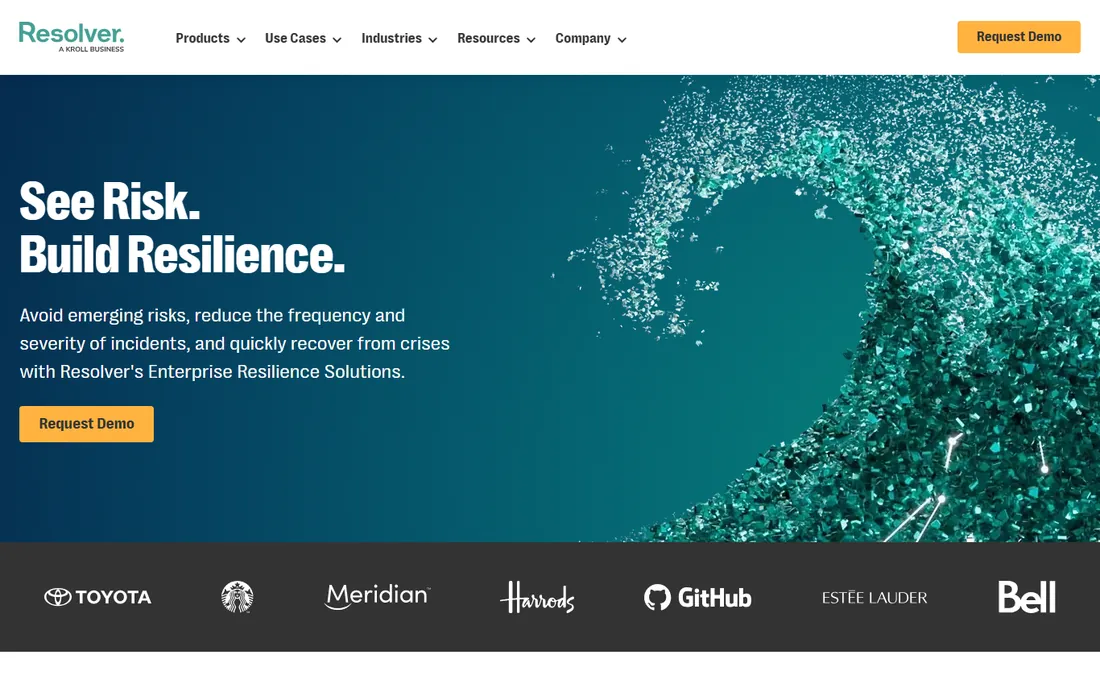
Resolver positions business continuity inside a wider risk intelligence platform that also covers incident management, investigations, security risk and compliance. The practical benefit is data flow: incidents, risks and continuity plans share one system, so the business impact analysis reflects what the incident data already knows. Kroll ownership adds corporate stability and a security-services adjacency.
The evaluation question is focus. Resolver is a risk platform with continuity capability, closer to LogicManager and Riskonnect than to a continuity pure-play. Buyers consolidating multiple risk functions get the value; buyers shopping for continuity alone should compare the specialists. Ask for a continuity-specific demo, not the platform overview, to judge fit.
What we like- Business continuity management as part of a broad integrated risk platform
- Strong incident and investigation workflows feed continuity data
- Now backed by Kroll
Watch out for- Continuity is one application among many
- Platform breadth can mean longer implementations
- No public pricing
How to choose business continuity software
Start with the program you actually run, not the one the vendor's slide deck describes. Map your must-haves: business impact analysis, plan development and storage, exercising and testing, emergency notification, and reporting. Most mid-size programs need all five, but the depth varies enormously. A manufacturer with one plant needs contact trees and recovery procedures. A bank needs scenario testing a regulator will inspect. Buy the depth your reality requires.
Then evaluate who will use it during an incident. The plan library that looks impressive in a demo is useless if the incident commander cannot find the right plan at 2am. Ask for a live walkthrough of the exact incident workflow: alert goes out, team assembles, plan activates, status tracks. Check mobile access, offline availability and how permissions work when the normal approver is unreachable. Continuity software fails at the moment of use, never in the demo.
Finally, price the whole program, not the license. Implementation services, data migration, template configuration, training and annual exercising support can exceed the first-year subscription. Since none of these vendors publish prices, get at least three quotes and compare the same scope: same user counts, same modules, same services. And ask each vendor what happens to your data if you leave; exit terms are negotiable before signing and painful after.
Business continuity vs. disaster recovery: the practical difference
Buyers often conflate these, and vendors encourage it. Business continuity is about keeping the business running during a disruption: which processes matter, who does what, how customers are served, how the team communicates. Disaster recovery is the IT subset: how systems and data are restored, with recovery time and recovery point objectives for each application. Preparis makes the split explicit with separate continuity and IT disaster recovery modules; most suites cover both under one roof.
The practical implication is who owns what. Business continuity belongs to operations and the business units, with IT as a participant. Disaster recovery belongs to IT. Software that serves both needs role-based views: the plant manager sees recovery procedures, the infrastructure lead sees system runbooks. When evaluating, check that the platform distinguishes the two rather than mashing them into one plan template. And confirm the exercising tools test both: a plan that has never been exercised is a document, not a capability.
Frequently asked questions
How much does business continuity software cost?
None of the established vendors publish prices; everything is custom-quoted based on users, modules and services. Expect enterprise-suite pricing from Riskonnect and Fusion, mid-market quotes from LogicManager, Onspring, Noggin and Resolver, and plan for implementation services on top of the subscription. Get three comparable quotes before deciding.
What is business impact analysis (BIA)?
The BIA identifies which business processes are critical, what happens when they stop, and how fast they must be restored. It sets recovery time objectives that drive the rest of the program: plans, resources and testing. Every platform on this list includes BIA tooling; the depth of scenario modeling varies.
Do small businesses need business continuity software?
Most do not need an enterprise suite. A small business needs documented plans, contact lists, backup and recovery procedures, and an annual test, which can live in simpler tools or even well-kept documents. The platforms here fit mid-size companies and up, or small firms in regulated industries.
What happened to Castellan?
Castellan was acquired by Riskonnect, and its site now redirects into Riskonnect's. We replaced it on this list with Onspring rather than cover a product that no longer exists independently. Existing Castellan customers are served through Riskonnect.
How is this different from backup software?
Backup software copies data so it can be restored. Business continuity software manages the human and process side: who does what, in which order, with what resources, when normal operations break. You need both; neither replaces the other.
Sources we checked (8)
- https://riskonnect.com/
- https://riskonnect.com/business-continuity-management-software/
- https://fusionrm.com/
- https://logicmanager.com/
- https://preparis.com/
- https://www.onspring.com
- https://www.noggin.io
- https://www.resolver.com
Is your product missing or out of date?
We review this list regularly. Vendors can request a listing, send updated pricing or ask about featured placement.

Shihab Mia · Founder, Rankite
Shihab has spent more than a decade helping SaaS and e-commerce brands grow through search. He writes Rankite's software buying guides from pricing pages, documentation and public user reviews. More about Shihab.