How we make this list: we compare pricing pages, product documentation and public user reviews. Rankite is independent; if a vendor ever pays for a featured spot, that listing is clearly labeled Partner.
Key takeaways
- On a budget? Start with Amplitude (2M events/month free), Mixpanel (1M free) or Kissmetrics (100k free): all three have real free tiers with no card required.
- Segment is the plumbing: collect customer data once, then route it to every analytics and marketing tool you already own.
- Woopra and Kissmetrics answer person-level journey questions; Gainsight, Odie, ChurnZero and Vitally run customer success motions on top of that data.
- The customer success platforms (Gainsight, Odie, ChurnZero, Vitally) publish no prices: expect a demo and an annual quote.
- Freshpaint has narrowed to healthcare: a privacy-first customer data platform for hospitals, payers and specialty providers.
Quick comparison
| Tool | Best for | Starting price | Free plan |
|---|
 Segment Segment | Companies that want one data pipeline feeding every analytics and marketing tool | See website (usage-based pricing) | Yes (free tier available) |
 Amplitude Amplitude | Teams that want deep behavioral analytics with a generous free tier | Free plan (2M events/month); Plus from $0 usage-based | Yes |
 Mixpanel Mixpanel | Product and marketing teams that want fast event-based customer analytics | Free plan (1M events/month); Growth from $0 usage-based | Yes |
 Woopra Woopra | Teams that want journey analytics across website, app, email and support | See website | Free trial (30 days) |
 Kissmetrics Kissmetrics | Businesses that want every event tied to a person and to revenue | $99/month (per vendor site) | Yes (100k events/month free) |
 Gainsight Gainsight | Mid-size and enterprise customer success teams with high-touch accounts | See website (custom quote) | No |
 Odie Odie | Post-sales teams that want AI-driven customer intelligence (formerly Totango) | See website | No |
 ChurnZero ChurnZero | Subscription businesses focused on onboarding, adoption and renewals | See website (demo-based pricing) | No |
 Vitally Vitally | Mid-market B2B SaaS teams that want customer success live in weeks | See website (demo-based pricing) | No |
 Freshpaint Freshpaint | Healthcare marketers that need privacy-safe customer data | See website | No |
Is your product missing or out of date?
We review this list regularly. Vendors can request a listing, send updated pricing or ask about featured placement.
The best customer analytics software
Here is the buyer's problem: your customer data lives in five different tools, none of them agrees with the others, and when churn spikes nobody can say why. Marketing sees one number, support sees another, and the founder gets a third from a spreadsheet. Customer analytics software exists to fix exactly that: collect what customers do across every touchpoint, stitch it into one view, and turn it into answers about acquisition, retention and revenue. These ten tools cover the three jobs buyers actually hire for: getting the data flowing, understanding the journey, and running customer success on what you learn.
#1
Segment
Best for: Companies that want one data pipeline feeding every analytics and marketing tool
Visit segment.com
Starting priceSee website (usage-based pricing)
Free planYes (free tier available)
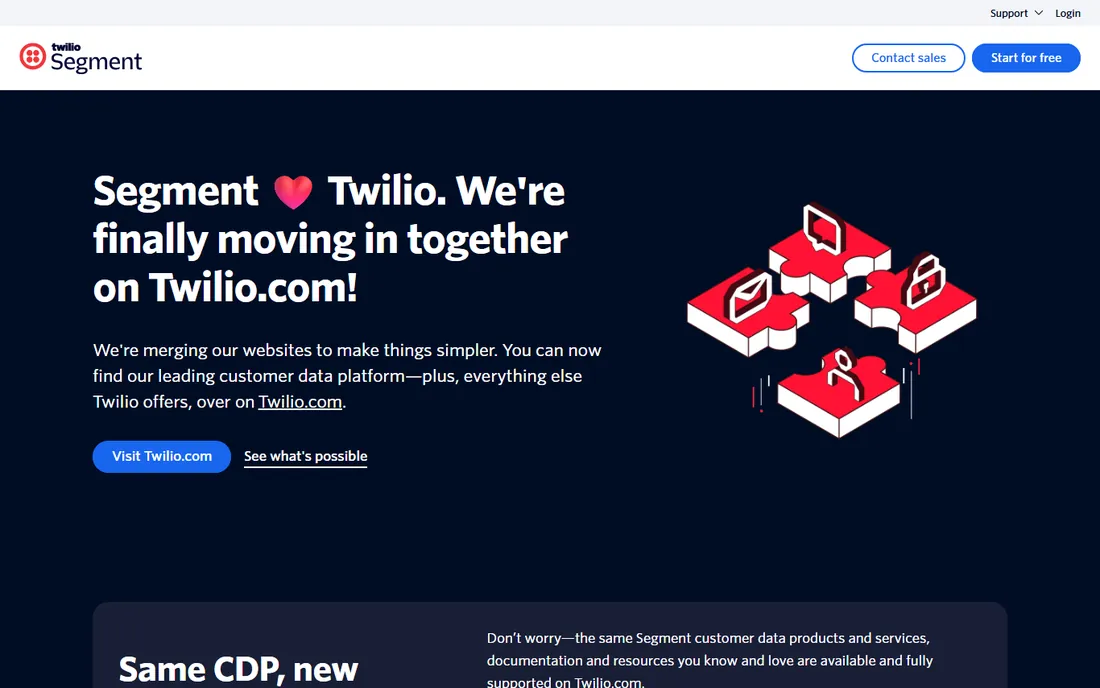
Companies whose customer data is scattered across a website, an app, a CRM and an email platform usually buy Segment first. The pitch is simple: instrument once, and every tool downstream receives clean, consistent events. Instead of wiring Mixpanel, your warehouse, your ad platforms and your support desk separately, you wire Segment and flip destinations on and off. Identity resolution merges anonymous and known users into one profile as they move between touchpoints.
The honest catch is that Segment answers no questions by itself. It is infrastructure. You still need an analytics tool to ask which campaign brings customers who stay, and the MTU-based pricing means the bill grows with your audience rather than your usage. Small teams with one or two destinations often do better starting with a free analytics tier and adding Segment when the stack gets messy.
What we like- One integration collects customer data and routes it to hundreds of destinations
- Identities are stitched across touchpoints into unified profiles
- Usage-based pricing with a free tier for getting started
Watch out for- Billed on MTUs, so costs rise as your tracked audience grows
- It is a data pipeline, not an analytics interface, so you still need an analytics tool on top
#2
Amplitude
Best for: Teams that want deep behavioral analytics with a generous free tier
Visit amplitude.com
Starting priceFree plan (2M events/month); Plus from $0 usage-based
Free planYes
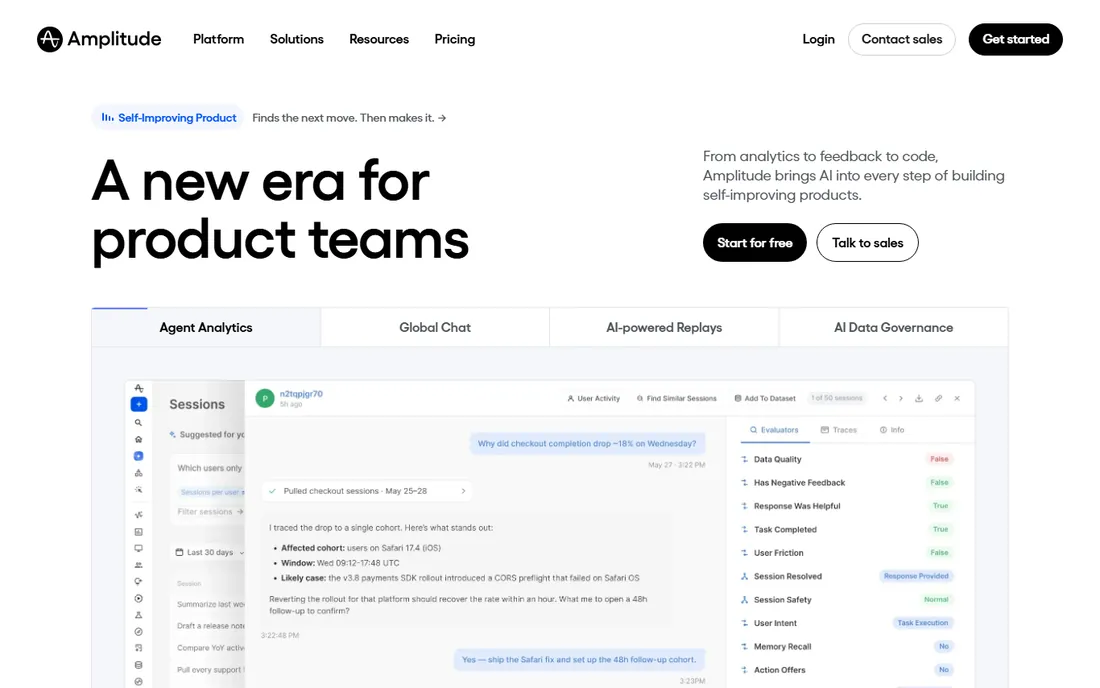
Amplitude earns its place on almost every customer analytics shortlist because the free tier is real: 2M events per month is enough for many small and mid-size businesses to run full behavioral analytics without paying anything. The analysis layer covers the customer questions that matter, like which onboarding steps predict retention, which cohorts come back, and where paid users drop off. Session replay and experimentation can be added when you are ready.
The trade is forecasting. Plus pricing is usage-based starting from $0, which sounds friendly until event volumes grow and the bill follows. Teams should also budget time for instrumentation: Amplitude is powerful precisely because it is flexible, and flexible tools need someone to define the taxonomy. If your team will not maintain event definitions, a simpler tool will serve you better.
What we like- Free plan covers 2M events per month, the most generous free tier on this list
- Journey, funnel and retention analysis built for cross-touchpoint customer views
- Session replay and experimentation add-ons available
Watch out for- Usage-based Plus pricing is hard to forecast as event volume scales
- Some advanced capabilities sit on paid tiers
#3
Mixpanel
Best for: Product and marketing teams that want fast event-based customer analytics
Visit mixpanel.com
Starting priceFree plan (1M events/month); Growth from $0 usage-based
Free planYes
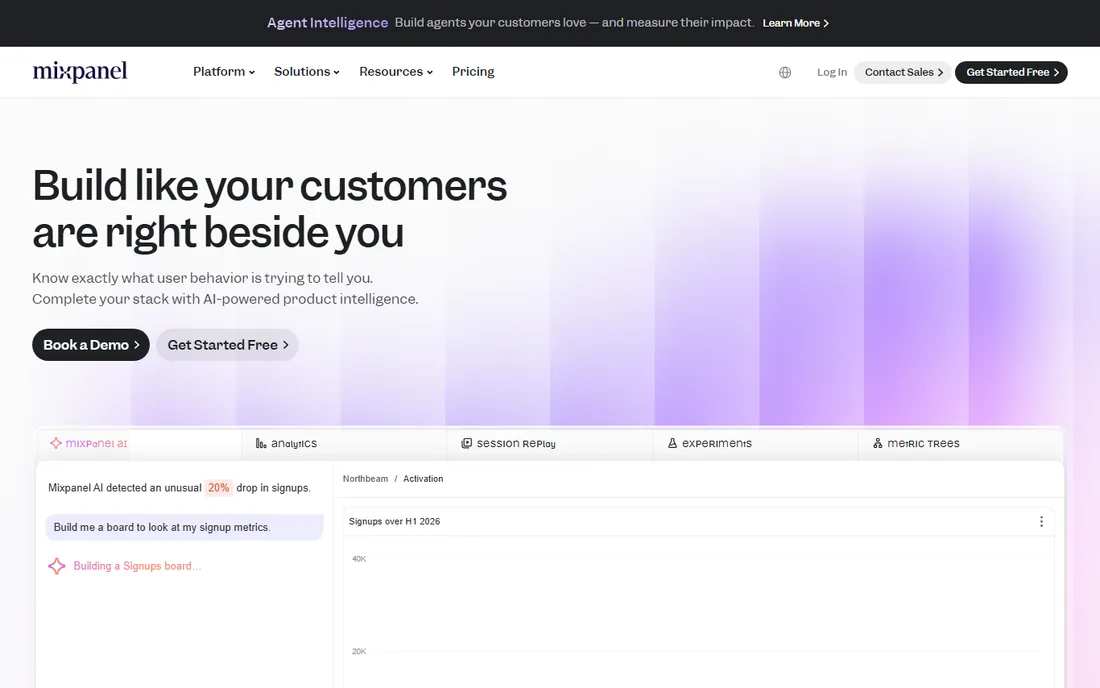
Pick Mixpanel when speed matters more than depth of setup. Queries return in seconds, the interface is built for non-technical users, and the newer AI features help teams phrase questions in plain language and get reports back. The free plan at 1M events per month is generous enough to evaluate it on real data, and Growth pricing starts from $0 with the first million events free before usage charges kick in. Session replays and feature flags make it a broader customer analytics suite than event charts alone.
Watch the event meter. The free allowance is real, but teams that track everything tend to blow past it, and usage pricing rewards disciplined instrumentation. Like Amplitude, Mixpanel works best when someone owns the event taxonomy; otherwise you get fast answers to badly defined questions. For teams that want quick reads on customer behavior without a data team, it is one of the easiest starts on this list.
What we like- Free plan covers 1M events per month
- Fast queries with an AI-assisted analysis layer
- Session replays and feature flags available in the same platform
Watch out for- Growth pricing adds up past the free event allowance
- Governance and data hygiene need attention at scale
#4
Woopra
Best for: Teams that want journey analytics across website, app, email and support
Visit woopra.com
Starting priceSee website
Free planFree trial (30 days)
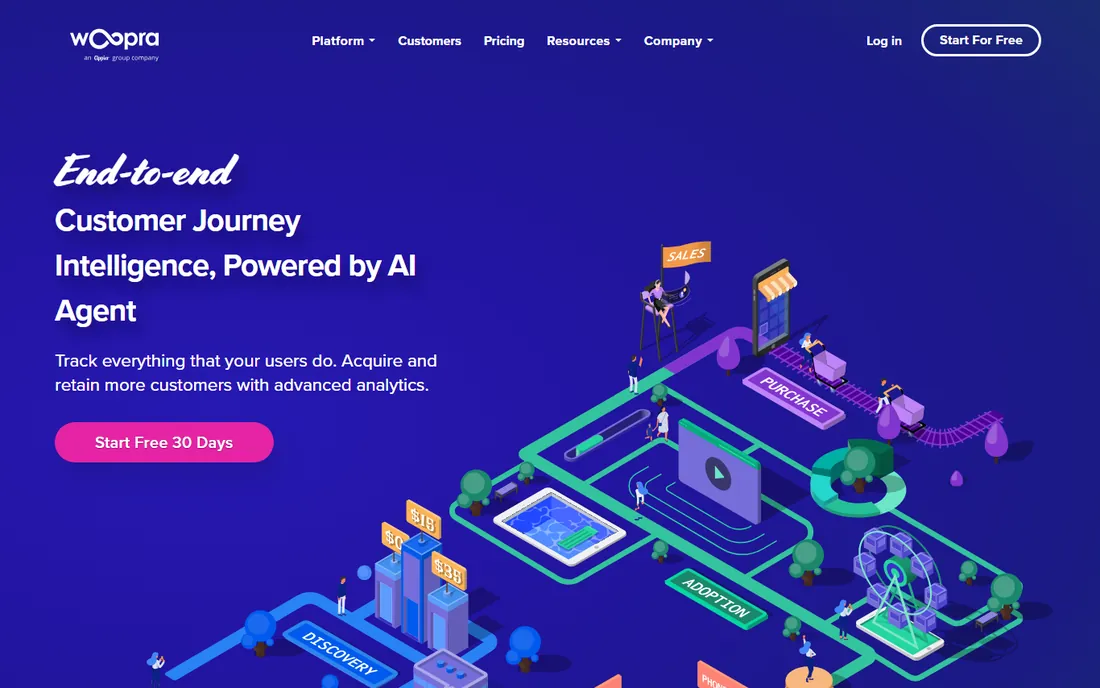
Woopra's difference is the unit of analysis: the person, not the pageview. Every touchpoint, from the first website visit through product usage, email opens and support tickets, lands on one customer timeline. That makes it natural for journey questions like which sequence of touches leads to a purchase, or which support interactions precede churn. Triggers close the loop by firing emails, Slack messages or Salesforce updates when behavior matches a pattern.
The catch is the price tier. Woopra sells a 30-day free trial, but paid plans are quote-based and positioned for teams with serious event volume, which puts it out of reach for most small businesses. It also overlaps heavily with Mixpanel and Amplitude on core event analytics, so buy it for the cross-touchpoint journey view and the automation triggers, not for funnels alone.
What we like- Tracks people across web, mobile, email and help desk in one timeline
- Journey and funnel reports need no SQL
- Triggers can send emails or update Salesforce from customer behavior
Watch out for- Pricing is quote-based and sits at the enterprise end
- Heavier than a simple event tool for small teams
#5
Kissmetrics
Best for: Businesses that want every event tied to a person and to revenue
Visit kissmetrics.io
Starting price$99/month (per vendor site)
Free planYes (100k events/month free)
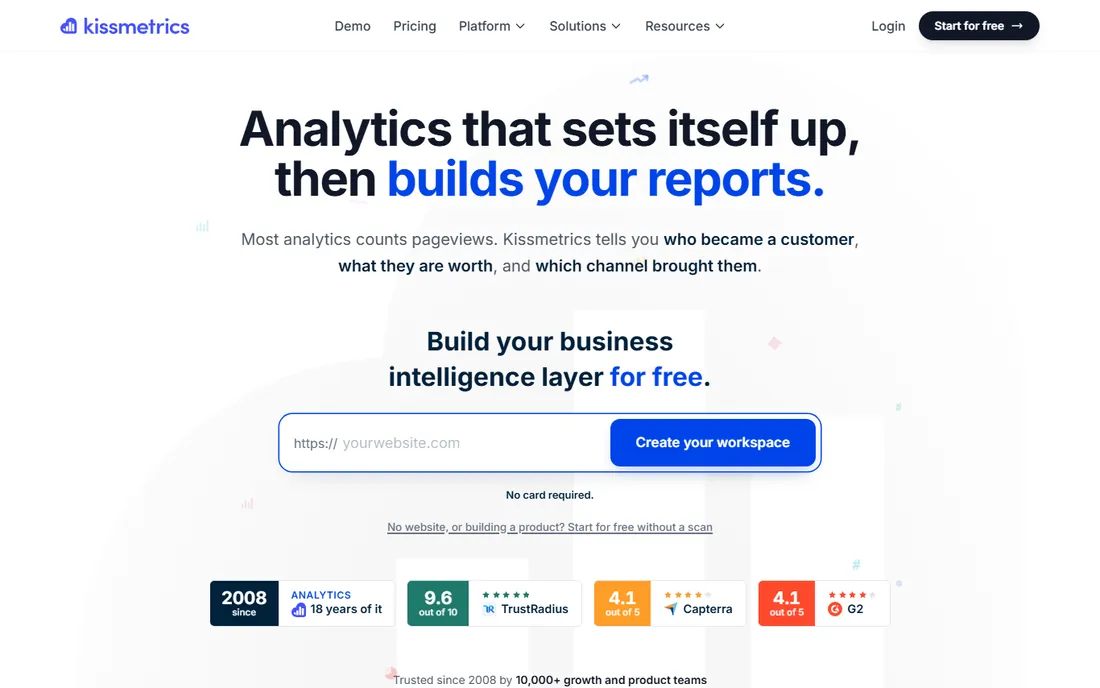
One of the oldest names in customer analytics, Kissmetrics rebuilt itself around a clear idea: most analytics counts pageviews, but businesses need to know who became a customer, what they are worth, and which channel brought them. The platform reads your site, installs its own tracking, works out what you sell, and builds the first dashboard before you touch anything. Reports cover funnels, cohorts and revenue attribution, all resolved to individual people across devices.
The free tier (100k events per month, no card) makes it easy to test on real traffic, and paid plans start at $99 per month on the vendor's own site. The honest catch is event-volume pricing: high-traffic sites can outgrow the entry tiers fast. It also lacks the destination breadth of a true CDP, so treat it as an analytics tool that happens to track well, not as your data pipeline.
What we like- Person-level tracking with revenue attribution out of the box
- Free tier covers 100k events per month with no card required
- Self-configuring dashboards build from one tracking snippet
Watch out for- Paid plans scale on event volume, so high-traffic sites should price carefully
- Smaller integration library than Segment or Amplitude
#6
Gainsight
Best for: Mid-size and enterprise customer success teams with high-touch accounts
Visit gainsight.com
Starting priceSee website (custom quote)
Free planNo
When the question shifts from "what are customers doing" to "which accounts are at risk and what do we do about it," Gainsight is the heavyweight answer. It combines customer health scoring, success plans, journey orchestration and renewal forecasting into one system of record for post-sales teams. Because it is deeply integrated with Salesforce, customer data stays behind the CRM's firewall, which matters to larger companies with strict security requirements.
Everything about Gainsight is enterprise-grade, including the cost and the implementation. Pricing is quote-based, onboarding is a project rather than an afternoon, and reviewers consistently describe it as expensive for smaller teams. Buy it when you have a real customer success team managing named accounts and renewals. If your team is five people and nobody owns renewals yet, the event analytics tools above will tell you more for less.
What we like- Customer health scoring, journey orchestration and playbooks in one platform
- Deep Salesforce-native data handling
- Renewal and expansion workflows built in
Watch out for- Enterprise pricing and implementation effort
- Overkill for teams that just need event analytics
#7
Odie
Best for: Post-sales teams that want AI-driven customer intelligence (formerly Totango)
Visit heyodie.ai
Starting priceSee website
Free planNo
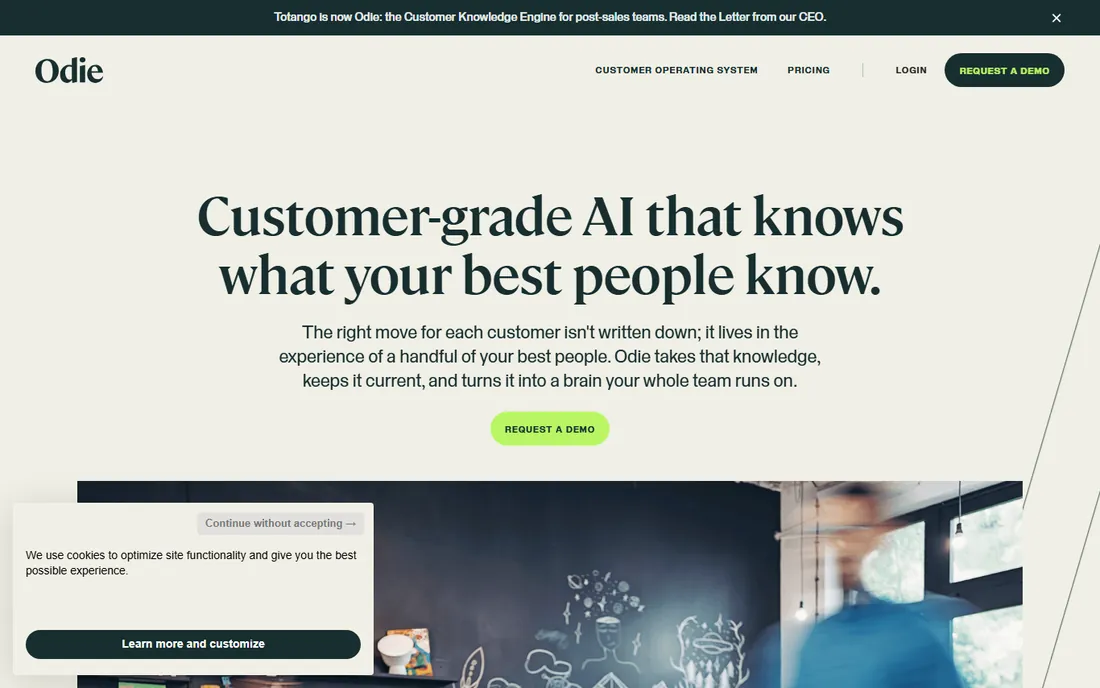
Odie is the new name for Totango, the long-standing customer success platform, now rebuilt around an AI "customer knowledge engine" for post-sales teams. The concept: instead of dashboards your team has to read, Odie maintains living customer narratives from CRM data, usage, emails, calls and meetings, and makes that knowledge available to the agents your team already builds. An optional guided workspace offers a more traditional customer success interface on top.
The interesting pricing detail is the model: no seat pricing and no token pricing, with cost based on the entities you maintain knowledge for and how you connect to the engine. That is friendlier to growing teams than per-seat CS platforms. The risk is newness: the rebrand is recent, published prices are absent, and you buy through a demo. Teams that liked Totango's CS depth should evaluate it; teams that need a proven quantity today may prefer ChurnZero or Gainsight.
What we like- AI knowledge engine built for post-sales teams and their agents
- Predictable pricing model with no seat-based billing
- Carries forward Totango's 15 years of customer success expertise
Watch out for- Brand and product are new, so the track record is short
- Demo-based buying with no published prices
#8
ChurnZero
Best for: Subscription businesses focused on onboarding, adoption and renewals
Visit churnzero.net
Starting priceSee website (demo-based pricing)
Free planNo

ChurnZero does one thing and does it thoroughly: help subscription businesses keep customers. Customer health scores flag at-risk accounts, plays and automation run onboarding and adoption campaigns, in-app messaging reaches users where they work, and renewal forecasting tells you where the quarter stands. It is the most churn-focused platform on this list, and its support and implementation teams get consistent praise from users.
There is no public pricing and no free tier; you book a demo and buy on annual terms. Third-party estimates put entry costs in the five-figure annual range, so this is a considered purchase, not a credit-card signup. For SaaS and subscription businesses with a real renewals motion, the depth justifies the process. For everyone else, start with event analytics and graduate to ChurnZero when churn becomes a line item worth a platform.
What we like- Health scoring, customer journeys and in-app engagement in one platform
- Strong renewal forecasting and expansion workflows
- Well-regarded support and onboarding
Watch out for- Pricing is not published
- Annual contracts are the norm
#9
Vitally
Best for: Mid-market B2B SaaS teams that want customer success live in weeks
Visit vitally.io
Starting priceSee website (demo-based pricing)
Free planNo
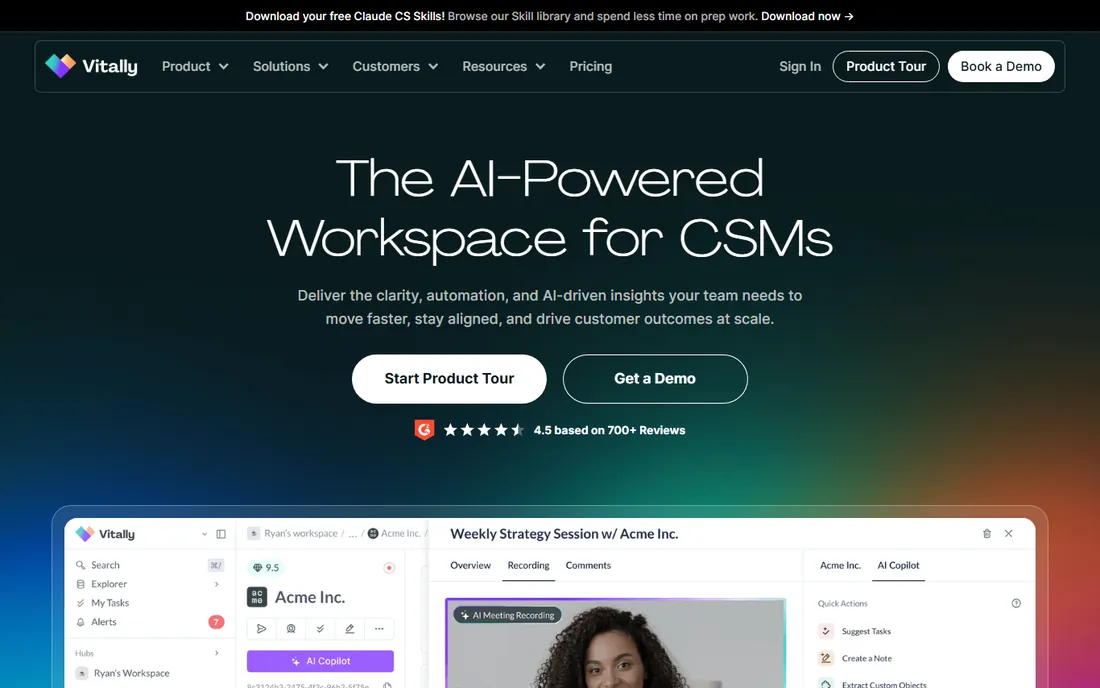
Vitally's pitch is speed to value. Where Gainsight implementations are measured in months, Vitally cites an average go-live around two months and positions itself as the CS platform teams choose for usability: health scoring, account 360 views, workflow automation, shared success plans and NPS surveys in an interface CSMs open voluntarily. AI additions include account summaries that synthesize activity across dozens of accounts and a meeting recorder that transcribes customer calls.
The buying process is traditional: no published prices, demo first, quote after. Reviewers note that AI add-ons can push the total above expectations, so price the configuration you will actually run. For mid-market B2B SaaS teams that want Gainsight-style coverage without the enterprise implementation project, Vitally is the pragmatic middle ground between event analytics and the big CS suites.
What we like- Modern interface that CSMs actually adopt
- Health scores, 360-degree profiles and automation with fast implementation
- AI summaries and a meeting recorder built in
Watch out for- Pricing requires a sales conversation
- Advanced AI features cost extra
#10
Freshpaint
Best for: Healthcare marketers that need privacy-safe customer data
Visit freshpaint.io
Starting priceSee website
Free planNo
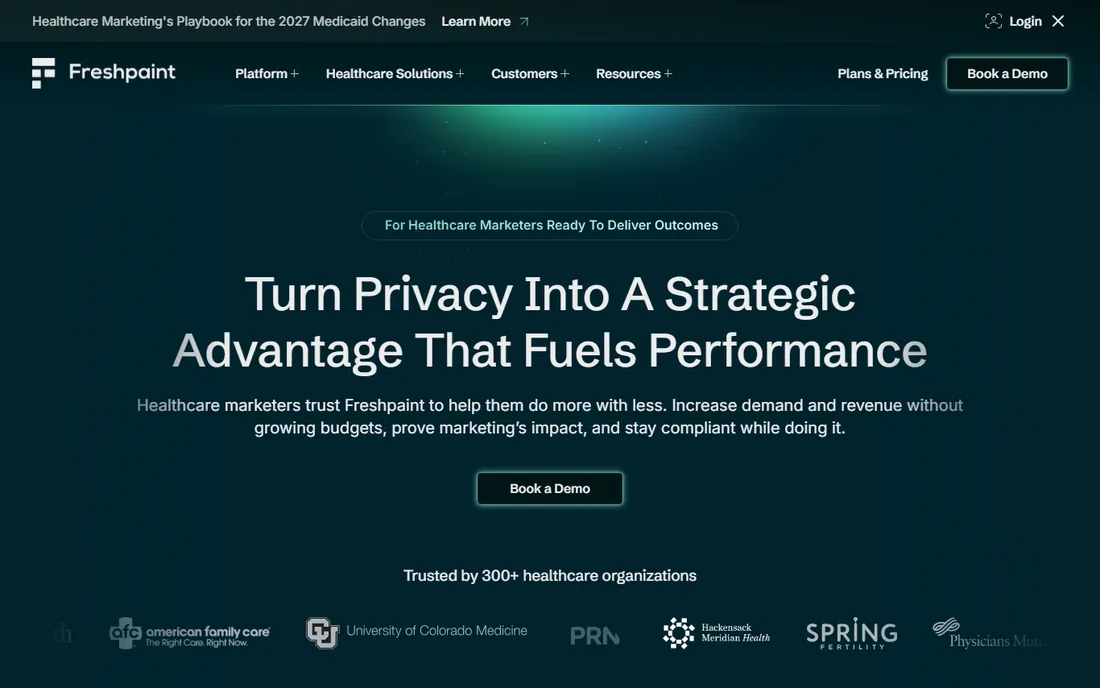
Freshpaint started as a general customer data platform, but its current site tells a narrower story: it is now a healthcare marketing performance and compliance platform. The value proposition is specific and strong for that audience: track the full patient journey from awareness to appointment, prove which campaigns drive visits and revenue, and do it all without violating HIPAA. It connects ad campaigns to attended appointments and feeds conversion data back into Google and social ad platforms.
That focus is also the limitation. If you run a hospital system, a dental group or a payer, Freshpaint solves a compliance problem no general CDP touches. If you are outside healthcare, this is not your tool; Segment or a similar CDP fits better. Pricing is demo-based, which suits the enterprise healthcare buyer but gives smaller practices nothing to evaluate against.
What we like- Collects customer data while keeping marketing HIPAA-safe
- Feeds conversion data back into ad platforms
- Built for hospitals, payers and specialty providers
Watch out for- Now focused on healthcare, so other industries should look elsewhere
- Demo-based pricing
Start from the question, not the dashboard
Most buyers pick customer analytics software backwards: they compare feature lists, then wonder why the tool does not answer their questions. Flip it. Write down the three customer questions that cost you money right now, then match the tool to the question.
If the question is "where do customers drop off and which campaigns bring the ones who stay," you need event-based behavioral analytics: Amplitude, Mixpanel or Kissmetrics, all of which have free tiers you can test this week. If the question is "our data is scattered and no two tools agree," fix the plumbing first with a customer data platform like Segment, then layer analytics on top. If the question is "which accounts will churn next quarter and what should we do about it," you need a customer success platform with health scoring: ChurnZero, Vitally, Gainsight or Odie. And if privacy law constrains what you can track, as in healthcare, start with the compliance requirement and work backwards; that is the entire reason Freshpaint exists.
Two practical notes before you buy. First, instrumentation discipline beats tool choice: every platform on this list is only as good as the events you define, so assign one owner to the tracking plan. Second, price the second year, not the first: free tiers and entry plans are cheap, but event-volume and per-seat pricing compound as you grow. Model your expected events or accounts for month 18, not month one.
Frequently asked questions
What is customer analytics software?
Software that collects what customers do across touchpoints (website, app, email, support, billing), combines it into unified customer profiles, and analyzes it to answer questions about acquisition, engagement, retention and revenue. It ranges from data pipelines (Segment) to behavioral analytics (Amplitude, Mixpanel) to customer success platforms (Gainsight, ChurnZero).
How is customer analytics different from product analytics?
Product analytics focuses on in-product behavior: feature adoption, funnels inside the app. Customer analytics is wider: it follows the whole relationship from first marketing touch through onboarding, support tickets, renewals and expansion. The tools overlap (Amplitude and Mixpanel do both), but customer success platforms like Gainsight and ChurnZero exist specifically for the post-sale side.
How much does customer analytics software cost?
It splits three ways. Event analytics tools have real free tiers (Amplitude: 2M events/month; Mixpanel: 1M; Kissmetrics: 100k) with usage-based paid plans from $0. Customer data platforms like Segment are usage-based with a free tier. Customer success platforms (Gainsight, Odie, ChurnZero, Vitally) publish no prices and sell annual contracts through demos, typically a five-figure yearly commitment.
Do I need a customer data platform like Segment too?
You need one when customer data lives in several tools that disagree. A CDP collects events once and routes clean, consistent data to your analytics, warehouse, ad platforms and CRM. If you run one website and one analytics tool, skip it. If marketing, product and support each have their own numbers, a CDP pays for itself in avoided arguments.
Can a small team use Gainsight or ChurnZero?
Technically yes, practically it is a stretch. Both are built for customer success teams managing named accounts and renewals, with implementation projects and annual contracts to match. Small teams usually get more value from a free event analytics tier plus disciplined health tracking in a spreadsheet or CRM, then graduate to a CS platform when renewals become someone's full-time job.
Is Freshpaint only for healthcare now?
Based on its current site, yes: Freshpaint positions itself as a healthcare marketing performance and compliance platform for hospitals, payers, urgent care and specialty providers. Healthcare buyers get HIPAA-safe tracking and patient-journey attribution. Companies outside healthcare should evaluate Segment or a similar general customer data platform instead.
Customer analytics is not product analytics
The two categories get confused because the same vendors sell both. Product analytics answers "what do users do inside our product": which features get adopted, where the signup funnel breaks, which experiments win. Customer analytics answers "what is the state of this customer": how they found you, whether onboarding stuck, how healthy the account looks, whether they will renew.
That is why this list looks different from a product analytics roundup. The behavioral tools (Amplitude, Mixpanel, Kissmetrics, Woopra) appear in both worlds because journeys cross the product boundary. But the customer success platforms (Gainsight, Odie, ChurnZero, Vitally) have no real product-analytics equivalent: health scoring, success plans, renewal forecasting and churn playbooks are post-sale disciplines. And the data layer (Segment, Freshpaint) exists to feed all of it.
Buy for the job. If your problem is feature adoption, buy product analytics. If your problem is churn, expansion and proving which customers are worth what, buy customer analytics. Most growing SaaS companies end up with one of each, connected by a data pipeline.
How we chose
We started with the categories buyers search: customer analytics software, customer data platform, customer journey analytics and customer success software. For each candidate we opened the vendor's own homepage to confirm the current brand and URL, checked the vendor's own pricing page for prices and free tiers, and compared features and buyer fit. Where a price could not be verified on the vendor's page we wrote "See website" rather than guessing. Tools that had shut down or been folded into another product were replaced with live alternatives.
Sources we checked (10)
- https://segment.com/
- https://amplitude.com
- https://mixpanel.com
- https://woopra.com/
- https://kissmetrics.io/
- https://gainsight.com/
- https://www.heyodie.ai
- https://churnzero.net/
- https://vitally.io/
- https://www.vitally.io/pricing
Is your product missing or out of date?
We review this list regularly. Vendors can request a listing, send updated pricing or ask about featured placement.

Shihab Mia · Founder, Rankite
Shihab has spent more than a decade helping SaaS and e-commerce brands grow through search. He writes Rankite's software buying guides from pricing pages, documentation and public user reviews. More about Shihab.