How we make this list: we compare pricing pages, product documentation and public user reviews. Rankite is independent; if a vendor ever pays for a featured spot, that listing is clearly labeled Partner.
Key takeaways
- 1NCE is the pricing disruptor: a flat one-time fee per SIM for up to 10 years, ideal for low-bandwidth fleets where cost predictability beats feature depth.
- Soracom is the developer's pick: cloud-native, API-first, with AI analytics and the SGP.32 eSIM orchestration platform in commercial availability.
- Aeris operates at the largest scale on this list, over 110 million devices on its IoT Accelerator platform, and suits automotive, utility and enterprise fleets.
- SGP.32, the GSMA's IoT eSIM standard, reached commercial reality in 2026 across Soracom, Eseye, Aeris, emnify, Onomondo and KORE: any shortlist should ask about it.
Quick comparison
| Tool | Best for | Starting price | Free plan |
|---|
 1NCE 1NCE | Low-bandwidth fleets needing predictable flat-fee pricing | See website (flat-fee Lifetime Flat model) | No |
 Soracom Soracom | Cloud-native developers wanting API-first connectivity plus AI | See website (pay-as-you-go) | No |
 Eseye Eseye | Global deployments needing managed multi-IMSI resilience | See website (quote-based) | No |
 Aeris Aeris | Massive automotive, utility and enterprise fleets | See website (quote-based) | No |
 EMnify EMnify | Enterprises wanting their own cloud-native core network | See website (quote-based) | No |
 Onomondo Onomondo | Teams wanting network transparency and real-time diagnostics | See website (quote-based) | No |
 floLIVE floLIVE | Localized, compliant connectivity with in-country data handling | See website (quote-based) | No |
 KORE KORE | Enterprises wanting managed services plus connectivity | See website (quote-based) | No |
Is your product missing or out of date?
We review this list regularly. Vendors can request a listing, send updated pricing or ask about featured placement.
The best IoT connectivity management software
#1
1NCE
Best for: Low-bandwidth fleets needing predictable flat-fee pricing
Visit 1nce.com
Starting priceSee website (flat-fee Lifetime Flat model)
Free planNo
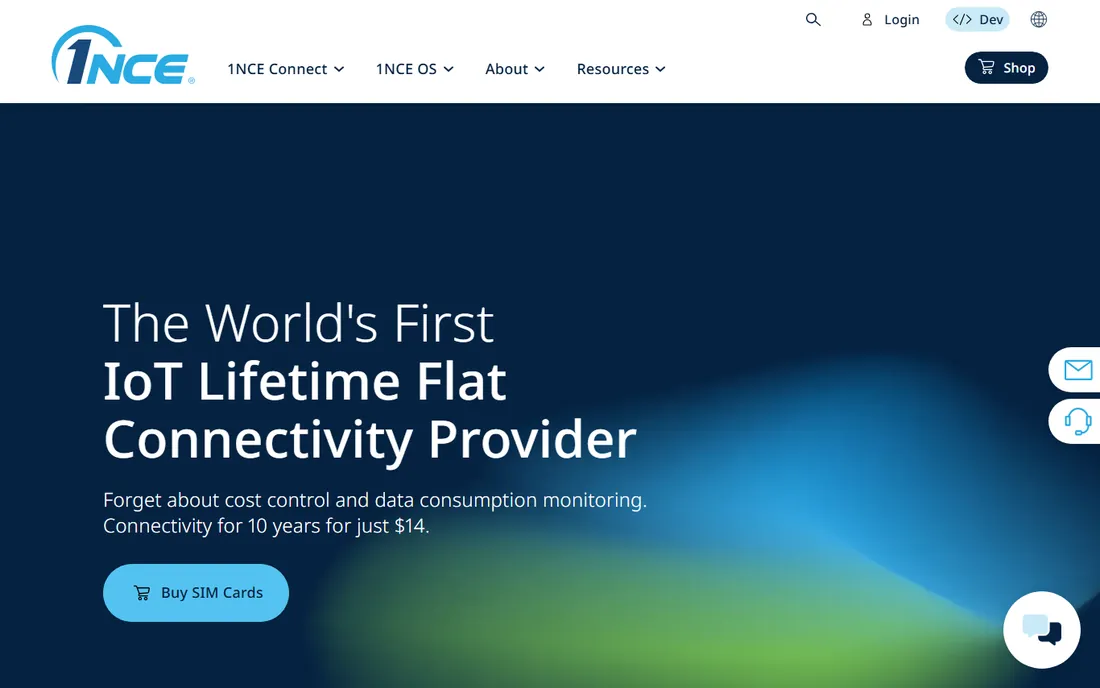
1NCE took the most annoying part of IoT, the connectivity bill, and deleted it. The company's IoT Lifetime Flat is a single one-time fee per SIM that bundles 500 MB of data and 250 SMS over up to 10 years, with software tools and APIs included. For asset trackers, smart meters and sensors that sip data, that turns connectivity from a recurring operational headache into a line item in the bill of materials.
Coverage spans more than 170 countries through multi-network SIMs supporting 2G, 3G, 4G, LTE-M and NB-IoT, backed by a strategic partnership with Deutsche Telekom. 1NCE OS adds lifecycle management, over-the-air updates and cloud integrations, and a 2026 Netmore partnership extended the platform to LoRaWAN alongside cellular.
The honest boundary is bandwidth. 500 MB over a decade is generous for a meter and nothing for a camera. 1NCE is also explicit that it targets low-bandwidth massive IoT. If your devices fit that profile, nothing else on this list matches the pricing simplicity; if they do not, look at Soracom or emnify.
What we like- One-time fee covers up to 10 years of connectivity: no monthly bills, no roaming surprises
- Coverage in 170+ countries via Deutsche Telekom partnership
- Developer-friendly APIs and 1NCE OS tooling
Watch out for- The data allowance (500 MB over the lifetime) only suits low-bandwidth use cases
- High-bandwidth devices need a different model
#2
Soracom
Best for: Cloud-native developers wanting API-first connectivity plus AI
Visit soracom.io
Starting priceSee website (pay-as-you-go)
Free planNo
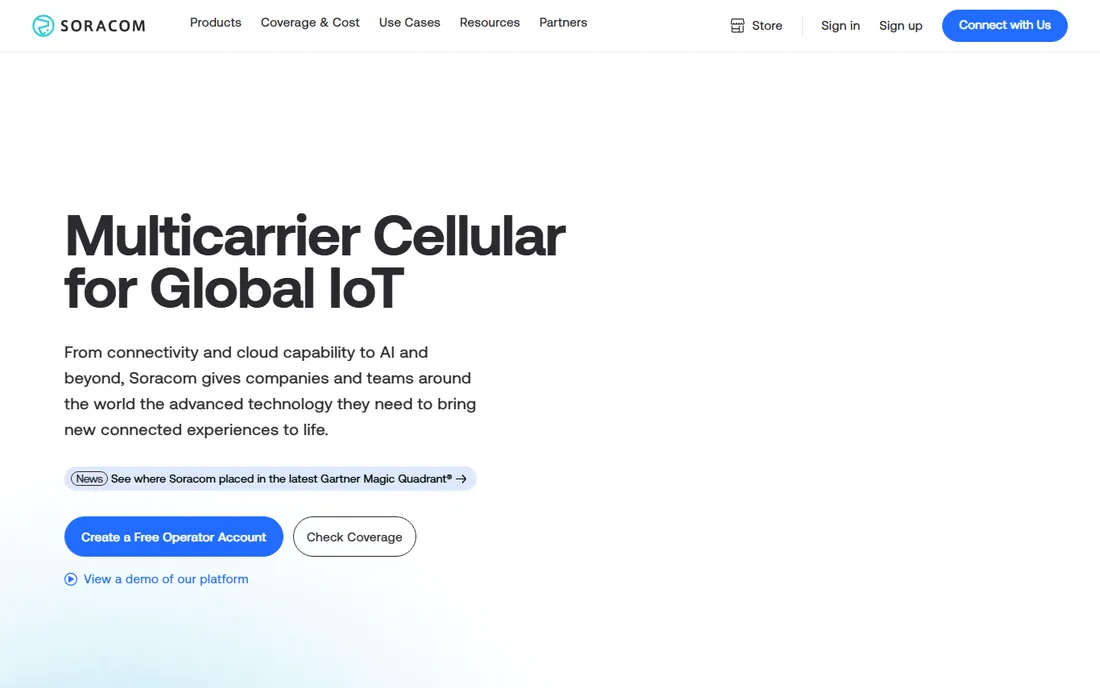
Soracom is the platform engineers pick when they want connectivity to behave like cloud infrastructure. Founded in 2014 and listed on the Tokyo Stock Exchange, the company runs a cloud-native IoT platform spanning cellular and satellite connectivity across more than 200 countries, with direct integration into AWS, Azure and Google Cloud. Everything is API-driven: provisioning, monitoring, data routing and billing all work the way developers expect cloud services to work.
Soracom Flux builds event-driven workflows on connectivity data, and Soracom Query lets operations teams interrogate device behavior and billing in natural language. In 2026 the company moved its SGP.32 eSIM platform and Connectivity Hypervisor into commercial availability, letting customers add, remove and switch operator profiles on remote eSIMs through one API.
Soracom's pricing is usage-based, which is flexible but demands monitoring: a misconfigured device can generate an unpleasant bill. For startups and enterprises building connected products with serious engineering teams, it is the most developer-native option here.
What we like- Genuinely cloud-native platform with deep AWS, Azure and Google Cloud integration
- Commercial SGP.32 eSIM orchestration
- AI analytics and workflow automation built on connectivity data
- Publicly traded with a long profitable track record
Watch out for- Pay-as-you-go pricing rewards careful usage monitoring
- Satellite and voice features add complexity smaller fleets may not need
#3
Eseye
Best for: Global deployments needing managed multi-IMSI resilience
Visit eseye.com
Starting priceSee website (quote-based)
Free planNo
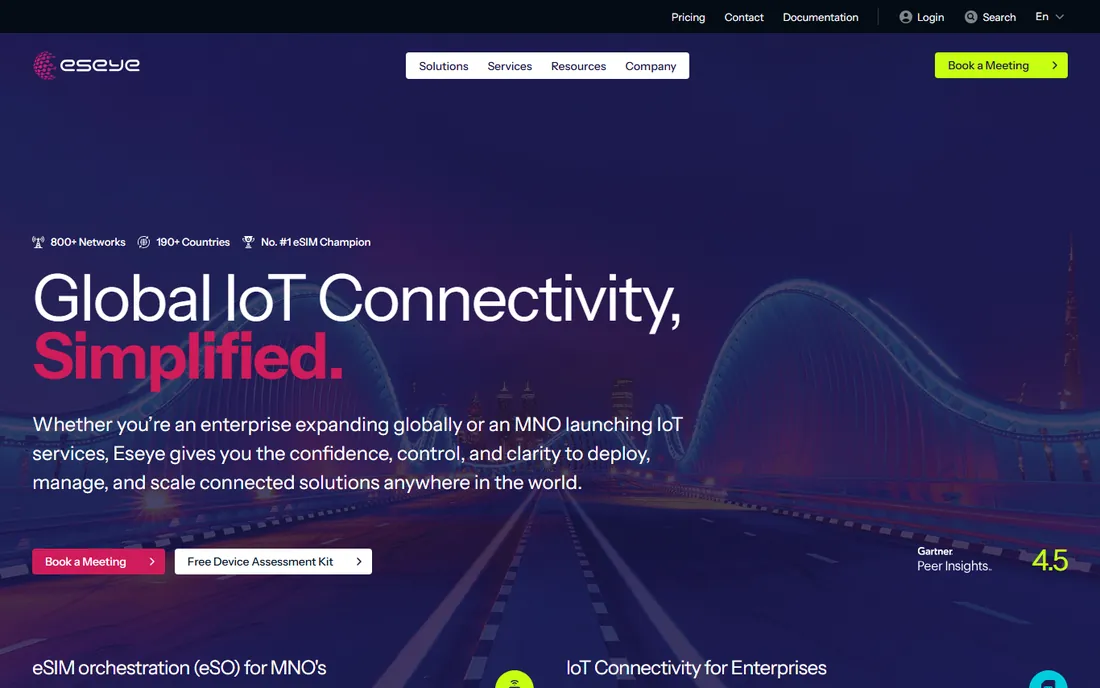
Eseye's answer to global IoT is resilience through redundancy. Its AnyNet multi-IMSI SIMs can switch between network operators over the air, and the Infinity connectivity management platform orchestrates the whole estate from one pane of glass: device status, data usage, firmware updates and security. With access to more than 700 networks across 190 countries, the pitch is near-100% global uptime.
The company leans into managed services more than most competitors here. Eseye will run the connectivity operation for you, from device design guidance through deployment and in-life management, which suits enterprises that want outcomes rather than a platform to operate. The AWS relationship is deep: Eseye's AnyNet integration lets customers manage global connectivity from inside their own AWS cloud, programmatically or through the console.
In 2026 Eseye integrated SGP.32 into its AnyNet+ eSIM and Infinity platform, combining remote SIM provisioning with its proven multi-IMSI fallback. For long-lived deployments like smart meters and EV chargers, where a dead device means a truck roll, that combination is the core argument.
What we like- Multi-IMSI AnyNet SIMs with intelligent network switching across 700+ networks in 190 countries
- Infinity platform gives single-pane lifecycle management
- Deep AWS integration and managed services
Watch out for- Quote-based enterprise sales
- Managed-service depth means less DIY control than Soracom
#4
Aeris
Best for: Massive automotive, utility and enterprise fleets
Visit aeris.com
Starting priceSee website (quote-based)
Free planNo
Aeris is the scale play. Its IoT Accelerator platform, acquired from Ericsson in early 2023, manages more than 110 million IoT devices including 44 million on eSIM, serving 7,000 enterprises across automotive, utilities, fleet and manufacturing. When Berg Insight sizes the connectivity management market, Aeris is the name at the top of the enterprise tier.
The 2026 story is eSIM orchestration. Aeris launched SGP.32 support with an eSIM Orchestrator that automates profile management by policy, a Single SKU eSIM so OEMs ship one device variant globally, and managed eIM-as-a-service for customers that do not want to run their own remote manager. One connection gives access to 30 pre-integrated operators across SGP.02, SGP.22 and SGP.32.
Aeris also sells Neo, a self-service connectivity platform with no contracts or minimums for smaller businesses, but the core business is enterprise. If you are shipping millions of connected vehicles or managing a national utility rollout, start here; if you are prototyping, start with Soracom or 1NCE.
What we like- Largest installed base here: 110+ million devices on IoT Accelerator
- The platform absorbed $2B+ of Ericsson investment before Aeris acquired it in 2023
- ESIM orchestration across all three GSMA standards with 30 pre-integrated operators
Watch out for- Enterprise sales motion with no self-serve path for small fleets
- Platform breadth can mean longer onboarding
#5
EMnify
Best for: Enterprises wanting their own cloud-native core network
Visit emnify.com
Starting priceSee website (quote-based)
Free planNo
EMnify's differentiator is ownership. Where many connectivity providers resell carrier capacity, emnify built its own cloud-native mobile core, distributed across nine regions, and runs the IoT SuperNetwork on top of it: 550+ mobile networks in 200+ countries, cellular plus satellite through a single eSIM. That independence from upstream carriers gives it direct control over coverage, commercial terms and technical behavior.
The platform story is real-time control: connectivity, routing and policy managed live, with AI-driven automation including a connectivity support copilot and anomaly detection. The company reports more than 23 million IoT connections deployed, across fleet management, aviation, EV charging and consumer electronics, and Gartner named it a Visionary in the 2026 Magic Quadrant for Managed IoT Connectivity Services.
A September 2026 leadership change saw founder Frank Stoecker move to Executive Chairman with Kenneth De Spiegeleire becoming CEO. For enterprises that care about who actually operates the network carrying their devices, emnify's owned-core model is the strongest answer on this list.
What we like- Owns and operates its cloud-native mobile core, no upstream carrier dependencies
- SuperNetwork spans 550+ networks in 200+ countries including satellite
- Named a Visionary in Gartner's 2026 Magic Quadrant for managed IoT connectivity
Watch out for- Quote-based pricing
- Infrastructure depth is more than small deployments need
#6
Onomondo
Best for: Teams wanting network transparency and real-time diagnostics
Visit onomondo.com
Starting priceSee website (quote-based)
Free planNo
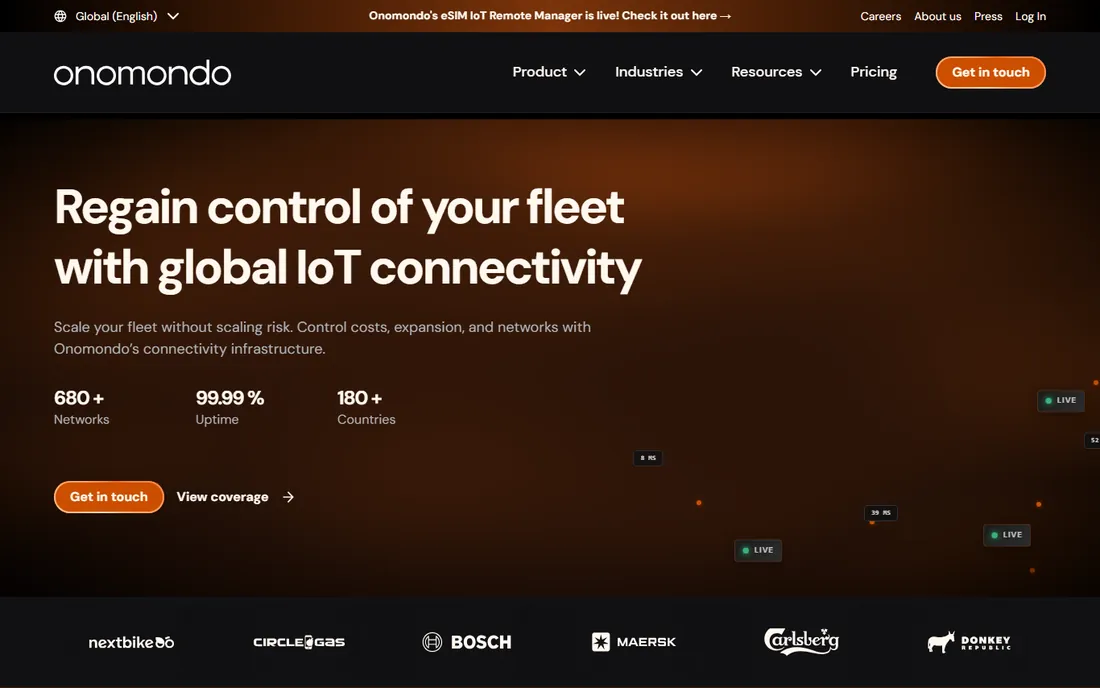
Onomondo's pitch is that telecom should not be a black box. The Copenhagen company built its own cloud-native core network and exposes what happens inside it: real-time traffic monitoring, network monitoring and signaling logs that let engineers see exactly why a device is misbehaving. Its SIMs are non-steered, arriving without preferred-network lists, so devices connect to the strongest available signal rather than the cheapest roaming deal.
The technology stack is distinctive. Beyond standard SIM form factors, Onomondo offers SoftSIM, a fully software-based SIM integrated into the modem firmware, and patented Cloud Connectors that simplify data routing to your cloud. A June 2026 partnership with Kigen delivered eSA-certified SGP.32 eSIMs with connectivity preloaded at the factory.
The company raised over 100 million euros in 2026 in a round led by Aspirity Partners, and counts Maersk among its customers, including what it describes as the world's largest private LTE network at sea across 450+ vessels. For engineering-led teams that debug connectivity themselves, Onomondo's transparency is unmatched.
What we like- Full network transparency with signaling and packet-level diagnostics
- Non-steered SIMs connect to the strongest signal
- SoftSIM removes the physical SIM entirely
- 680+ networks in 180+ countries
Watch out for- Smaller vendor than Aeris or KORE
- Quote-based pricing with limited public detail
#7
floLIVE
Best for: Localized, compliant connectivity with in-country data handling
Visit flolive.net
Starting priceSee website (quote-based)
Free planNo

floLIVE built for the regulatory problem other platforms treat as an edge case. Its cloud-managed network runs distributed core nodes with local breakout, so device data stays in the country it originates in, and local IMSI profiles apply automatically when devices enter markets with permanent roaming restrictions like Brazil or Turkey. For healthcare, automotive and any deployment touching data sovereignty rules, that architecture is the point.
The platform is a full-stack connectivity management suite: SIM lifecycle management, real-time monitoring and diagnostics, policy and QoS control, integrated rating and billing with no per-SIM license fees, and white-labeling for operators and resellers. It supports 2G through 5G plus LPWA and satellite non-terrestrial networks, and its CMP Aggregator can even manage third-party SIMs from other providers under one pane of glass.
floLIVE's own materials admit portal self-service and pricing clarity are still maturing, so expect a sales-led process. But for compliance-driven global deployments, the localized architecture deserves a place on every shortlist.
What we like- Distributed core with local breakout keeps data in-country for GDPR and sovereignty compliance
- 750+ networks with automatic local IMSI in permanent-roaming-restricted markets
- Full-stack CMP with integrated billing and white-labeling
Watch out for- Portal self-service and pricing clarity still maturing by its own account
- Smaller brand than the enterprise incumbents
Starting priceSee website (quote-based)
Free planNo
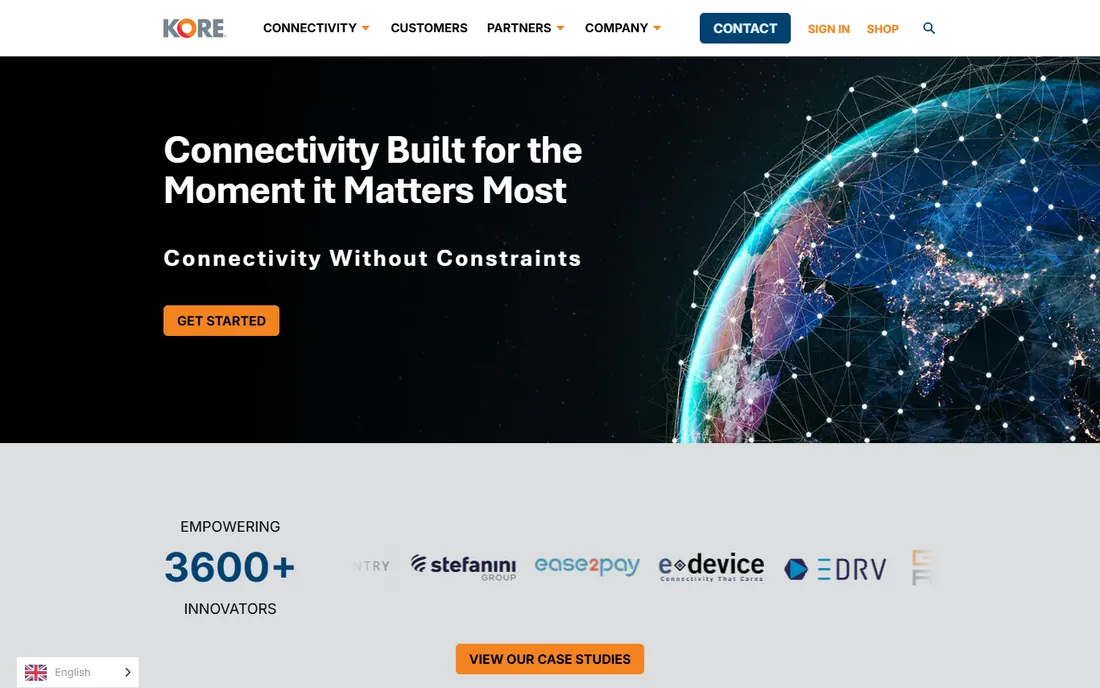
KORE is the full-service option: carrier-agnostic cellular and satellite connectivity plus the operational wrap enterprises need, device deployment and logistics through MODGo, managed services, and a single point of contact. Its ConnectivityPro platform orchestrates multi-network deployments with analytics dashboards, automated rule builders and eSIM orchestration, managed through the PRiSMPro interface.
The company is publicly traded and long-established in M2M, with particular strength in healthcare, logistics and connected equipment. Its 2026 partnership with Kigen targets SGP.32-based connectivity with commercial availability in the second half of the year, promising remote provisioning and intelligent failover across long device lifecycles.
KORE fits enterprises that want one throat to choke: connectivity, hardware logistics, deployment and ongoing management from a single vendor. Teams that prefer to operate the stack themselves will find Soracom or Onomondo more their speed.
What we like- Carrier-agnostic connectivity plus genuine managed services: deployment, logistics, device management
- ConnectivityPro platform with analytics dashboards and automated rules
- SGP.32 partnership with Kigen for next-generation eSIM
Watch out for- Enterprise sales motion
- Managed-services breadth can mean higher total cost than pure-play connectivity
SGP.32: the eSIM standard reshaping every shortlist in 2026
The biggest story in IoT connectivity this year is not a vendor but a standard. SGP.32 is the GSMA's remote SIM provisioning specification built specifically for IoT: it lets enterprises add, remove and switch operator profiles on unattended devices over the air, with no screens, no QR codes and no technician visits. For years the industry talked about it as a roadmap item; in 2026 it went commercial.
Soracom launched its SGP.32 eSIM platform and orchestration into general availability. Eseye integrated SGP.32 into its AnyNet+ eSIM and Infinity platform. Aeris shipped an eSIM Orchestrator with SGP.32 support and single-SKU eSIMs. KORE partnered with Kigen for SGP.32 solutions. Onomondo partnered with Kigen for certified SGP.32 eSIMs. Even emnify lists SGP.32 among its supported standards.
What this means for buyers: any connectivity decision made in 2026 should be evaluated against SGP.32 readiness. Ask each vendor not just whether they support the standard but how profile orchestration works at your scale, which eIM options they offer, and what happens to your fleet if you switch providers in three years. The vendors above all have answers; make them show you.
How we chose
We did not deploy devices on each platform. We reviewed each vendor's current product pages and announcements, confirmed every platform is live and commercially offered today, read analyst coverage including Gartner's 2026 Magic Quadrant for managed IoT connectivity and Berg Insight's market sizing, and checked 2026 product news so the SGP.32 claims here reflect actual launches. Prices come from the vendor's own published pages; this market is overwhelmingly quote-based, so where vendors do not publish pricing we say so rather than repeating directory estimates.
Coverage vs. localization
Global network counts are marketing until you check your markets. Ask specifically about the countries you ship to, and whether connectivity there is roaming-based or localized. If you operate in permanent-roaming-restricted markets, floLIVE's local-breakout model or equivalent local-IMSI support is not optional.
Pricing model
The market spans 1NCE's one-time flat fee, Soracom's pay-as-you-go, and everyone else's quotes. Model total cost over your device lifetime, including data growth: a flat fee wins for predictable low-bandwidth fleets, while usage-based pricing suits variable or high-bandwidth devices. Get the overage math in writing.
eSIM and SGP.32 support
In 2026 this is table stakes to ask about. Confirm which GSMA standards the platform supports (SGP.02, SGP.22, SGP.32), how profile switching is orchestrated at scale, and whether you can bring your own eIM. Avoid lock-in to a single provider's provisioning stack.
Diagnostics and APIs
When devices go dark in the field, the platform's diagnostics are your only flashlight. Evaluate real-time monitoring, signaling-level visibility like Onomondo's, alerting, and API completeness. If your team automates operations, the API is the product: test it before you commit.
Security posture
Ask about private APNs, VPN integration, network-level threat detection like Aeris IoT Watchtower, and certifications. Connectivity is the attack surface for your entire fleet; the management platform should offer zero-trust controls, not just a dashboard.
Frequently asked questions
What is an IoT connectivity management platform?
Software plus connectivity that provisions, monitors and manages cellular-connected IoT devices from one console: SIM activation, data usage tracking, network switching, diagnostics, and routing device data to your cloud. It replaces direct carrier contracts and manual SIM management.
How much does IoT connectivity cost per device?
It ranges from a one-time flat fee (1NCE's Lifetime Flat covers up to 10 years) to monthly per-SIM fees plus data charges on usage-based or quoted enterprise plans. Most enterprise pricing is custom-quoted on device count, data volume and coverage. Always model total cost over the device's expected lifetime, not just year one.
What is SGP.32 and should I care?
SGP.32 is the GSMA standard for remotely managing eSIM profiles on IoT devices: switching operators over the air without physical access. If you deploy unattended devices across borders, yes, you should care: it went commercially live across major vendors in 2026 and is the main defense against carrier lock-in.
Can I switch connectivity providers without swapping SIMs?
With eSIM and SGP.32, increasingly yes: profiles can be downloaded and switched remotely. Without it, switching usually means physical SIM swaps. Ask vendors specifically about profile portability and what migration looks like for your fleet size.
Do these platforms work with my cloud?
Generally yes. Soracom integrates natively with AWS, Azure and Google Cloud; Eseye offers deep AWS IoT Core integration; Onomondo routes directly to AWS IoT Core; and all eight expose APIs and webhooks for custom pipelines. Confirm your specific region and protocol requirements during evaluation.
Sources we checked (13)
- https://www.everythingrf.com/news/details/21301-1nce-iot-connectivity-simple-global-predictable-iot-connectivity-for-scalable-deployments
- http://iotinsider.com/industries/communications/soracom-launches-commercial-sgp-32-iot-esim-platform-for-global-device-connectivity/
- https://soracom.io/press-releases/ceo-americas-announcement/
- https://www.eseye.com/constant-iot-connectivity-for-smart-meters-and-utilities/
- https://iotm2mcouncil.org/iot-library/news/iot-newsdesk/eseye-integrates-sgp-32-to-strengthen-iot-resilience/
- https://www.businesswire.com/news/home/20260127961011/en/Aeris-Soars-Past-100-Million-Connected-Devices-Delivering-Nearly-90-Percent-Growth-and-Outpacing-IoT-Market
- https://iot-now.com/2026/10/05/158675-aeris-iot-esim-orchestration-sgp32-physical-ai/
- https://www.emnify.com/hubfs/emnify_fleet_management_solution_brief.pdf
- http://onomondo.com/blog/onomondo-and-kigen-partner-to-deliver-customers-a-fully-interoperable-sgp-32-ecosystem/
- https://dealroom.co/news/157848-onomondo-lands-over-100m-to-scale-its-global-iot-network/
- https://flolive.net/cmp-platform/
- https://iotm2mcouncil.org/iot-library/news/iot-newsdesk/kore-kigen-to-launch-sgp-32-iot-connectivity/
- https://telcomagazine.com/top10/top-10-iot-connectivity-platforms
Is your product missing or out of date?
We review this list regularly. Vendors can request a listing, send updated pricing or ask about featured placement.

Shihab Mia · Founder, Rankite
Shihab has spent more than a decade helping SaaS and e-commerce brands grow through search. He writes Rankite's software buying guides from pricing pages, documentation and public user reviews. More about Shihab.