How we make this list: we compare pricing pages, product documentation and public user reviews. Rankite is independent; if a vendor ever pays for a featured spot, that listing is clearly labeled Partner.
Key takeaways
- StockTrim at $199 per month is the most accessible serious forecasting tool for SMBs in wholesale, manufacturing, and ecommerce.
- Prediko at $49 per month is the cheapest entry point, built specifically for Shopify brands that need demand forecasting fast.
- Netstock starts at $900 per month and is the pick for mid-market companies that already run an ERP like NetSuite or Sage.
- RELEX, EazyStock, and Slimstock serve larger operations with complex networks, but all price by quote, so expect an enterprise sales process.
- Lokad is the outlier for data-driven teams that want programmable forecasting rather than a packaged app.
Quick comparison
| Tool | Best for | Starting price | Free plan |
|---|
 Netstock Netstock | ERP-driven mid-market planning | $900/month | No |
 StockTrim StockTrim | SMBs needing AI forecasting | $199/month | Free trial |
 Inventory Planner by Sage Inventory Planner by Sage | Multi-channel sellers on major platforms | See website | Free trial |
 Prediko Prediko | Shopify brands starting with forecasting | $49/month | Free trial |
 EazyStock EazyStock | Cloud replenishment for distributors | See website | No |
 Lokad Lokad | Programmable forecasting for data teams | See website | No |
 RELEX Solutions RELEX Solutions | Enterprise retail network optimization | See website | No |
 Slimstock (Slim4) Slimstock (Slim4) | Demand sensing across channels | See website | No |
 Forecast Pro Forecast Pro | Statistical forecasting on the desktop | See website | Free trial |
Is your product missing or out of date?
We review this list regularly. Vendors can request a listing, send updated pricing or ask about featured placement.
The best best inventory forecasting software
How much cash is sitting on your warehouse shelves right now in products nobody will buy this quarter? That is the question inventory forecasting software exists to answer. Every overstocked SKU ties up working capital, and every stockout hands a sale to a competitor. Most small and mid-size businesses still plan reorders with spreadsheets and gut feel, which is why both problems persist.
The second question is where your sales data lives. A Shopify brand needs a tool that reads the store directly. A wholesaler on NetSuite needs forecasting that sits on top of the ERP. A distributor with 50,000 SKUs needs something that handles seasonality, promotions, and supplier lead times without manual intervention. The tools below cover that spread.
Pricing ranges from $49 a month to quote-only enterprise contracts. The right tier depends less on company size than on SKU count and sales channel complexity, so count both before you start trialing.
Starting price$900/month
Free planNo
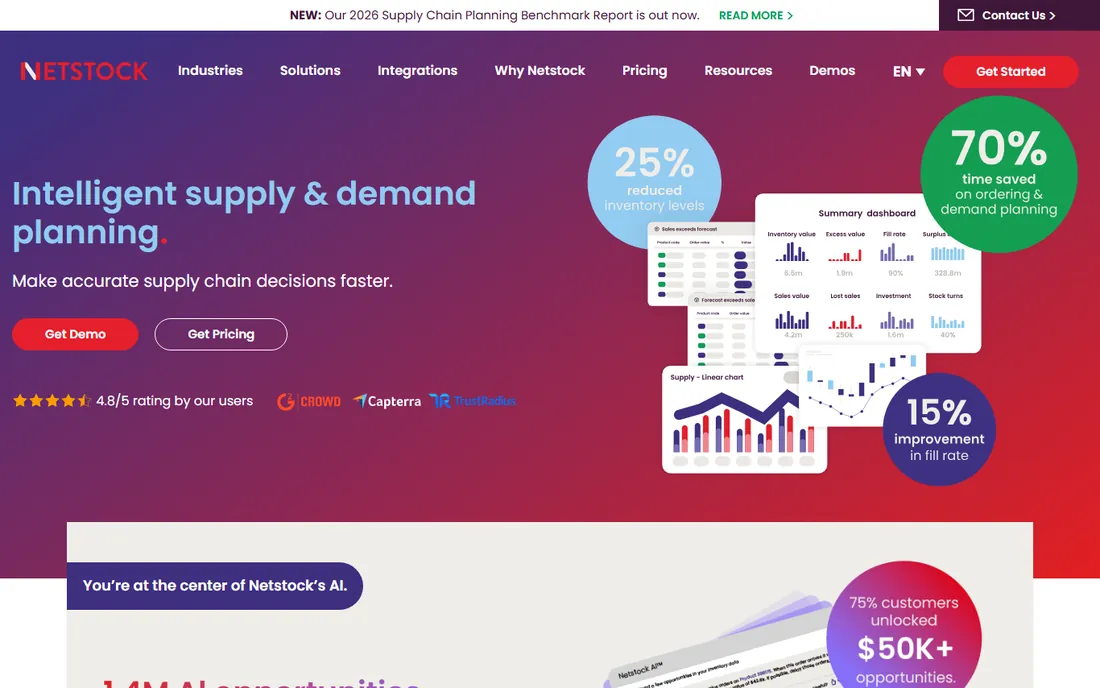
Netstock is the established choice for mid-market companies that already run their business on an ERP. It connects to NetSuite, Sage, Acumatica, and similar systems, then layers demand forecasting, order planning, and supplier performance tracking on top. The official pricing FAQ puts the starting point at $900 per month, which positions it clearly above the SMB apps.
The product behaves like formal planning software rather than a store add-on. It handles multi-location inventory, transfer orders, and constrained supply scenarios, with an AI pack that assists with the analytical heavy lifting. For wholesale distributors and manufacturers with thousands of SKUs, that depth matters.
The honest trade-offs are cost and commitment. Netstock requires an annual contract, and the entry price rules out small businesses. It also does not connect to Shopify or QuickBooks-style setups directly, since it assumes an ERP as the system of record. If that describes your company, it is the most proven option in this price band.
What we like- Deep ERP integrations
- Mature forecasting and ordering engine
- AI-assisted planning features
Watch out for- Annual commitment required
- $900 entry price excludes small businesses
- Implementation takes planning
Starting price$199/month
Free planFree trial
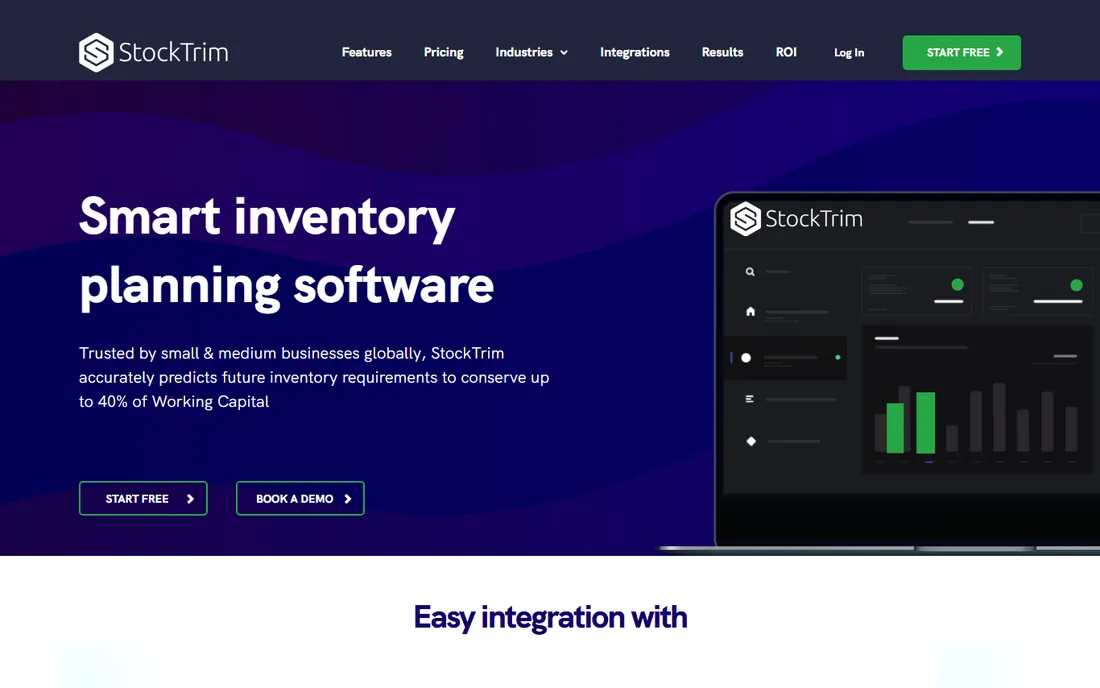
StockTrim sits in the sensible middle of this market: far more capable than a lightweight Shopify app, far more accessible than an enterprise planning suite. Machine learning models analyze sales history and recommend order quantities, timing, and safety stock, with support for new-product forecasting, manufacturing, and multi-location inventory.
Pricing is published in three tiers at $199, $299, and $399 per month, plus custom enterprise pricing, which makes budgeting straightforward. The integration list is long, covering Shopify, QuickBooks Commerce, Cin7, NetSuite, Fishbowl, and dozens more. A 14-day free trial lets you run your actual sales data through the models before paying.
The catch is scaling cost. As SKU counts and locations grow, you move up the tiers, and the monthly bill can surprise teams that estimated from the entry price. The vendor also does not publish forecasting accuracy benchmarks, so validate against your own history during the trial rather than trusting marketing claims.
What we like- Published tiered pricing
- AI forecasting with order plans
- Broad integration list
- 14-day free trial
Watch out for- Monthly cost climbs with SKU count
- No published accuracy figures
- Support is email-based at lower tiers
Starting priceSee website
Free planFree trial
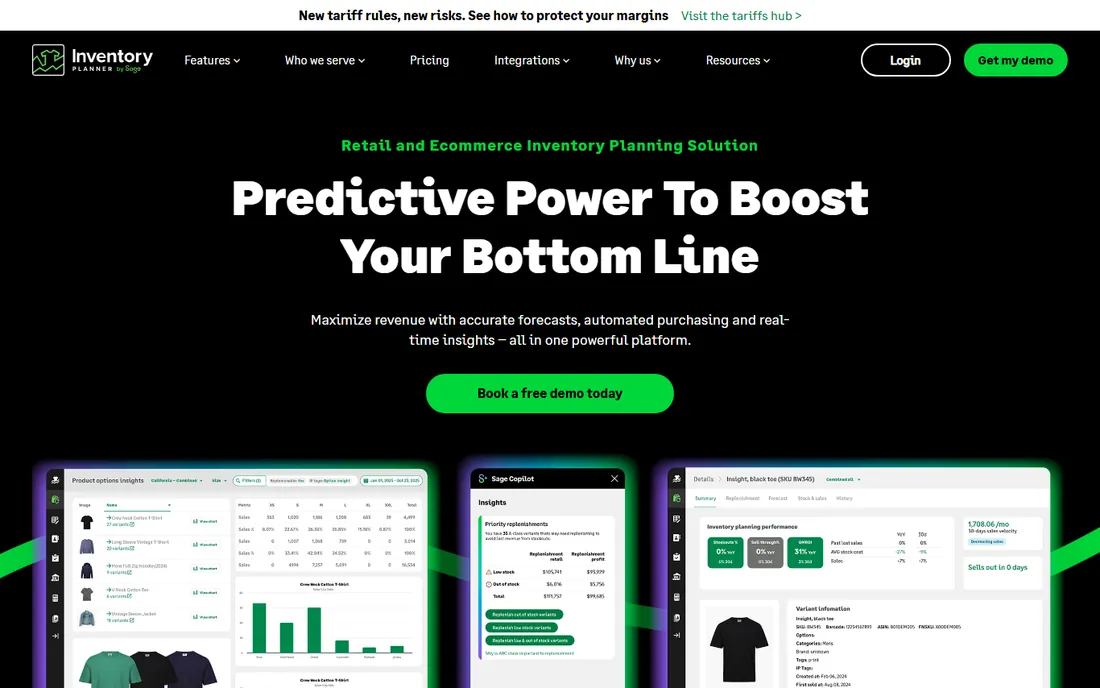
Inventory Planner, now part of Sage, is built for businesses selling across multiple channels that need centralized replenishment planning. It forecasts demand per SKU per location, generates purchase orders, and tracks supplier performance, with integrations spanning Shopify, Amazon, major inventory systems, and accounting platforms.
Being inside Sage gives it stability and a long integration list, and the 14-day free trial requires no credit card, which lowers the evaluation risk. The forecasting engine handles seasonality and trends competently, and the purchasing workflow is more developed than in most SMB tools.
The friction points are pricing opacity and fit. Sage does not publish pricing, so every deal is a conversation, and third-party estimates vary widely. Single-channel sellers may also find it heavier than necessary. It earns its place for multi-channel operations doing serious volume, less so for a brand with one store and one warehouse.
What we like- Backed by Sage
- Strong multi-channel replenishment
- 14-day free trial with no credit card
Watch out for- Pricing not published
- Acquired-product roadmap questions linger
- Can feel heavy for single-channel sellers
Starting price$49/month
Free planFree trial
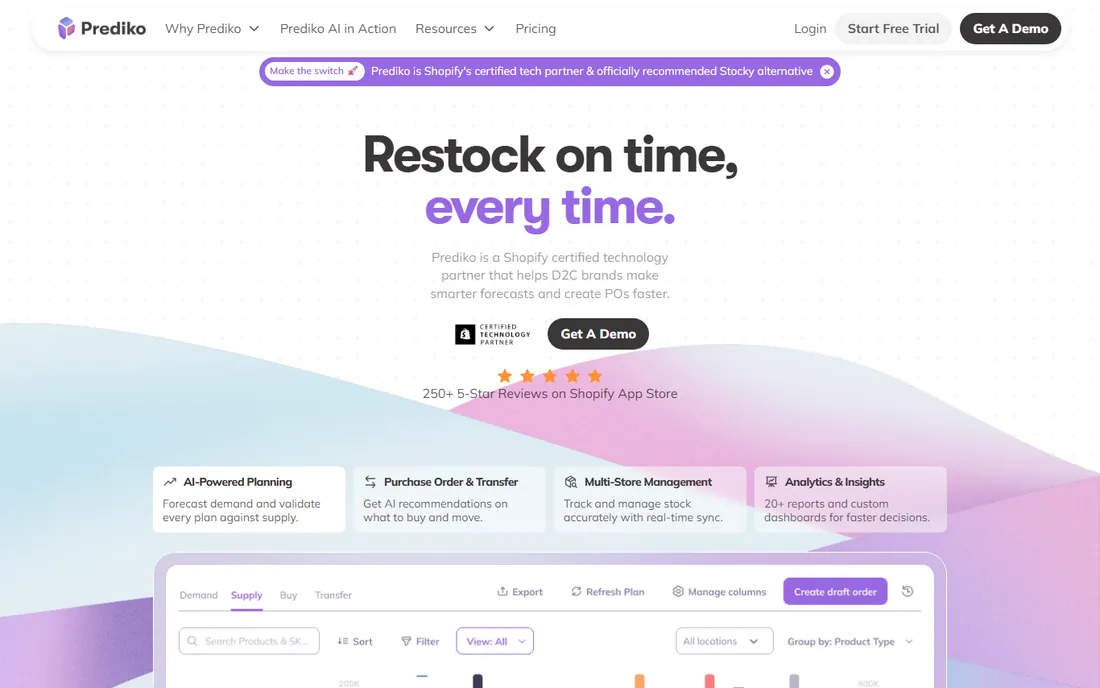
Prediko is the on-ramp for Shopify brands that have never done formal demand forecasting. At $49 per month for the starter tier, it costs less than most brands spend on apps they barely use, and because it is Shopify-native, setup means connecting the store and waiting for forecasts rather than a data integration project.
The product covers the essentials: demand forecasts, reorder suggestions, and stockout alerts, presented in a clean interface designed for operators rather than planners. The 14-day free trial gives you real forecasts against your actual sales history before committing, which is the right way to evaluate any forecasting tool.
The limitation is scope. Prediko is Shopify-only, so brands selling on Amazon, wholesale, or retail alongside DTC will outgrow it or need to supplement it. The planning depth also lags the mid-market tools. Think of it as the first forecasting tool, not the last one.
What we like- Cheapest credible entry price
- Shopify-native with instant data connection
- 14-day free trial
Watch out for- Shopify-only, so multi-channel sellers need more
- Newer vendor
- Advanced planning features are thinner
Starting priceSee website
Free planNo
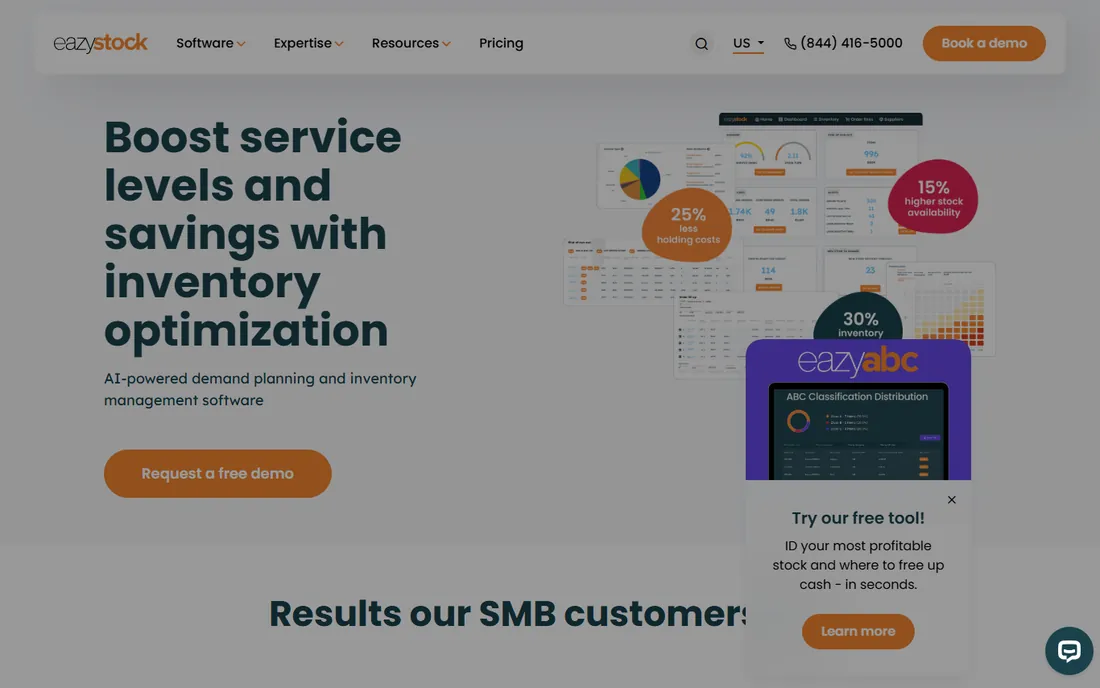
EazyStock, part of the Syncron group, is a cloud inventory optimization tool aimed at distributors and wholesalers. It classifies SKUs by demand pattern, forecasts with seasonality and trend detection, and generates replenishment proposals tuned to supplier constraints like minimum order quantities and lead times.
Deployment is cloud-based and relatively quick compared to on-premises planning suites, which appeals to mid-size distributors without large IT teams. The demand classification approach means slow movers, erratic sellers, and steady runners each get appropriate service-level treatment rather than one-size-fits-all safety stock.
The evaluation process is the friction. There is no self-serve trial; you go through demos and a guided proof of concept. Pricing is quote-based and typically lands in the mid-market enterprise band. It fits distributors doing tens of millions in revenue, not small wholesalers.
What we like- Cloud-based with quick deployment
- Strong for wholesale distribution
- Handles seasonality and promotions
Watch out for- Demo-only evaluation, no self-serve trial
- Quote-based pricing
- ERP integration quality varies by system
Starting priceSee website
Free planNo
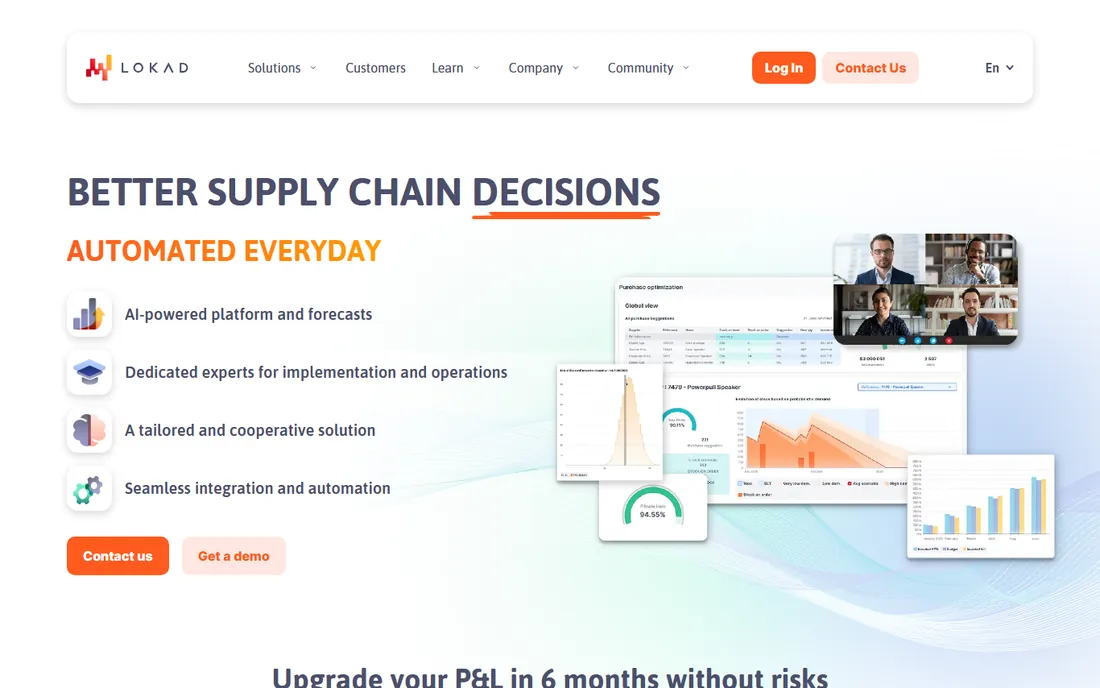
Lokad is the odd one out on this list, and deliberately so. Instead of a packaged forecasting app, it offers a programmable platform where forecasting logic is written in its own scripting language. For companies with data science capability, that means forecasts tuned to the business's exact economics rather than a vendor's generic model.
The platform handles very large SKU counts and complex scenarios like cannibalization, promotions, and pricing optimization that packaged tools approximate. Pricing is usage-based rather than per seat, which can work out cheaper than traditional licenses for the right workload.
The honest catch is that Lokad is not software you buy and configure; it is a platform you adopt with technical staff or with Lokad's own consultants. There is no trial-and-click evaluation. It belongs on the shortlist of companies that have outgrown packaged forecasting, not companies buying their first tool.
What we like- Fully programmable forecasting logic
- Usage-based pricing can beat seat licenses
- Handles extreme SKU counts
Watch out for- Requires technical skill to operate
- Not a packaged app
- Onboarding is consultative
Starting priceSee website
Free planNo
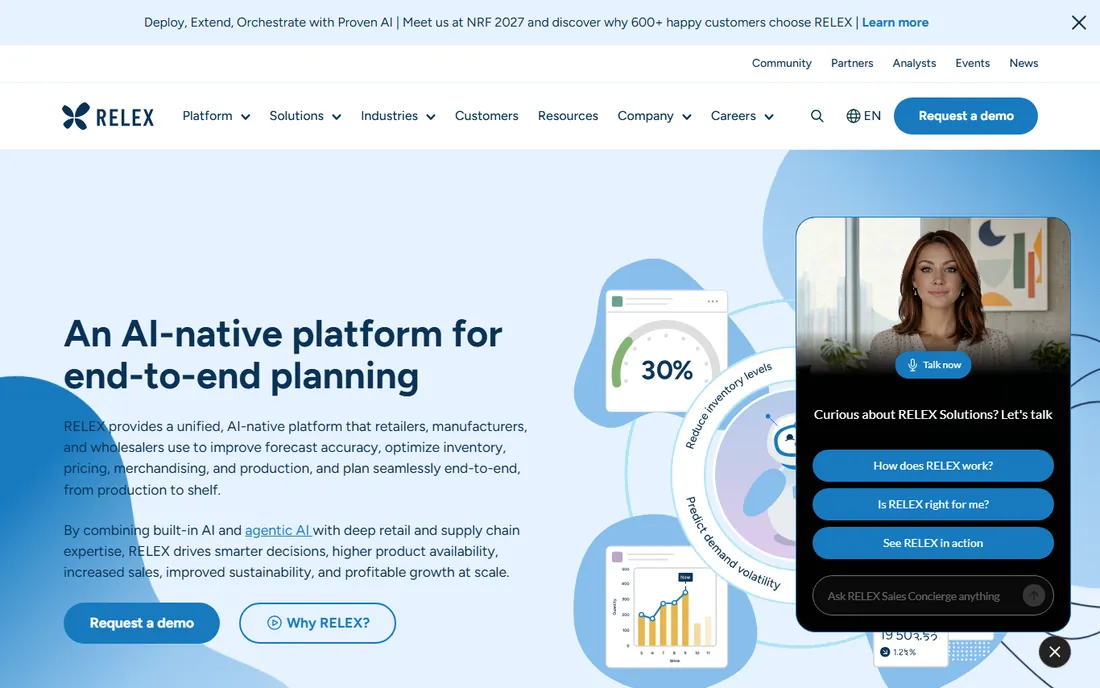
RELEX is the enterprise answer to the question this whole category asks. Its AI-native platform unifies demand forecasting, replenishment, allocation, and promotion planning across entire retail networks, optimizing inventory across warehouses and stores together rather than location by location. Major grocery and retail chains run on it.
The technical differentiation is real: the platform models the supply chain as a network, so a promotion in one region or a disruption at one supplier propagates correctly through the plan. For retailers with thousands of stores and complex assortments, that network view is the difference between planning and guessing.
Everything about the buying process is enterprise. Pricing is not published, evaluation is consultative, and implementation is a multi-month project. RELEX is the right comparison when the problem is network optimization at scale, and the wrong one when the problem is reordering for a single warehouse.
What we like- AI-native unified retail planning
- Handles full network complexity
- Strong grocery and retail references
Watch out for- Enterprise-only in practice
- No public pricing
- Implementation is a major project
Starting priceSee website
Free planNo
Slimstock's Slim4 platform combines AI forecasting with demand sensing, which means it reacts to real-time demand signals rather than relying purely on historical patterns. Scenario planning lets planners model promotions, assortment changes, and supply disruptions before committing to orders. It is well established with mid-market wholesalers and retailers in Europe.
The platform covers the full planning cycle from forecasting through replenishment and S&OP alignment, with the commercial and operational sides kept in sync. For companies dealing with volatile demand or frequent promotions, the sensing capability is a genuine differentiator over purely statistical forecasting.
The US buyer should note the geographic skew: Slimstock's reference base and partner network are stronger in Europe. Pricing is quote-based and sits in the mid-market enterprise range. It deserves a look from distributors and wholesalers that find the pure enterprise tools oversized but need more than an SMB app.
What we like- AI forecasting with demand sensing
- Scenario planning
- Strong European mid-market presence
Watch out for- Quote-only pricing
- Less known in the US market
- Implementation needs planning expertise
Starting priceSee website
Free planFree trial
Forecast Pro, from Business Forecast Systems, is the statistician's forecasting tool. It offers an unusually deep bench of forecasting models with automatic expert selection, so the software picks the best-performing model per SKU rather than applying one method everywhere. For demand planners who care about methodology, it remains respected.
The product's history includes perpetual licensing, which still appeals to companies tired of subscription creep, though current pricing requires contacting the vendor. A free trial lets planners test the modeling against their own data, which is the only evaluation that matters for a statistical tool.
The honest weakness is the delivery model. Forecast Pro is desktop software in a category that has moved to the cloud, which means no real-time collaboration, no automatic data connections to modern platforms, and an interface that shows its age. It fits a single expert planner, not a planning team.
What we like- Deep statistical forecasting toolkit
- Expert model selection
- One-time purchase options historically
Watch out for- Desktop software in a cloud world
- Dated interface
- Collaboration features are limited
Why SKU count matters more than company size
Forecasting vendors price by SKU count, order volume, or revenue far more often than by employee headcount, because the computational work scales with SKUs, not staff. A 10-person wholesaler with 40,000 SKUs is a bigger forecasting customer than a 200-person company with 500 SKUs. Count your active SKUs across all locations before requesting quotes.
SKU count also determines which tools are even viable. Sub-$100 tools handle hundreds to low thousands of SKUs comfortably. Mid-market platforms take tens of thousands. Enterprise tools go into the millions. Buying an enterprise tool for 800 SKUs wastes money; buying an SMB tool for 80,000 SKUs produces forecasts you cannot trust.
Growth trajectory matters too. If you plan to triple SKUs in two years, check the vendor's pricing at that tier now, not the entry tier. The cheapest tool at 1,000 SKUs is rarely the cheapest at 10,000.
Questions to ask during the trial
Ask how the tool handles your specific demand patterns. Bring your hardest SKUs to the trial: the seasonal ones, the ones with lumpy wholesale orders, the new products with no history. A demo on clean sample data proves nothing. Your messy reality is the test.
Ask where the forecast numbers come from and whether you can adjust them. The best tools show their logic and let planners override with documented reasons. Black-box forecasts that cannot be questioned will be ignored by the team the first time they disagree with one, which defeats the purpose.
Ask about the replenishment workflow, not just the forecast. A forecast nobody acts on is trivia. The tool should turn forecasts into purchase orders, respect supplier minimums and lead times, and handle multi-location transfers. Evaluate the full loop from forecast to order, because that is where the working capital savings actually happen.
How we put this list together
We started with the forecasting tools that dominate buyer shortlists and review categories: the SMB apps like StockTrim and Prediko, the mid-market platforms like Netstock and Inventory Planner, and the enterprise names like RELEX and Slimstock, plus the specialist options reviewers mention, including EazyStock, Lokad, and Forecast Pro. We reviewed current pricing pages, product documentation, and public review summaries on G2, Capterra, and GetApp.
Pricing comes from vendor-published figures wherever available; vendors that sell by quote are marked as See website rather than estimated. We did not run forecasting accuracy tests; this guide reflects documentation, published pricing, and aggregated user feedback. Run every candidate against your own sales history during the trial, because accuracy on your data is the only metric that counts.
Frequently asked questions
What is inventory forecasting software?
Inventory forecasting software predicts future demand for each product, usually per location, and turns those predictions into replenishment plans: what to order, how much, and when. It replaces spreadsheet-based reordering with statistical models that account for seasonality, trends, and promotions.
How much does inventory forecasting software cost?
Entry-level tools start around $49 per month for small Shopify brands, SMB platforms run $199 to $400 per month, mid-market tools start near $900 per month, and enterprise platforms are quote-only, often reaching tens of thousands per year. Price usually scales with SKU count or revenue.
Can inventory forecasting software integrate with my ERP or ecommerce platform?
Most tools integrate with common systems, but the specific connections vary widely. Shopify-native tools may not support NetSuite, and ERP-focused tools may not support Shopify. Verify your exact system and version on the vendor's integration page before trialing, since some connections require middleware.
How accurate is AI demand forecasting?
Accuracy depends more on your data quality and demand patterns than on the vendor's claims. Stable, high-volume SKUs forecast well; new products, lumpy wholesale orders, and promotion-driven spikes are harder for every tool. Run a backtest on your own history during the trial and measure the error yourself.
What is the difference between inventory forecasting and inventory management software?
Inventory management software tracks what you have: stock levels, locations, and movements. Forecasting software predicts what you will need and plans replenishment. Many companies need both, and some platforms combine them, but the forecasting engine is a separate capability worth evaluating on its own.
Do I need inventory forecasting software or just better reorder points?
Static reorder points work when demand is stable and lead times are predictable. Forecasting software earns its price when you have seasonality, promotions, many SKUs, multiple locations, or long supplier lead times. If stockouts and overstocks persist despite tuned reorder points, forecasting is the next step.
Sources we checked (10)
- https://www.netstock.com/pricing/
- https://www.stocktrim.com/pricing/
- https://www.inventory-planner.com/pricing/
- https://www.prediko.io/pricing/
- https://www.eazystock.com/pricing/
- https://www.lokad.com/pricing/
- https://www.relexsolutions.com/pricing/
- https://www.slimstock.com/pricing/
- https://www.forecastpro.com/pricing/
- https://www.prediko.io/blog/best-inventory-forecasting-software
Is your product missing or out of date?
We review this list regularly. Vendors can request a listing, send updated pricing or ask about featured placement.

Shihab Mia · Founder, Rankite
Shihab has spent more than a decade helping SaaS and e-commerce brands grow through search. He writes Rankite's software buying guides from pricing pages, documentation and public user reviews. More about Shihab.