How we make this list: we compare pricing pages, product documentation and public user reviews. Rankite is independent; if a vendor ever pays for a featured spot, that listing is clearly labeled Partner.
Key takeaways
- Clarifai and Nyckel lead for teams that need custom-trained models without hiring an ML team.
- Google Cloud Vision, Amazon Rekognition and Azure AI Vision are the default cloud choices, with generous free tiers and pay-as-you-go pricing.
- Roboflow is the developer favorite for the full vision pipeline, from annotation to edge deployment.
- Viso Suite suits enterprises running cameras across sites, with a free tier for trying prompt-based vision apps.
- Imagga and Ximilar are the lean specialist APIs for tagging, moderation and visual search.
Quick comparison
| Tool | Best for | Starting price | Free plan |
|---|
 Clarifai Clarifai | custom-trained vision models without ML staff | Pay-as-you-go, no monthly commitment | Yes |
 Google Cloud Vision AI Google Cloud Vision AI | Google Cloud teams needing labeling, OCR and faces | Pay-per-use, 1,000 units/month free | Yes |
 Amazon Rekognition Amazon Rekognition | AWS teams with image and video analysis needs | See website | Free trial |
 Azure AI Vision Azure AI Vision | Microsoft shops building vision into agents | See website | Free trial |
 Imagga Imagga | simple tagging and content moderation API | $79/month Indie | Yes |
 Roboflow Roboflow | end-to-end vision pipeline for developers | See website | Yes |
 Viso Suite Viso Suite | enterprise camera networks across sites | See website | Yes |
 Nyckel Nyckel | reliable custom predictions from examples | $149/month Starter | Yes |
 Ximilar Ximilar | no-code visual AI for ecommerce and catalogs | See website | Free trial |
Is your product missing or out of date?
We review this list regularly. Vendors can request a listing, send updated pricing or ask about featured placement.
The image recognition market splits into two jobs. The first is calling a pretrained model: tag this image, read this text, flag this face. The second is training a model that knows your world: your products, your defects, your brand's visual language. The cloud giants win at job one. The specialists on this list win at job two, and that distinction decides which tool you should shortlist. Price also divides the field: per-request API pricing scales linearly, while platforms with free tiers let you prototype for nothing.
Starting pricePay-as-you-go, no monthly commitment
Free planYes
Clarifai sits between the cloud giants and the no-code tools. You get pretrained models for classification, detection and segmentation at published per-request prices (pre-trained classification starts at $0.0012 per request), plus custom model training billed per GPU hour from $4. A Community plan with limited monthly requests is free, while Essential and Professional tiers raise the caps. For teams that outgrow a simple tagging API but cannot hire ML engineers, that combination is hard to beat.
The pricing page is a maze of node sizes and per-minute GPU rates, and estimating a real monthly bill takes work. Clarifai also leans toward developers comfortable with APIs and data pipelines; it is not a drag-and-drop product. If your use case needs a model trained on your own images and you want predictable per-request costs, Clarifai belongs on the shortlist.
What we like- Train custom models with no ML expertise
- Pay-per-request pricing from $0.0012
- Community plan is free
Watch out for- Pricing gets complex across compute options
- Enterprise features need sales conversations
Starting pricePay-per-use, 1,000 units/month free
Free planYes
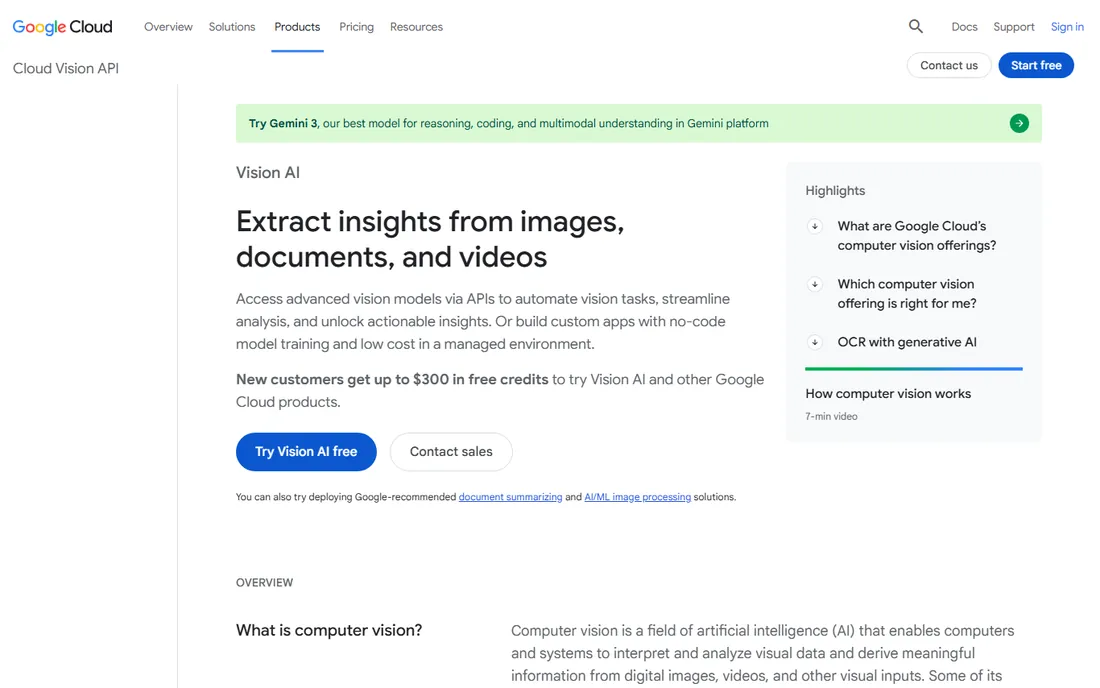
Google's Vision API is the straightforward choice if you already run on Google Cloud. Image labeling, face and landmark detection, OCR and explicit-content tagging arrive as simple REST calls, with the first 1,000 units free each month and new customers getting up to $300 in credits. The OCR quality is genuinely good, especially on documents and street scenes, and integration with the rest of Google Cloud (storage, BigQuery, Vertex) keeps pipelines simple.
The billing model charges per feature applied to each image, so a request that labels, OCRs and detects faces costs three units, not one. At scale that multiplies fast, and the newer Gemini-based vision options have their own pricing that sits apart from the classic Vision API. For moderate volumes inside Google Cloud, though, this is the path of least resistance.
What we like- First 1,000 units free every month
- $300 new-customer credits
- Strong OCR and landmark detection
Watch out for- Per-feature billing adds up
- Gemini vision pricing is a separate maze
Starting priceSee website
Free planFree trial
Rekognition is AWS's answer to image and video analysis, and it covers an unusually wide surface: face detection and comparison, custom labels trained from tiny datasets, text detection in skewed images, content moderation and celebrity recognition. Video gets first-class treatment with segment detection and streaming analysis. You pay per image or per minute of video analyzed, with no infrastructure to manage.
The honest friction is AWS itself. The pricing page spans multiple tables, IAM permissions take setup, and features like face search carry compliance responsibilities you should not hand-wave. But if your stack already lives on AWS, Rekognition slots in with the least operational overhead, and Custom Labels makes branded-object detection accessible without an ML team.
What we like- Pay only for images and videos analyzed
- Custom labels train from as few as 10 images
- Strong video analysis
Watch out for- Console and pricing are AWS-complex
- Face features need careful compliance handling
Starting priceSee website
Free planFree trial
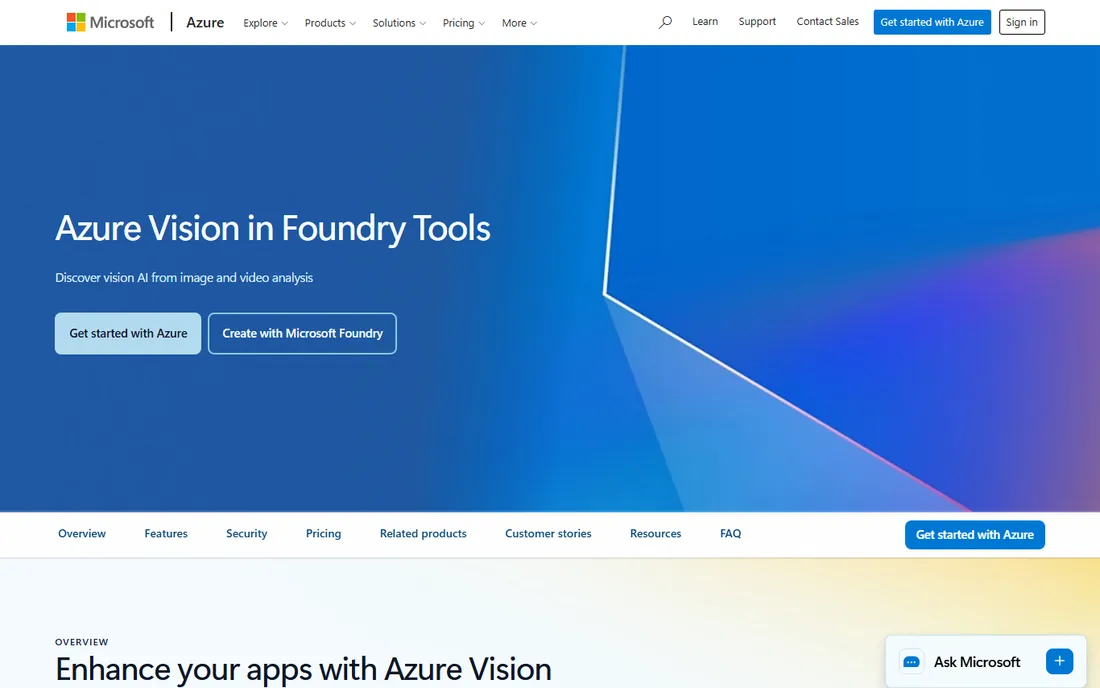
Microsoft has folded Azure AI Vision into its Foundry Tools platform, positioning it as the vision layer for AI agents rather than a standalone service. The capabilities stay familiar: image analysis with captions and smart crop, object detection, spatial analysis for video, and OCR that handles printed and handwritten text in mixed languages. Model customization lets you prototype a classifier with as little as one image per label, and Microsoft states it deletes your images after processing rather than training on them.
The rebrand creates real confusion: documentation, product names and pricing references are mid-migration from "Azure AI Services" to "Foundry Tools," so expect to hunt for current pages. Few-shot customization works well for visually distinct categories and less well for subtle differences. For Microsoft-centric teams building agents that need to see, this is the natural API.
What we like- Image analysis, OCR and object detection in one API
- Model customization from one image per label
- Data deleted after processing
Watch out for- Rebranded into Foundry Tools, which confuses product docs
- Few-shot accuracy varies by use case
Starting price$79/month Indie
Free planYes
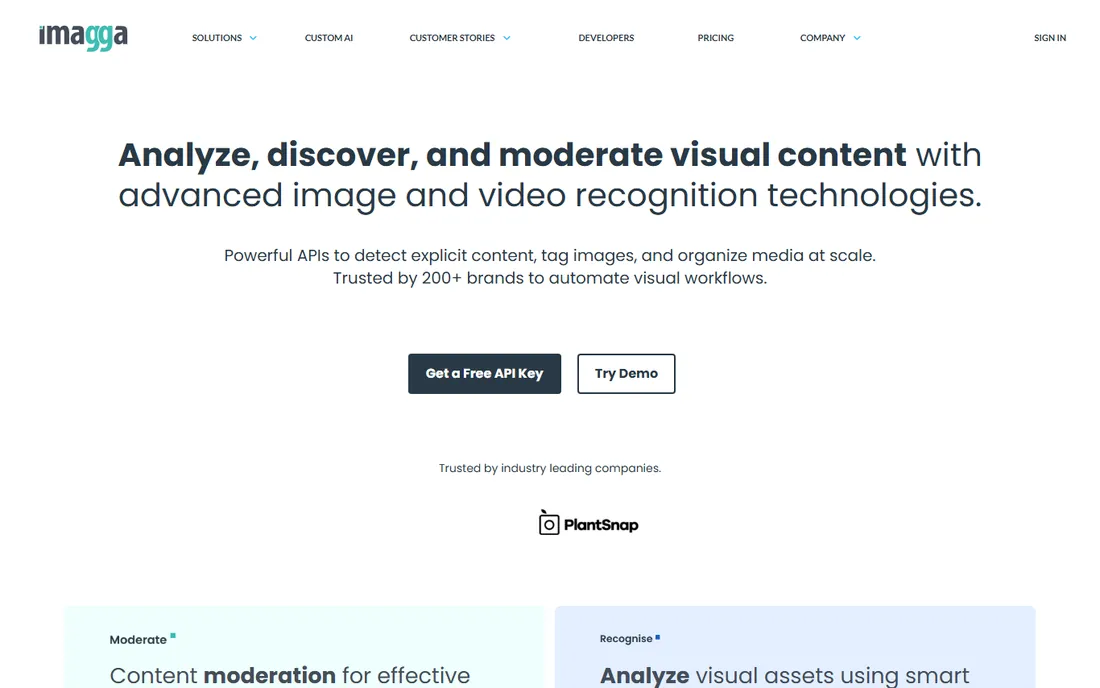
Imagga is the specialist that keeps things simple: image tagging, categorization, content moderation, visual search, background removal and OCR, behind one API. Pricing is published and straightforward: a free plan at $0 a month with 100 API requests for testing, Indie at $79 a month with 70,000 requests, Pro at $349 a month with 300,000 requests, and Enterprise for custom models and on-premise deployment. No credit card is needed for the free plan.
The free tier is a test drive, not a production plan, at 100 requests. And custom model training, where Imagga could compete with Clarifai and Nyckel, sits behind Enterprise pricing. For startups and indie developers who need reliable tagging or moderation without cloud-vendor complexity, the Indie tier is one of the fairest deals in this category.
What we like- Free plan with no credit card required
- Clear tiered pricing
- Strong tagging and moderation APIs
Watch out for- Free tier caps at 100 requests
- Custom models reserved for Enterprise
Starting priceSee website
Free planYes
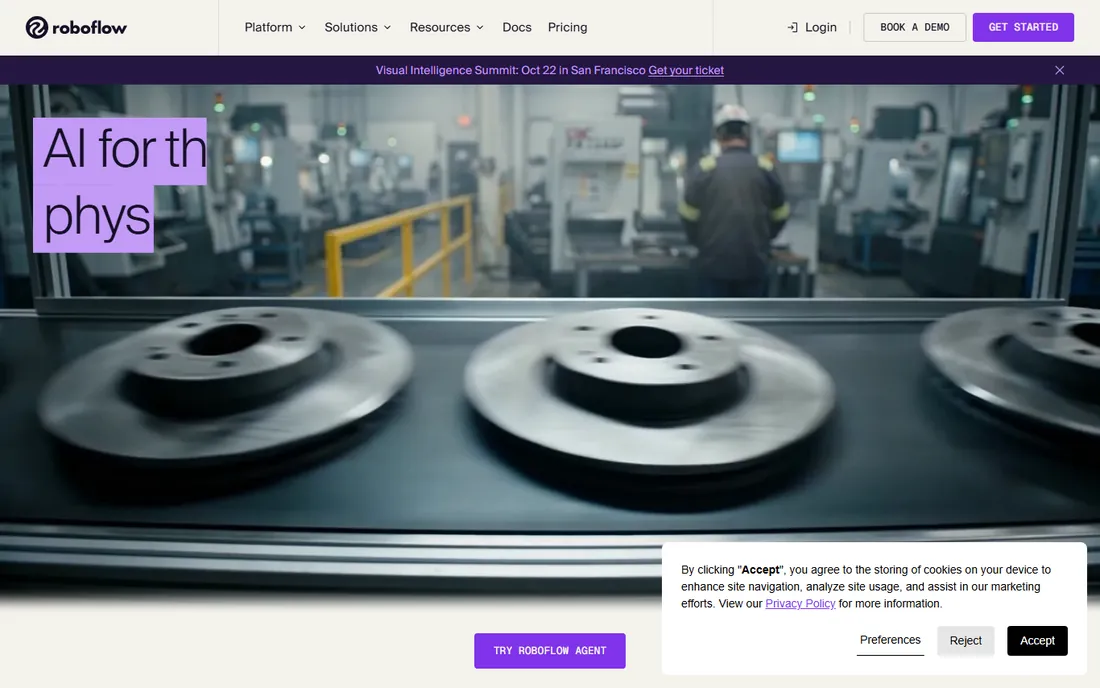
Roboflow covers the whole computer vision lifecycle: annotate data with AI-assisted labeling, train custom models, deploy to cloud or edge devices, and monitor production performance. The homepage states plans start at $0, and the platform is built for developers with workflows, APIs and integrations for industrial systems. It is the tool teams reach for when a single API call is not enough and they need to own the pipeline.
That completeness is also the catch. If you only need image tagging, Roboflow's platform is heavier than Imagga or a cloud API. Pricing beyond the free tier is quote-based for larger deployments, which makes budgeting harder than with published per-request rates. For computer vision teams shipping real products, especially to edge devices, it is the most complete option here.
What we like- Annotation, training, deployment and monitoring in one platform
- Plans start at $0
- Strong edge deployment
Watch out for- Full platform is overkill for simple tagging
- Pricing details need a sales conversation at scale
#7
Viso Suite
Best for: enterprise camera networks across sites
Visit viso.ai
Starting priceSee website
Free planYes
Viso Suite takes a different angle from every other tool here: it is an operating system for computer vision across camera networks. The newer visonow product lets you describe what you want in plain language and get a working vision application in minutes, free with no credit card. The enterprise Viso Suite manages cameras across hundreds of sites with edge, on-prem or cloud deployment, and carries SOC 2, ISO 27001, GDPR and CCPA compliance.
This is not an API for tagging product photos. Enterprise pricing is quote-based, and the platform's depth around governance, camera fleets and multi-site deployment is wasted on simple use cases. But for manufacturing, logistics and retail operations that need vision AI running on real camera networks, Viso is built for exactly that scale.
What we like- Prompt-based vision app builder with free tier
- Manages 10,000+ cameras
- SOC 2, ISO 27001 and GDPR compliant
Watch out for- Enterprise pricing is quote-based
- Overkill for single-image API use cases
Starting price$149/month Starter
Free planYes
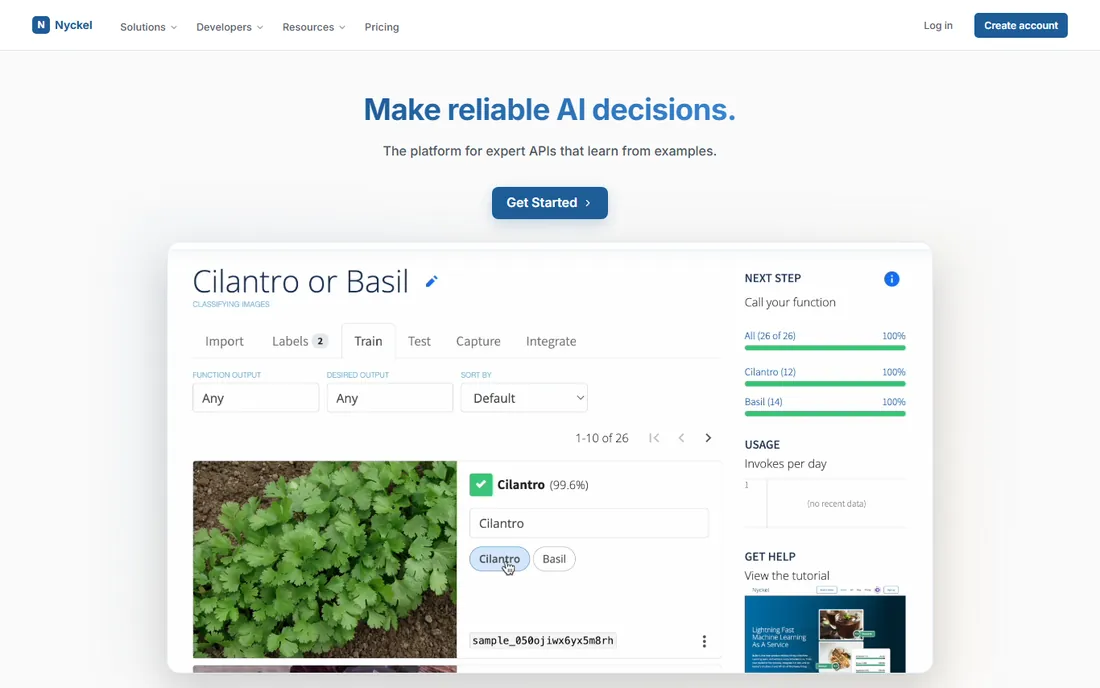
Nyckel's pitch is precision: applications need the same decision made reliably millions of times, with confidence scores, and Nyckel builds that from your example data. Pricing is published and transparent: Free at $0 a month with 100 invokes, Starter at $149 a month with 15,000 invokes and custom-trained models, Business at $599 a month with 300,000 invokes, and Enterprise custom. The platform covers classification, detection and segmentation for images plus text and tabular data.
The free tier uses ready-made models, so custom training starts at Starter. Overage pricing at $0.005 per invoke on the lower tiers means costs can climb if volumes spike unexpectedly. For product teams that need dependable custom image classification without touching model code, Nyckel's combination of transparent pricing and active-learning improvement loop is compelling.
What we like- Free plan with 100 invokes a month
- Custom models from your examples
- Transparent usage-based pricing
Watch out for- Free tier cannot train custom models
- Invoke overages add up at scale
Starting priceSee website
Free planFree trial
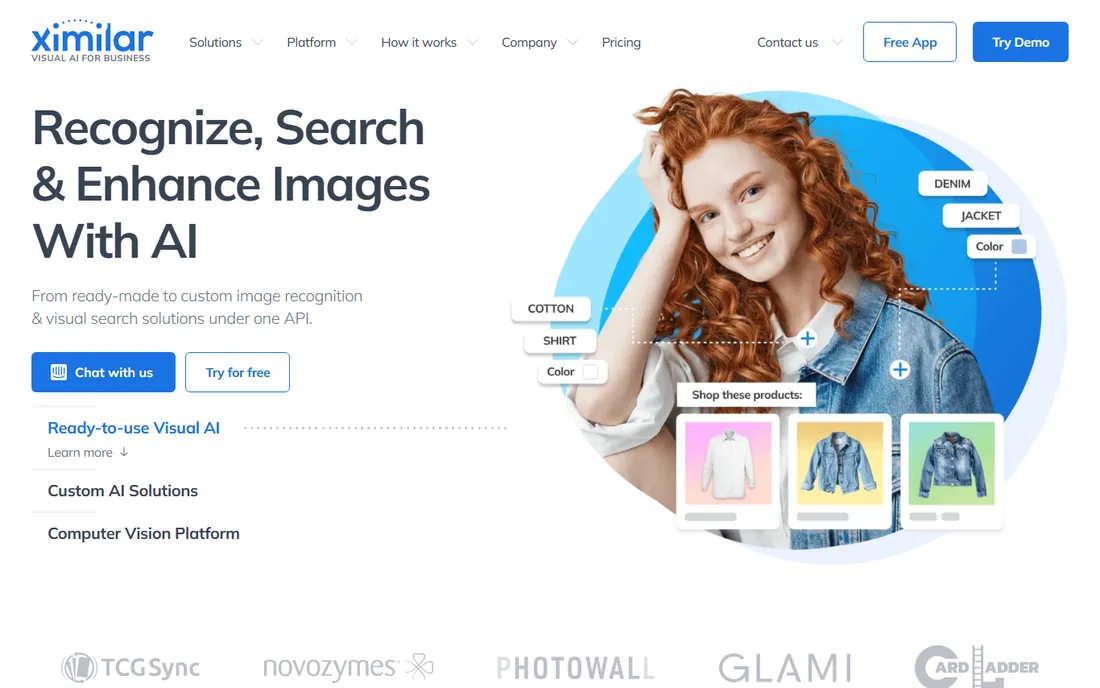
Ximilar fills a gap the general APIs ignore: vision models tuned for specific verticals. Fashion tagging, home decor recognition, collectible card identification and stock photo search come ready-made, and the no-code platform lets you build custom models on your own images without ML staff. Everything deploys through a REST API with Python, PHP and cURL examples, and data stays on EU servers under GDPR.
The vertical focus cuts both ways. If you sell fashion, furniture or collectibles, Ximilar speaks your language out of the box. If your use case is industrial inspection or medical imaging, you will be building custom models like anywhere else. Pricing is consumption-based via API credits with a credit calculator, though published plan details are thin, so budget conversations start with a quote.
What we like- Ready-made models for fashion, collectibles and stock photos
- No-code model builder
- REST API with clear docs
Watch out for- Niche focus on retail and collectibles
- Pricing not published on the main site
We verified every vendor homepage and its final URL, then checked pricing pages, plan pages and published FAQs for prices, free tiers and trial terms. Where pricing was quote-based or gated, we marked it as "See website" instead of estimating. We compared feature sets against vendor documentation and cross-checked real-world fit against public reviews on G2 and Capterra, plus practitioner discussions on Reddit and Hacker News. Every tool on this list sells a purchasable product in 2026, and none of our research involved hands-on testing.
Per-request pricing looks cheap until you do the math at scale. At $0.0012 per classification request, a million images costs $1,200 a month on Clarifai's published rate, which is fine for a prototype and painful for a high-traffic product. Cloud APIs from Google, Amazon and Microsoft price similarly, with free tiers (Google's 1,000 units a month) that cover development but not production. If your volume is steady and high, tiered plans like Imagga's Pro or Nyckel's Business usually beat per-request billing.
Platform pricing works differently. Roboflow, Viso and Clarifai's GPU options charge for infrastructure or seats rather than per call, which rewards teams with their own annotation and deployment workflows. Nyckel's invoke model sits between the two. The cheapest option is almost always the one that matches your usage pattern: prototypes belong on free tiers, steady moderate volumes belong on published plans, and unpredictable or massive volumes belong in a sales conversation with committed-use discounts. Run your own numbers with the vendor's calculator before signing anything.
Frequently asked questions
What is the difference between image recognition and computer vision?
Image recognition is one task inside computer vision: identifying what is in an image. Computer vision is the broader field, covering object detection, segmentation, tracking, OCR, scene understanding and video analysis. The tools on this list span both, from simple tagging APIs to full computer vision platforms.
Which image recognition API is cheapest?
For tiny volumes, Google Cloud Vision's 1,000 free monthly units and the free tiers from Imagga, Nyckel and Roboflow cost nothing. At moderate scale, published per-request prices run from about $0.0012 per classification on Clarifai to tiered plans like Imagga Indie at $79 a month. At large scale, committed-use discounts from the cloud vendors or enterprise tiers beat list prices. Your volume decides the winner.
Do I need machine learning expertise to use these tools?
No. Every tool here works without ML staff: the cloud APIs are pretrained, and Clarifai, Nyckel, Roboflow, Viso and Ximilar all offer custom model training through uploads and clicks rather than code. You still need someone who understands your data, evaluation and API integration, but not someone who trains neural networks.
How accurate are these image recognition APIs?
Accuracy depends more on your use case than the vendor. Pretrained tagging APIs perform well on common objects and scenes and worse on niche domains, which is why custom training exists. The practical approach is to test each API against a labeled sample of your own images before committing, since published benchmarks rarely match your data.
Can these tools recognize custom objects like my products?
Yes, through custom model training. Amazon Rekognition Custom Labels, Clarifai, Nyckel, Roboflow and Ximilar all let you upload labeled examples and get a model that recognizes your specific products, defects or categories. Expect to provide dozens to hundreds of example images for good results, depending on how visually distinct the objects are.
What about privacy and data handling?
Check each vendor's terms before sending sensitive images. Microsoft states it deletes Azure Vision inputs after processing and does not train on them. Nyckel does not share your data with other customers. Ximilar stores training data on EU servers under GDPR. Enterprise tiers across the board offer VPC, on-premise or air-gapped deployment for regulated industries.
Sources we checked (12)
- https://clarifai.com/
- https://www.clarifai.com/pricing
- https://cloud.google.com/vision
- https://aws.amazon.com/rekognition/
- https://azure.microsoft.com/en-us/products/ai-services/ai-vision
- https://imagga.com/
- https://imagga.com/pricing
- https://roboflow.com
- https://viso.ai/
- https://www.nyckel.com
- https://www.nyckel.com/pricing
- https://www.ximilar.com
Is your product missing or out of date?
We review this list regularly. Vendors can request a listing, send updated pricing or ask about featured placement.

Shihab Mia · Founder, Rankite
Shihab has spent more than a decade helping SaaS and e-commerce brands grow through search. He writes Rankite's software buying guides from pricing pages, documentation and public user reviews. More about Shihab.