How we make this list: we compare pricing pages, product documentation and public user reviews. Rankite is independent; if a vendor ever pays for a featured spot, that listing is clearly labeled Partner.
Key takeaways
- Epic is the standard for large hospitals and health systems; athenaOne leads for independent physician practices.
- eClinicalWorks, NextGen Healthcare, Practice Fusion, DrChrono and Tebra compete in the ambulatory and independent-practice space, each with a different strength.
- SimplePractice dominates the therapy and wellness niche with integrated telehealth and a 30-day free trial.
- Practice Fusion publishes the clearest entry price in the group: $199 per month per provider.
The best healthcare software
A patient books online at midnight, gets a text reminder the day before, checks in on a tablet, and leaves with the prescription already at their pharmacy. That chain of small moments is healthcare software doing its job, and when any link breaks, the practice feels it in no-shows, denials and burned-out staff. These eight platforms cover the category: hospital EHRs, ambulatory suites and practice management tools for independent practices.

#1
Epic
Best for: Large hospitals and health systems that need one comprehensive record
Visit epic.com
Starting priceSee website
Free planNo
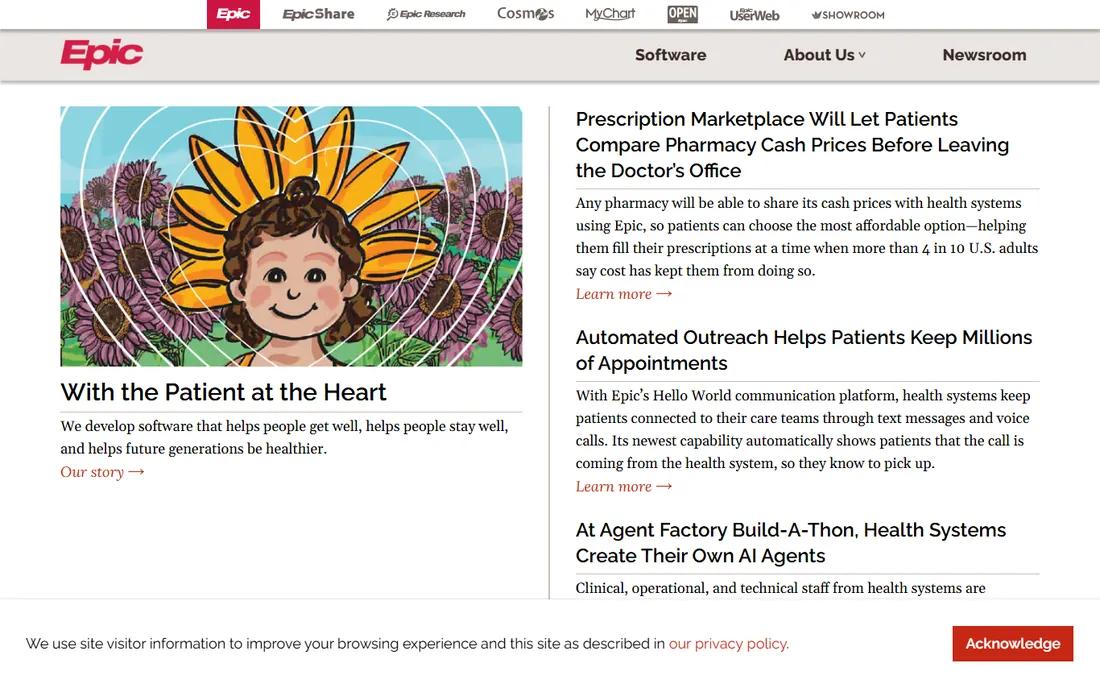
Epic is the EHR that runs a huge share of American hospital care. Its pitch is a single, comprehensive medical record informed by every patient interaction, and its scale funds serious R&D: recent announcements cover AI-supported visit documentation, automated patient outreach and native AI charting. Health systems choose Epic for the long term, often consolidating multiple legacy systems onto it.
The trade-offs are scale and cost. Epic does not publish pricing, and implementations run into the millions for health systems. Small and independent practices should look elsewhere on this list. For hospitals and large systems evaluating a platform for the next two decades, Epic is the reference point every other vendor is measured against.
What we like- The industry standard for enterprise health systems, with a single comprehensive patient record
- Deep investment in AI, patient communication and interoperability
- Massive peer community of large providers
Watch out for- Pricing is not published and implementations are famously expensive
- Designed for large organizations, not small practices
- Go-lives are long, complex projects

#2
athenahealth (athenaOne)
Best for: Independent physician practices that want EHR, billing and engagement in one
Visit athenahealth.com
Starting priceSee website
Free planNo
athenahealth built its name on a simple idea: the EHR should come with the billing service, not fight it. athenaOne combines the clinical record, revenue cycle management and patient engagement tools, with specialty-specific workflows so the system works the way different clinicians think. The vendor's homepage highlights embedded AI documentation support and practices rating the suite highly.
For independent and small-group practices, the bundled model is the appeal: one vendor accountable for both the record and the revenue. Pricing is quote-based, so practices should request a personalized demo and proposal. If billing headaches are the reason you are shopping, athenahealth belongs on the shortlist.
What we like- AthenaOne bundles EHR, revenue cycle and patient engagement with specialty-specific workflows
- The vendor reports practices see collections gains after switching
- Strong focus on reducing administrative burden
Watch out for- Pricing is not published
- The bundled model means committing to athenahealth across functions
- Large health systems will find Epic-style depth elsewhere
Starting priceSee website
Free planNo
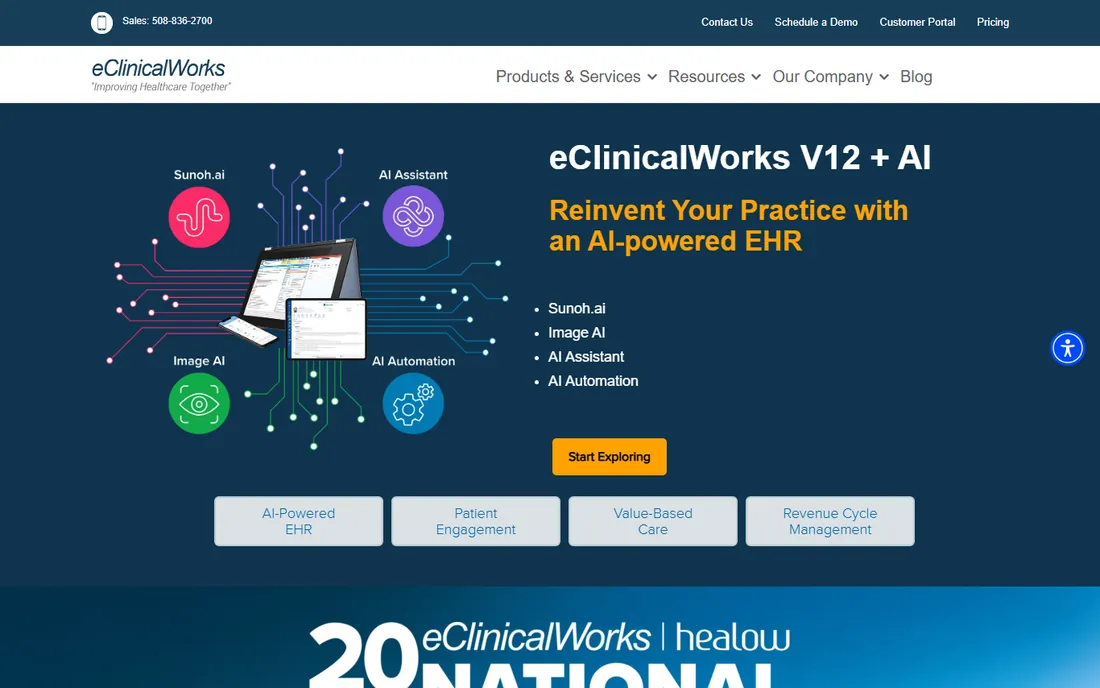
eClinicalWorks describes itself as the largest cloud-based EHR in the US, and the numbers on its homepage (180,000+ physicians and NPs, 110,000+ facilities) back the scale claim. The platform covers EHR, practice management, telehealth, patient engagement and revenue cycle, with AI additions like the Sunoh.ai medical scribe for documentation and healow Genie for patient calls.
For ambulatory practices that want an established cloud vendor with deep telehealth and engagement tooling, eClinicalWorks is a proven choice. Pricing is not published, so expect a sales process. New practices get a dedicated "kickstart" program, which is worth asking about.
What we like- One of the largest cloud-based EHR installed bases, with 180,000+ physicians and NPs per the vendor
- Integrated telehealth, patient engagement and an AI scribe option
- Specialty-tailored solutions
Watch out for- Pricing is not published
- The breadth of modules can complicate implementation
- Support experiences vary by practice size
Starting priceSee website
Free planFree trial (30 days)
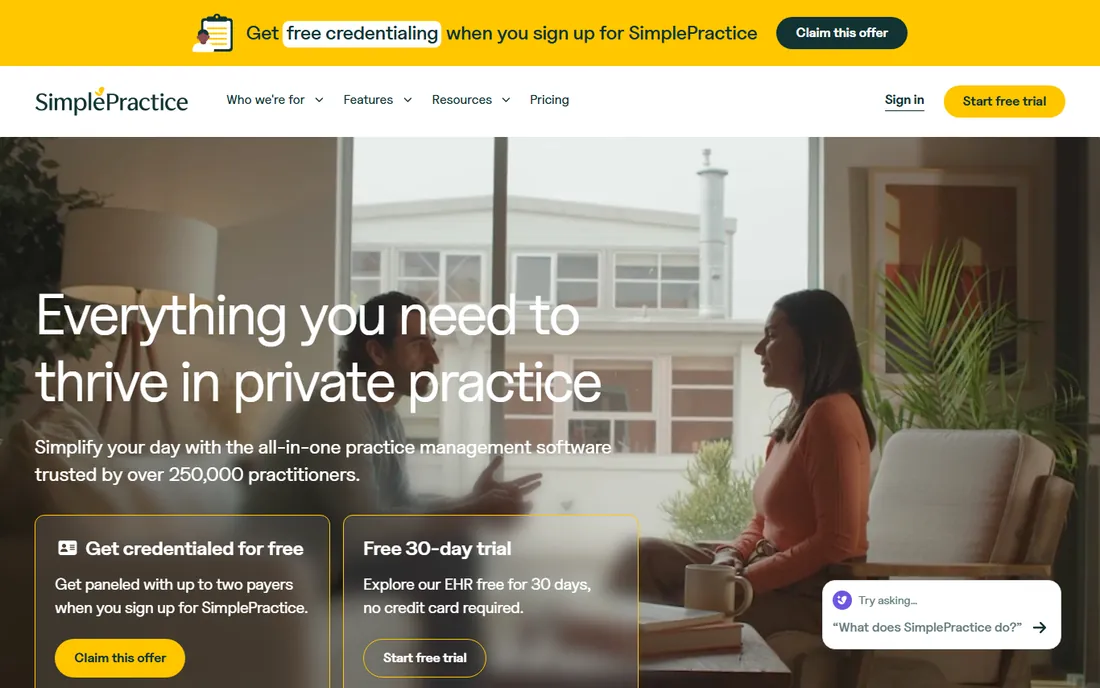
SimplePractice owns the therapy niche by designing for it from the start: intake forms, treatment plans, progress notes, integrated telehealth and insurance billing built for how therapists actually work. The homepage also advertises free credentialing (paneling with up to two payers) for new signups, a genuinely valuable perk for practices starting out.
The 30-day free trial with no credit card makes it the easiest platform on this list to evaluate. Solo and group therapy practices, dietitians, occupational therapists and wellness providers should start here. Medical practices with complex billing or hospital affiliations need one of the bigger platforms instead.
What we like- Purpose-built for behavioral health and wellness, not retrofitted from medical EHR
- Integrated telehealth, templates and insurance tools
- 30-day free trial with no credit card
Watch out for- Not designed for medical specialties or hospitals
- Pricing details require visiting the pricing page
- Advanced billing features trail the enterprise platforms
Starting price$199/month per provider (annual commitment; see website for current pricing)
Free planFree trial

Practice Fusion wins the transparency award: the homepage states pricing starts at $199 per month per provider, with a free trial that requires no credit card and no upfront costs. For small practices tired of "call for pricing," that openness is refreshing. The platform covers charting, e-prescribing, patient engagement and billing services.
The asterisk matters: pricing excludes taxes and requires an annual commitment, and the feature set targets small to mid-size practices rather than health systems. Still, for an independent practice that wants to know the price before the sales call, Practice Fusion is the most straightforward option here.
What we like- Publishes entry pricing at $199 per month per provider, rare in this category
- Free trial with no credit card
- EHR with billing services bundle for small practices
Watch out for- The $199 figure excludes taxes and requires annual commitment
- Feature depth trails Epic and athenaOne for complex organizations
- Best suited to smaller practices

#6
DrChrono
Best for: Independent practices that want a mobile-first, AI-powered EHR
Visit drchrono.com
Starting priceSee website
Free planNo
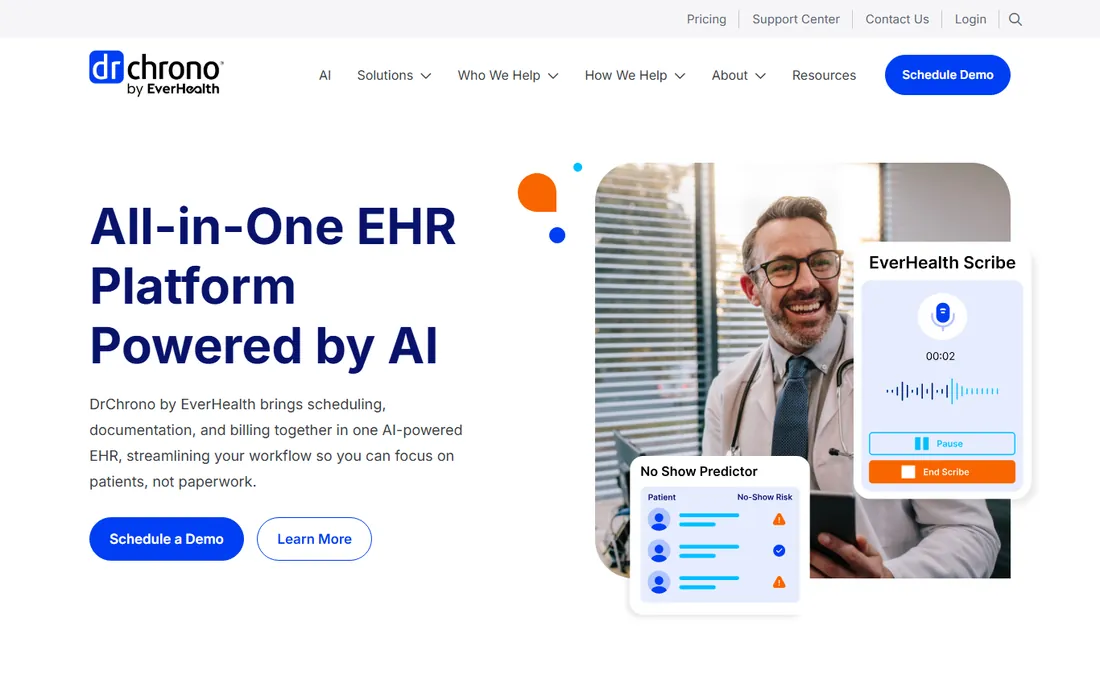
DrChrono's differentiator is mobility: it was built for the iPad era, letting providers chart, prescribe and bill from the exam room rather than a desktop. The platform combines clinical workflows, patient engagement and revenue management, with AI-powered documentation and specialty-specific templates from family medicine to podiatry.
The vendor positions DrChrono as the all-in-one platform for independent practices, with an implementation team guiding setup and migration. Pricing is quote-based. Practices where providers live on tablets, or that want AI documentation without enterprise complexity, should give it a serious look.
What we like- Mobile-first design built for how providers actually work, with strong iPad workflows
- AI-powered clinical documentation and integrated billing
- Customizable specialty templates
Watch out for- Pricing is not published
- Mobile-first can mean desktop workflows feel secondary
- Smaller vendor footprint than Epic or athenahealth

#7
NextGen Healthcare
Best for: Specialty and ambulatory practices that want an integrated EHR and PM platform
Visit nextgen.com
Starting priceSee website
Free planNo

NextGen Healthcare (the vendor now brands as NextGen) has served ambulatory practices for decades, and the platform reflects that: specialty-focused EHR content, integrated practice management, a virtual front door for patient scheduling and payments, and population health tools for value-based care. The mobile EHR extension keeps documentation flowing into the chart from anywhere.
It is a steady, proven choice for specialty groups that want depth without Epic-scale complexity. Pricing is quote-based. Practices evaluating NextGen should compare it directly against athenaOne and eClinicalWorks on specialty workflows, since that is where the decision usually turns.
What we like- Long-established ambulatory EHR with specialty-specific content
- Integrated practice management, patient experience and population health tools
- Mobile EHR extension for providers on the go
Watch out for- Pricing is not published
- The interface reflects a mature product rather than a modern redesign
- Implementation requires real planning

#8
Tebra
Best for: Independent practices that want EHR plus growth and reputation tools
Visit tebra.com
Starting priceSee website
Free planNo
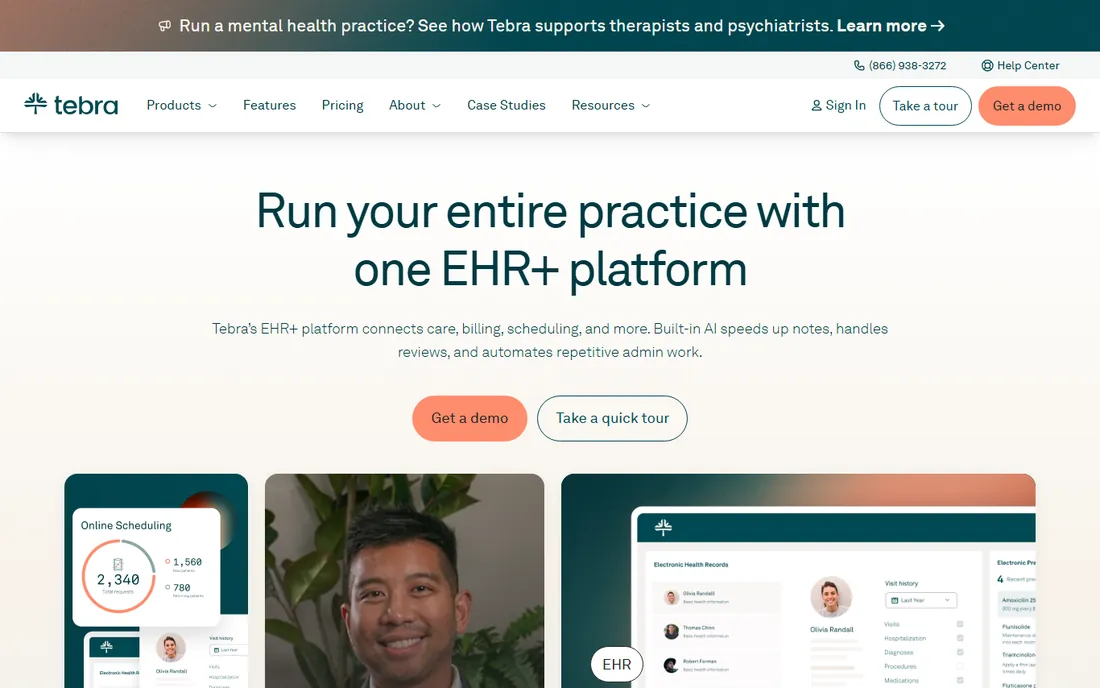
Tebra (formed from the Kareo and PatientPop combination) pitches the all-in-one independent practice platform: EHR with AI-generated notes, billing and claims, smart scheduling, and reputation tools that request reviews and manage online presence. The argument is that most EHRs stop at clinical notes while practices also need patients and cash flow.
The vendor emphasizes transparent pricing, though specific numbers were not on the homepage at the time of writing. For independent practices that want clinical and growth tools from one vendor, Tebra's bundle is distinctive. Pure clinical buyers should compare the EHR itself against athenaOne and DrChrono before deciding.
What we like- EHR+ platform connects clinical, billing, scheduling and reputation management in one login
- AI Note Assist speeds documentation
- Strong focus on helping practices attract patients and get paid
Watch out for- Pricing is not published despite "transparent pricing" claims
- The growth-marketing angle adds features some practices will not use
- Younger combined brand than the legacy vendors
How we chose
We defined healthcare software as EHR and practice management platforms used by providers to deliver care: clinical documentation, scheduling, billing and patient engagement. Consumer health apps and pure billing services did not qualify. For each candidate we opened the vendor's homepage, confirmed the product is current, and recorded pricing only where published. Only Practice Fusion publishes an entry price; the rest are quote-based.
Quick comparison
| Tool | Best for | Starting price | Free plan |
|---|
| Epic | Large hospitals and health systems that need one comprehensive record | See website | No |
| athenahealth (athenaOne) | Independent physician practices that want EHR, billing and engagement in one | See website | No |
 eClinicalWorks eClinicalWorks | Ambulatory practices that want a cloud EHR with telehealth built in | See website | No |
 SimplePractice SimplePractice | Therapists, counselors and health and wellness professionals | See website | Free trial (30 days) |
 Practice Fusion Practice Fusion | Small practices that want transparent pricing and a free trial | $199/month per provider (annual commitment; see website for current pricing) | Free trial |
| DrChrono | Independent practices that want a mobile-first, AI-powered EHR | See website | No |
| NextGen Healthcare | Specialty and ambulatory practices that want an integrated EHR and PM platform | See website | No |
| Tebra | Independent practices that want EHR plus growth and reputation tools | See website | No |
Is your product missing or out of date?
We review this list regularly. Vendors can request a listing, send updated pricing or ask about featured placement.
Hospital EHR versus practice EHR: different sports
The biggest mistake in healthcare software buying is comparing Epic to SimplePractice. They are not competitors; they serve organizations whose needs barely overlap. Hospital EHRs (Epic) handle inpatient workflows, OR scheduling, lab integration, and thousands of concurrent users across facilities. Practice EHRs (the other seven) handle appointments, office visits, billing and patient communication for ambulatory care.
The practical split: if you run a hospital or large health system, your shortlist is Epic and its enterprise peers. If you run a practice, ignore the hospital vendors entirely and compare the ambulatory platforms on your specialty's workflows, your billing complexity, and whether you want the vendor to also handle your revenue cycle. Buying the wrong category is the most expensive error in this market.
Start with specialty and size. Solo and small therapy practices: SimplePractice, with its free trial, is the obvious first stop. Small medical practices that want price transparency: Practice Fusion. Independent groups wanting EHR plus billing: athenaOne, Tebra and DrChrono, compared on specialty fit and AI documentation. Established specialty groups: NextGen Healthcare and eClinicalWorks. Hospitals: Epic.
Then evaluate the non-negotiables: specialty-specific templates and content, e-prescribing and lab integration, the billing model (in-house, vendor-managed or third-party), patient engagement tools, and the migration plan for your existing data. Every vendor offers demos; the useful evaluation is a scripted demo using your own visit types and your own billing scenarios, not the vendor's highlight reel. Plan the data migration early: it is the part of every EHR project that takes longer than expected.
Frequently asked questions
How much does EHR software cost?
It ranges enormously. Practice Fusion publishes $199 per month per provider. Mid-market ambulatory platforms typically run several hundred dollars per provider per month, quote-based. Enterprise hospital EHRs like Epic cost millions to implement. Always ask what is included: implementation, training, data migration, support and clearinghouse fees can double the headline number.
What is the difference between an EHR and practice management software?
The EHR is the clinical record: notes, orders, prescriptions, lab results. Practice management software handles the business: scheduling, registration, billing and claims. Modern platforms bundle both, which is why athenaOne, Tebra and eClinicalWorks sell integrated suites. Buying them separately is increasingly rare for new practices.
How long does EHR implementation take?
Small practices can go live in weeks, especially on cloud platforms with guided onboarding. Mid-size groups typically need two to four months including data migration and training. Hospital EHR implementations run one to three years. The data migration and workflow redesign, not the software installation, drive the timeline.
Do these platforms support telehealth?
Yes, across the board now. SimplePractice, eClinicalWorks, DrChrono and Tebra all include integrated telehealth; athenahealth and NextGen offer it as part of their patient engagement suites. Epic supports virtual visits within its enterprise workflows. Confirm the telehealth is truly integrated (one schedule, one chart) rather than a bolted-on video link.
What should I ask about before signing an EHR contract?
Ask about total cost including implementation, training, migration and support; the contract term and renewal terms; who owns your data and how you get it out; uptime and support SLAs; and the process and cost for adding providers or locations. Get the data-export terms in writing before you sign, not when you want to leave.
Sources we checked (8)
- https://www.epic.com
- https://www.athenahealth.com
- https://www.eclinicalworks.com
- https://www.simplepractice.com
- https://practicefusion.com/
- https://www.drchrono.com
- https://nextgen.com/
- https://tebra.com/
Is your product missing or out of date?
We review this list regularly. Vendors can request a listing, send updated pricing or ask about featured placement.

Shihab Mia · Founder, Rankite
Shihab has spent more than a decade helping SaaS and e-commerce brands grow through search. He writes Rankite's software buying guides from pricing pages, documentation and public user reviews. More about Shihab.