How we make this list: we compare pricing pages, product documentation and public user reviews. Rankite is independent; if a vendor ever pays for a featured spot, that listing is clearly labeled Partner.
Key takeaways
- E2open (now part of WiseTech Global) is the broadest GTM platform, recognized as a leader for both manufacturers and retailers.
- Descartes is the compliance content leader, with deep denied party screening and customs connectivity.
- Oracle GTM and SAP GTS are the natural picks for companies already running Oracle or SAP.
- Every serious GTM platform is quote-based enterprise software; budget for implementation alongside licenses.
Quick comparison
| Tool | Best for | Starting price | Free plan |
|---|
 E2open E2open | End-to-end supply chain GTM | See website | No |
 Descartes Descartes | Trade compliance content | See website | No |
 Oracle GTM Oracle GTM | Oracle supply chain shops | See website | No |
 SAP GTS SAP GTS | SAP S/4HANA exporters | See website | No |
 Thomson Reuters ONESOURCE Thomson Reuters ONESOURCE | Trade content and tax | See website | No |
 WiseTech CargoWise WiseTech CargoWise | Freight forwarders | See website | No |
 MIC MIC | Customs and compliance depth | See website | No |
 CrimsonLogic CrimsonLogic | Asia-Pacific trade facilitation | See website | No |
 AEB AEB | European trade compliance | See website | No |
Is your product missing or out of date?
We review this list regularly. Vendors can request a listing, send updated pricing or ask about featured placement.
The best global trade management software
Starting priceSee website
Free planNo
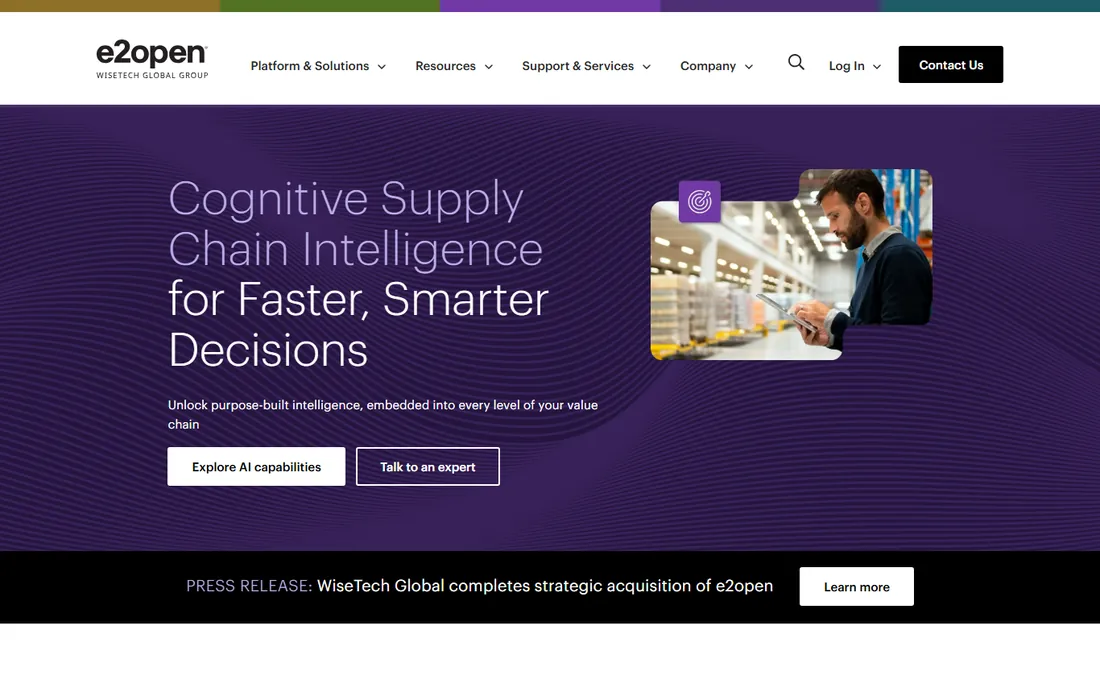
E2open offers one of the most complete global trade management platforms, covering import and export management, denied party screening, duty management, trade agreements and customs filings across a network of 500,000+ connected partners. IDC named it a leader for both manufacturers/exporters and retailers/importers. In 2025-2026 it became part of WiseTech Global, pairing its network with CargoWise.
Pricing is quote-based enterprise. Implementations are substantial. For large importers, exporters and retailers that want trade compliance inside a wider supply chain platform, E2open is the broadest choice.
What we like- Broadest multi-enterprise network
- Strong trade content
- IDC-recognized leader
Watch out for- Enterprise pricing and complexity
- Now part of WiseTech Global
Starting priceSee website
Free planNo
Descartes built its GTM strength on content: tariff rates, denied party lists, export controls and regulatory rules updated continuously across jurisdictions. Visual Compliance provides denied party screening via API, and the logistics network connects customs brokers and carriers. Entry screening tiers start around $2,000 per year, with full platforms far higher.
The modular portfolio means pricing stacks as you add capabilities. For companies where compliance accuracy is the primary need, Descartes' content depth is the industry reference.
What we like- Deep tariff and regulatory content
- Visual Compliance screening
- Customs broker connectivity
Watch out for- Modular pricing adds up
- Enterprise sales process
Starting priceSee website
Free planNo
Oracle Global Trade Management runs trade compliance inside Oracle Cloud SCM: restricted party screening, customs declarations, license management and landed cost, connected to order management and logistics. For Oracle shops, the native integration avoids middleware and duplicate data.
Standalone value is lower; this is an Oracle ecosystem play. Pricing is quote-based with cloud subscriptions reported from around $2,500 per month. If your supply chain runs on Oracle, GTM is the path of least resistance.
What we like- Native to Oracle Cloud SCM
- Automated customs filing
- Unified with logistics execution
Watch out for- Best value inside Oracle
- Quote-based pricing
Starting priceSee website
Free planNo
SAP Global Trade Services manages export controls, sanctions screening, customs declarations and trade preference processing natively inside S/4HANA. For SAP-centric manufacturers and exporters, compliance checks run automatically against live order and product data.
Outside SAP it makes little sense, and licensing is characteristically complex. Reported entry points run from around $3,000 per month for cloud modules. For the SAP exporter, GTS is the compliance backbone.
What we like- Tight S/4HANA integration
- Export controls and preference processing
- Proven at scale
Watch out for- SAP-only value
- Complex licensing
Starting priceSee website
Free planNo

ONESOURCE Global Trade (including the former Integration Point) combines trade content intelligence with automated classification, denied party screening and tax compliance. Thomson Reuters' regulatory research operation keeps content current across jurisdictions, which is the product's core value.
Pricing is quote-based with entry tiers reported around $1,500 per month. The broader ONESOURCE suite covers tax and legal beyond trade. For companies that want trade compliance plus tax in one vendor relationship, it consolidates well.
What we like- Strong trade content and classification
- Tax compliance depth
- Global regulatory coverage
Watch out for- Quote-based
- Broad suite can overwhelm
Starting priceSee website
Free planNo
CargoWise is the operating system for the world's largest freight forwarders, with customs, compliance, forwarding and warehousing in one global platform. Its single-database architecture gives forwarders consistency across 130+ countries. With E2open now in the group, the combined trade capabilities are formidable.
The product is built for logistics providers rather than shippers directly. Pricing is enterprise. For forwarders and 3PLs, CargoWise is the industry standard; shippers benefit through their forwarder's capabilities.
What we like- Dominant forwarder platform
- Deep customs and compliance
- Global single-platform model
Watch out for- Forwarder-centric
- Enterprise pricing
Starting priceSee website
Free planNo
MIC (now part of a larger group) provides global trade compliance software with particular depth in customs filing, export controls and origin management. Automotive and manufacturing exporters with complex customs requirements are its core customers.
North American brand recognition trails Descartes and E2open. Pricing is quote-based. For manufacturers with serious customs complexity, especially in Europe, MIC's functional depth deserves evaluation.
What we like- Deep customs functionality
- Strong in automotive and manufacturing
- Global coverage
Watch out for- Less known in North America
- Enterprise sales
Starting priceSee website
Free planNo
CrimsonLogic specializes in trade facilitation across Asia-Pacific, with roots in Singapore's pioneering TradeNet system. Port community systems, single-window customs and cross-border compliance are its strengths. Governments and enterprises across APAC run on its platforms.
Western market presence is limited. For companies trading heavily in Southeast Asia, China and the broader APAC region, CrimsonLogic's regional expertise and government connectivity are unmatched.
What we like- Strong APAC government and trade links
- Single-window expertise
- Port community systems
Watch out for- Regional focus
- Less presence in Western markets
Starting priceSee website
Free planNo
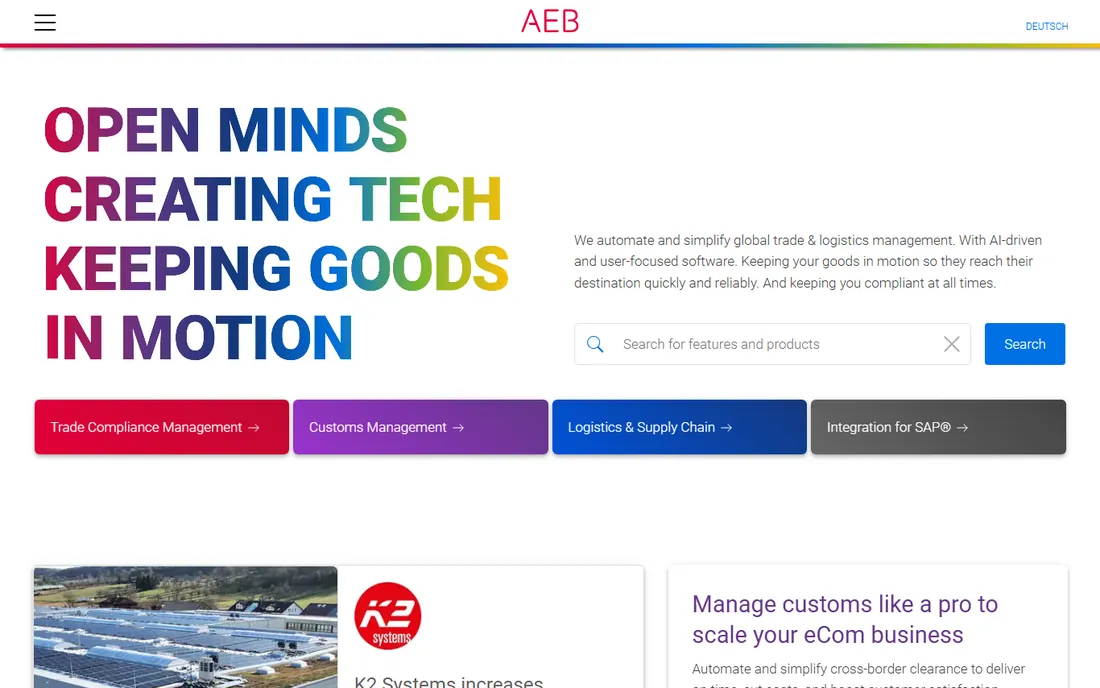
AEB provides global trade and logistics software with deep European customs and export control coverage. As part of Descartes since the acquisition, it combines AEB's functional depth with Descartes' content and network. Manufacturers and exporters with heavy EU trade are its natural customers.
Pricing is quote-based. The brand is consolidating into Descartes over time, so new buyers should clarify the long-term product roadmap. For EU-centric trade compliance, AEB remains a strong regional pick.
What we like- Strong European customs coverage
- Export controls depth
- Now backed by Descartes
Watch out for- Quote-based
- Brand consolidating into Descartes
What GTM software must do
At minimum: denied party and sanctions screening on every transaction, export license determination, customs declaration support, duty and landed cost calculation, and document generation (commercial invoices, certificates of origin). Advanced needs add trade agreement qualification, drawback management and free trade zone handling. During evaluation, run your actual product classifications and trade lanes through the system; content quality varies by country.
The acquisition wave
GTM is consolidating fast. E2open joined WiseTech Global, AEB joined Descartes, Amber Road and BluJay folded into E2open, Integration Point into Thomson Reuters. Consolidation brings integrated platforms but also roadmap uncertainty. Ask every vendor which products are strategic versus maintenance mode, and get roadmap commitments for the modules you buy.
Denied party screening essentials
Denied party screening is the compliance function that keeps companies out of catastrophic trouble, and it is one area where the software either works or the company is exposed. Governments maintain lists of individuals, companies and entities with whom trade is restricted or prohibited: the US OFAC SDN list, the Commerce Department Entity List, EU and UN sanctions lists, and dozens more. Screening means checking every transaction party (customers, suppliers, freight forwarders, banks) against these lists, and the lists change constantly. Manual screening is not viable at any real volume; the software must automate it.
The screening workflow has a specific shape. Parties are screened at onboarding and re-screened continuously, because list updates can implicate existing partners overnight. Name matching must handle transliteration variants, aliases and fuzzy matches; exact-match-only screening misses the entities trying to hide. When a potential match fires, the workflow routes it for human review with the match details, never auto-blocking on a fuzzy hit (the false positive rate would paralyze operations) and never auto-clearing either. Document every decision: why a match was cleared or escalated. Regulators who investigate want to see the process, not just the outcome. During evaluation, test with known tricky names and verify the match quality; this is the core competency.
Integration points determine whether screening actually happens. The GTM system should screen automatically at order creation, shipment booking, and payment release, pulling party data from the ERP without manual entry. Gaps between systems are where violations occur: the order was screened but the freight forwarder was added later by email and never checked. Map every point where a new party can enter a transaction and verify screening covers it. Also confirm the list update frequency; daily updates are the standard, and the vendor should document their sources and update SLAs. A screening system running on month-old lists provides false confidence.
Record retention for screening decisions runs long. US regulations generally expect five years of records, and investigations can reach back further. The system must archive screening results, list versions used, and reviewer decisions in tamper-evident form. "We screened them" without records is not a defense. Also plan for the human side: designate a compliance owner, train them on the review workflow, and establish escalation criteria for true matches (when to involve counsel, when to file voluntary disclosures). The software handles the detection; the organization handles the judgment. Both must be in place before the first shipment, not after the first violation notice.
Frequently asked questions
How much does global trade management software cost?
Entry screening tools start around $2,000 per year (Descartes Visual Compliance). Full GTM platforms are quote-based, typically tens of thousands to hundreds of thousands annually depending on transaction volume, countries and modules. Implementation often matches license costs.
What is denied party screening?
Checking customers, suppliers and partners against government restricted-party lists (OFAC, BIS, EU sanctions) before trading with them. It is legally required in most jurisdictions, and violations carry severe penalties. Automation is essential at any real volume.
Do small importers need GTM software?
Small importers usually rely on their customs broker and forwarder. GTM software earns its cost when you manage compliance in-house across multiple countries, products or entities. Start with screening tools before full platforms.
What is the difference between GTM and a freight forwarder's system?
Your forwarder's system (often CargoWise) manages their operations. GTM software manages your compliance obligations: screening, classification, licenses and audit trails. Many companies need both.
How long does GTM implementation take?
Screening tools deploy in weeks. Full GTM platforms take 3 to 12 months depending on countries, ERP integration and data readiness. Product classification cleanup is usually the longest pole.
Can GTM software calculate landed cost?
Yes. Leading platforms calculate duties, taxes, fees and freight to landed cost by SKU and lane, which feeds pricing and sourcing decisions. Accuracy depends on classification and content quality.
How we chose
We compared the GTM platforms importers and exporters actually evaluate, from screening tools to full suites. Pricing is quote-based across the category. We weighted compliance content quality, customs functionality, ERP integration and fit for different trade profiles. We noted major acquisitions since they affect roadmaps. No hands-on testing was performed; assessments rest on documentation and public reviews.
Sources we checked (11)
- https://www.e2open.com/
- https://www.descartes.com/
- https://www.oracle.com/
- https://www.sap.com/
- https://www.thomsonreuters.com/
- https://www.wisetechglobal.com/
- https://www.mic-cust.com/
- https://www.crimsonlogic.com/
- https://www.aeb.com/
- https://github.com/ishandutta2007/awesome-global-trade-management/blob/HEAD/README.md
- https://markets.financialcontent.com/punxsutawneyspirit/article/bizwire-2026-1-29-e2open-named-a-leader-in-two-global-trade-management-idc-marketscape-reports
Is your product missing or out of date?
We review this list regularly. Vendors can request a listing, send updated pricing or ask about featured placement.

Shihab Mia · Founder, Rankite
Shihab has spent more than a decade helping SaaS and e-commerce brands grow through search. He writes Rankite's software buying guides from pricing pages, documentation and public user reviews. More about Shihab.