How we make this list: we compare pricing pages, product documentation and public user reviews. Rankite is independent; if a vendor ever pays for a featured spot, that listing is clearly labeled Partner.
Key takeaways
- Onfleet is the most capable last mile platform for mid-market and on-demand operations, but the $619/month entry price rules it out for small fleets.
- Routific is the best value for growing local delivery businesses: free for 100 orders a month, $150 a month up to 1,000 orders, with full features on every tier.
- OptimoRoute's per-driver pricing ($39/driver/month on Lite) beats per-task pricing for fleets with predictable daily routes and high stop counts.
- Track-POD is the pick when proof of delivery is the job: barcode scanning, photos, and signatures are its core, not an add-on.
Quick comparison
| Tool | Best for | Starting price | Free plan |
|---|
 Onfleet Onfleet | Mid-market and on-demand delivery operations | $619 per month (Launch plan, 2,500 tasks) | Free trial (14 days) |
 Routific Routific | Growing local delivery businesses | $0 for up to 100 orders/month; $150 per month for up to 1,000 orders | Yes |
 OptimoRoute OptimoRoute | Fleets with predictable daily routes | $39 per driver per month (Lite, up to 700 stops) | Free trial (30 days) |
 Route4Me Route4Me | Businesses that want modular add-ons | See website (pricing through sales) | Free trial |
 Track-POD Track-POD | Operations where proof of delivery is critical | $49 per driver per month (billed annually, 3-driver minimum) | Free trial |
 Spoke Dispatch Spoke Dispatch | Courier companies with multiple shipper clients | $125 per month (Starter, up to 1,000 stops) | Free trial (7 days) |
 Upper Upper | Teams moving off spreadsheets | $40 per user per month (Essentials) | Free trial |
 Bringg Bringg | Enterprise retailers orchestrating delivery | See website (custom quote; third-party estimates from $150 per driver/month) | No |
 Tookan Tookan | Affordable on-demand dispatch | See website | Free trial |
Is your product missing or out of date?
We review this list regularly. Vendors can request a listing, send updated pricing or ask about featured placement.
The best last mile delivery software
A bakery distributor in New Jersey ran six vans across three counties, and every morning the dispatcher spent ninety minutes building routes by hand on a printed map. One sick driver meant rebuilding everything, and customers called all day asking where their order was. They switched to route optimisation software with live tracking, and the dispatcher now finishes routes before the coffee is done. The customer calls stopped because the tracking link answers them.
The last mile is the most expensive part of delivery, and it is where small operations feel the pain first. A missed time window, a driver doubling back across town, or a disputed delivery can erase the margin on a whole route. The best last mile delivery software does three things: it builds efficient routes, it keeps drivers and customers connected in real time, and it proves the delivery happened. The top delivery management software on this list all cover those basics; they differ on price model, depth, and who they were built for.
Prices below were checked against vendor-published pricing in 2026, and where a vendor prices through sales, the table says so.
Starting price$619 per month (Launch plan, 2,500 tasks)
Free planFree trial (14 days)
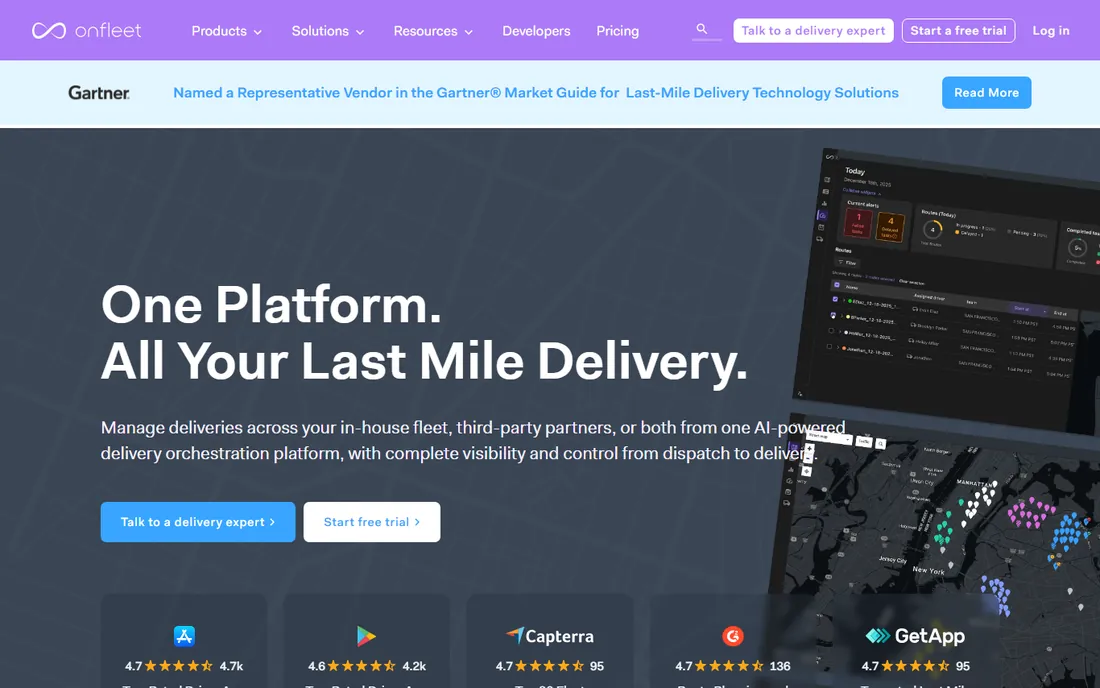
Onfleet is the platform serious delivery operations graduate to. The driver app is consistently rated the best in the category, predictive ETAs and branded customer tracking cut the "where is my order" calls dramatically, and the API lets engineering teams wire delivery into their own systems. For on-demand and high-frequency operations where tasks arrive dynamically, the auto-dispatch on the Scale plan is genuinely powerful.
The price is the whole conversation. Launch starts at $619 a month for 2,500 tasks, and the features most operations actually want, like advanced route optimization and barcode scanning, sit on Scale at $1,349. Add the $299-a-month Courier Suite for client portals and invoicing, plus per-message SMS charges, and the real monthly bill climbs fast. Onfleet is worth it when delivery is the business. For everyone else, the tools below deliver most of the value at a fraction of the cost.
What we like- Best-in-class driver app and customer tracking
- Unlimited users on every plan
- Strong API for custom integrations
Watch out for- $619 a month minimum prices out small fleets
- Advanced routing and auto-dispatch gated behind the $1,349 Scale tier
- SMS billed separately
Starting price$0 for up to 100 orders/month; $150 per month for up to 1,000 orders
Free planYes
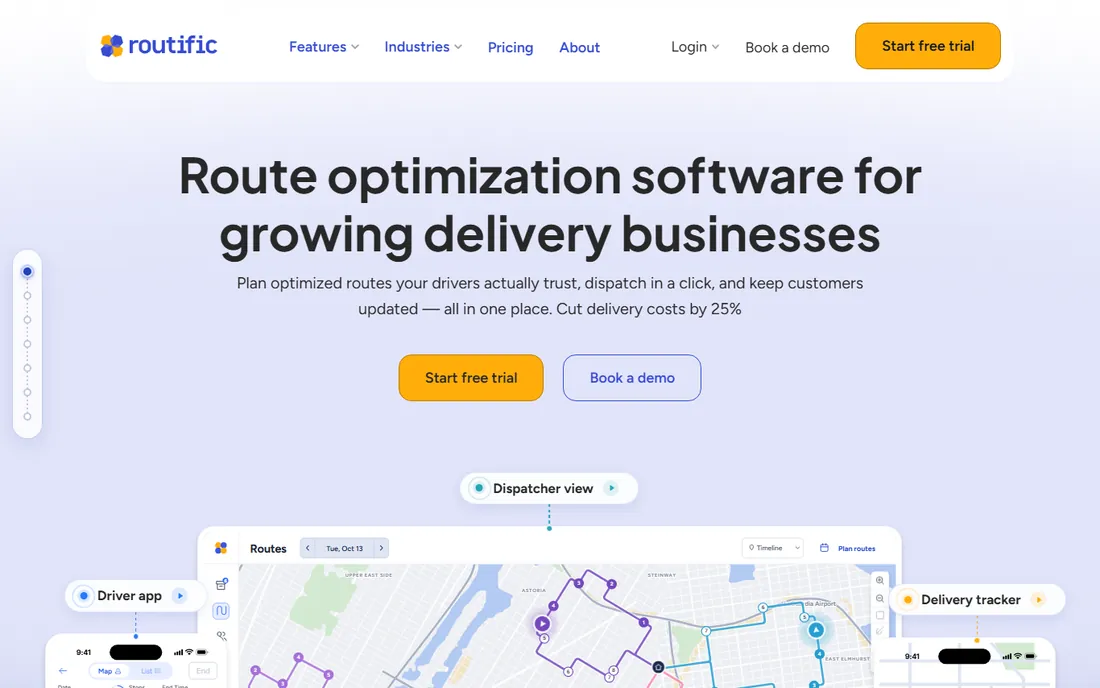
Routific is the friendliest entry point in last mile software. The free tier covers 100 orders a month with full route optimization, and at $150 a month for up to 1,000 orders it stays affordable while the business grows. Unlike Onfleet, nothing is gated: every tier gets the optimization engine, unlimited drivers, the dispatcher dashboard, the driver app, GPS tracking, and electronic proof of delivery.
The model has two limits worth knowing. First, Routific is built for planned routes, not on-demand dispatch where orders arrive all day. Second, the per-order pricing that looks cheap at 500 orders gets expensive past a few thousand, at which point per-driver tools like OptimoRoute cost less. For the classic local delivery business, bakery routes, meal delivery, parcel runs, it is the best value on this list.
What we like- Free tier is genuinely usable for tiny operations
- Every plan includes all features, no gating
- Realistic ETAs and balanced driver workloads
Watch out for- Not built for on-demand dispatch
- Per-order pricing gets expensive at high volumes
Starting price$39 per driver per month (Lite, up to 700 stops)
Free planFree trial (30 days)
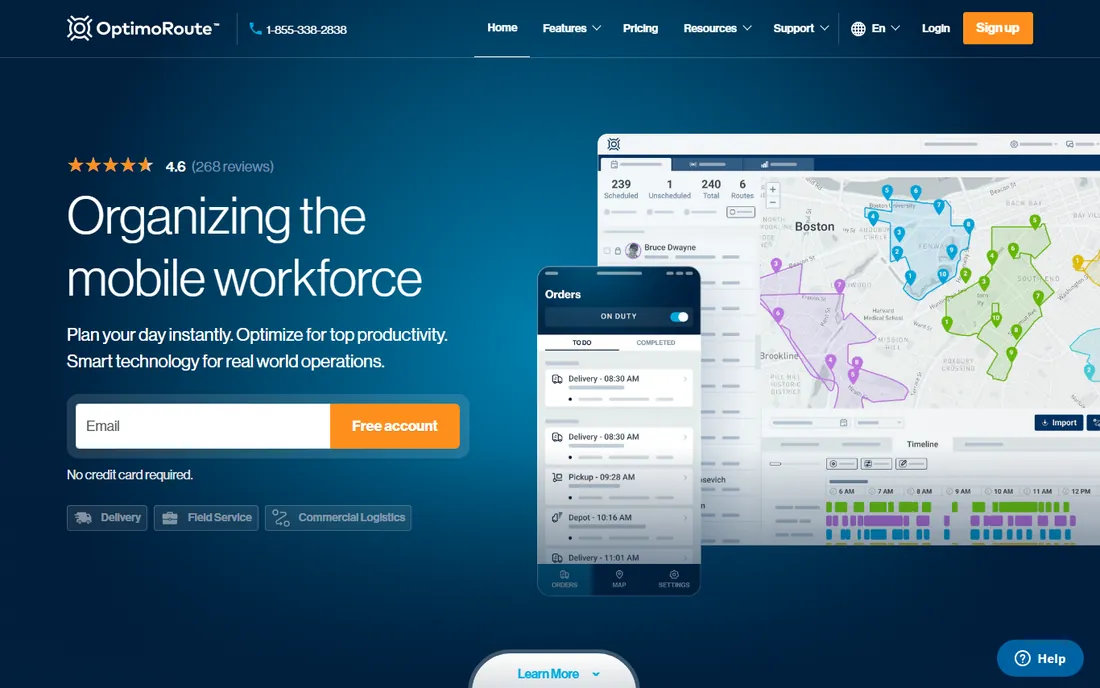
OptimoRoute prices per driver rather than per stop or per order, which changes the math completely for busy fleets. A driver doing 40 stops a day costs $39 a month on Lite regardless of how many deliveries those stops produce, where a per-task tool charges for every one. The multi-day planning and depot reloading features suit operations with complex weekly schedules, and the 30-day trial is the longest in the category.
Reviewers note the routing is not perfect: overlapping routes and odd sequencing sometimes need manual fixes before dispatch. The interface is functional rather than modern. But for operations where the day's stops are known each morning and volume is high, the per-driver model usually wins on cost, and the planning depth covers scenarios the simpler tools cannot.
What we like- Per-driver pricing beats per-task pricing at high stop counts
- Strong multi-day and multi-depot planning
- Generous 30-day trial
Watch out for- Routes can overlap awkwardly and need manual cleanup
- The interface feels dated next to newer tools
Starting priceSee website (pricing through sales)
Free planFree trial
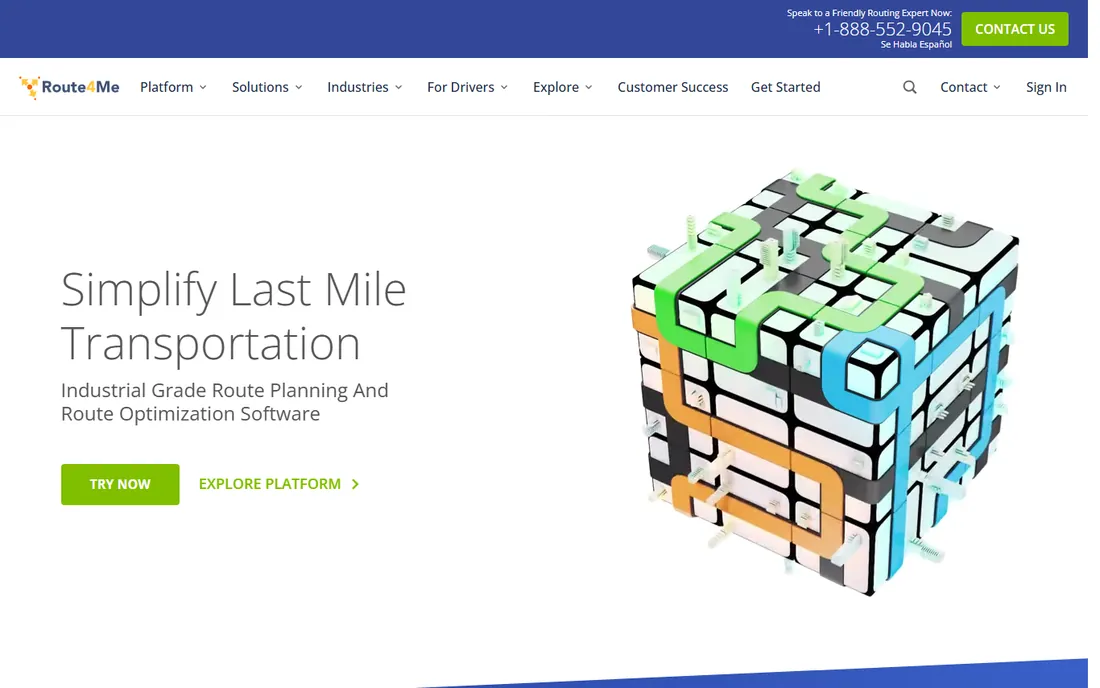
Route4Me is the most configurable routing platform on this list, with a marketplace of add-on modules for SMS alerts, geofencing, e-commerce integrations, curbside pickup, and even field service routing alongside delivery. Businesses with unusual workflows, like mixed delivery and service visits, can assemble exactly the system they need instead of accepting a fixed feature set.
The flexibility has a price beyond money: pricing runs entirely through sales with no public page, so buyers cannot compare costs without a call. The add-ons that make it attractive each add to the bill, and the optimizer's habit of minimizing vehicle count can produce overloaded driver days if constraints are not set carefully. It suits operations with complex needs and the patience for a sales process. Simple delivery businesses should pick a simpler tool.
What we like- Huge marketplace of add-on modules
- Handles both delivery routing and field service
- Very configurable for unusual workflows
Watch out for- No public pricing, everything runs through sales
- Add-on costs stack up
- The optimizer tends to minimize vehicles, which can overload drivers
Starting price$49 per driver per month (billed annually, 3-driver minimum)
Free planFree trial
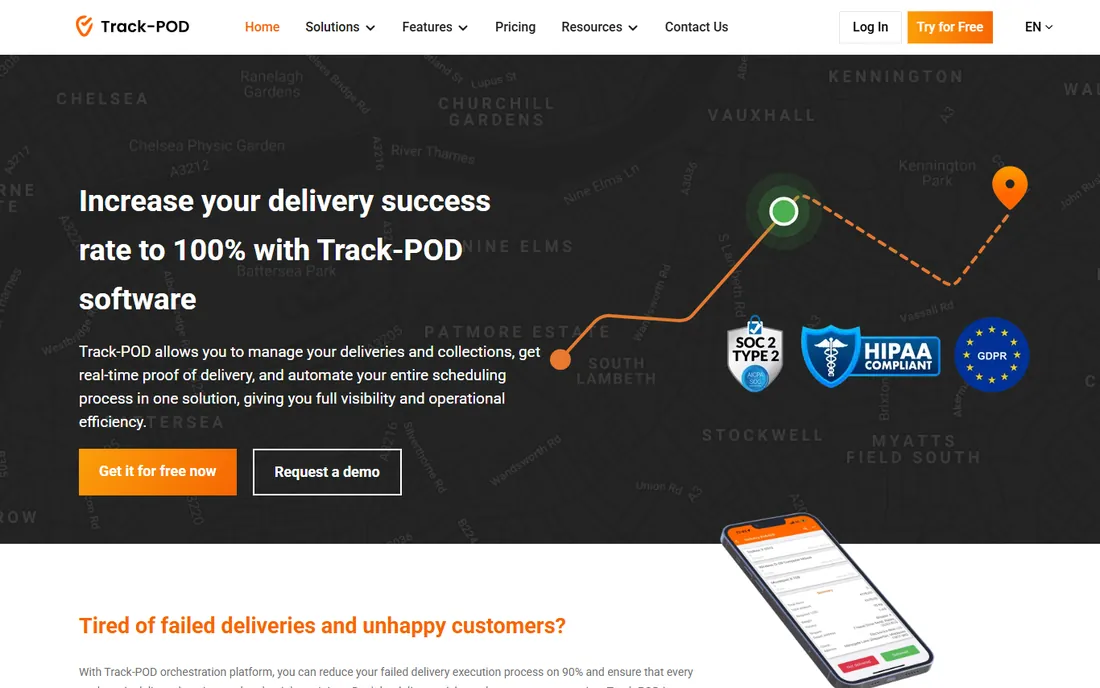
When the delivery itself is the liability, like pharmaceuticals, high-value goods, or B2B drops where disputes cost real money, Track-POD is the specialist. Electronic proof of delivery is its core rather than a checkbox: barcode scanning, photo capture, signatures, and GPS timestamps document every handoff. The dual pricing model, per-driver or per-order, lets operations pick whichever matches their volume pattern.
The buying experience is the weak point. The plan tiers confuse even careful buyers, and the driver app carries extra cost on some plans, which feels like charging for the steering wheel. Look past the packaging, though, and the POD depth is unmatched at this price. If disputed deliveries are a regular cost of doing business, this is the tool that makes them stop.
What we like- Deepest proof-of-delivery features: barcode, photo, signature, GPS stamps
- Per-driver pricing option
- Per-order plans also available
Watch out for- Plan tiers are confusing
- The driver app costs extra on some tiers
- Interface is utilitarian
#6
Spoke Dispatch
Best for: Courier companies with multiple shipper clients
Visit spoke.com
Starting price$125 per month (Starter, up to 1,000 stops)
Free planFree trial (7 days)
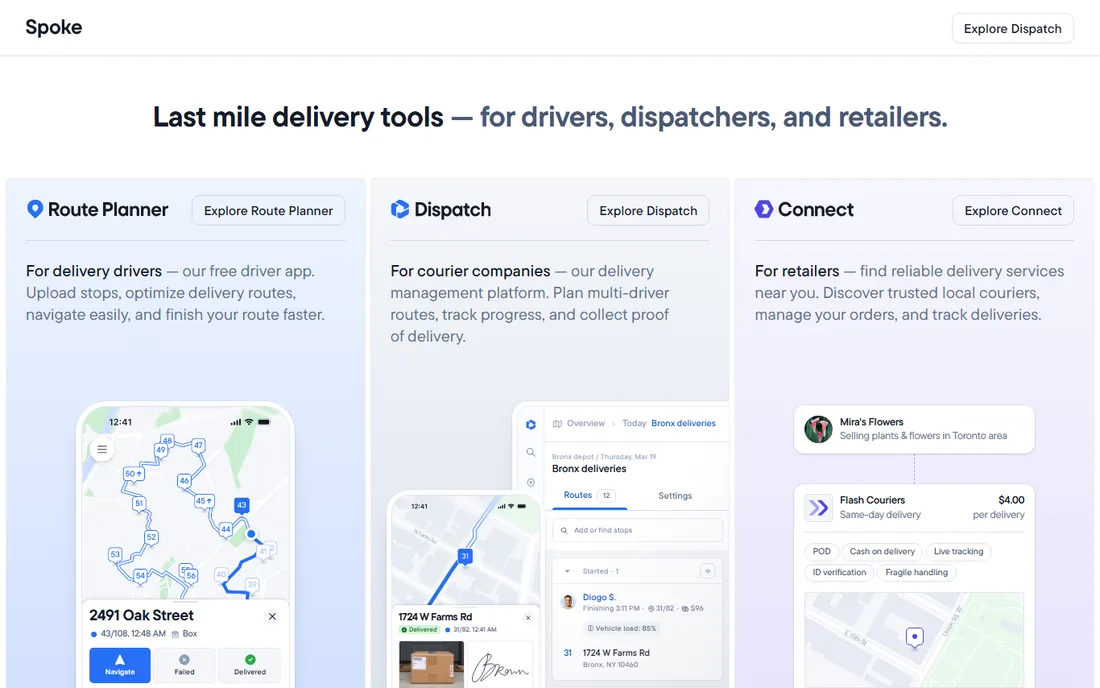
Spoke Dispatch, formerly known as Circuit for Teams, is built for the dispatcher coordinating drivers across several shipper clients, each with its own rules and proof requirements. It replaces the spreadsheets, group chats, and paper proof that courier dispatchers juggle daily. The per-stop pricing with unlimited drivers is the standout: adding drivers does not raise the software bill the way per-driver platforms do.
The trade-off is routing depth. For pure route quality on complex multi-constraint days, OptimoRoute and Routific go further. Spoke wins on the operational layer around the routes: client portals, per-shipper proof requirements, and billing support. Courier companies with five or more drivers that live in dispatch chaos should trial it against the per-driver alternatives and compare the real monthly cost at their volume.
What we like- Built specifically for courier dispatch workflows
- Per-stop pricing with unlimited drivers
- Client portals and multi-shipper billing support
Watch out for- Route optimization depth is lighter than OptimoRoute
- Newer brand with a smaller track record
Starting price$40 per user per month (Essentials)
Free planFree trial
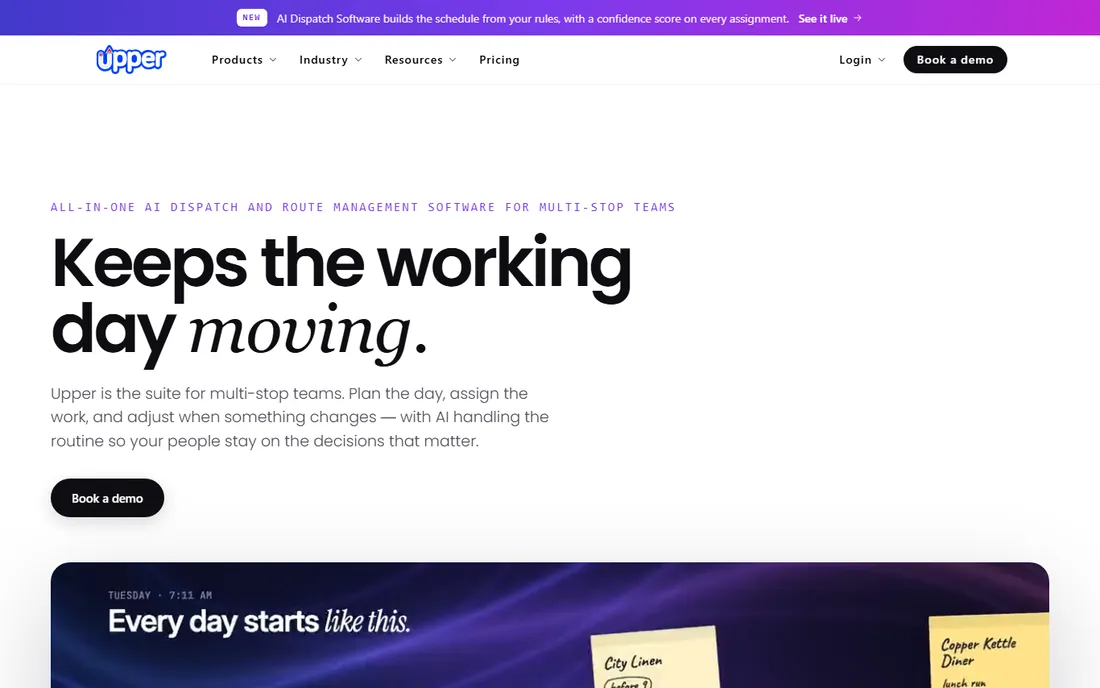
Upper is the tool for teams whose current routing system is a spreadsheet and a prayer. It focuses on multi-stop route planning done well, with a driver app that does not require training and unlimited route creation on the paid plans. At $40 a user a month on Essentials, it undercuts most competitors for small teams, and the 20 percent annual discount brings it lower still.
It does not try to match the constraint depth of OptimoRoute or the dispatch operations of Spoke. Complex time windows, capacity rules, and multi-depot reloading are thinner here. But many delivery operations do not need those, and for them Upper's simplicity is the feature. If the team will actually use it because it is easy, it beats a powerful tool nobody opens.
What we like- Simple to learn, genuinely usable driver app
- Unlimited route creation
- 20 percent discount on annual billing
Watch out for- Fewer advanced constraints than OptimoRoute
- Smaller company with a thinner integration ecosystem
Starting priceSee website (custom quote; third-party estimates from $150 per driver/month)
Free planNo
Bringg is enterprise delivery orchestration: it coordinates dispatch across a retailer's own fleet, third-party carriers, and store networks from one platform, with returns management and deep API capabilities. Customers include major global retailers, and for that profile, coordinating hundreds of stores and carriers, nothing else on this list operates at the same level.
For everyone else, it is the wrong tool by a wide margin. Implementation fees start around $50,000 with three to six months of onboarding, and the per-driver pricing sits far above the rest of the market. Mid-market reviewers consistently describe it as over-engineered for non-enterprise operations. Include it here for completeness; shortlist it only if your operation genuinely spans multiple fleets and carriers.
What we like- True delivery orchestration across internal fleets and third-party carriers
- Strong omnichannel fulfillment
- Built for retail scale
Watch out for- Implementation runs $50,000-plus with months of onboarding
- Massively over-engineered for small and mid-size operations
Starting priceSee website
Free planFree trial
Tookan is the budget answer for on-demand delivery: dispatching, driver tracking, and customer notifications at a price small operations can afford. It covers the standard verticals, food, grocery, pharmacy, parcels, with workflow templates for each, and the agent app keeps drivers connected without expensive hardware.
The limits show up as operations mature. Multi-shipper billing, client portals, and deep analytics are thin or absent, which is why growing courier companies eventually move to Spoke or Onfleet. But as a starting point for a local on-demand operation, or as the dispatch layer for a business whose main product is not delivery, it delivers the essentials without the enterprise bill.
What we like- Low-cost entry for on-demand delivery
- Agent app with real-time tracking
- Supports food, grocery, and parcel verticals
Watch out for- Lacks the operational depth of courier-specific platforms
- Analytics and reporting are basic
How the ranking was put together
We compared platforms that US delivery operations actually buy, identified through logistics publications, vendor documentation, and reviews on Capterra, G2, and courier forums. Every tool had to handle route planning or optimization, driver communication, and proof of delivery as a shipping product in 2026. Pricing reflects the lowest monthly tier each vendor published as of mid-2026, cross-checked across vendor pages and editorial comparisons; where vendors price through sales, the tables say "See website". This is a research-based comparison, not hands-on testing.
What to check before you commit to a plan
The pricing model matters more than the sticker price, so model your cost at real volume before anything else. Per-task pricing (Onfleet) punishes high stop counts. Per-driver pricing (OptimoRoute, Track-POD) punishes large teams with light routes. Per-order pricing (Routific) is cheapest at low volume and expensive at high volume. Per-stop pricing with unlimited drivers (Spoke) rewards big teams. Run your actual monthly stops, orders, and driver count through each model, because the cheapest option at 500 deliveries is rarely the cheapest at 5,000.
Then check what sits outside the base price. SMS customer notifications are billed separately almost everywhere and can add hundreds a month at volume. Overage fees on task and order plans kick in quietly. Barcode scanning, auto-dispatch, and client portals are gated behind higher tiers on several platforms. Ask each vendor for the all-in monthly cost at your volume, in writing, including every add-on you will actually use.
Finally, trial with real data. Import a week of actual stops, run the optimizer, and put the routes in front of your best driver. Drivers spot bad routing instantly, and their verdict predicts adoption better than any feature checklist. Every tool here offers a trial; the ones worth buying survive contact with your actual operation.
The pricing models, decoded
Last mile software pricing looks chaotic until you see the four models underneath. Per-task and per-order plans charge for output, which is fair when volume is low and punishing when it grows. Per-driver plans charge for capacity, which rewards busy drivers and punishes idle ones. Flat monthly plans with usage tiers, like Spoke's per-stop bands, sit in between. None is a trick; each vendor priced for the customer they built for. The mistake is comparing sticker prices across models instead of modeling your own operation through each one. A spreadsheet with your monthly stops, drivers, and orders, run against three vendors' pricing pages, takes an hour and saves thousands.
Frequently asked questions
What is the difference between route optimisation software and last mile delivery software?
Route optimisation software focuses on building the most efficient stop sequences. Last mile delivery software includes routing plus the operational layer: dispatch, driver apps, live tracking, customer notifications, and proof of delivery. If you only need better routes, a pure optimiser is cheaper. If you run drivers daily, you need the full platform.
How much does last mile delivery software cost?
Small operations can start free (Routific's free tier) or around $40 to $150 a month (Upper, OptimoRoute Lite, Spoke Starter). Mid-market platforms run $600 to $1,400 a month (Onfleet). Enterprise orchestration starts in the thousands plus implementation fees. Always model the cost at your actual volume, since pricing models behave very differently as you scale.
Do I need proof of delivery features?
If disputed deliveries cost you money or customer trust, yes. Photo, signature, and GPS-stamped proof ends most disputes before they start. For low-value, high-volume drops where disputes are rare, basic confirmation may be enough. Regulated goods like pharmaceuticals effectively require it.
Can these tools handle on-demand orders that arrive during the day?
Some can, some cannot. Onfleet and Tookan are built for on-demand dispatch with auto-assignment. Routific and OptimoRoute are built for planned routes and handle intraday additions poorly or not at all. Match the tool to how your orders actually arrive, because this is the hardest thing to work around.
How long does implementation take?
Self-serve tools like Routific, Upper, and OptimoRoute go live in days. Onfleet typically takes weeks with onboarding support. Bringg and enterprise platforms take months. The fastest path is importing your real stops into a trial and running a live week before committing.
Should I choose per-driver or per-task pricing?
Choose per-driver pricing when your drivers run full, predictable days with high stop counts; the cost stays flat while output grows. Choose per-task or per-order pricing when volume is low or seasonal, since you pay nothing for idle capacity. Model both at your peak and off-peak months before deciding.
Sources we checked (9)
- https://www.routific.com/blog/best-last-mile-delivery-software
- https://www.routific.com/blog/routific-vs-onfleet
- https://onfleet.com/blog/best-medical-courier-software/
- https://spoke.com/dispatch/blog/onfleet-competitors
- https://spoke.com/dispatch/blog/optimoroute-alternatives
- https://www.upperinc.com/comparison/onfleet-vs-optimoroute/
- https://www.upperinc.com/reviews/onfleet-reviews/
- https://cigotracker.com/blog/last-mile-routing-software/
- https://locus.sh/blogs/routific-vs-onfleet-vs-locus/
Is your product missing or out of date?
We review this list regularly. Vendors can request a listing, send updated pricing or ask about featured placement.

Shihab Mia · Founder, Rankite
Shihab has spent more than a decade helping SaaS and e-commerce brands grow through search. He writes Rankite's software buying guides from pricing pages, documentation and public user reviews. More about Shihab.