How we make this list: we compare pricing pages, product documentation and public user reviews. Rankite is independent; if a vendor ever pays for a featured spot, that listing is clearly labeled Partner.
Key takeaways
- Kingdom and Petra changed hands in 2026: S&P Global sold its geoscience software portfolio to SLB, and the sale closed on September 1, 2026. Both are now SLB products, and existing users should confirm support and licensing terms with SLB.
- OpendTect is the only genuinely free option working geoscientists take seriously. The open-source core handles 2D, 3D and 4D interpretation, with a commercial Pro tier for advanced plugins.
- Mining, geothermal and environmental buyers are usually better served by Leapfrog Geo or RockWorks than by the oil and gas interpretation suites. Leapfrog's implicit modeling is built for drillhole-heavy datasets, and RockWorks starts at $860 per year.
- Every enterprise tool on this list except OpendTect and RockWorks is quote-based. Plan your budget around training, implementation and workstation hardware, not just the license line item.
Quick comparison
| Tool | Best for | Starting price | Free plan |
|---|
 Kingdom Kingdom | Independent operators needing fast Windows-based interpretation | See website (quote-based) | No |
 Petrel Petrel | Large E&P teams standardizing on one subsurface platform | See website (quote-based) | No |
 Petra Petra | US onshore geological teams doing prospect and well work | See website (quote-based) | No |
 HampsonRussell HampsonRussell | Geophysicists focused on reservoir characterization and inversion | See website (quote-based) | No |
 OpendTect OpendTect | Researchers, students and small teams with no license budget | Free (open source; OpendTect Pro is licensed separately) | Yes |
 MOVE MOVE | Structural geologists validating complex 3D models | See website (quote-based) | No |
 Leapfrog Geo Leapfrog Geo | Mining and geothermal teams building fast 3D geological models | See website (quote-based) | No |
 RockWorks RockWorks | Environmental and geotechnical firms logging boreholes on a budget | $860 per year (Basic annual license) | Free trial |
Is your product missing or out of date?
We review this list regularly. Vendors can request a listing, send updated pricing or ask about featured placement.
The best geology and seismic software
#1
Kingdom
Best for: Independent operators needing fast Windows-based interpretation
Visit slb.com
Starting priceSee website (quote-based)
Free planNo
Kingdom has been the working geologist's interpretation tool for decades, and its reputation rests on one thing: speed. A competent interpreter can load a 3D survey, pick horizons and faults, and have a prospect mapped in Kingdom faster than in almost any competing package. It was built for Windows from the start, so it runs on a high-end laptop rather than demanding a Linux workstation or a cluster, which matters for small shops and consultants.
The big change is ownership. Kingdom was developed by Seismic Micro-Technology, bought by IHS, folded into IHS Markit, then S&P Global. In April 2026 S&P Global agreed to sell its geoscience software portfolio to SLB, and the deal closed on September 1, 2026. Kingdom is now an SLB product, so confirm with SLB how your existing license agreements, maintenance terms and support contacts carry over.
Kingdom fits independent operators, small consultancies and university departments that need production-quality interpretation without enterprise overhead. For full-field reservoir simulation or massive regional studies, Petrel or a cloud platform earns its keep instead. Pricing is quote-based through SLB sales.
What we like- Runs on standard Windows workstations, no HPC cluster needed
- Fast path from loading seismic to a mapped prospect
- Large, loyal user community among independent geologists
Watch out for- Advanced 3D modeling depth trails the biggest platforms
- Sold by S&P Global to SLB in 2026, so licensing and support channels are in transition
#2
Petrel
Best for: Large E&P teams standardizing on one subsurface platform
Visit slb.com
Starting priceSee website (quote-based)
Free planNo
Petrel is the default subsurface platform at most major oil companies, and its strength is breadth. Seismic interpretation, well correlation, geological modeling, geomechanics, uncertainty analysis and reservoir simulation plug into one shared earth model. SLB has been pushing Petrel toward cloud deployment through Delfi and adding AI-assisted interpretation, including a 2025 deal that put Petrel across Shell's global assets.
That breadth is also the catch. Petrel is sold as modules, and the quote grows with every workflow you add. Small companies routinely find that the license, the hardware to run it well, and the training to use it properly cost several times the headline number. Implementation is measured in weeks, not days, and you will want an internal champion who owns the data model.
Buy Petrel when you are standardizing a whole asset team or a whole company on one platform and can staff it. If you are a five-person shop that mostly picks horizons and maps prospects, Kingdom or OpendTect will get you there with far less overhead.
What we like- Single platform from seismic interpretation to reservoir simulation
- Huge plugin ecosystem through the Ocean framework
- Strong enterprise support and training network
Watch out for- Expensive and complex for small teams
- Demands serious workstation hardware and trained administrators
#3
Petra
Best for: US onshore geological teams doing prospect and well work
Visit slb.com
Starting priceSee website (quote-based)
Free planNo
Petra is the quiet workhorse of US onshore geology. Where Kingdom leads with seismic interpretation and Petrel with full-field modeling, Petra sits in the middle: mapping, cross sections, log analysis, production data and well planning in one project. For a geologist at a small Permian or Appalachian operator, that combination covers most of the working week.
Like Kingdom, Petra moved from S&P Global Energy to SLB when the September 2026 sale closed. SLB lists it as Petra geological software, promising continuity plus tighter integration with its digital platforms over time. If you hold a Petra license, ask before signing a multi-year term whether SLB will keep it standalone or fold its workflows into Petrel.
Petra makes sense for teams whose work is well-centric rather than seismic-centric: correlating logs, mapping structure from well control, screening acreage, planning locations. It is not the tool you buy for advanced seismic inversion or 4D analysis.
What we like- Purpose-built for the daily workflows of US land operators
- Combines geology, geophysics, engineering and production data
- Lower learning curve than the flagship platforms
Watch out for- Narrower scope than Petrel or Kingdom for pure seismic work
- Same 2026 ownership transition as Kingdom to work through with SLB
#4
HampsonRussell
Best for: Geophysicists focused on reservoir characterization and inversion
Visit viridiengroup.com
Starting priceSee website (quote-based)
Free planNo
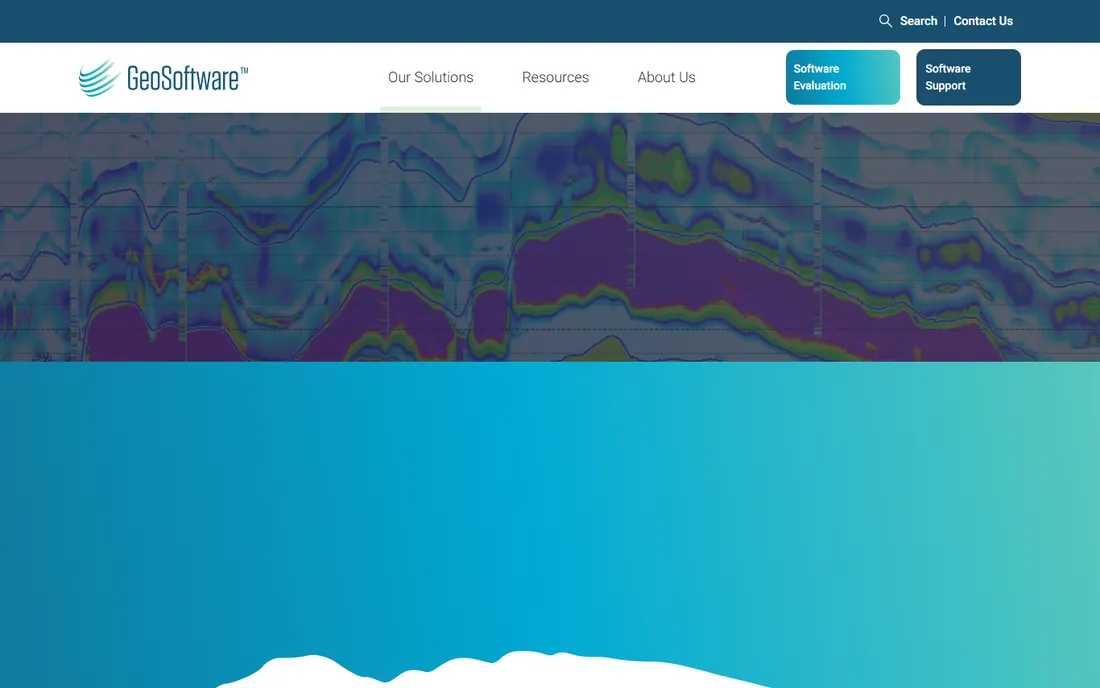
HampsonRussell does one job and does it better than almost anyone: turning seismic amplitudes into rock properties. Its modules cover AVO modeling and analysis, post-stack and pre-stack inversion, multi-attribute analysis, and geostatistical mapping. Geophysicists who need to predict lithology or fluid content away from well control tend to reach for it regardless of which interpretation platform they use for picking.
The vendor story needs a footnote. HampsonRussell is part of the GeoSoftware portfolio of CGG, which rebranded as Viridien. The product pages now live on viridiengroup.com. The software itself is unchanged, but buyers searching for the old CGG branding should know where to look.
HampsonRussell is not where you build your base interpretation. Most users run it alongside Kingdom, Petrel or OpendTect, exporting horizons and wells for the quantitative work. Budget it as a specialist add-on, not your only license. Pricing is quote-based; academic departments can ask about the university donation program.
What we like- Deep toolkit for AVO analysis, inversion and attribute work
- Designed so generalist geophysicists can run advanced workflows
- Strong academic donation program
Watch out for- A specialist tool, not a full interpretation system
- Vendor rebranded from CGG to Viridien, which confuses first-time buyers
#5
OpendTect
Best for: Researchers, students and small teams with no license budget
Visit dgbes.com
Starting priceFree (open source; OpendTect Pro is licensed separately)
Free planYes
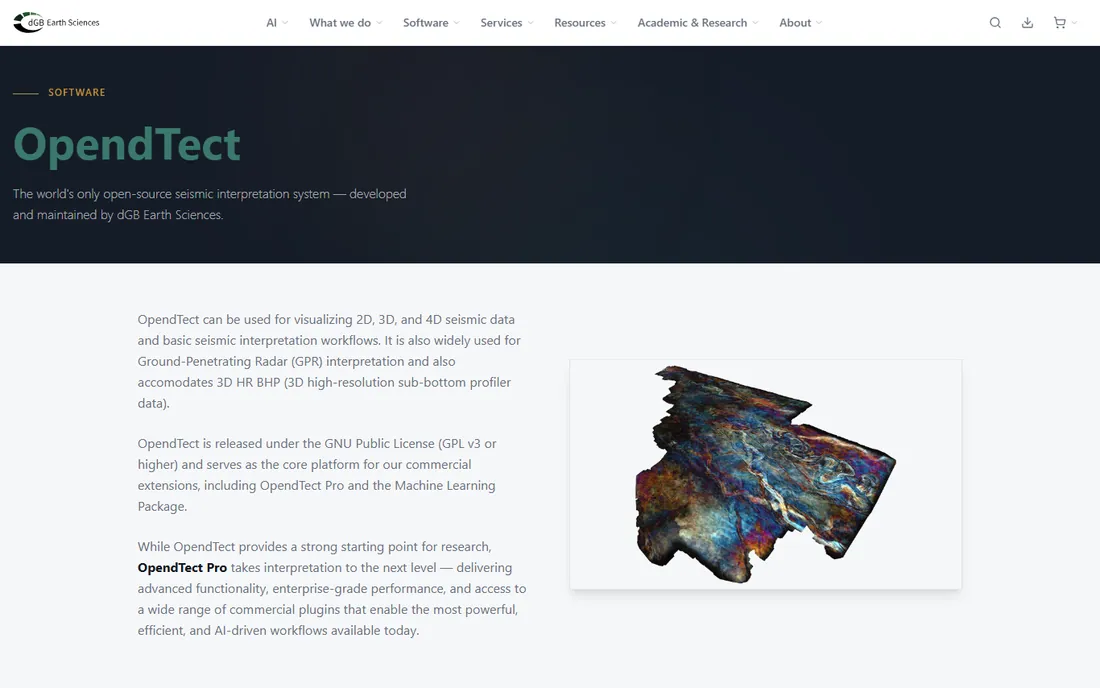
OpendTect is the only free tool on this list a professional geophysicist would use without apology. Developed by dGB Earth Sciences and released under the GPL, it covers horizon and fault interpretation, attributes, spectral decomposition, well ties and 3D visualization. The plugin system, with direct Python integration, makes it a genuine research platform rather than a viewer.
The free core has limits that matter in production. The headline advanced workflows, sequence stratigraphic interpretation through HorizonCube, the machine learning package, and commercial plugins, sit behind OpendTect Pro, which dGB licenses commercially. Support is community-driven unless you pay. And the user experience, while functional, does not match the fit and finish of tools that cost six figures.
Still, the price is right in a way nothing else here can match, and the academic licensing terms are generous. If you are evaluating whether seismic interpretation software earns its keep before committing budget, start here. You will learn exactly which commercial features you actually miss.
What we like- Full 2D, 3D and 4D seismic interpretation at zero license cost
- Runs on Windows, macOS and Linux
- Plugin architecture with Python integration for custom workflows
Watch out for- Interface and polish lag the commercial tools
- Advanced modules like HorizonCube and machine learning require paid Pro licenses
#6
MOVE
Best for: Structural geologists validating complex 3D models
Visit petex.com
Starting priceSee website (quote-based)
Free planNo
MOVE, from Petroleum Experts in Edinburgh, answers a question the interpretation platforms mostly dodge: is your structural model actually possible? Its 2D and 3D kinematic modeling, geomechanical modeling, fracture modeling and fault analysis let structural geologists restore, validate and de-risk complex geology, from thrust belts to salt provinces. The suite is modular, so a team can license the core plus the two or three analysis modules it uses.
Petroleum Experts also gives away FieldMOVE and FieldMOVE Clino, digital field mapping apps for tablets and phones. Academic licenses are donated widely, so most geology graduates have seen the software.
The honest framing is that MOVE is a specialist's tool. You would not buy it as your only subsurface software; you buy it when structural uncertainty is your biggest risk and you need to test whether a cross section or 3D model balances. Pricing is quote-based and sold by module, so get the full module list before budgeting.
What we like- Best-in-class kinematic restoration and structural validation
- Modular suite so you license only what you need
- Free field mapping apps for tablets and phones
Watch out for- Structural modeling focus means it complements rather than replaces an interpretation platform
- Pricing is opaque and module-based
#7
Leapfrog Geo
Best for: Mining and geothermal teams building fast 3D geological models
Visit seequent.com
Starting priceSee website (quote-based)
Free planNo
Leapfrog Geo takes a different approach from the seismic-first tools on this list. Instead of picking horizons on seismic volumes, it builds 3D geological models implicitly from drillhole data, surface maps and structural measurements. For mining, geothermal and civil engineering teams sitting on hundreds of boreholes, that workflow turns weeks of manual section drawing into a model that updates when new drilling comes in. Seequent, now part of Bentley Systems, reports its technology supports a large share of global geothermal power generation.
The line has grown beyond mining: Leapfrog Geothermal, Leapfrog Energy and Leapfrog Works cover adjacent markets, and Seequent Central adds cloud model management. Recent releases stream drill core imagery into the modeling interface.
Leapfrog is not a seismic interpretation platform, and oil and gas buyers should be clear-eyed about that. It handles the geology side brilliantly and leaves seismic to tools built for it. Licensing is subscription-based and quote-driven, so cost scales with team size. For a mining or geothermal group, it is usually the first tool to evaluate; for a seismic shop, it is a complement.
What we like- Implicit modeling builds 3D geology from drillholes far faster than manual methods
- Strong mining, geothermal and civil workflows
- Cloud collaboration through Seequent Central
Watch out for- Oil and gas seismic workflows are not its strength
- Subscription pricing adds up across large teams
#8
RockWorks
Best for: Environmental and geotechnical firms logging boreholes on a budget
Visit rockware.com
Starting price$860 per year (Basic annual license)
Free planFree trial
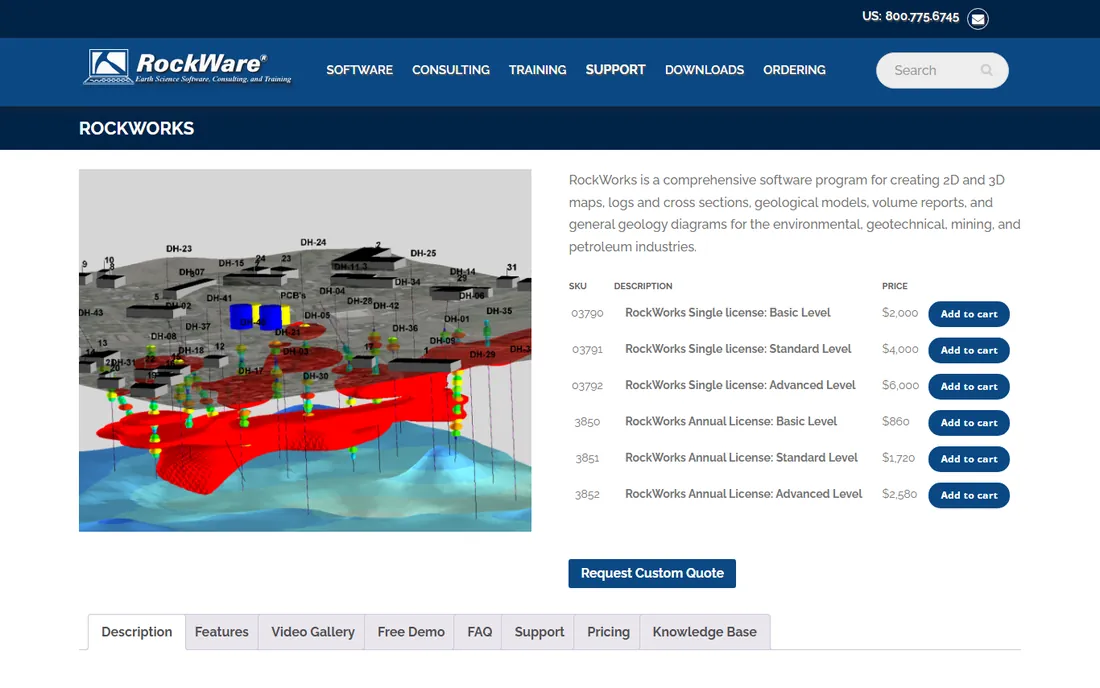
RockWorks is the pragmatic choice for environmental, geotechnical, mining and petroleum teams whose work starts with boreholes rather than seismic. Its Borehole Manager stores lithology, stratigraphy, geochemistry and geotechnical observations, then turns them into strip logs, cross sections, fence diagrams and 3D solid models. If your deliverable is a site investigation report rather than a prospect map, this is your category.
RockWare has the clearest pricing in geoscience software. The 2025 list puts Basic at $860 per year or $2,000 perpetual, Standard at $1,720 or $4,000, and Advanced at $2,580 or $6,000, with network licenses available. A free trial is offered.
The trade-offs are real. This is Windows desktop software with an interface that shows its age, and the Basic tier limits you to observed data with no modeling. Teams that need SQL Server support, scripting automation or unlimited faults must step up to Advanced. Still, for borehole-driven geology on a fixed budget, nothing else on this list competes at this price.
What we like- Published pricing, rare in this market
- Perpetual licenses available alongside annual rental
- Purpose-built borehole database with logs, sections and 3D solid models
Watch out for- Windows-only desktop software with a dated interface
- Advanced modeling needs the $2,580 per year Advanced tier
How we chose
We did not test-drive these packages in a lab. We reviewed each vendor's current pricing pages and product documentation, checked ownership and availability as of October 2026, read public user reviews on G2, Capterra and Reddit, and compared feature lists, integrations and fit for different team sizes. Where a vendor or product had been renamed or acquired, we used the current name and noted the old one once. Prices come from the vendor's own published pages; where vendors sell only through sales teams, we say so instead of guessing.
What to check before you sign a geoscience software contract
Data in and data out
Confirm the formats you use. Every serious tool reads SEG-Y, but wells, logs and archives move through LAS, DLIS, shapefiles and proprietary formats. Ask how a project exports, not just how it imports. Data trapped in a proprietary project file is the real switching cost.
Hardware and deployment
The desktop tools on this list assume a strong workstation with a discrete GPU, and the enterprise platforms assume more. Kingdom and OpendTect are the lightest; Petrel and the cloud suites want real iron or a cloud budget. Decision-class buyers should price the hardware refresh alongside the license, because a slow machine turns expensive software into shelfware.
Licensing model
Node-locked, network floating, named user, subscription, perpetual: the same product can cost wildly different amounts by license type. RockWorks publishes all of its tiers. For quote-based vendors, ask for network terms if your team shares seats, and ask what happens to your projects if maintenance lapses.
Support and training
Geoscience software is not self-serve. Check whether support covers your time zone, whether training is included or billed extra, and whether an active user community exists. After the SLB and Viridien ownership changes, get support contacts and renewal terms confirmed by the current vendor, not the one on your old invoice.
The 2026 ownership shuffle, and what it means for your renewal
S&P Global sold Kingdom, Petra, Harmony Enterprise and the rest of its geoscience portfolio to SLB, with the deal closing September 1, 2026. CGG's GeoSoftware group, including HampsonRussell, now operates under the Viridien name. Seequent continues under Bentley Systems.
For buyers, the practical effects are paperwork, not geology. License agreements, support portals and sales contacts move to the new owner, and multi-year renewals signed under the old brand deserve a careful read. If your renewal is due in the next twelve months, start the conversation with the current vendor early and get continuity terms in writing.
Frequently asked questions
What is geology and seismic software used for?
It helps geoscientists image and interpret the subsurface. Seismic tools turn acoustic survey data into maps of rock layers, faults and reservoirs. Modeling tools build 3D models from wells, outcrops and maps. Oil and gas, mining, geothermal and environmental teams all use versions of it, with different features mattering to each.
How much does geology and seismic software cost?
It ranges from free to six figures per seat. OpendTect is free and open source, and RockWorks publishes pricing from $860 per year. The enterprise platforms are quote-based, and a working seat with the modules a team needs often lands in the tens of thousands per year once training and hardware are included.
Can I do real seismic interpretation with free software?
Yes, within limits. OpendTect handles 2D, 3D and 4D interpretation, attributes and visualization at no cost, and universities teach full courses on it. You will miss the polished workflows, advanced inversion modules and commercial support of paid tools. For learning, research and small projects, it is genuinely capable.
Do these tools run on Mac?
Mostly no. Kingdom, MOVE, RockWorks and HampsonRussell are Windows-first. OpendTect is the exception, with native builds for Windows, macOS and Linux. Petrel and Leapfrog Geo have cloud paths Mac users can use, but confirm your setup with the vendor first.
Who owns Kingdom and Petra now?
SLB. S&P Global agreed in April 2026 to sell its geoscience software portfolio, including Kingdom and Petra, to SLB, and the sale closed on September 1, 2026. Both are now listed as SLB software. If you licensed them from S&P Global or earlier owners, confirm your agreement and support contacts with SLB.
Sources we checked (10)
- https://www.slb.com/products-and-services/delivering-digital-at-scale/software
- https://theenergyyear.com/news/slb-buys-upstream-software-portfolio-from-sp-global/
- https://www.dgbes.com/software/opendtect/
- https://github.com/OpendTect/OpendTect
- https://www.petex.com/products/move-suite/move/
- https://www.viridiengroup.com/geosoftware/hampsonrussell
- https://www.rockware.com/product/rockworks/
- https://www.rockware.com/wp-content/uploads/2025/catalog/RockWorks%20Brochure%202025.pdf
- https://im-mining.com/2025/08/20/seequent-enables-streaming-of-high-resolution-core-imagery-into-leapfrog/
- https://files.seequent.com/PDFs/Leapfrog-Geo-White-Paper-EN-V2.pdf
Is your product missing or out of date?
We review this list regularly. Vendors can request a listing, send updated pricing or ask about featured placement.

Shihab Mia · Founder, Rankite
Shihab has spent more than a decade helping SaaS and e-commerce brands grow through search. He writes Rankite's software buying guides from pricing pages, documentation and public user reviews. More about Shihab.