How we make this list: we compare pricing pages, product documentation and public user reviews. Rankite is independent; if a vendor ever pays for a featured spot, that listing is clearly labeled Partner.
Key takeaways
- A general contractor's estimating tool must handle diverse project types, coordinate multiple trades, and scale from conceptual budgets to detailed bid submissions.
- Cloud takeoff tools like STACK lead for GCs that want the full preconstruction workflow; PlanSwift remains the classic choice for estimators who think in Excel.
- Small residential GCs get the most from Buildxact, which bundles estimating with scheduling and job management at a small-contractor price.
- Commercial estimating departments standardizing on deep cost databases look at Sage Estimating or DESTINI Estimator; heavy civil is HCSS territory.
- Almost no estimating vendor publishes pricing. Expect per-user annual licenses for takeoff tools and quotes for the enterprise platforms.
Quick comparison
| Tool | Best for | Starting price | Free plan |
|---|
 STACK STACK | general contractors wanting cloud takeoff plus preconstruction | See website | No |
 PlanSwift PlanSwift | estimators transitioning from Excel without relearning everything | See website | No |
 Buildxact Buildxact | small residential GCs that need estimating through invoicing | See website | No |
 Bluebeam Revu Bluebeam Revu | teams that need PDF takeoff plus markup and review | See website | No |
 Sage Estimating Sage Estimating | commercial GCs standardizing on trade-specific cost databases | See website | No |
 DESTINI Estimator DESTINI Estimator | GCs estimating from concept through detailed bid | See website | No |
 HCSS HeavyBid HCSS HeavyBid | heavy civil contractors and DOT work | See website | No |
 Kreo Kreo | small contractors experimenting with AI takeoff cheaply | See website | No |
Is your product missing or out of date?
We review this list regularly. Vendors can request a listing, send updated pricing or ask about featured placement.
The best general contractor estimating software
#1
STACK
Best for: general contractors wanting cloud takeoff plus preconstruction
Visit stackct.com
Starting priceSee website
Free planNo

Bid day is Thursday. Your estimator opens the plans on a laptop at home, measures quantities in the cloud, and the project manager reviews the same live estimate from the office. That is the STACK workflow. Its cloud takeoff handles 2D plans with AI assistance that detects doors, windows, rooms and walls from blueprints, and the platform extends into full preconstruction with bid management and integrations to major ERP and accounting systems.
STACK positions as a mid-range option with serious capability, and independent accuracy evaluations have put it within a few percent of baseline measurements. Pricing is not published. For a GC that wants takeoff, estimating and preconstruction in one cloud system, it is the modern default.
What we like- Strong cloud-based 2D takeoff
- AI-assisted detection of doors, windows and rooms
- Integrates with ERP and accounting
Watch out for- Pricing not published
- Mid-range cost adds up per user
#2
PlanSwift
Best for: estimators transitioning from Excel without relearning everything
Visit planswift.com
Starting priceSee website
Free planNo
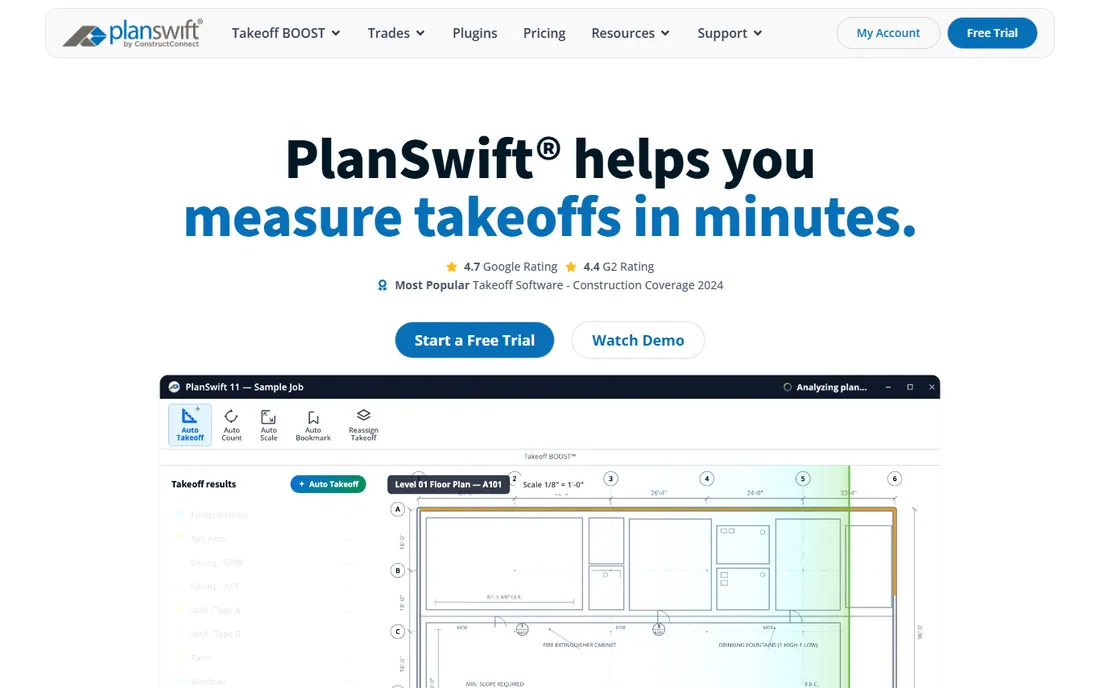
PlanSwift has been the takeoff tool of record for small and mid-size contractors for years. The formula is simple: measure quantities digitally on PDF plans, and the numbers flow into Excel-based estimating templates the estimator already understands. The learning curve is gentle because the estimating logic stays in a spreadsheet.
The tradeoff is modernity. Cloud collaboration and mobile access are limited compared with STACK or Buildxact, and the interface shows its age. Pricing is not published. For an estimator who wants digital takeoff without abandoning Excel workflows, PlanSwift remains the comfortable choice.
What we like- Familiar Excel-based estimating
- Strong 2D PDF takeoff
- Huge existing user base
Watch out for- Limited cloud and mobile
- Pricing not published
- Aging interface
#3
Buildxact
Best for: small residential GCs that need estimating through invoicing
Visit buildxact.com
Starting priceSee website
Free planNo
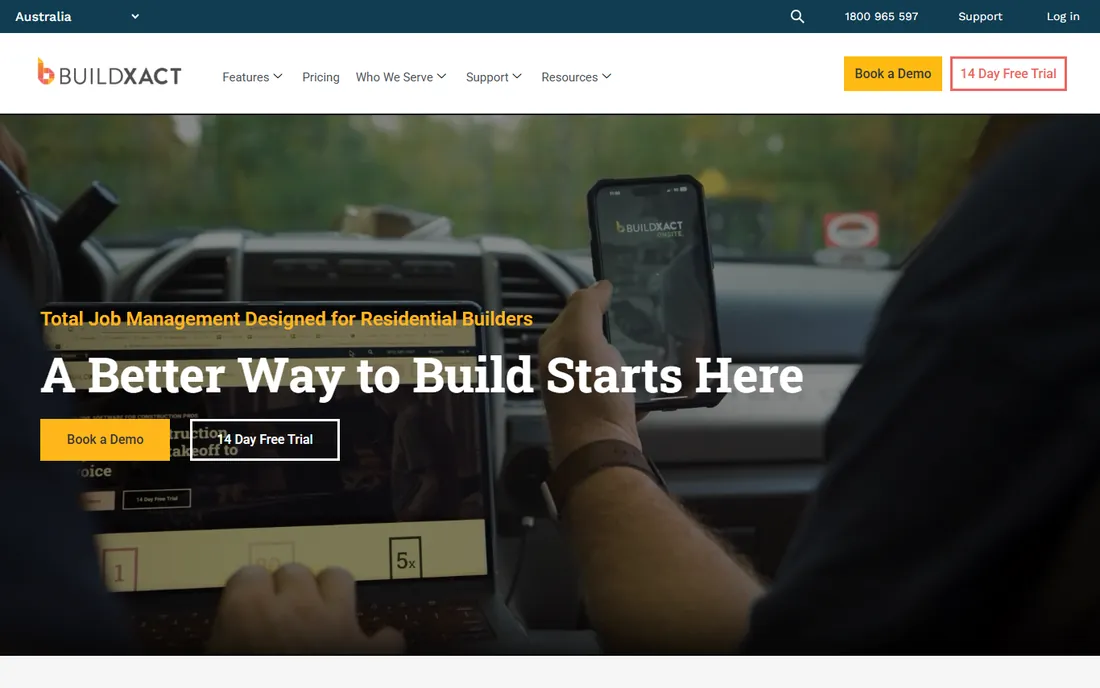
Buildxact is built for the residential contractor who does everything. Takeoffs run on plans, bills of quantities generate automatically, supplier price lists update costs, and the estimate flows into scheduling and invoicing without retyping. One affordable tool covers the job from first measurement to final invoice.
It is not a commercial-grade estimating platform. Customization is limited, and large projects with complex assemblies will outgrow it. Pricing is subscription-based and positioned for small contractors. For a residential GC or remodeler, the estimate-to-invoice workflow is the reason to buy.
What we like- Estimating plus scheduling and job management
- Easy to learn
- Built-in price lists
Watch out for- Limited customization
- Not built for large commercial projects
#4
Bluebeam Revu
Best for: teams that need PDF takeoff plus markup and review
Visit bluebeam.com
Starting priceSee website
Free planNo
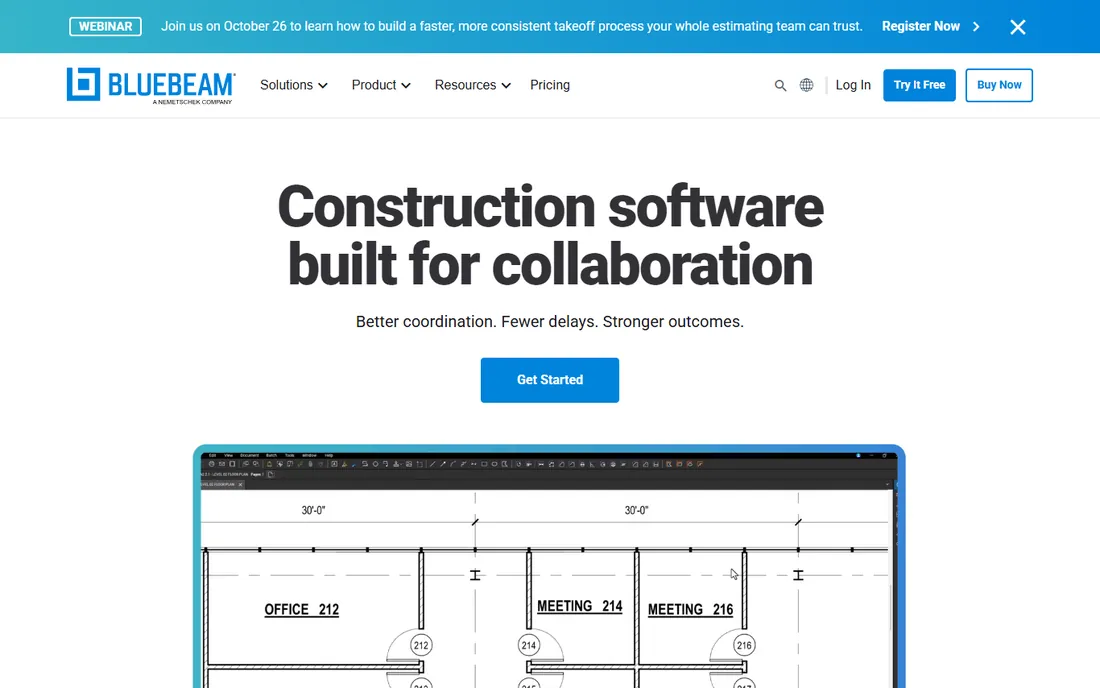
Bluebeam Revu is the PDF tool the construction industry standardized on. Markup, measurement and takeoff happen on the plans themselves, with collaboration across the team in real time. For takeoff-first workflows, its measurement tools are fast and accurate.
It is not a full estimating system. Quantities come out of Bluebeam and into Excel or a dedicated estimating platform for pricing. Per-user annual pricing applies. Most GCs end up with Bluebeam for takeoff and review plus a separate estimating tool, and that combination works well.
What we like- Industry-standard PDF markup
- Strong measurement tools
- Web and mobile access
Watch out for- Estimating depth needs Excel or another tool
- Per-user pricing
#5
Sage Estimating
Best for: commercial GCs standardizing on trade-specific cost databases
Visit sage.com
Starting priceSee website
Free planNo
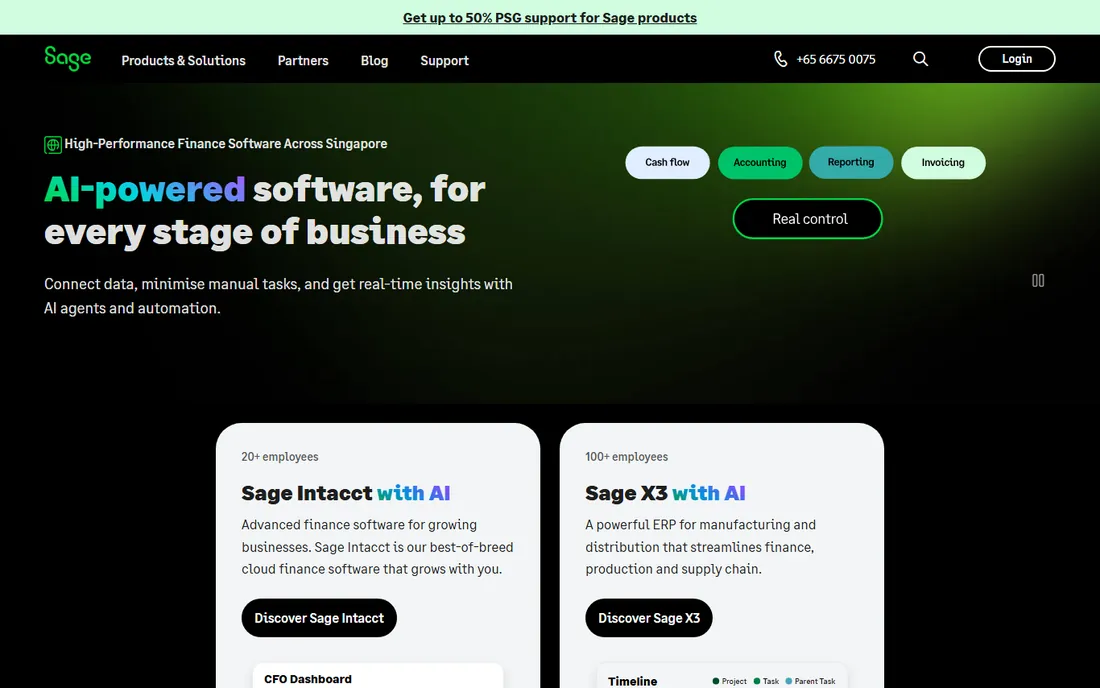
Sage Estimating is the professional estimator's platform. AI-assisted takeoff, trade-specific cost databases, and multi-user collaboration support large commercial projects with the rigor that bid-day demands. Integration with Sage's construction accounting and project management products keeps estimate data flowing into the job cost system.
It is expensive relative to the takeoff tools, requires real training, and makes the most sense for companies already using Sage products. Pricing is quote-based. For a commercial estimating department standardizing its cost data across projects, it is the deep option.
What we like- Deep trade-specific cost databases
- Multi-user collaboration
- Integrates with Sage construction software
Watch out for- Quote-based pricing
- Requires training
- Best inside the Sage ecosystem
Starting priceSee website
Free planNo
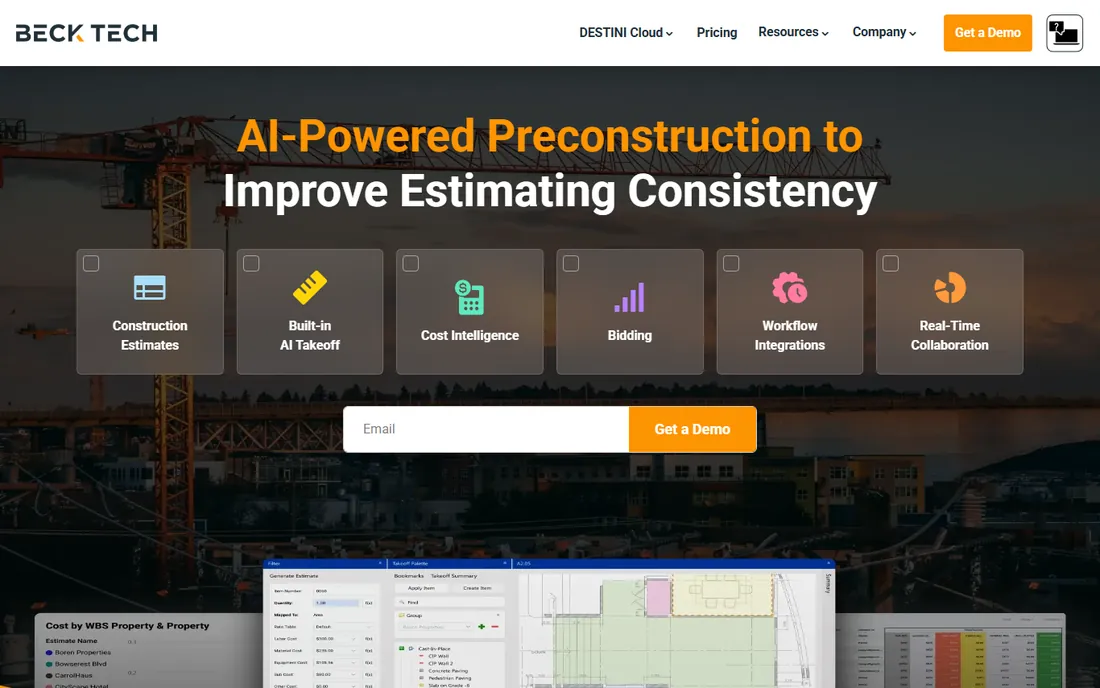
DESTINI Estimator, from Beck Technology, covers the complete preconstruction workflow that general contractors actually run. Conceptual estimating builds early budgets from minimal design information, then the same estimate refines into detailed assemblies, subcontractor pricing and bid-day management as the project develops. Value engineering and scenario modeling help owners compare options.
Historical cost analysis feeds actual project data back into future estimates, which is how estimating departments get smarter over time. The cloud architecture keeps distributed teams on the same current estimate. Pricing is quote-based, and the depth suits mid-size to large GCs rather than small shops.
What we like- Conceptual and detailed estimating in one
- Assembly libraries
- Historical cost analysis
- Cloud collaboration
Watch out for- Quote-only pricing
- Enterprise-grade complexity for small firms
#7
HCSS HeavyBid
Best for: heavy civil contractors and DOT work
Visit hcss.com
Starting priceSee website
Free planNo

Heavy civil estimating is its own discipline, with DOT pay items, quantity breakdowns and bid analysis that building-construction tools handle poorly. HCSS HeavyBid is the category standard for it. Estimators who bid highway, bridge and infrastructure work get workflows built around how those bids actually work, from takeoff through bid-day analysis.
For a general building contractor, it is the wrong tool. For heavy civil, it is close to mandatory. Pricing is quote-based and enterprise-grade. If your work is DOT and infrastructure, HeavyBid belongs on every shortlist.
What we like- Purpose-built for heavy civil
- DOT pay-item workflows
- Bid analysis and cross-bid comparison
Watch out for- Overkill for building construction
- Quote-based enterprise pricing
#8
Kreo
Best for: small contractors experimenting with AI takeoff cheaply
Visit kreo.net
Starting priceSee website
Free planNo

Kreo brings AI takeoff to contractors who cannot justify enterprise pricing. Automated detection and measurement work across 2D and 3D workflows, and a chat-based interface lets estimators refine results conversationally. Caddie AI handles tasks like renaming and scaling that eat estimator time.
The company is newer and smaller than the established players, and independent accuracy testing is limited, so treat vendor claims with appropriate skepticism. The entry price is the lowest in this category, which makes a trial cheap. For a small contractor curious about AI takeoff, Kreo is the low-risk experiment.
What we like- AI-assisted takeoff including 3D and BIM
- Chat-based refinement
- Low entry price
Watch out for- Smaller user base
- Independent accuracy validation is limited
Start with who owns the estimate. A dedicated estimator doing commercial bids needs takeoff speed and database depth: STACK, Sage Estimating or DESTINI. A project manager who inherits estimates needs the estimate visible against budgets: Procore-style platforms or Buildxact. An owner-operator wearing every hat needs one affordable tool from estimate to invoice.
Second, separate takeoff from estimating. Some tools do both; many GCs use Bluebeam or STACK for takeoff and Excel or a database tool for pricing. Decide whether you want one system or a best-of-breed pair, because the answer changes the shortlist.
Third, check plan revision handling. Real projects revise drawings constantly, and the cost of re-doing takeoffs on every revision is enormous. Ask each vendor how their tool handles revised plans before you buy.
Fourth, follow the estimate past bid day. The estimate should become the budget, the budget should track against actuals, and the actuals should feed the next estimate. Tools that connect to your accounting and project management systems close that loop. Tools that do not leave it to you.
How we chose
We selected estimating tools that exist today and serve real GC workflows: takeoff, cost databases, bid management and preconstruction. We verified each vendor homepage, replacing one vendor whose site was unreachable from our network with a verified alternative. Pricing facts come from vendor pages and documentation checked in October 2026; estimating vendors rarely publish prices, so those are listed as See website. Confirm live pricing with each vendor.
The database is the real product
Estimators focus on takeoff speed, but the durable asset is the cost database. A takeoff tool measures quantities; the database turns quantities into money. Companies that win bids consistently have clean, current, trade-specific cost data with historical actuals feeding back into future estimates.
That means the implementation work matters more than the software choice. Whoever owns estimating must maintain the database: update material prices, record actual costs, and retire stale assemblies. The best software with a neglected database produces confident wrong numbers. Budget the maintenance time, not just the license.
Frequently asked questions
What is the best estimating software for a general contractor?
It depends on the work. STACK suits GCs wanting cloud takeoff plus preconstruction. PlanSwift suits Excel-based estimators. Buildxact suits small residential GCs. Sage Estimating and DESTINI suit commercial departments with deep cost databases. HCSS HeavyBid owns heavy civil.
How much does construction estimating software cost?
Takeoff tools typically run from tens to a few hundred dollars per user per month, though most vendors do not publish prices. Enterprise platforms like Sage Estimating, DESTINI and HCSS use quote-based pricing. Confirm current pricing on each vendor's site.
Can estimating software replace Excel?
For takeoff and quantity management, yes, and most estimators should make the switch. For custom calculations and quick what-if analysis, many estimators keep Excel alongside their estimating platform. The best tools integrate with Excel rather than demanding you abandon it.
What is digital takeoff?
Measuring quantities (lengths, areas, counts) directly on digital plans instead of with a scale ruler on paper. Takeoff software like STACK, PlanSwift and Bluebeam lets estimators click on a PDF or BIM model to capture quantities, which then flow into the estimate.
Do I need BIM for estimating software?
No. Most GC estimating runs on 2D PDF plans, and every tool on this list handles that. BIM-based takeoff (3D models) matters for large commercial projects with models available. Kreo and DESTINI handle 3D; the rest focus on 2D.
How long does it take to learn estimating software?
Takeoff tools like STACK and Buildxact take days to weeks for a working estimator. Database-driven platforms like Sage Estimating take weeks to months including cost database setup. The database, not the interface, is usually the long pole.
Sources we checked (7)
- https://www.constructionplacements.com/top-construction-estimating-software/
- https://constructionestimatorindia.com/best-estimating-software-for-general-contractors/
- https://www.knack.com/blog/top-general-contractor-estimating-software/
- https://www.getclue.com/blog/top-construction-estimating-software
- https://www.beck-technology.com/blog/complete-guide-construction-estimating-software
- https://dancumberlandlabs.com/blog/ai-construction-estimating-software/
- https://tasktagapp.medium.com/8-best-ai-construction-estimating-software-tools-in-2026-b1c0c925cbbf
Is your product missing or out of date?
We review this list regularly. Vendors can request a listing, send updated pricing or ask about featured placement.

Shihab Mia · Founder, Rankite
Shihab has spent more than a decade helping SaaS and e-commerce brands grow through search. He writes Rankite's software buying guides from pricing pages, documentation and public user reviews. More about Shihab.