How we make this list: we compare pricing pages, product documentation and public user reviews. Rankite is independent; if a vendor ever pays for a featured spot, that listing is clearly labeled Partner.
Key takeaways
- Most freelance marketplaces take 10 to 20 percent of each payment, so a platform with low fees can matter more than one with more listings.
- Upwork remains the default for long contracts, Fiverr for quick packaged gigs, and Toptal for vetted senior talent, but none of them is the cheapest.
- Zero-commission options exist: Contra charges freelancers nothing, and Guru and PeoplePerHour cut their fees sharply once you bill the same client repeatedly.
- FlexJobs is the odd one out on this list: it charges the job seeker a subscription instead of taking a cut of earnings, and every listing is screened by a person.
- If you hire in Europe, Malt is worth a look alongside the global platforms, and WorkGenius targets enterprises rather than solo buyers.
There is no single best freelance platform. There is only the platform whose fee structure, talent pool and vetting match the kind of work you do, and whose trade-offs you can live with. Most comparisons pretend these are interchangeable storefronts. They are not. Upwork's variable fee per contract behaves very differently from Fiverr's flat 20 percent cut, and a screened network like Toptal plays a different game from an open bidding site like Freelancer.com. The wrong choice costs you real money every single invoice.
I compared ten platforms on what freelancers and clients actually pay, from the giants to a few quieter options. What follows is honest about the catches: the fee that does not show up on the marketing page, the proposal system that quietly costs money, the paid plan that is practically required. Here are the ten best freelance platforms for 2026.
Quick comparison
| Tool | Best for | Starting price | Free plan |
|---|
 Upwork Upwork | Long-term contracts across almost any skill | See website | Yes |
 Fiverr Fiverr | Packaged services bought in a few clicks | See website | Yes |
 Toptal Toptal | Vetted senior talent for critical work | See website | No |
 Freelancer.com Freelancer.com | Competitive bidding on tight budgets | See website | Yes |
 Contra Contra | Portfolio-first work with zero commission | See website | Yes |
 PeoplePerHour PeoplePerHour | UK and European clients, fixed-price Hourlies | See website | Yes |
 Guru Guru | Ongoing client relationships at lower fees | See website | Yes |
 Malt Malt | European freelance hiring, especially France | See website | Yes |
 WorkGenius WorkGenius | Enterprise contingent workforce programs | See website | No |
 FlexJobs FlexJobs | Vetted remote job listings without scams | $2.95 for 14-day access | No |
Is your product missing or out of date?
We review this list regularly. Vendors can request a listing, send updated pricing or ask about featured placement.
Starting priceSee website
Free planYes
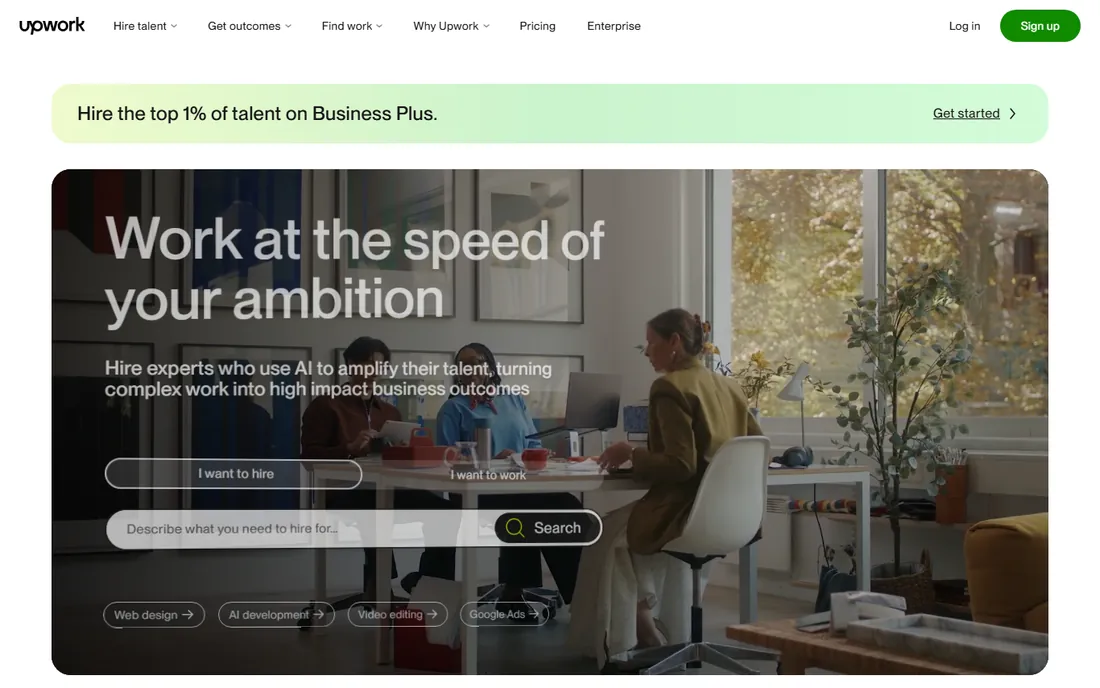
Upwork is the biggest freelance marketplace: almost any skill is here, from mobile development to bookkeeping, and hourly and fixed-price contracts are both supported. Joining is free, clients post jobs free, and payment protection runs through escrow.
The fee structure changed in May 2025 and is worth understanding. Upwork replaced its old flat 10 percent with a variable freelancer fee of 0 to 15 percent, set per contract and shown before you bid. Most freelancers land near 10 percent, per current guides. Upwork is at its best for longer engagements where you want one platform for contracts, time tracking and payments, but you should read the exact fee on each contract before you bid.
What we like- Enormous talent pool with hourly and fixed-price contracts
- Escrow protection on milestones
- Variable fee can be low on some contracts
Watch out for- Fee is set per contract and is hard to predict up front
- Proposal Connects cost money, so applying is not free
Starting priceSee website
Free planYes
Fiverr flips the marketplace model: freelancers package their work as gigs with fixed scopes and prices, and buyers browse and purchase like a storefront. For a client who wants a logo or a landing page rewrite without writing a job post, nothing is faster. Joining is free for both sides, and payment only moves when the order completes.
The catch is the fee. Sellers pay a flat 20 percent on all earnings, including tips, with no volume discount, which is the highest headline cut among the platforms here. Buyers pay a 5.5 percent service fee on top, plus a small flat fee on orders under $200, so the combined take sits around 25 percent. Fiverr is superb for repeatable, well-defined services, but if you sell here, price the commission into your gigs from day one.
What we like- Gig packaging makes pricing predictable for buyers
- Huge category range with quick delivery options
- Order system with payment protection
Watch out for- Flat 20 percent seller commission is the steepest on this list
- Buyer service fee adds 5.5 percent to every order
Starting priceSee website
Free planNo
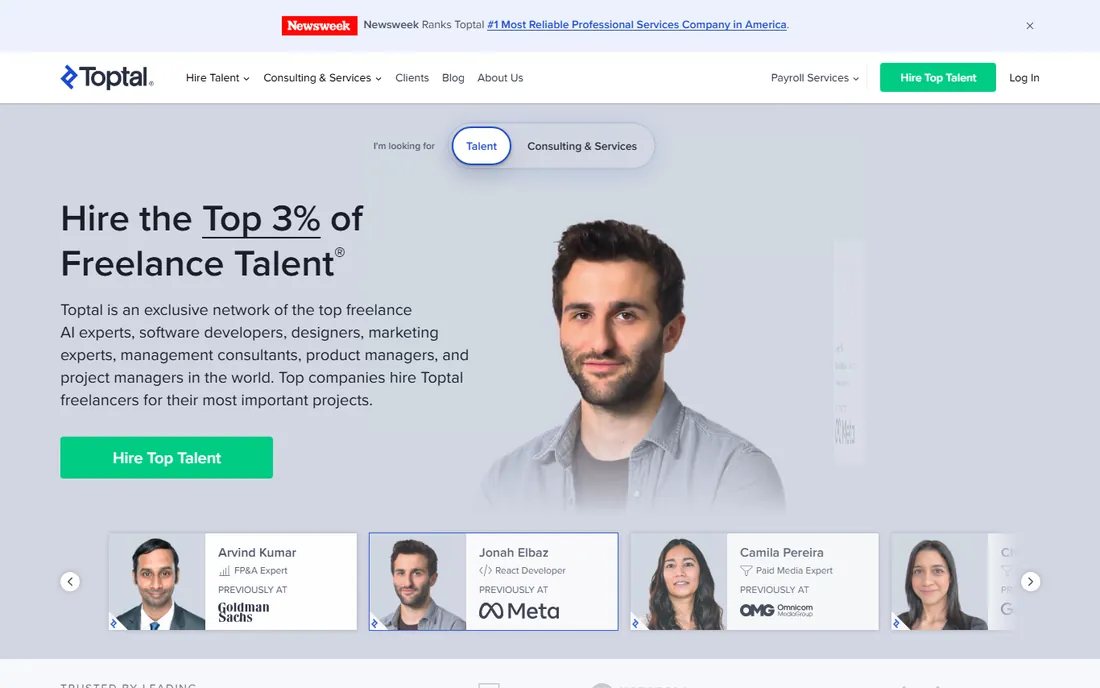
Toptal is a screened talent network, not an open marketplace. Its pitch is the top 3 percent of freelance developers, designers, finance experts and consultants, backed by a trial engagement where the client only pays if satisfied. For a company staffing a high-stakes build, the vetting is the product.
The pricing model is unusual: freelancers receive their full quoted rate with no commission deducted, which makes it one of the most attractive platforms for senior talent that can pass screening. Clients pay the difference through a $79 per month subscription, hourly rates commonly $60 to $150 and up, plus a $500 refundable deposit. Toptal suits buyers who would rather pay premium rates than run their own interview process.
What we like- Freelancers keep 100 percent of their quoted rate
- Screening admits a small fraction of applicants
- Trial period with a fit guarantee
Watch out for- Client costs run high, with a $79 per month subscription and a $500 refundable deposit
- Getting accepted as a freelancer is difficult
Starting priceSee website
Free planYes
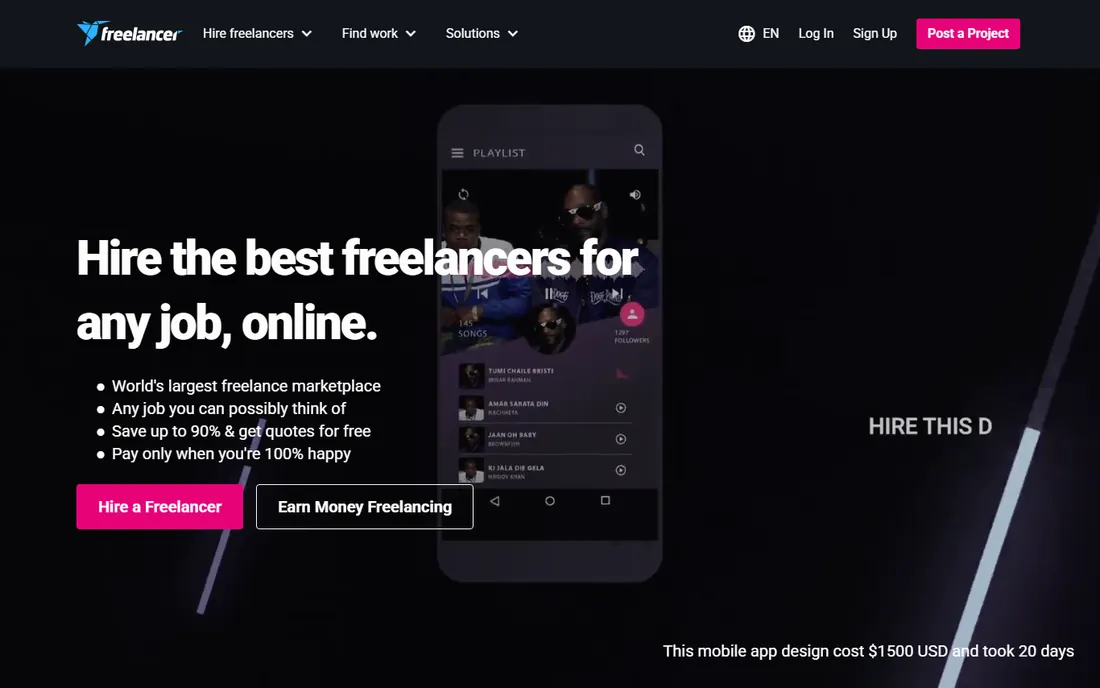
Freelancer.com is one of the oldest open marketplaces, and its scale is still its selling point: post a project free and bids can arrive within the hour. It also runs design contests, where freelancers submit finished concepts and the client awards a prize. Milestone payments hold funds until the client releases them.
Freelancers pay a 10 percent project fee or $5, whichever is greater, on fixed-price work, with the same 10 percent on hourly payments, and clients pay roughly 3 percent. The real caveat is cultural: with so many freelancers bidding openly, prices drift downward, and picking the cheapest bid often buys rework. It works best for well-specified, budget-sensitive projects where you review portfolios carefully instead of sorting by price.
What we like- Free job posting with a huge volume of bids
- Contests let you see design concepts before paying
- Milestone payments protect buyers
Watch out for- 10 percent freelancer fee with a $5 minimum stings on small jobs
- Bidding culture can push rates and quality down
Starting priceSee website
Free planYes
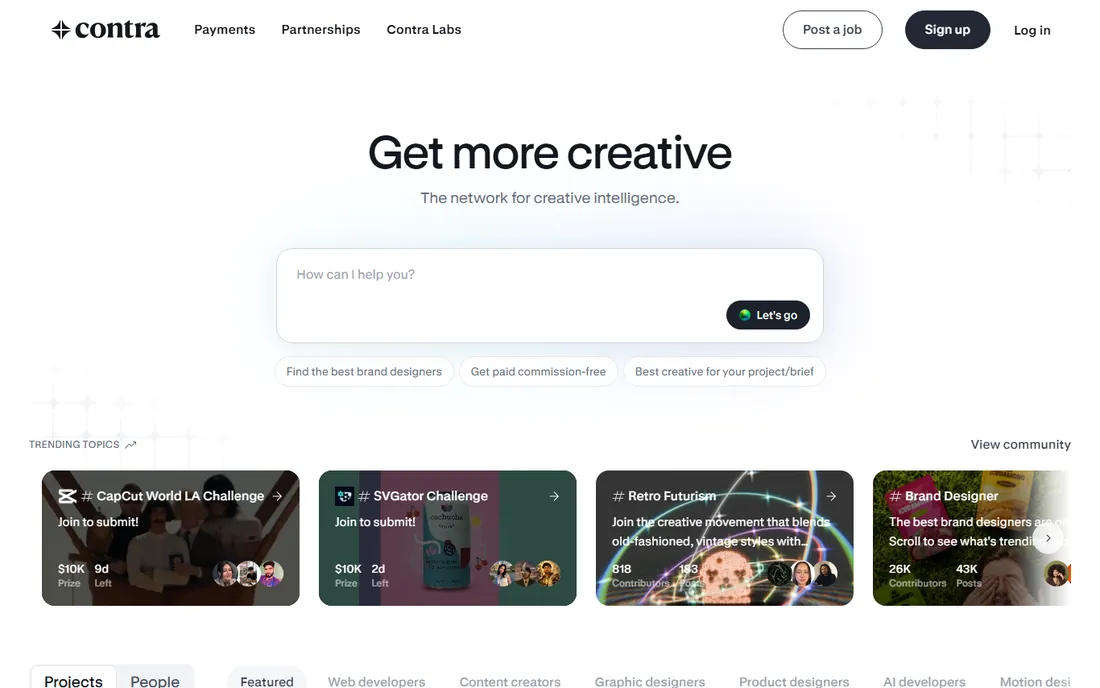
Contra's headline is simple and real: freelancers pay 0 percent commission. The platform makes money from client-side transaction fees (a flat $2 to $29 per payment) and from paid freelancer tiers, so a $1,000 project pays the freelancer $1,000. It is built around portfolios that look genuinely good, with contracts, invoicing and scheduled payments baked in.
The trade-off is discovery. Contra's open job count is a fraction of the big marketplaces, and it skews toward design, writing and video. It shines as a home base for freelancers who already have clients and want a polished place to bill them.
What we like- 0 percent commission for freelancers
- Beautiful portfolio pages that double as a personal brand
- Built-in contracts, invoicing and scheduled payments
Watch out for- Much smaller job volume than Upwork or Fiverr
- Premium tiers are pushed for advanced features
Starting priceSee website
Free planYes
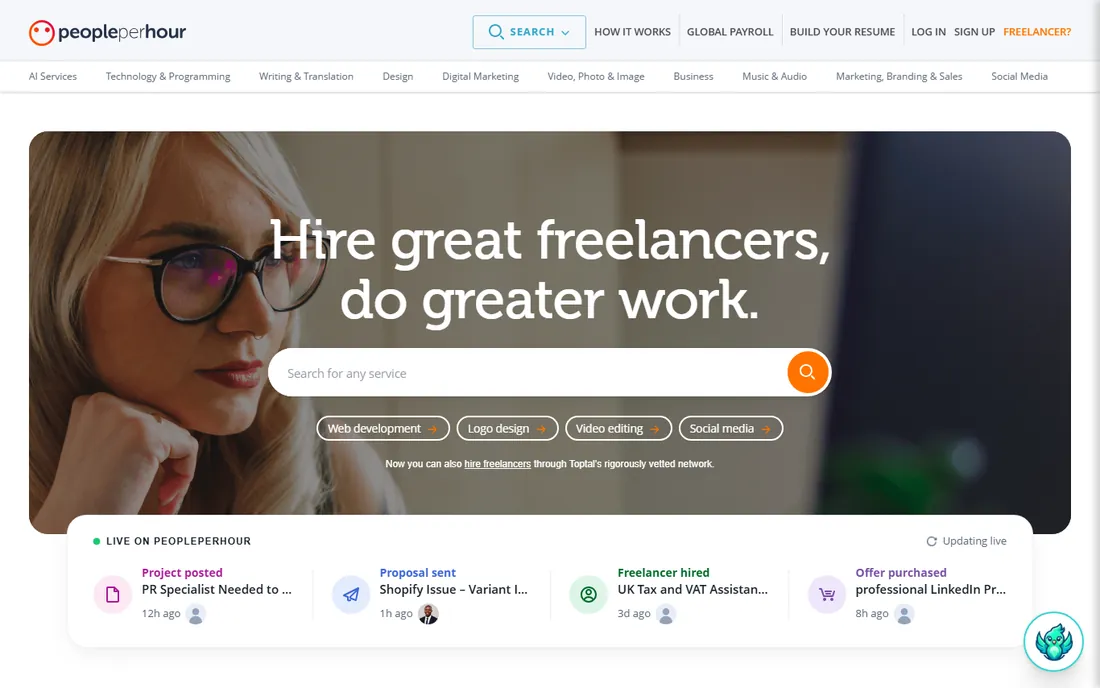
PeoplePerHour is a UK-first marketplace pairing project bidding with Hourlies, its packaged fixed-price services. Every freelancer is reviewed before approval, which keeps quality more consistent than on fully open platforms, and escrow protection covers projects. It is free to join and browse, and buyers can contact freelancers directly.
It is free to join and browse. Its fee schedule rewards repeat business: freelancers pay 20 percent on the first £500 billed to a client, then 7.5 percent, then 3.5 percent above about £5,000 of lifetime billing with that buyer. That structure makes PeoplePerHour one of the cheaper platforms for long client relationships and one of the priciest for first gigs.
What we like- Fee drops to 3.5 percent on high lifetime billing per client
- Hourlies make fixed-price services easy to buy
- Freelancers are hand-reviewed
Watch out for- 20 percent opening fee is steep for first-time client relationships
- Strongest talent density is UK and Europe
#7
Guru
Best for: Ongoing client relationships at lower fees
Visit guru.com
Starting priceSee website
Free planYes
Guru has been running since 1998: agreements support fixed-price, hourly, task-based and recurring payments, and dedicated WorkRooms keep messages, milestones and files attached to each job. SafePay holds client funds in escrow before work begins. Joining and posting jobs is free.
The free tier charges a 9 percent fee, and paid memberships bring it down to 5 percent, which beats Upwork and Fiverr for freelancers billing steady volume. The catch is marketplace size: there are fewer listings here than on the biggest platforms, so it rewards freelancers who bring their own clients and use Guru as a low-fee billing and contract layer.
What we like- Fees as low as 5 percent with a paid membership
- SafePay escrow with flexible payment terms
- WorkRooms keep communication and files in one place
Watch out for- Smaller marketplace and fewer job postings than the giants
- The lowest fees require a monthly membership
#8
Malt
Best for: European freelance hiring, especially France
Visit malt.com
Starting priceSee website
Free planYes
Malt is the leading European freelance marketplace, founded in France in 2013 and now operating across nine countries and regions including Belgium, Germany, the Netherlands, Spain, Switzerland, the UAE and the UK. It covers tech, data, design, marketing and consulting. Projects are insured and compliance handling is built in, which matters for corporate clients.
Malt charges 10 percent per contract for clients found through the platform, dropping to 5 percent after six months of collaboration, and 2 percent if you invite your own clients to bill through Malt. Joining is free. If you sell services to European companies, Malt puts you in front of buyers the US-centric platforms barely reach.
What we like- Strong presence in France and several European markets
- Fee drops with longer client relationships
- Free to create a profile and browse
Watch out for- Weaker coverage outside Europe
- Commission is 10 percent for new client relationships
Starting priceSee website
Free planNo
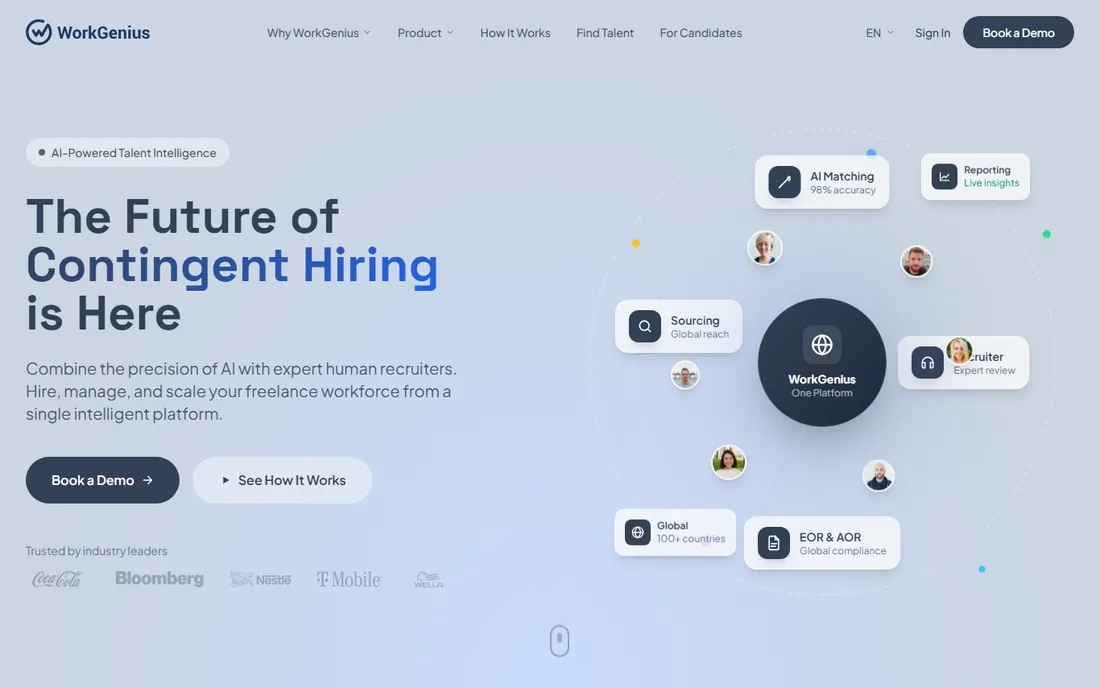
WorkGenius is a freelance management platform aimed at companies running contingent workforce programs. AI scans its talent pool to surface candidates, and human recruiters verify fit, with first matches typically arriving within 48 hours. It handles contracts, classification, payroll and compliance across US states and more than 100 countries.
This is not a place to create a profile and wait for gigs. Engagement starts with a consultation or demo, and pricing is custom rather than published. For enterprises stitching together freelance sourcing, compliance and spend control in one system, it competes with Toptal's enterprise offering rather than with Upwork.
What we like- AI matching combined with human recruiters
- Pre-vetted talent with a top-3-percent bar
- Compliance and employer-of-record coverage
Watch out for- Built for companies, not individual freelancers browsing gigs
- Pricing is quote-based, so costs are opaque
Starting price$2.95 for 14-day access
Free planNo
FlexJobs takes the opposite approach to every other platform here: instead of charging a commission on your earnings, it charges the job seeker a subscription and screens every listing with human reviewers. The result is a job board with no ads, no commission-only postings and no multilevel marketing junk. That screening is the entire value proposition.
Pricing comes from FlexJobs' own pricing page: $2.95 buys 14 days of full access, with longer plans at $9.95 per month for three months or $5.95 per month billed annually, and a money-back guarantee in the first 14 days. There is no free tier, though free members can preview short listing descriptions. It is not a marketplace, so there is no bidding, no escrow and no commission math to do.
What we like- Every listing is hand-screened, so scams and junk are excluded
- 50 plus career categories beyond tech
- Refund available within the first 14 days
Watch out for- No free tier, so you pay before you can apply
- Subscription model makes it a poor fit for one-off gigs
How we chose
We compared these ten platforms on the things that actually decide whether one is worth your time: the full fee structure on both the freelancer and client sides, how talent gets in (open sign-up versus screening), payment protection, and whether the business model suits solo buyers, agencies or enterprises. We read each vendor's own pricing and fee documentation, public help-center pages and current third-party fee comparisons, and we checked community discussion on Reddit and review sites for where the stated terms break down in practice. We did not claim hands-on testing. Where a vendor does not publish its pricing, we say so instead of guessing.
Start from your position, not the platform's marketing. If you are a freelancer selling packaged services, compare the effective take-home: Fiverr's 20 percent versus Guru's 5 percent on a paid plan is a gap of $150 on every $1,000 invoice. If you are a buyer hiring for one project, the client's fee matters more than the freelancer's: several platforms charge the buyer 3 to 10 percent on top of the quoted rate.
Think about where your clients actually are. US buyers cluster on Upwork, Fiverr and Toptal. European buyers are better reached through Malt and PeoplePerHour. Enterprise procurement teams that need compliance and consolidated invoicing should look at WorkGenius or Toptal rather than an open marketplace.
Finally, weigh discovery against cost. The big platforms have the most listings and the highest fees. Smaller platforms like Contra and Guru cost less but ask you to bring your own clients.
Fees, contracts and the fine print
Read the fee page before you commit, because the headline number is rarely the whole story. Proposal credits, subscription tiers and client-side fees all shift the real cost. On Upwork, the per-contract fee is shown before you bid, so check each one. On Fiverr, the buyer fee is added at checkout, so quote accordingly. On Freelancer.com, the $5 minimum fee means tiny tasks carry a disproportionate charge.
Contracts and payment protection deserve equal attention. Escrow systems on Upwork, Freelancer.com, Guru and PeoplePerHour hold funds before work starts, which protects both sides. Contra and Malt build contracts and invoicing into the platform, which matters if you want one system for the paperwork.
Frequently asked questions
Which freelance platform has the lowest fees?
Among general marketplaces, Contra charges freelancers 0 percent, and Guru's paid plan brings its fee down to 5 percent. PeoplePerHour drops to 3.5 percent once you have billed a single client about £5,000. Toptal also takes 0 percent from freelancers, but its clients pay premium rates and a subscription instead.
Is Upwork or Fiverr better for beginners?
Fiverr is easier to start on if your service can be packaged with a fixed scope and price, since buyers come to your gig. Upwork suits beginners who can write strong proposals and want hourly or longer contracts. Both are free to join, but Upwork's proposal Connects cost money while Fiverr charges nothing until you make a sale.
Do freelance platforms take a cut of my earnings?
Almost all of them do. Fiverr takes a flat 20 percent from sellers, Upwork charges a variable 0 to 15 percent per contract, Freelancer.com takes 10 percent, and Malt takes 10 percent dropping to 5 percent over time. The exceptions are Contra and Toptal, which take 0 percent from freelancers and monetize the client side instead, and FlexJobs, which charges job seekers a subscription and takes no commission at all.
Can I use these platforms if I am outside the US?
Upwork, Fiverr, Freelancer.com, Guru and Toptal all operate globally, though payment methods and tax paperwork vary by country. PeoplePerHour and Malt are strongest in the UK and Europe respectively. FlexJobs lists remote jobs across many countries, but some listings are restricted to specific regions, so filter by your location.
Which platform is best for finding remote jobs rather than gigs?
FlexJobs is built exactly for that: every listing is screened by a person, and there are no scams or junk postings, but you pay a subscription to apply.
Should I be on more than one freelance platform?
Usually yes. A common setup is one high-volume marketplace for discovery plus one low-fee platform for billing repeat clients. That way you are not paying 20 percent on work you sourced yourself. Keep your profiles consistent across platforms.
Sources we checked (17)
- https://www.upwork.com
- https://www.fiverr.com
- https://www.toptal.com
- https://www.freelancer.com
- https://contra.com
- https://peopleperhour.com/
- https://guru.com/
- https://malt.com/
- https://workgenius.com/
- https://www.flexjobs.com
- https://www.flexjobs.com/pricing
- https://www.freelancer.pk/feesandcharges
- https://www.lancerwise.com/freelance-platform-fees
- https://colorlib.com/wp/popular-freelance-marketplaces/
- https://which-50.com/freelance-platform-commission-rate-comparison-statistics/
- https://www.legitreviewslab.com/reviews/sites/contra.html
- https://wise.com/en-fr/blog/malt-freelance-platform-france
Is your product missing or out of date?
We review this list regularly. Vendors can request a listing, send updated pricing or ask about featured placement.

Shihab Mia · Founder, Rankite
Shihab has spent more than a decade helping SaaS and e-commerce brands grow through search. He writes Rankite's software buying guides from pricing pages, documentation and public user reviews. More about Shihab.