How we make this list: we compare pricing pages, product documentation and public user reviews. Ratings come from G2, Capterra or Trustpilot, with the date we checked them.

Key takeaways
- Failed payments split into silent fixes, such as retries and card updates, and customer actions, such as card update emails, and the best tools handle both.
- Dedicated dunning tools beat native billing retries when email, SMS, and retry timing need tuning by decline reason.
- Flat monthly pricing suits predictable budgets, while performance-based pricing suits teams that want to pay only on recovered revenue.
- Start with your billing platform: Stripe, Chargebee, Paddle, and Recurly users should check native recovery before adding a tool.
- Measure recovery on cleared payments only, and compare against a baseline, because headline recovery rates hide different counting methods.
Quick comparison
Is your product missing or out of date?
We review this list regularly. Vendors can request a listing, send updated pricing or ask about featured placement.
The best failed payment recovery software
Starting price$269 per month
Free planNo

ChurnBuster suits subscription brands that want a dedicated recovery team without paying a percentage of recovered revenue. It tunes retry timing to each failure, sends branded dunning emails and SMS nudges only when customer action is needed, and offers a no-login card update page on Stripe and Braintree. Cancel flows sit in the same platform, so a team can handle both involuntary churn from failed payments and voluntary churn from cancellations in one place. Month-to-month terms make it easier to test ROI before a longer commitment.
The entry price is the barrier for early-stage brands. At $269 per month for dunning alone in published guides, a business with little failed-payment volume may recover less than the fee. ChurnBuster also works across many subscription platforms, but its deepest fit remains e-commerce and SaaS. Choose it when failed payments already cost more than the monthly fee each month, and when you want a flat, predictable cost.
What we like- Dunning plus cancel flows in one platform
- Flat fee by MRR tier with no share of recovered revenue
- SMS nudges and no-login card update pages
Watch out for- Higher entry price for very small brands
- Main focus on subscription e-commerce and SaaS
Starting price$250 per month
Free planNo
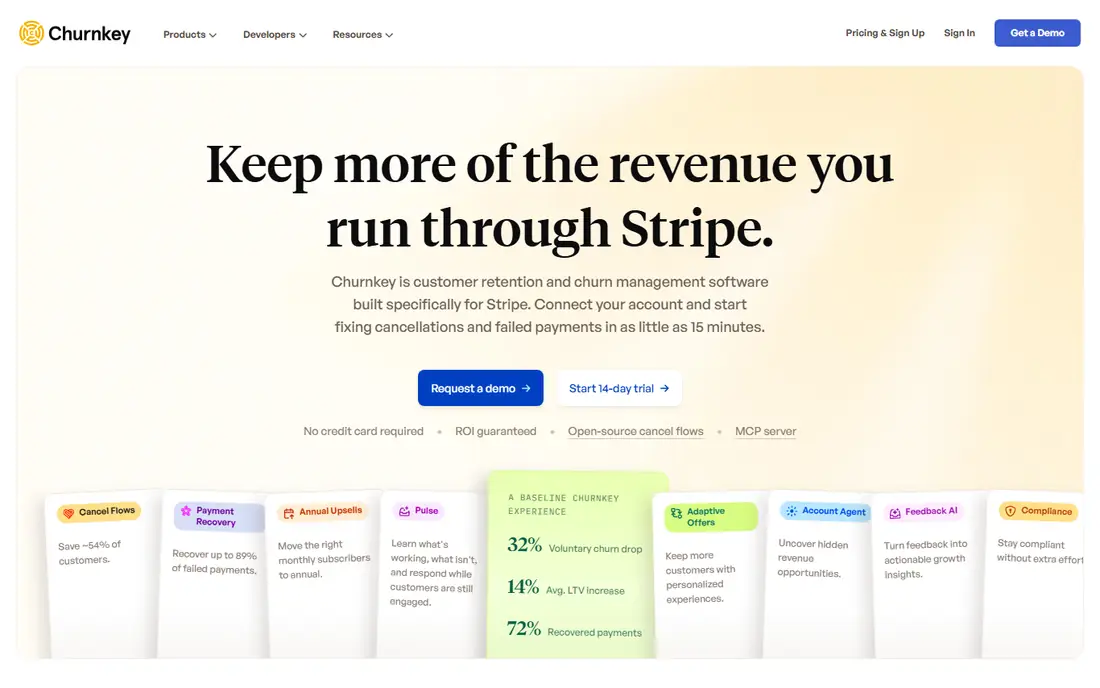
Churnkey is built for SaaS teams on Stripe that want recovery and cancellation prevention together. Connect Stripe and it syncs billing data, runs precision retries, sends dunning campaigns, and shows a failed payment wall when a customer needs to update a card. Cancel flows use the same data, so a team can see why customers leave and test offers to keep them. Setup is reported at about 15 minutes, which matters when engineering time is scarce.
The platform focus is also its limit. Teams billing outside Stripe, Chargebee, or Paddle will not get the same native fit. The $250 starting price for smaller teams means it only pays when churn volume is meaningful. Pick Churnkey when you run on Stripe, want one retention suite for both failed payments and cancellations, and can measure the lift against your current baseline.
What we like- Native Stripe integration with fast setup
- Precision retries and failed payment walls
- Cancel flows and churn analytics in one suite
Watch out for- Stripe, Chargebee, and Paddle focus limits other billing stacks
- Entry price suits teams with real churn volume
Starting price$69 per month
Free planFree trial
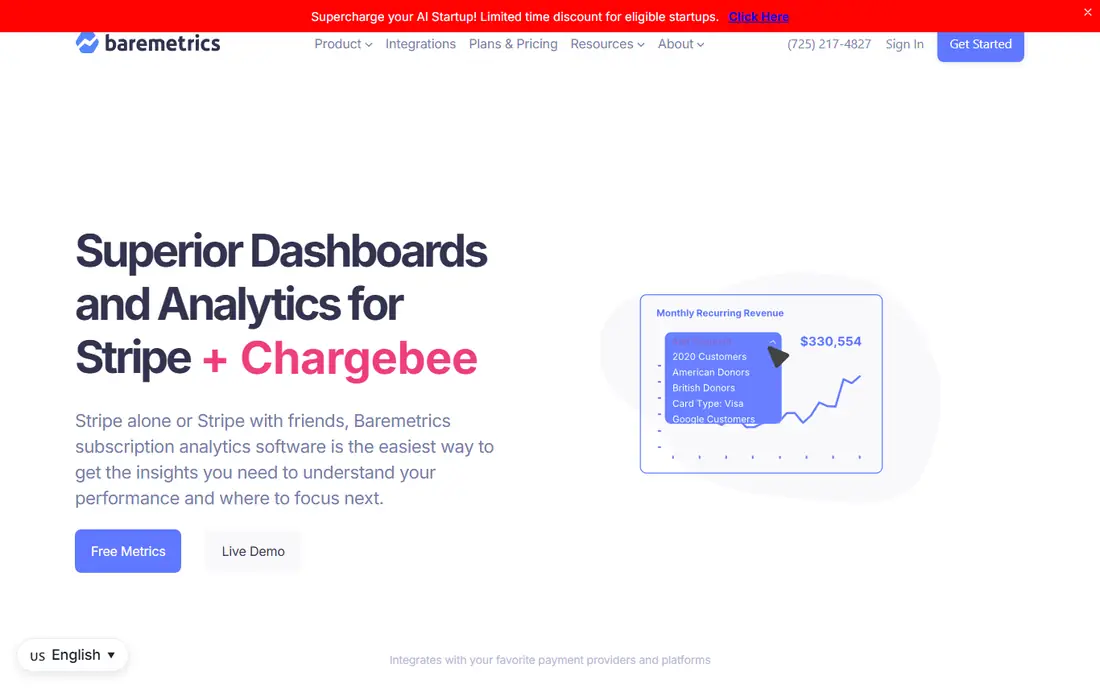
Baremetrics Recover is the budget pick for early-stage SaaS teams already using Baremetrics analytics. It sends drip dunning campaigns, provides a billing update link and widget for card capture, and reports recovered revenue alongside MRR, churn, and benchmarks. That pairing helps a small team see failed payments in context, rather than as an isolated metric. The $69 starting price for Recover at lower MRR tiers makes it accessible before failed payments become a large line item.
It is lighter than ChurnBuster or Churnkey on retry tuning and multi-channel outreach. Teams with high volume, complex decline mixes, or non-Stripe billing may outgrow it. Choose Baremetrics Recover when you already use Baremetrics, want a low-cost recovery layer, and value analytics alongside dunning.
What we like- Low entry price for early SaaS
- Drip campaigns and card capture widget
- Pairs with Baremetrics analytics and benchmarks
Watch out for- Recovery depth is lighter than dedicated dunning specialists
- Best fit is Stripe SaaS only
Starting priceSee website
Free planNo

Chargebee Retention, including its smart dunning features, suits teams that already bill on Chargebee and do not want another vendor in the payment path. Because dunning lives inside billing, retry logic, invoice handling, and customer records stay in one system, with no sync delays or duplicate data. That native fit simplifies reporting and reduces the chance of a retry conflicting with a billing rule. For Chargebee users, it is often the fastest way to improve recovery without a migration.
The drawback is obvious: it is not a standalone tool for Stripe or Recurly users, and moving to Chargebee just for dunning rarely makes sense. Feature depth also depends on your Chargebee plan. Choose it when Chargebee is already your billing system and you want recovery without adding a separate platform.
What we like- Native dunning inside Chargebee billing
- Smart retry logic and customer outreach without a second tool
- Works with existing plans and gateways
Watch out for- Only makes sense inside Chargebee
- Standalone dunning features vary by plan
Starting priceSee website
Free planNo

Paddle Retain, evolved from ProfitWell Retain, serves digital product companies selling through Paddle as merchant of record. It recovers failed payments with tactical retries and dunning, offers no-login payment updates, and adds cancellation flows to cut both involuntary and voluntary churn. Because Paddle handles payments, tax, and compliance, Retain sits close to the transaction data, which helps with retry timing and card updater use. That closeness is valuable for SaaS and app sellers with global customers.
It only applies if you sell through Paddle. Teams on Stripe or another billing stack cannot use it without migrating their sales model. Pricing also varies, with published guides citing $500 per month for smaller companies and performance-based terms for larger ones, so get a quote on your volume. Choose Paddle Retain when Paddle is already your route to market.
What we like- Tactical retries and dunning inside Paddle
- No-login payment updates
- Cancellation prevention in the same retention product
Watch out for- Only for Paddle merchant-of-record sellers
- Pricing varies by company size and model
Starting priceSee website
Free planNo

Recurly Recover suits subscription teams already billing on Recurly. Its retry logic uses network and gateway signals to time retries, rather than a fixed schedule, and dunning workflows follow up when customer action is needed. Because recovery sits inside Recurly, it works with the platform's gateway routing and fraud tools, which can lift first-time authorization rates as well as retry success. That combined effect matters: fewer failures at checkout means fewer recoveries needed later.
As with other native options, it only fits Recurly users, and pricing is contract-based rather than a simple list price. Teams on Stripe or Chargebee should compare dedicated tools instead. Choose Recurly Recover when Recurly is your billing platform and you want recovery tuned to its gateway data.
What we like- Network-informed retry logic inside Recurly
- Dunning workflows without a separate tool
- Gateway routing can lift authorization rates
Watch out for- Requires Recurly billing
- Standalone recovery pricing is contract-based

#7
Stripe Billing Smart Retries
Best for: Native Stripe baseline
Visit stripe.com
Starting priceSee website
Free planNo

Stripe Billing Smart Retries is the baseline every Stripe team should measure against. It retries failed payments on a machine-timed schedule, sends recovery emails when enabled, and uses Stripe's card updater to refresh many expired or reissued cards without customer action. There is no extra vendor to integrate, and the cost sits inside your Stripe Billing setup. For many small teams, that baseline recovers a meaningful share of failures with no added fee or complexity.
The limits appear as volume grows. Stripe's built-in emails are generic compared with segmented dunning campaigns, there is no SMS channel, and retry tuning by customer value or decline reason is limited. Dedicated tools such as ChurnBuster and Churnkey coordinate around Smart Retries rather than replacing them. Start with Smart Retries, measure your baseline, and add a dedicated tool only when the lift covers its fee.
What we like- Built into Stripe Billing with no extra vendor
- Machine-timed retries and recovery emails
- Card updater refreshes many expired cards silently
Watch out for- Email-only customer outreach
- Less tuning than dedicated dunning tools
Starting priceSee website
Free planNo

Slicker takes a different commercial approach: it uses an ensemble of AI models to read decline reason, card type, issuer behavior, and customer history, then decides whether to retry silently or send a personalized email. Emails go out under your brand with a one-click payment link, and only when the failure actually needs customer action. The vendor's AABB testing compares recovered dollars against your current setup with statistical checks, and its pitch is that you do not pay if it does not outperform. Setup is reported at about five minutes with no engineering work.
As a newer vendor, Slicker has less history than ChurnBuster or the native billing platforms, and results-based pricing needs a pilot to understand total cost at your volume. It also focuses on email, so teams that need SMS or human outreach may still need another channel. Choose Slicker when you want AI-tuned retries with a measured proof step, and when you can run a pilot on your own failed-payment data.
What we like- AI models choose retry timing and amount by decline reason
- Emails only when customer action is needed
- AABB testing proves recovered dollars
Watch out for- Newer vendor with less long-term track record
- Pricing is results-based and needs a pilot to size
How we chose
We compared vendor pricing pages, product documentation, and current dunning guides, and we opened each homepage to confirm the product still exists and fits failed payment recovery. We favored tools with a distinct fit, such as Stripe-native, Chargebee-native, Paddle-native, Recurly-native, flat-fee specialist, or AI-measured recovery, over near-identical email tools. One candidate, Butter Payments, was left out because its homepage returned only a verification page during checking. Prices change by MRR tier and billing platform, so where a current list price could not be confirmed, we wrote See website.
Measuring recovery honestly
Count only cleared payments, not emails sent or retries attempted. A tool that retries often can look busy while recovering little, and a tool that sends many emails can annoy customers who would have updated their card anyway. Compare recovered revenue against the same period before the tool, and split results by decline reason, because expired cards, insufficient funds, and stolen cards behave very differently.
Watch customer experience as closely as revenue. Cap email frequency, stop outreach the moment a payment clears, and make card updates easy with a no-login link where your billing platform supports it. Check contract terms too: flat fees are predictable, performance fees align incentives but need a clear definition of recovered revenue, and month-to-month terms let you test without a long lock-in. This is not financial advice; recovery results vary by business model, card mix, and customer base.
Frequently asked questions
What is failed payment recovery software?
It is software that recovers subscription payments after a charge fails, through smart retries, card updater services, and dunning emails or SMS that ask customers to update payment details. It also reports how much revenue was recovered and why payments failed.
Should I use native billing retries or a dedicated dunning tool?
Start with native retries from Stripe, Chargebee, Paddle, or Recurly, then add a dedicated tool when failed payments cost more than its fee. Dedicated tools add segmented messaging, SMS, and decline-aware retry timing that native tools lack.
How much does dunning software cost?
Entry prices in this guide range from $69 per month for Baremetrics Recover to $269 per month for ChurnBuster dunning, with Churnkey from $250 per month. Native billing recovery is included in your billing platform cost, while some tools charge on recovered revenue.
What is the difference between soft and hard declines?
A soft decline, such as insufficient funds or a temporary issuer issue, may succeed on retry, while a hard decline, such as a stolen or closed card, needs a new payment method. Good tools treat them differently instead of retrying every failure on the same schedule.
How do I know if a dunning tool is working?
Measure cleared payments recovered, involuntary churn change, and email and SMS response rates against a baseline period. Use a holdout or AABB test when the vendor offers one, so you can separate the tool's lift from payments that would have recovered anyway.
Sources we checked (8)
- https://churnbuster.io/pricing
- https://churnkey.com/pricing
- https://baremetrics.com/pricing
- https://www.chargebee.com/pricing
- https://www.paddle.com/pricing
- https://recurly.com/pricing
- https://stripe.com/pricing
- https://www.slickerhq.com/pricing
Is your product missing or out of date?
We review this list regularly. Vendors can request a listing, send updated pricing or ask about featured placement.

Shihab Mia · Founder, Rankite
Shihab has 5+ years in B2B and SaaS SEO. He writes Rankite's software buying guides from pricing pages, documentation and public user reviews. More about Shihab.
 ChurnBuster
 Churnkey
 Baremetrics Recover
 Chargebee Retention
 Paddle Retain
 Recurly Recover
 Slicker