How we make this list: we compare pricing pages, product documentation and public user reviews. Rankite is independent; if a vendor ever pays for a featured spot, that listing is clearly labeled Partner.
Key takeaways
- Confluent remains the default pick for enterprises that want Kafka with managed Flink processing, connectors and governance in one contract.
- Redpanda is the strongest alternative when latency matters and you want Kafka compatibility without JVM tuning.
- Materialize and RisingWave suit teams that would rather write SQL than operate a stream processor, sitting downstream of Kafka rather than replacing it.
- If your workload is database CDC into a warehouse, Estuary is purpose-built for that job and simpler than running a full streaming platform.
- Cloud-native teams usually save money and time by starting with their cloud provider's service (MSK, Event Hubs) before adding a multi-cloud vendor.
Quick comparison
| Tool | Best for | Starting price | Free plan |
|---|
 Confluent Confluent | Enterprises standardizing on Kafka | Usage-based, pay as you go | Free trial ($400 credits) |
 Redpanda Redpanda | Low-latency Kafka-compatible streaming | Usage-based | Free trial |
 Aiven for Apache Kafka Aiven for Apache Kafka | Multi-cloud managed open source | From $35/month (Developer tier) | Free trial (credits) |
 Amazon MSK Amazon MSK | AWS-centered teams | Pay as you go (per broker-hour) | No |
 Azure Event Hubs Azure Event Hubs | Microsoft shops and IoT ingestion | Pay as you go (per throughput unit) | Free trial (Azure free account) |
 StreamNative StreamNative | Pulsar-based event streaming | Usage-based, pay as you go | Free trial |
 Materialize Materialize | SQL teams needing live views | Usage-based (compute and storage) | Free trial (14 days) |
 RisingWave RisingWave | Postgres-fluent streaming SQL | Usage-based (compute and storage) | Yes (free Developer tier) |
 Estuary Estuary | Real-time CDC and ELT pipelines | Usage-based | Yes (free tier, 30-day trial) |
Is your product missing or out of date?
We review this list regularly. Vendors can request a listing, send updated pricing or ask about featured placement.
The best event stream processing software
Starting priceUsage-based, pay as you go
Free planFree trial ($400 credits)
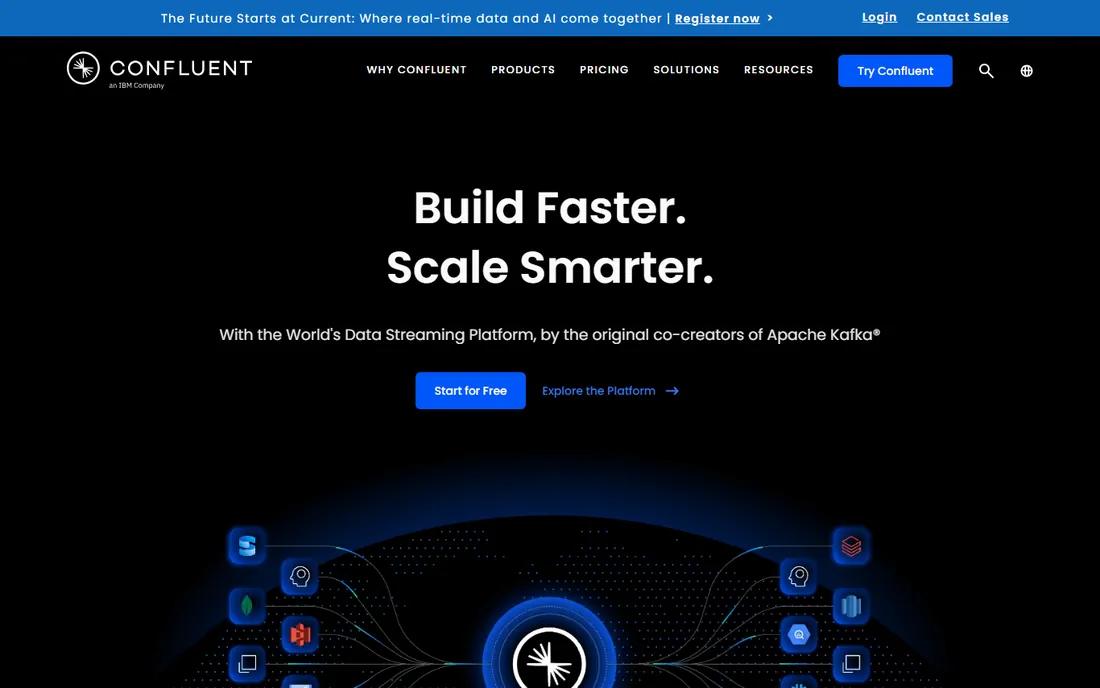
Confluent is the company founded by the creators of Apache Kafka, and its platform is still the reference implementation most enterprises compare everything else against. Confluent Cloud runs on a cloud-native engine with autoscaling, and the surrounding platform covers the pieces raw Kafka leaves to you: a managed schema registry, stream governance, cluster linking for multi-region replication, and Apache Flink for SQL-based stream processing.
The honest catch is the bill. Confluent's pricing is usage-based across several dimensions, and teams routinely discover that connectors and networking outweigh the broker cost. If your main workload is change data capture into a warehouse, a dedicated replication tool will be cheaper. But if you need genuine event streaming with multiple consumers and low-latency delivery, Confluent is the safest enterprise bet.
What we like- Built by the original Kafka creators
- Managed Flink for stream processing
- 120+ pre-built connectors with schema registry and governance
Watch out for- Costs scale fast with connectors and cross-AZ traffic
- The full platform is more than small teams need
Starting priceUsage-based
Free planFree trial
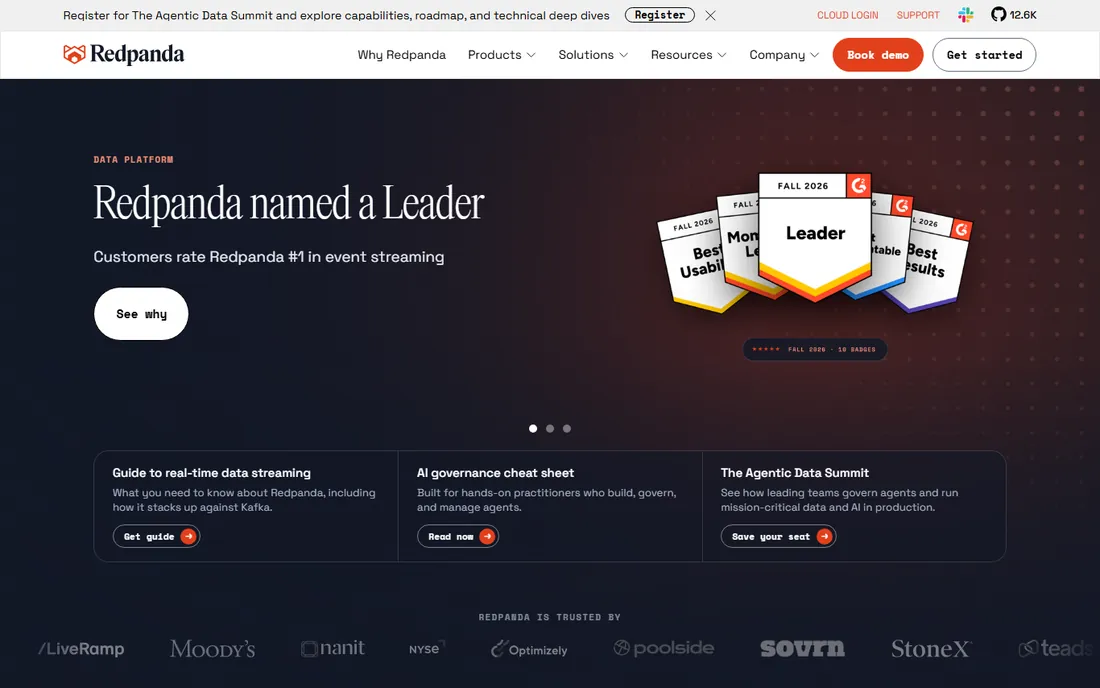
Redpanda rewrote the Kafka protocol in C++ on the Seastar framework, which removes the JVM tuning and ZooKeeper baggage that make Kafka operations painful. Because it speaks the Kafka API, existing producers, consumers and Kafka Connect connectors work without rewrites. The single-binary deployment, built-in schema registry and built-in web console mean a small team can run production streaming without the usual supporting cast of sidecar services.
Its sweet spot is latency-sensitive and Kubernetes-native environments, where predictable tail latency and a smaller resource footprint show up in the infrastructure bill. The tradeoff is ecosystem maturity: Confluent's connector catalog is deeper, and Redpanda's community edition carries a Business Source License rather than Apache 2.0. For greenfield projects that want Kafka semantics with less operational weight, it is the most compelling alternative on this list.
What we like- Kafka API compatible with no JVM or ZooKeeper
- Predictable low tail latency
- Built-in schema registry, HTTP proxy and console
Watch out for- Younger ecosystem than Kafka
- Some advanced Kafka features need workarounds
- BSL license on community edition
#3
Aiven for Apache Kafka
Best for: Multi-cloud managed open source
Visit aiven.io
Starting priceFrom $35/month (Developer tier)
Free planFree trial (credits)
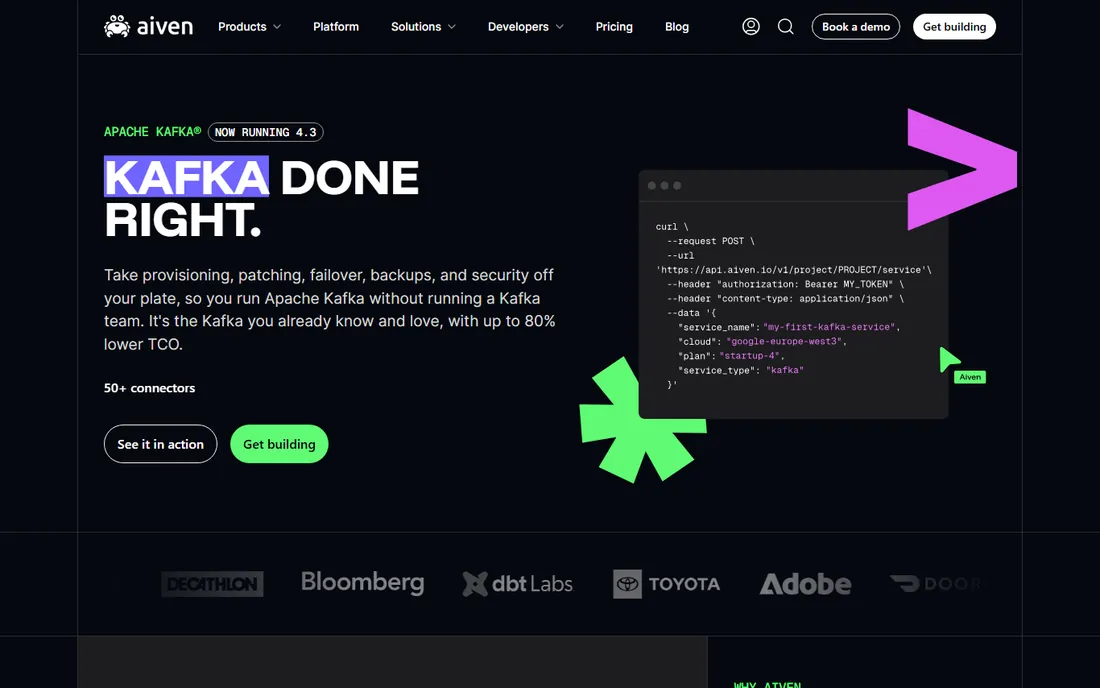
Aiven takes the opposite approach from the cloud-native rewrites: it runs genuine open source Kafka, managed for you, on whichever cloud you prefer. That matters for teams avoiding lock-in, because the same service and the same Terraform provider work across AWS, Google Cloud, Azure, DigitalOcean and UpCloud.
The entry Developer tier starts around $35 a month, which makes it one of the cheapest ways to get a managed Kafka cluster for development and small production workloads. The catch is that you are still operating Kafka conceptually: partitions, consumer groups and retention need the same design care as self-managed clusters. Teams that want a single vendor for Kafka plus Postgres, OpenSearch and caching alongside it will find Aiven's platform story attractive.
What we like- Runs unmodified open source Kafka on AWS, GCP, Azure and others
- Strong Terraform and API support
- One vendor for the whole data stack
Watch out for- It is still Kafka underneath, with Kafka's learning curve
- Pricing is plan-based rather than truly serverless
Starting pricePay as you go (per broker-hour)
Free planNo
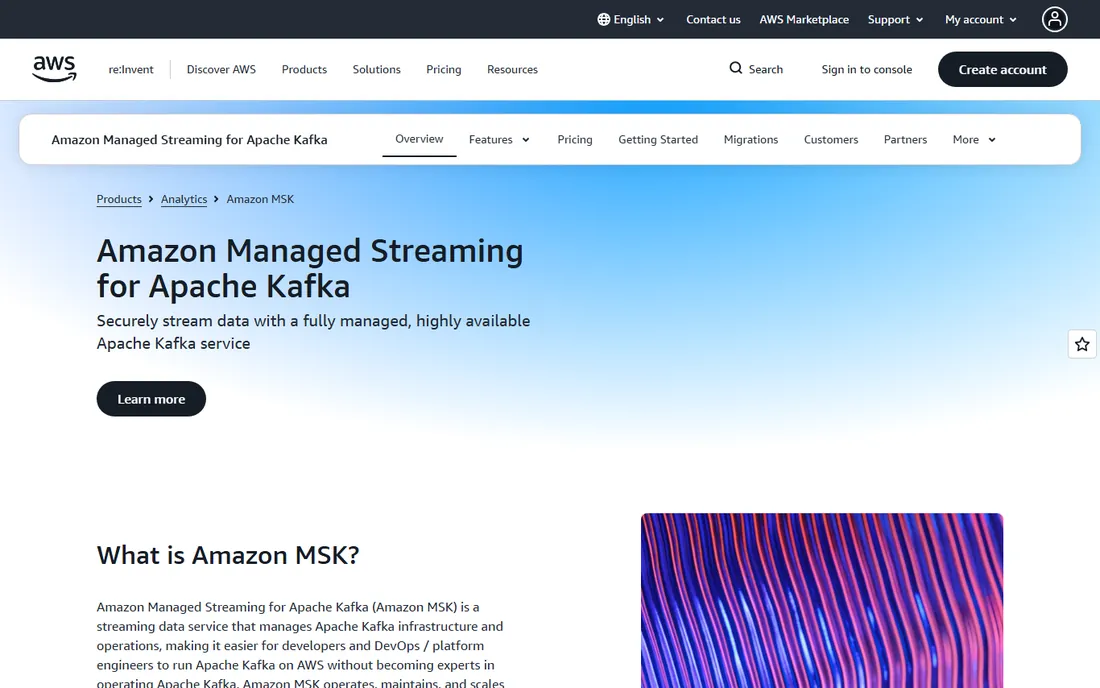
Amazon Managed Streaming for Apache Kafka is the path of least resistance if your infrastructure already lives in AWS. MSK provisions brokers across availability zones, handles patching and failure recovery, and plugs into the AWS services you already use: IAM for authentication, Glue for schema registry, Lambda and Amazon Managed Service for Apache Flink for processing. There are no upfront commitments, and you pay for the broker capacity you run.
MSK comes in provisioned and serverless flavors, and MSK Connect runs Kafka Connect connectors without separate infrastructure. The limitations are the usual AWS ones: you are tied to one cloud, and MSK does not abstract away all Kafka operations, so your team still needs to understand topics, partitions and consumer lag. For single-cloud organizations, pricing MSK first is usually the right move, because the integration savings are real even when the sticker price looks similar to a third-party managed service.
What we like- Fully managed Kafka inside your VPC
- Integrates with IAM, Glue schema registry, Lambda and managed Flink
- No upfront commitment
Watch out for- AWS-only by design
- Some Kafka version upgrades lag
- Monitoring and tuning still partly your job
Starting pricePay as you go (per throughput unit)
Free planFree trial (Azure free account)
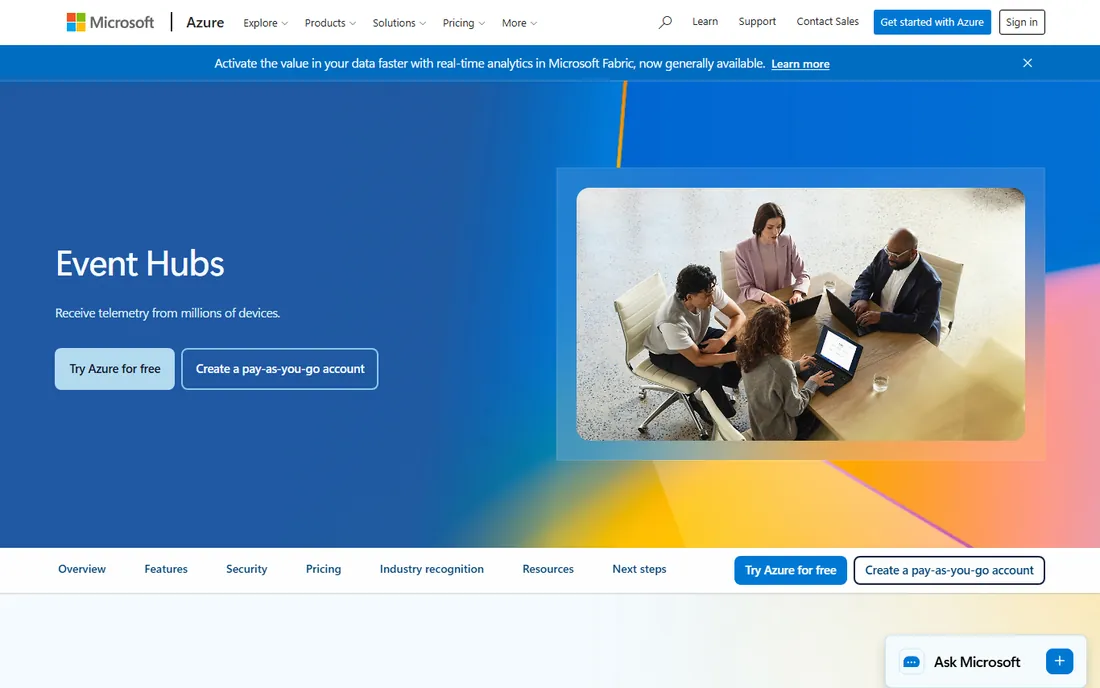
Azure Event Hubs is Microsoft's fully managed event ingestion service, and it is the natural choice for organizations standardized on Azure. It can ingest millions of events per second with low latency, supports AMQP, HTTPS and a Kafka-compatible endpoint, so existing Kafka producers can point at it without code changes. Integration with Stream Analytics, Azure Functions and Microsoft Fabric makes it easy to build an end-to-end serverless streaming pipeline without leaving the Azure portal.
The pricing model is throughput-unit based with several tiers, and costs can surprise teams that do not model their event volume carefully. Data retention tops out at 7 days on Standard and 90 days on Premium or Dedicated, so long-term storage needs a downstream sink like Data Lake or a warehouse. If your company runs on Microsoft 365 and Azure Active Directory, the identity integration alone often justifies the choice.
What we like- Ingests millions of events per second
- Built-in Kafka endpoint for existing clients
- Deep integration with Stream Analytics and Fabric
Watch out for- Pricing gets complex at scale
- Retention is limited (7 days standard, 90 on premium)
- Azure lock-in
Starting priceUsage-based, pay as you go
Free planFree trial
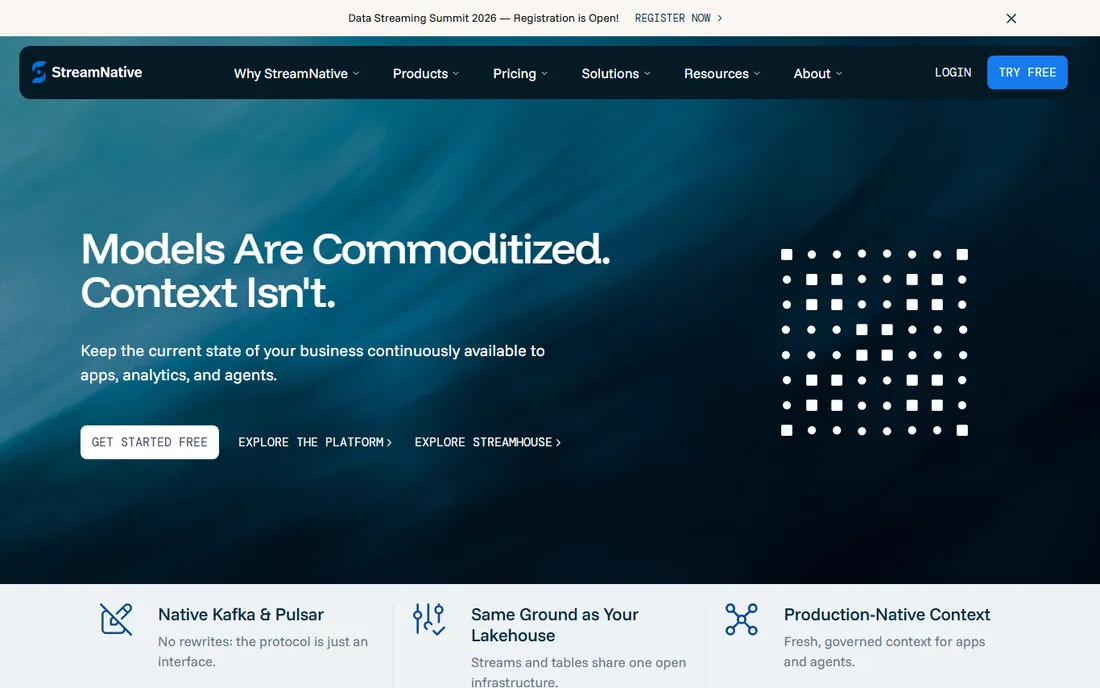
StreamNative is the commercial company behind Apache Pulsar, founded by the project's original creators. Pulsar's architecture separates serving from storage, which gives it two advantages over Kafka: true multi-tenancy and clean geo-replication across regions. StreamNative Cloud offers it fully managed with hosted, bring-your-own-cloud and private-license deployment options, and newer releases added Kafka protocol compatibility so existing Kafka workloads can migrate without rewrites.
Pulsar is a strong technical fit for large organizations that need strict tenant isolation or active-active replication, and StreamNative has been expanding toward lakehouse and AI workloads with its streamhouse positioning. The honest weakness is ecosystem size: Kafka's connector and tooling universe is far larger, and StreamNative's pricing tends to be quote-based rather than transparent. Choose it when Pulsar's architectural strengths map to a real requirement, not just as a novelty.
What we like- Built by the original Pulsar creators
- Multi-tenancy and geo-replication are native
- Kafka protocol support eases migration
Watch out for- Pulsar's ecosystem is smaller than Kafka's
- Managed pricing is quote-driven
- Fewer third-party integrations
Starting priceUsage-based (compute and storage)
Free planFree trial (14 days)
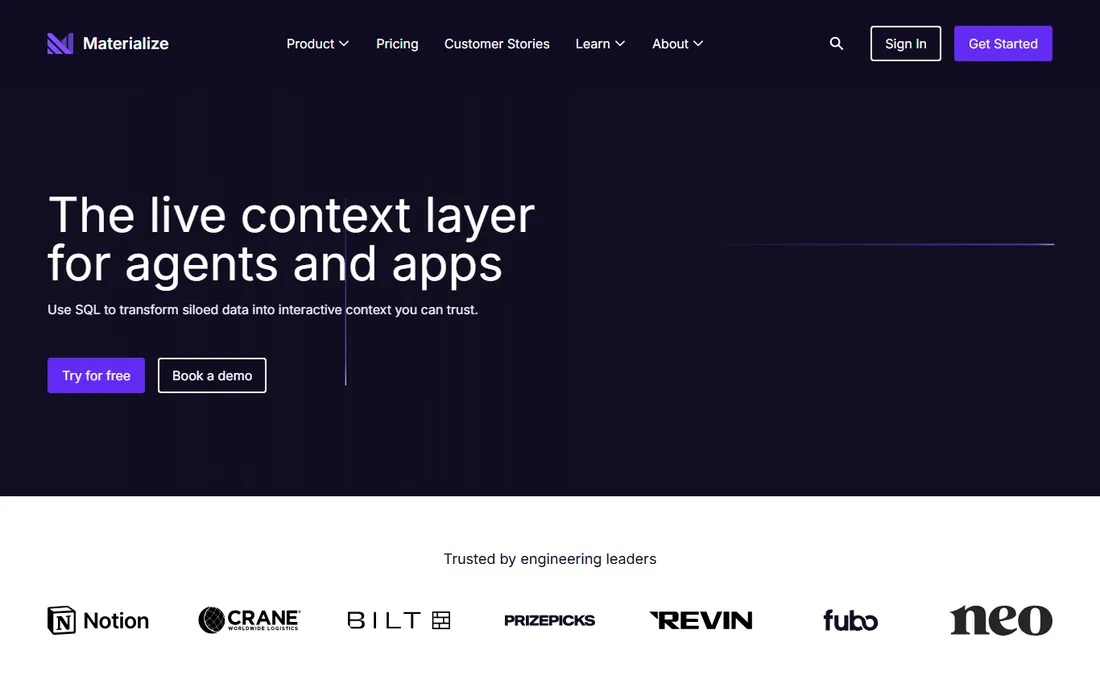
Materialize is a streaming database, not a message broker: it sits downstream of Kafka or your operational databases and keeps SQL views continuously up to date as new data arrives. Any engineer who knows SQL can define a materialized view and query it with single-digit millisecond latency, which makes it a practical way to build live dashboards and real-time APIs without writing stream-processing code.
The important distinction is that Materialize does not transport events; you still need Kafka, Redpanda or a CDC pipeline feeding it. It is also resource-intensive by nature, since maintaining incrementally updated views costs compute, and very complex view graphs need care. For teams whose bottleneck is serving fresh results to applications rather than moving the events themselves, it removes an entire layer of consumer code.
What we like- Standard SQL creates incrementally maintained materialized views
- Strong consistency
- Serves queries directly without a separate database
Watch out for- It complements Kafka rather than replacing it
- Resource usage grows with view complexity
- Smaller community than Flink
Starting priceUsage-based (compute and storage)
Free planYes (free Developer tier)
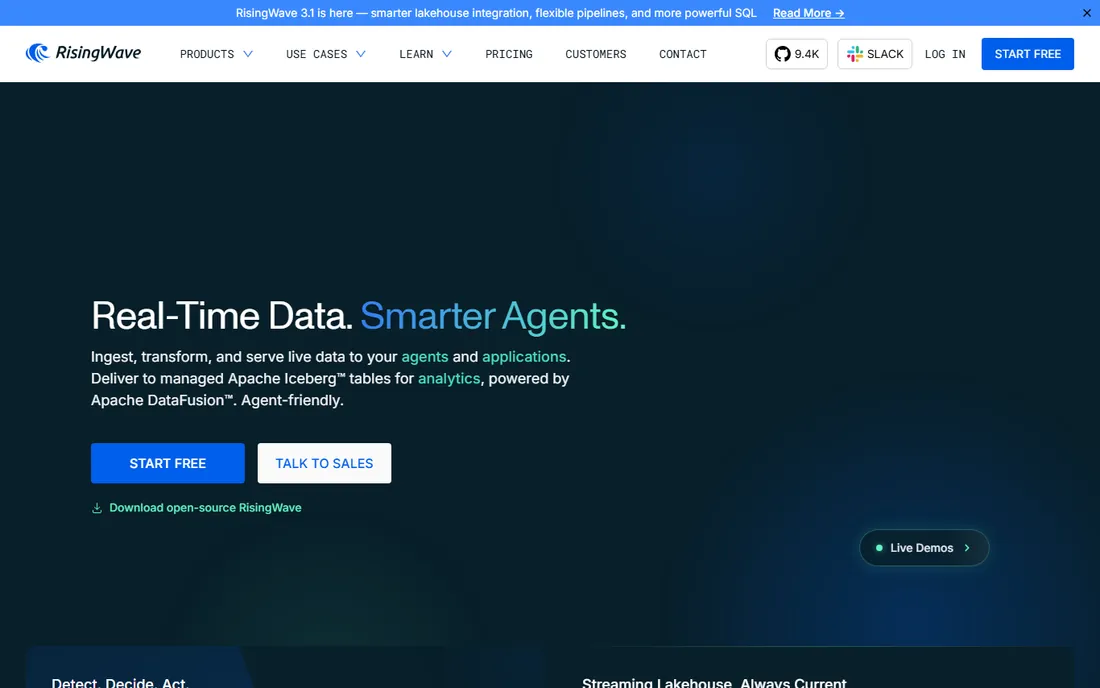
RisingWave takes the same streaming-database idea as Materialize but leans harder into PostgreSQL compatibility: you connect with psql or any Postgres driver and write standard SQL to define sources, materialized views and sinks. It ingests from Kafka, database CDC, S3 and other sources, keeps views incrementally updated with exactly-once semantics, and serves queries directly, which removes the need for a separate serving database or cache in many architectures. The core engine is Apache 2.0 licensed, and the cloud service offers a free Developer tier.
For a Postgres-fluent team, the learning curve is close to zero, and features like managed state on object storage and fast failure recovery address real Flink pain points. The caveats are its youth as a project and the reality that SQL-expressible workloads are its sweet spot; workloads needing custom operators or complex event pattern matching still belong on Flink. It is an excellent default for streaming ETL, real-time dashboards and alerting pipelines.
What we like- PostgreSQL wire-compatible, so existing tools just connect
- Apache 2.0 open source core
- Built-in serving with no downstream database needed
Watch out for- Young project with a smaller community
- Very complex event patterns may still need Flink
- Managed pricing is usage-based and variable
Starting priceUsage-based
Free planYes (free tier, 30-day trial)
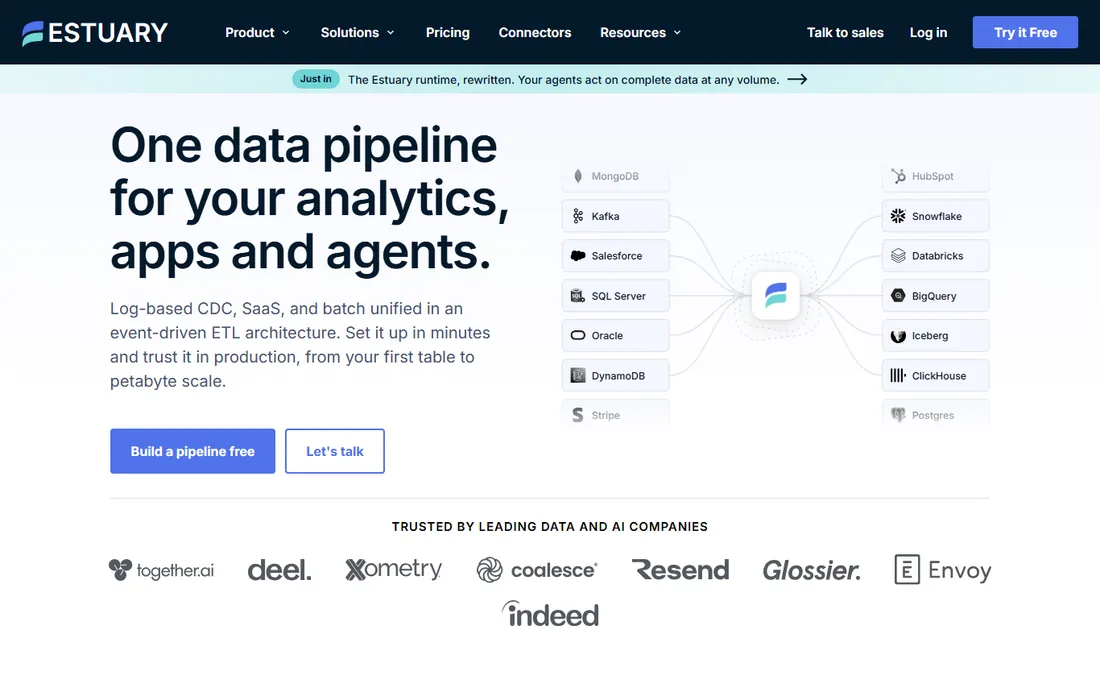
Estuary Flow unifies CDC, streaming and batch ELT in one managed platform, and it is the most direct answer when the job is "get data out of production databases into the warehouse or lakehouse in real time." Connectors capture inserts, updates and deletes with log-based CDC, land them in collections, and materialize to destinations like Snowflake, BigQuery, Databricks or Kafka-compatible endpoints. Setup takes minutes, no credit card is required for the trial, and there is a free tier for small volumes.
Estuary is not a replacement for Kafka as an application messaging backbone; it is the pipeline layer that feeds analytics and downstream systems. Its strength is eliminating the custom CDC code and batch jobs that teams otherwise maintain by hand, with schema evolution and backfills handled automatically. If your streaming initiative is really a data integration project wearing a streaming costume, start here before buying a broker.
What we like- Log-based CDC from databases with exactly-once delivery
- No-code setup in minutes
- Kafka-compatible API for streaming use cases
Watch out for- It is a data integration platform, not a general event broker
- Advanced transformations are lighter than a full stream processor
How we chose
We compared platforms that are actively maintained and generally available in 2026, drawing on vendor pricing pages, product documentation, public reviews on G2 and Capterra, and engineering discussions on Reddit and Hacker News. Every tool above exists today and fits the event stream processing category, though they split into three jobs: transporting events (Confluent, Redpanda, Aiven, MSK, Event Hubs, StreamNative), processing them with SQL (Materialize, RisingWave), and moving them into analytics systems (Estuary). We weighted managed-service quality, protocol compatibility, pricing transparency and fit for small to mid-size teams, and we did not count vendor marketing claims as evidence. No hands-on testing was performed; the write-ups reflect documented features and reported user experience.
What to look for before you buy
Start by naming the actual workload, because "streaming" covers three different purchases. If services need to exchange events with replay and ordering guarantees, you are buying a broker and should compare Confluent, Redpanda, Aiven, MSK, Event Hubs and StreamNative. If the events already exist and you need fresh results served to dashboards or APIs, a streaming database like Materialize or RisingWave may replace a fleet of consumer services. If the goal is fresh data in the warehouse, a CDC platform like Estuary is usually cheaper and simpler than a full streaming stack.
Then check the cost dimensions that surprise buyers. Broker bills are driven by throughput, retention, partitions, connectors and cross-availability-zone traffic, not just the cluster size, so model a realistic month with your event volume before committing. Ask how schema evolution is handled, what exactly-once guarantees cover (producing, processing, or both), and how you get data out again if you leave. Confirm the Kafka protocol version supported if you plan to reuse existing clients, and check whether the managed service runs in your cloud region with the compliance certifications your customers require. Finally, run the proof of concept on production-shaped data, not a demo topic with ten events a second.
Managed service or self-hosted: the real cost question
The sticker price of a managed streaming service always looks higher than self-hosting until you count the engineering time. Running Kafka yourself means owning ZooKeeper or KRaft operations, broker upgrades, partition rebalancing, connector hosting, monitoring and on-call rotations, which is easily a full engineer or more once you pass modest scale. Managed services convert that into a bill, and the right comparison is the bill against the loaded cost of the people who would otherwise carry the pager.
Self-hosting still makes sense for strict data residency, unusual networking, or scale where owned hardware clearly wins on unit economics. A practical middle path is to start managed, learn your real throughput and retention patterns for six months, and only then decide whether bringing it in-house saves money. Most small and mid-size teams never reach the scale where self-hosting wins.
Frequently asked questions
Do I need Kafka to do event stream processing?
Not necessarily. Kafka is the most common transport, but the processing layer is a separate decision: managed Flink, ksqlDB, Materialize, RisingWave and cloud services like Stream Analytics all process streams, and some teams never run Kafka at all. What matters is matching the tool to the workload: transport, processing, or integration. Many architectures use a broker for transport plus a SQL engine for processing.
What is the difference between event streaming and message queuing?
Message queues are built for task distribution with per-message acknowledgement, while streaming platforms keep an ordered, replayable log that multiple consumers read independently. If consumers need to rewind and reprocess history, you want a log-based platform. If each message goes to exactly one worker, a queue is simpler and cheaper.
How much does event streaming cost at small scale?
A development or small production workload typically runs from tens to a few hundred dollars a month on managed services: Aiven's Developer tier starts around $35 a month, serverless options bill near zero at low volume, and most vendors offer trial credits. Costs climb with throughput, retention, partitions and connectors, so the proof of concept should use realistic volumes.
Can I migrate from Kafka to Redpanda or Pulsar without rewriting applications?
Redpanda speaks the Kafka protocol, so existing Kafka clients usually connect without code changes, and StreamNative has added Kafka compatibility to Pulsar for the same reason. Migration still requires planning around schema registries, connectors and security configuration. Test consumer behavior carefully before cutting over production traffic.
When should I choose a streaming database instead of Flink?
When the processing logic is expressible in SQL: aggregations, joins, windowing, filtering and CDC enrichment. Streaming databases remove the need to write, deploy and operate Flink jobs for these workloads. Flink remains the right choice for custom operators and complex event pattern detection that SQL cannot express.
Is self-hosted Kafka still worth it in 2026?
For teams with the operational skill and sufficient scale, yes: the software is free and the unit economics can beat managed services at high throughput. The cost is engineering time for operations, upgrades and on-call coverage. Most small and mid-size companies find managed services cheaper once staff time is counted honestly.
Sources we checked (12)
- https://www.confluent.io/
- https://aiven.io/kafka
- https://aws.amazon.com/msk/
- https://azure.microsoft.com/en-us/products/event-hubs
- https://streamnative.io/
- https://materialize.com/
- https://risingwave.com/
- https://estuary.dev/
- https://redpanda.com
- https://github.com/ishandutta2007/awesome-streaming-etl/blob/HEAD/README.md
- https://estuary.dev/blog/confluent-alternatives/
- https://www.g2.com/products/redpanda-streaming/competitors/alternatives
Is your product missing or out of date?
We review this list regularly. Vendors can request a listing, send updated pricing or ask about featured placement.

Shihab Mia · Founder, Rankite
Shihab has spent more than a decade helping SaaS and e-commerce brands grow through search. He writes Rankite's software buying guides from pricing pages, documentation and public user reviews. More about Shihab.