How we make this list: we compare pricing pages, product documentation and public user reviews. Rankite is independent; if a vendor ever pays for a featured spot, that listing is clearly labeled Partner.
Introduction
Enterprise AI agent platforms have moved from pilot projects to boardroom budgets. The pitch is straightforward: instead of chatbots that answer questions, agents take action, resolving tickets, triaging incidents, qualifying leads and executing multi-step workflows across your systems. The catch is governance. Enterprises need agents that respect permissions, stay within guardrails and leave audit trails.
The market splits into two camps. The big platform vendors, Microsoft, Salesforce, ServiceNow, Google and UiPath, sell agents as part of broader enterprise suites. The specialists, Kore.ai, Cognigy, Rasa, Botpress and Glean, focus on specific jobs like contact centers, employee search or developer-friendly agent building.
This guide compares nine platforms, looking at how each one builds agents, what it connects to, and which enterprise use case it fits best.
Key takeaways
- Microsoft Copilot Studio and Salesforce Agentforce are the default choices if you already live in Microsoft 365 or Salesforce.
- ServiceNow AI Agents pair with its workflow platform, and the Moveworks acquisition strengthened its employee-facing agent story.
- Kore.ai, Cognigy and Rasa are specialist picks for customer service and contact center automation at scale.
- Botpress offers the most accessible entry point, while Glean excels at permission-aware agents grounded in company data.
- Google Agentspace is now part of Gemini Enterprise, so Google buyers should evaluate the platform under its current name.
Quick comparison
| Tool | Best for | Starting price | Free plan |
|---|
 Microsoft Copilot Studio Microsoft Copilot Studio | Enterprises building agents inside the Microsoft ecosystem | See website | No |
 Salesforce Agentforce Salesforce Agentforce | Salesforce customers automating sales, service and commerce | See website | No |
 ServiceNow AI Agents ServiceNow AI Agents | Automating IT, HR and customer workflows on the ServiceNow platform | See website | No |
 UiPath UiPath | Enterprises combining AI agents with RPA and process automation | See website | No |
 Kore.ai Kore.ai | Large enterprises standardizing on one agent platform across departments | See website | No |
 NiCE Cognigy NiCE Cognigy | Contact centers deploying voice and chat AI agents at scale | See website | No |
 Rasa Rasa | Product teams building customer-facing AI agents in-house | See website | No |
 Botpress Botpress | Teams that want an accessible, action-taking support agent platform | See website | Yes |
 Glean Glean | Permission-aware agents grounded in all of your company's data | See website | No |
Is your product missing or out of date?
We review this list regularly. Vendors can request a listing, send updated pricing or ask about featured placement.
Starting priceSee website
Free planNo
Copilot Studio is Microsoft's platform for building AI agents, available both as a web app and inside Teams. Makers create agents with natural language, connect them to business data through prebuilt or custom plugins, and publish across websites, mobile apps, Teams and other channels supported by Azure Bot Service.
The real power comes from the Microsoft stack. Agents can extend Microsoft 365 Copilot with enterprise data and scenarios, and Dataverse provides the data backbone. Agent flows automate repetitive tasks triggered manually, on schedule or by other agents. For IT departments already running Power Platform, the learning curve is short.
Pricing follows the Microsoft model: pay-as-you-go, pre-purchase capacity and M365 Copilot add-ons, with a free trial to start. Non-Microsoft shops will find less value here, but for the enormous installed base of Microsoft 365, this is the natural agent platform.
What we like- Deep Microsoft 365 integration, low-code builder, huge connector library
Watch out for- Tied to Microsoft licensing, costs add up with Copilot licenses
#2
Salesforce Agentforce
Best for: Salesforce customers automating sales, service and commerce
Visit salesforce.com
Starting priceSee website
Free planNo
Agentforce is Salesforce's agentic layer, built on top of the Customer 360 data model. Agents get native access to customer history, accounts and records without complex integration work, and they can take real actions: creating cases, updating records, sending emails and processing orders.
The platform centers on Agent Builder, a low-code tool for configuring agents, plus pre-built templates for service, sales development and sales coaching. The Trust Layer provides enterprise governance with audit trails, data masking and toxicity detection. Multi-agent orchestration lets agents work as a coordinated team across sales, service and commerce.
Pricing runs on Flex Credits or per-conversation models, which aligns cost with value but can surprise at scale. Agentforce is strongest for organizations where Salesforce is already the system of record; without that foundation, much of the advantage disappears.
What we like- Native Customer 360 context, low-code Agent Builder, Trust Layer governance
Watch out for- Requires Salesforce foundation, per-conversation pricing scales quickly
#3
ServiceNow AI Agents
Best for: Automating IT, HR and customer workflows on the ServiceNow platform
Visit servicenow.com
Starting priceSee website
Free planNo
ServiceNow's AI Agents act across IT, HR, customer service and security, embedded in the ServiceNow AI Platform rather than bolted on. AI Agent Studio lets teams build and customize agents with natural language, while the AI Agent Orchestrator coordinates teams of agents on complex workflows. AI Control Tower provides centralized governance for ServiceNow and third-party agents alike.
The platform supports voice agents, web agents that navigate browser-based apps and desktop agents that automate work where no API exists. The Model Context Protocol client and Agent2Agent protocol connect agents to external tools and to each other.
A notable addition to the story: ServiceNow acquired Moveworks, the employee AI assistant company, strengthening its position in employee-facing agents. For existing ServiceNow customers, this is the obvious agent platform; others face a significant platform commitment.
What we like- Built into the workflow platform, AI Agent Studio, strong governance via Control Tower
Watch out for- Requires ServiceNow deployment, premium pricing on top of base licenses
#4
UiPath
Best for: Enterprises combining AI agents with RPA and process automation
Visit uipath.com
Starting priceSee website
Free planNo
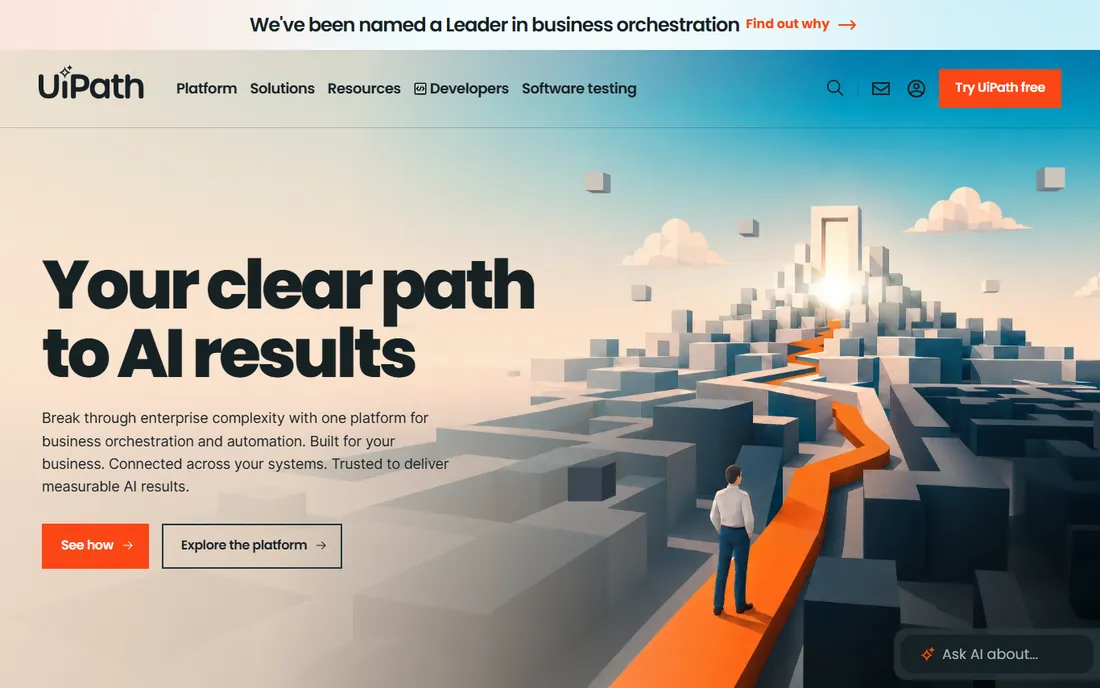
UiPath repositioned itself from RPA leader to agentic automation platform, unifying AI agents, robots and people on one system. The three-layer model covers orchestration (coordinating work across AI, people and systems), execution (agents reason, robots act, people decide) and governance (every action captured in a regulator-ready record).
Maestro Flow, the developer-first orchestration layer, coordinates agents, robots, APIs, documents and people within single flows, running on the same governed engine enterprises already trust for automation. Ready-to-deploy solutions target banking, healthcare, finance and manufacturing with prebuilt agentic workflows.
UiPath fits organizations that already automate with RPA and want agents inside the same governed environment. It is less about building a chatbot and more about running complete business processes where agents handle judgment and robots handle repetition.
What we like- Agents plus robots plus people on one platform, strong governance, durable orchestration
Watch out for- Platform breadth can be complex, pricing is enterprise-grade
#5
Kore.ai
Best for: Large enterprises standardizing on one agent platform across departments
Visit kore.ai
Starting priceSee website
Free planNo
Kore.ai has spent over a decade building enterprise AI, and its Agent Platform now spans customer experience, employee productivity and process automation. The current Artemis edition frames the platform as the harness for the agentic enterprise: build, deploy, govern and optimize multi-agent systems with governance defined before any agent goes live.
The model-agnostic approach lets enterprises choose their preferred LLMs, clouds and systems, avoiding lock-in. Prebuilt solutions like BankAssist, HealthAssist and HR Assist accelerate deployment in regulated industries, and the company claims more than 500 Global 2000 customers.
A newer Agent Management Platform adds a control layer for AI sprawl, governing agents built on other frameworks like LangGraph, CrewAI and Microsoft Foundry. Kore.ai suits large organizations that want one governed platform for agents across the whole business.
What we like- Model-agnostic architecture, prebuilt industry solutions, strong governance
Watch out for- Enterprise sales cycle, platform depth requires dedicated teams
#6
NiCE Cognigy
Best for: Contact centers deploying voice and chat AI agents at scale
Visit cognigy.com
Starting priceSee website
Free planNo
Cognigy, now a NiCE company, is the contact center specialist of this list. Its platform deploys AI agents across voice, chat and messaging channels, with voice AI that handles empathetic phone conversations at scale and an Agent Copilot that assists human service agents in real time.
The enterprise credentials are strong: large brands in automotive, airlines, healthcare and retail run millions of automated conversations annually on the platform, and it was named a Leader in the Forrester Wave for conversational AI platforms for customer service. Knowledge AI grounds answers in enterprise sources like SharePoint and Confluence.
Cognigy goes deep rather than wide. If your primary agent use case is customer service automation across voice and digital channels, its focused architecture is an advantage. For general enterprise agent needs outside the contact center, the broader platforms fit better.
What we like- Voice AI strength, contact center specialization, strong enterprise customer base
Watch out for- Contact center focus limits broader use cases
#7
Rasa
Best for: Product teams building customer-facing AI agents in-house
Visit rasa.com
Starting priceSee website
Free planNo
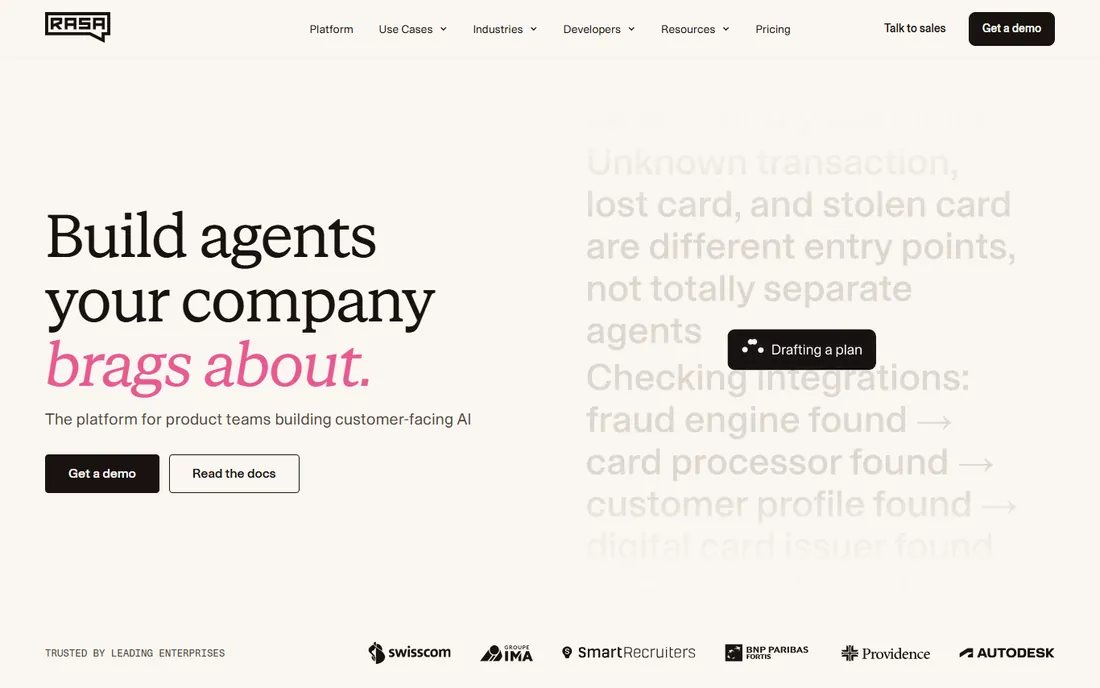
Rasa targets product teams that want to build agents in-house rather than buying a black box. The workflow starts with a prompt, tunes in the UI or code, evaluates automatically across simulated conversations, ships with version control and then monitors every conversation for issues to fix.
The open, modular architecture lets teams swap any piece as priorities shift, and agents deploy on your own infrastructure with your own models and data. Multi-channel support covers voice, Slack, web chat, WhatsApp and email from one agent codebase.
Healthcare, finance, telecom and retail enterprises use Rasa for customer-facing assistants with strict explainability requirements. It is the pick for teams with engineering capacity that want full control over their agent stack.
What we like- Developer-friendly, open and modular, deploy on your own infrastructure
Watch out for- Requires engineering resources, less turnkey than low-code platforms
#8
Botpress
Best for: Teams that want an accessible, action-taking support agent platform
Visit botpress.com
Starting priceSee website
Free planYes
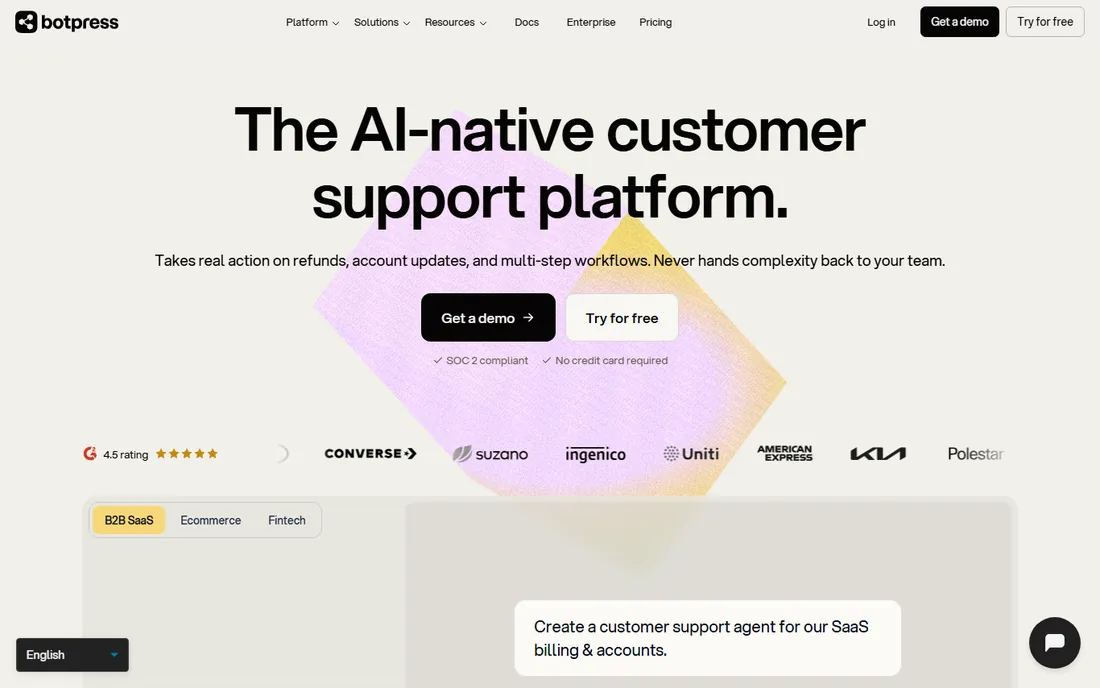
Botpress positions itself as an AI agent company that built a helpdesk, not the other way around. Its agents handle refunds, account updates and multi-step workflows end to end, with hot handoffs to humans that carry full context and a learning loop that turns resolutions into permanent knowledge.
The pricing model stands out: no per-seat cost and no separate AI billing, with a free tier that requires no credit card. SOC 2 compliance and GDPR support cover the enterprise basics, and it works on top of your existing helpdesk or as a standalone one.
Botpress is the most accessible entry point on this list. Teams that want agents resolving support tickets this month, without enterprise procurement cycles, should start here and scale up as needs grow.
What we like- No per-seat pricing, free to start, agents take real actions
Watch out for- Support-focused, less suited to complex enterprise orchestration
#9
Glean
Best for: Permission-aware agents grounded in all of your company's data
Visit glean.com
Starting priceSee website
Free planNo
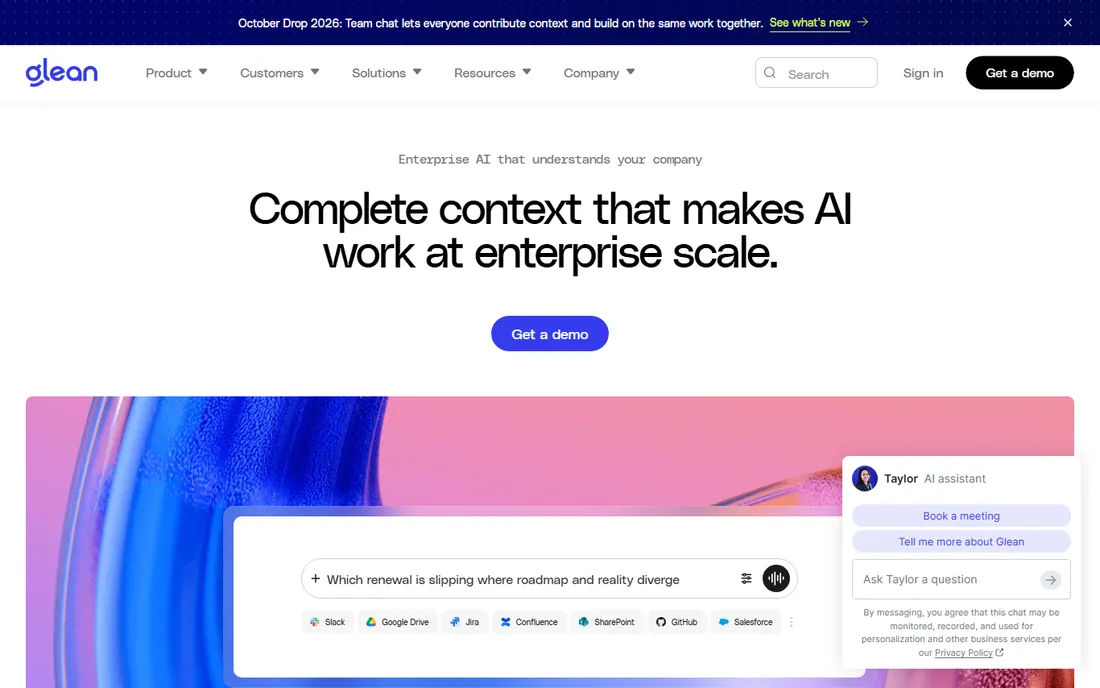
Glean built its reputation on enterprise search, and its agent platform extends that foundation. The Enterprise Graph encodes workflows, relationships and context across the company, so agents plan and execute with full organizational understanding rather than generic knowledge.
The platform connects to more than 275 work apps and data sources with permission-aware access built in from day one, so users only see what they are allowed to see. SOC 2 Type II, ISO 27001, GDPR and HIPAA certifications cover compliance-heavy environments, and the agentic engine supports adaptive planning with long-term memory.
Glean fits enterprises where data grounding is the hard problem. If your agents need to reason over scattered company knowledge with strict permissions, Glean's context layer is the differentiator. It is less of a general-purpose agent builder and more of a Work AI platform with serious agent capabilities.
What we like- Enterprise Graph context, 275+ connectors, strong security certifications
Watch out for- Sales-led enterprise pricing, less of a general agent builder
Start with your existing platform commitments. Microsoft 365 shops should look at Copilot Studio first, Salesforce customers at Agentforce, ServiceNow customers at ServiceNow AI Agents, and automation-heavy organizations at UiPath. The integration advantage of staying in-ecosystem is enormous.
Next, define the job. Contact center automation points to Cognigy or Kore.ai. Employee search and knowledge agents point to Glean. In-house product teams that want control point to Rasa. Quick support wins point to Botpress.
Then evaluate governance honestly. Ask how permissions are enforced, what the audit trail looks like, and who approves agent actions. Enterprise agents that touch real systems need real controls, and this is where the platform vendors and Kore.ai are strongest.
Finally, model the pricing. Per-conversation, per-seat and consumption models behave very differently at scale. Run a realistic usage estimate before committing, and watch for the platform tax of licenses plus implementation plus administration.
How we chose
We selected platforms with established enterprise adoption for building and running AI agents, covering both suite vendors and specialists. Google's Agentspace was excluded because the product has been folded into Gemini Enterprise and its standalone URL no longer resolves; Glean takes its place in the enterprise agent category. Moveworks is covered under ServiceNow following its acquisition. Cognigy appears under its current NiCE Cognigy branding. Pricing is quote-based across the category, so all entries show See website except Botpress, which offers a free tier.
Frequently asked questions
What is an enterprise AI agent platform?
It is software for building, deploying and governing AI agents that take actions in enterprise systems, not just answer questions. It typically includes agent builders, connectors to business systems, orchestration, permissions and audit trails.
How are AI agents different from chatbots?
Chatbots follow scripts and answer questions. AI agents reason over goals, use tools and APIs to take actions, coordinate with other agents and adapt based on results, all within defined guardrails.
Which platform is best for Microsoft shops?
Microsoft Copilot Studio is the natural choice, with native integration into Microsoft 365, Teams, Power Platform and Azure services, plus the ability to extend Microsoft 365 Copilot itself.
Do I need to be a Salesforce customer to use Agentforce?
Effectively, yes. Agentforce's main advantage is native access to Customer 360 data and actions inside Salesforce. Without a Salesforce foundation, other platforms will serve you better.
What happened to Google Agentspace and Moveworks?
Google folded Agentspace into Gemini Enterprise, its unified workplace AI platform. ServiceNow acquired Moveworks, folding the employee AI assistant into its agent portfolio.
How much do enterprise AI agent platforms cost?
Most use quote-based enterprise pricing, often combining platform licenses with consumption or per-conversation charges. Botpress offers a free tier, and most vendors provide trials or demos before committing.
Sources we checked (16)
- https://copilotstudio.microsoft.com
- https://www.salesforce.com/agentforce/
- https://www.servicenow.com/products/ai-agents.html
- https://www.uipath.com
- https://kore.ai/
- https://www.cognigy.com
- https://rasa.com
- https://botpress.com
- https://glean.com/
- https://github.com/microsoft/copilot-camp/blob/HEAD/docs/pages/make/copilot-studio/00-prerequisites.md
- https://www.salesforce.com/customer-stories/agentforce-for-customer-support/?blaid=6860006&bc=OTH
- https://github.com/neo4j-labs/neo4j-agent-integrations/blob/HEAD/servicenow-ai-agents/README.md
- https://www.businesswire.com/news/home/20250430530663/en/UiPath-Launches-the-First-Enterprise-Grade-Platform-for-Agentic-Automation
- https://www.businesswire.com/news/home/20260722302267/en/Kore.ai-Names-Uma-Sandilya-Chief-Commercial-Officer-Placing-Sales-Marketing-and-Strategy-Under-One-Leader
- https://www.devoteam.com/expert-view/google-agentspace-becomes-gemini-enterprise-your-guide/
- https://github.com/mortadhamannai/generative-ai
Is your product missing or out of date?
We review this list regularly. Vendors can request a listing, send updated pricing or ask about featured placement.

Shihab Mia · Founder, Rankite
Shihab has spent more than a decade helping SaaS and e-commerce brands grow through search. He writes Rankite's software buying guides from pricing pages, documentation and public user reviews. More about Shihab.