How we make this list: we compare pricing pages, product documentation and public user reviews. Rankite is independent; if a vendor ever pays for a featured spot, that listing is clearly labeled Partner.
Key takeaways
- PostgreSQL and MySQL handle serious traffic for free, but horizontal write scaling takes architectural work; most teams add Redis as a caching layer before they change databases.
- Managed serverless options, Amazon DynamoDB and Google Cloud Spanner, absorb traffic spikes without capacity planning, with Spanner's Standard edition starting at $0.030 per 100 processing units per hour per replica.
- For write-heavy workloads at extreme scale, Apache Cassandra and ScyllaDB scale linearly by adding nodes; ScyllaDB's C++ engine targets lower latency per node.
- CockroachDB and YugabyteDB bring PostgreSQL compatibility to distributed deployments, so teams keep their SQL skills while gaining multi-region resilience.
- The most common mistake is choosing by brand instead of workload: read-heavy, write-heavy, and globally distributed traffic need different answers.
Traffic doubles after a launch, a sale, or a viral moment, and the database is usually the first thing that falls over. Application servers scale horizontally without much thought; databases do not, because your data has to stay consistent while requests multiply. Choosing database software for high traffic means choosing how reads, writes, and geographic distribution behave when the load curve goes vertical.
The ten tools below cover the real options: proven open source workhorses, in-memory speed layers, distributed NoSQL systems, and managed cloud databases that scale without capacity planning. The right pick depends on your workload shape, your team's skills, and how much operational burden you want to carry.
Quick comparison
| Tool | Best for | Starting price | Free plan |
|---|
 PostgreSQL PostgreSQL | reliable relational workloads at scale | Free (open source) | Yes |
 MySQL MySQL | read-heavy web applications | Free (open source) | Yes |
 MongoDB MongoDB | flexible document data at scale | Free (Community Server) | Yes |
 Redis Redis | in-memory caching and real-time speed | Free (open source) | Yes |
 Apache Cassandra Apache Cassandra | write-heavy workloads at massive scale | Free (open source) | Yes |
 CockroachDB CockroachDB | distributed SQL with global consistency | See website | Yes |
 Google Cloud Spanner Google Cloud Spanner | global applications needing strong consistency | From $0.030 per 100 processing units per hour per replica (Standard edition) | Free trial |
 YugabyteDB YugabyteDB | PostgreSQL-compatible distributed deployments | Free (open source) | Yes |
 Amazon DynamoDB Amazon DynamoDB | serverless AWS workloads with spiky traffic | Pay as you go | Yes |
 ScyllaDB ScyllaDB | low-latency NoSQL at extreme throughput | See website | Free trial |
Is your product missing or out of date?
We review this list regularly. Vendors can request a listing, send updated pricing or ask about featured placement.
The best database software for handling high traffic
Starting priceFree (open source)
Free planYes
PostgreSQL is the database high-traffic teams choose when they want predictable performance without a license bill. Its multi-version concurrency control keeps readers and writers from blocking each other, and the query planner stays stable as data grows. With connection pooling, read replicas, and sensible indexing, a single primary handles workloads that surprise people who assume they need something exotic.
The honest limit is horizontal writes. Read scaling is straightforward with replicas, but write throughput on one primary tops out, and sharding means extensions like Citus or application-level partitioning. Version 14 stops receiving fixes on November 12, 2026, per postgresql.org, so plan upgrades. For most high-traffic relational workloads, PostgreSQL plus Redis covers the need.
What we like- Proven under heavy transactional load
- Excellent indexing and query planner
- Massive extension ecosystem
Watch out for- Horizontal write scaling needs sharding or extensions
- Connection handling needs pooling at high concurrency
Starting priceFree (open source)
Free planYes
MySQL powers a huge share of the high-traffic web because read-heavy workloads are its home turf. Replication is simple to configure, read replicas absorb traffic predictably, and every cloud provider and host on earth offers managed MySQL. The InnoDB engine delivers ACID transactions with crash recovery you can trust.
For straightforward access patterns, indexed lookups, feed queries, session data, MySQL stays fast and consistent under load. It strains sooner on complex joins and analytics, where query planning matters more. MySQL Community Edition is free and open source; HeatWave and Enterprise editions add managed analytics and support. When your traffic is mostly reads, this is the pragmatic default.
What we like- Simple replication for read scaling
- Enormous hosting and tooling ecosystem
- Low operational overhead
Watch out for- Fewer advanced features than PostgreSQL
- Complex analytics can strain the optimizer
Starting priceFree (Community Server)
Free planYes
MongoDB's document model maps naturally to application objects, which is why product teams moving fast pick it for high-traffic apps. Data that your app reads together lives together in a document, cutting the join overhead that slows relational queries under load. Built-in sharding distributes data across nodes as traffic grows, and Atlas, the managed service, handles the operations.
The trade is that sharding is not free complexity: shard key choice affects everything, and rebalancing takes planning. Multi-document ACID transactions exist but perform best when you design around document-level atomicity instead. Community Server is free; Atlas has a free tier for getting started. For content platforms, catalogs, and apps with evolving schemas, MongoDB scales well.
What we like- Document model fits fast-moving app schemas
- Horizontal sharding built in
- Atlas managed service scales with you
Watch out for- Sharding adds operational complexity
- Multi-document transactions cost performance
#4
Redis
Best for: in-memory caching and real-time speed
Visit redis.io
Starting priceFree (open source)
Free planYes
Redis is rarely the whole answer and almost always part of it. As an in-memory layer in front of your primary database, it absorbs the repeated reads that would otherwise crush throughput: sessions, leaderboards, rate limits, feed caches, real-time counters. Sub-millisecond latency is the norm, and data structures like sorted sets and streams handle jobs that would be awkward in SQL.
Memory is the budget line to watch. Datasets that fit in RAM fly; datasets that do not need tiering strategies or the commercial tiered storage options. Redis 8 is downloadable as free open source software, per redis.io, and Redis Cloud offers managed hosting. Before changing databases for performance, most teams should try Redis first.
What we like- Sub-millisecond responses for cached data
- Versatile data structures beyond simple caching
- Huge ecosystem
Watch out for- Memory costs grow with dataset size
- Persistence tuning needs care
Starting priceFree (open source)
Free planYes
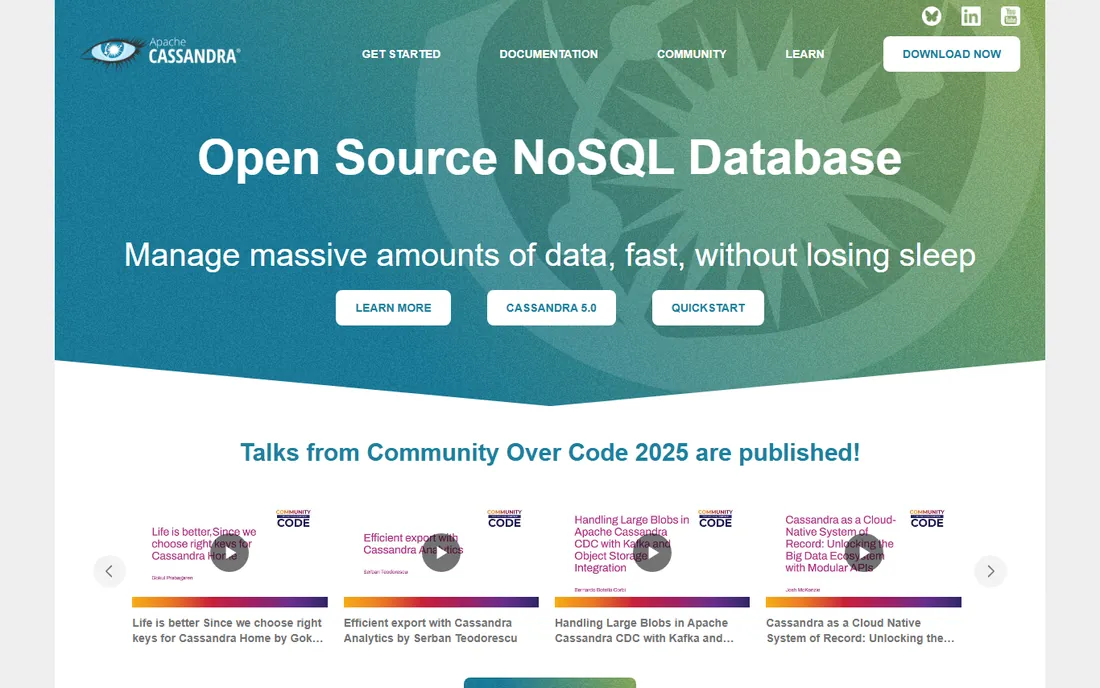
Cassandra was built for the problem most databases dodge: absorbing enormous write throughput across many machines. Add nodes and both read and write capacity grow linearly, with no downtime. The masterless architecture survives data center outages, which is why companies like Netflix and Bloomberg run it for critical workloads. If your traffic is write-heavy time-series, messaging, or event data, this is the classic answer.
The price is expertise. Data modeling in Cassandra punishes relational habits; you design tables around queries, not entities, and getting it wrong is expensive to fix. Operating large clusters takes real skill. It is free and open source under the Apache license. Choose Cassandra when writes dominate and you have the team to run it.
What we like- Linear write scaling by adding nodes
- No single point of failure
- Proven at huge companies
Watch out for- Data modeling is unforgiving
- Operational expertise required
Starting priceSee website
Free planYes

CockroachDB gives you the SQL your team already knows, distributed across regions with strong consistency. Data replicates automatically, failed nodes get replaced without downtime, and multi-region deployments stay consistent without application-level conflict resolution. For businesses that cannot tolerate regional outages, banks, marketplaces, global SaaS, that resilience is the product.
Distributed consensus has a latency cost; a single-region PostgreSQL will answer simple queries faster. CockroachDB wins when the alternative is building multi-region logic yourself. There is a free self-hosted option and a managed cloud offering. If you want PostgreSQL familiarity with planet-scale resilience, start here.
What we like- PostgreSQL-compatible distributed SQL
- Survives region failures automatically
- Strong consistency across regions
Watch out for- Latency overhead versus single-region databases
- Pricing for managed cloud needs a quote
Starting priceFrom $0.030 per 100 processing units per hour per replica (Standard edition)
Free planFree trial
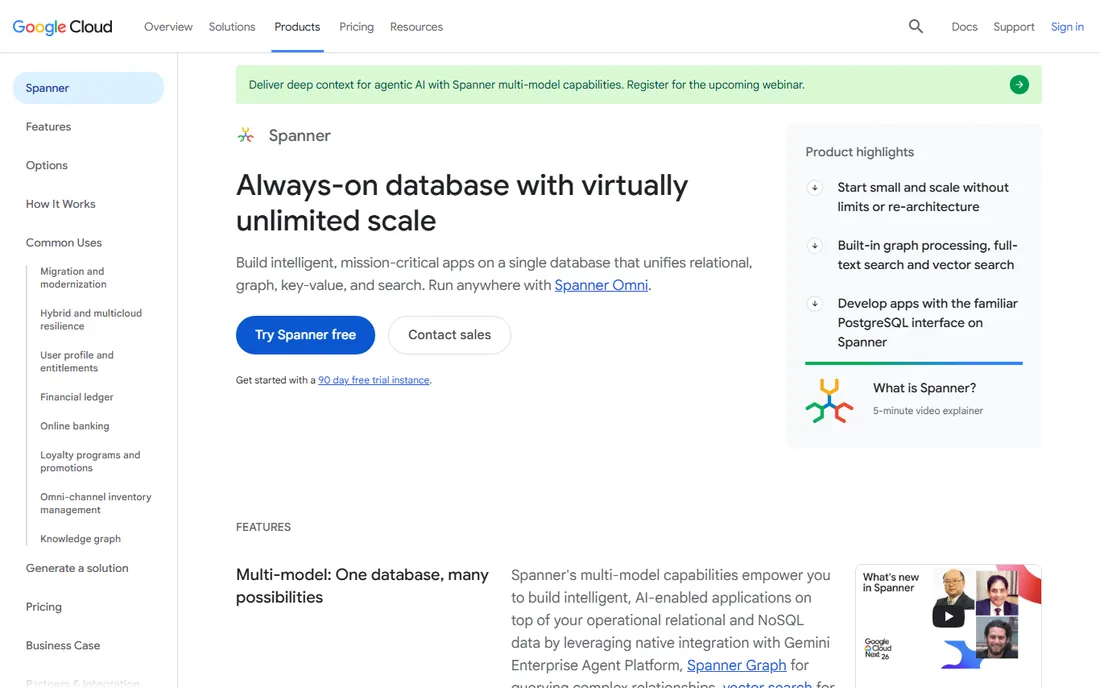
Spanner is Google's answer to the hardest database problem: globally consistent transactions at virtually unlimited scale. TrueTime synchronization keeps data consistent across regions, availability reaches 99.999%, and you get it as a managed service with no sharding to design. Pricing is published: Standard edition compute starts at $0.030 per 100 processing units per hour per replica, with Enterprise tiers above.
The cost is real money at scale, and you are committing to Google Cloud. Spanner also offers a downloadable Omni edition for running outside Google's cloud. For financial ledgers, global inventory, and user data that must be consistent everywhere, Spanner removes an entire category of engineering work. Few workloads need it; those that do know who they are.
What we like- Strong global consistency at scale
- 99.999% availability SLA
- PostgreSQL and GoogleSQL interfaces
Watch out for- Premium pricing versus self-hosted options
- Google Cloud commitment
Starting priceFree (open source)
Free planYes
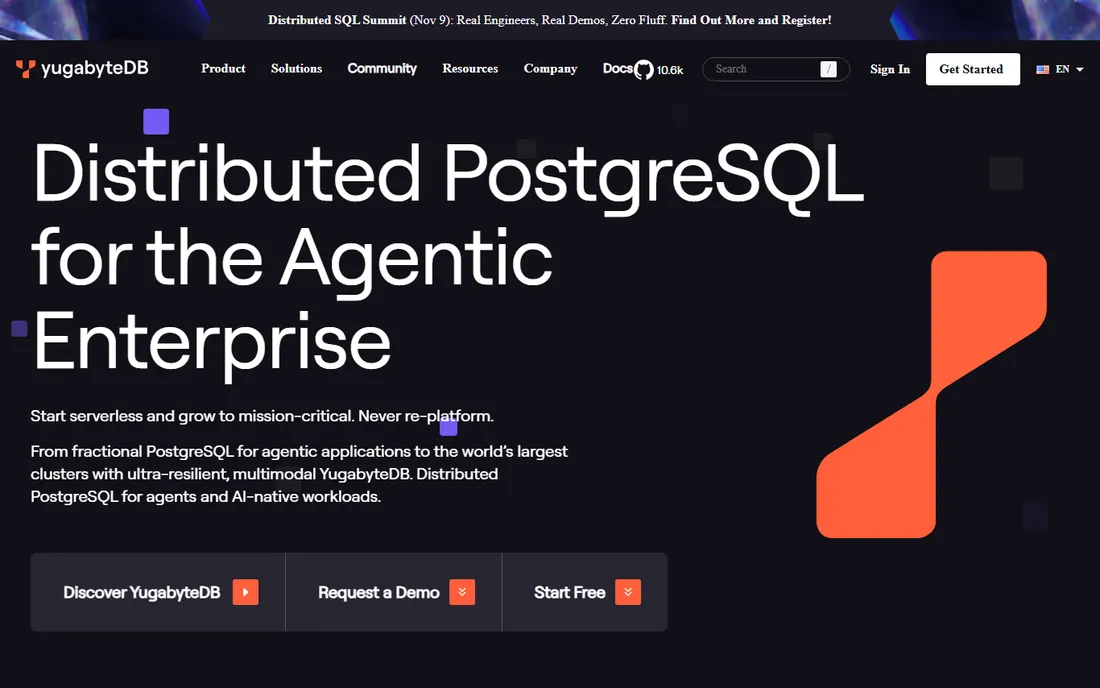
YugabyteDB takes the distributed SQL idea and anchors it to PostgreSQL compatibility: extensions, tooling, and drivers that work with Postgres work here. Data distributes and rebalances automatically across nodes and regions, with resilience to zone and region failures built in. The open source core is free to download, and the managed Aeon service offers a free account to start.
Compared with CockroachDB, the ecosystem is smaller but the Postgres compatibility runs deeper, which matters for teams with heavy Postgres investments. Distributed databases still demand respect for latency and data modeling. If your team thinks in Postgres and needs to scale past one server without rewriting the application, YugabyteDB is the natural path.
What we like- Full PostgreSQL compatibility, not a dialect
- Open source core
- Automatic sharding and rebalancing
Watch out for- Smaller ecosystem than CockroachDB
- Distributed tuning still needs expertise
Starting pricePay as you go
Free planYes
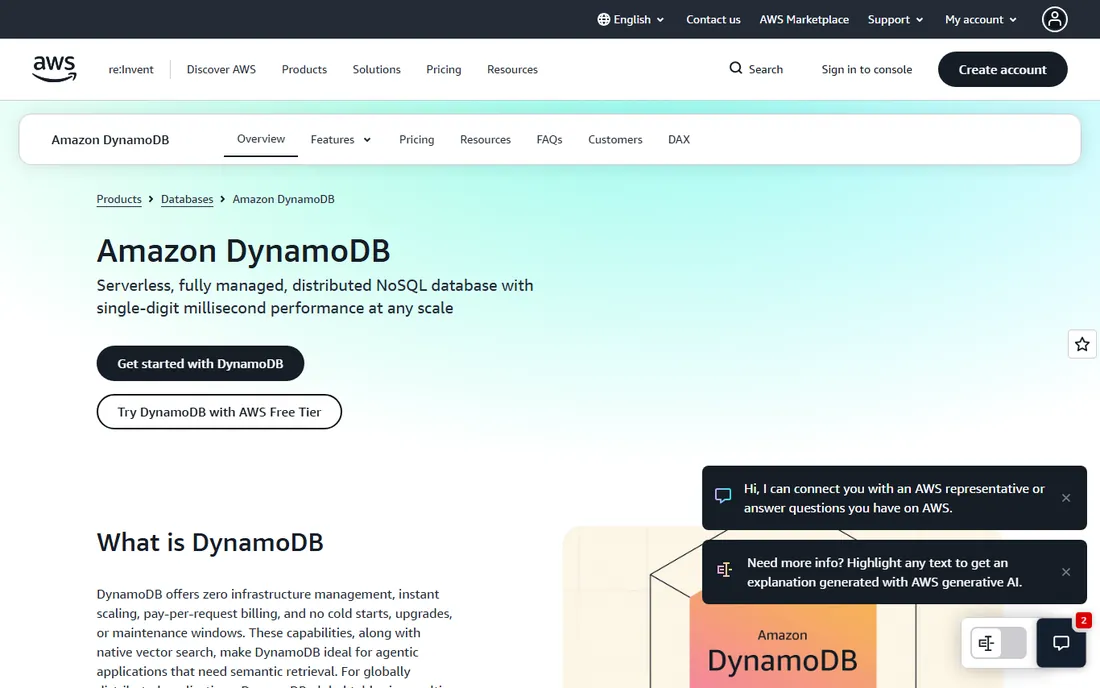
DynamoDB is the database for traffic you cannot predict. On-demand mode absorbs spikes from zero to massive without capacity planning, you pay per request, and single-digit millisecond latency holds at scale. Global tables replicate across regions, and integration with Lambda, streams, and the rest of AWS makes it the default for serverless architectures.
The modeling discipline is strict: you design tables around known access patterns, and ad-hoc queries are not its strength. Costs are pay-as-you-go, which is cheap at moderate scale and worth modeling carefully at extreme throughput. There is an always-free tier for getting started. If you live in AWS and your traffic spikes unpredictably, DynamoDB removes the capacity question entirely.
What we like- Scales to any traffic without provisioning
- Single-digit millisecond latency
- Deep AWS integration
Watch out for- Data modeling around access patterns is strict
- Costs surprise at very high throughput
Starting priceSee website
Free planFree trial

ScyllaDB reimplements the Cassandra architecture in C++ for dramatically better throughput per node and steadier tail latency. It speaks Cassandra's CQL and also offers a DynamoDB-compatible API, so existing applications can migrate with minimal changes. The shard-per-core design squeezes modern servers hard, which is why benchmarks show it doing more work on fewer nodes.
The community is smaller than Cassandra's, and running it yourself still demands distributed systems knowledge; the managed Cloud service handles that for a price. Note that the open source edition's direction has shifted toward the Cloud offering, so check current licensing for your use case. For teams hitting Cassandra's limits or wanting DynamoDB compatibility without AWS lock-in, ScyllaDB is the performance play.
What we like- Cassandra and DynamoDB API compatibility
- C++ engine with predictable low latency
- High throughput per node
Watch out for- Smaller community than Cassandra
- Self-hosting needs distributed systems skill
How we chose
We compared these databases the way a buyer would: reading vendor documentation and pricing pages, checking public benchmarks and engineering blog posts, reviewing community discussions on Reddit and Hacker News, and mapping each system against high-traffic workload patterns, read-heavy, write-heavy, spiky, and globally distributed. We verified every vendor homepage and used only vendor-published pricing. No vendor paid for placement, and we did not claim hands-on testing.
Pick by workload, not by logo
The fastest way to choose wrong is to pick the database your last company used. Match the tool to the traffic shape instead.
Read-heavy traffic
Content sites, catalogs, and feeds hammer reads while writes stay modest. MySQL or PostgreSQL with read replicas handle this well, and Redis in front absorbs the hottest keys. This combination serves most high-traffic web applications without exotic technology.
Write-heavy traffic
Event ingestion, messaging, IoT telemetry, and time-series data need write throughput that scales linearly. Cassandra and ScyllaDB are built for this; DynamoDB's on-demand mode absorbs it serverlessly. Relational databases can work with careful partitioning, but the NoSQL options scale more naturally.
Spiky, unpredictable traffic
Launches, sales, and viral moments create traffic cliffs. DynamoDB on-demand and Spanner scale without pre-provisioning, which is exactly what you want when you cannot predict the peak. Self-hosted systems need over-provisioned headroom for the same safety, which costs money whether the spike comes or not.
Globally distributed traffic
Users on multiple continents need data close to them. Spanner, CockroachDB, and YugabyteDB offer strongly consistent multi-region deployments; Cassandra and DynamoDB global tables favor availability with tunable consistency. Match the consistency model to your business: money needs strong consistency, activity feeds usually do not.
Where the money goes at scale
Database costs at high traffic come from four places, and the mix differs by product.
Compute is the big one for managed services: Spanner bills processing units per hour, DynamoDB bills per request, managed Postgres bills instance hours. Model your actual request volume against the pricing calculator before committing; back-of-napkin math at 10x your current traffic reveals surprises early.
Memory dominates Redis costs, since speed comes from RAM. Storage is cheap almost everywhere except when it is not: DynamoDB storage and backup costs add up on large tables. Finally, data transfer between regions or out to the internet is the line item everyone forgets until the first bill. Multi-region deployments multiply it.
Self-hosted open source, PostgreSQL, MySQL, Cassandra, is not free at scale either: engineering time, monitoring, backups, and hardware are real costs. The honest comparison is managed service fees versus the fully loaded cost of running it yourself, including the 3 a.m. pages.
Frequently asked questions
SQL or NoSQL for high traffic?
Both handle high traffic; they handle different shapes. SQL databases like PostgreSQL excel at complex queries and strong consistency for transactional workloads. NoSQL systems like Cassandra and DynamoDB excel at massive write throughput and horizontal scaling with simpler access patterns. Many architectures use both: SQL for transactions, NoSQL for scale-out workloads, Redis for speed.
How many database connections do I need?
Fewer than you think, with pooling. Application servers should share a pool of persistent connections rather than opening one per request. Tools like PgBouncer for PostgreSQL multiply effective capacity. Serverless apps need special care, since each function instance can open connections; use a proxy or a serverless-friendly driver.
Will caching solve my database problems?
Often, yes, for read-heavy workloads. Redis or Memcached in front of the database absorbs repeated reads and is the cheapest performance win available. Caching does not help write bottlenecks or complex queries that cannot be cached, so diagnose before assuming.
When should I shard?
When vertical scaling and read replicas stop being enough, usually when write throughput or dataset size exceeds one server comfortably. Sharding adds permanent complexity to queries, operations, and future migrations, so exhaust simpler options first: better indexing, caching, read replicas, and archiving cold data.
Managed or self-hosted: which is cheaper at scale?
It depends on your team's cost and expertise. Managed services charge a premium over raw infrastructure but eliminate operational work. Self-hosting looks cheaper on infrastructure bills while consuming engineering time and carrying outage risk. At very large scale with a skilled team, self-hosted often wins; below that, managed usually does.
Sources we checked (10)
- https://www.postgresql.org/
- https://www.mysql.com/
- https://www.mongodb.com/
- https://redis.io/
- https://cassandra.apache.org/
- https://www.cockroachlabs.com/
- https://cloud.google.com/spanner
- https://www.yugabyte.com/
- https://aws.amazon.com/dynamodb/
- https://www.scylladb.com/
Is your product missing or out of date?
We review this list regularly. Vendors can request a listing, send updated pricing or ask about featured placement.

Shihab Mia · Founder, Rankite
Shihab has spent more than a decade helping SaaS and e-commerce brands grow through search. He writes Rankite's software buying guides from pricing pages, documentation and public user reviews. More about Shihab.