How we make this list: we compare pricing pages, product documentation and public user reviews. Rankite is independent; if a vendor ever pays for a featured spot, that listing is clearly labeled Partner.
Key takeaways
- Buying CRM and ERP separately is how companies end up with two systems that refuse to talk to each other. A combined platform keeps customer, order, and finance data in one place.
- Oracle NetSuite and SAP Business One are the established enterprise picks. Odoo and ERPNext are the value plays with real open-source roots.
- Microsoft Dynamics 365 Business Central is the natural choice if your company already lives in Microsoft 365.
- Expect implementation to cost more than the software in year one. Budget for it, or pick a simpler platform.
- Almost nobody in this category publishes prices. Plan on demos, quotes, and a proper procurement process.
Quick comparison
Is your product missing or out of date?
We review this list regularly. Vendors can request a listing, send updated pricing or ask about featured placement.
Starting priceSee website
Free planNo
NetSuite is the default answer when a growing company needs one system for sales, orders, inventory, and accounting. Because CRM and ERP share one database, a quote converts to an order converts to an invoice without re-entry or sync jobs. The SuiteApp marketplace and a deep partner network mean most industry needs have a prebuilt answer.
The honest cost is implementation. NetSuite projects routinely take months and need consultants, and Oracle's pricing is quote-based with annual uplifts to watch. Smaller companies can find themselves paying enterprise overhead. But if you are past $10M in revenue and outgrowing QuickBooks plus a separate CRM, this is the safest big bet.
What we like- True single-database CRM and ERP
- Huge ecosystem of modules and partners
- Proven at serious scale
Watch out for- Implementation is long and expensive
- Pricing is opaque and negotiated

#2
SAP Business One
Best for: Small to mid-size manufacturers
Visit sap.com
Starting priceSee website
Free planNo
SAP Business One brings real SAP DNA to smaller companies: proper MRP, batch and serial traceability, multi-warehouse inventory, and financials that auditors respect. The CRM side covers sales pipeline, service calls, and marketing basics, all tied to the same item and customer masters as the ERP side. For manufacturers and distributors, that depth matters more than a pretty interface.
The interface does feel dated next to cloud-native rivals, and your experience depends heavily on the implementation partner you choose. Pricing is per-user and quote-based. If you make or move physical goods and want SAP credibility without an S/4HANA project, Business One is the pragmatic SAP choice.
What we like- SAP-grade manufacturing and inventory depth
- Large global partner network
- Strong localization for many countries
Watch out for- Interface feels dated
- Partner quality varies widely by region
Starting priceSee website
Free planYes
Odoo's pricing model is disarming: one app free for unlimited users, then a flat per-user price for everything else. The app library is enormous, spanning CRM, sales, purchase, inventory, manufacturing, accounting, HR, and e-commerce, all sharing the same database. For a small company, you can run the whole business on it for a fraction of NetSuite's cost.
The catch is accounting depth outside Odoo's strongest regions, and the classic open-source tradeoff: flexibility in exchange for needing technical help on bigger projects. The community and partner network is large, which helps. If budget is the constraint and you have some technical confidence, Odoo delivers remarkable value.
What we like- Free plan for one app with unlimited users
- Huge app library covers CRM, inventory, accounting, and more
- Open-source core
Watch out for- Accounting localization varies by country
- Complex projects still need an integrator
#4
Microsoft Dynamics 365 Business Central
Best for: Microsoft-centric companies
Visit microsoft.com
Starting priceSee website
Free planFree trial
If your company runs on Outlook, Teams, and Excel, Business Central feels like home. Quotes, orders, and invoices flow through an interface your staff already half-knows, and the Teams integration puts approvals and customer data where people actually work. The CRM functionality covers sales and service well enough for most B2B companies, and Power Platform extends it without code.
Pure-play CRM users will find the sales side thinner than Salesforce or HubSpot, and serious customization still means hiring a partner. Microsoft's per-user pricing is published and straightforward, which is refreshing in this category. For the Microsoft shop, this is usually the right default.
What we like- Deep integration with Microsoft 365 and Teams
- Familiar interface for Office users
- Strong ISV add-on market
Watch out for- CRM depth lags pure-play CRMs
- Customization often needs a partner
Starting priceSee website
Free planNo
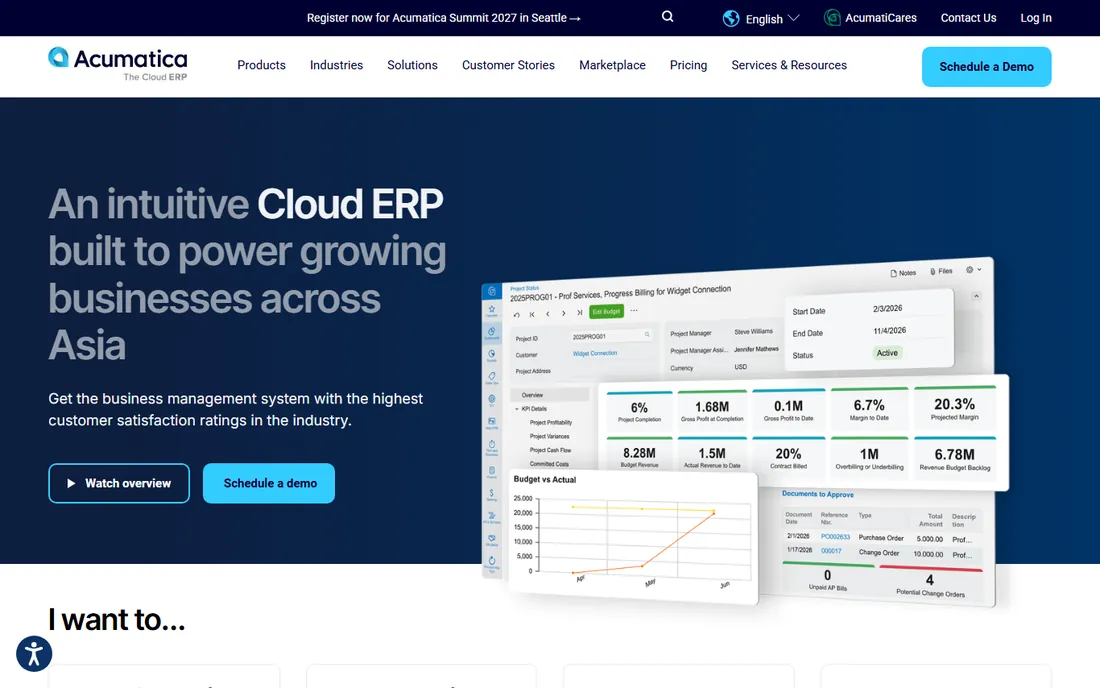
Acumatica's headline differentiator is pricing: you pay for resources consumed, not per user, so you can give the whole company access without the seat-count anxiety that plagues per-user ERP. The product itself is a true cloud ERP with solid CRM, covering financials, distribution, manufacturing, and project accounting in industry editions.
You buy through partners, which means implementation quality depends on who you pick, and pricing is still quote-based despite the friendlier model. For companies where everyone from the warehouse to the sales team needs system access, the unlimited-user model can save serious money as you grow.
What we like- Consumption-based pricing instead of per-user seats
- Strong distribution and manufacturing editions
- Modern cloud architecture
Watch out for- Sold only through partners, so experiences vary
- Pricing still requires a quote
Starting priceSee website
Free planNo
Epicor Kinetic (formerly Epicor ERP) is built for companies that make things. Advanced planning and scheduling, MES for the shop floor, quality management, and configured products come standard rather than as expensive add-ons. The CRM side handles quotes, cases, and field service tied directly to jobs and orders.
This depth comes with complexity. Implementations are substantial projects run through partners, and the product makes little sense for services or retail businesses. But for a manufacturer outgrowing entry-level systems, Kinetic's shop-floor-to-cash functionality is hard to match at its price point.
What we like- Deep manufacturing functionality including MES
- Strong for make-to-order and mixed-mode
- Industry-specific editions
Watch out for- Complex and partner-dependent
- Not a fit outside manufacturing and distribution

#7
Sage Intacct
Best for: Finance-led growing businesses
Visit sage.com
Starting priceSee website
Free planNo
Sage Intacct started as pure cloud accounting and it still shows: multi-entity consolidation, revenue recognition, and dimensional reporting are excellent. The CRM and order management around it serve services businesses, nonprofits, and SaaS companies well, especially those consolidating multiple entities or preparing for an audit.
The CRM side is not as deep as NetSuite's or Dynamics', so sales-heavy organizations should evaluate carefully. Pricing is modular and quote-based, and costs climb as you add entities and modules. If finance leads the buying decision and multi-entity accounting is the pain, Intacct deserves the shortlist.
What we like- Best-in-class cloud financials
- Multi-entity consolidation done right
- Strong audit trail
Watch out for- CRM is lighter than ERP-first rivals
- Pricing adds up with modules
Starting priceFree
Free planYes
ERPNext is the real open-source alternative in a category full of "open core" marketing. The full system, CRM through manufacturing and accounting, is free to self-host with no user limits and no feature gates. Frappe, the company behind it, also offers managed cloud hosting if you do not want servers. The community is active and the product improves steadily.
The tradeoff is responsibility. Self-hosting means you handle upgrades, backups, and performance, and the integration marketplace is thinner than Odoo's or NetSuite's. Companies with in-house technical staff get enormous value here; companies without it should price the managed cloud or a service partner before comparing costs.
What we like- Fully open source with no license fees
- CRM, HR, manufacturing, and accounting included
- Active community
Watch out for- You own hosting, upgrades, and support
- Fewer polished integrations than commercial rivals
Starting priceSee website
Free planFree trial
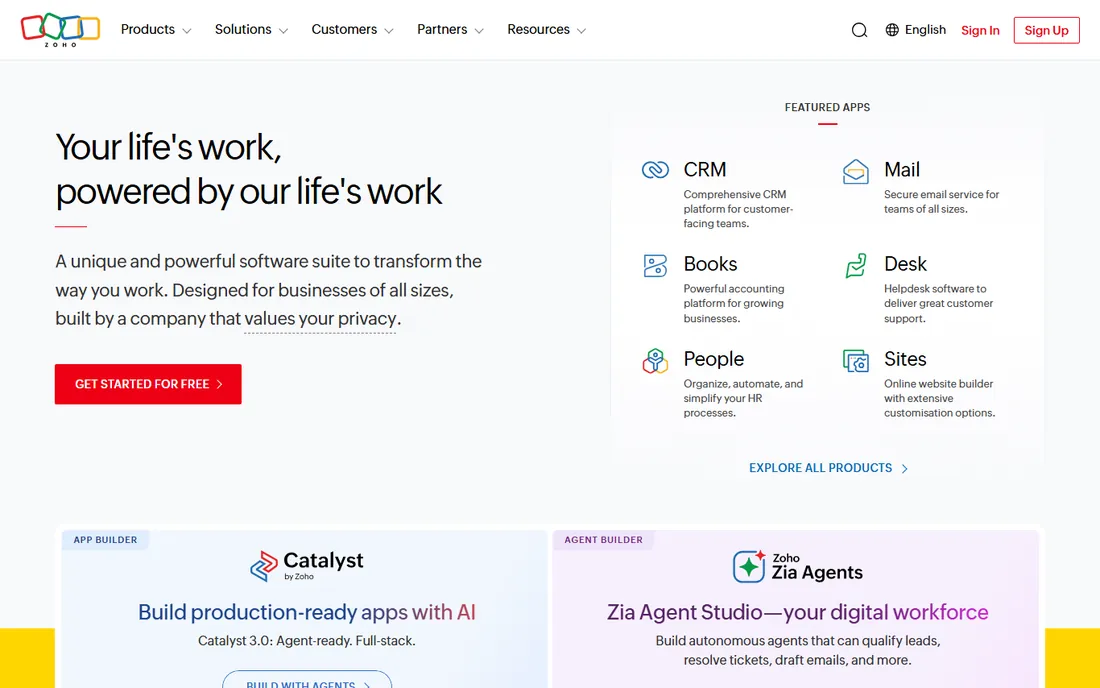
Zoho One is not an ERP in the NetSuite sense; it is a bundle of 45+ business apps, including Zoho CRM, Books, Inventory, and Projects, for a single per-employee price. For a small business, that bundle replaces a half-dozen subscriptions and the apps share data reasonably well. The price is the story: it undercuts nearly everything here.
Depth is the limit. Zoho Books is fine for small-company accounting but not a NetSuite or Intacct replacement, and there is no real manufacturing module. Think of it as the best-value integrated suite for companies under 50 people that need CRM plus light operations, not as heavy ERP.
What we like- 45+ apps for one per-employee price
- CRM Plus and Books integrate well
- Affordable for small teams
Watch out for- Individual apps are less deep than specialists
- Advanced ERP needs are beyond its scope
Starting priceSee website
Free planNo
Rootstock takes a clever approach: instead of integrating CRM and ERP, it builds the ERP natively on Salesforce. If your sales team lives in Salesforce, your operations team works in the same system with the same customer records, the same security model, and the same AppExchange ecosystem. Quote-to-cash becomes one flow instead of two systems synced with middleware.
The obvious requirement is Salesforce itself, and you will pay for both platforms. For manufacturers already committed to Salesforce, though, Rootstock removes the integration tax entirely and is worth a serious look against NetSuite.
What we like- Native on the Salesforce platform
- Single data model from lead to cash
- Inherits Salesforce security and ecosystem
Watch out for- Requires Salesforce licenses too
- Overkill if you are not already on Salesforce
The implementation question nobody asks early enough
Software selection gets the attention, but implementation decides the outcome. A NetSuite or SAP project can cost two to five times the first-year subscription in consulting, data migration, and training. Even Odoo and ERPNext need real effort if your processes are messy. The vendors that look cheapest on license cost often need the most services.
Ask every finalist three questions. How long do similar implementations take, with references you can call. What does data migration from your current systems actually involve. And who trains your team, because an ERP nobody uses is just an expensive database. Get the services estimate in writing alongside the license quote, and add a contingency. The companies that regret ERP purchases almost always regret the implementation, not the software.
How to choose a combined CRM and ERP
Start from the transaction, not the org chart
List the five transactions that run your business: quote to cash, procure to pay, hire to retire, whatever applies. The right platform handles those flows natively. If a vendor needs heavy customization for your core flow, it is the wrong vendor no matter how good the demo looked.
Count the real users
Per-user pricing punishes broad adoption. If 200 people need occasional access, Acumatica's consumption model or Odoo's flat pricing beats per-seat quotes. If only 20 people will ever log in, per-user pricing from Microsoft or Sage may be cheaper. Model three years of growth, not today's headcount.
Weight accounting properly
The finance team lives in this system daily. Multi-entity, revenue recognition, and audit requirements should be selection criteria, not afterthoughts. Sage Intacct and NetSuite lead here; lighter suites will cost you in spreadsheets and auditor fees later.
Plan the exit before you sign
ERP switches are painful, so negotiate data export, contract terms, and price-increase caps now. Ask how you get your data out in a usable format. The answer tells you a lot about the vendor.
How we chose
We reviewed vendor product pages, documentation, and published pricing where available, plus analyst reports and public reviews on G2, Capterra, and TrustRadius. We weighted true single-database CRM-plus-ERP over stitched-together integrations, checked manufacturing and financial depth where relevant, and noted pricing transparency, since most vendors in this category require quotes. We did no hands-on testing; enterprise ERP evaluations require demos and reference calls, which we recommend before any purchase.
Frequently asked questions
Should a small business buy combined CRM and ERP software?
Usually not at first. A small business typically does better with a good CRM plus simple accounting software until transaction volume or complexity forces the issue. Odoo and Zoho One are the exceptions that work for smaller companies because the price and complexity stay manageable.
How much does CRM ERP software cost?
It varies enormously. Open-source options like ERPNext can be free to self-host. Mid-market platforms typically run from tens of thousands to hundreds of thousands per year including implementation. Enterprise deployments run higher. Almost every vendor quotes based on users, modules, and services, so get written quotes from at least three finalists.
How long does implementation take?
Small Odoo or Zoho deployments can go live in weeks. Mid-market NetSuite, Business Central, or Acumatica projects typically take three to nine months. Complex manufacturing implementations with Epicor or SAP can run a year or more. Data migration quality is usually the bottleneck, not the software.
Can we keep our existing CRM and just buy ERP?
You can, but integration becomes a permanent tax. Every customer, order, and invoice syncs between systems, and every upgrade risks breaking the integration. Combined platforms exist precisely to eliminate that tax. If your CRM is deeply embedded, evaluate native options on your CRM's platform first, like Rootstock for Salesforce shops.
What is the difference between ERP with CRM and a CRM with ERP features?
ERP-first platforms like NetSuite and SAP treat the general ledger, inventory, and orders as the core, with sales pipeline attached. CRM-first bundles like Zoho One treat the customer relationship as the core, with lighter operational depth. Match the emphasis to which side of the business causes more pain.
Sources we checked (10)
- https://www.netsuite.com
- https://www.sap.com
- https://www.odoo.com
- https://www.microsoft.com
- https://www.acumatica.com
- https://www.epicor.com
- https://www.sage.com
- https://erpnext.com
- https://www.zoho.com
- https://www.rootstock.com
Is your product missing or out of date?
We review this list regularly. Vendors can request a listing, send updated pricing or ask about featured placement.

Shihab Mia · Founder, Rankite
Shihab has spent more than a decade helping SaaS and e-commerce brands grow through search. He writes Rankite's software buying guides from pricing pages, documentation and public user reviews. More about Shihab.
 Oracle NetSuite
 Odoo
Odoo Acumatica
 Epicor Kinetic
 ERPNext
 Zoho One
 Rootstock Cloud ERP