How we make this list: we compare pricing pages, product documentation and public user reviews. Rankite is independent; if a vendor ever pays for a featured spot, that listing is clearly labeled Partner.
Key takeaways
- Cloud-native teams usually land on Dialogflow CX or Amazon Lex for pay-per-request pricing, or Microsoft Copilot Studio if they already live in Microsoft 365.
- Enterprises with compliance or data-residency requirements should shortlist Rasa for self-hosting and Cognigy for regulated contact centers.
- Small teams and solo builders get the most value from Botpress and Voiceflow, both of which have usable free tiers and transparent pricing.
- Outcome-based pricing (per resolution) from Yellow.ai, Ada and Intercom-style tools is friendlier for support teams than message-based pricing is for product teams.
Quick comparison
| Tool | Best for | Starting price | Free plan |
|---|
 Dialogflow CX Dialogflow CX | Teams building on Google Cloud | $0.007 per chat request (Flows) | Free trial ($600 credit) |
 Amazon Lex Amazon Lex | AWS-native chatbots and voice bots | $0.00075 per text request | Yes (10,000 text and 5,000 speech requests per month, first year) |
 Microsoft Copilot Studio Microsoft Copilot Studio | Enterprises standardized on Microsoft 365 | $200 per month per tenant (25,000 messages) | No |
 Rasa Rasa | Engineering teams that need full control and self-hosting | $0 (Developer Edition) | Yes |
 Kore.ai Kore.ai | Fortune-scale enterprises with complex service operations | Custom (typical deployments reported at $300K+ per year) | No |
 Yellow.ai Yellow.ai | Omnichannel support across chat, voice, email and WhatsApp | $0 (free plan, then $0.99 per resolution) | Yes |
 Cognigy Cognigy | Regulated contact centers running voice and digital at scale | From $2,500 per month (pilots) | No |
 Voiceflow Voiceflow | Product and design teams who build visually | $60 per editor per month (Plus) | Yes |
 Botpress Botpress | Developers who want an open, extensible stack | $0 (pay-as-you-go plan) | Yes |
 Ada Ada | Large consumer brands deflecting high support volume | Custom (reported entry around $30,000 per year) | No |
Is your product missing or out of date?
We review this list regularly. Vendors can request a listing, send updated pricing or ask about featured placement.
Starting price$0.007 per chat request (Flows)
Free planFree trial ($600 credit)
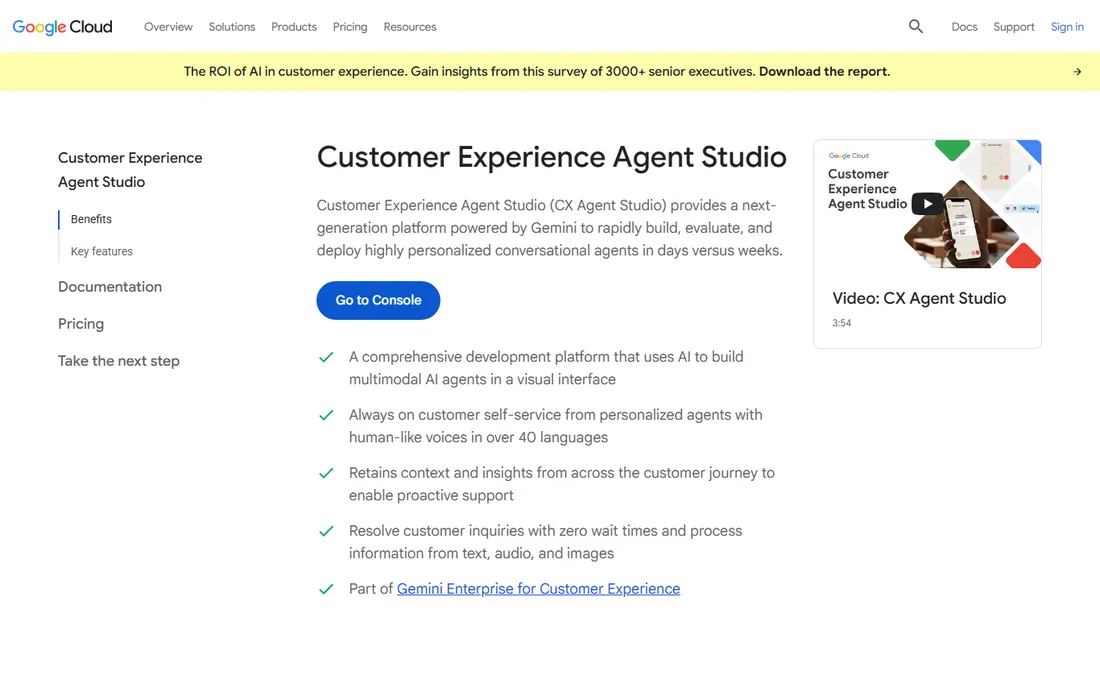
Dialogflow CX, now sold under Google's Conversational Agents branding, remains the default choice for teams already on Google Cloud. The Flows model gives you deterministic control over complex conversations, while Playbooks add generative behavior grounded in your data. Pricing is usage-based: $0.007 per chat request on Flows, $0.012 on Playbooks, with voice billed per second of audio.
New customers get a $600 credit, and there is no per-seat fee, which keeps small pilots cheap. The catch is the ecosystem tax: telephony and contact-center integrations are strongest inside Google's own stack, and voice workloads can surprise you at scale.
What we like- Mature NLU with strong telephony integrations
- Pay only for what you use
- Generative Playbooks alongside deterministic Flows
Watch out for- Google Cloud lock-in
- Audio pricing adds up fast on voice workloads
Starting price$0.00075 per text request
Free planYes (10,000 text and 5,000 speech requests per month, first year)
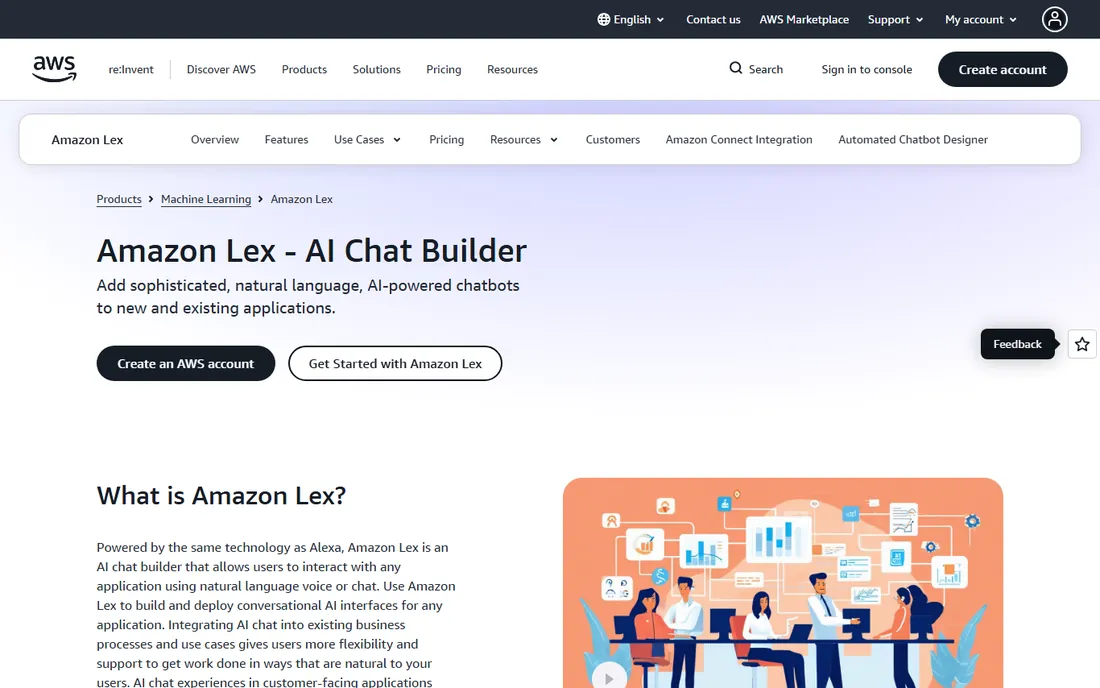
Amazon Lex is the workhorse of the category: unglamorous, cheap and deeply embedded in AWS. At $0.00075 per text request and $0.004 per speech request, it undercuts Dialogflow CX on price, and it plugs straight into Lambda, Connect, DynamoDB and the rest of the AWS services your team already uses. The first year includes 10,000 text and 5,000 speech requests per month free, which covers serious prototyping.
Lex V1 reached end of support in September 2025, so everything now runs on V2, a different API and bot model. The catch is that Lex is a toolkit, not a product: there is no visual builder worth using, so you need engineers.
What we like- The cheapest per-request pricing in the category
- Deep integration with Lambda, Connect and the AWS stack
- V1 fully retired, so V2 is the stable target
Watch out for- Building non-trivial bots still needs real engineering
- The free tier shrank for newer accounts
#3
Microsoft Copilot Studio
Best for: Enterprises standardized on Microsoft 365
Visit microsoft.com
Starting price$200 per month per tenant (25,000 messages)
Free planNo
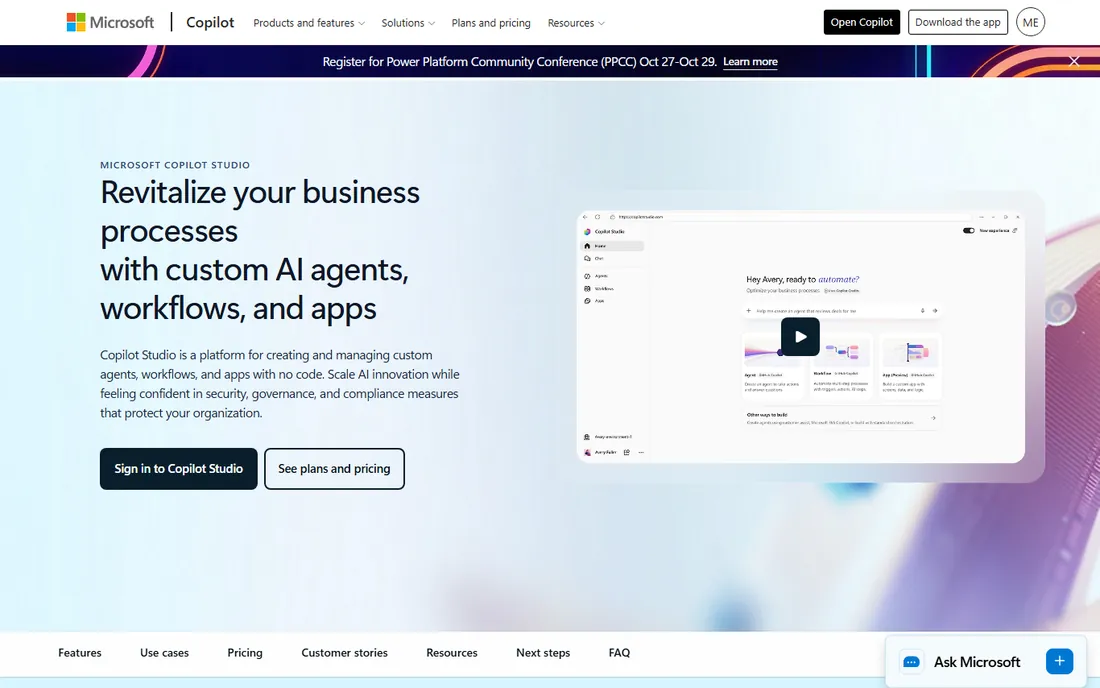
Copilot Studio, formerly Power Virtual Agents, is Microsoft's answer for organizations that want custom agents grounded in their own data. Agents can draw on SharePoint sites, Dataverse tables, web URLs and Microsoft Graph, then deploy to Teams, web chat, voice or custom apps. Authoring costs nothing; you pay for consumption at $200 per month per 25,000 messages, or $0.01 per message pay-as-you-go.
The 2026 shift to Copilot Credits complicates the math: autonomous actions and tool calls consume multiple credits per turn, so a simple agent and an agentic one can cost very different amounts. There is no free tier and no self-hosting option. But if your company already pays for Microsoft 365 Copilot, employee-facing agent use is included within fair-use limits, which can make the effective price zero for internal deployments.
What we like- Native grounding in SharePoint, Teams and Microsoft Graph
- No per-seat authoring cost
- Strong governance through Purview
Watch out for- Azure-only with no self-hosting
- Message-based billing gets complicated with autonomous agents
#4
Rasa
Best for: Engineering teams that need full control and self-hosting
Visit rasa.com
Starting price$0 (Developer Edition)
Free planYes
Rasa is the platform for teams that refuse to hand their conversational data to a vendor's cloud. The Developer Edition is free up to 1,000 conversations per month and runs the full stack, including CALM, Rasa's approach where a language model handles understanding while your code defines the actions. Growth starts around $35,000 per year and Enterprise is custom, both based on conversation volume with no per-seat fees.
The trade is total: you get architectural control and auditability, but you also own the infrastructure and the pager. For regulated teams with real engineering, that trade is exactly right. For everyone else, managed platforms ship faster.
What we like- Self-host from day one with your data staying yours
- Open foundation with CALM for LLM-driven dialogue
- No per-seat fees
Watch out for- You own the infrastructure and the operations burden
- Paid tiers start around $35,000 per year
#5
Kore.ai
Best for: Fortune-scale enterprises with complex service operations
Visit kore.ai
Starting priceCustom (typical deployments reported at $300K+ per year)
Free planNo
Kore.ai is the enterprise heavyweight: a full agent platform with prebuilt solutions for banking, healthcare, retail and HR, voice and digital channels, agent-assist tools and on-premise deployment. It shows up as a Leader in analyst evaluations for a reason, the breadth is real, and large contact centers run serious volume on it.
The price of admission is a sales process. Pricing is custom and quote-only, with typical annual spends reported in the low-to-mid six figures, billed on sessions plus seat licensing plus voice add-ons. Implementation usually goes through systems integrators, which adds cost and time. Shortlist Kore.ai when you need proven enterprise breadth and have the budget and patience for an enterprise purchase. Do not shortlist it for a pilot you want live next month.
What we like- Deep library of prebuilt industry agents
- On-premise deployment option
- Consistently rated a Leader by analysts
Watch out for- Quote-only pricing with long sales cycles
- Implementation typically runs through partners
#6
Yellow.ai
Best for: Omnichannel support across chat, voice, email and WhatsApp
Visit yellow.ai
Starting price$0 (free plan, then $0.99 per resolution)
Free planYes
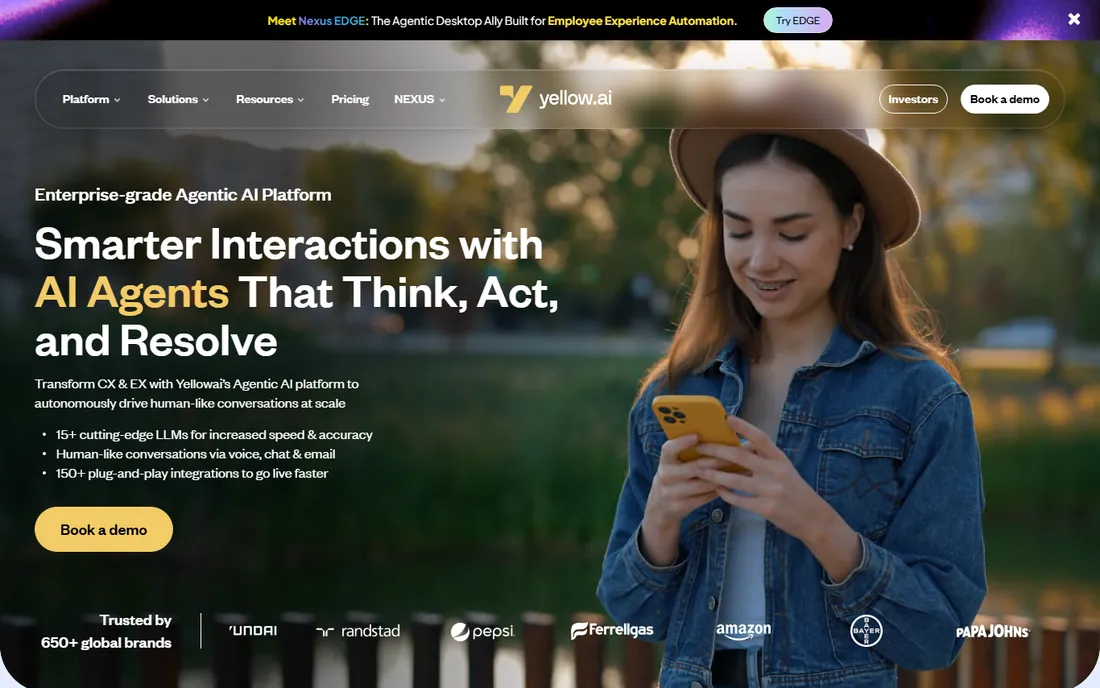
Yellow.ai is strongest in APAC and with global brands that need many channels and languages from a single vendor. The platform covers chat, voice, email, SMS and messaging apps including WhatsApp, with its own voice product and workflow builders that let business teams configure logic without writing code. It claims over 1,300 enterprise customers.
The pricing model is unusually friendly to start: a free plan with 500 chat sessions a month, then $0.99 per resolution beyond that. Enterprise is quote-only, and third-party reports put typical contracts well into six figures, so budget accordingly. The honest catch is that the workflow abstraction that gets you live fast can limit deep customization later, and non-enterprise accounts report uneven support. It is a strong pick for multi-channel CX at scale, less so for a single-channel side project.
What we like- 35+ channels and 135+ languages on one platform
- A real free tier to start
- Per-resolution pricing aligns cost with value
Watch out for- Enterprise pricing is quote-only and reported contracts run large
- Smaller teams report slow support
#7
Cognigy
Best for: Regulated contact centers running voice and digital at scale
Visit cognigy.com
Starting priceFrom $2,500 per month (pilots)
Free planNo
Cognigy, acquired by NiCE in September 2025 and now sold as NiCE Cognigy, is built for the hardest enterprise requirements: banks, insurers, healthcare and government running voice and digital channels under strict compliance. It offers role-based access, audit trails, on-premise and air-gapped deployment, and deep integrations with Genesys, Avaya, Amazon Connect and the NiCE CXone suite.
Pricing is sales-led: pilots reportedly start around $2,500 to $5,000 per month, and its AWS Marketplace listing prices a Basic tier at $43,080 for 12 months. Voice minutes and LLM tokens bill separately. There is no free trial, only demos.
What we like- Enterprise-grade security with on-premise and air-gapped options
- Excellent voice capabilities
- Now backed by NiCE
Watch out for- No self-serve path and opaque pricing
- Overkill below a few thousand conversations a month
Starting price$60 per editor per month (Plus)
Free planYes
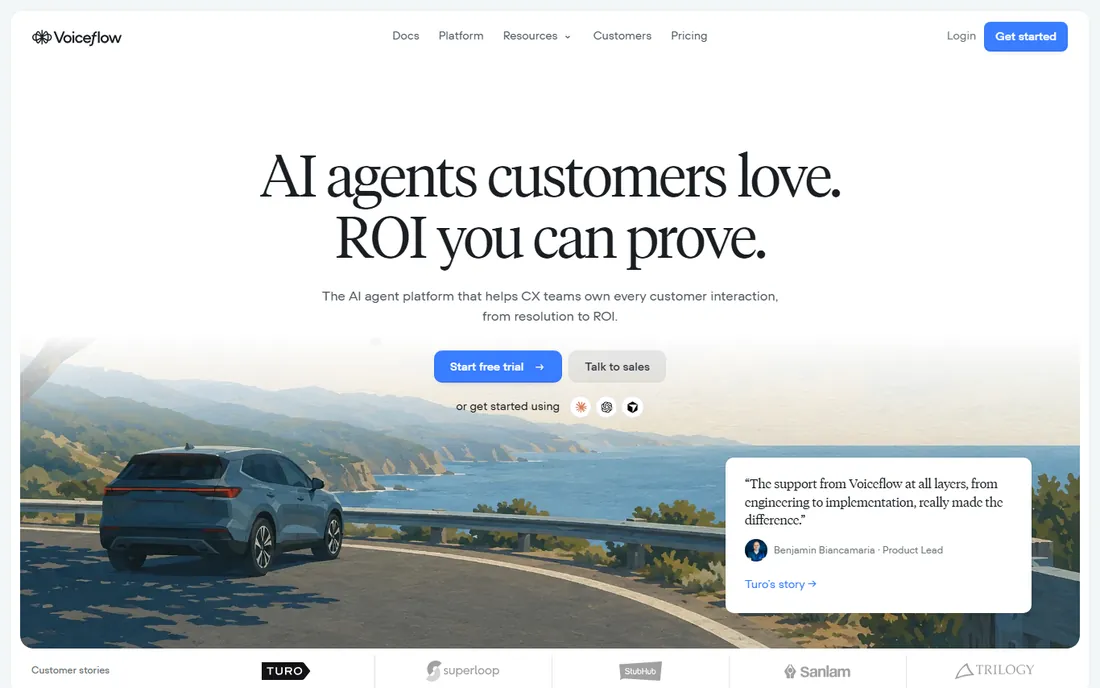
Voiceflow started as the design tool for voice apps and grew into a full agent platform. Its visual canvas is genuinely the nicest way to design conversations in this list: product managers and designers can build real logic, developers can drop into code where needed, and the same project can deploy to chat and voice. Teams at companies like Turo and StubHub use it in production.
There is a free tier for getting started, and paid plans center on per-editor pricing, with Plus reported around $60 per editor per month and Team and Enterprise tiers above that. The catch is that the pricing page has become less transparent over time, with more paths routed through sales. For design-led teams that want to move fast without engineers as a bottleneck, it is still the most pleasant builder here.
What we like- The best visual builder in the category
- Native voice support
- Designers and developers can collaborate in one canvas
Watch out for- Pricing has moved toward sales-led tiers
- Production usage costs scale with editors and volume
Starting price$0 (pay-as-you-go plan)
Free planYes
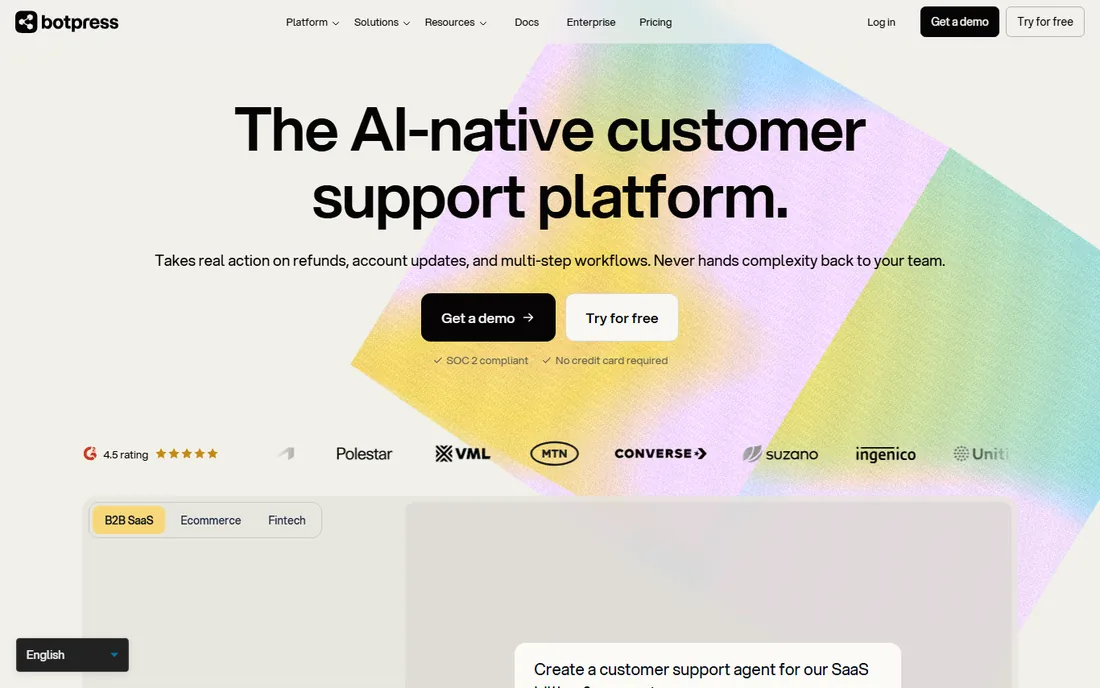
Botpress is the developer's choice: an open-source core with a visual building studio, an integration hub and the freedom to self-host or run on their cloud. The pricing is refreshingly public. The pay-as-you-go plan is $0 plus AI Spend and includes 500 messages a month, Plus is $79 per month billed annually ($89 monthly), and Team is $445 per month billed annually ($495 monthly). LLM consumption, called AI Spend, is billed separately at provider cost.
The honest catch is that AI Spend makes total cost harder to predict than a flat per-message price, so set the spend caps before going live. But for developers who want to inspect the code, extend the platform and avoid vendor lock-in, Botpress offers the most freedom per dollar here. The free tier is genuinely enough to build and test a real bot.
What we like- Open-source foundation with a visual studio
- Transparent published pricing
- LLM usage billed at provider cost with no markup
Watch out for- AI Spend is variable and needs careful modeling
- Serious production use lands on paid tiers quickly
#10
Ada
Best for: Large consumer brands deflecting high support volume
Visit ada.cx
Starting priceCustom (reported entry around $30,000 per year)
Free planNo
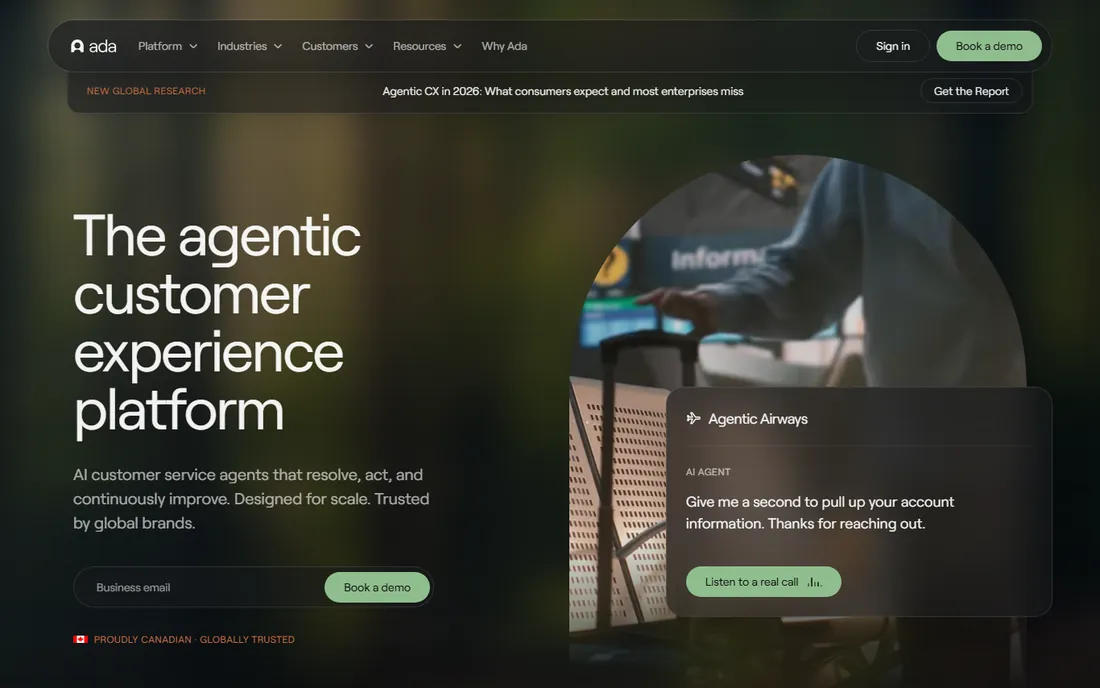
Ada carved out a specific niche: helping large brands resolve customer service conversations end to end. Its "action-based AI" executes tasks like processing returns or updating account details rather than just answering questions, which is what separates it from basic chatbot tools. The no-code builder lets CX teams ship quickly, and the analytics focus on containment and resolution rates that support leaders actually care about.
Pricing is conversation-based and quote-only, with third-party reports putting entry around $30,000 per year and median contracts near $70,000. There is no free tier and no self-serve path. That positions it squarely at high-volume support organizations. If you are a startup with a few hundred tickets a month, Ada will be overkill in both price and process. If you are a large brand drowning in repetitive queries, it is purpose-built for you.
What we like- Action-based AI that completes tasks, not just answers
- Strong containment analytics
- Fast no-code builder for CX teams
Watch out for- Enterprise-only pricing with no free tier
- Overkill for small teams
How we chose
We reviewed each vendor's pricing page and documentation, analyst coverage, and public reviews on G2, Capterra and PeerSpot, and we favored platforms with transparent pricing and verifiable production deployments. The list mixes hyperscaler utilities, enterprise suites and developer tools so different buyers find their fit. We did not test any platform hands-on, and enterprise pricing changes frequently, so confirm quotes directly with vendors.
The platform decision is really a team decision. If you have engineers and live on AWS, Lex is the economical default; on Google Cloud, Dialogflow CX; in a Microsoft shop, Copilot Studio. The hyperscalers win on price per request and lose on speed of building, because you are assembling a bot from services rather than using a product.
If your builders are designers and product managers, not engineers, flip the list: Voiceflow and Botpress get you to a working agent fastest, and Yellow.ai covers the most channels with the least code. The per-editor and per-message pricing of these tools is easier to forecast than enterprise session billing, which matters when you are defending a budget.
And if compliance owns the decision, the shortlist writes itself: Rasa for self-hosted control, Cognigy for regulated contact centers, Kore.ai for prebuilt industry depth. Expect six-figure contracts, sales-led procurement and implementation partners. That is the price of auditability, and for regulated industries it is worth paying.
What pricing models actually mean for your budget
Per-request pricing (Lex, Dialogflow CX) is the cheapest at low volume and the most predictable to model: multiply expected requests by the unit price. The surprise comes from everything around the request, speech minutes, Bedrock or LLM calls, Lambda invocations, which can exceed the headline rate.
Per-message and per-editor pricing (Copilot Studio, Voiceflow, Botpress) shifts the risk to usage patterns. A simple FAQ bot and an autonomous agent that calls tools can differ 10x in cost on the same plan, because each tool call burns multiple messages or credits. Model your most complex conversation, not your average one.
Per-resolution and conversation pricing (Yellow.ai, Ada) aligns cost with value: you pay when the bot actually handles something. It is the friendliest model for support leaders because it maps to the headcount it replaces. Just confirm what counts as a resolution before signing, since definitions vary and a handoff that a human finishes can still bill.
Frequently asked questions
What is the difference between a chatbot platform and a conversational AI platform?
A chatbot platform typically handles scripted question-and-answer flows. A conversational AI platform adds natural language understanding, context management across turns, integrations with backend systems, and increasingly generative AI that can reason and take actions. Everything on this list qualifies as the latter, though they range from developer toolkits (Lex, Rasa) to full products (Ada, Yellow.ai).
Which conversational AI platform is cheapest to start with?
Botpress and Amazon Lex are the cheapest serious starting points. Botpress has a $0 pay-as-you-go tier with 500 messages a month, and Lex's free tier covers 10,000 text requests a month for the first year. Rasa's Developer Edition is free up to 1,000 conversations a month if you can self-host. All three let you build something real before spending anything.
Do I need engineers to use these platforms?
It depends on the platform. Lex, Rasa and Copilot Studio at depth need real engineering. Voiceflow, Botpress's studio, Yellow.ai and Ada are built so that product managers, designers or CX teams can ship without engineers, though complex integrations still benefit from technical help. Be honest about your team's skills before choosing.
What does it cost to run a customer support bot for 10,000 conversations a month?
Roughly: on Lex, about $7.50 in request charges plus surrounding AWS costs. On Yellow.ai's free tier overflow, around $0.99 per resolution beyond included sessions. On Ada or Kore.ai, you are in custom enterprise territory, typically thousands per month. The engineering and maintenance time usually exceeds the platform bill, so factor that in first.
Can these platforms handle voice, or just chat?
Most handle both now. Dialogflow CX, Amazon Lex, Kore.ai, Cognigy, Yellow.ai and Voiceflow all support voice with telephony integrations. Voice is billed separately almost everywhere, usually per minute or per second of audio, so price voice workloads on their own rather than assuming chat pricing applies.
How do I avoid lock-in with a conversational AI platform?
Prefer platforms with open foundations (Rasa, Botpress), standard APIs and exportable training data. The hyperscaler tools (Lex, Dialogflow CX, Copilot Studio) tie your bot logic to their services, which is fine if you are already committed to that cloud. Before signing an enterprise contract, confirm you can export your intents, flows and conversation data.
Sources we checked (10)
- https://cloud.google.com/products/conversational-agents/pricing
- https://www.voiceflow.com/blog/amazon-lex
- https://www.microsoft.com/microsoft-copilot/microsoft-copilot-studio/pricing
- https://rasa.com/blog/copilot-studio-alternatives
- https://rasa.com/blog/kore-ai-alternatives
- https://www.cloudtalk.io/blog/yellow-ai-review
- https://www.dialora.ai/blog/cognigy-vs-synthflow-vs-dialora
- https://quiq.com/blog/voiceflow-vs-botpress/
- https://www.ada.cx/platform/
- https://g2.com/products/rasa/pricing
Is your product missing or out of date?
We review this list regularly. Vendors can request a listing, send updated pricing or ask about featured placement.

Shihab Mia · Founder, Rankite
Shihab has spent more than a decade helping SaaS and e-commerce brands grow through search. He writes Rankite's software buying guides from pricing pages, documentation and public user reviews. More about Shihab.