How we make this list: we compare pricing pages, product documentation and public user reviews. Rankite is independent; if a vendor ever pays for a featured spot, that listing is clearly labeled Partner.
Key takeaways
- Managed Kubernetes (GKE, EKS, AKS) charges roughly $0.10 per cluster per hour; GKE offsets this with $74.40 in monthly credits, and AKS has a free tier.
- Rancher and Spectro Cloud Palette sit above any infrastructure, managing clusters across clouds and on-prem from one control plane.
- OpenShift is the pick for regulated workloads with built-in security, CI/CD and operator support.
- Portainer offers a lightweight self-hosted UI for teams that do not want a heavy platform, starting at $9,995 per year.
- The core decision is managed service versus self-managed platform, then single-cloud versus multi-cloud.
Quick comparison
| Tool | Best for | Starting price | Free plan |
|---|
 Rancher Rancher | multi-cluster Kubernetes governance | $1,000/node/yr (reported) | Yes |
 Red Hat OpenShift Red Hat OpenShift | regulated enterprise workloads | from $0.076/hr (official) | Free trial |
 Google Kubernetes Engine Google Kubernetes Engine | autoscaling GCP workloads | $0.10/cluster/hr (official) | Yes |
 Amazon EKS Amazon EKS | AWS-native Kubernetes | $0.10/cluster/hr (official) | No |
 Azure Kubernetes Service Azure Kubernetes Service | Microsoft shop clusters | Free tier; $0.10/cluster/hr Standard (official) | Yes |
 Portainer Portainer | lightweight self-hosted management | $9,995/yr (official) | Yes |
 Spectro Cloud Palette Spectro Cloud Palette | declarative full-stack lifecycle | $15/node/mo (reported) | Free trial |
Is your product missing or out of date?
We review this list regularly. Vendors can request a listing, send updated pricing or ask about featured placement.
The best cluster management software
Are you trying to run Kubernetes without hiring a platform team to babysit it? The tools here take two forms: managed services from the cloud providers, which run the control plane for you, and management platforms you run yourself, which unify clusters across clouds, data centers and edge sites.
Starting price$1,000/node/yr (reported)
Free planYes
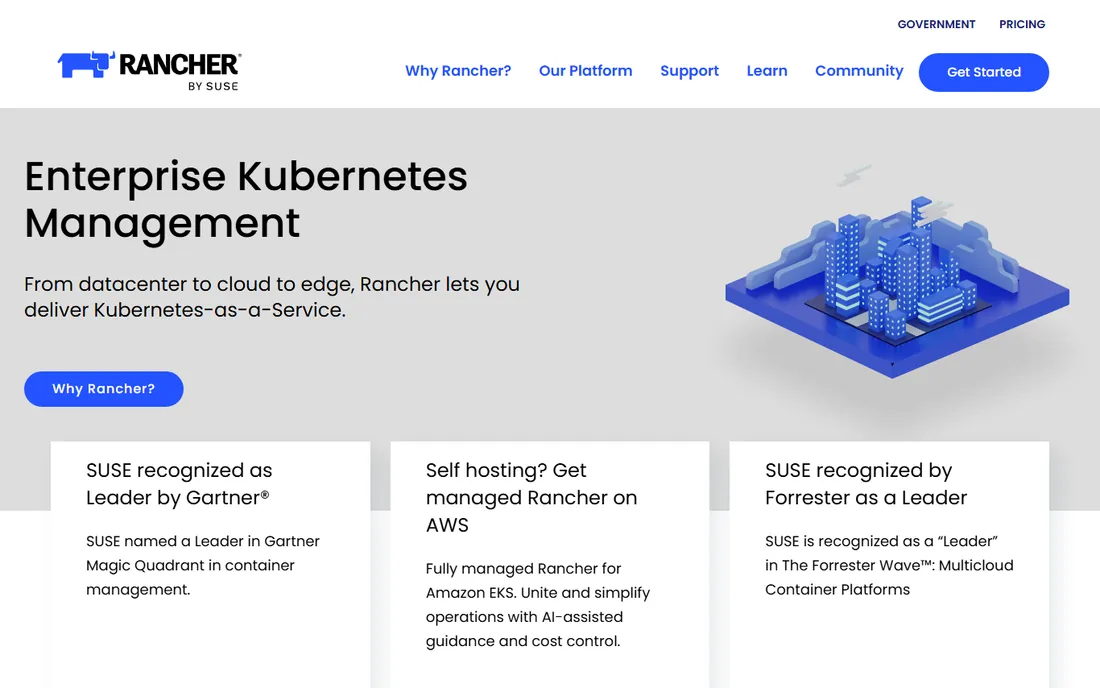
Rancher, now part of SUSE, is the most established vendor-neutral management platform. It provisions and operates RKE2, K3s, and imported EKS, GKE and AKS clusters from one console, with centralized role-based access control and Fleet for GitOps deployments across the fleet. If your clusters live in two clouds plus a data center, Rancher gives you one pane of glass over all of them.
The community edition is open source and free for unlimited clusters, which makes Rancher the natural starting point for teams that want multi-cluster management without a vendor contract. Rancher Prime is the supported commercial tier, reported around $1,000 per node per year. The tradeoff is operational weight: Rancher is a real platform to run, not a SaaS signup.
What we like- Manages any cluster anywhere from one UI
- Open-source community edition free forever
- Central RBAC and Fleet GitOps
Watch out for- Complexity grows with scale
- Prime pricing is quote-based
Starting pricefrom $0.076/hr (official)
Free planFree trial
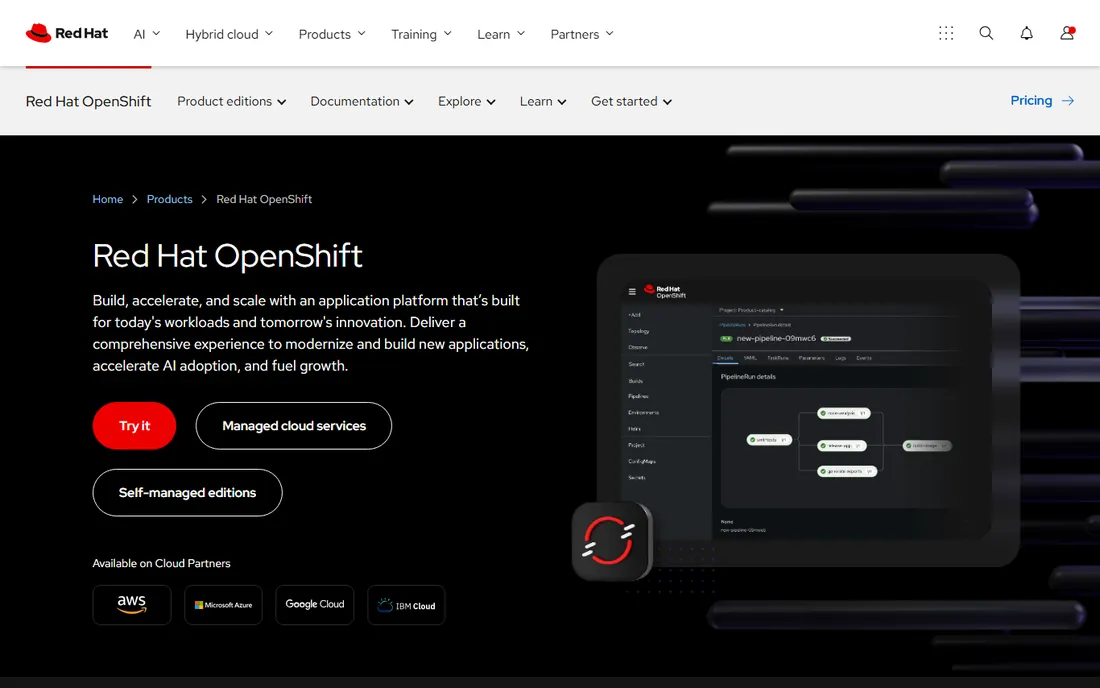
OpenShift turns Kubernetes into a full application platform. On top of the orchestrator you get an integrated container registry, CI/CD pipelines, service mesh, monitoring and logging, plus hardened security defaults that make auditors happy. It runs self-managed or as a Red Hat managed cloud service on AWS, Azure, Google Cloud and IBM Cloud.
Pricing is subscription-based, with cloud services listed from $0.076 per hour for a 4 vCPU configuration on a 3-year contract. Self-managed editions are licensed per core, and third-party breakdowns put the range around $150 to $500 per core per year. OpenShift fits organizations where security and compliance outweigh simplicity.
What we like- Integrated security, operators and CI/CD
- Strong compliance posture
- Available as cloud services on major clouds
Watch out for- Per-core licensing adds up
- Heavier platform than plain Kubernetes
Starting price$0.10/cluster/hr (official)
Free planYes
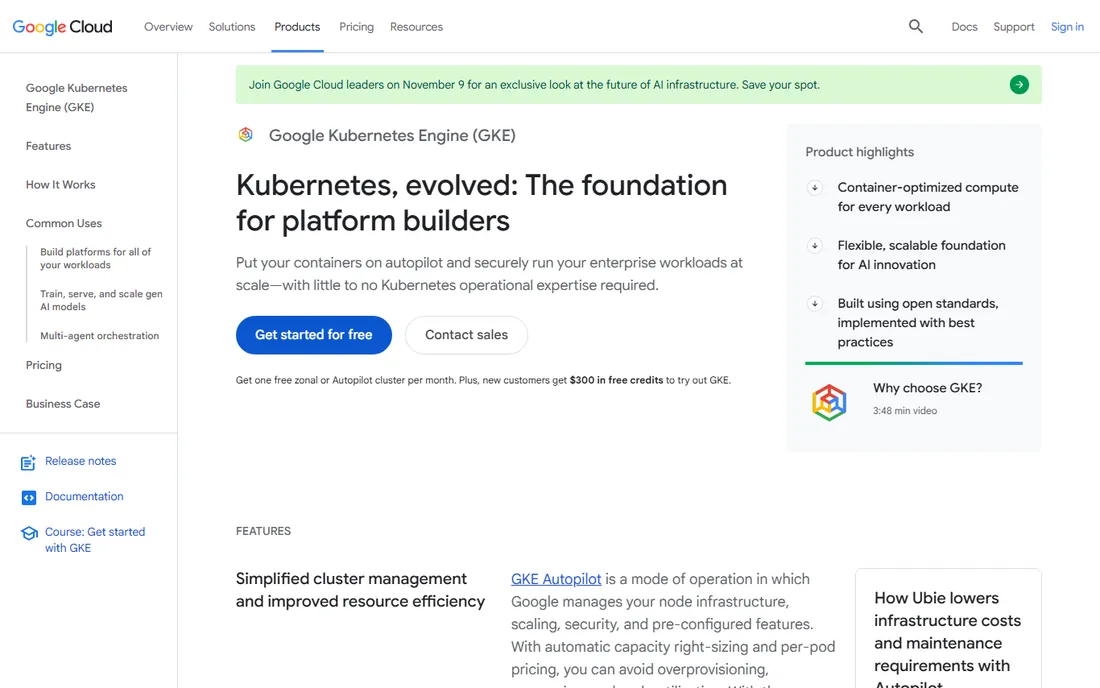
GKE is Google's managed Kubernetes service, and it invented the category. The cluster management fee is $0.10 per cluster per hour, but Google applies $74.40 in monthly credits per billing account, which effectively makes one small Standard or Autopilot cluster free of management fees. You pay for the worker nodes on top.
Two modes matter: Standard gives you full node control, while Autopilot manages nodes for you and bills per pod's requested CPU and memory. GKE's autoscaling, auto-repair and auto-upgrade are the most mature in the industry. If your workloads already live on Google Cloud, GKE is the path of least resistance.
What we like- Free tier credits cover one small cluster
- Autopilot removes node management
- Mature autoscaling
Watch out for- GCP lock-in
- Compute costs dominate the bill
Starting price$0.10/cluster/hr (official)
Free planNo
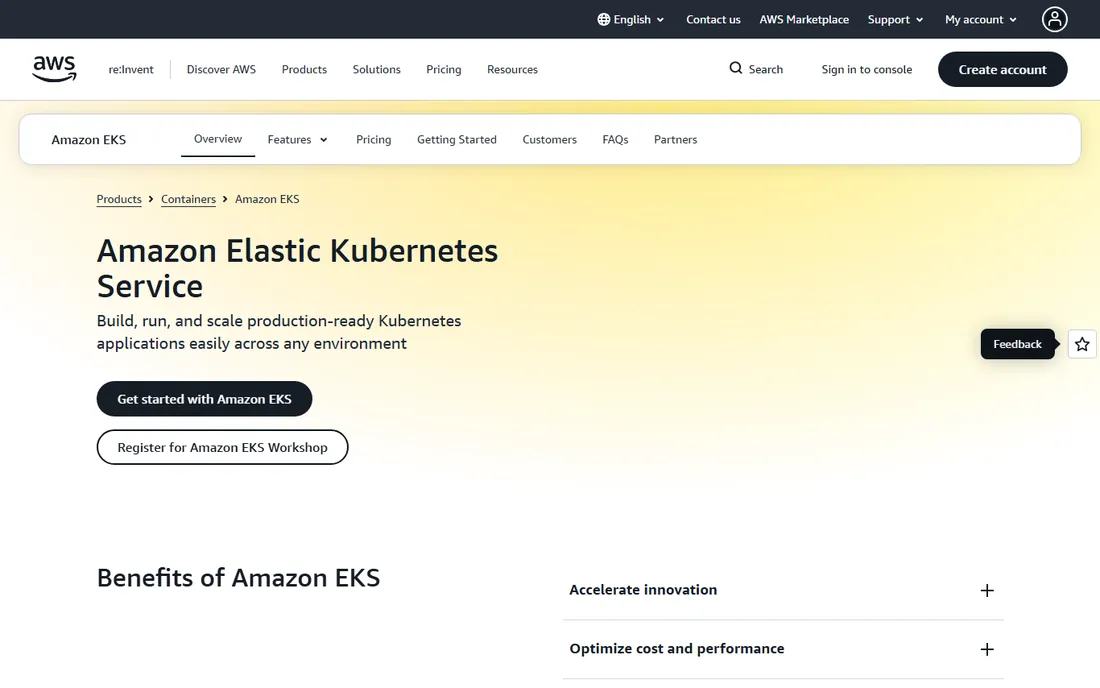
EKS is Amazon's managed Kubernetes, charging $0.10 per cluster per hour for the control plane plus the cost of your worker nodes. EKS Auto Mode, the newer option, provisions and manages nodes, storage and networking automatically, charging node costs plus a management surcharge. EKS Anywhere extends the same tooling to your own hardware with no cluster fee.
The strengths are integration: IAM for authentication, ALB for ingress, EBS and EFS for storage, CloudWatch for monitoring, all native. The honest catch is that there is no free tier for the control plane fee, so every cluster costs about $73 per month before a single pod runs. Consolidate workloads into fewer clusters where you can.
What we like- Deep AWS integration (IAM, load balancers, storage)
- Runs on EC2, Fargate, Outposts and on-prem
- Auto Mode for hands-off clusters
Watch out for- No free cluster tier
- Control plane fee even with zero workloads
Starting priceFree tier; $0.10/cluster/hr Standard (official)
Free planYes
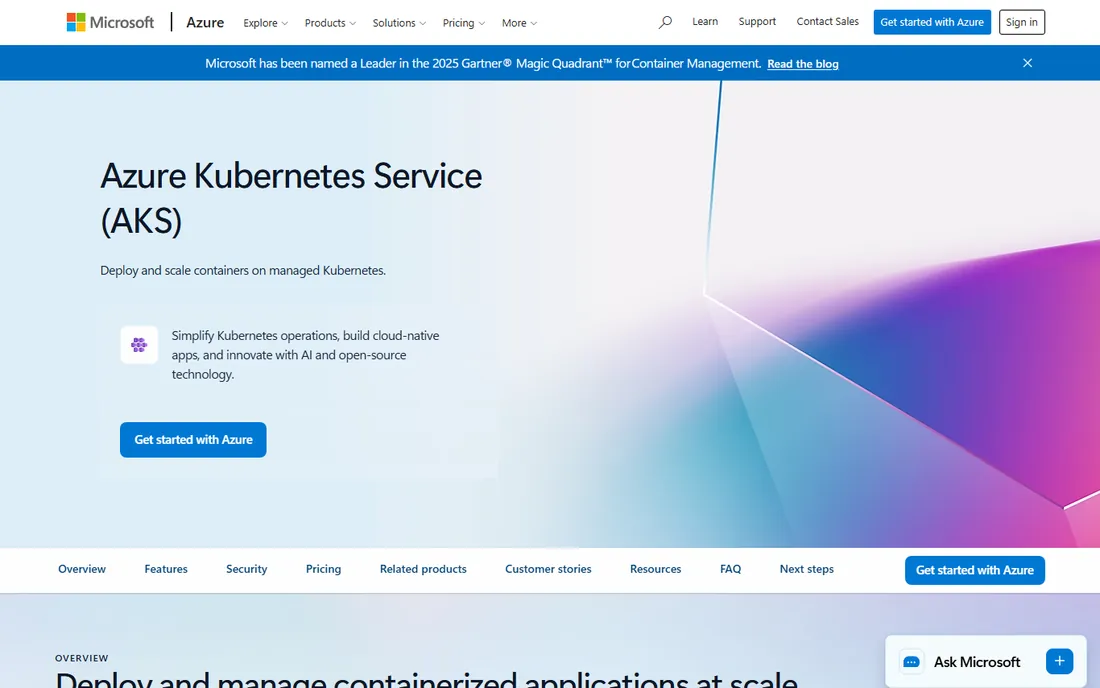
AKS offers the most generous free tier of the big three: free cluster management for dev and test clusters (you pay only for nodes), with Standard tier at $0.10 per cluster per hour adding the uptime SLA, and Premium adding long-term Kubernetes version support. AKS Automatic creates preconfigured production clusters with built-in best practices for upgrades, scaling and networking.
Microsoft shops get Entra ID authentication, Azure CNI networking, Key Vault integration and Azure Monitor out of the box. The tier structure means you can start free and only pay for the SLA when workloads go to production.
What we like- Free tier for dev and test
- Entra ID integration and Azure CNI
- AKS Automatic for preconfigured production clusters
Watch out for- Standard tier needed for uptime SLA
- Azure ecosystem learning curve for non-Microsoft teams
Starting price$9,995/yr (official)
Free planYes
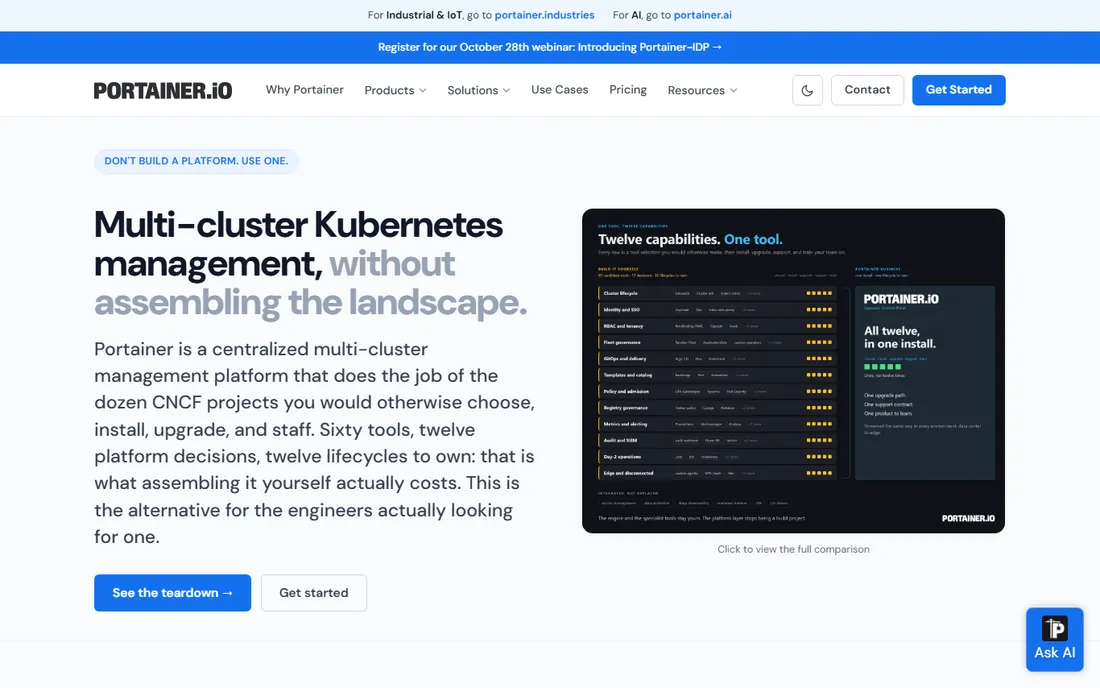
Portainer takes the opposite approach to the heavy platforms: a lightweight management container that gives you a clean web UI for daily Kubernetes, Docker, Swarm and Podman operations. Teams without deep Kubernetes expertise can deploy apps, manage namespaces and troubleshoot through guided workflows instead of YAML and kubectl. It can manage thousands of remote clusters and edge sites from one control plane.
Pricing starts at $9,995 per year for Enterprise IT, with an Edge and IIoT edition at $14,400. The Community Edition is free for homelabs and non-production use, and the Take3 program gives 3 free Business Edition nodes. Portainer suits platform teams that want central governance without adopting a full-stack platform.
What we like- Simple web UI over Kubernetes, Docker, Swarm and Podman
- Runs as a lightweight container
- 3 free Business nodes via Take3
Watch out for- Less depth than Rancher or OpenShift
- Enterprise features need the paid edition
Starting price$15/node/mo (reported)
Free planFree trial
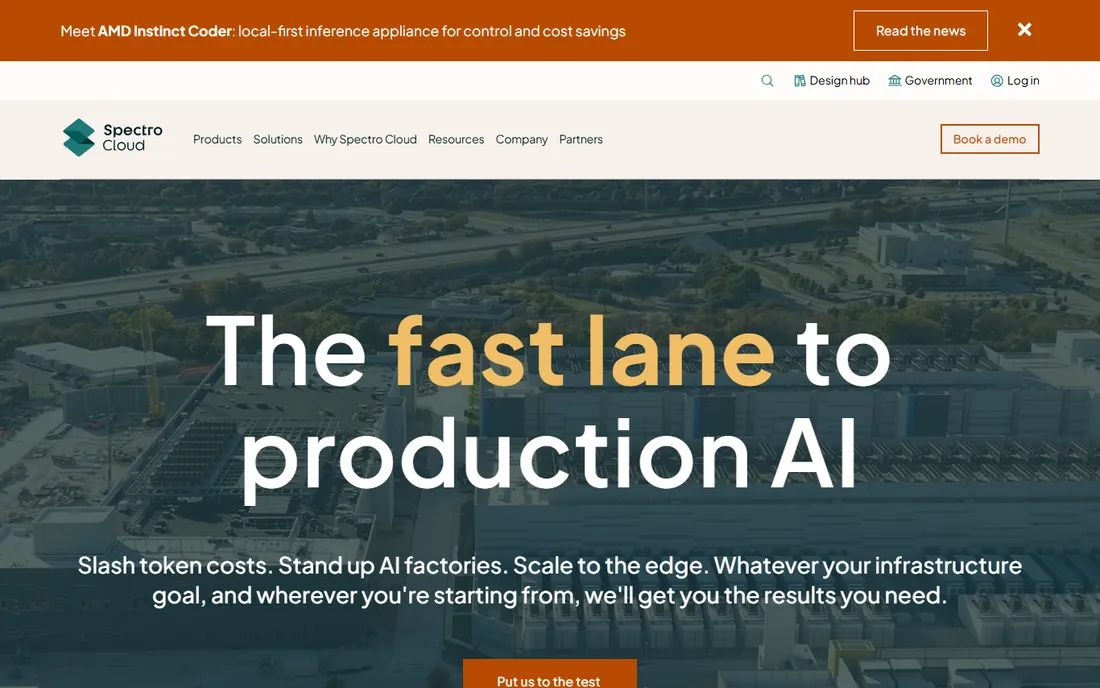
Spectro Cloud Palette is the newer enterprise entrant, built around Cluster Profiles that declare the entire cluster stack: OS, Kubernetes distribution, networking, storage and applications. It auto-remediates drift down to the OS level and is consistently rated a leader in analyst coverage of declarative management. Palette works as a SaaS tier or self-hosted.
Reported pricing is around $15 per node per month for the SaaS tier, with a 30-day free trial including 50 node-hours and up to 5 managed clusters. Palette fits platform teams that want GitOps-style declarative management across clouds without running the management plane themselves.
What we like- Cluster profiles define the full stack declaratively
- Drift auto-remediation
- SaaS or self-hosted
Watch out for- Younger vendor than Rancher or Red Hat
- Pricing not published
How we chose
We reviewed vendor pricing pages and documentation, managed-service pricing breakdowns from FinOps analysts, and public comparisons on review directories like G2, Capterra, Slashdot and TrustRadius. We compared multi-cluster support, managed versus self-hosted models, pricing transparency, free tiers, and fit for small versus enterprise teams. We did not claim hands-on testing.
What to evaluate before you buy
Start with where your clusters live. If everything is in one cloud, the managed service (GKE, EKS or AKS) is the simplest answer, and the decision comes down to your cloud vendor. Managed services remove the control plane burden but charge per cluster, so consolidate.
If clusters span clouds, data centers or edge sites, you need a management layer above them: Rancher for open-source control, Portainer for lightweight operations, Spectro Cloud for declarative stacks, or OpenShift for regulated environments. Watch out for extended-support fees: running old Kubernetes versions on EKS jumps the cluster fee from $0.10 to $0.60 per hour.
Finally, model the real cost, not just the management fee. Nodes, storage, networking and load balancers dwarf control plane charges. The $74.40 monthly GKE credit and AKS free tier make small clusters nearly free to manage; at scale, committed-use discounts on compute matter far more than which console you use.
These two categories solve different problems. A managed service like GKE, EKS or AKS runs your clusters: it provisions the control plane, handles upgrades, repairs failed nodes, and integrates with its own cloud. You manage workloads; the provider manages the infrastructure.
A management platform like Rancher, Portainer or Spectro Cloud Palette sits above clusters wherever they run: on-prem, in any cloud, at the edge. It unifies access control, policy, GitOps deployments and monitoring across the fleet. Many teams use both: a managed service for the clusters themselves, and a platform like Rancher on top for governance across clouds. This layering is common in practice because the managed service handles day-to-day reliability while the platform handles consistency.
Portainer sits in a middle position here. It does not replace a managed service's automation, but it gives smaller teams and edge deployments a single web UI without the weight of Rancher or the cost of OpenShift. Teams running kiosks, retail sites or factory floors with small clusters often pick Portainer for exactly this reason: it is fast to install, easy to hand to non-specialists, and the Take3 program covers three Business nodes at no cost. The tradeoff is depth. If you need fleet-wide policy enforcement, air-gapped edge updates at scale, or built-in CI/CD, you will outgrow it.
Frequently asked questions
What is the cheapest way to run a Kubernetes cluster?
For small clusters, GKE's $74.40 monthly credit covers one cluster's management fee, and AKS offers a free management tier. Compute costs still apply everywhere.
Do I need Rancher if I use EKS?
Not necessarily. Rancher adds value when you manage clusters across multiple clouds or on-prem environments. If all clusters live in AWS, EKS plus AWS tooling is usually enough.
What is the difference between OpenShift and Kubernetes?
OpenShift is a Kubernetes-based platform that adds integrated security, CI/CD, a container registry, monitoring and support. Kubernetes alone is just the orchestrator.
How much does EKS cost per month?
The control plane costs $0.10 per cluster per hour, about $73 per month, plus your EC2 or Fargate node costs. Clusters on extended-support versions cost $0.60 per hour.
Is Portainer free?
Portainer Community Edition is free for non-production and homelab use. Production use needs Business Edition, from $9,995 per year, though the Take3 program offers 3 free nodes.
Can I manage clusters across clouds?
Yes. Rancher, Portainer and Spectro Cloud Palette are designed for multi-cloud and hybrid environments, managing clusters wherever they run from one control plane.
Sources we checked (7)
- https://www.portainer.io/blog/best-kubernetes-management-tools
- https://www.portainer.io/blog/rancher-alternatives
- https://www.perfectscale.io/blog/gke-autopilot-pricing-costs-examples-5-best-practices
- https://www.nops.io/blog/amazon-eks-pricing/
- https://learn.microsoft.com/en-us/azure/aks/free-standard-pricing-tiers
- https://www.redhat.com/en/technologies/cloud-computing/openshift/pricing
- https://github.com/ishandutta2007/awesome-kubernetes-management-platform/blob/HEAD/README.md
Is your product missing or out of date?
We review this list regularly. Vendors can request a listing, send updated pricing or ask about featured placement.

Shihab Mia · Founder, Rankite
Shihab has spent more than a decade helping SaaS and e-commerce brands grow through search. He writes Rankite's software buying guides from pricing pages, documentation and public user reviews. More about Shihab.