How we make this list: we compare pricing pages, product documentation and public user reviews. Rankite is independent; if a vendor ever pays for a featured spot, that listing is clearly labeled Partner.
Key takeaways
- Apache Tomcat remains the default for running Java web applications: free, proven, and everywhere.
- Red Hat JBoss EAP is the commercial open-source choice for enterprises that want full Jakarta EE with a support contract.
- Oracle WebLogic and IBM WebSphere suit large organizations already committed to those vendors' ecosystems.
- WildFly, GlassFish, TomEE, and Jetty give you serious capability at zero license cost.
- Payara Server, now part of Azul, is the pragmatic escape route for teams migrating off WebLogic or WebSphere.
Quick comparison
Is your product missing or out of date?
We review this list regularly. Vendors can request a listing, send updated pricing or ask about featured placement.
The best application server software
Starting priceFree
Free planYes
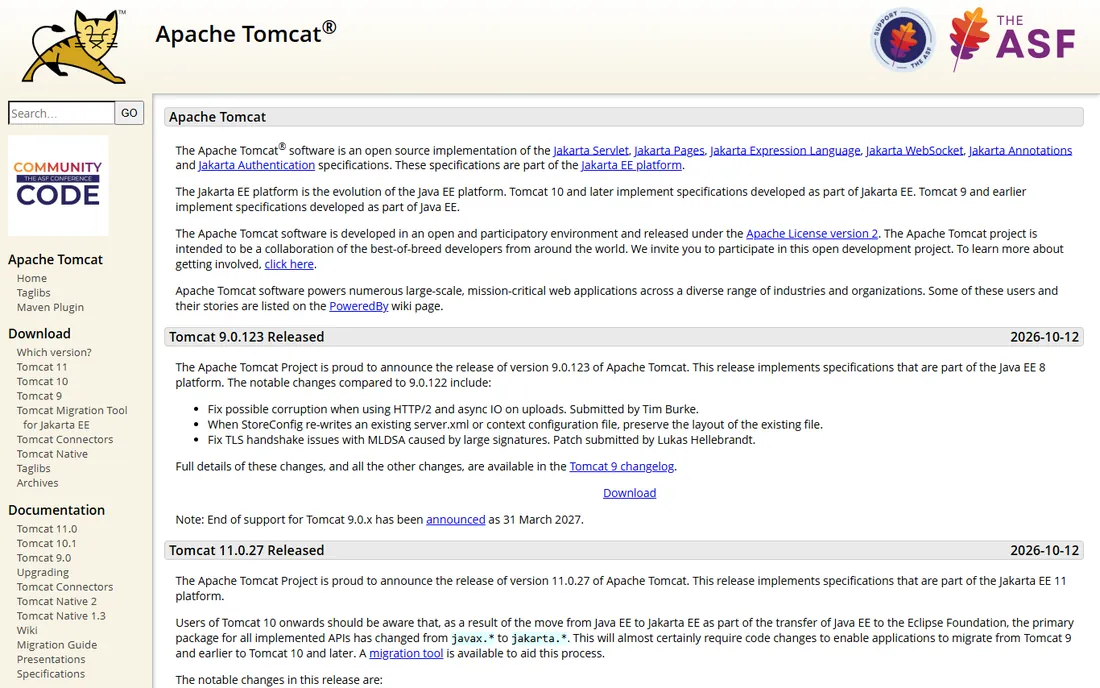
Tomcat is the most deployed Java application server on earth, and its appeal is simplicity. It runs servlets, JSPs, and WebSockets with minimal configuration and a fraction of the memory footprint of full enterprise servers. For the large class of applications that are really just web apps with a database behind them, Tomcat is everything needed and nothing more.
What it does not do is the full Jakarta EE stack: no EJB container, no built-in JMS provider, no distributed transaction coordinator out of the box. Teams that need those either add components or move to TomEE or a full server. But for straightforward web workloads, Tomcat's combination of zero cost, tiny resource use, and decades of operational knowledge is unmatched.
What we like- Free, tiny footprint, and enormously battle-tested
- Huge community and documentation
- The reference for servlet and JSP workloads
Watch out for- Not a full Jakarta EE server, so EJBs and full JMS need add-ons
- No commercial support contract from a vendor

#2
Red Hat JBoss EAP
Best for: Enterprise Jakarta EE with support
Visit redhat.com
Starting priceSee website
Free planNo
JBoss Enterprise Application Platform is Red Hat's commercial answer for organizations that run Jakarta EE in production and need accountability. It is built from the WildFly upstream project, hardened, and backed by Red Hat's support organization with patch SLAs that matter to regulated industries. Migration from WildFly to EAP is straightforward by design, which gives teams a free on-ramp and a paid destination.
The subscription model means budgeting through Red Hat sales rather than a download button. For simple servlet workloads it is also more server than necessary. But for enterprises standardizing on Red Hat across OS, middleware, and cloud, EAP is the coherent choice, and the support contract is the product as much as the software.
What we like- Full Jakarta EE on a stable, long-life codebase
- Red Hat support with defined SLAs
- Smooth path from the free WildFly upstream
Watch out for- Subscription pricing is quote-based
- Heavier than Tomcat for simple workloads
Starting priceSee website
Free planNo
WebLogic is the application server of the Oracle shop. If your data lives in Oracle Database and your integrations run through Oracle middleware, WebLogic fits like the missing piece: connection pooling, transaction coordination, and clustering all tuned for that world. Its high-availability and disaster-recovery features are genuinely strong, which is why banks and telecoms still run it.
The price of admission is Oracle licensing, which is expensive and famously complex to navigate. Administration is a specialty skill, not something a generalist picks up in a week. Organizations already deep in Oracle's ecosystem accept this as the cost of coherence. Everyone else should think hard before buying into a stack this heavy.
What we like- Deep integration with Oracle database and Fusion Middleware
- Strong clustering and high-availability features
- Long enterprise track record
Watch out for- Licensing costs are famously high
- Administration complexity demands specialists

#4
IBM WebSphere Application Server
Best for: IBM-centric enterprises
Visit ibm.com
Starting priceSee website
Free planNo
WebSphere has processed some of the world's biggest transaction volumes for decades, and it shows in the engineering: workload management, failover, and administrative control are built for scale that most servers never see. For IBM-centric enterprises, particularly in financial services, it remains a known quantity with deep institutional knowledge.
Like WebLogic, it belongs to an era of heavyweight middleware. It wants serious hardware, trained administrators, and license budgets to match. IBM's direction emphasizes its Liberty profile and container story for new work, while traditional WebSphere keeps the legacy estate running. New projects should evaluate whether they need this weight or whether a lighter server does the job.
What we like- Proven in the largest transaction-processing environments
- Strong administrative tooling
- Fits IBM hybrid cloud strategy
Watch out for- Resource-heavy and complex to operate
- Licensing costs add up
Starting priceFree
Free planYes
WildFly is what JBoss EAP is made from, minus the subscription. It delivers the full Jakarta EE platform, clustering, messaging, transactions, and all, as a free download with impressively fast startup times. Development teams love it because the code they test on WildFly deploys unchanged to JBoss EAP in production.
The trade is support. There is no SLA, no one to call, only community forums and documentation. Many teams accept that happily; some augment it with third-party support. If you want enterprise Jakarta EE without enterprise licensing, WildFly is the most capable free option, and the EAP upgrade path stays open if needs change.
What we like- Complete Jakarta EE implementation at zero cost
- Fast startup and low memory use for its class
- The upstream of JBoss EAP
Watch out for- No vendor support contract on the free version
- Community support only
Starting priceFree
Free planYes
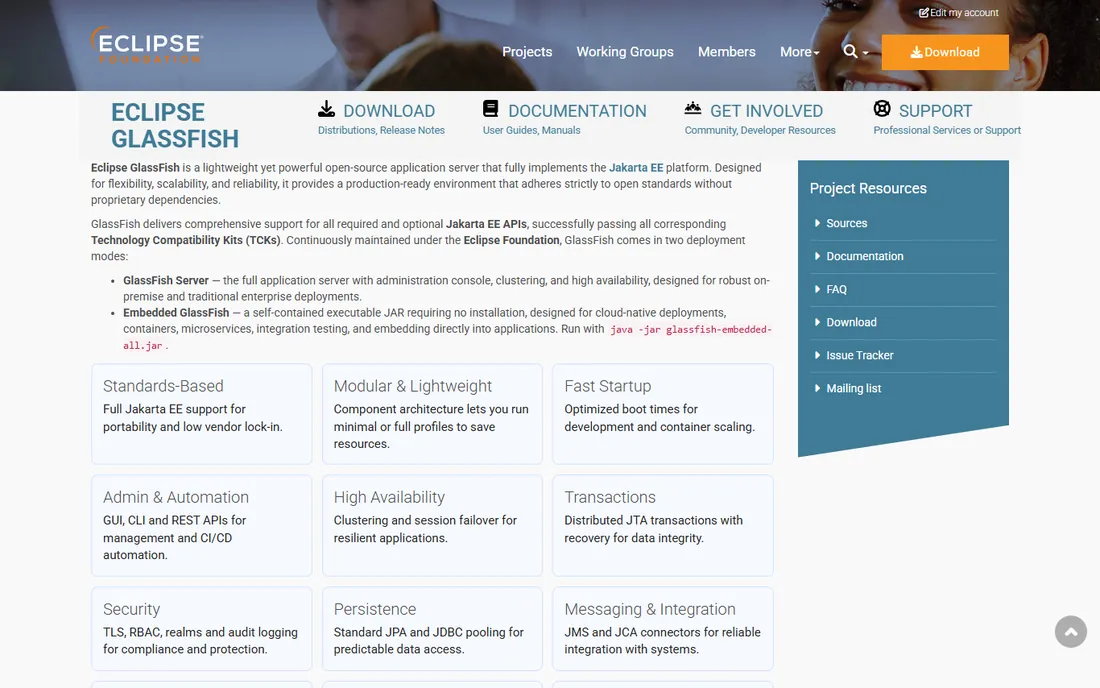
GlassFish carries the reference-implementation DNA of Java EE into the Jakarta EE era under the Eclipse Foundation. Recent releases track the latest Jakarta EE specifications closely, with an embedded mode that runs as a single executable JAR for containers and microservices. For teams that value strict standards compliance and portability, it is a principled choice.
The community is smaller than Tomcat's or WildFly's, which means fewer Stack Overflow answers and fewer third-party integrations. Commercial support options exist but are niche. GlassFish suits teams comfortable with open source self-reliance who want a clean, standards-faithful server, and it pairs naturally with Payara for those who later want commercial backing.
What we like- Reference implementation lineage for Jakarta EE
- Active development with 2026 releases
- Embedded mode suits containers and microservices
Watch out for- Smaller community than Tomcat or WildFly
- Commercial support ecosystem is thin
Starting priceFree
Free planYes
Jetty is the server you have used a thousand times without knowing it. It embeds inside build tools, frameworks, IDEs, and products from major vendors because it starts fast, sips memory, and handles modern protocols well. For microservices and embedded use cases, it is often the right-sized choice where a full application server would be absurd.
It does not try to be WebLogic. There is no EJB container, no heavy admin console, no clustering suite. That is the point. Developers who need a servlet engine inside their application, or a light standalone server for services, get exactly that and nothing else. Commercial support is available through Webtide for teams that want it.
What we like- Extremely lightweight and embeddable
- Powers countless frameworks and tools behind the scenes
- Efficient HTTP/2, HTTP/3, and WebSocket support
Watch out for- Not a full application server, it is a servlet container
- Admin tooling is minimal

#8
Payara Server (Azul)
Best for: Migrating off legacy commercial servers
Visit payara.fish
Starting priceSee website
Free planYes
Payara began as the commercially supported GlassFish for production, and it has since been acquired by Azul, the Java runtime company. The pitch is pragmatic: lift existing Jakarta EE applications off expensive WebLogic, WebSphere, or JBoss EAP installations without rewriting them, onto a server with monthly security patches and per-vCore pricing that undercuts legacy vendors substantially. The free Community edition keeps the open-source on-ramp alive.
The Azul acquisition is recent enough that buyers should ask about roadmap continuity, though Azul's Java focus makes the combination logical. For organizations paying six figures a year in legacy application server support, Payara's migration story, same admin tooling as GlassFish, no code changes, is the most credible exit ramp available.
What we like- Drop-in familiarity for GlassFish users with commercial support
- Transparent per-vCore pricing
- Positioned as the migration path off WebLogic and WebSphere
Watch out for- Now part of Azul, so watch how the roadmap evolves
- Enterprise features need the paid edition
Starting priceFree
Free planYes
TomEE answers a specific question: what if you like Tomcat but need the Java EE APIs it lacks? It layers EJB, CDI, JPA, JMS, and JAX-RS onto the Tomcat base, giving you a certified stack without leaving the Tomcat world your team already knows. For applications that outgrow plain Tomcat's servlet-only model, it is the gentlest upgrade path.
The project moves more slowly than Tomcat itself and the community is a fraction of the size, so the newest Jakarta EE features arrive later. But for stable, long-lived applications that need enterprise APIs without enterprise servers, TomEE hits a sweet spot: familiar operations, zero license cost, and just enough platform.
What we like- Adds EJB, JPA, JMS, and more to familiar Tomcat
- Free under the Apache license
- Lighter than full enterprise servers
Watch out for- Smaller community than plain Tomcat
- Release cadence is slower
How to choose between free and commercial
The license cost is rarely the deciding factor; the support model is. Free servers (Tomcat, WildFly, GlassFish, Jetty, TomEE) cost nothing to download and everything in staff expertise. If your team can diagnose a transaction deadlock at midnight, free is genuinely free. If not, the commercial options (JBoss EAP, WebLogic, WebSphere, Payara Enterprise) sell you someone to call, plus patch SLAs your auditors will ask about.
A common middle path works well: develop and test on the free upstream (WildFly, GlassFish), then buy support only for production. And if you are currently paying for WebLogic or WebSphere mostly out of inertia, get a Payara migration quote before renewing; the savings claims are aggressive but directionally real.
Deployment patterns that have won
A few architectural notes that matter more than brand choice.
Containers changed the calculus
Heavyweight application servers made sense when one big server ran many applications. In the container era, one small server per service is the norm, which favors lightweight options like Tomcat, Jetty, or embedded GlassFish. Do not lift a full WebSphere topology into Kubernetes without asking whether each service needs it.
Match the server to the APIs you use
Inventory your application's actual API usage before choosing. Servlet and JSP only: Tomcat or Jetty. Full Jakarta EE with EJBs and JMS: WildFly, GlassFish, Payara, or TomEE. Buying a full platform for a servlet app wastes memory and money; running EJBs on Tomcat wastes engineering time on workarounds.
Plan your Java version
Jakarta EE 10 and 11 require modern JDKs, and the javax-to-jakarta namespace migration still bites teams upgrading old applications. Check each server's supported JDK range against your runtime plans, and budget time for the namespace migration if your code predates it.
How we chose
We covered the servers that actually run production Java workloads: the dominant open-source options and the commercial platforms with real enterprise installed bases. We verified each project's current status through its official site and documentation, confirming active 2026 releases where applicable. We read operator discussions on Reddit, Stack Overflow, and vendor forums, weighting operational concerns like memory footprint, startup time, clustering behavior, and upgrade pain over feature checklists. Prices reflect vendor-published information; commercial servers here are quote-based.
Frequently asked questions
What is an application server?
An application server runs your application code and provides shared services like transaction management, database connection pooling, messaging, and security. For Java, it typically implements some or all of the Jakarta EE specification. It sits between your application and the operating system, handling infrastructure concerns so your code does not have to.
What is the difference between Tomcat and a full application server?
Tomcat is a servlet container: it runs web applications but not the full Jakarta EE stack (no EJB, no built-in JMS). Full application servers like WildFly, GlassFish, or WebLogic implement the complete platform. TomEE bridges the gap by adding enterprise APIs to Tomcat.
Is JBoss the same as WildFly?
WildFly is the free upstream community project; Red Hat JBoss EAP is the commercially supported product built from it. Code runs on both, but only EAP comes with Red Hat support SLAs and long-term patching.
Do I still need an application server with microservices?
Often a lighter one. Microservices typically embed a servlet container like Jetty or Tomcat, or run an embedded server inside the service. Full application servers still make sense for large monolithic enterprise applications, but they are overkill for most new microservices.
How much does a commercial application server cost?
Vendors price by quote, usually per core or per virtual core annually. Costs range from modest four-figure subscriptions for small JBoss EAP deployments to six figures for large WebLogic or WebSphere estates. Always compare against the migration cost to a lighter or open-source alternative before renewing.
What happened to Java EE?
Oracle donated Java EE to the Eclipse Foundation, where it became Jakarta EE. The javax namespace became jakarta, which means old applications need code changes to run on new servers. Current servers implement Jakarta EE 10 or 11.
Sources we checked (9)
- https://tomcat.apache.org
- https://www.redhat.com
- https://www.oracle.com
- https://www.ibm.com
- https://www.wildfly.org
- https://glassfish.org
- https://www.eclipse.dev/jetty
- https://payara.fish/
- https://tomee.apache.org
Is your product missing or out of date?
We review this list regularly. Vendors can request a listing, send updated pricing or ask about featured placement.

Shihab Mia · Founder, Rankite
Shihab has spent more than a decade helping SaaS and e-commerce brands grow through search. He writes Rankite's software buying guides from pricing pages, documentation and public user reviews. More about Shihab.
 Apache Tomcat
 Oracle WebLogic Server
 WildFly
 Eclipse GlassFish
 Eclipse Jetty
 Apache TomEE