How we make this list: we compare pricing pages, product documentation and public user reviews. Rankite is independent; if a vendor ever pays for a featured spot, that listing is clearly labeled Partner.
Key takeaways
- ALM means Application Lifecycle Management: requirements, design, testing, traceability and release in one governed system, not general project tracking.
- The enterprise leaders (Jama Connect, Polarion, Codebeamer, IBM ELM) all price by quote; expect a sales cycle, not a buy button.
- If your product gets audited or certified, prioritize native traceability, baselining and electronic signatures over feature count.
- Azure DevOps and Tuleap cover the delivery side for far less money, but the compliance layer becomes your own build project.
Quick comparison
| Tool | Best for | Starting price | Free plan |
|---|
 Jama Connect Jama Connect | requirements-led complex products | Custom (quote-based) | Free trial |
 Siemens Polarion Siemens Polarion | large systems engineering programs | Custom (quote-based) | Free trial |
 PTC Codebeamer PTC Codebeamer | automotive and safety-critical work | Custom (quote-based) | Free trial |
 Perforce Helix ALM Perforce Helix ALM | test-heavy engineering teams | ~$35/user/month | Free trial |
 Visure Solutions Visure Solutions | requirements engineering depth | Custom (quote-based) | 14-day free trial |
 IBM Engineering Lifecycle Management IBM Engineering Lifecycle Management | defence, aerospace and rail at scale | Custom (quote-based) | No |
 Tuleap Tuleap | open-source ALM | Free (open source); Enterprise plans paid | Yes |
 Azure DevOps Azure DevOps | general software delivery | Free for 5 users; Basic $6/user/month | Yes (5 users free) |
Is your product missing or out of date?
We review this list regularly. Vendors can request a listing, send updated pricing or ask about featured placement.
The best ALM software
On G2, the most-reviewed ALM platforms cluster tightly: Jama Connect at 4.3 out of 5 from 195 reviews, Polarion at 4.2, Perforce ALM at 4.1 and IBM DOORS Next at 4.0 (g2.com). The ratings are close because the products are genuinely capable; the real differences show up in audit readiness, administration burden and price. The eight below cover the full range from regulated-industry specialists to general delivery platforms.
Starting priceCustom (quote-based)
Free planFree trial
Jama Connect is the strongest product in this roundup on the requirements process itself. Decomposition of high-level needs into testable requirements, multi-stakeholder review cycles with comments, and baselined approval of requirement sets are all handled well. For complex products where the hardest part is getting several engineering disciplines to agree on what to build, that discipline is genuinely valuable.
Jama Software positions the product around requirements, risk and test management, which means quality management records and document control typically live in a second system. Budget for that integration and for the fact that evidence sits in two places. Pricing is quote-based and aimed at mid-size to enterprise programs; trials are available. Jama Connect fits teams whose bottleneck is requirements agreement and review. Teams that wanted one repository for both the design record and the quality record should look at Codebeamer or Matrix-style specialists instead.
What we like- Strongest review and approval workflows for requirements
- Baselined requirement sets
- Broad integrations including Jira and Azure DevOps
Watch out for- Quality management records live outside it
- Review process can feel heavy for smaller teams
Starting priceCustom (quote-based)
Free planFree trial
Polarion is the broadest ALM product here. Requirements, test management, release management and configuration management sit in one application, with a variant and branching model built for product families that live for years. Large systems engineering programs with hundreds of engineers, running on Siemens tooling like Teamcenter, are where it earns its keep.
That breadth carries an administration cost. Polarion rewards a dedicated tool administrator, and its configuration model is deep enough that an unmanaged instance drifts into a slow, half-configured system. Implementation is measured in months, and pricing is enterprise quote-based. It is wrong for small teams that need to be productive in the first month. For organizations already standardized on Siemens engineering tools, though, the ecosystem fit is hard to beat.
What we like- Broadest lifecycle coverage on this list
- Strong variant and branching model for product families
- Deep Siemens ecosystem integration
Watch out for- Needs a dedicated administrator
- Overkill below roughly twenty engineers
#3
PTC Codebeamer
Best for: automotive and safety-critical work
Visit ptc.com
Starting priceCustom (quote-based)
Free planFree trial
Codebeamer's center of gravity is automotive and industrial software. Its process templates for Automotive SPICE and functional safety are among the most complete available, and its variant management handles the platform-plus-derivatives pattern that automotive programs live in. Requirements, risk, testing and release traceability connect end to end in one configurable system.
The product expects to be configured: the value sits in the process model you build inside it, so it amplifies process discipline you already have rather than supplying it. Plan on staffing an administrator and a real implementation project. Pricing is quote-based enterprise. Codebeamer deserves a serious look from automotive and safety-critical teams; teams wanting opinionated defaults out of the box, or medical-device teams where its template edge is thinner, should compare Jama Connect and Visure first.
What we like- Excellent Automotive SPICE and functional-safety templates
- Strong variant management
- Highly configurable workflows
Watch out for- Heavy to configure and needs an owner
- Template advantage is smaller outside automotive
Starting price~$35/user/month
Free planFree trial
Helix ALM connects requirements, test cases and issues as one linked triad, and that connection is its strength. Teams whose real pain is test coverage and defect traceability, rather than requirements authoring, often find it the most direct fit. The modular design means a team can adopt requirements management, test management or issue tracking separately instead of swallowing a whole suite at once.
Pricing signals sit around $35 per user per month, which is refreshingly concrete in a category of quote-only enterprise deals. The tradeoff is template depth: Helix ALM ships fewer sector-specific compliance templates than Codebeamer or Visure, so more of the regulatory shaping is yours to build. It also leans on a smaller ecosystem than the Atlassian or Microsoft stacks. For test-driven engineering organizations that want linked lifecycle artifacts without enterprise sales theater, it is a pragmatic middle ground.
What we like- Requirements, test cases and issues linked as one triad
- Modular design lets teams adopt pieces
- Transparent per-user pricing signal
Watch out for- Fewer sector-specific compliance templates
- Smaller integration marketplace than Atlassian or Microsoft
Starting priceCustom (quote-based)
Free plan14-day free trial
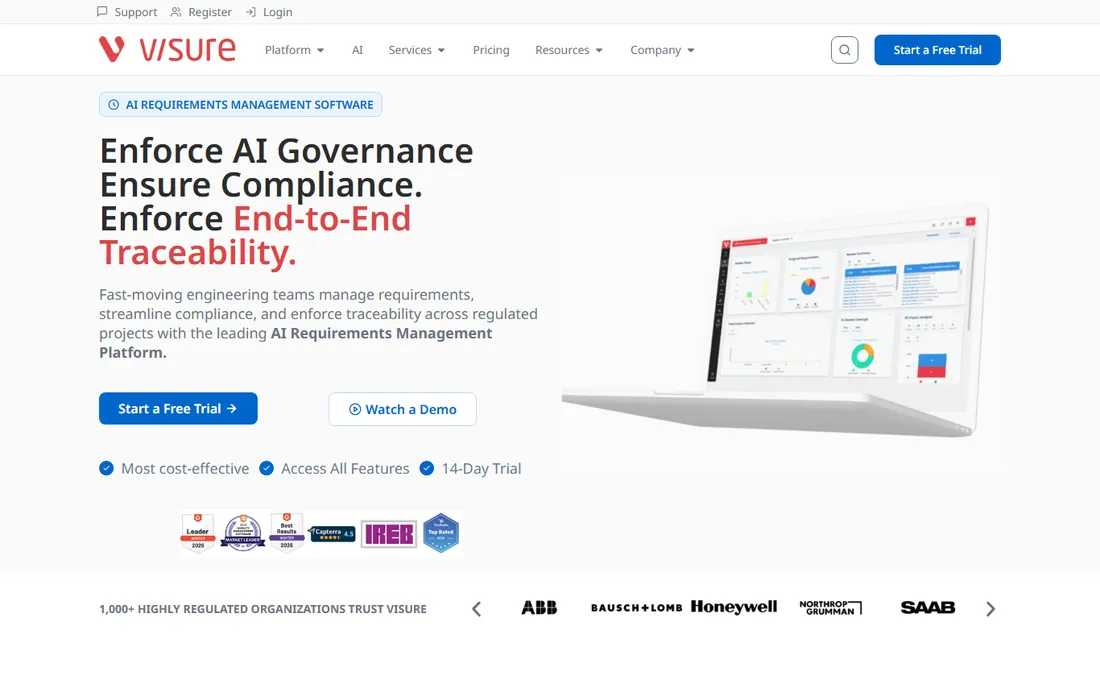
Visure is a requirements-first platform with unusually strong analysis features and one of the broadest template libraries for named standards: ISO 26262, IEC 62304, IEC 61508, DO-178C, SPICE and more. Where the bottleneck is writing, reviewing and formally structuring requirements against a standard, it is a serious option. Import from Word and Excel is smooth, and ReqIF exchange keeps legacy toolchains in the loop.
The company also offers a 14-day free trial, which is generous for this category. Pricing beyond the trial is quote-based. The honest limitation is lifecycle breadth: test management and quality records usually live in another system, so the end-to-end evidence chain needs integration work. Visure also added an on-premise AI assistant for drafting requirements, aimed at teams that cannot let data leave their environment. Pick it when requirements engineering is the job; pick a fuller ALM suite when you need one repository for the whole chain.
What we like- Deep requirements analysis features
- Broad library of standards templates
- Tight MS Word and Excel round-tripping
Watch out for- Lifecycle coverage thins past requirements
- Test and quality records often mean a second system
#6
IBM Engineering Lifecycle Management
Best for: defence, aerospace and rail at scale
Visit ibm.com
Starting priceCustom (quote-based)
Free planNo
IBM's ELM suite, including DOORS Next, remains the standing answer in defence, aerospace and rail, where a product will outlive several generations of tooling. Scale, rigour and a very deep requirements model are its strengths, and its position in those sectors is earned: programs running for decades need baselines and configuration management that survive staff turnover and technology shifts.
The cost is effort and modernity. Deployment, administration and the day-to-day user experience all reflect a product with a long history, and getting a new team productive takes longer than with anything else on this list. Pricing is enterprise quote-based with no free tier to speak of. IBM ELM is wrong for startups, mid-size teams and anyone who needs to be running inside a quarter. For the programs it was built for, though, nothing else has the same multi-decade evidence.
What we like- Unmatched track record in very long-lived programs
- Deep requirements model with DOORS Next
- Rigorous configuration management
Watch out for- Long deployment and learning curve
- User experience feels dated next to newer tools
Starting priceFree (open source); Enterprise plans paid
Free planYes
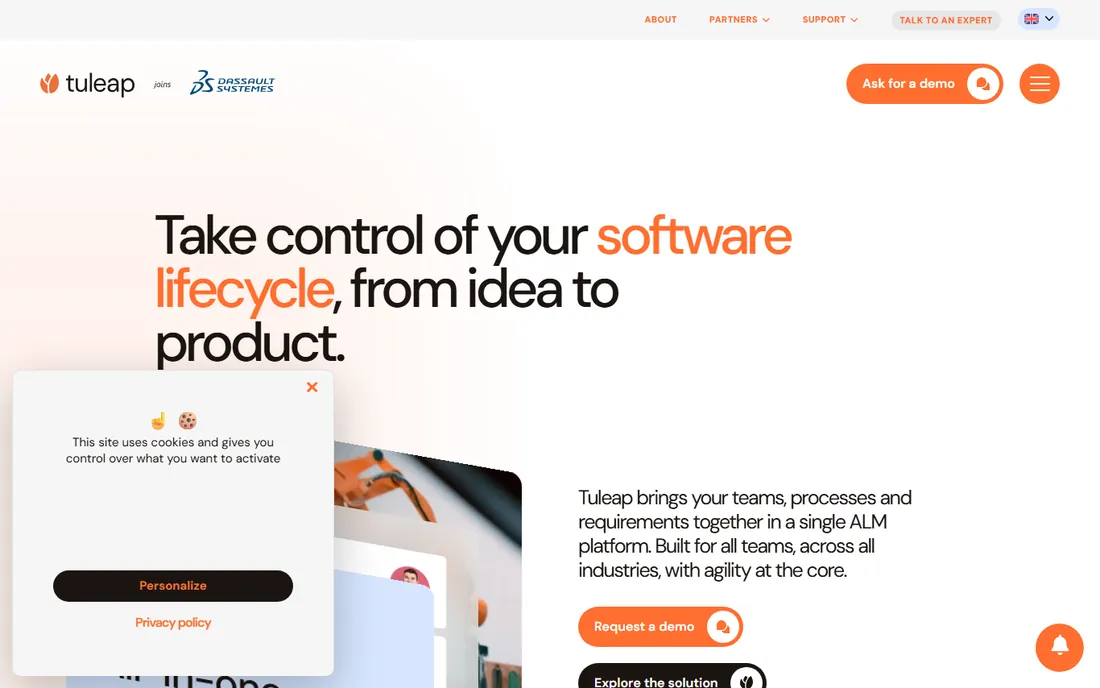
Tuleap is the open-source answer to ALM: agile boards, Git hosting, document management, trackers and dashboards in one self-hostable platform, free under an open-source license. For teams that want lifecycle coverage without a vendor contract, or that must keep everything inside their own infrastructure, it removes the biggest barrier in this category, which is price.
The Enterprise edition adds support and advanced features on a paid plan, which is the honest way to fund critical tooling. What Tuleap will not give you is the deep compliance template libraries of Codebeamer or Visure, nor the audit-oriented evidence model of the regulated specialists. It is also a smaller project than the commercial suites, so the ecosystem is narrower. For software teams that need solid ALM plumbing and can shape their own process, Tuleap delivers remarkable value at zero license cost.
What we like- Genuinely free open-source core
- Agile planning, Git hosting, docs and trackers in one
- Can self-host
Watch out for- Compliance templates are thinner than commercial ALM
- Enterprise support costs extra
Starting priceFree for 5 users; Basic $6/user/month
Free planYes (5 users free)
Azure DevOps is the best general-purpose software delivery platform on this list, and for many teams it is the right buy. Boards, Git repositories, CI/CD pipelines, package artifacts and test plans sit together in one service, and the first five users are free with Basic plans at $6 per user per month after that. On value for a team whose job is shipping software quickly, it is very hard to beat.
It is not an audit tool. There is no native risk item type, no electronic signature with regulated attributability, and no baselining that freezes a full evidence set for later reproduction. Teams do build those things with extensions, custom work-item types and exported reports, but that build becomes a system of its own that you own, validate and maintain through staff turnover and extension upgrades. Azure DevOps is the right choice for unregulated software delivery and the wrong choice when an inspector will ask for proof.
What we like- Boards, repos, pipelines, artifacts and test plans in one place
- Outstanding value for shipping software
- Huge extension marketplace
Watch out for- No native risk model, electronic signatures or regulated baselining
- Compliance layer becomes your own build project
How to shortlist ALM software without wasting six months
Sketch your evidence chain before any demo
Draw your item types and the links between them: requirement to risk to design to test to defect to release. If risks appear in the sketch, every tool with no native risk item type has already failed, and that removes half the shortlist in ten minutes. Demos then become validation, not discovery.
Assign an owner before you sign
An ALM platform with no administrator degrades. Polarion, Codebeamer and IBM ELM all assume somebody owns configuration; Jama Connect and Visure need less but still benefit. If the role is not in somebody's job description, buy the tool that needs the least configuration, not the most capable one.
Plan the migration honestly
Moving requirements between tools is easy; every product here imports from Excel, ReqIF or CSV. Moving traceability links is harder, and moving approval history in a way that preserves attributability is usually impossible. The normal answer is to keep the old system read-only for released products and start fresh at the next release.
Why ALM pricing is almost never public
Enterprise ALM vendors price by quote because the deal includes far more than licenses: implementation services, migration, training, validation support and multi-year commitments all move the number. Published per-user figures, where they exist (Helix ALM around $35, Azure DevOps at $6), cover the platform alone. When comparing quotes, normalize on a three-year total cost including implementation and the administrator's time. A cheaper license with a six-month implementation often costs more than a pricier one that goes live in eight weeks.
How we chose
We compared these platforms using current vendor pages and documentation, public reviews on G2 and Capterra, and four detailed 2026 comparisons (TechBullion's ALM ranking, scmGalaxy's ALM tool comparison, Analytics Insight's requirements management ranking and Matrix's Jira-integration analysis). We weighted native traceability and audit readiness highest, then lifecycle breadth, administration burden, integration ecosystems, pricing transparency and fit for US engineering teams from startups to enterprises. Where vendors publish no pricing, we say so instead of guessing.
Frequently asked questions
What does ALM stand for in software?
ALM stands for Application Lifecycle Management: the coordinated management of requirements, design, development, testing, deployment and maintenance in one governed system. It is not the same as asset management, and it goes well beyond issue tracking.
How is ALM different from PLM?
ALM governs the lifecycle of software and systems; PLM (Product Lifecycle Management) governs physical products from concept through manufacturing to service. They overlap in industries like automotive and aerospace, where software is embedded in a physical product, and tools like Polarion and Codebeamer often bridge both.
How much does ALM software cost?
It ranges from free (Tuleap open source, Azure DevOps for five users) to quote-based enterprise deals that run into six figures annually for large programs. Mid-market signals sit around $20 to $39 per user per month. Always compare three-year totals including implementation, not just license fees.
Can Jira replace a dedicated ALM tool?
For agile delivery without external audit, often yes, especially with Confluence and plugins. For regulated development, Jira becomes an assembly project: traceability, approvals and baselines depend on plugins and conventions you maintain yourself. The question is whether maintaining that assembly is a good use of your engineers over several years.
How long does ALM implementation take?
Anywhere from weeks to a year. Azure DevOps or Tuleap can be productive in days for a software team. Enterprise ALM rollouts at Polarion, Codebeamer or IBM ELM scale typically run three to twelve months including process design, migration and training. Regulated-industry specialists often quote two to three months for a first validated project.
Should we choose cloud or on-premises ALM?
Regulated industries often require on-premises or private cloud for data control, and most enterprise ALM tools offer both. Cloud is faster to start and easier to maintain; on-premises gives you control over updates, which matters when revalidating after every upgrade. Tuleap and most commercial options support self-hosting.
Sources we checked (6)
- https://techbullion.com/best-alm-solutions-2026/
- https://www.scmgalaxy.com/tutorials/top-10-application-lifecycle-management-alm-tools-in-2025-features-pros-cons-comparison/
- https://www.g2.com/products/codebeamer-alm/competitors/alternatives
- https://www.analyticsinsight.net/technology/best-requirements-management-software-in-2026-8-tools-ranked
- https://matrixone.health/blog/requirements-management-tools-jira-integration
- https://mgtechsoft.com/blog/doors-next-vs-polarion-vs-codebeamer-vs-ptc-integrity/
Is your product missing or out of date?
We review this list regularly. Vendors can request a listing, send updated pricing or ask about featured placement.

Shihab Mia · Founder, Rankite
Shihab has spent more than a decade helping SaaS and e-commerce brands grow through search. He writes Rankite's software buying guides from pricing pages, documentation and public user reviews. More about Shihab.