How we make this list: we compare pricing pages, product documentation and public user reviews. Rankite is independent; if a vendor ever pays for a featured spot, that listing is clearly labeled Partner.
Key takeaways
- Dynatrace and Datadog lead for AI-driven root cause analysis inside a full observability stack, but both bill on usage meters that demand careful cost monitoring.
- BigPanda is the cleanest choice when the pain is alert noise rather than missing telemetry: it sits on top of the monitoring tools you already own and compresses thousands of alerts into a handful of incidents.
- If your shop already runs ServiceNow, BMC, or Splunk as the system of record, the native AIOps modules are usually cheaper to adopt than a fourth platform, though each comes with quote-only pricing.
- Free tiers exist at Datadog, New Relic, and PagerDuty, so a small team can validate alert correlation behavior before signing an enterprise contract.
Quick comparison
| Tool | Best for | Starting price | Free plan |
|---|
 Dynatrace Dynatrace | Enterprises wanting deterministic root cause | See website | Free trial (15 days) |
 Datadog Datadog | Cloud-native teams consolidating tools | $15 per host/month (Pro, billed annually) | Yes (free for up to 5 hosts) |
 New Relic New Relic | Teams that prefer usage-based pricing | See website | Yes (100 GB data ingest per month) |
 Splunk ITSI Splunk ITSI | Splunk shops adding service intelligence | See website | Free trial (14 days) |
 PagerDuty PagerDuty | On-call teams adding AIOps to incident response | $21 per user/month (Professional, billed annually) | Yes (free plan for up to 5 users) |
 BigPanda BigPanda | Multi-tool estates drowning in alert noise | See website | No |
 LogicMonitor LogicMonitor | Hybrid infrastructure and MSPs | $16 per Hybrid Unit/month (LM Essentials) | Free trial (14 days) |
 ScienceLogic ScienceLogic | Large enterprises standardizing on one platform | See website | No |
 BMC Helix AIOps BMC Helix AIOps | BMC shops modernizing operations | See website | No |
 ServiceNow ITOM ServiceNow ITOM | ServiceNow customers unifying ops and ITSM | See website | No |
Is your product missing or out of date?
We review this list regularly. Vendors can request a listing, send updated pricing or ask about featured placement.
Alert fatigue is the tax every growing engineering org pays. One outage triggers hundreds of alerts from a dozen tools, nobody knows which one matters, and the on-call engineer scrolls while customers wait. AIOps platforms compress that chaos: they ingest events, metrics, logs, and topology, correlate related signals with machine learning, and hand responders a probable root cause instead of a wall of red.
Starting priceSee website
Free planFree trial (15 days)
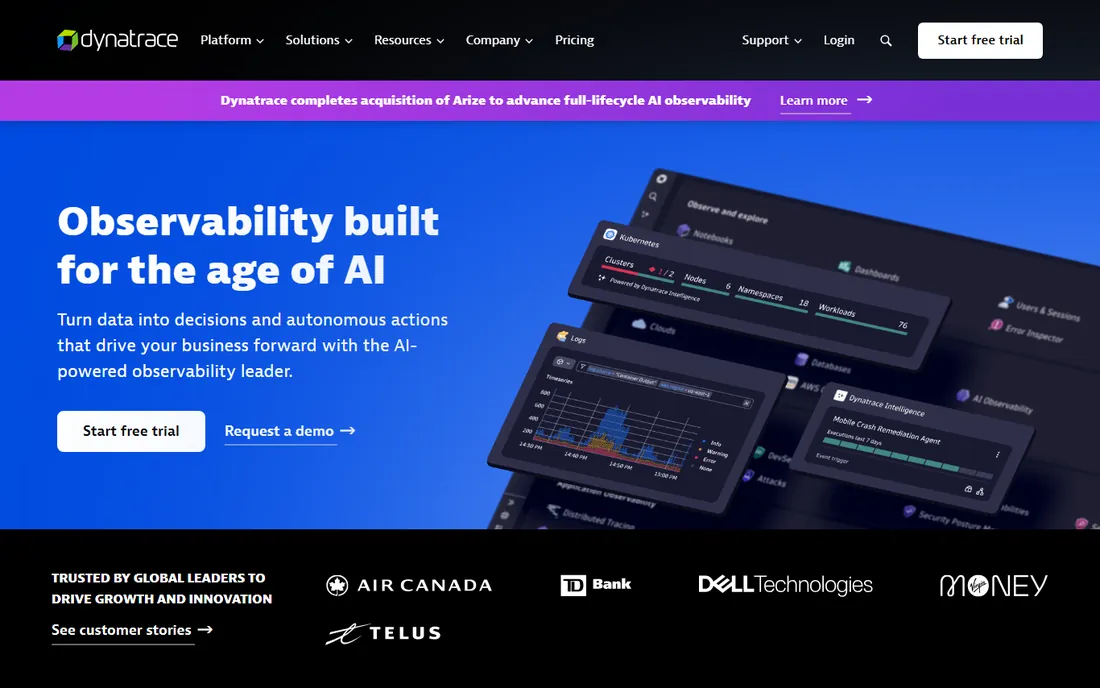
Dynatrace has been doing AI-assisted operations longer than most vendors on this list, and it shows. Its Davis AI engine works from a continuously updated map of your environment, so when something breaks it can trace the causal chain and name the actual root cause rather than handing you a probability ranking. For large shops running hundreds of microservices, that determinism matters: responders trust the answer and act on it.
The honest catch is the pricing model. Dynatrace bills on consumption through Dynatrace Platform Subscription units, and forecasting spend takes real work. Teams that instrument heavily without guardrails get surprised. Run the 15-day trial with production-like traffic, watch the consumption dashboard daily, and you will know what the contract should look like.
What we like- Causal Davis AI gives one likely root cause instead of a ranked guess list
- Automatic topology mapping with OneAgent
- Deep code-level analysis for microservices
Watch out for- Usage-based DPS pricing is hard to forecast without a trial
- Strongest inside its own telemetry, less flexible with third-party data
Starting price$15 per host/month (Pro, billed annually)
Free planYes (free for up to 5 hosts)
Datadog is the gravitational center of the cloud-native monitoring world, and its AIOps story rides on that breadth. Watchdog flags anomalies across everything flowing into the platform without manual threshold tuning, while Bits AI agents can investigate an incident, pull related telemetry, and suggest a cause. If your team already lives in Datadog dashboards, these capabilities feel like a natural extension.
The bill is the recurring complaint, and it is a fair one. Infrastructure at $15 per host per month is just the entry ticket; APM, logs, RUM, and synthetics each carry their own meter, and hosts are billed at the monthly peak, so a traffic spike sets your whole month's rate. Small teams get real value from the free tier (up to five hosts). Set up billing alerts early and treat observability spend like cloud spend: budgeted and reviewed.
What we like- More than 800 integrations and one UI for metrics, logs, traces, and RUM
- Watchdog anomaly detection works out of the box
- Bits AI agents help investigate incidents
Watch out for- Per-product meters stack up fast at scale
- Log indexing costs force hard retention tradeoffs
Starting priceSee website
Free planYes (100 GB data ingest per month)
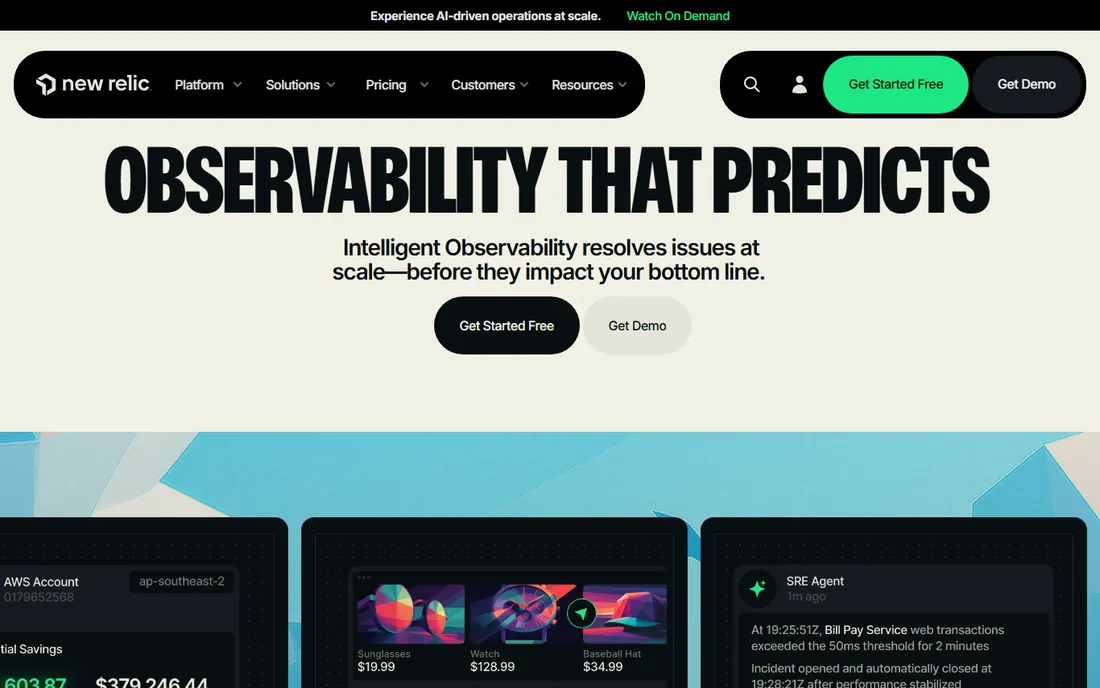
New Relic rebuilt its pricing around a simple idea: pay for data and people, not hosts. Every account gets 100 GB of monthly ingest free, one free full-platform user, and unlimited basic users, which makes it one of the easiest AIOps-adjacent platforms to trial on a real workload. Its AI features focus on anomaly detection, alert noise reduction, and incident context.
Where teams get tripped up is the seat math. Full-platform users on paid tiers run into the hundreds of dollars per user per month on annual commitments, so a 40-person engineering org pays meaningfully more than the headline data rate suggests. The model favors small, senior teams with high data volume. If that matches your shape, New Relic is excellent value; if you need fifty people in dashboards, model the user cost first.
What we like- Genuine free tier with 100 GB monthly ingest and a full-platform user
- One NRQL query language across all telemetry
- Strong OpenTelemetry support
Watch out for- Per-user pricing on paid tiers gets expensive as teams grow
- Data overages beyond the free tier add up for log-heavy shops
#4
Splunk ITSI
Best for: Splunk shops adding service intelligence
Visit splunk.com
Starting priceSee website
Free planFree trial (14 days)
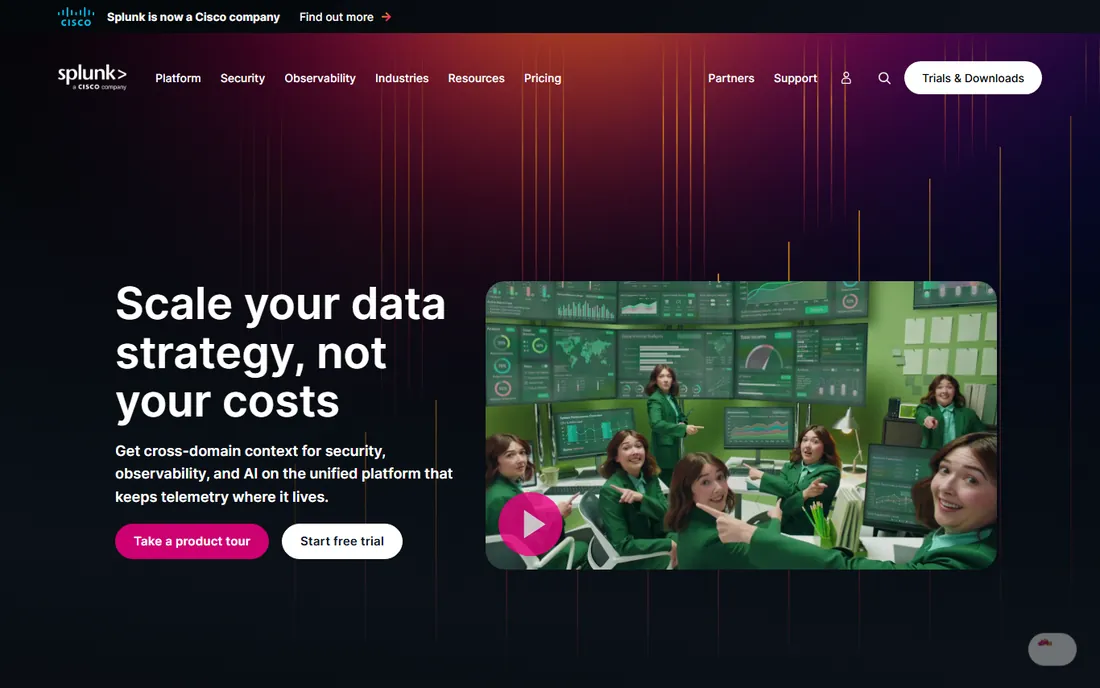
Splunk IT Service Intelligence is the AIOps layer for organizations already running Splunk. ITSI applies machine learning to the logs, metrics, and events already flowing into Splunk: adaptive thresholding, anomaly detection, and service-level KPI modeling that rolls hundreds of underlying signals into a single health score per business service.
The catch is that Splunk pricing has always been data-volume driven, and ITSI does not change that equation. If your ingest is already large, the incremental license is justifiable because the data is a sunk cost. If you are not a Splunk shop, there is little reason to become one just for ITSI. Treat ITSI as an upgrade to an existing investment, not a first purchase.
What we like- Predictive ML analytics on top of the Splunk data you already collect
- Strong service topology and KPI modeling
- Deep security and observability convergence since the Cisco acquisition
Watch out for- Pricing is quote-based and historically expensive at data scale
- Best value requires existing Splunk investment
Starting priceSee website
Free planNo
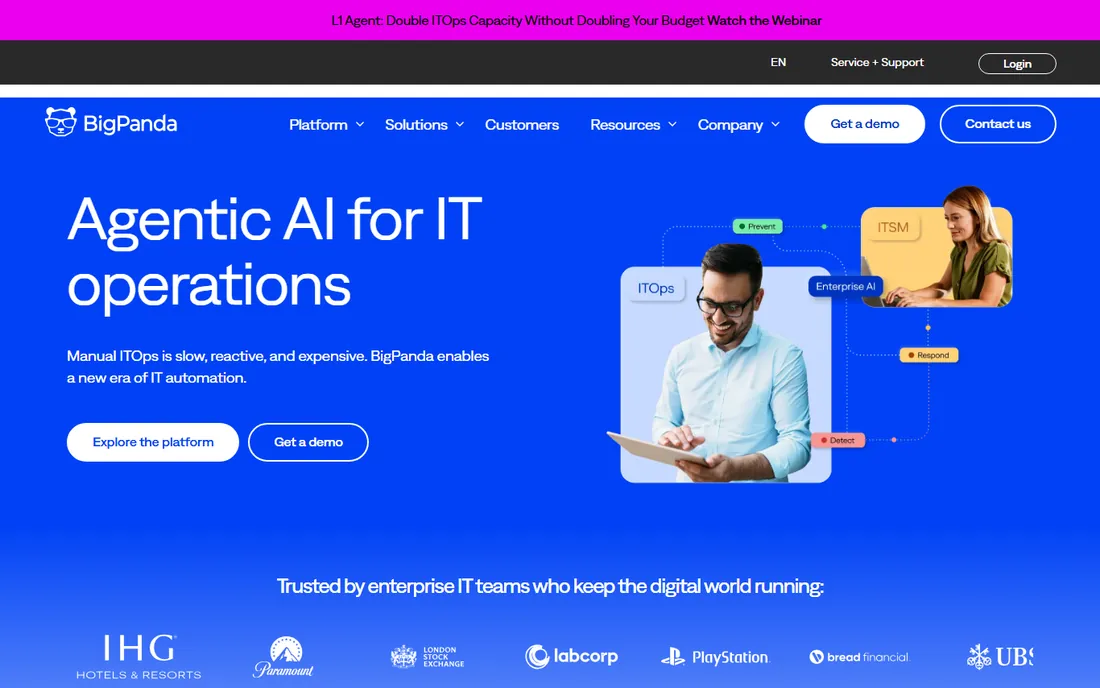
BigPanda does one thing and does it well: it takes alerts from every monitoring tool you own, enriches them with topology and change data, and uses machine learning to compress them into a small number of actionable incidents. It is deliberately not another monitoring tool; it is the layer above them, which is why enterprises with twenty-plus data sources keep choosing it.
Two honest limitations. First, there is no free tier and no public pricing; the deal is sized on your event volume. Second, BigPanda stops at diagnosis: it hands the incident to your team with rich context, but automated remediation happens in your own runbook tools. If you want a correlator that respects your existing stack instead of replacing it, that focus is a feature.
What we like- Purpose-built event correlation that sits above your existing tools
- Open Box ML adapts to your environment
- Customers report noise cuts of 80 percent or more
Watch out for- No free tier and quote-only pricing
- It correlates and recommends but does not execute remediation itself
Starting price$16 per Hybrid Unit/month (LM Essentials)
Free planFree trial (14 days)
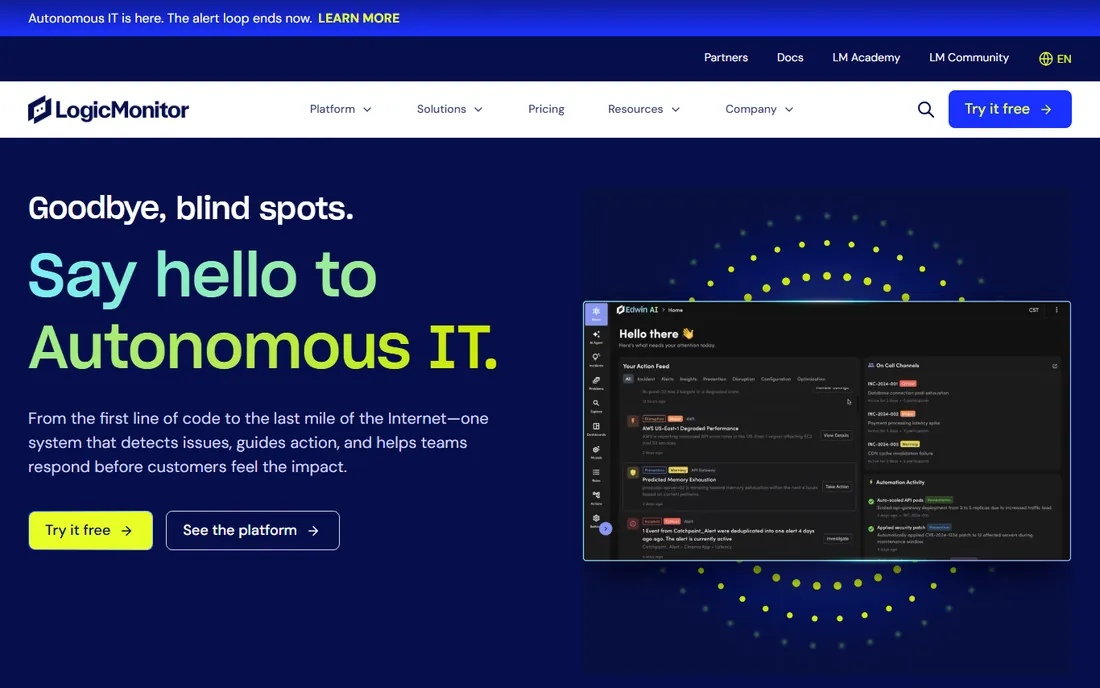
LogicMonitor has quietly become the hybrid-infrastructure specialist, and its Edwin AI assistant is the current differentiator. The platform discovers devices, cloud resources, Kubernetes pods, and network gear without agents, then Edwin helps operators investigate alerts, forecast capacity, and understand service impact in plain language.
The pricing model changed recently to Hybrid Units, a normalized measure across resource types, with LM Essentials starting at $16 per unit per month, Advanced at $27, and Signature with Edwin AI at $53. That is transparent once you map your estate to units, but the mapping exercise is the work; ask for a sizing workshop before signing. Also know that deep APM and log analytics are separate services, so budget beyond the base monitoring price.
What we like- Agentless auto-discovery covers on-prem and cloud uniformly
- Edwin AI assists with troubleshooting and forecasting
- Strong MSP multi-tenancy
Watch out for- New Hybrid Unit pricing model takes effort to map to your estate
- APM and log analysis are add-ons to the core platform
Starting priceSee website
Free planNo
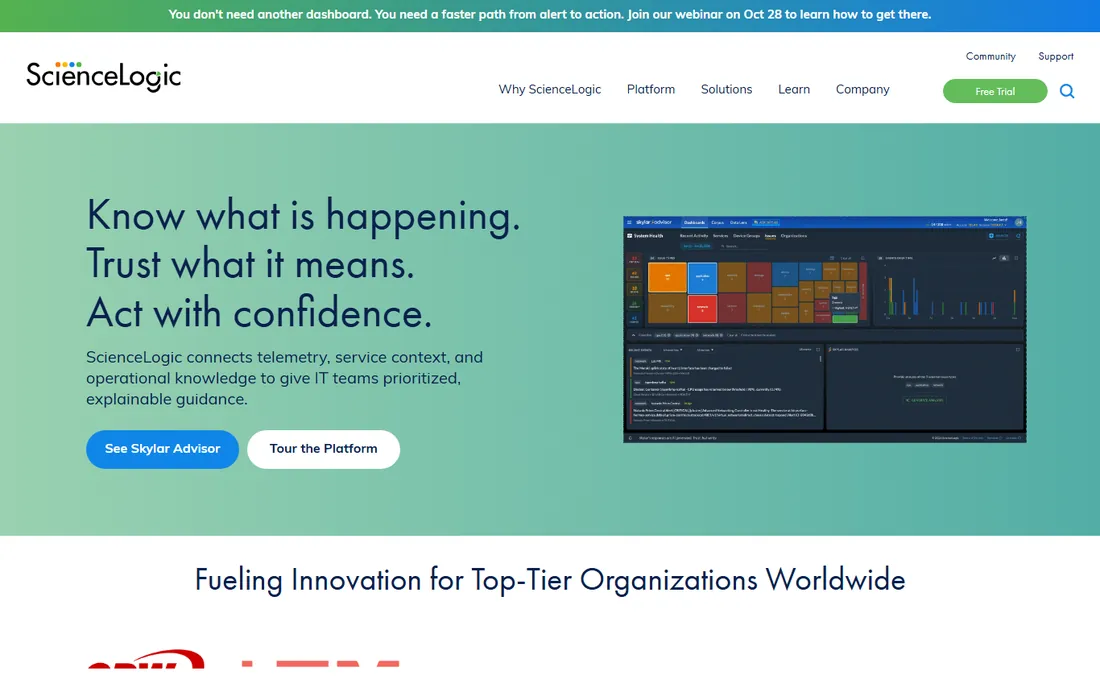
ScienceLogic's SL1 platform targets the classic enterprise problem: a sprawling hybrid estate monitored by a dozen disconnected tools. It discovers everything via agent, agentless, SNMP, and API methods, builds a real-time operational data lake, and applies machine learning to cut through the noise. The Hollywood AI assistant explains root cause findings in plain language, which helps mixed-skill NOC teams act on ML output instead of ignoring it.
This is unapologetically enterprise software. Pricing is quote-based, deployments are scoped projects with professional services, and the sales cycle reflects that. In return you get one of the most complete hybrid monitoring platforms available, with automation that keeps CMDBs current and triggers remediation workflows. Mid-market teams will find faster time-to-value elsewhere.
What we like- SL1 unifies discovery, monitoring, and automation for hybrid IT
- Hollywood AI delivers plain-language root cause analysis
- Strong federal and service-provider pedigree
Watch out for- Quote-only enterprise pricing
- Implementation is a project, not a signup
#9
BMC Helix AIOps
Best for: BMC shops modernizing operations
Visit bmc.com
Starting priceSee website
Free planNo
BMC Helix AIOps brings service modeling discipline to AI-driven operations. Rather than correlating raw events, it builds dynamic service models from discovery data, then applies ML-based causal analysis to isolate root cause within the service topology. The predictive side forecasts service outages from health trends, giving SRE teams a chance to act before users notice. It runs as SaaS or on-premises, which matters for regulated industries.
The platform makes most sense inside a BMC estate: paired with Helix Discovery, ITSM, and automation, it becomes a genuinely proactive operations loop. Bought standalone and bolted onto third-party tools, it is competent but less differentiated. Pricing is entirely quote-based, so budget for a proper scoping conversation.
What we like- Service-centric event correlation with knowledge-graph root cause isolation
- Outage prediction from health indicators
- SaaS or on-premises deployment
Watch out for- Quote-only pricing
- Full value needs the wider BMC Helix ecosystem
Starting priceSee website
Free planNo
ServiceNow's Predictive AIOps is the AIOps story for the million-plus organizations already running the Now Platform. Health Log Analytics applies ML to log and metric data to predict issues before they become incidents, while event management correlates alerts into the service context your CMDB already understands. Because it lives inside ServiceNow, correlated incidents flow straight into incident, problem, and change workflows without integration projects.
The economics are enterprise-grade: third-party listings note minimum order values in the six figures for the ITOM suite, and pricing is quote-only. It also assumes a healthy CMDB and service mapping practice; without those, the AI has thin context to work with. But if ServiceNow is already your system of record, adding Predictive AIOps is usually cheaper than introducing a fourth platform.
What we like- Predictive AIOps with Health Log Analytics cuts event noise dramatically
- Native integration with ITSM, CMDB, and change
- Remediation workflows run where tickets already live
Watch out for- Enterprise pricing with high minimums
- Value depends on ServiceNow maturity
How we chose
We built this list from vendor documentation and pricing pages, public product documentation, and review aggregators including G2 and Capterra, plus practitioner discussions on Reddit and engineering blogs. Every tool above is a real, buyable product with an active AIOps or AI-assisted operations offering in 2026. We weighted breadth of AI capability, deployment flexibility, pricing transparency, and fit for different company sizes. We did not claim hands-on testing of any product; where a vendor does not publish pricing, we say so instead of guessing.
What to check before you sign an AIOps contract
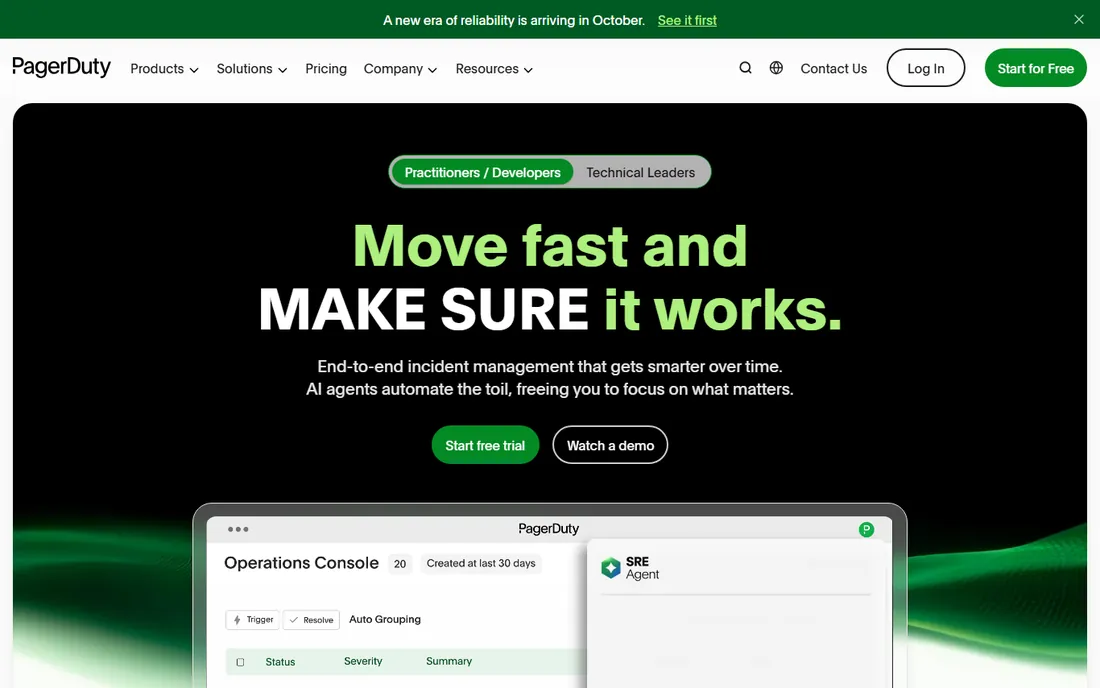
Start from the pain, not the platform. If engineers complain about too many alerts from tools that otherwise work, a correlator like BigPanda solves the actual problem for less money than a rip-and-replace observability migration. If the complaint is blind spots and slow detection, you need the detection layer first, which points to Dynatrace, Datadog, or New Relic. If the complaint is chaotic incident response, PagerDuty's AIOps add-on or ServiceNow's native capabilities attach closest to the workflow.
Second, model the pricing on your real telemetry. Usage-based pricing (hosts, data volume, events, Hybrid Units) is standard across this category, and every vendor's example assumes a tidy environment. Trial on production traffic, export the consumption report weekly, and extrapolate before the procurement call. The vendors with free tiers, Datadog, New Relic, and PagerDuty, let you do this homework at zero cost.
Third, check the remediation story. Most AIOps platforms detect, correlate, and diagnose; far fewer execute fixes. If you want automated remediation, confirm which runbook or ITSM tools the platform drives natively. A platform that recommends brilliantly but cannot act is still valuable, but you should staff for the gap.
AIOps versus observability: the distinction that saves money
The terms get used interchangeably and they should not be. Observability is collecting telemetry and making systems understandable. AIOps is applying AI and machine learning to operations data: finding anomalies, correlating events, predicting failures, and recommending or executing responses. You can have observability without AIOps, and in practice the AI is only as good as the data feeding it.
Why the distinction matters commercially: many teams buy an "AIOps platform" when what they lack is basic observability hygiene, consistent tagging, and a CMDB that reflects reality. AI layered on messy data produces confident-sounding wrong answers. Before budgeting six figures for AIOps, audit whether your telemetry answers "which service is broken and who owns it" today. Every platform on this list performs better with clean service context, and some, notably ServiceNow and BMC, depend on it.
Frequently asked questions
What is an AIOps platform?
An AIOps platform applies artificial intelligence and machine learning to IT operations data. It ingests alerts, events, metrics, logs, and topology, then uses ML models to detect anomalies, correlate related signals into incidents, identify probable root causes, and in some cases predict outages or trigger automated remediation.
Do I still need AIOps if I already use Datadog or Dynatrace?
Possibly not as a separate purchase. Both platforms include AI-assisted detection and root cause features natively. A separate AIOps layer like BigPanda earns its place when you run many monitoring tools side by side and the pain is correlating across them.
How much do AIOps platforms cost?
It varies widely. Public entry points include Datadog at $15 per host per month, PagerDuty Professional at $21 per user per month, and LogicMonitor from $16 per Hybrid Unit per month. Enterprise correlators and ITSM-native options (BigPanda, Splunk ITSI, ServiceNow ITOM, BMC Helix, ScienceLogic) are quote-based and typically land in five or six figures annually. Always trial on production traffic before budgeting.
Can AIOps replace on-call engineers?
No. Current platforms are strong at detection, correlation, and diagnosis, and improving at recommending actions, but they do not replace human judgment for novel failures or customer communication. The realistic outcome is fewer pages and faster triage.
How long does AIOps implementation take?
SaaS correlators that sit atop existing tools, like BigPanda, typically show value within weeks because the telemetry already exists. Full observability platforms need agent rollout and tuning, which runs weeks to months. Enterprise ITSM-native options need service modeling and CMDB work first, which can extend the timeline to a quarter or more.
Sources we checked (11)
- https://www.dynatrace.com/solutions/full-stack-observability/
- https://criticalcloud.ai/blog/datadog/checklist-for-evaluating-datadog-pricing-plans/
- https://www.logicmonitor.com/blog/how-logicmonitor-pricing-works
- https://www.bigpanda.io/blog/what-is-an-aiops-platform/
- https://www.bigpanda.io/blog/what-is-aiops/
- https://www.servicenow.com/es/company/media/press-room/omdia-universe-aiops-leader-2021.html
- https://www.bmc.com/it-solutions/aiops.html
- https://sciencelogic.com/articles/hybrid-cloud-monitoring
- https://openobserve.ai/blog/top-10-aiops-platforms/
- https://kurums.com/best-incident-management-software-2026-comparison/
- https://www.g2.com/compare/bigpanda-vs-datadog
Is your product missing or out of date?
We review this list regularly. Vendors can request a listing, send updated pricing or ask about featured placement.

Shihab Mia · Founder, Rankite
Shihab has spent more than a decade helping SaaS and e-commerce brands grow through search. He writes Rankite's software buying guides from pricing pages, documentation and public user reviews. More about Shihab.