How we make this list: we compare pricing pages, product documentation and public user reviews. Rankite is independent; if a vendor ever pays for a featured spot, that listing is clearly labeled Partner.
Key takeaways
- Smith.ai uniquely offers both AI and human receptionists under one roof, letting businesses blend automation with live agents.
- Ruby and Abby Connect lead on polished human answering with AI layered in; PATLive and AnswerFirst compete on value and flexibility.
- VoiceNation now operates as Moneypenny; Davinci Virtual bundles receptionists with virtual office services.
- Price by the minute pool, not the headline: per-minute billing means long calls drain small plans fast; model your real call volume.
Quick comparison
| Tool | Best for | Starting price | Free plan |
|---|
 Smith.ai Smith.ai | Businesses wanting AI and human receptionists from one vendor | See website | Yes |
 Ruby Ruby | Brands where caller warmth justifies premium pricing | See website | No |
 Abby Connect Abby Connect | Dedicated receptionist teams with AI backup | See website | Yes |
 PATLive PATLive | Flexible 24/7 answering without contracts | See website | Free trial |
 AnswerFirst AnswerFirst | Budget-conscious businesses wanting no-contract answering | See website | No |
 Davinci Virtual Davinci Virtual | Solos wanting receptionist plus virtual office | See website | No |
 VoiceNation VoiceNation | Businesses wanting an established answering brand | See website | No |
 Specialty Answering Service Specialty Answering Service | Affordable answering with healthcare-friendly compliance | See website | No |
Is your product missing or out of date?
We review this list regularly. Vendors can request a listing, send updated pricing or ask about featured placement.
Virtual receptionists answer your calls when you cannot: AI voice agents handle routine calls automatically, human receptionists handle everything with judgment, and hybrids blend both. Eight services across that spectrum, compared on what callers actually experience.
#1
Smith.ai
Best for: Businesses wanting AI and human receptionists from one vendor
Visit smith.ai
Starting priceSee website
Free planYes
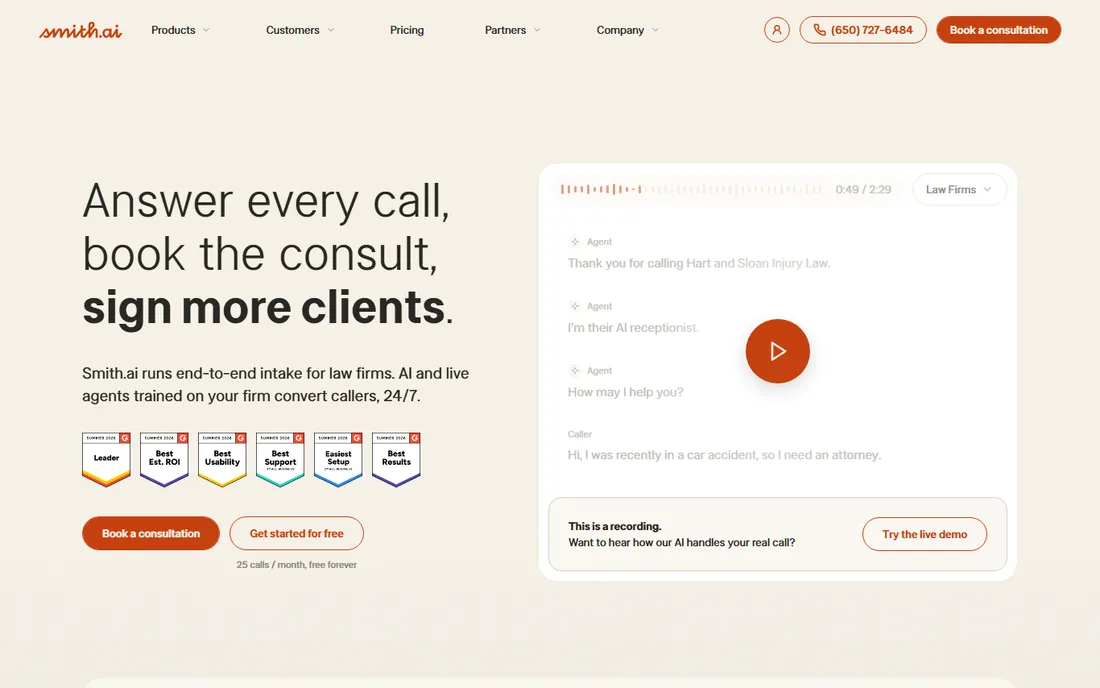
Smith.ai's distinctive move is offering both: an AI receptionist (with a free tier and low-cost plans) and a separate human virtual receptionist service, so businesses automate routine calls and escalate the rest to people. Both emphasize lead intake, scheduling and integrations with tools like Clio and Calendly.
The honest complexity is the choice. Running AI plus human means understanding two pricing models and handoff rules. But for businesses that want automation for volume and humans for value, getting both from one vendor with one integration set is genuinely convenient.
What we like- Sells AI receptionist and human virtual receptionist plans separately
- AI plan has a free tier
- Strong intake, scheduling and CRM integrations
Watch out for- Two product lines means choosing (or managing) both
- Human plans start at a premium
Starting priceSee website
Free planNo
Ruby built its reputation on receptionists who sound like your best in-house hire: warm, professional, brand-aware. AI now works in the background (transcripts, sentiment analysis, call flows) while humans handle the conversation, and thousands of integrations connect it to your systems.
The honest math is per-minute. Plans bill receptionist minutes, and long or complex calls consume small pools quickly. Ruby is worth it when caller experience directly drives revenue (law, medical, high-end services); for high-volume routine calls, AI-first options cost far less.
What we like- Live US-based receptionists on every call
- AI transcripts and sentiment analysis included
- Polished, hospitality-grade caller experience
Watch out for- Per-minute pricing gets expensive at volume
- Premium positioning throughout
#3
Abby Connect
Best for: Dedicated receptionist teams with AI backup
Visit abby.com
Starting priceSee website
Free planYes
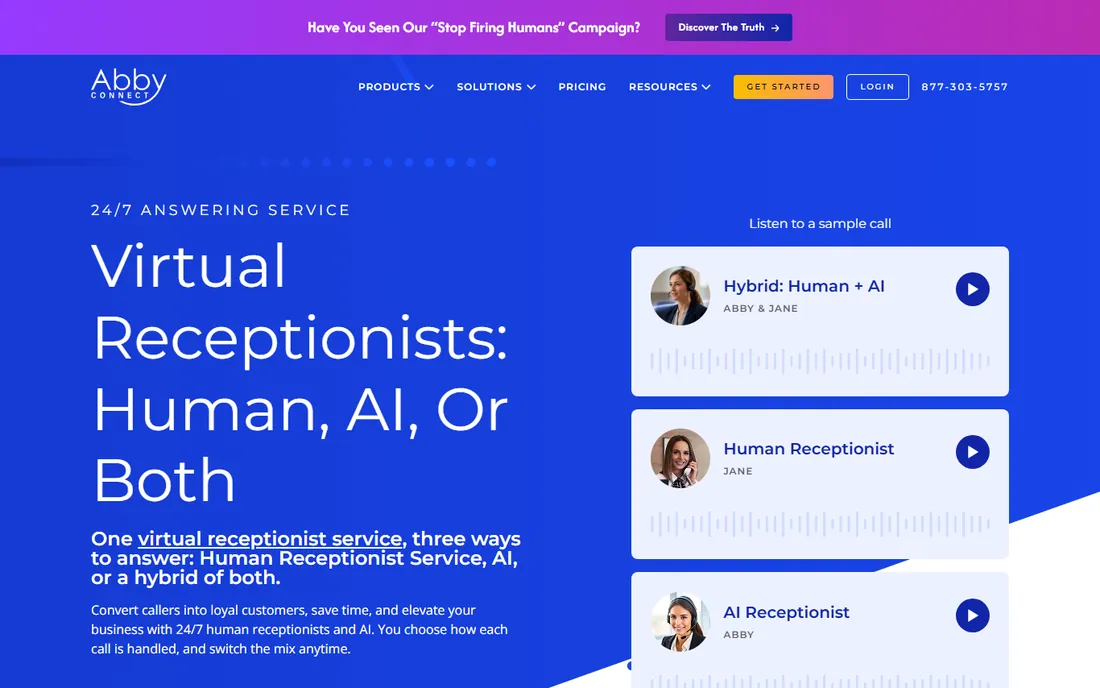
Abby Connect assigns dedicated receptionist teams (10 to 20 people who learn your business) rather than a rotating pool, and its Abby AI receptionist handles calls with clean handoffs to live US-based agents for complex or sensitive conversations. The blend targets businesses that want familiarity plus automation.
The honest fit is relationship depth. The dedicated-team model shines for professional services with ongoing caller relationships; businesses needing occasional overflow may find simpler per-minute services more economical. But for consistent caller experience with AI efficiency, the combination is well designed.
What we like- Dedicated teams of receptionists per client
- Abby AI receptionist with human backup on demand
- About 20 years of answering experience
Watch out for- Dedicated-team model suits ongoing relationships more than sporadic use
- Pricing scales with service level
Starting priceSee website
Free planFree trial
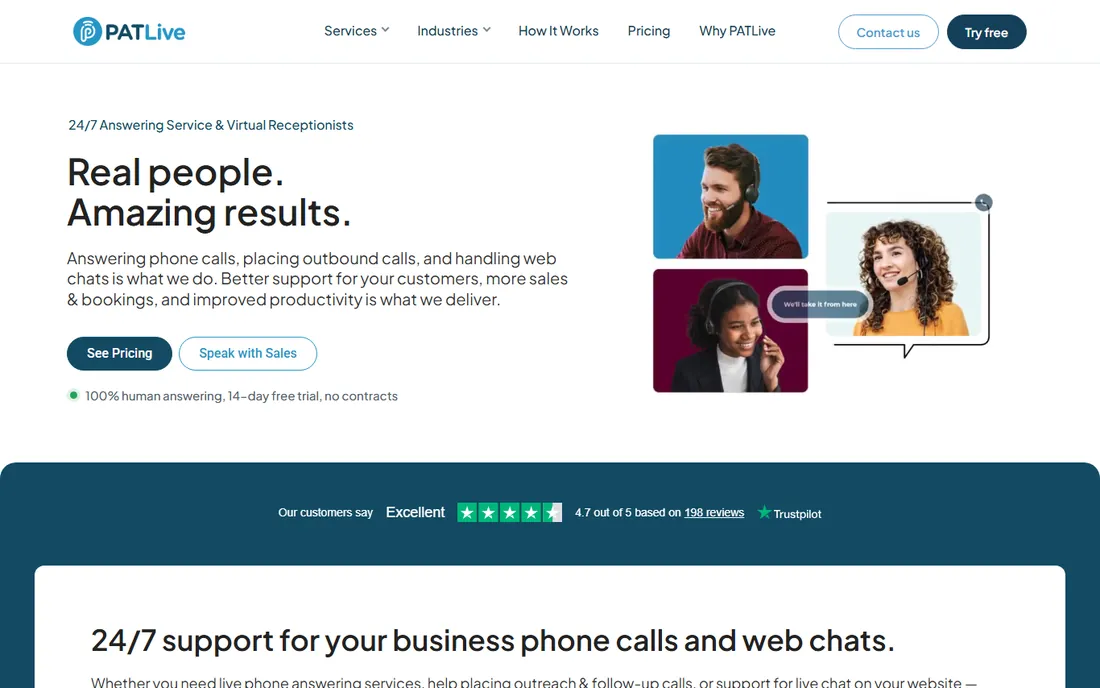
PATLive is the experienced value player: decades of 24/7 answering, transparent all-inclusive pricing, no contracts, and integrations that make remote receptionists feel in-house. Industry-specific setups (legal, medical, home services, tech) show operational maturity.
The honest positioning is traditional. PATLive's AI story is quieter than the AI-first vendors; buyers prioritizing the newest voice AI look elsewhere. But for reliable human answering with honest pricing and deep experience, it remains a strong evaluation candidate.
What we like- 24/7 US-based answering since 1990
- All-inclusive pricing with no contracts
- Strong integrations from CRM to helpdesk
Watch out for- Less AI-forward than Smith.ai or Abby
- Brand less known than Ruby
Starting priceSee website
Free planNo
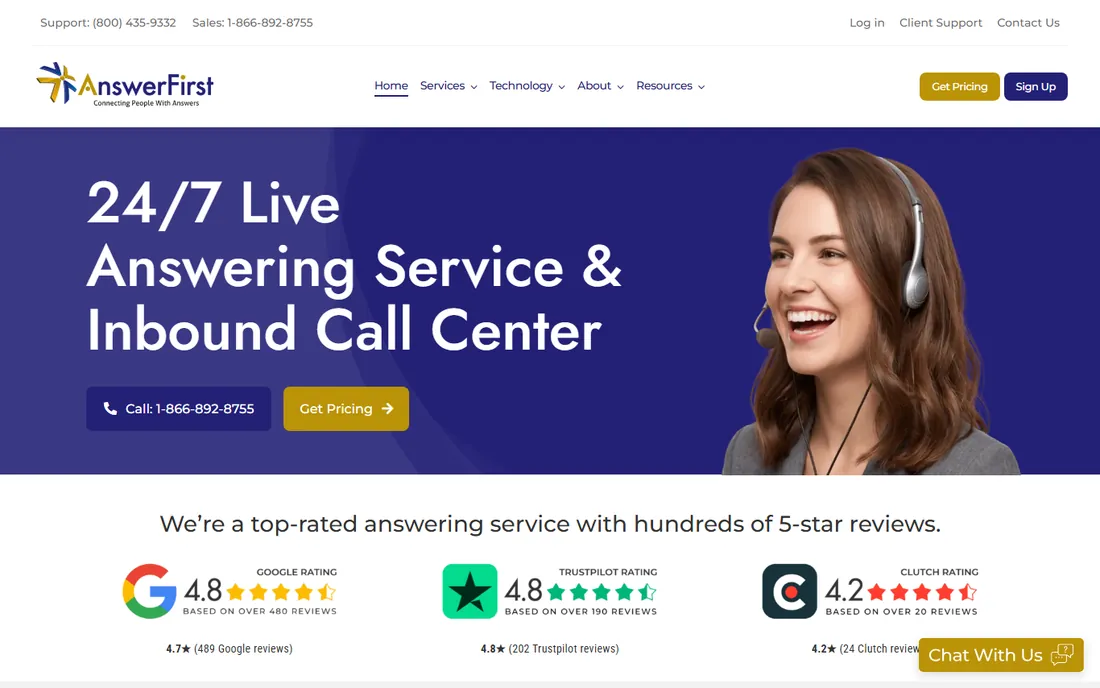
AnswerFirst competes on accessibility: low entry pricing, no contracts, 24/7 live answering from its Florida call center. Small businesses that simply need calls answered professionally without enterprise features get exactly that.
The honest trade-off is depth. Integrations, AI features and dedicated teams belong to pricier competitors. But the price-to-reliability ratio suits solo practitioners and small businesses whose needs are genuinely basic: answer, message, route.
What we like- Plans starting around $30 monthly with no contracts
- Tampa-based 24/7 operation
- Straightforward message and call handling
Watch out for- Basic feature set
- Less integration depth than premium competitors
Starting priceSee website
Free planNo
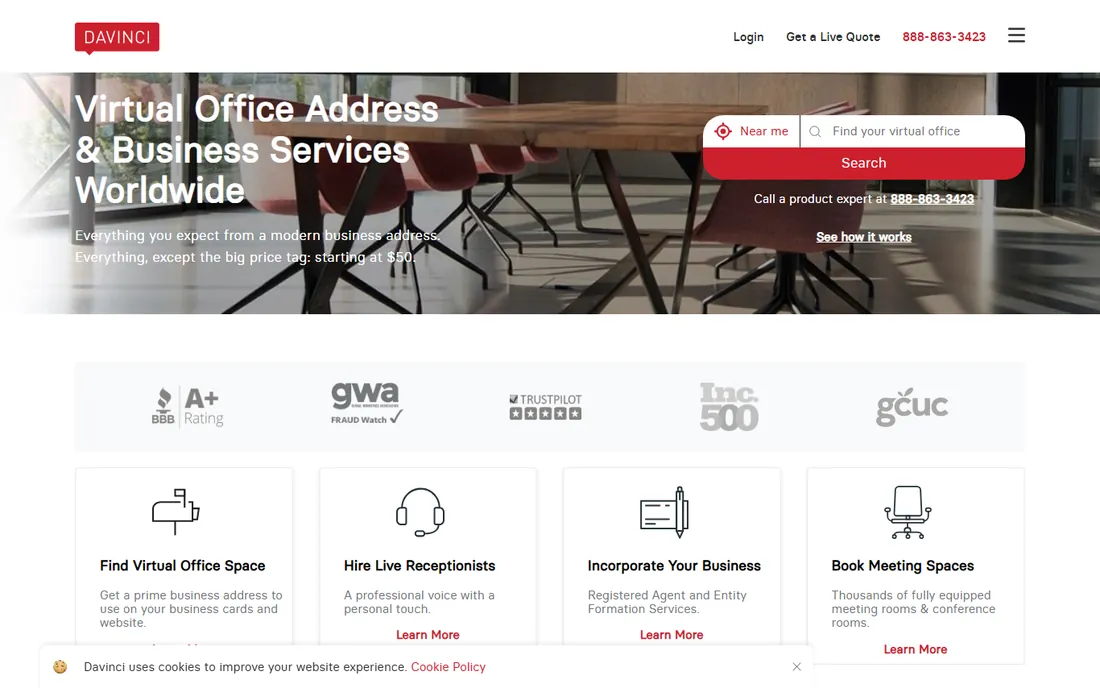
Davinci Virtual pairs live receptionist services with virtual office infrastructure: business addresses, mail handling and meeting rooms alongside call answering. Solo lawyers, consultants and remote professionals get a complete presence package.
The honest question is the bundle. If you need the virtual office anyway, the receptionist add-on is efficient; if you only need answering, pure-play services offer deeper call-handling features. Evaluate Davinci when presence (address plus phones) is the actual requirement.
What we like- Bundles live receptionists with virtual office addresses and meeting rooms
- Custom scripting
- Good for solo professionals projecting presence
Watch out for- Receptionist depth less than pure-play services
- Bundle value depends on needing the office side
Starting priceSee website
Free planNo
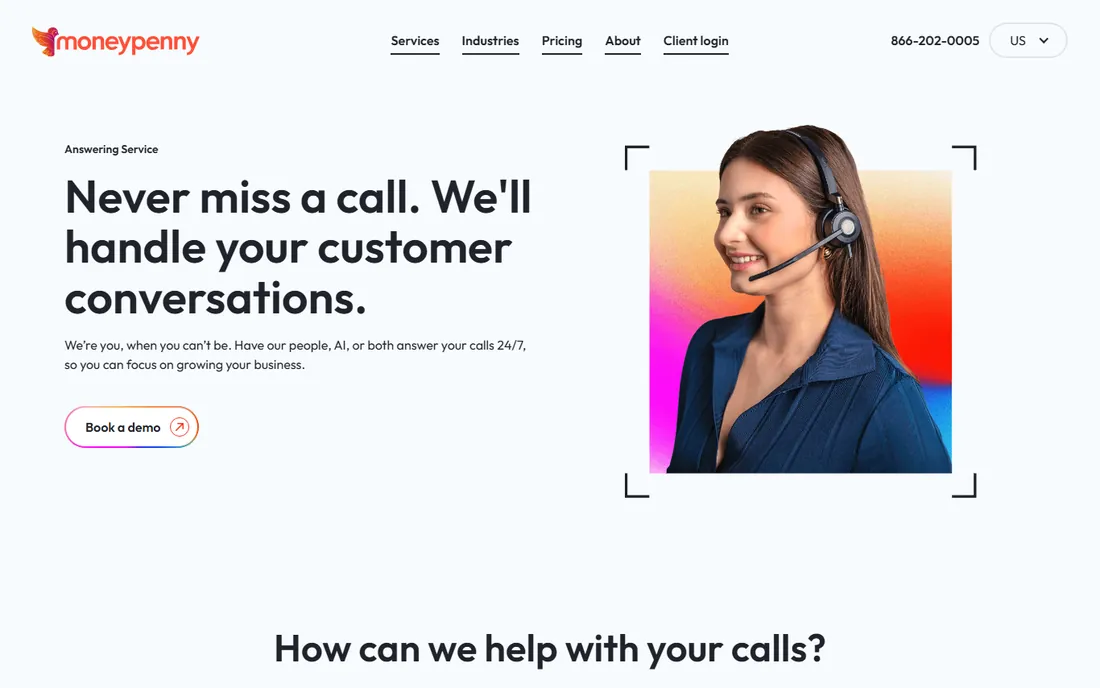
VoiceNation built one of the better-known virtual receptionist brands with accessible pricing, and now operates as part of Moneypenny, the larger receptionist group. Callers get professional live answering with the backing of an established operation.
The honest note is the rebrand: the service continues under Moneypenny ownership, so new buyers should evaluate the current Moneypenny offering. We list VoiceNation because the brand equity persists in search and reviews; confirm current plans on the site.
What we like- Long-established virtual receptionist service
- Plans from budget-friendly tiers
- Now part of the Moneypenny group
Watch out for- Brand transition (now operating as Moneypenny) can confuse
- Feature set varies by plan
Starting priceSee website
Free planNo
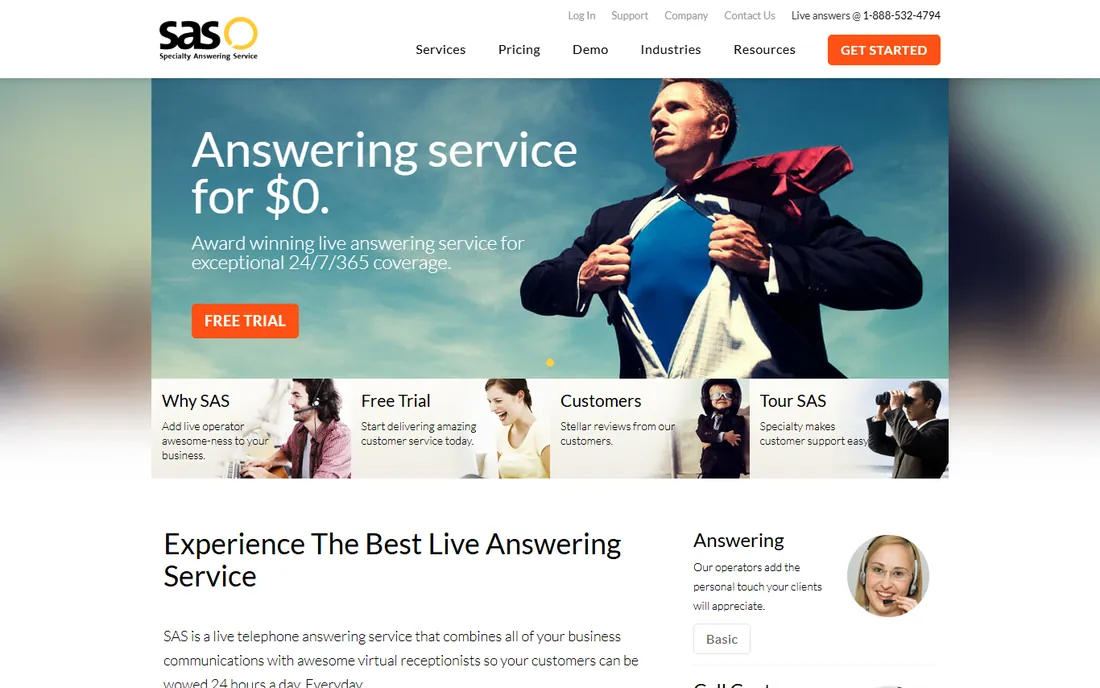
Specialty Answering Service (SAS) is the budget-conscious specialist: low entry pricing, HIPAA-aware handling for medical callers, legal intake experience and detailed reporting. Small practices that need compliant, affordable answering find a purpose-built option.
The honest limits are polish. The platform experience trails Ruby and Smith.ai, and integration depth is thinner. But for practices where compliance and cost dominate the decision, SAS covers the requirements at a fraction of premium pricing.
What we like- Entry plans from around $44 monthly
- HIPAA-compliant options
- Detailed reporting and legal intake experience
Watch out for- Smaller brand
- Interface and integrations less modern than leaders
How we chose
We selected established virtual receptionist services with real business adoption, spanning AI-first, human-first and hybrid models across price tiers. We weighed caller experience quality, pricing transparency, AI capability honesty, integration depth and fit for different business types. Pricing comes from each vendor's own pricing page; unverifiable plans are marked "See website." No hands-on testing was performed.
What to look for before you buy
Decide AI, human or hybrid first. AI handles routine calls cheaply; humans handle judgment, emotion and complexity. Most businesses need both, which makes hybrid vendors (Smith.ai, Abby) worth a hard look.
Model per-minute economics honestly. Estimate your monthly call count and average duration, then price the minute pools. A cheap headline plan with a small minute pool costs more than a bigger plan if your calls run long.
Test with mystery calls. Have someone call as a customer during the trial and report the experience. Marketing promises about caller experience are verified only by calling.
Finally, check the escalation and integration paths. How do urgent calls reach you? Do messages land in your CRM? The answering is table stakes; the workflow around it determines value.
What to test during a receptionist service trial
Most virtual receptionist services offer trial periods, and the trial is where you learn what marketing cannot tell you. A structured two-week test reveals call quality, reliability and fit far better than sales calls. Run the same test protocol across two finalists and the decision usually makes itself.
Test with real call scenarios, not just "hello". Have colleagues call with the situations you actually get: a new customer asking about services and pricing, an existing customer with a complaint, a caller with a thick accent, someone calling after hours, a wrong number. Score each call on greeting accuracy, message completeness, hold handling and how the caller felt. Five to ten test calls across scenarios give a reliable picture.
Check message delivery speed and accuracy. The point of a receptionist is that you learn about the call promptly and correctly. Time how long messages take to reach you (text, email, app notification) and verify names, numbers and details are captured right. A service that answers beautifully but delivers garbled messages fails at its core job.
Stress the handoff and escalation paths. Call with something the receptionist cannot handle and see what happens: do they follow your escalation instructions, reach the right person, stay professional with a frustrated caller? The edge cases are where services differentiate; routine calls all sound fine.
Evaluate the after-hours experience specifically. If 24/7 coverage is why you are buying, test at 11pm and 6am, not just business hours. Staffing quality often drops overnight; some services use different (weaker) teams after hours. Your buyers who call at midnight deserve the same quality as the noon callers.
Read the call recordings or transcripts the service provides. Beyond quality checking, this shows you what callers actually ask, which is market intelligence. Several businesses discover their receptionist data reveals pricing confusion or service gaps worth fixing. The trial is also a chance to confirm the dashboard and reporting give you what you need without extra work.
Frequently asked questions
What is a virtual receptionist?
A remote service (human agents, AI voice agents, or both) that answers your business calls, takes messages, schedules appointments and routes urgent calls, acting as your front desk without in-house staff.
AI receptionist vs human virtual receptionist: which is better?
AI is cheaper and instant for routine calls; humans handle nuance, emotion and complexity better. Hybrids (AI with human backup) increasingly offer the best of both; the right mix depends on your call types.
How much does a virtual receptionist cost?
AI plans can start free or around $150 monthly; human services typically run $30 to $350-plus monthly depending on minutes and features. Per-minute billing means heavy users pay significantly more.
Can a virtual receptionist schedule appointments?
Yes, most integrate with calendars (Google, Outlook, Calendly) to book appointments directly, and many handle intake questionnaires for industries like legal and medical.
Are virtual receptionist calls HIPAA compliant?
Some services offer HIPAA-compliant plans (notably SAS and medical-focused providers). Compliance must be contracted explicitly (BAA); never assume it from marketing language.
Will callers know it is a virtual receptionist?
Good services brief agents on your business so calls feel in-house; AI voices keep improving but can still be detected. Mystery-call your own service to judge honestly.
Sources we checked (9)
- https://www.smith.ai
- https://www.callruby.com
- https://www.abby.com
- https://www.patlive.com
- https://www.answerfirst.com
- https://www.davincivirtual.com
- https://www.voicenation.com
- https://www.specialtyansweringservice.net
- https://unity-connect.com/our-resources/blog/which-ai-virtual-receptionist-is-best-for-small-businesses/
Is your product missing or out of date?
We review this list regularly. Vendors can request a listing, send updated pricing or ask about featured placement.

Shihab Mia · Founder, Rankite
Shihab has spent more than a decade helping SaaS and e-commerce brands grow through search. He writes Rankite's software buying guides from pricing pages, documentation and public user reviews. More about Shihab.