How we make this list: we compare pricing pages, product documentation and public user reviews. Rankite is independent; if a vendor ever pays for a featured spot, that listing is clearly labeled Partner.
Key takeaways
- No-code tools like Browse AI, Octoparse and ParseHub let non-developers build scrapers by pointing and clicking.
- Developer-first APIs from Firecrawl, Diffbot, Zyte and Apify turn web pages into clean, structured data with a single call.
- Bright Data and Oxylabs provide the underlying infrastructure: proxy networks, unblocking and managed data delivery at enterprise scale.
- Most vendors offer a free tier or trial, so you can test extraction quality on your own target sites before paying.
- The right choice depends on who builds the scraper and how much scale you need, not on feature lists alone.
Every pricing page, product listing and news article on the public web is data waiting to be used. The hard part was never wanting the data. It was getting it reliably: sites change their layouts, bot defenses block automated requests, and a script that worked on Monday breaks by Friday. AI scraping tools exist to absorb that pain. Some use machine learning to adapt when pages change. Others wrap the whole problem in an API so you never manage a proxy or a browser yourself. This guide compares nine serious options, from point-and-click tools for business users to infrastructure platforms for engineering teams, so you can match the tool to the job instead of the other way around.
Quick comparison
| Tool | Best for | Starting price | Free plan |
|---|
 Bright Data Bright Data | Enterprises that need large-scale, compliant web data collection infrastructure | See website | Free trial |
 Apify Apify | Teams that want ready-made scrapers or a platform to run custom ones | See website | Yes |
 Oxylabs Oxylabs | Businesses that need premium proxies and clean data APIs | See website | Free trial |
 Browse AI Browse AI | Non-technical users who want to scrape and monitor websites without code | See website | Free trial |
 Octoparse Octoparse | Business users who want a visual, no-code scraper with cloud execution | See website | Free trial |
 ParseHub ParseHub | Users who want a capable free scraper for interactive websites | See website | Yes |
 Diffbot Diffbot | Developers who need AI-classified structured data and entity intelligence | See website | Yes |
 Firecrawl Firecrawl | Developers and AI agents that need clean, LLM-ready web data via API | See website | Yes |
 Zyte Zyte | Engineering teams that want scraping handled as a managed API | See website | Free trial |
Is your product missing or out of date?
We review this list regularly. Vendors can request a listing, send updated pricing or ask about featured placement.
#1
Bright Data
Best for: Enterprises that need large-scale, compliant web data collection infrastructure
Visit brightdata.com
Starting priceSee website
Free planFree trial
Bright Data, formerly Luminati Networks, is the infrastructure company behind a large share of the web's commercial data collection. Its platform combines proxy networks across residential, datacenter, ISP and mobile IPs with scraping tools, automated CAPTCHA solving and bot-defense bypass features, and pre-collected datasets. The pitch is simple: you get clean public web data without building or maintaining the access layer yourself.
For AI teams, Bright Data has positioned itself as the data layer for model training and agents, offering an MCP server and browser infrastructure so agents can search, extract and act on live websites. Compliance is a real part of the story here: the company emphasizes opt-in proxy sourcing and public-data-only collection, which matters when legal teams review your pipeline. Smaller users should know this is an enterprise platform first, with sales-led pricing and a trial aimed at registered companies.
What we like- Huge proxy network with global coverage
- CAPTCHA and bot-defense handling
- Strong compliance posture
Watch out for- Pricing is quote-based and enterprise-oriented
- Overkill for small one-off projects
#2
Apify
Best for: Teams that want ready-made scrapers or a platform to run custom ones
Visit apify.com
Starting priceSee website
Free planYes
Apify is a cloud platform where scrapers, called Actors, run as serverless programs. The Apify Store hosts thousands of them, built by Apify and by the community, covering everything from Google Maps and Instagram to Amazon and real estate sites. If a scraper for your target already exists, you can be pulling data within minutes. If not, you can build your own Actor in Python or JavaScript and run it on their infrastructure.
The platform handles the unglamorous parts: proxies, browsers, scheduling, storage and API access to your results. Pricing is usage-based, and new accounts get monthly platform credit without a credit card, which makes it easy to evaluate. Apify has also moved into the AI agent space with MCP connectors so agents can run Actors directly. For developers who want building blocks rather than a black box, it is one of the most practical options here.
What we like- Large marketplace of pre-built scrapers
- Generous free tier
- Strong developer tooling and API
Watch out for- Costs scale with compute usage
- Picking the right community actor takes some vetting
#3
Oxylabs
Best for: Businesses that need premium proxies and clean data APIs
Visit oxylabs.io
Starting priceSee website
Free planFree trial
Oxylabs is a Lithuanian web intelligence company offering premium proxies, scraping APIs and datasets to businesses of all sizes. Its proxy network spans well over a hundred million IPs, and its Web API product brings search and data retrieval together under one interface with output formatted for AI workflows. The company also runs OxyCon, a well-known industry conference on web scraping.
The differentiator is quality positioning: Oxylabs sells itself on ethically sourced infrastructure, patents and compliance, and it counts large enterprises among its clients. For teams feeding data into AI pipelines, the agent-ready structured output and MCP support reduce integration work. Pricing is quote-based, so expect a sales conversation, and smaller projects may find the entry cost steep compared with developer-first APIs.
What we like- Large, high-quality proxy pool
- Web API unifies search and scraping
- Agent-ready output formats
Watch out for- Enterprise pricing
- The product range can be confusing for first-time buyers
#4
Browse AI
Best for: Non-technical users who want to scrape and monitor websites without code
Visit browse.ai
Starting priceSee website
Free planFree trial
Browse AI lets you train a scraping robot by pointing at a webpage and selecting the data you want. Its headline feature is adaptability: when a site changes its layout, the AI detects the change and adjusts the robot instead of silently breaking. Robots can also monitor pages on a schedule and alert you to changes, which makes it popular for price tracking, lead monitoring and content watching.
The platform includes hundreds of prebuilt robots for common sites, bulk extraction across thousands of pages, and integrations with Google Sheets, Zapier and thousands of other apps. Data can be exported as CSV or JSON or turned into an API. Pricing runs on credits, with a free starting allowance, so light users can get real work done before paying. For business users who will never write a scraper in Python, this is the most approachable tool on this list.
What we like- Genuinely no-code robot training
- Automatic adaptation when sites change
- Built-in monitoring and alerts
Watch out for- Credit-based pricing adds up at scale
- Complex logins can still need workarounds
#5
Octoparse
Best for: Business users who want a visual, no-code scraper with cloud execution
Visit octoparse.com
Starting priceSee website
Free planFree trial
Octoparse is a no-code web scraping platform built around a visual workflow designer. You load a page in its built-in browser, click the elements you want, and it builds the extraction logic, including loops for pagination and handling for AJAX-loaded content. Tasks can run locally or on Octoparse's cloud, where they can be scheduled to run automatically.
The company has added AI-assisted features and an MCP server so AI assistants can drive scraping through natural language. Export options cover Excel, CSV, JSON and direct database connections. A free trial lets you test paid features, and annual billing brings the monthly cost down. For analysts and operations teams that need recurring data pulls without engineering help, Octoparse is a proven workhorse.
What we like- Intuitive point-and-click workflow builder
- Cloud extraction with scheduling
- Handles pagination and dynamic content
Watch out for- Desktop app heritage shows in the workflow
- Advanced anti-bot targets can need cloud plans
#6
ParseHub
Best for: Users who want a capable free scraper for interactive websites
Visit parsehub.com
Starting priceSee website
Free planYes
ParseHub is a visual scraping tool from Toronto that turns websites into spreadsheets or APIs. Its machine learning engine understands page structure, so selecting one element usually captures similar ones automatically. It handles the interactive cases that break simpler tools: forms, dropdowns, logins, infinite scroll, tabs and pop-ups.
The standout is the free tier, which lets you run real projects without paying, with collection handled on ParseHub's servers and results available via JSON, Excel or API. Paid plans add more pages, faster runs and priority support. The interface takes some learning for complex sites, but the documentation and support team have a good reputation. For individuals and small teams starting out, ParseHub is the easiest free on-ramp in this category.
What we like- Free tier is genuinely useful
- Handles JavaScript, AJAX, logins and infinite scroll
- Desktop app plus cloud
Watch out for- Complex projects have a learning curve
- Paid plans get expensive at volume
#7
Diffbot
Best for: Developers who need AI-classified structured data and entity intelligence
Visit diffbot.com
Starting priceSee website
Free planYes
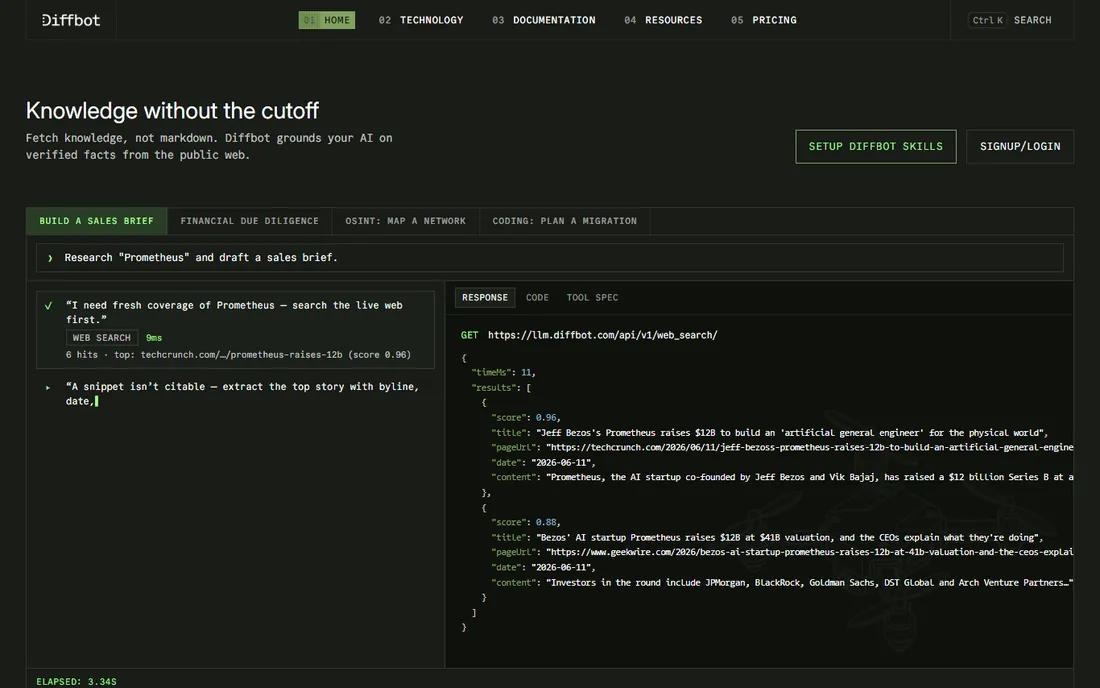
Diffbot takes a different approach from most scrapers: instead of you defining selectors, its AI classifies each page and extracts structured data automatically. Point the Extract API at a product page and you get back name, price, brand and images as JSON without writing a single rule. The Crawl API walks entire sites into structured datasets, and the Knowledge Graph offers structured data on companies, people and news drawn from the public web.
The free plan includes monthly credits with no credit card required, covering the Extract, Search, Knowledge Graph and Natural Language APIs. That makes Diffbot unusually easy to evaluate for developers. The trade-off is that it is unapologetically a developer product: there is no point-and-click interface, and getting the most from the knowledge graph takes some learning. For data science teams and AI products that need structured web facts, it is a strong fit.
What we like- Automatic page classification into products, articles and more
- Massive knowledge graph
- Generous free credit tier
Watch out for- API-first design is not for non-developers
- Knowledge graph queries have a learning curve
#8
Firecrawl
Best for: Developers and AI agents that need clean, LLM-ready web data via API
Visit firecrawl.dev
Starting priceSee website
Free planYes
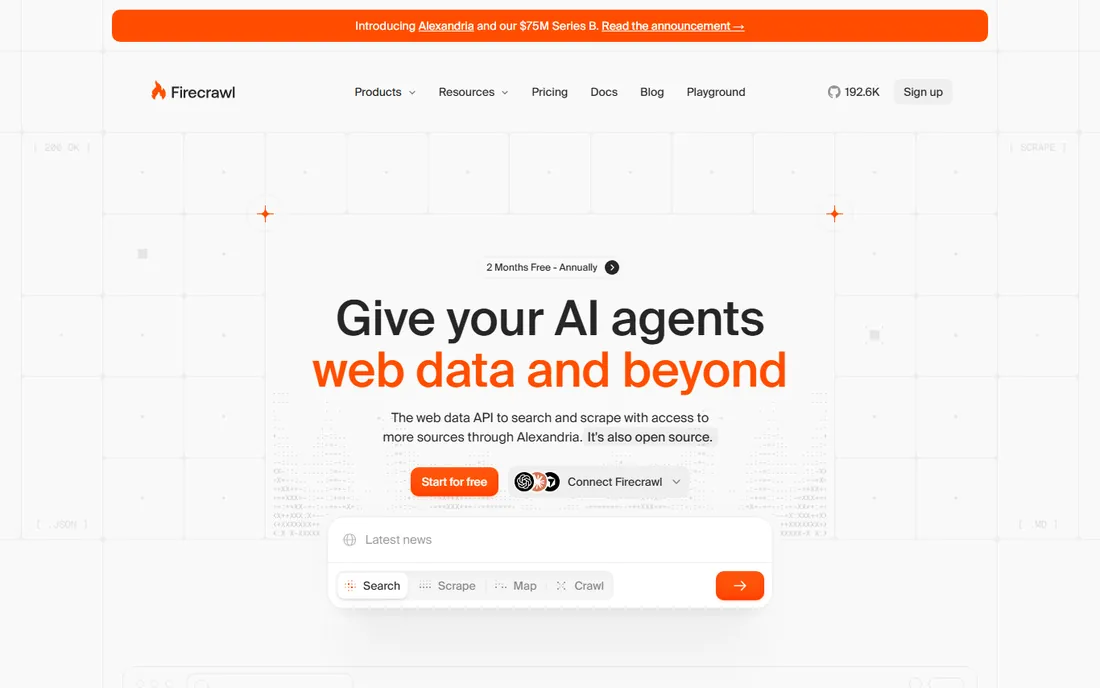
Firecrawl has become the default web data API for the AI agent era. Send it a URL and it returns clean markdown, HTML, screenshots or structured JSON, handling JavaScript rendering automatically. The crawl endpoint walks entire sites, the search endpoint combines search with full-page extraction, and the interact feature lets agents click, scroll and fill forms. An official MCP server plugs it straight into coding agents.
The project is open source with a large community, while the hosted version adds managed proxies, rendering and scale. Billing is credit-based with free monthly credits and no card required, and paid plans add more in small increments with a configurable cap. For developers building RAG pipelines, research agents or lead enrichment, Firecrawl's combination of clean output and simple API is hard to beat.
What we like- Clean markdown output optimized for LLMs
- Open-source core
- Generous free monthly credits
Watch out for- Young company with fast-moving pricing
- Heavy JavaScript sites cost more credits
#9
Zyte
Best for: Engineering teams that want scraping handled as a managed API
Visit zyte.com
Starting priceSee website
Free planFree trial
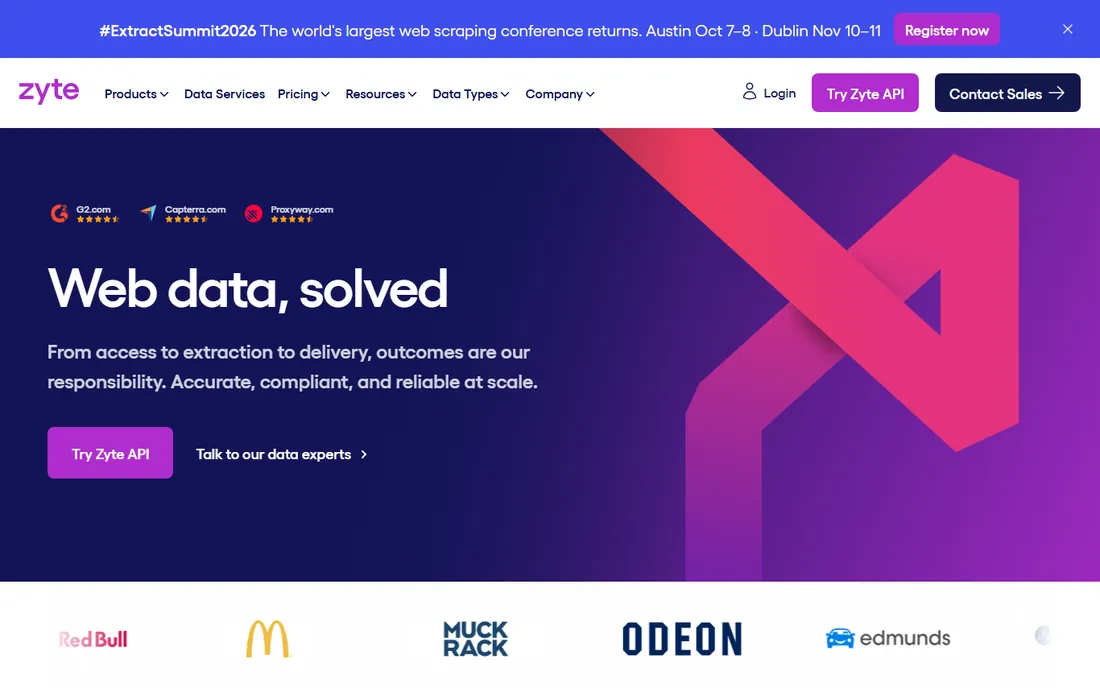
Zyte, formerly Scrapinghub, is built by the team behind Scrapy, the most popular open-source scraping framework. Its API takes a URL and returns structured data, automatically choosing the lightest access method that works and escalating through proxies, browsers and unblocking as needed. You are billed on successful results rather than attempts, which aligns the pricing with outcomes.
Beyond the API, Zyte offers Scrapy Cloud for hosting your own crawlers and a fully managed data service where their team builds and maintains the collection for you. An MCP server brings the platform into AI coding agents. For engineering teams that want to stop thinking about bans, CAPTCHAs and browser fleets, Zyte's pitch is that web data becomes someone else's problem. Pricing is usage-based, so model your volumes before committing.
What we like- Automatic anti-bot handling
- Managed data delivery service available
- Maintained by the Scrapy team
Watch out for- Pricing can surprise at scale
- Less of a no-code story than visual tools
Start with who will operate it. If the answer is a marketer, analyst or founder with no code, shortlist the visual tools: Browse AI, Octoparse and ParseHub. If the answer is a developer or an AI agent, look at the APIs: Firecrawl, Diffbot, Zyte and Apify. If the answer is a data engineering team at scale, talk to Bright Data or Oxylabs about infrastructure.
Next, test on your actual targets. Every vendor claims to handle difficult sites, but bot defenses vary wildly by target, and the only test that matters is your URL list. Use the free tiers and trials to run the same set of pages through two or three candidates and compare success rates, data cleanliness and cost per thousand pages. Pay special attention to JavaScript-heavy pages and sites with aggressive rate limiting.
Finally, think about maintenance. Websites change, and scrapers break. Tools with automatic adaptation, like Browse AI, or managed services, like Zyte's data delivery, shift that burden to the vendor. API tools with clean output reduce the parsing code you maintain. Whatever you choose, build monitoring that alerts you when extraction quality drops, because silent data rot is worse than an honest error.
Where AI scraping is headed
The category is converging on agents. A year ago, scraping tools sold to humans; now every serious vendor ships an MCP server, agent skills or a natural-language interface so AI agents can collect web data autonomously. Firecrawl, Apify, Zyte, Bright Data and Octoparse all have agent-facing integrations, and that list will only grow. The practical effect is that the skill floor keeps dropping: describing what you want in plain language increasingly produces a working data pipeline.
The counter-pressure is on the supply side. Websites keep improving bot defenses, regulators keep sharpening rules around data collection, and AI companies keep negotiating licensed access to content. Tools that emphasize compliance, provenance and licensed data, like Bright Data's compliance posture and Firecrawl's licensed content programs, are positioning for a world where scraping everything indiscriminately gets harder. When you evaluate vendors, ask about both: how they handle blocks today, and how they stay on the right side of the rules tomorrow.
We mapped the AI scraping category into its real buyer groups: no-code users, developers building products, and enterprises running data operations at scale. For each group we selected established vendors with public product documentation, a verifiable homepage and a track record in web data extraction. We opened vendor homepages directly where possible and confirmed the rest through company profiles, press releases and developer documentation. We checked for acquisitions and renames, noting for example that Bright Data was formerly Luminati Networks and Zyte was formerly Scrapinghub. We did not run hands-on extraction tests, and we did not invent pricing, customer counts or performance figures. Where a vendor does not publish pricing on its own site, we wrote See website.
Frequently asked questions
What is the best AI scraping tool for beginners?
Browse AI and ParseHub are the friendliest starting points. Browse AI trains robots by pointing at a webpage and adapts when sites change, while ParseHub offers a genuinely useful free tier for interactive sites. Both need no coding, so you can have working scrapers the same day you sign up.
What is the difference between a scraping API and a proxy provider?
A scraping API, like Firecrawl or Zyte, takes a URL and returns structured data, handling browsers, proxies and anti-bot measures for you. A proxy provider, like Bright Data or Oxylabs, sells the underlying IP infrastructure that you or your scrapers route traffic through. Many teams use both: an API for simplicity, or proxies when they run their own scraping code.
Is web scraping legal?
Scraping publicly available data is generally legal in many jurisdictions, and courts have upheld the right to collect public web data in notable cases. What matters is how you scrape and what you collect: respect terms of service, rate limits and privacy regulations like GDPR, and avoid personal data you have no right to process. When in doubt, consult a lawyer, not a blog post.
How much do AI scraping tools cost?
Pricing models vary. Developer APIs like Firecrawl and Diffbot use credit-based pricing with free monthly allowances. No-code tools like Browse AI and Octoparse use subscription plans with usage limits. Enterprise infrastructure from Bright Data and Oxylabs is quote-based. Always test with the free tier on your own target sites before committing.
Can AI scrapers handle JavaScript-heavy websites?
Yes, most modern tools render JavaScript automatically. Firecrawl, Zyte, Apify, Browse AI and ParseHub all handle dynamic content, with approaches ranging from managed browsers to AI-driven interaction. Very aggressive bot defenses may still require premium unblocking features or managed services, so test your hardest targets during the trial.
Which tool is best for feeding data to AI agents?
Firecrawl is the most agent-native option, with clean markdown output, an MCP server and agent skills built for the purpose. Apify, Zyte and Bright Data also offer MCP integrations, and Diffbot's structured extraction works well for grounding AI on verified facts. Choose based on whether you need raw pages, structured records or knowledge graph entities.
Sources we checked (15)
- https://brightdata.com
- https://apify.com
- https://oxylabs.io/
- https://browse.ai
- https://www.octoparse.com/
- https://parsehub.com/
- https://www.diffbot.com/
- https://firecrawl.dev/
- https://zyte.com/
- https://it.einnews.com/pr_news/838603953/bright-data-launches-the-web-mcp-for-free-to-grant-ai-agents-live-web-access
- https://www.einpresswire.com/article-pdf/918412647/apify-announces-mcp-connectors
- https://github.com/stephenygg/octoparse-mcp
- https://github.com/idoy12/awesome-free-ai-apis/blob/HEAD/docs/providers/diffbot.md
- https://github.com/idoy12/awesome-free-ai-apis/blob/HEAD/docs/providers/firecrawl.md
- https://github.com/api-evangelist/zyte
Is your product missing or out of date?
We review this list regularly. Vendors can request a listing, send updated pricing or ask about featured placement.

Shihab Mia · Founder, Rankite
Shihab has spent more than a decade helping SaaS and e-commerce brands grow through search. He writes Rankite's software buying guides from pricing pages, documentation and public user reviews. More about Shihab.