How we make this list: we compare pricing pages, product documentation and public user reviews. Ratings come from G2, Capterra or Trustpilot, with the date we checked them.
Direct answer
eClinicalWorks is the top pick for ambulatory groups that want published EHR pricing, with EHR Only at $499 per month per provider and no start-up costs. Epic suits large health systems that need enterprise depth, while Practice Fusion suits small practices at $199 per month per provider.
Key takeaways
- Ambulatory groups that want published math should start with eClinicalWorks EHR Only at $499 per month per provider, with training included for 1 to 9 providers.
- Small independent practices should compare Practice Fusion at $199 per month per provider, where 1 provider license includes 3 signing staff licenses.
- Low-volume practices should check Tebra EHR Starter at $99 per provider per month for non-physicians submitting fewer than 100 claims per month.
- Specialty groups should look at NextGen Enterprise, which vendor pages describe as configurable for 30+ specialties.
- Practices that want billing handled in 1 system should compare athenahealth, whose pricing is a percentage of collections with no percentage published.
Quick comparison
| Tool | Best for | Starting price | Free plan |
|---|
 eClinicalWorks | Ambulatory groups wanting published pricing | $499/mo per provider, EHR Only | None found on vendor page |
 Practice Fusion | Small independent practices wanting cloud EHR | $199/month per provider, annual commitment | Free trial, no credit card required |
 Tebra | Independent practices wanting EHR plus billing | EHR Starter $99 per provider per month | None found on vendor page |
 athenahealth | Ambulatory practices wanting billing handled | See website | None found on vendor page |
 Epic | Large health systems and academic centers | See website | None found on vendor page |
 Oracle Health | Hospitals needing enterprise EHR | See website | None found on vendor page |
 MEDITECH | Community hospitals and regional systems | See website | None found on vendor page |
 NextGen Healthcare | Specialty and mid-size ambulatory groups | See website | None found on vendor page |
 Veradigm | Multi-location, multi-specialty organizations | See website | None found on vendor page |
 DrChrono | Independent practices wanting mobile EHR | See website | None found on vendor page |
Is your product missing or out of date?
We review this list regularly. Vendors can request a listing, send updated pricing or ask about featured placement.
The best top rated ehr software
Top rated EHR software splits by practice size more than by feature lists. Hospitals need inpatient depth, order sets, and enterprise rollout support. Small practices need charting, e-prescribing, billing, and a price they can verify. This list ranks tools by published pricing, practice-size fit, and limits stated on vendor pages, not by review scores. Only 3 of the 10 tools publish a usable per-provider price on opened vendor pages. Prices marked See website had no dollar amount on the opened vendor pricing text, so buyers must request a quote.
Starting price$499/mo per provider, EHR Only
Free planNone found on vendor page

eClinicalWorks is the strongest pick for ambulatory groups that want to budget without a sales quote. Its pricing page lists EHR Only at $499 per month per provider with no start-up costs, EHR with Practice Management at $599 per month per provider, and RCM as a Service at 2.9% of practice collections. EHR Only includes a patient portal, ePrescribing with formulary checking, registry reporting, 24x7 support, cloud hosting, and disaster recovery. Free data migration from an existing EHR is offered, and initial training is included for practices with 1 to 9 providers.
The catch is that practices with more than 9 providers pay additional implementation fees, and fees apply per patient statement and per eClinicalMessenger transaction. Pick eClinicalWorks if published per-provider pricing and ambulatory depth fit your group. Look elsewhere if you need inpatient hospital workflows or practice management inside the $499 tier. Ask for implementation, statement, and messaging fees in the quote.
What we like- Published per-provider prices with no start-up costs
- EHR Only includes patient portal, ePrescribing, and 24x7 support
- Free data migration from an existing EHR
Watch out for- Practices over 9 providers pay additional implementation fees
- Practice management is a higher tier at $599/mo per provider
Starting price$199/month per provider, annual commitment
Free planFree trial, no credit card required

Practice Fusion suits small independent practices that want a simple cloud EHR. Its pricing page lists $199 per month per provider with a required annual commitment, taxes not included, and a free trial with no credit card required. One provider license includes 3 signing staff licenses and unlimited non-signing staff licenses. Vendor pages name lab and imaging orders with results returned to the patient chart, customizable charting templates, and support by phone, chat, and tickets. Practice Fusion is a sibling product of Veradigm, positioned by the same company for small independent practices rather than multi-specialty organizations.
The catch is that fully integrated billing services are a separate offering arranged through a sales call, with no price on the pricing page. Pick Practice Fusion if simple charting and a $199 per-provider price fit your practice. Look elsewhere if billing must be priced in the same plan, or if you need hospital workflows. EPCS is available only in the 50 US states and District of Columbia.
What we like- 1 provider license includes 3 signing staff licenses
- Cloud EHR with automatic updates on any device
- Lab and imaging orders return results to the chart
Watch out for- $199/month requires annual commitment and excludes taxes
- Integrated billing services are a separate sales-led offering
#3
Tebra
Best for: Independent practices wanting EHR plus billing
Visit tebra.com
Starting priceEHR Starter $99 per provider per month
Free planNone found on vendor page
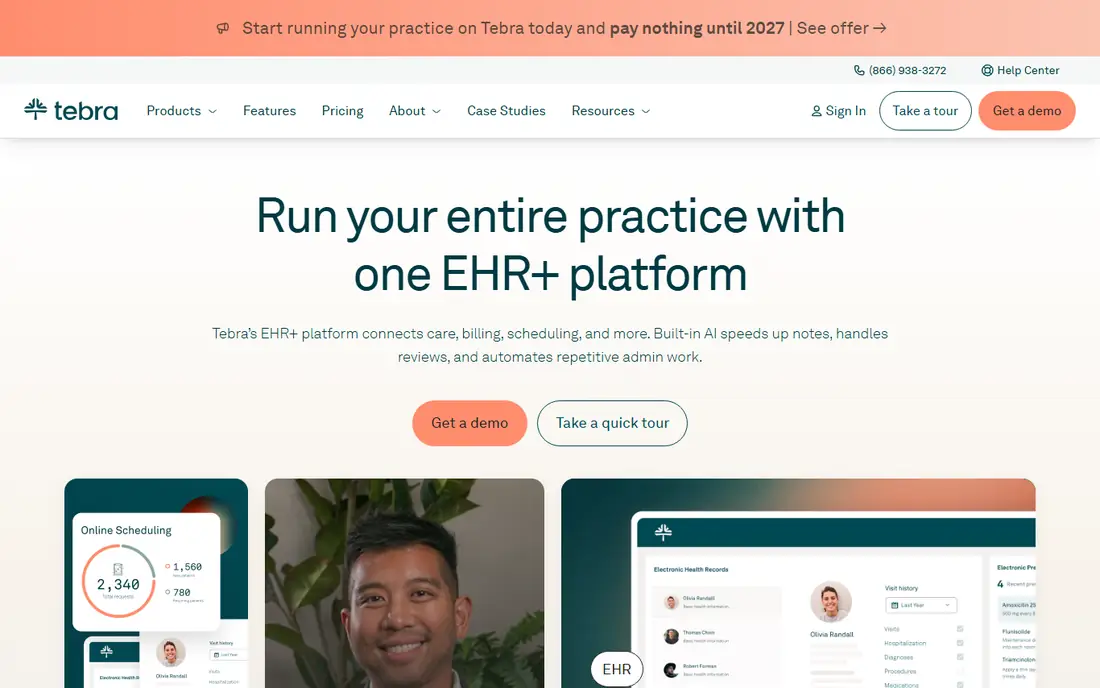
Tebra fits independent practices that want EHR, billing, and patient engagement together. Its pricing page lists EHR Starter starting at $99 per provider per month for non-physicians and $199 for physicians, for practices submitting fewer than 100 claims per month. The Practice Essentials bundle is $599 per physician per month at the standard tier, bundling clinical EHR, billing software, and telehealth. Vendor pages state subscription pricing is not based on a percentage of collections. Tebra was formed by the Kareo and PatientPop merger in 2021, as stated on its pricing page.
The catch is that EHR Starter requires purchase of the Billing Starter plan, so the $99 and $199 figures are not the full entry cost. Pick Tebra if low claim volume and bundled billing fit your practice. Look elsewhere if you submit well over 100 claims monthly, since low-volume pricing transitions to the standard tier after 3 consecutive months over the threshold. AI add-ons cost extra at $99 to $149 per provider per month.
What we like- Subscription pricing not based on percentage of collections
- Practice Essentials bundles EHR, billing, and telehealth
- Low-volume pricing for 100 or fewer claims monthly
Watch out for- EHR Starter requires purchase of Billing Starter plan
- AI add-ons cost $99 to $149 per provider per month extra
Starting priceSee website
Free planNone found on vendor page
athenahealth, sold as athenaOne, suits ambulatory practices that want billing work handled with the EHR. Vendor pages describe a fully integrated EHR, medical billing and practice management, and patient engagement in one solution, with web, mobile, and voice-driven documentation workflows. A rules engine and billing experts identify claim errors before submission, with authorization support from a specialist team. The vendor states no long-term contracts and that customers can take their data. Pricing is a percentage of collections model, and the cost page says to reach out for custom pricing, with no percentage or dollar figure stated.
The catch is that cost cannot be compared without a quote, because the percentage of collections is not published. Pick athenahealth if billing support and claim-error checks matter more than a fixed per-provider price. Look elsewhere if you need a published monthly figure for budgeting. Ask for the collections percentage, what counts as collections, and what happens to fees in a low-collection month.
What we like- Integrated EHR, billing, practice management, and patient engagement
- Rules engine flags claim errors before submission
- Vendor states no long-term contracts
Watch out for- Pricing is percentage of collections with no percentage published
- Cost ties to collections rather than fixed per-provider rate
#5
Epic
Best for: Large health systems and academic centers
Visit epic.com
Starting priceSee website
Free planNone found on vendor page
Epic suits large health systems and academic medical centers that need enterprise EHR depth. Its cost disclosure describes EpicCare Inpatient with CPOE, clinical documentation, electronic medication administration, and drug-drug, drug-allergy, and drug-formulary checks. Quarterly upgrades are available without charge as part of annual maintenance. Hosting options include Epic Hosting, self or third-party hosting, and sublicense models named Connect and Garden Plot. That depth fits hospitals with complex inpatient, pharmacy, and multi-site workflows. The official cost disclosure lists cost types and models but no dollar prices, so the starting price is See website.
The catch is that implementation requires project team training and certification at Epic before the build phase, plus hardware and infrastructure planning. Pick Epic if enterprise inpatient depth is the deciding factor. Look elsewhere if you run a small ambulatory practice that needs published per-provider pricing and a fast start. Some third-party software and content licenses are required and may be one-time or volume based.
What we like- EpicCare Inpatient includes CPOE and medication checks
- Quarterly upgrades available without charge in annual maintenance
- Hosting options include Epic Hosting and sublicense models
Watch out for- Cost disclosure lists cost types but no dollar prices
- Implementation requires project team training and certification at Epic
Starting priceSee website
Free planNone found on vendor page
Oracle Health, the former Cerner line, suits hospitals and health systems that need an enterprise EHR. Vendor pages describe a cloud-based suite for providers, payers, and public health organizations, with a clinical suite positioned to simplify workflows and documentation. An interoperability management console covers provider exchange, payment, public health, labs, and benefits data. A fully managed delivery model is offered for community, rural, and critical access hospitals. The Oracle cost disclosure still carries the Cerner name and Millennium and PowerChart product names, and lists cost types only, with no dollar amounts.
The catch is that costs are contract based, professional services vary by customer election, and requests outside managed services scope may carry additional fees. Pick Oracle Health if hospital scale and managed delivery fit your system. Look elsewhere if you need published pricing or a small-practice rollout. Ask which interface, report, and hosting items sit inside the contract and which are billed as extras.
What we like- Cloud suite for providers, payers, and public health
- Interoperability console for exchange, labs, and benefits data
- Managed delivery for community and rural hospitals
Watch out for- Costs are contract based with no public rate card
- Interface or report changes beyond specifications may carry fees
Starting priceSee website
Free planNone found on vendor page
MEDITECH Expanse suits community hospitals and regional health systems. Vendor pages describe a cloud-native, scalable platform with a longitudinal interoperable patient view and a mobile-first design for physicians and nurses. Ambient intelligence captures and summarizes patient conversations into documentation. MEDITECH as a Service is a subscription model described as reducing the time and cost of procuring, hosting, and maintaining the EHR, with a streamlined contract. The subscription page publishes no rates, so the starting price is See website. Customer examples on vendor pages center on hospitals and health systems rather than small independent practices.
The catch is that deployment is an enterprise-level EHR implementation through partner contracts, not a self-serve practice signup. Pick MEDITECH if you run a community hospital and want a subscription EHR model. Look elsewhere if you need ambulatory per-provider pricing or a trial. Ask for subscription rates by bed count, implementation scope, training, support, hosting, and what ambient documentation costs.
What we like- Cloud-native Expanse with longitudinal patient view
- Ambient intelligence summarizes conversations into documentation
- As-a-service subscription reduces hosting burden
Watch out for- Subscription page publishes no rates
- Positioning centers on hospitals, not small practices
#8
NextGen Healthcare
Best for: Specialty and mid-size ambulatory groups
Visit nextgen.com
Starting priceSee website
Free planNone found on vendor page
NextGen Healthcare suits specialty and mid-size ambulatory groups. Vendor pages describe NextGen Enterprise with configurable clinical content for 30+ specialties, and NextGen Office as a cloud clinical and billing solution for practices under 10 providers with a patient portal and claims clearinghouse. Practice management features include real-time eligibility verification and clearinghouse selection. No pricing page was found in this run, and the contact page offers demo and sales contact only, so the starting price is See website. Implementation uses project managers, consultants, and trainers, which signals a scoped rollout rather than instant setup.
The catch is that the lineup splits by practice size, so a group near 10 providers must confirm which product fits before pricing talks. Pick NextGen if specialty content for your field is the deciding factor. Look elsewhere if published pricing or a free trial is required. Ask for per-provider pricing for Office and Enterprise, plus implementation and clearinghouse fees.
What we like- Enterprise configurable for 30+ specialties
- Office cloud solution for practices under 10 providers
- Real-time eligibility verification in practice management
Watch out for- No pricing page found, buying route is demo or sales
- Product choice splits by practice size
Starting priceSee website
Free planNone found on vendor page
Veradigm EHR suits multi-location, multi-specialty organizations that need customization. Vendor pages name customizable workflows, specialty specific content, one-click templates, smart lists, automated compliance reporting, PDMP integration, RxTruePrice, integrated telehealth, and a mobile app. Veradigm is formerly Allscripts, and it is a sibling product of Practice Fusion from the same company. Veradigm presents its EHR for multi-specialty organizations and Practice Fusion for small independent practices, so the two should not be read as unrelated rivals. No pricing page was found, and the EHR page routes buyers to contact Veradigm or book a demo.
The catch is that advanced customization adds setup work, and the vendor itself contrasts Veradigm with Practice Fusion as the out-of-the-box option. Pick Veradigm if multi-specialty workflows and customization justify a sales-led rollout. Look elsewhere if you want simple small-practice pricing. An ambient scribe is presented as a distinct feature with no price stated, so ask what it costs per provider.
What we like- Customizable workflows and specialty content
- One-click templates, smart lists, and PDMP integration
- Integrated telehealth and mobile app
Watch out for- No published pricing, buyers routed to contact or demo
- Advanced customization is not the simple small-practice pick
Starting priceSee website
Free planNone found on vendor page
DrChrono suits independent practices that want mobile EHR and billing. Vendor pages list fully integrated EHR mobile apps, telehealth, patient check-in and kiosk, and a patient portal app across tiers, with unlimited staff accounts. A specialty specific form and template library includes customization tools, and plan features list a dedicated implementation specialist, training team, and data migration. The opened pricing page shows feature tiers but no base subscription dollar amount, so the starting price is See website. That fits practices that chart on tablets and want staff accounts without per-staff license math.
The catch is that medication management, extended lab integration, medical speech-to-text, and EverHealth Scribe are marked as add-ons on lower tiers. Pick DrChrono if mobile workflows and unlimited staff accounts fit your practice. Look elsewhere if you need a published base price before a sales call. Text, phone reminder, and e-fax allowances are capped by tier, and eligibility checks and claims are labeled per check and per claim.
What we like- Integrated mobile apps, telehealth, check-in, and patient portal
- Unlimited staff accounts
- Specialty form and template library with customization
Watch out for- Pricing page shows tiers but no base dollar amount
- Key tools marked as add-ons on lower tiers
Per provider, percentage, or subscription: which pricing model fits?
The pricing model decides your real EHR bill more than the feature list. Per-provider pricing is easiest to budget: eClinicalWorks charges $499 per month per provider for EHR Only, Practice Fusion charges $199 per month per provider, and Tebra starts at $99 to $199 per provider per month for low-volume practices. Percentage-of-collections pricing, used by athenahealth, ties fees to revenue and can suit practices that want billing handled, but the percentage is not published. Subscription models, such as MEDITECH as a Service, bundle hosting and maintenance for hospitals. Enterprise systems such as Epic and Oracle Health price by contract. Count providers, claim volume, and billing scope, then compare the model, not only the headline figure.
Which EHR software is best for small practices?
Practice Fusion and Tebra fit small practices best on published pricing. Practice Fusion is $199 per month per provider with an annual commitment, a free trial, and 3 signing staff licenses included per provider license. Tebra EHR Starter is $99 per provider per month for non-physicians and $199 for physicians submitting fewer than 100 claims per month, but it requires the Billing Starter plan. eClinicalWorks at $499 per month per provider suits groups that want deeper ambulatory tools and training included for 1 to 9 providers. A 2-provider practice pays about $398 per month at Practice Fusion pricing before taxes and billing services.
Which EHR software is best for hospitals?
Epic, Oracle Health, and MEDITECH fit hospitals best in this list. Epic offers inpatient depth with CPOE, medication administration, and drug checks, plus sublicense models for affiliated sites. Oracle Health offers a cloud suite and managed delivery for community, rural, and critical access hospitals. MEDITECH Expanse offers a cloud-native platform and an as-a-service subscription for community hospitals and regional systems. None of the 3 publishes a usable dollar price on opened vendor pages, so hospital buyers should compare contract scope, implementation staffing, hosting, and third-party license costs in writing.
How much does EHR software cost per provider?
Published per-provider prices in this list are $499 per month for eClinicalWorks EHR Only, $599 for eClinicalWorks with Practice Management, $199 per month for Practice Fusion, and $99 to $199 per month for Tebra EHR Starter at low claim volume. Tebra Practice Essentials is $599 per physician per month at the standard tier. athenahealth charges a percentage of collections with no percentage published. Epic, Oracle Health, MEDITECH, NextGen, Veradigm, and DrChrono showed no usable dollar price on opened vendor pages. Add implementation, billing, messaging, and AI add-ons before comparing.
Frequently asked questions
What is the best EHR software overall?
There is no single best EHR for every setting. eClinicalWorks is the strongest ambulatory pick here with published pricing at $499 per month per provider. Epic fits large health systems, Practice Fusion fits small practices at $199 per month per provider, and Tebra fits low-volume practices that want billing bundled. Match the tool to practice size and pricing model first.
Which EHR software has published pricing?
eClinicalWorks, Practice Fusion, and Tebra publish usable per-provider prices on opened vendor pages: $499, $199, and $99 to $199 per provider per month. The other 7 tools in this list showed no dollar amount on opened pricing text. athenahealth uses a percentage of collections. Enterprise systems price by contract, so request written quotes with implementation included.
Is Practice Fusion related to Veradigm?
Yes. Veradigm and Practice Fusion are sibling products from the same company. Veradigm presents Veradigm EHR for multi-location, multi-specialty organizations with advanced customization, and Practice Fusion for small independent practices. Practice Fusion is $199 per month per provider. Veradigm publishes no price on opened pages. Choose by practice size, not by brand familiarity alone.
What is the cheapest EHR software here?
Tebra EHR Starter has the lowest published figure at $99 per provider per month for non-physicians, but it requires the Billing Starter plan and applies below 100 claims per month. Practice Fusion is $199 per month per provider with an annual commitment. eClinicalWorks EHR Only is $499 per month per provider. Compare full entry cost, including required billing plans and taxes.
Do any of these EHR tools offer a free trial?
Practice Fusion offers a free trial with no credit card required, though the duration was not stated in the opened pricing text. The other 9 tools showed no free trial on opened vendor pages. eClinicalWorks offers free data migration for switchers, which is not a trial. Use any trial to test charting, e-prescribing, and billing with your own templates.
What to look for before you buy
First, match the EHR to your setting, hospital, ambulatory group, or small practice, before comparing features. Second, count providers, signing staff, claim volume, and locations against the pricing model. Third, confirm billing, e-prescribing, patient portal, and telehealth are included or priced as add-ons. Fourth, ask for implementation, training, data migration, and third-party license costs in writing. Fifth, check contract terms, data export rights, and what happens to records if you leave.
How we chose
We ranked tools by practice-size fit, published pricing, pricing model, and limits stated on vendor pages. Prices and facts were checked on vendor pricing and product pages on 2026-11-29. Where opened vendor text showed no dollar amount, the price is See website. We did not use review scores, claim hands-on testing, or use third-party prices as listed prices.
Sources we checked (10)
- https://www.eclinicalworks.com/products-services/pricing/
- https://www.practicefusion.com/pricing/
- https://www.tebra.com/pricing/overview
- https://www.athenahealth.com/why-choose-us/cost-value
- https://www.epic.com/mu
- https://www.oracle.com/health/
- https://ehr.meditech.com/ehr-solutions/meditech-as-a-service-maas
- https://www.nextgen.com/contact-us
- https://veradigm.com/
- https://www.drchrono.com/pricing/
Is your product missing or out of date?
We review this list regularly. Vendors can request a listing, send updated pricing or ask about featured placement.

Shihab Mia · Founder, Rankite
Shihab has 5+ years in B2B and SaaS SEO. He writes Rankite's software buying guides from pricing pages, documentation and public user reviews. More about Shihab.