How we make this list: we compare pricing pages, product documentation and public user reviews. Rankite is independent; if a vendor ever pays for a featured spot, that listing is clearly labeled Partner.
Key takeaways
- The best free EHR software is almost always open source. Six of the seven tools here are free forever because their code is open, not because of a trial or freemium hook.
- OpenEMR is the strongest pick for US small practices: it is ONC-certified, handles billing, and has the largest community. OpenMRS wins for customization and global health work.
- Free never means zero cost. Open-source tools need hosting, setup, and maintenance, which can run hundreds of dollars a month unless you have technical help in-house.
- 75Health is the only cloud option with a documented free tier (Lite at $0 per user per month), so it is the pick if you cannot run your own server.
- Practice Fusion, the famous free EHR, is no longer free. It now starts at $199 per provider per month, which is why it is not on this list.
The best free EHR software

#1
OpenEMR
Best for: US small practices that want a full-featured, certified free EHR
Visit open-emr.org
Starting price$0 (open source)
Free planYes (free forever)
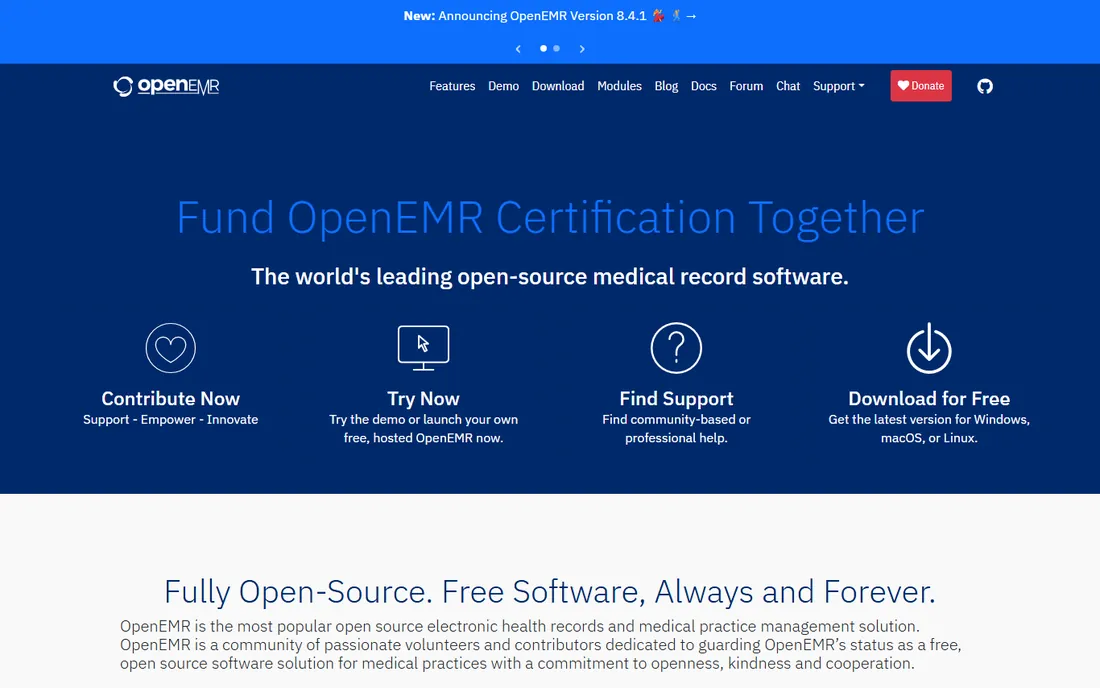
OpenEMR describes itself as the most popular open-source electronic health records and medical practice management solution, and the claim holds up. It is ONC-certified, which matters for US practices that need to meet federal requirements. The feature list covers scheduling, e-prescribing, medical billing with HIPAA transaction standards, CMS reporting, lab integration, and clinical decision rules. It runs in more than 30 languages.
For a US small practice, OpenEMR is the default free choice. Nothing else free covers the full visit-to-billing workflow with certification. The tradeoff is the total cost of ownership. The software is free, but you need a server (yours or a cloud host), someone to install and update it, and someone to fix things when they break. Practices without IT support often end up paying a vendor for hosted OpenEMR, which defeats the purpose. Go in with your eyes open about the maintenance burden.
What we like- ONC-certified, integrated billing, large global community
Watch out for- Dated interface, needs technical help to install and maintain, hosting costs extra

#2
OpenMRS
Best for: Clinics and organizations that need a customizable, standards-based platform
Visit openmrs.org
Starting price$0 (open source)
Free planYes (free forever)

If OpenEMR is the free EHR for US practices, OpenMRS is the free EHR for the world. Its community counts more than 3,000 members, 8,000 facilities, and 15 million patient records across 70 countries. There are no license fees and no vendor lock-in. The platform is built on open standards with REST and FHIR APIs, so it integrates with other health tools.
OpenMRS shines when you need to adapt the system to specific clinical programs: HIV, TB, malaria, maternal health, COVID, and more. It is highly translatable and designed for local needs. For a typical US private practice, though, it is more platform than product. You will need developers or an implementing partner to shape it into a working clinic system, and US billing workflows are not its strength. Choose OpenMRS if customization matters more than out-of-the-box billing.
What we like- Huge global community, REST and FHIR APIs, highly adaptable to local needs
Watch out for- Requires technical skill to implement, less US billing focus than OpenEMR, enterprise-scale complexity
Starting price$0 (open source)
Free planYes (free forever)
NOSH ChartingSystem was created by a US physician who wanted an EHR that fit how small practices actually work. That origin story shows in the design: it is built around the workflows of independent doctors rather than hospital IT departments. The code is open source, and the project has been listed on SourceForge and Launchpad for years.
The appeal is focus. Where OpenEMR and OpenMRS try to serve everyone, NOSH targets the small US practice. The risk is community size. A smaller project means fewer contributors, slower updates, and less help available when something goes wrong. For a tech-comfortable solo practitioner who likes the philosophy, it is worth evaluating. For a practice that needs guaranteed support, the larger projects are safer.
What we like- Built by a US doctor for US workflows, open source, focused on small practices
Watch out for- Smaller community than OpenEMR, less documentation, solo-practice scale

#4
LibreHealth EHR
Best for: Clinics that want an open-source EHR designed to be usable out of the box
Visit librehealth.io
Starting price$0 (open source)
Free planYes (free forever)
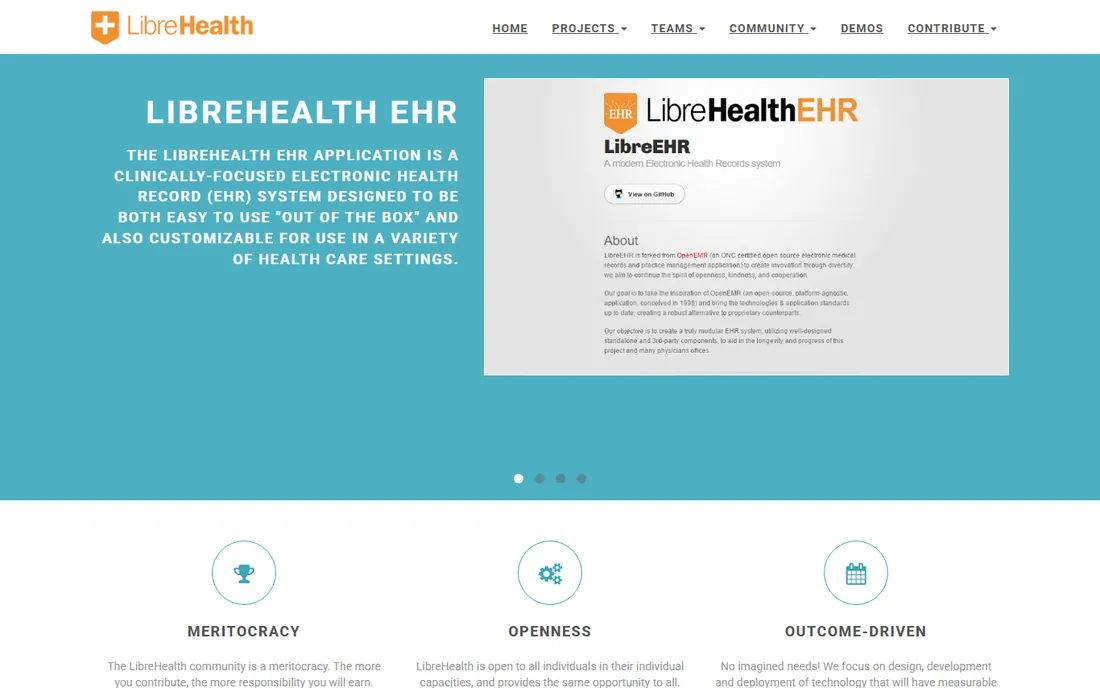
LibreHealth started as a fork of OpenEMR with a specific goal: make the system easy to use out of the box while keeping it customizable. The project describes its EHR as clinically focused and approachable, which is a direct response to the most common complaint about OpenEMR's interface. It also offers a radiology information system and a toolkit with a REST API for building health IT applications.
The community runs as a meritocracy and publishes its code on GitLab. For a clinic that likes the idea of OpenEMR but dreads the learning curve, LibreHealth is a reasonable alternative to test. The honest caveat is scale: the community and install base are smaller, so you trade ease of use for a thinner support network. US practices should also verify certification status for their specific reporting needs before committing.
What we like- Designed for ease of use, REST API and toolkit, active community
Watch out for- Smaller install base, limited US certification story, fewer third-party integrations

#5
GNU Health
Best for: Hospitals and health centers, especially outside the United States
Visit gnuhealth.org
Starting price$0 (open source)
Free planYes (free forever)
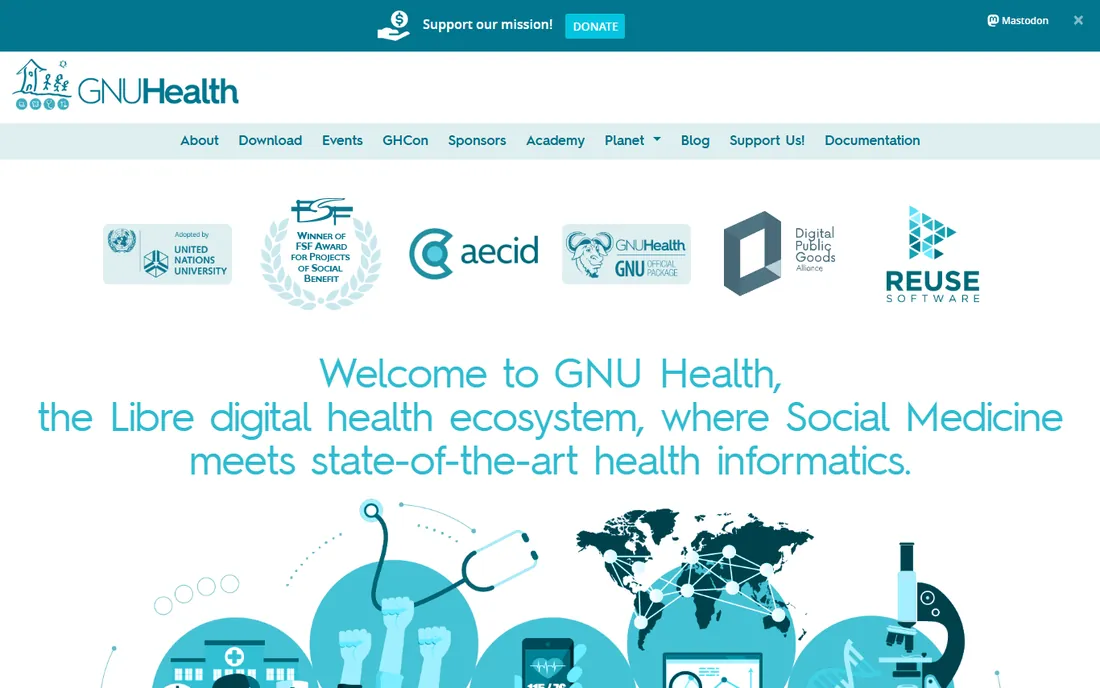
GNU Health is a free and open-source hospital information system with the motto "Freedom and Equity in Healthcare." Its implementations include ministries of health, public hospitals, and NGOs across Jamaica, Argentina, Laos, Cameroon, Gabon, Spain, and India. It covers far more than charting: it is a full hospital management system.
For a US small practice, GNU Health is usually the wrong fit. Its strengths are public health, hospital operations, and low-resource settings, not US insurance billing. But it belongs on this list because "free EHR software" is a global search, and for hospitals and NGOs, GNU Health is one of the most proven free options in existence. If your context is a hospital or a health program rather than a US private practice, it deserves a serious look.
What we like- Complete hospital information system, strong track record in public health, free software philosophy
Watch out for- Limited US billing and coding workflows, technical installation, less US community support

#6
Bahmni
Best for: Hospitals that need EMR, billing, labs, and imaging in one free system
Visit bahmni.org
Starting price$0 (open source)
Free planYes (free forever)
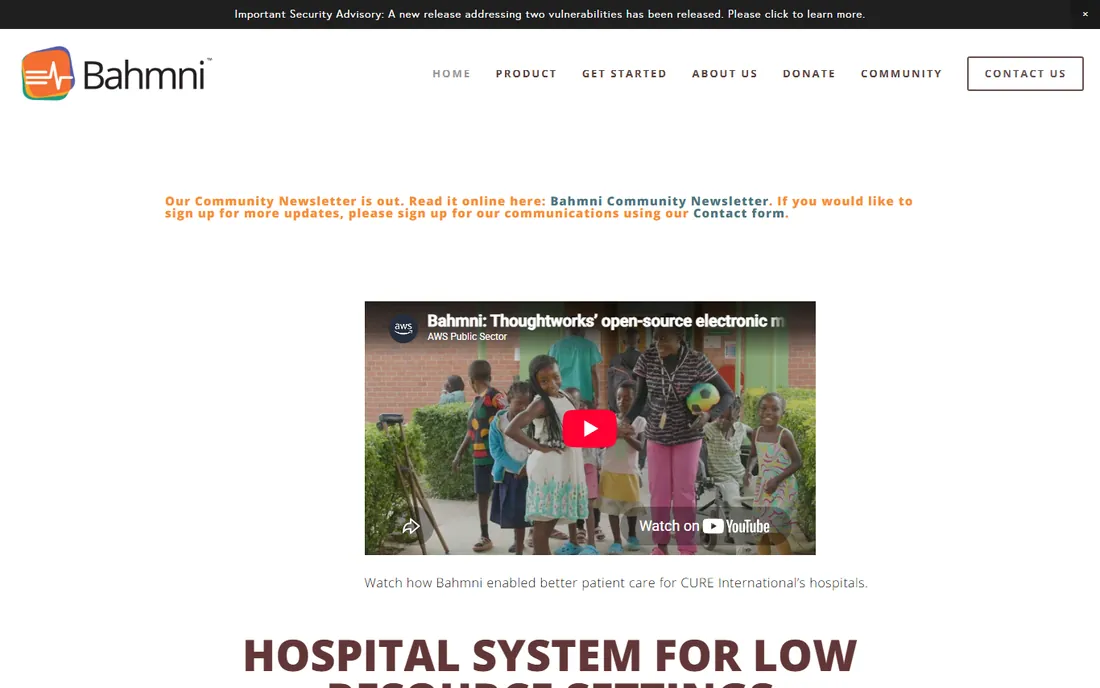
Bahmni takes a clever approach: instead of building everything from scratch, it combines proven open-source products into one hospital system. OpenMRS handles records and patient management, OpenERP handles inventory and billing, OpenELIS handles labs, and DICOM/PACS handles imaging. The result is an EMR and hospital information system that works at the point of care with minimal training.
The numbers are impressive: more than 500 sites in 50 countries and over 20 million patient records. Bahmni won the Open Source Creation category at the Future of Government Awards 2023. For a hospital that needs the full stack, it is arguably the best free option in the world. For a five-doctor US practice, it is too much system. Implementation is a real project, not a signup form, so budget for technical help.
What we like- Complete hospital system out of the box, proven at 500-plus sites, award-winning open-source project
Watch out for- Heavy implementation, overkill for small practices, needs technical staff

#7
75Health
Best for: US small practices that want a cloud EHR with a free tier and no server to run
Visit 75health.com
Starting price$0 (Lite plan)
Free planYes (Lite free tier)
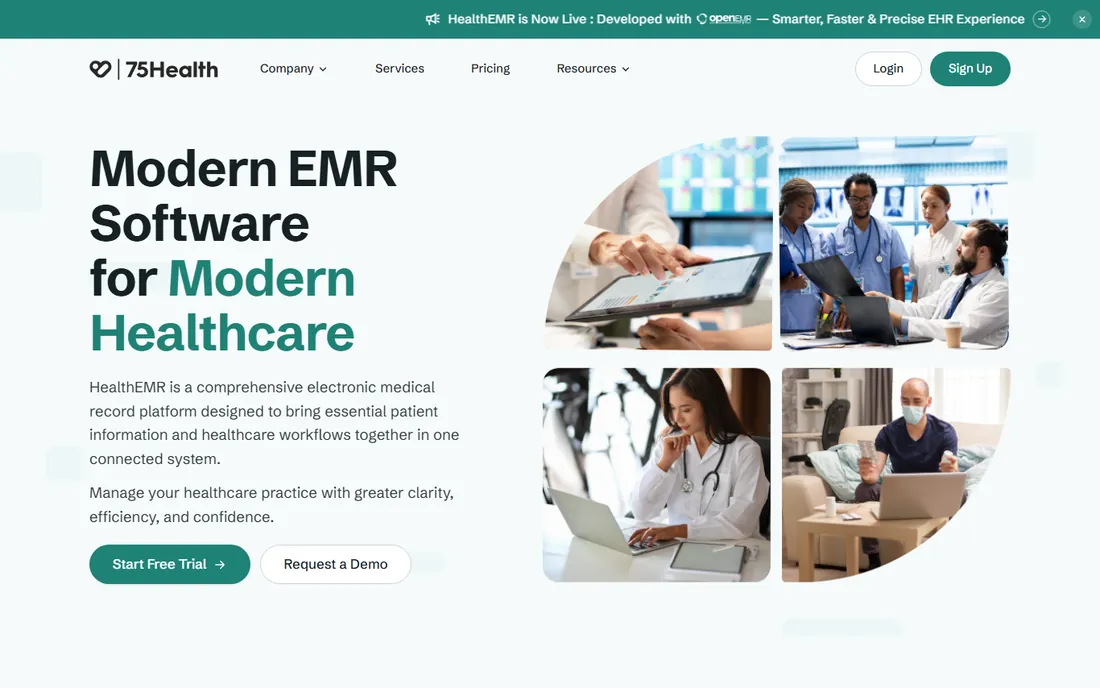
75Health is the odd one out on this list, and that is exactly why it is here. Every other tool is open source and self-hosted. 75Health is a cloud EHR from a US company in Hayward, California, with a documented free Lite tier at $0 per user per month, confirmed by third-party reviewers including Software Finder, Tekpon, and Zoftware. Paid tiers run $10, $25, and $40 per user per month.
The free tier is limited, so treat it as a way to run a real EHR without buying a server, not as a full practice system. Features include charting, scheduling, e-prescribing, billing, and a patient portal. One caution: the 75health.com homepage now brands the product as HealthEMR, so confirm the current Lite tier details before signing up. For a small practice with no IT staff, a free cloud tier beats a free download you cannot install.
What we like- Cloud-based with no server needed, free Lite tier, US-based company
Watch out for- Lite tier has limited features, paid tiers start at $10 per user per month, vendor site has rebranded
Quick comparison
| Tool | Best for | Starting price | Free plan |
|---|
| OpenEMR | US small practices that want a full-featured, certified free EHR | $0 (open source) | Yes (free forever) |
| OpenMRS | Clinics and organizations that need a customizable, standards-based platform | $0 (open source) | Yes (free forever) |
 NOSH ChartingSystem NOSH ChartingSystem | US small practices that want a system designed by a practicing physician | $0 (open source) | Yes (free forever) |
| LibreHealth EHR | Clinics that want an open-source EHR designed to be usable out of the box | $0 (open source) | Yes (free forever) |
| GNU Health | Hospitals and health centers, especially outside the United States | $0 (open source) | Yes (free forever) |
| Bahmni | Hospitals that need EMR, billing, labs, and imaging in one free system | $0 (open source) | Yes (free forever) |
| 75Health | US small practices that want a cloud EHR with a free tier and no server to run | $0 (Lite plan) | Yes (Lite free tier) |
Is your product missing or out of date?
We review this list regularly. Vendors can request a listing, send updated pricing or ask about featured placement.
We started with the free and open-source EHR shortlists on Capterra, Software Advice, and GitHub, then checked each product's website to confirm it is still active in 2026. Several once-popular names turned out to be archived or discontinued, including HospitalRun, whose project site now states it has been archived. Those did not make the list.
We verified that every tool is genuinely free: six are open source with no license fees, and the seventh has a documented $0 tier. We read feature documentation, checked community activity and release history (OpenMRS shipped version 3.7.1 in August 2026), and looked at public reviews on Capterra and G2 where available. We weighted for US small-practice relevance while keeping strong global options, since free EHR searches come from everywhere. We excluded tools that are free only as trials, freemium products without a usable free tier, and projects with no activity in years.
Open source vs. free-tier cloud EHR (buying guide)
These are two different kinds of free, and the difference matters more than the feature lists. Open-source EHRs like OpenEMR and OpenMRS cost nothing to license, but they cost real money to run. You need hosting, installation, updates, backups, and someone who understands both the software and HIPAA security. For a small practice, that often means paying a consultant or a managed hosting vendor, which can run several hundred dollars a month. The software is free; the system is not.
Free-tier cloud EHRs like 75Health flip the tradeoff. There is no server and no installation. You sign up and start charting. But the vendor controls the free tier: they can limit features, cap users, or change the terms. You are also trusting a third party with patient data, so verify their HIPAA compliance and business associate agreement before entering a single record.
The decision rule is simple. If you have technical help, open source gives you more control and more features for less money over time. If you do not, a free cloud tier gets you running this week instead of this quarter. Either way, budget for the hidden costs: data migration from your old system, staff training, and the time it takes to customize templates to your specialty.
Why Practice Fusion is not on this list
Anyone who has searched for free EHR software before 2020 remembers Practice Fusion. It was the free EHR: ad-supported, cloud-based, and genuinely free for small practices. Allscripts acquired it, and the free ride ended. Practice Fusion now starts at $199 per provider per month, which puts it firmly in paid territory.
This matters because half the "free EHR" articles on the internet still list it. Those articles are outdated. Including it here would be misleading, so we left it out and said so plainly. If you liked Practice Fusion's model of a free cloud EHR, 75Health's free Lite tier is the closest current equivalent. If you liked the idea of free and independent, OpenEMR is the closest in spirit.
Frequently asked questions
Is there really a completely free EHR?
Yes, but with caveats. Open-source EHRs like OpenEMR, OpenMRS, and LibreHealth are free to download and use forever. You still pay for hosting, setup, and maintenance unless you do it yourself. The only cloud option with a documented free tier is 75Health's Lite plan at $0 per user per month.
Is OpenEMR really free?
The software is free and open source, and it is ONC-certified. What costs money is everything around it: a server or cloud host, installation, updates, backups, and support. Many practices pay a vendor for hosted OpenEMR, which typically costs less than commercial EHRs but is not zero.
What is the best free EHR for a small US practice?
OpenEMR, because it is ONC-certified and handles US billing workflows. If you cannot manage a server, 75Health's free Lite tier is the simplest cloud alternative. NOSH ChartingSystem is worth a look for solo practitioners who want something designed specifically for small practices.
Can a free EHR handle e-prescribing and billing?
OpenEMR handles both, including e-prescribing and integrated billing with HIPAA transaction standards. OpenMRS can be configured for billing but needs more setup. 75Health includes e-prescribing and billing in its paid tiers; check what the free Lite tier covers before relying on it.
Is Practice Fusion still free?
No. Practice Fusion ended its free offering after the Allscripts acquisition and now starts at $199 per provider per month. Any article still listing it as free is outdated.
Are free EHRs HIPAA compliant?
The software can be configured to be HIPAA compliant, but compliance depends on how you deploy it. Self-hosted open-source EHRs need proper server security, access controls, and a signed business associate agreement with your host. With cloud free tiers, verify the vendor's HIPAA compliance and BAA before entering patient data.
Sources we checked (14)
- https://open-emr.org/
- https://openmrs.org/
- https://www.noshchartingsystem.com
- https://slashdot.org/software/p/NOSH-ChartingSystem/
- https://librehealth.io
- https://gnuhealth.org/
- https://www.bahmni.org
- https://75health.com/
- https://softwarefinder.com/emr-software/75health
- https://tekpon.com/software/75health/reviews/
- https://zoftwarehub.com/products/75health/pricing
- https://hospitalrun.io/
- https://github.com/diya4covid/EHR-SOFTWARE
- https://www.capterra.com/electronic-medical-records-software/
Is your product missing or out of date?
We review this list regularly. Vendors can request a listing, send updated pricing or ask about featured placement.

Shihab Mia · Founder, Rankite
Shihab has spent more than a decade helping SaaS and e-commerce brands grow through search. He writes Rankite's software buying guides from pricing pages, documentation and public user reviews. More about Shihab.