How we make this list: we compare pricing pages, product documentation and public user reviews. Rankite is independent; if a vendor ever pays for a featured spot, that listing is clearly labeled Partner.
Key takeaways
- Lob, PostGrid, and Postalytics all offer free tiers, but the free plans carry the highest per-piece costs, so they suit testing more than scale.
- PebblePost, Postie, PFL, Sendoso, and PostPilot publish no pricing, which usually means a sales call and volume minimums.
- Click2Mail and Thanks.io charge no platform fee at all, so you pay only for what you mail, a good fit for irregular senders.
- Per-piece pricing is the number that matters most: it bundles print, processing, and postage, and it drops sharply on paid plans and at higher volumes.
Quick comparison
| Tool | Best for | Starting price | Free plan |
|---|
 Lob Lob | engineering teams mailing at scale | Free Developer plan; paid from $260/mo (Startup) | Yes |
 Postalytics Postalytics | marketers running CRM-triggered campaigns | Free plan; paid from $199/mo (Marketer) | Yes |
 PostGrid PostGrid | teams needing mail plus address verification in one API | Free Starter tier; per-piece from ~$0.86/postcard | Yes |
 Click2Mail Click2Mail | operational mail with no subscription | No platform fee; 6x11 postcards from $0.73 per piece | Yes |
 PostPilot PostPilot | Shopify brands doing winback mail | See website | No |
 PebblePost PebblePost | programmatic mail from web behavior | See website | No |
 Postie Postie | digital-style measurement of direct mail | See website | No |
 PFL PFL | enterprise tactile marketing and ABM | See website | No |
 Sendoso Sendoso | sales teams pairing gifts with mail | See website | No |
 Thanks.io Thanks.io | handwritten-style mail with no minimums | Postcards from $0.64/piece (print and postage included) | No |
Is your product missing or out of date?
We review this list regularly. Vendors can request a listing, send updated pricing or ask about featured placement.
The best direct mail automation software
A prospect who deleted your last forty emails will still walk to the mailbox, pick up a postcard, and read every word on it. That is the entire argument for direct mail in 2026. Email inboxes are crowded and ad costs keep climbing, while a physical piece lands somewhere your competitors are not. Automation is what makes it affordable for small teams: instead of coordinating printers, mail houses, and lists by hand, the software below handles design, printing, addressing, postage, and delivery tracking from one dashboard or API call.
Starting priceFree Developer plan; paid from $260/mo (Startup)
Free planYes
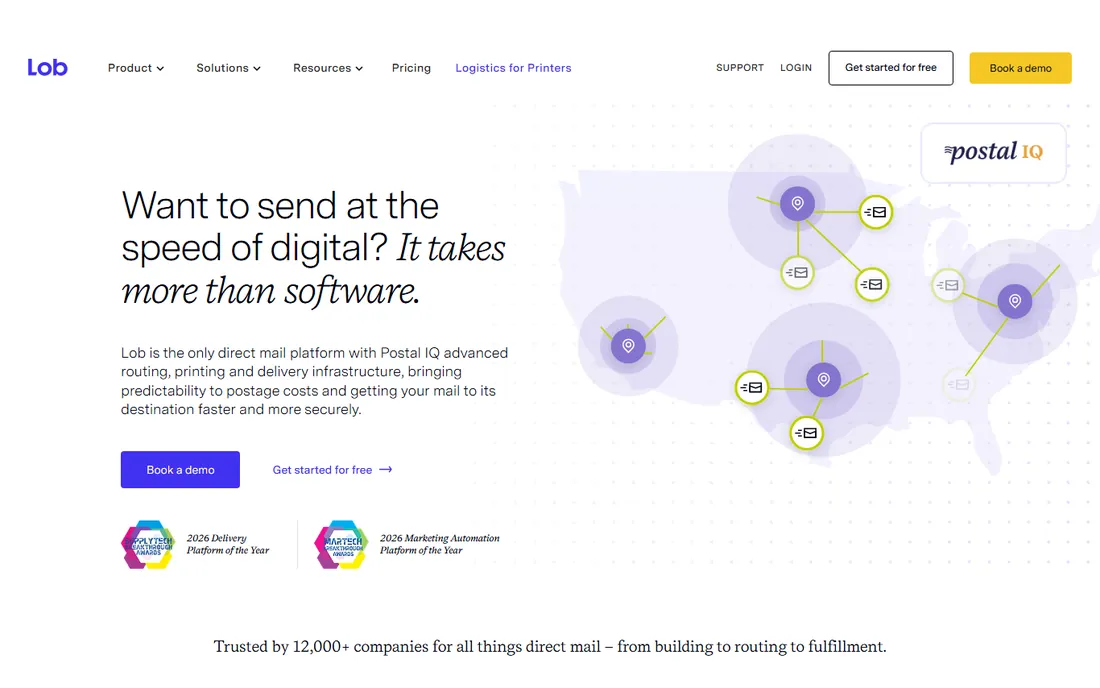
Developers tend to pick Lob first because the API behaves the way APIs should. Test keys simulate the full mail lifecycle for free, so you can build and debug without printing a single piece. When you go live, the platform routes each piece through the most efficient USPS entry point and prints it near its destination, which keeps delivery times predictable.
The pricing structure rewards commitment. On the free Developer plan (up to 500 mailings a month), a postcard starts around $0.81 before volume discounts; on the $260/month Startup plan it drops to about $0.55, and on the $550/month Growth plan to about $0.52. If you mail thousands of pieces a month, those gaps add up fast. Add-ons like US address verification are billed separately, and the free plan includes only a small monthly allotment.
What we like- Well-documented APIs with test keys
- Postal IQ routing picks efficient USPS entry points
- Nationwide print delivery network
- Supports HIPAA, GDPR, and CCPA workflows
Watch out for- Per-piece rates are highest on the free plan
- Monthly platform fees start at $260
- HIPAA mailings and custom envelopes require Enterprise
Starting priceFree plan; paid from $199/mo (Marketer)
Free planYes
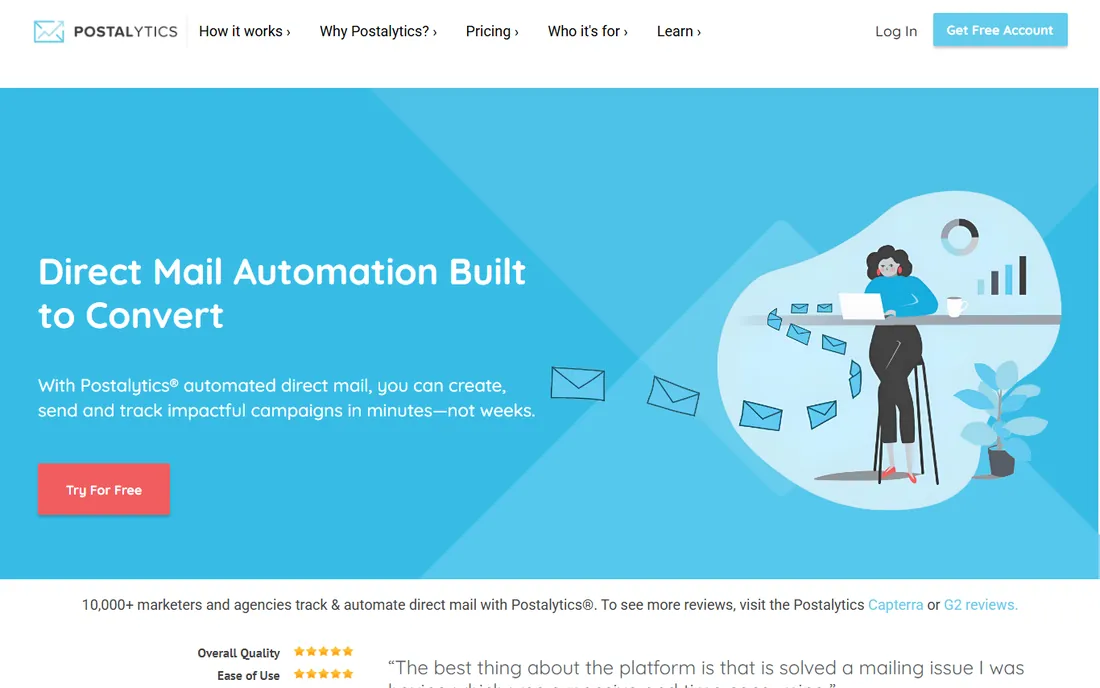
Postalytics is the friendliest option for a marketing team that wants direct mail to behave like email automation. You design postcards and letters in a visual editor, connect your CRM, and set triggers for birthdays, abandoned carts, or lifecycle stages. The platform tracks each piece with Intelligent Mail barcodes and ties scans of QR codes or pURLs back to campaigns.
The free plan is genuinely useful for pilots, but check the per-piece math before you scale: it carries the highest per-piece rates of any tier. The $199/month Marketer plan adds one user login and most integrations, while the $399/month Pro and Agency plans add multi-touch flows, unlimited user logins, and agency white labeling. Mailing lists are sold separately, so budget for data on top of the platform fee.
What we like- Built for marketers, not developers
- HubSpot and Salesforce integrations
- Unlimited IMB tracking plus personalized QR codes and pURLs
- Free plan includes the API and triggered drips
Watch out for- Free plan has the highest per-piece cost (about $1.05 for a 6x9 postcard)
- Full Salesforce integration needs the $399/mo Pro and Agency plans
- Mails only in the US and Canada
#3
PostGrid
Best for: teams needing mail plus address verification in one API
Visit postgrid.com
Starting priceFree Starter tier; per-piece from ~$0.86/postcard
Free planYes
PostGrid bundles two problems that usually require two vendors: sending physical mail and keeping the addresses clean. Its address verification API checks US, Canadian, and international addresses against postal standards, which cuts down on undeliverable pieces that cost you full postage. The print and mail API covers letters, postcards, checks, and self-mailers.
The Starter tier is free with up to 500 mailings a month, letters from about $1.02 and postcards from about $0.86 per piece, all print and postage included. The Enterprise plan switches to custom volume pricing with a dedicated account manager. If you also need ongoing verification, those plans run from $18/month for 2,000 US and Canada lookups, with annual billing saving about 10 percent.
What we like- Print and mail API plus address verification APIs in one account
- Verifies addresses in 245+ countries
- Free tier allows up to 500 mailings a month
- Real-time delivery tracking
Watch out for- Per-piece rates sit above some competitors
- SSO and express mailing need the Enterprise plan
- Address verification plans are billed separately
Starting priceNo platform fee; 6x11 postcards from $0.73 per piece
Free planYes
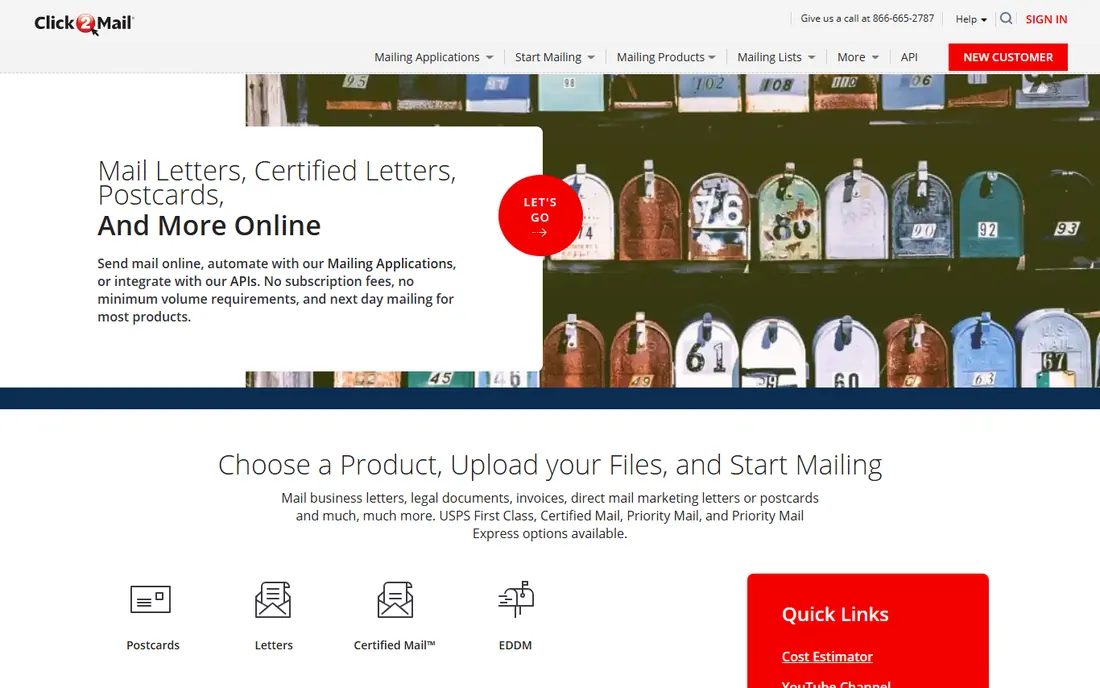
Click2Mail is the workhorse pick for businesses that mail statements, invoices, legal notices, and marketing postcards without wanting another monthly bill. There is no software fee at all; you pay only when mail goes out. The product range is wide: postcards, letters, certified mail with proof of delivery, EDDM neighborhood saturation, flyers, booklets, and reply mail.
Pricing is per piece and published on the site. A 6x11 postcard starts at $0.73, and smaller 4.25x6 postcards run lower. Volume discounts apply automatically as quantities grow. Support runs Monday through Friday, 9 AM to 8 PM Eastern, at 866-665-2787, and the company has been operating since 2003, which matters when you are trusting someone with compliance mail. Free address validation and change-of-address updates are included, saving roughly the cost of a returned piece each time they catch a bad address.
What we like- No subscription fees and no minimum volumes
- Next-day mailing for most products
- Certified mail, EDDM, and priority mail options
- Free CASS-certified address validation and NCOA updates
Watch out for- Campaign automation is thinner than marketer-first tools
- The interface shows its age
- Design services cost extra
Starting priceSee website
Free planNo
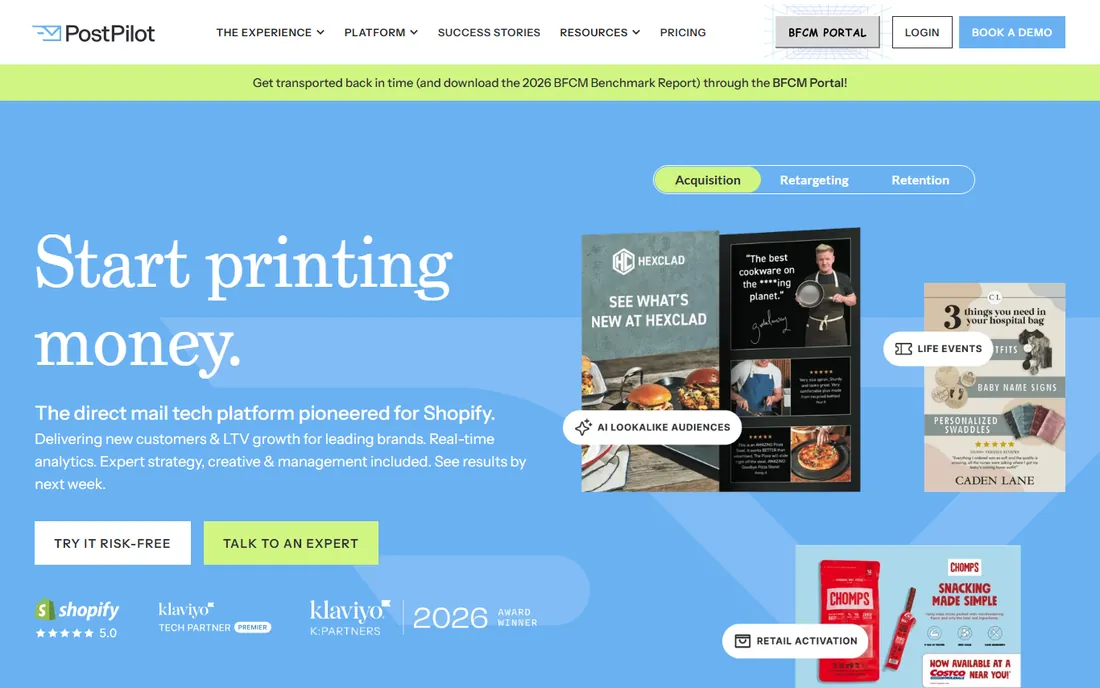
PostPilot treats direct mail as a retention channel for online stores. It plugs into Shopify and fires postcards to lapsed buyers, cart abandoners, and high-value segments automatically, with the same kind of segmentation logic marketers use in email. The pitch is winback revenue from customers who stopped opening emails, and the customer wall on its homepage is full of DTC founders.
The catch is that everything runs through a sales conversation. Pricing is not published, so you will need to talk to the team and share your order volume before you see numbers. If you are not on Shopify or your mail is operational rather than promotional, one of the API-first platforms above will fit better.
What we like- Purpose-built for Shopify and ecommerce
- Covers acquisition, retargeting, and retention in one platform
- Programmatic triggered sends
- MailMatch audience features
Watch out for- No published pricing
- Focused on ecommerce, not operational or compliance mail
- Per-piece costs can climb on large catalogs
Starting priceSee website
Free planNo
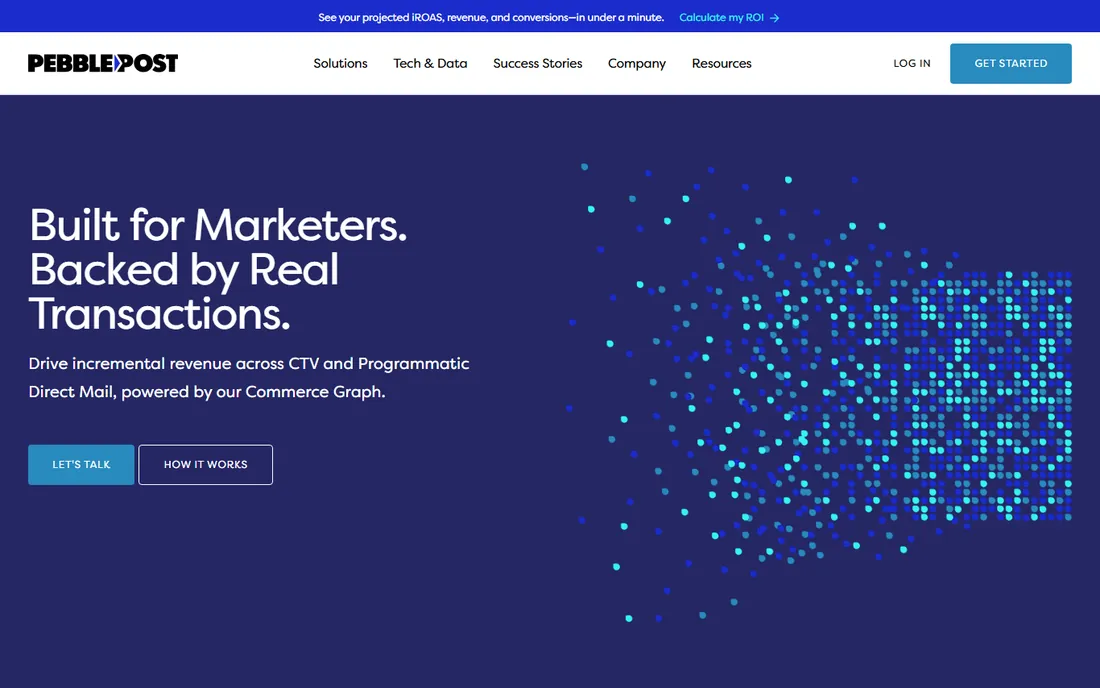
PebblePost invented the programmatic direct mail category: it watches digital intent signals and mails postcards to people who browsed but did not buy, usually within a day or two of the visit. For brands spending heavily on retargeting ads, it extends the same logic to the mailbox, where attention is less divided.
This is not a self-serve tool. There is no pricing page, no free tier, and no dashboard you can sign up for on your own; everything runs through custom deals. That structure can work well at serious volume, since pricing can be tied to performance, but smaller senders should expect to be steered toward more accessible platforms.
What we like- Programmatic direct mail triggered by online browsing and purchase intent
- Deals are structured around performance
- Positions mail as backed by real transaction data
Watch out for- Publishes no pricing
- Custom deals imply meaningful minimums
- Managed-service model, not self-serve
Starting priceSee website
Free planNo
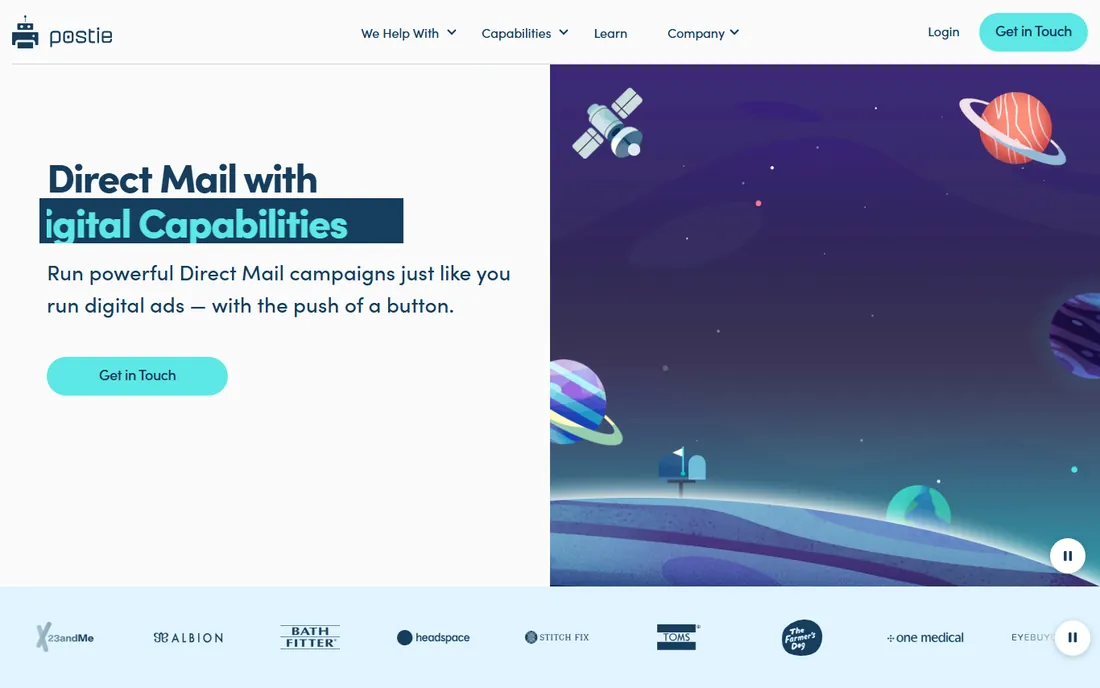
Postie pitches direct mail the way media buyers think about paid social: audiences, lookalikes, triggers, and attribution in one place. Its machine-learning engine builds lookalike models from your best customers, and identity resolution lets you mail people who visited your site without ever logging in. Campaign dashboards track cost per acquisition and return on ad spend in real time.
The platform is clearly aimed at growth teams with real budgets. Pricing is not public, and the feature set assumes you have enough volume for lookalike modeling and A/B testing to be meaningful. If you want to send ten thousand postcards and measure them like a Facebook campaign, this is the shape of tool you want. If you want to send five hundred, look at the self-serve options above.
What we like- Machine-learning lookalike audiences from your customer data
- Identity resolution matches anonymous site visitors to home addresses
- Real-time CPA, CVR, and ROAS dashboards
- Built-in A/B testing
Watch out for- No published pricing
- Likely volume minimums and a managed onboarding
- Overkill for simple batch postcard sends
#8
PFL
Best for: enterprise tactile marketing and ABM
Visit pfl.com
Starting priceSee website
Free planNo
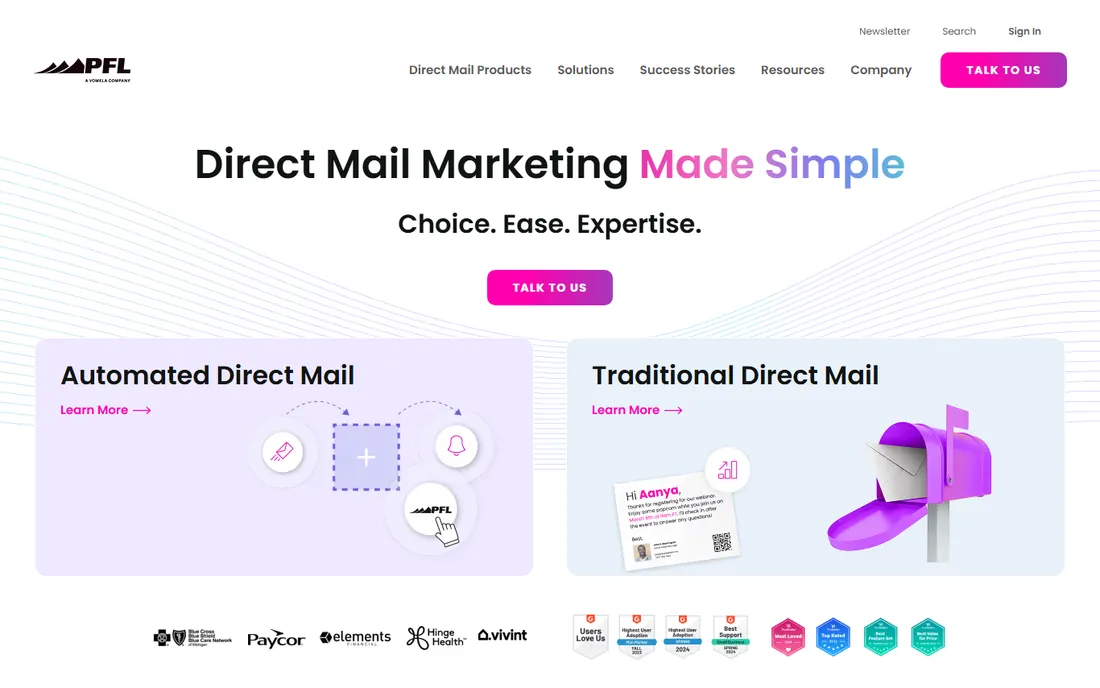
PFL has been in the direct mail business for decades and now positions its platform around tactile marketing: dimensional mailers, personalized packages, and orchestrated sends that support account-based marketing plays. It integrates with the marketing automation tools enterprise teams already run, so mail becomes a step inside existing campaign workflows rather than a separate project.
Everything about the offering points upmarket. Pricing is quote-based, and the value proposition centers on strategy, creative services, and fulfillment at scale. Mid-market and enterprise teams running ABM will find the most to like here. Smaller businesses will get faster answers and lower costs from self-serve platforms.
What we like- Tactile marketing platform built for ABM
- Deep integrations with marketing automation platforms
- Strong creative and fulfillment services
- Long enterprise track record
Watch out for- No published pricing
- Enterprise sales process
- Far more than a small team needs for basic postcard campaigns
Starting priceSee website
Free planNo
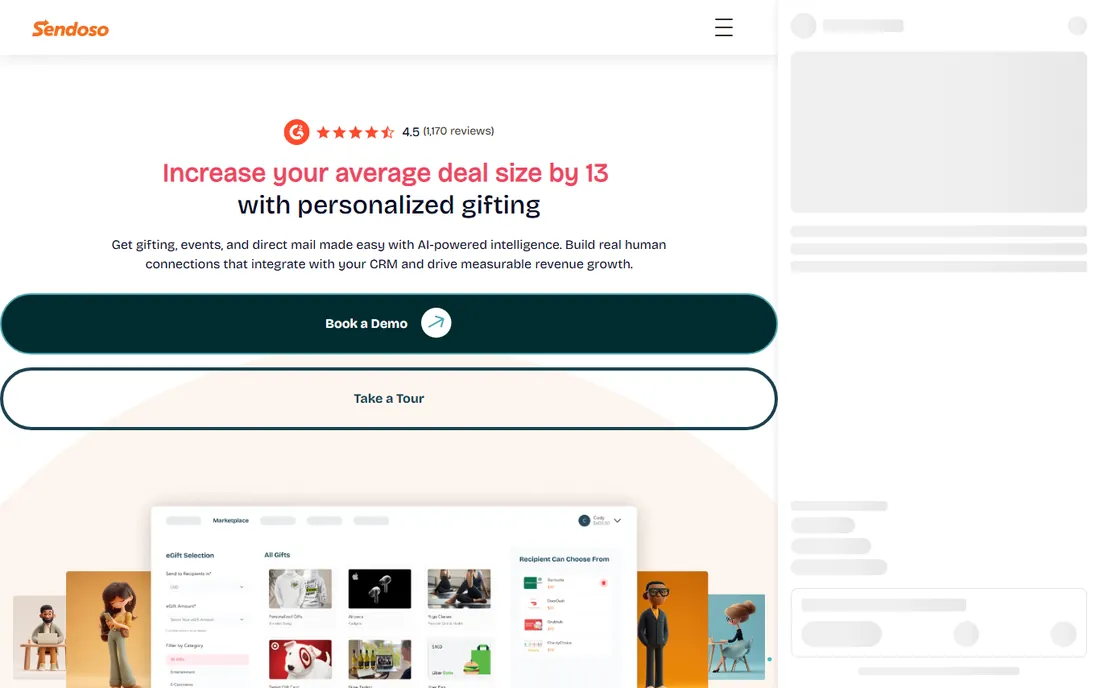
Sendoso is a sending platform rather than a pure direct mail tool. Sales and marketing teams use it to send eGifts, branded merchandise, handwritten notes, and direct mail from one place, with address confirmation so packages do not go to stale addresses. The Salesforce integration is a genuine strength: sends and engagement data flow back into the CRM for pipeline reporting.
Pricing is demo-gated, which tells you the target customer. If your use case is "send a thoughtful package to fifty target accounts," Sendoso is excellent. If your use case is "mail twenty thousand postcards a month at the lowest per-piece cost," the API platforms will be cheaper and simpler.
What we like- Combines gifting, direct mail, and handwritten notes in one platform
- Native Salesforce and Marketo integrations
- Address confirmation improves deliverability
- In-house fulfillment with custom packaging
Watch out for- No published pricing
- Broader than pure direct mail, so you pay for features you may not use
- Per-send costs add up on large campaigns
#10
Thanks.io
Best for: handwritten-style mail with no minimums
Visit thanks.io
Starting pricePostcards from $0.64/piece (print and postage included)
Free planNo
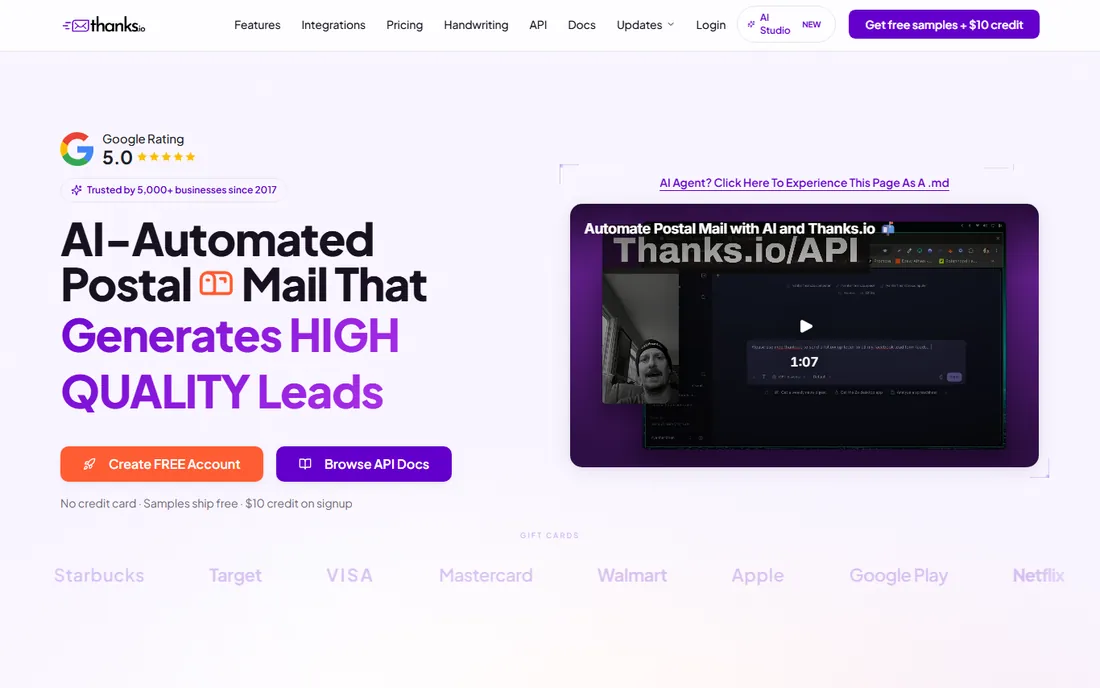
Thanks.io stands out by making small sends painless. There are no minimums, no monthly platform fee, and pricing is published plainly: postcards from $0.64 a piece, letters from $0.79, and premium folded notecards from $1.49, with print, handwriting rendering, and US postage all included. Prices were last updated on its site in July 2026.
The differentiator is the handwritten look. Its engine produces postcards, letters, and notecards that read as personally written, with QR tracking, automated drip campaigns for birthdays and milestones, and an AI studio that drafts campaigns from a plain-English description. Integrations cover Zapier, Make, HubSpot, Salesforce, and Shopify, plus a REST API. Teams and agencies sending over 1,000 pieces a month can ask for custom rates and get a dedicated account manager.
What we like- No minimums, send one piece or ten thousand
- All-in per-piece pricing with postage included
- Handwritten-style postcards, letters, and notecards
- QR tracking and automated drip campaigns
- Zapier, HubSpot, Salesforce, and API access
Watch out for- Handwritten style limits design flexibility
- Gift card sends need Business plans or higher
- No free tier, though there is no platform fee either
How we chose
We started with the full field of direct mail automation vendors and narrowed it to tools that are actually selling and supporting the product today. That mattered here because one legacy name, Inkit, has pivoted to document management and no longer offers direct mail, so it was replaced. We pulled pricing only from the vendors' own pricing pages and product pages, checking each against the page's last-updated stamp where one was shown. Where a vendor publishes no pricing, we wrote "See website" rather than guessing from third-party roundups.
We compared the tools across the dimensions buyers ask about: per-piece costs with postage included, platform fees and minimums, API quality and documentation, CRM and ecommerce integrations, delivery tracking, address verification, compliance support, and how the sales process works (self-serve versus sales call). We also read public reviews on G2, Capterra, and Slashdot, plus Reddit threads, to see where users report surprises around setup time, support responsiveness, and billing.
Start with your mail type, because the category splits cleanly. If developers will trigger mail from your product or CRM, you want an API-first platform like Lob or PostGrid with test environments and webhooks. If marketers will run campaigns, you want a marketer-first platform like Postalytics, Postie, or PostPilot with visual editors, templates, and CRM integrations. If you mail statements, notices, or legal documents, reliability and compliance matter more than creative tools, and Click2Mail's range of mail classes fits well.
Count the real per-piece cost
Per-piece pricing is the number that decides your budget. Confirm it includes printing, processing, and postage, since some vendors quote print-only prices that look cheap until postage lands. Ask how the rate changes at your actual volume, because the gap between a free-tier rate and a paid-plan rate can be 30 percent or more. Thanks.io and Click2Mail publish all-in per-piece prices, which makes comparison easy.
Check minimums, contracts, and setup time
Self-serve platforms let you sign up and send the same day with no minimums and no contract. Managed platforms usually require a sales call, an onboarding period, and a volume commitment. If you mail in bursts around product launches or holidays, a no-minimum, no-platform-fee tool saves you from paying for idle months.
Verify data, integrations, and tracking
Ask where the mailing list comes from. Some platforms include list-building or lookalike data; others expect you to bring your own CRM export. Check that the platform integrates with the CRM or ecommerce tool you actually use, and confirm what tracking you get: Intelligent Mail barcode scans, delivery webhooks, and QR or pURL attribution are the features that let you measure direct mail like a digital channel. Free address verification and change-of-address processing are worth real money at volume.
Confirm compliance and data export
If you mail in healthcare or finance, you need HIPAA-friendly workflows, audit trails, and data processing agreements, which Lob supports on its higher tiers. Ask how you export your campaign data and mailing history if you ever leave; platforms that lock reporting inside the dashboard make switching painful.
How direct mail pricing really works
Direct mail pricing has two parts and vendors mix them differently. The first part is the platform fee: a monthly subscription (Postalytics, Lob's paid plans) or nothing at all (Click2Mail, Thanks.io, PostGrid's Starter tier). The second part is the per-piece cost, which should bundle printing, processing, and USPS postage. A vendor with no platform fee and a slightly higher per-piece cost often wins for small or irregular senders, while a vendor with a platform fee and lower per-piece rates wins once you cross a few thousand pieces a month.
Postage itself is the floor you cannot negotiate away. USPS raised rates in July 2026, with a domestic postcard stamp at $0.65, so any all-in per-piece price under about $0.60 deserves a careful look at what is actually included. Volume discounts, presort rates, and nonprofit pricing can move the number, and most vendors publish tiered tables or a cost estimator. Before you sign anything, run your real quantity through the vendor's estimator and compare the all-in cost per delivered piece, not the headline rate.
Frequently asked questions
How much does direct mail cost per piece in 2026?
For standard postcards through automation platforms, expect roughly $0.64 to $1.05 per piece all-in, including print and postage. Thanks.io lists postcards from $0.64, Lob's Startup plan starts around $0.55, and Postalytics' free plan runs about $1.05 for a 6x9 postcard. Managed platforms and dimensional mailers cost more. Your actual rate depends on size, mail class, and volume.
Do I need my own mailing list?
It depends on the platform. Tools like Lob, PostGrid, and Click2Mail expect you to upload your own list. Postie and PostPilot can build lookalike audiences from your customer data or site visitors. Some vendors sell lists separately, and EDDM services like Click2Mail's let you saturate a neighborhood with no list at all.
How long does direct mail take to arrive?
Production plus USPS delivery usually runs 5 to 12 business days for standard mail. Lob cites two to three days to get a piece printed and into the mail stream, and platforms that print near the destination, like Lob's print delivery network, trim transit time. First-class options arrive faster but cost more per piece.
Can I track direct mail like a digital campaign?
Mostly, yes. Platforms offer Intelligent Mail barcode tracking, delivery webhooks, and personalized QR codes or pURLs that tie responses back to campaigns. Postie and Postalytics build dashboards around these metrics, and Thanks.io sends real-time notifications when recipients scan codes. You will not get open rates the way email does, but scan and response tracking comes close.
Is direct mail automation HIPAA compliant?
Some platforms support it. Lob offers HIPAA-compliant mailings with the security practices to back them, but only on its Enterprise plan. If you mail in healthcare, confirm the vendor will sign a business associate agreement and ask which plan level compliance features require before you commit.
Should I choose an API platform or a marketer platform?
Choose based on who will operate it. API platforms (Lob, PostGrid) fit engineering teams embedding mail into products or workflows, with test keys and documentation. Marketer platforms (Postalytics, Postie, PostPilot) fit marketing teams running campaigns, with visual editors and CRM integrations. Picking the wrong type means paying for power your team will not use.
Sources we checked (20)
- https://www.lob.com/
- https://www.postgrid.com/
- https://postalytics.com/
- https://www.click2mail.com/
- https://www.postpilot.com/
- https://www.pebblepost.com/
- https://postie.com/
- https://pfl.com/
- https://www.sendoso.com/
- https://thanks.io/
- https://www.saasworthy.com/product/lob-address-verification/pricing
- https://www.postgrid.com/best-print-on-demand-companies/
- https://github.com/api-evangelist/postgrid
- https://www.Softwareadvice.com/marketing/postalytics-profile/reviews/
- https://www.GetApp.com/all-software/a/postalytics/
- https://oppizi.com/us/en/resources/blog/direct-mail/best-direct-mail-companies/
- https://click2mail.com/postcard-6-x-11
- https://www.dontpayfull.com/at/click2mail.com
- https://slashdot.org/software/comparison/Click2Mail-vs-PebblePost/
- https://slashdot.org/software/comparison/PostGrid-vs-Thanks.io/
Is your product missing or out of date?
We review this list regularly. Vendors can request a listing, send updated pricing or ask about featured placement.

Shihab Mia · Founder, Rankite
Shihab has spent more than a decade helping SaaS and e-commerce brands grow through search. He writes Rankite's software buying guides from pricing pages, documentation and public user reviews. More about Shihab.