How we make this list: we compare pricing pages, product documentation and public user reviews. Rankite is independent; if a vendor ever pays for a featured spot, that listing is clearly labeled Partner.
Key takeaways
- Standalone trust accounting starts at $59/month (TrustBooks); all-in-one practice suites run $39 to $129 per user per month, and per-user math multiplies fast across attorneys and staff.
- Three-way reconciliation (bank balance vs. trust journal vs. client ledgers) is the non-negotiable feature; every tool here does it, but only some automate it monthly.
- QuickBooks Online cannot do trust accounting alone. Firms pair it with LeanLaw ($55/user/month) or accept the manual discipline, which is where most violations start.
- Free trials range from 7 to 30 days, but PCLaw and several enterprise-leaning tools offer demos only, so budget evaluation time accordingly.
- If your state bar runs aggressive trust audits, native one-ledger systems (CosmoLex, PCLaw) leave the cleanest paper trail.
Quick comparison
| Tool | Best for | Starting price | Free plan |
|---|
 CosmoLex CosmoLex | Firms that want trust and operating books in one ledger | From $49/user/month (billed annually) | Free trial (10 days) |
 Clio Manage Clio Manage | Firms that value integrations and practice depth | From $49/user/month (EasyStart) | Free trial (7 days) |
 TrustBooks TrustBooks | Firms that want trust accounting without a full suite | From $59/month (Tier One) | Free trial (14 days) |
 LeanLaw LeanLaw | Firms committed to QuickBooks Online | From $55/user/month (Core) | Free trial (7 days) |
 MyCase MyCase | Small firms that prize simplicity and client communication | From $49/user/month (Basic) | Free trial |
 Rocket Matter Rocket Matter | Billing-first firms that want trust accounting on every tier | From $39/user/month (Essentials, billed annually) | Free trial |
 PracticePanther PracticePanther | Firms that want full accounting without leaving the suite | From $49/user/month (Solo) | Free trial (7 days) |
 TimeSolv TimeSolv | Firms that bill time and want trust accounting attached | From ~$47.50/user/month (15+ users) | Free trial (30 days) |
 PCLaw PCLaw | Firms that want traditional accounting depth | From ~$39/user/month (subscription) | Demo only |
Is your product missing or out of date?
We review this list regularly. Vendors can request a listing, send updated pricing or ask about featured placement.
The best trust accounting software
Trust accounting is the one software decision that can cost you your license. A missed three-way reconciliation or a client ledger that drifts from the bank balance is not a bookkeeping annoyance; in most states it is an ethics violation. The nine tools below handle IOLTA and client trust funds properly, with very different ideas about what else your firm needs.
#1
CosmoLex
Best for: Firms that want trust and operating books in one ledger
Visit cosmolex.com
Starting priceFrom $49/user/month (billed annually)
Free planFree trial (10 days)
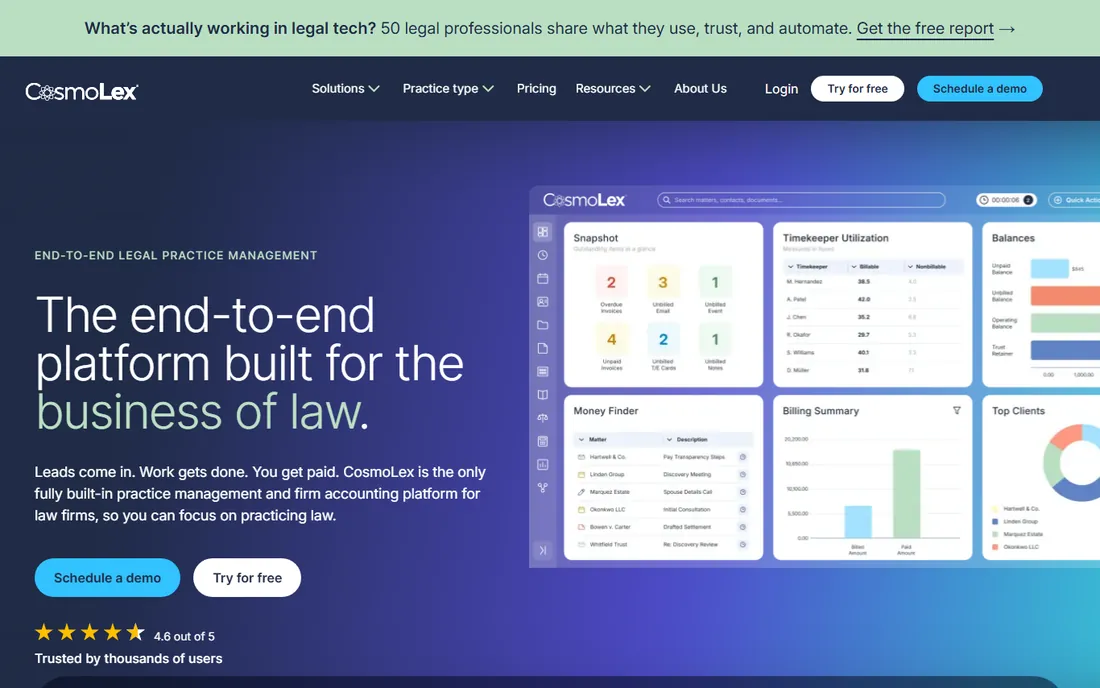
CosmoLex leads with accounting instead of bolting it on. Trust deposits, fee transfers and journal entries live in one cloud ledger, so the monthly three-way reconciliation (bank balance, trust journal, client-ledger totals) is a built-in workflow rather than a spreadsheet exercise. Launch starts at $49 per user per month billed annually, with Core at $99 and Pro at $129.
The trade is breadth. Outside accounting, the feature set is narrower than Clio's and the integration list is shorter, which matters if your firm runs exotic workflows. Onboarding is guided rather than self-serve, support includes phone and chat, and contracts are annual for the best rates. For firms where trust accounting is the actual pain point, high IOLTA volume or a prior audit scare, the one-ledger design is the headline reason to pick it.
What we like- Native three-way reconciliation inside one system
- Trust, billing and matter data share a single ledger
- No QuickBooks needed
Watch out for- Third-party integration catalog is smaller than Clio's
- Top tier reaches $129/user/month
- Practice management features are narrower than pure-play suites
#2
Clio Manage
Best for: Firms that value integrations and practice depth
Visit clio.com
Starting priceFrom $49/user/month (EasyStart)
Free planFree trial (7 days)

Nobody disputes Clio's position as the category's center of gravity. Manage handles trust accounting with matter-level safeguards and three-way reconciliation, wrapped in the practice management platform most integrations are built for. EasyStart begins at $49 per user per month, stepping through Essentials ($89), Advanced ($129) and beyond, with AI and accounting modules as paid add-ons.
The honest catch is the add-on math. The entry price looks close to rivals, but accounting, intake and AI each add $20 to $150+ per user per month, so price the fully configured stack, not the headline. Setup takes real effort to do well, support runs on tickets and chat with phone options, and annual billing earns the discount. If your firm lives on integrations, nothing else matches the ecosystem.
What we like- 300+ integrations, the largest ecosystem in legal tech
- Trust accounting with three-way reconciliation
- Bar approvals in all 50 states
Watch out for- Real accounting depth needs the Clio Accounting add-on
- Per-user costs stack with add-ons
- Steeper setup learning curve
Starting priceFrom $59/month (Tier One)
Free planFree trial (14 days)

TrustBooks is the specialist: trust accounting and nothing else. Tier One at $59 per month covers state-bar-compliant trust accounting with one-click reporting and client ledgers; Tier Two at $79 adds firm financials and legal-specific reports; Tier Three at $249 has the TrustBooks team complete your bank reconciliations for you. The 14-day trial needs no sales call.
The catch is scope. This is not practice management, so you will run it next to billing software, which suits firms that already like their current stack and just need the trust piece fixed. Flat pricing is kind to larger staff counts, support is email and phone, and there is no per-user multiplication. For a firm drowning in spreadsheet reconciliations, it is the fastest relief on this list.
What we like- Built only for legal trust accounting, nothing extraneous
- Flat monthly pricing, not per-user
- Done-for-you reconciliation service on the top tier
Watch out for- No practice management features at all
- You still need billing software alongside it
- The $249 tier caps at 100 transactions per month
Starting priceFrom $55/user/month (Core)
Free planFree trial (7 days)
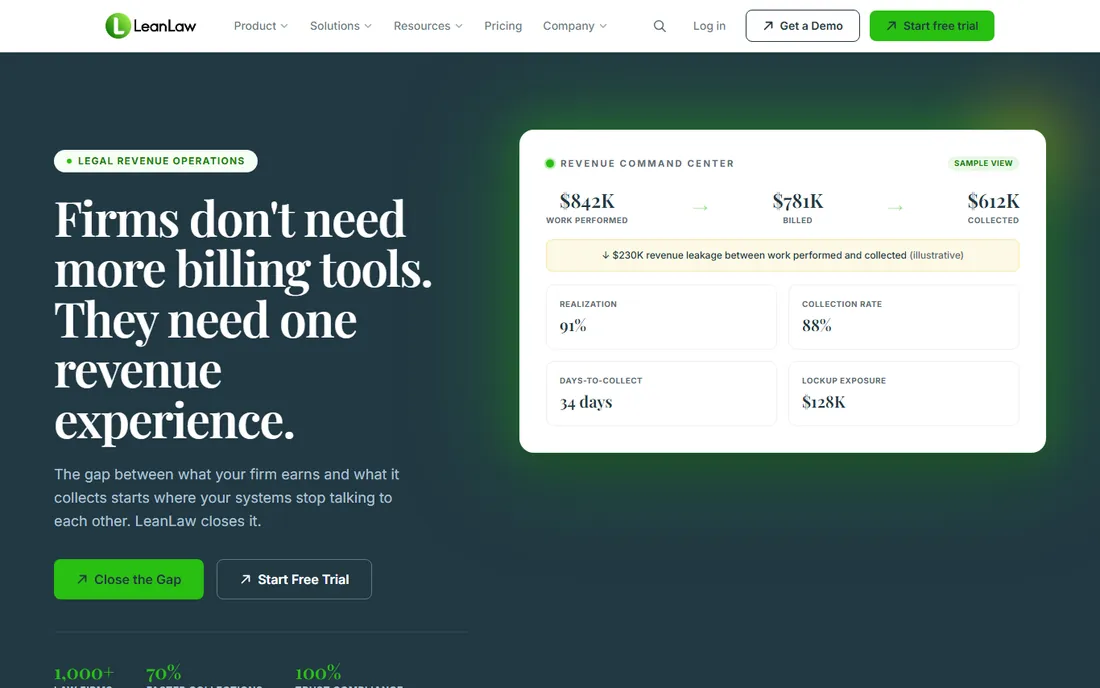
LeanLaw takes the opposite approach from CosmoLex: instead of replacing QuickBooks, it makes QuickBooks trust-compliant. Time entries, invoices, payments and trust activity flow into QBO through a real-time two-way sync, with matter-level client ledgers and automated three-way reconciliation. Core is $55 per user per month, Pro is $75, and Elite and Contingency are custom.
The catch is the dependency. You must hold a QuickBooks Online subscription (Desktop is not supported), so add that to the total. The 7-day trial covers billing workflows but not data migration, which begins with the paid subscription. Support is phone and email, and annual terms apply. If your CPA insists on QBO access, this is the cleanest compliant path.
What we like- Trust activity syncs two-way into QuickBooks Online
- Trust accounting included on every plan
- Your bookkeeper works in books they already know
Watch out for- Requires an active QuickBooks Online subscription on top
- LEDES billing needs Pro or higher
- Migration help starts after you subscribe, not during trial
#5
MyCase
Best for: Small firms that prize simplicity and client communication
Visit mycase.com
Starting priceFrom $49/user/month (Basic)
Free planFree trial
MyCase (now 8am MyCase) wins fans on usability. Trust accounting with three-way reconciliation sits inside an all-in-one platform covering intake, calendaring, documents, billing and a well-liked client portal. Basic starts at $49 per user per month, with Pro at $99 and Advanced at $119, and payments run through the integrated LawPay rails.
The catch is depth. Firms with heavy trust volume or complex reporting sometimes outgrow it and graduate to CosmoLex or Clio plus an accounting layer. Onboarding is genuinely quick, support hours are Monday to Friday 6am to 5pm PST with phone and chat, and annual billing discounts apply. For solos and small firms that want one system without a learning cliff, it is the friendliest pick here.
What we like- Genuinely easy interface with strong client portal
- IOLTA-compliant payments through 8am LawPay
- Quick onboarding with migration help
Watch out for- Trust accounting depth is tier-dependent
- Advanced reporting lags specialists
- Customization options are lighter than Clio or CosmoLex
Starting priceFrom $39/user/month (Essentials, billed annually)
Free planFree trial
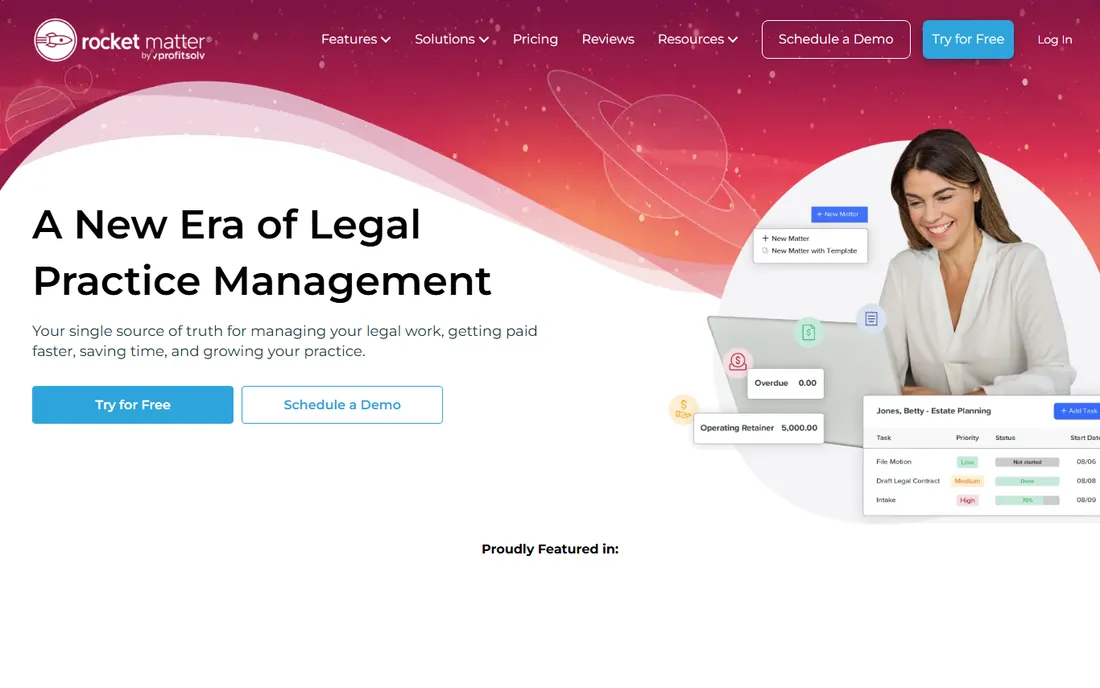
Rocket Matter has served small firms since 2008 with a billing-led workflow. Every tier includes client and matter trust accounting, and Essentials at $39 per user per month billed annually ($49 monthly) covers matter management, time and billing, online payments and conflict checks. Pro ($59 annual) and Premier ($89 annual) add automation, document assembly and business intelligence.
The catch is flexibility. Users praise the billing engine but note rigid templates and thinner reporting than CosmoLex or PCLaw. Setup is fast, support is phone and chat, and the short minimum term makes it low-risk to try. For insurance defense and other billing-heavy practices that need LEDES without enterprise pricing, it punches above its price.
What we like- Trust accounting included even on the cheapest tier
- Strong billing automation and LEDES support
- Short minimum commitment
Watch out for- Templates can feel rigid for unusual workflows
- Support responsiveness draws mixed reviews
- Reporting depth trails the accounting-first tools
Starting priceFrom $49/user/month (Solo)
Free planFree trial (7 days)

PracticePanther splits the difference: every tier includes a trust account ledger and reconciliation, but the full accounting suite (trust plus operating, GL, AR, P&L, balance sheet) appears at Business Pro for $114 per user per month. Solo ($49), Essential ($69) and Business ($89) cover practice management with growing depth.
The catch is the price of the accounting you actually want. Budget for Business Pro if the general ledger matters to you, and remember every paralegal and billing clerk multiplies the per-user cost. The 7-day trial needs no credit card, onboarding includes live training, and VIP support comes on higher tiers. For firms that want one modern system and can pay for the top tier, it delivers.
What we like- Business Pro tier adds full trust and operating accounting with guided reconciliations
- Clean modern interface
- Free data migration on higher tiers
Watch out for- Real accounting depth costs $114/user/month
- Lower tiers have trust ledgers but not the full GL
- Per-user pricing adds up for support staff
#8
TimeSolv
Best for: Firms that bill time and want trust accounting attached
Visit timesolv.com
Starting priceFrom ~$47.50/user/month (15+ users)
Free planFree trial (30 days)

TimeSolv is a time-and-billing tool first, with trust accounting built in rather than bolted on. The Legal plan scales from $58 per user per month for small teams down to about $47.50 at 15+ users, covering trust accounting, LEDES billing, ABA task codes and 30+ reports. The 30-day trial is the longest on this list.
The catch is scope. If you need deep matter management, document automation or intake, you will pair it with another tool. One-on-one training is included, support is phone and email, and QuickBooks and LawPay integrations are solid. For firms whose core need is bulletproof time capture plus compliant trust handling, the value is strong.
What we like- Built-in compliant trust accounting with automated three-way reconciliation
- Generous 30-day trial
- Volume pricing rewards growth
Watch out for- Practice management features are lighter than full suites
- Mobile app lags the desktop
- Performance complaints surface with large client lists
Starting priceFrom ~$39/user/month (subscription)
Free planDemo only
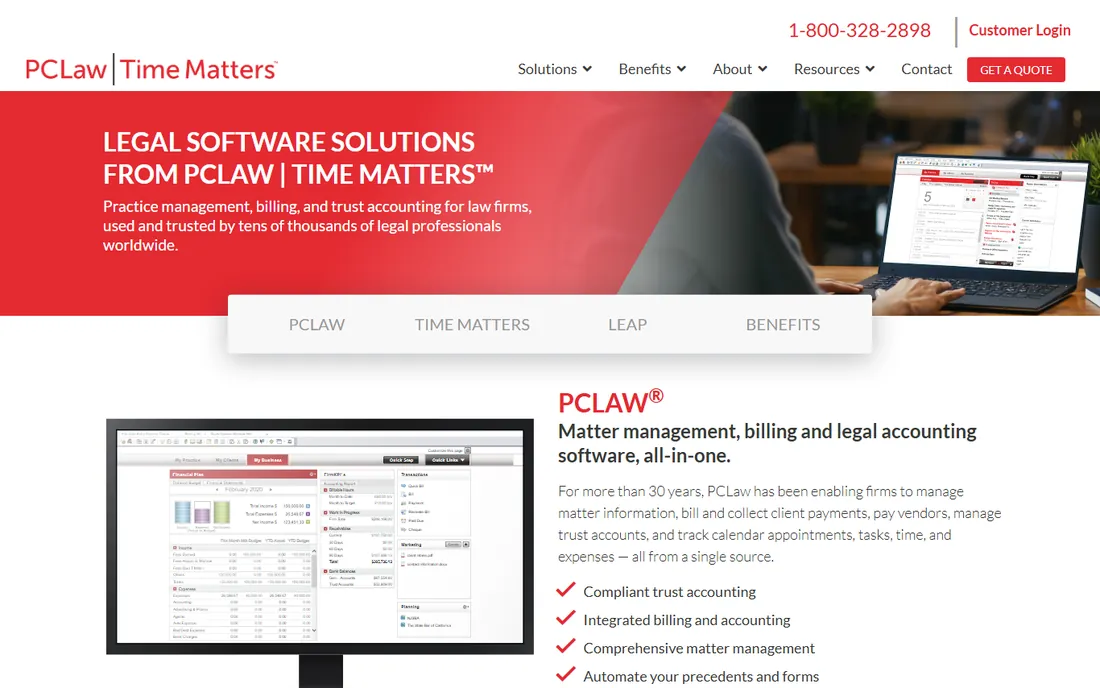
PCLaw is the veteran: more than 30 years of matter management, billing and legal accounting from a single database, now run as a LexisNexis and LEAP joint venture. Subscriptions start around $39 per user per month, with perpetual licenses and an Annual Maintenance Plan also available. Trust accounting is genuinely deep, not a checkbox.
The catch is modernity. There is no self-serve trial, the interface feels traditional next to cloud-native rivals, and pricing requires a conversation. Implementation can involve data migration costs ($1,500 to $8,000 per industry estimates), and support runs through the AMP membership. Firms with several timekeepers who need real accounting depth, and who do not mind classic software, still swear by it.
What we like- Three decades of legal accounting refinement
- Full business and trust/IOLTA accounting in one system
- Pairs with Time Matters for deeper case management
Watch out for- No free trial, demo only
- Interface shows its age
- Pricing is quote-driven and varies by firm size
How to choose trust accounting software for your firm
Start with your accounting reality, not the feature list. These five questions sort the field fast.
Do you want one system or best of breed?
One-ledger systems (CosmoLex, PCLaw, PracticePanther Business Pro) keep trust, billing and matters in a single database, which makes audits clean. Best-of-breed stacks (LeanLaw plus QuickBooks Online, or TrustBooks beside your current billing tool) give your accountant familiar books but add sync points. Pick the model your bookkeeper will actually maintain.
How many people touch the money?
Per-user pricing ($39 to $129/user/month across this list) multiplies across attorneys, paralegals and billing staff. A five-person firm at $99/user/month pays nearly $6,000 a year before add-ons. Flat-priced TrustBooks ($59 to $79/month) can be dramatically cheaper for staff-heavy firms. Count every login before you compare.
What does your state bar actually audit?
Some states run aggressive trust-account audit programs; others rarely look. If yours audits, prioritize native three-way reconciliation with an audit trail (CosmoLex, PCLaw) and ask each vendor how their reports map to your state's specific requirements. A generic reconciliation report may not satisfy a picky auditor.
Who does the monthly reconciliation?
If the answer is you, automation matters more than features: look for one-click or guided three-way reconciliation and automatic bank feeds. If you outsource to a bookkeeper, confirm the software gives them accountant-friendly access and exports. TrustBooks' $249 tier even has their team do the reconciliation for you.
Can you leave?
Ask about data export before you sign. Client ledgers, trust journals and reconciliation history must export cleanly, because switching trust systems mid-year is miserable. Also confirm contract length: most vendors discount annual terms, but a firm in flux may prefer monthly even at the higher rate.
Frequently asked questions
What is trust accounting, and why can't I just use QuickBooks?
Trust accounting tracks client money your firm holds but does not own: unearned retainers, settlement proceeds, cost advances. Every dollar must sit in a separate IOLTA or trust account with a per-client ledger, and the account must reconcile three ways monthly. QuickBooks lacks client-level trust ledgers, three-way reconciliation and the safeguards that stop you from spending one client's money on another's matter. Firms use it only with a legal layer like LeanLaw on top.
What is three-way reconciliation?
It is the monthly proof that three numbers agree: the bank statement balance, the trust journal (your book of all trust transactions), and the sum of every individual client ledger. If all three match, no client is overdrawn and no money is missing. Most state bars require it monthly, and it is the first thing an auditor checks. Good software generates it in one workflow; bad setups need spreadsheets.
How much should a small firm budget?
For a solo or two-attorney firm, $59 to $150 per month covers standalone trust accounting (TrustBooks) or an entry all-in-one tier. A five-person firm on a mid-tier suite lands around $400 to $600 per month. Add payment processing fees (usually passed to clients or absorbed at ~3%) and possible data migration ($0 to $8,000 for complex moves). Price the first full year, not the monthly headline.
Should I pick standalone trust software or an all-in-one suite?
Standalone (TrustBooks) wins when you already like your billing and practice tools and only the trust piece is broken. All-in-one (CosmoLex, Clio, MyCase, PracticePanther) wins when you are replacing several systems at once or starting fresh. The middle path, LeanLaw on QuickBooks Online, wins when your accountant demands QBO. Do not buy a suite for trust accounting alone if you will not use the rest.
What happens if my trust account falls out of compliance?
Consequences range from a corrective action plan to suspension or disbarment, depending on the state and whether client money was actually at risk. Even innocent bookkeeping errors trigger audits once discovered. This is why the software matters less than the discipline: automated reconciliation, monthly reviews, and never commingling funds. The tool should make compliance the path of least resistance.
Do these tools handle multi-state compliance?
They handle the mechanics (ledgers, reconciliation, reporting) that every state requires, but rules differ by state: some mandate specific report formats or more frequent reconciliations. Confirm with the vendor that their reports match your state bar's requirements, and have your ethics counsel review the setup. No software replaces knowing your jurisdiction's rules.
How we chose
We started from the tools that dominate buyer conversations on legal tech directories, bar association member-benefit lists and legal accounting guides, then verified each vendor's own site for current plans, pricing and trial terms. Prices come from vendor homepages and pricing pages captured in October 2026, cross-checked against G2, Capterra, LawNext and FinancesOnline listings; where third-party figures conflicted, we favored the vendor's own published numbers.
We weighted the list toward what actually protects a firm: native three-way reconciliation, per-client ledgers, audit trails, and whether the accounting is real or cosmetic. We read public user reviews for recurring complaints (support quality, pricing jumps, reporting limits) and reported them as each tool's honest catch. No vendor paid for placement, and we ran no hands-on trials; every factual claim traces to a vendor page or public review source below.
Red flags when evaluating trust accounting software
A few warning signs should stop a purchase. First, any tool that cannot produce a three-way reconciliation report on demand is not trust accounting software, whatever the marketing says. Second, watch for per-user pricing that excludes the accounting module you need; the entry tier is often a practice management shell with trust features gated higher. Third, be wary of "QuickBooks compatible" claims that mean CSV export rather than real sync; ask whether trust transactions post automatically or need manual journal entries.
Also confirm the boring details: how client ledgers export if you leave, whether the vendor has documented state-specific report formats, and what support actually costs on your tier. Trust accounting fails quietly, through drift and skipped months, so favor the tool your staff will actually open every month over the one with the longest feature list.
Sources we checked (23)
- https://www.cosmolex.com/
- https://www.clio.com/
- https://trustbooks.com/
- https://www.leanlaw.co/
- https://www.mycase.com/
- https://www.rocketmatter.com/
- https://www.practicepanther.com/
- https://www.timesolv.com/
- https://www.pclawtimematters.com/
- https://www.cosmolex.com/blog/software-finder-comparison-of-cosmolex-and-clio-what/
- https://www.g2.com/products/cosmolex/pricing
- https://www.g2.com/products/paradigm-practicepanther/pricing
- https://www.g2.com/products/timesolv/pricing
- https://getapp.com/legal-law-software/a/timesolv-legal-billing/pricing/
- https://directory.lawnext.com/products/practicepanther/pricing/
- https://directory.lawnext.com/products/rocket-matter/pricing/
- https://www.trustradius.com/compare-products/clio-vs-pclaw
- https://www.trustradius.com/compare-products/mycase-vs-pclaw
- https://softwarefinder.com/legal/pclaw
- https://softwareconnect.com/reviews/lexisnexis-pclaw/
- https://beancount.io/blog/2026/10/07/law-firm-accounting-software-clio-cosmolex-mycase-quickbooks-2026-guide
- https://www.ramp.com/blog/best-law-firm-accounting-software
- https://www.uptimelegal.com/pclaw-review/
Is your product missing or out of date?
We review this list regularly. Vendors can request a listing, send updated pricing or ask about featured placement.

Shihab Mia · Founder, Rankite
Shihab has spent more than a decade helping SaaS and e-commerce brands grow through search. He writes Rankite's software buying guides from pricing pages, documentation and public user reviews. More about Shihab.