How we make this list: we compare pricing pages, product documentation and public user reviews. Ratings come from G2, Capterra or Trustpilot, with the date we checked them.
Key takeaways
- Google Vertex AI and Azure Machine Learning are the closest cloud replacements, and the best one usually follows the cloud your company already uses.
- Databricks and Dataiku suit teams that want data, notebooks, and model work in one collaborative workspace.
- RunPod, Lambda, and Paperspace suit teams that mainly need GPU compute at a clearer hourly price.
- SageMaker alternatives price very differently: some charge per user, others per GPU hour, so compare costs on your own workload, not on a headline rate.
Quick comparison
| Tool | Best for | Starting price | Free plan |
|---|
 Google Cloud Vertex AI | Google Cloud teams building and deploying models | See website | Free trial |
 Azure Machine Learning | Microsoft and Azure-centered teams | See website | Free trial |
 Databricks | Unified data and AI workspaces | See website | Free trial |
 Dataiku | Collaborative data science for mixed teams | See website | Free trial |
 H2O.ai | Automated machine learning and AI apps | See website | Free trial |
 RunPod | Flexible GPU cloud for training and inference | See website | No |
 Lambda Cloud | GPU compute for large model work | See website | No |
 Paperspace | GPU notebooks and deployments | See website | Free trial |
Is your product missing or out of date?
We review this list regularly. Vendors can request a listing, send updated pricing or ask about featured placement.
The best SageMaker alternatives
#1Google Cloud Vertex AI
Best for: Google Cloud teams building and deploying models4.3/5 on
G2 (660 reviews, checked Oct 2026)
Visit cloud.google.com
Starting priceSee website
Free planFree trial
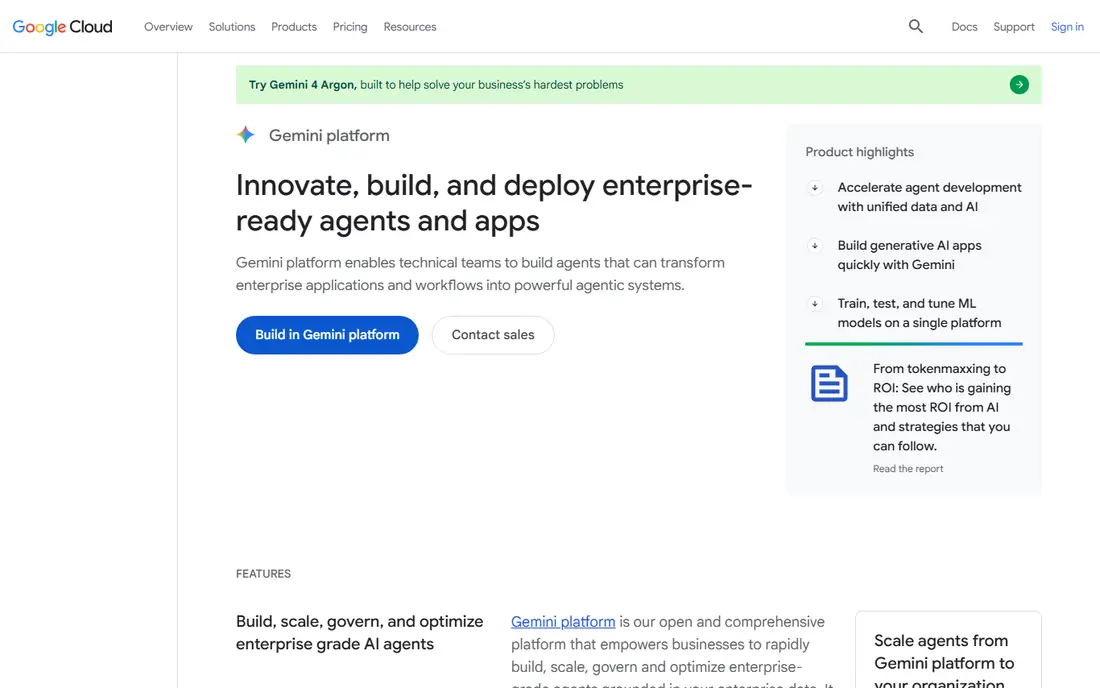
Vertex AI is Google's managed machine learning platform, covering data preparation, training, tuning, evaluation, and deployment in one place. It connects closely to BigQuery and Google Cloud storage, which helps teams whose data already lives in Google Cloud. AutoML options also let less specialized teams build models from tabular or image data.
Costs are usage based, so idle endpoints, large training jobs, and storage can add up without clear alerts. Teams should set budgets and shut down unused resources. For a Google Cloud company, Vertex AI is the most direct SageMaker replacement.
What we like- Unified training, tuning, and deployment
- Strong AutoML
- BigQuery integration
Watch out for- Pay-as-you-go costs need monitoring
- Learning curve for new Google Cloud users
#2Azure Machine Learning
Best for: Microsoft and Azure-centered teams4.3/5 on
G2 (90 reviews, checked Oct 2026)
Visit azure.microsoft.com
Starting priceSee website
Free planFree trial
Azure Machine Learning offers notebooks, automated machine learning, pipelines, model registry, and deployment options inside Azure. It pairs well with Azure DevOps, Microsoft Entra ID, and other Microsoft services, which matters for companies with strict identity and compliance needs. Responsible AI dashboards add model explanations and fairness checks.
The pricing model combines compute, storage, and service fees, so a simple comparison with SageMaker takes a workload estimate. The portal also carries many options, which can slow new users. For an Azure-centered team, those costs are worth the integration and governance benefits.
What we like- Strong MLOps tooling
- Responsible AI features
- Azure DevOps integration
Watch out for- Pricing is layered
- Portal can feel complex
#3Databricks
Best for: Unified data and AI workspaces4.6/5 on
G2 (1,383 reviews, checked Oct 2026)
Visit databricks.com
Starting priceSee website
Free planFree trial
Databricks combines data engineering, SQL, notebooks, and machine learning in one lakehouse platform. Teams can prepare data, train models, track experiments with MLflow, and serve models without moving data between systems. That unity is its main advantage over a standalone model platform.
Pricing depends on compute type, workspace tier, and usage, so small teams should start with a clear workload and budget. Databricks can also feel oversized for a single-model project. For data-heavy teams that already use Spark or Delta Lake, it is a compelling SageMaker alternative.
What we like- Lakehouse data plus notebooks
- Strong Spark and MLflow support
- Collaboration
Watch out for- Costs depend on compute choice
- Can feel large for small model projects
#4Dataiku
Best for: Collaborative data science for mixed teams4.4/5 on
G2 (266 reviews, checked Oct 2026)
Visit dataiku.com
Starting priceSee website
Free planFree trial
Dataiku is built for teams where analysts, data scientists, and engineers share one platform. Visual recipes handle data preparation, while code notebooks and AutoML cover modeling. Governance features track datasets, models, and projects, which helps regulated companies explain how a model was built.
Pricing is quote based for most business use, so small teams should ask for a clear proposal early. Solo developers may find it heavier than a GPU cloud or notebook service. For a mixed team that needs collaboration and governance, Dataiku is a strong fit.
What we like- Visual and code workflows
- Collaboration for analysts and engineers
- Governance
Watch out for- Enterprise pricing by quote
- Heavier for solo developers
#5H2O.ai
Best for: Automated machine learning and AI apps4.6/5 on
Capterra (10 reviews, checked Oct 2026)
Visit h2o.ai
Starting priceSee website
Free planFree trial
H2O.ai offers automated machine learning for tabular data, document AI, and app building, alongside its well-known open source libraries. Teams that want fast baselines, explainable models, and production apps without building every pipeline by hand will find it useful. The open source side also lets developers test core ideas at no license cost.
The managed platform is priced by quote, and it does not replace a full cloud ML suite for every workload. Teams with heavy custom deep learning or GPU training may still need a GPU cloud beside it. For tabular AutoML and business AI apps, H2O.ai deserves a trial.
What we like- Strong AutoML
- Open source H2O libraries
- AI app building
Watch out for- Enterprise platform pricing by quote
- Less of a general cloud ML suite
#6
RunPod
Best for: Flexible GPU cloud for training and inference
Visit runpod.io
Starting priceSee website
Free planNo
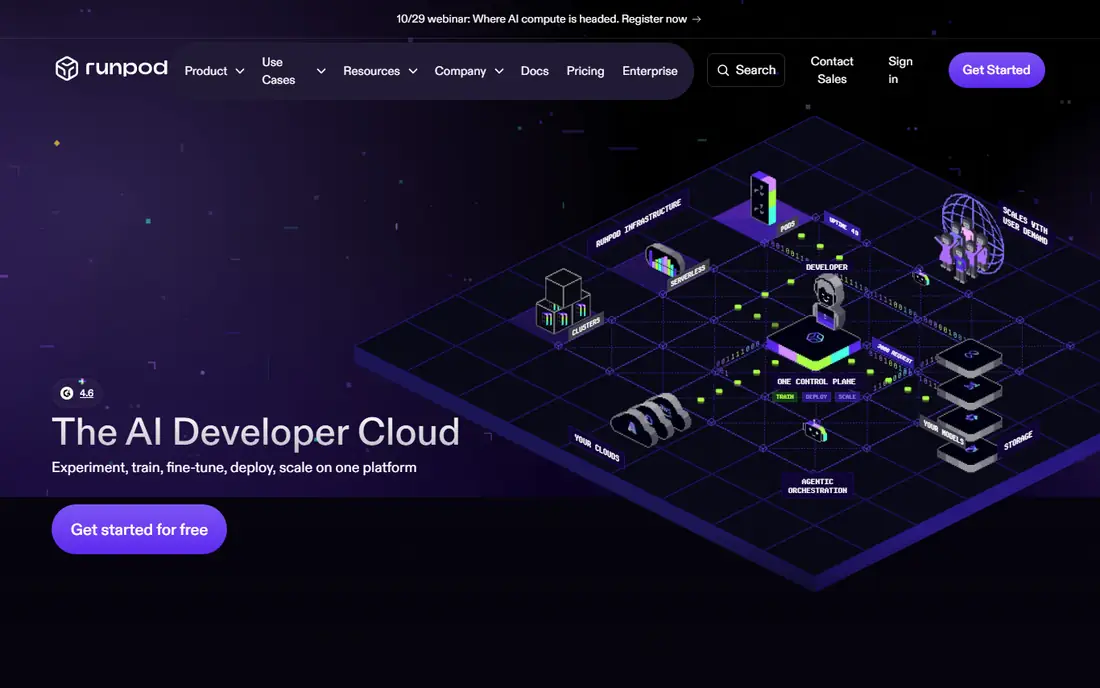
RunPod is a GPU cloud rather than a full managed ML platform. You rent GPUs by the hour, run notebooks or containers, and deploy serverless endpoints for inference. That simplicity appeals to developers who know what hardware they need and want to avoid SageMaker's layered pricing.
The trade-off is tooling. RunPod does not offer the same managed pipelines, model registry, and AutoML depth as Vertex AI or Azure ML. You will manage more yourself, including environments and scaling. For training, fine-tuning, and inference where GPU price matters most, RunPod is a practical alternative.
What we like- Clear per-hour GPU pricing
- Fast startup
- Serverless endpoints
Watch out for- Less managed ML tooling
- You manage more of the stack
Starting priceSee website
Free planNo
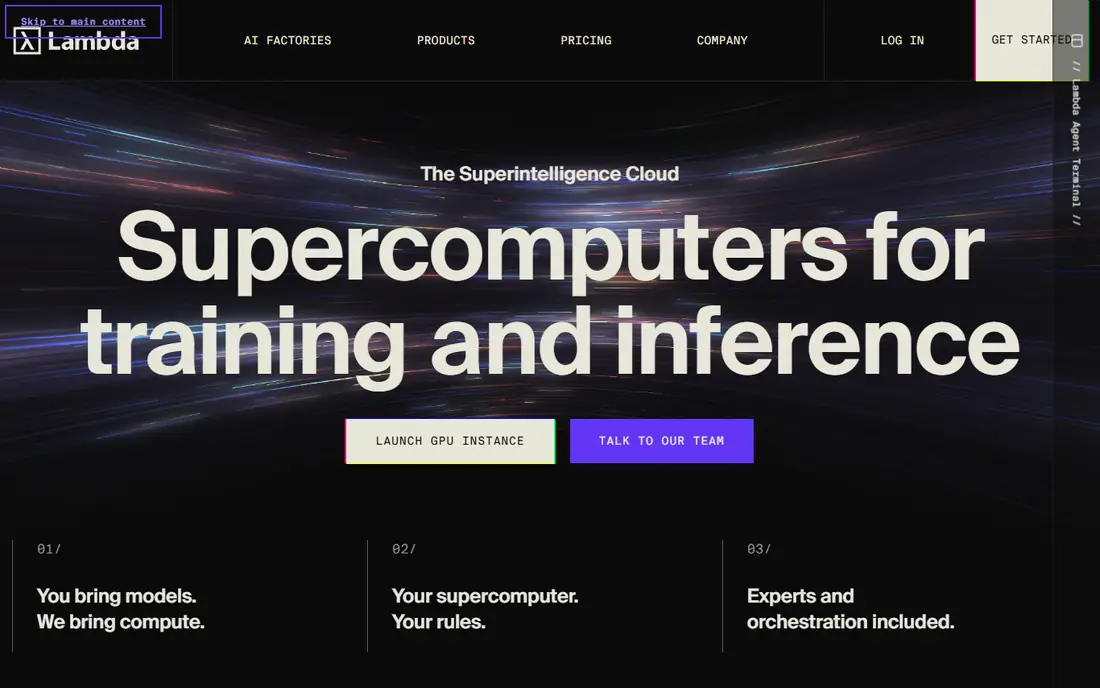
Lambda focuses on GPU infrastructure for deep learning, with on-demand instances, reserved capacity, and clusters for larger work. Teams training large models or running steady inference often choose Lambda for hardware access and pricing clarity. Its stack is tuned for PyTorch, TensorFlow, and common deep learning workflows.
It is not a managed ML platform in the SageMaker sense. Pipelines, experiment tracking, and deployment tooling come from your own stack or third-party tools. If your main need is reliable GPU capacity rather than managed ML features, Lambda is a strong option.
What we like- High-end GPU capacity
- On-demand and reserved options
- Deep learning focus
Watch out for- No free tier
- Less managed workflow tooling than cloud ML platforms
#8Paperspace
Best for: GPU notebooks and deployments4.9/5 on
G2 (10 reviews, checked Oct 2026)
Visit paperspace.com
Starting priceSee website
Free planFree trial
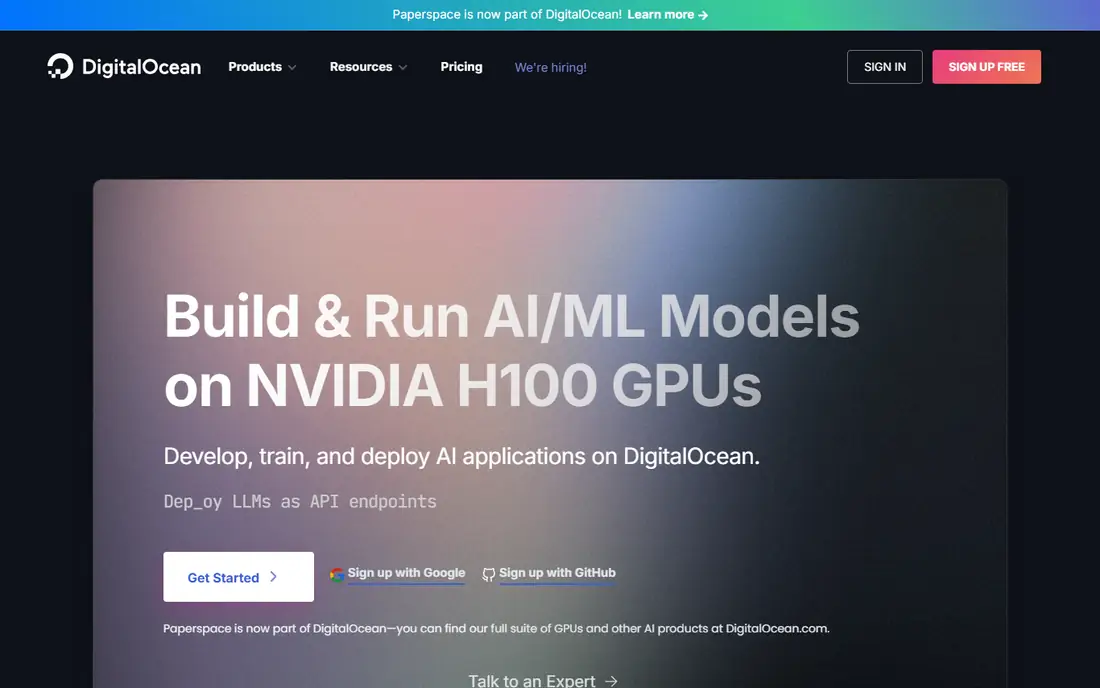
Paperspace offers GPU notebooks, a managed Gradient platform, and deployment options for models and apps. It suits individual developers and small teams that want GPU access without managing cloud infrastructure from scratch. The notebook experience is approachable, and machine types cover a range of budgets.
Scale is the limit. Paperspace is smaller than Google, Microsoft, or Amazon clouds, and enterprise governance features are less deep. For a small team that wants fast GPU notebooks and simple deployments, it is a useful SageMaker alternative.
What we like- GPU notebooks
- Gradient platform
- Deployment options
Watch out for- Smaller scale than hyperscale clouds
- Pricing varies by machine type
How we chose
We compared pricing pages, product documentation, and public reviews for managed ML platforms, collaborative data science tools, and GPU clouds that overlap with SageMaker's training, deployment, and MLOps features. We used "See website" where pricing is usage based, quote based, or varies by hardware, rather than inventing a single rate. We did not claim hands-on testing.
Matching the alternative to your workload
Start with where your data already lives. A team on Google Cloud will move faster on Vertex AI, a team on Azure will move faster on Azure Machine Learning, and a team with a lakehouse will benefit most from Databricks. Moving data across clouds for a marginal feature gain rarely pays off once transfer, security, and retraining costs are counted.
Next, separate model work from GPU work. If your team needs AutoML, governance, pipelines, and deployment in one managed system, choose a platform such as Vertex AI, Azure ML, Dataiku, or H2O.ai. If your team mainly needs GPUs for training and inference, a GPU cloud such as RunPod, Lambda, or Paperspace will usually cost less and start faster.
Finally, run the same workload on two options before committing. Train a representative model, deploy a small endpoint, and record total cost, run time, and setup effort. Include idle time, storage, and data transfer in that total, because those are the charges that surprise teams after the first month.
One more cost check helps before committing: track spending for a full training and deployment cycle, not just a single training run. Include data storage, idle endpoints, experiment tracking, and any data transfer between services, since those charges appear on later bills. Set budget alerts at half and three quarters of your expected monthly spend, and assign one person to review them each week during a pilot. Also check GPU availability in your chosen region, because a low hourly rate means little if the hardware you need is unavailable when a deadline arrives. Reserved capacity or a second region can reduce that risk for steady workloads. A pilot that records cost, time, and availability together gives a fairer comparison than any pricing page alone.
Before you finish, write down your top three requirements and rank the shortlist against them in plain language. That short list stops a demo or a discount from pulling the choice toward a feature you will rarely use. Share the ranking with the people who will use the tool daily, and ask them to flag any deal-breaker you missed, such as a missing integration, a device limit, or a workflow step that would take longer than it does today. Their answers often change the order. Once you have a winner, set a review date three months after launch to check cost, usage, and complaints, and be ready to switch if the tool is not earning its place. A planned review keeps the decision honest and prevents a poor fit from lingering for years.
Frequently asked questions
What is the closest alternative to SageMaker?
Google Cloud Vertex AI and Azure Machine Learning are the closest managed replacements, covering training, tuning, deployment, and MLOps. The best choice usually follows the cloud your company already uses for data and identity.
Which SageMaker alternative is cheapest?
It depends on workload. GPU clouds such as RunPod often look cheapest per GPU hour, while managed platforms can cost more but save engineering time. Compare total cost for your training and inference pattern, not a single hourly rate.
Can I use open source tools instead of SageMaker?
Yes. Tools such as MLflow, Kubeflow, and H2O open source libraries cover experiment tracking, pipelines, and modeling, but you must host and maintain them. Many teams pair open source tooling with a GPU cloud rather than replacing a managed platform outright.
Do these platforms support large language models?
Yes, most support fine-tuning and serving large models, but hardware needs and costs vary widely. Check GPU availability, context limits, and inference pricing for your model size before choosing, and test with a smaller model first.
How hard is it to migrate from SageMaker?
Migration effort depends on how much you rely on SageMaker-specific features. Notebooks and training scripts often move with modest changes, while pipelines, endpoints, and monitoring need rebuilding. Plan a pilot with one model before moving a full portfolio.
Should a small team use a managed platform or a GPU cloud?
A small team with one or two models often moves faster on a GPU cloud plus notebooks, while a team that needs governance, collaboration, and repeatable pipelines benefits from a managed platform. Start simple, and add platform tooling only when manual work becomes a bottleneck.
Sources we checked (8)
- https://cloud.google.com/vertex-ai
- https://azure.microsoft.com/en-us/products/machine-learning
- https://www.databricks.com
- https://www.dataiku.com
- https://h2o.ai
- https://www.runpod.io
- https://lambda.ai
- https://www.paperspace.com
Is your product missing or out of date?
We review this list regularly. Vendors can request a listing, send updated pricing or ask about featured placement.

Shihab Mia · Founder, Rankite
Shihab has 5+ years in B2B and SaaS SEO. He writes Rankite's software buying guides from pricing pages, documentation and public user reviews. More about Shihab.