How we make this list: we compare pricing pages, product documentation and public user reviews. Ratings come from G2, Capterra or Trustpilot, with the date we checked them.
Key takeaways
- n8n uses a fair-code licence, not an OSI-approved open source licence, so teams that need a true open source licence should look elsewhere.
- Activepieces is the closest visual replacement, with an MIT-licensed community edition and a free cloud plan.
- Windmill and Kestra suit code-first teams that want unlimited self-hosted executions without per-run fees.
- Node-RED and Huginn are the lightest options for personal projects, home servers, and device flows.
- Apache Airflow fits scheduled data pipelines better than app-to-app automation, so pick it only when data work is the main job.
Quick comparison
| Tool | Best for | Starting price | Free plan |
|---|
 Activepieces | Visual workflows like n8n | $0 self-hosted | Yes |
 Windmill | Code-first script workflows | $0 self-hosted | Yes |
 Automatisch | Simple self-hosted automation | $0 self-hosted | Yes |
 Huginn | Personal monitoring and scraping | $0 self-hosted | Yes |
 Node-RED | Event and device flows | $0 self-hosted | Yes |
 Apache Airflow | Scheduled data pipelines | $0 self-hosted | Yes |
 Kestra | Declarative YAML pipelines | $0 self-hosted | Yes |
 Trigger.dev | Durable background jobs | $0 self-hosted | Yes |
Is your product missing or out of date?
We review this list regularly. Vendors can request a listing, send updated pricing or ask about featured placement.
The best open source n8n alternatives
Starting price$0 self-hosted
Free planYes
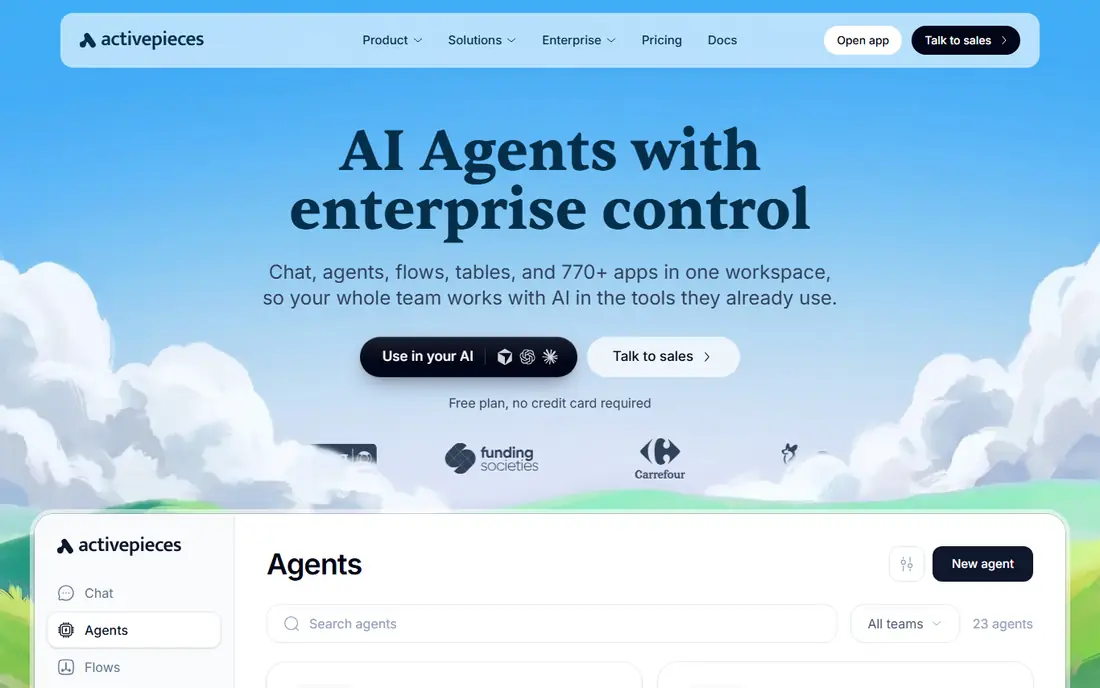
Activepieces is the first tool to try if you like n8n's visual canvas but want a genuine open source licence. Its community edition carries an MIT licence, which means you can self-host it without the resale limits that come with n8n's Sustainable Use Licence. The builder will feel familiar at once: triggers on the left, steps in the middle, and a wide set of app connectors for common business tools.
The free cloud plan is generous in one specific way. Runs are unlimited, but active flows are capped, so it suits a small set of always-on workflows rather than dozens of experiments. Paid cloud plans start around $20 per month for a larger credit allowance, and self-hosting removes the per-run cost entirely. One honest catch is catalog size. Activepieces covers the popular apps well, but teams with unusual tools may need custom API steps or webhooks where n8n already has a ready connector.
What we like- MIT-licensed community edition
- Visual builder close to n8n
- Free cloud plan with unlimited runs
Watch out for- Smaller integration catalog than n8n
- Enterprise features need a commercial licence
- Cloud free plan caps active flows
Starting price$0 self-hosted
Free planYes
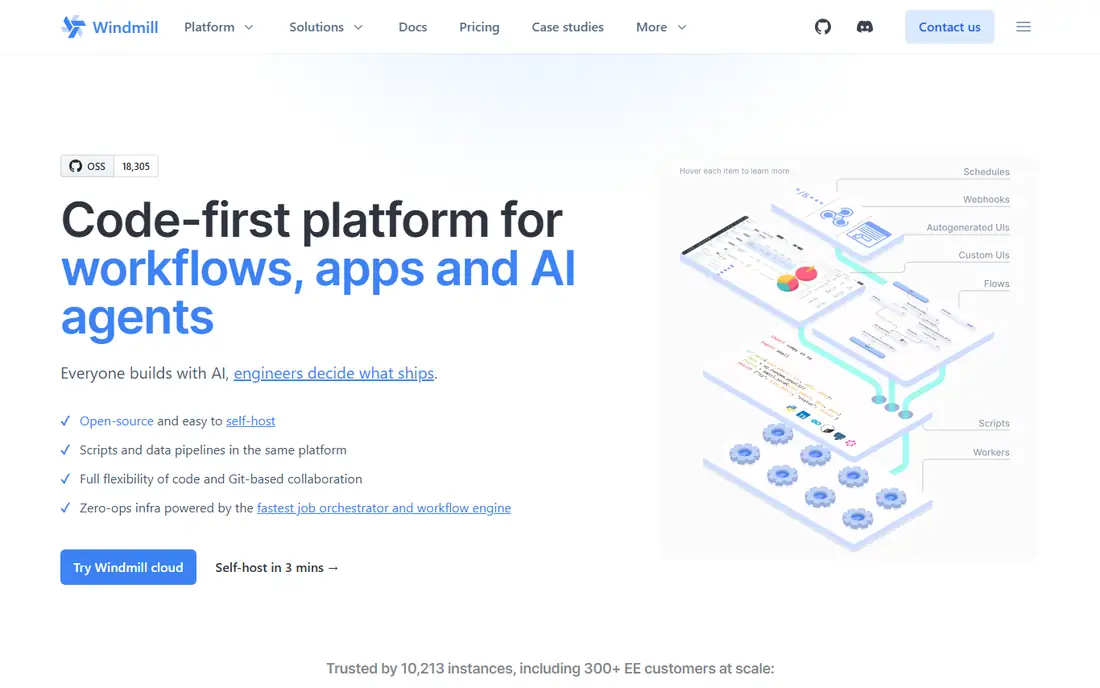
Windmill takes a different approach from n8n. Every workflow step is a script, written in TypeScript, Python, Go, or Bash, and the platform adds scheduling, retries, approvals, and a web interface around those scripts. That design appeals to engineering teams that already keep code in version control and want workflows they can review like any other change.
Self-hosting is free with unlimited executions, which makes Windmill cheap to run at high volume once a server is in place. The trade-off is accessibility. A marketing or operations team that builds flows by dragging nodes will find Windmill harder to pick up than Activepieces or n8n. It also has fewer ready-made app connectors, so expect to write API calls for less common services. For teams that value code review and script reuse over a visual canvas, that trade is worth it.
What we like- Unlimited self-hosted executions
- Scripts in TypeScript, Python, Go, and Bash
- Strong scheduling and approvals
Watch out for- Less friendly for non-coders
- App connector catalog is smaller
- Enterprise features need a paid licence
Starting price$0 self-hosted
Free planYes
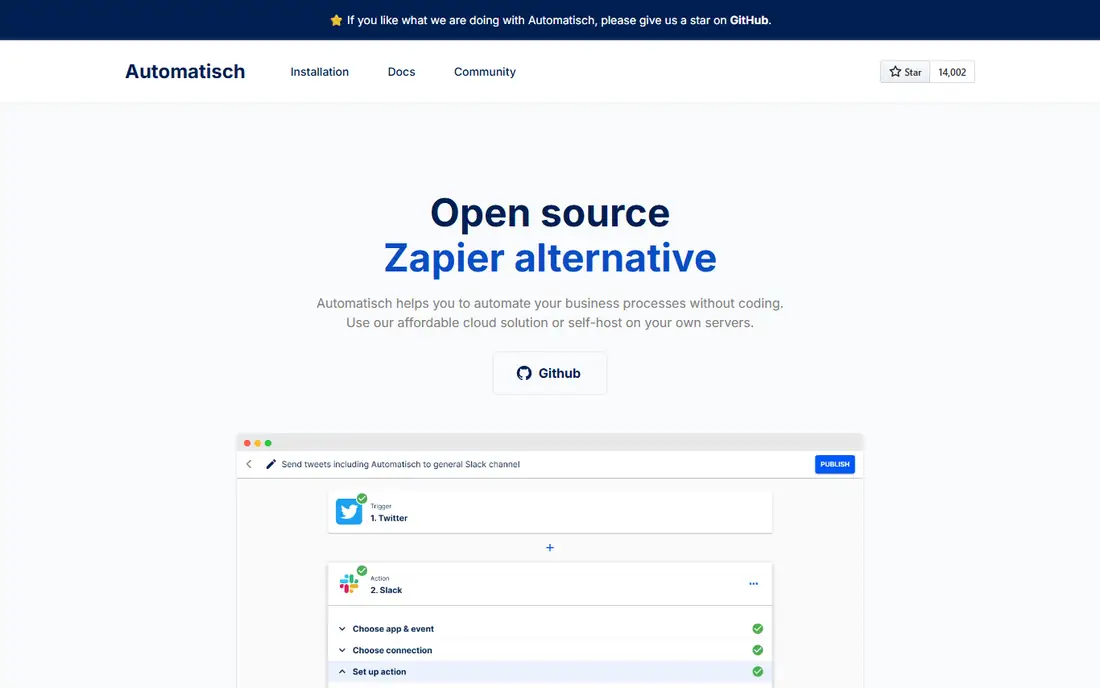
Automatisch is a deliberately simple open source automation tool. It offers a visual flow builder, a set of common app integrations, and Docker-based self-hosting that a small team can set up in an afternoon. If your needs are modest, such as syncing a form to a spreadsheet or posting alerts to a chat channel, Automatisch covers them without the weight of a larger platform.
The limits show up as workflows grow. The integration catalog is far smaller than n8n's, and advanced features like complex branching, long-running jobs, and detailed audit logs are thinner. Support on the free edition comes from the community, so teams that need guaranteed response times should plan accordingly. Still, for a personal server or a small business with a handful of flows, Automatisch is one of the easiest open source options to run.
What we like- Clean visual builder
- Easy self-hosting with Docker
- No per-run fees when self-hosted
Watch out for- Smaller integration catalog
- Community support only on the free edition
- Fewer advanced workflow features
Starting price$0 self-hosted
Free planYes
Huginn is the oldest tool on this list, and it shows in both good and bad ways. It is built around agents that watch websites, feeds, and APIs, then act when something changes. That makes it excellent for personal projects: tracking price changes, watching a page for updates, collecting RSS items, or sending yourself alerts. The software is MIT-licensed and completely free to self-host.
The interface feels dated next to modern builders, and setup needs some comfort with Ruby and server administration. Business teams will also miss the polished app connectors and team features found in n8n or Activepieces. Huginn is best treated as a personal automation engine rather than a company-wide platform. For a single user with a home server, it remains hard to beat on cost, since the only expense is the server itself.
What we like- Fully free MIT-licensed software
- Great for scraping and monitoring
- Large agent library for personal use
Watch out for- Ruby setup can be fiddly
- Dated interface
- Not built for team workflows or business apps
#5Node-RED
Best for: Event and device flows4.5/5 on
G2 (25 reviews, checked Oct 2026)
Visit nodered.org
Starting price$0 self-hosted
Free planYes
Node-RED is a browser-based flow editor originally built for wiring hardware devices, sensors, and APIs together. Its visual style will feel familiar to n8n users: nodes on a canvas, connected by wires, with messages passing between them. The community has built thousands of extra nodes, so support for MQTT, home automation platforms, and odd hardware is unusually strong.
That strength is also its limit. Node-RED was not designed as a business automation suite, so its catalog of SaaS app connectors is thinner, and large flows can become hard to read and maintain. There are no built-in team roles or approval workflows, which matters once more than one person edits flows. For event-driven work, device data, and home automation, Node-RED is a strong free choice. For company-wide business automation, Activepieces or Windmill will fit better.
What we like- Apache-2.0 licence
- Huge community node library
- Ideal for IoT and home automation
Watch out for- Flow design gets messy at scale
- No built-in team or permission features
- Business app catalog is thin
Starting price$0 self-hosted
Free planYes
Apache Airflow is the standard open source tool for scheduled data pipelines, and it belongs on this list with a clear warning. It orchestrates tasks written in Python, with scheduling, retries, backfills, and a web interface for monitoring runs. Data teams use it to move data between warehouses, run nightly transforms, and chain jobs that must run in order.
It is not a drop-in n8n replacement for app-to-app automation. There is no drag-and-drop canvas for business users, and every workflow is code. Setup also takes more work than the other tools here, since Airflow expects a database, a scheduler, and workers. Choose Airflow when your main job is data pipelines at scale. If your main job is connecting business apps, pick a visual tool instead and keep Airflow for the data work it does best.
What we like- Apache-2.0 licence
- Proven at large scale
- Rich scheduling, retries, and monitoring
Watch out for- Overkill for simple app automation
- Needs Python skills
- Setup and upkeep take real effort
Starting price$0 self-hosted
Free planYes
Kestra defines workflows in YAML files that live in Git, which makes every change reviewable and easy to roll back. It supports scripts, containers, and a growing set of plugins, and the open source edition runs unlimited executions when self-hosted. Teams that already treat infrastructure as code will find this approach natural, and the built-in interface gives a clear view of runs, logs, and failures.
The catch is the same as with Windmill: Kestra is code-first, so non-technical users will struggle to build flows on their own. Its community is also smaller than Airflow's, which means fewer ready examples for unusual tools. Kestra sits between Airflow and Windmill in spirit. It is lighter than Airflow for general orchestration, and more declarative than Windmill's script-per-step model. For engineering teams that want Git-based workflows without Airflow's weight, it is a strong pick.
What we like- Apache-2.0 licence
- Workflows defined in YAML and stored in Git
- Unlimited self-hosted executions
Watch out for- Code-first by design
- Smaller community than Airflow
- Visual editing is secondary
Starting price$0 self-hosted
Free planYes
Trigger.dev is built for developers who need background jobs that do not get lost: sending emails after signup, processing uploads, running scheduled tasks, and retrying failed work. Jobs are written in TypeScript, and the platform handles queues, retries, delays, and schedules. The project is open source and can be self-hosted, with a cloud plan for teams that prefer not to run servers.
This is not a general automation tool for business users. There is no visual canvas for connecting apps, and building a flow means writing code. That focus is also its strength. If your team already builds in TypeScript and needs reliable background work inside an application, Trigger.dev fits better than a general workflow canvas. If your team needs marketing or operations staff to build flows, choose Activepieces or Automatisch instead.
What we like- Open source
- Durable jobs with retries and schedules
- TypeScript-first developer experience
Watch out for- Developer-only tool
- No visual builder for business users
- Self-hosting needs more setup than a visual tool
How we chose
We compared published licences, pricing pages, and feature documentation for each tool, and checked community comparisons that list self-hosting options and free tiers. A tool made this list only if its core is available under an OSI-approved open source licence and can be self-hosted without per-run fees. We excluded closed tools such as Zapier and Make, even though they are popular n8n alternatives, because this article is about open source options. Prices are shown as self-hosted cost, which is $0 for the software itself, with server costs separate. Cloud prices change often, so check the vendor pricing page before you commit.
What to check before you switch
Start by counting your flows and your monthly runs. A visual tool with a free cloud plan may be cheaper than self-hosting if you run only a few flows, while a self-hosted tool wins quickly once volume grows. Next, check the integration catalog for the exact apps you use. A missing connector can turn a simple migration into custom API work, so list your must-have apps before you choose.
Licence terms matter more than they first appear. n8n's fair-code licence allows internal use but limits resale as a service. If you plan to offer automation to clients or embed the tool in a product, an MIT or Apache licence removes that worry. Also plan for upkeep. Self-hosting means updates, backups, and security patches are your job. Teams without server experience should weigh a managed cloud plan, even a paid one, against the hidden cost of running their own server.
Frequently asked questions
Is n8n open source?
n8n is source-available under its own Sustainable Use Licence, which is a fair-code licence and not OSI-approved. You can self-host and modify it for internal use, but you cannot resell it as a hosted service. The tools in this article use OSI-approved licences such as MIT, Apache-2.0, or AGPL.
Which open source n8n alternative is easiest for non-coders?
Activepieces is the easiest pick for non-coders, because its visual builder closely matches n8n and its cloud plan needs no server. Automatisch is a simpler second option for small setups. Windmill, Kestra, and Trigger.dev are better suited to developers.
Is self-hosting really free?
The software itself is free under its open source licence, but you still pay for the server, domain, backups, and your time. A small virtual server can cost a few dollars per month, while a production setup with redundancy costs more. Compare that total against a cloud plan before deciding.
Can I migrate my n8n workflows to these tools?
There is no one-click import from n8n to most of these tools. You will rebuild flows by hand, though the logic usually transfers directly. Budget time for rebuilding and testing, and start with your least critical flows to learn the new tool.
Which tool is best for high-volume automation?
Windmill and Kestra are strong for high volume, because self-hosted executions are unlimited and you pay only for server capacity. Activepieces self-hosted is also unlimited. Avoid per-run cloud pricing if your volume is large and steady.
Do these tools support AI agents?
Activepieces and Windmill both support AI-related workflows, including calling language models from flows and exposing flows as tools. Node-RED and Huginn can call model APIs through HTTP steps, but they are not built around agent frameworks. If agents are your main use case, compare dedicated agent tools as well.
Sources we checked (8)
- https://www.activepieces.com/pricing
- https://www.windmill.dev/pricing
- https://automatisch.io
- https://github.com/huginn/huginn
- https://nodered.org
- https://airflow.apache.org
- https://kestra.io
- https://trigger.dev/pricing
Is your product missing or out of date?
We review this list regularly. Vendors can request a listing, send updated pricing or ask about featured placement.

Shihab Mia · Founder, Rankite
Shihab has 5+ years in B2B and SaaS SEO. He writes Rankite's software buying guides from pricing pages, documentation and public user reviews. More about Shihab.