How we make this list: we compare pricing pages, product documentation and public user reviews. Ratings come from G2, Capterra or Trustpilot, with the date we checked them.
Key takeaways
- Fivetran charges by monthly active rows, so the best alternative often depends on whether your cost driver is rows, events, volume, or connector count.
- Airbyte suits teams that want open source control or a low entry price, while Qlik Talend Cloud suits teams that want a governed enterprise platform with Stitch-style replication inside it.
- Hevo and Integrate.io suit teams that want predictable pricing and built-in transformation without adding a separate tool.
- Estuary suits real-time and streaming use cases where a batch schedule is too slow for dashboards or operations.
- Matillion suits warehouse-centred teams that need transformation at scale, while Portable suits teams that want many prebuilt connectors with predictable pricing.
Quick comparison
| Tool | Best for | Starting price | Free plan |
|---|
 Airbyte | open source pipelines with cloud option | $20 per month | Yes |
 Qlik Talend Cloud | enterprise pipelines with Stitch replication inside | See website | See website |
 Hevo Data | no-code pipelines with flat pricing | $299 per month | Yes |
 Matillion | warehouse transformation at scale | See website | Free trial |
 Portable | prebuilt connectors with predictable pricing | See website | See website |
 Integrate.io | fixed-price pipelines with transformation | $1,999 per month | Free trial |
 Estuary | real-time streaming and CDC | Free | Yes |
 Skyvia | simple cloud replication for small teams | See website | Yes |
Is your product missing or out of date?
We review this list regularly. Vendors can request a listing, send updated pricing or ask about featured placement.
The best Fivetran alternatives
#1Airbyte
Best for: open source pipelines with cloud option4.4/5 on
G2 (78 reviews, checked Oct 2026)
Visit airbyte.com
Starting price$20 per month
Free planYes
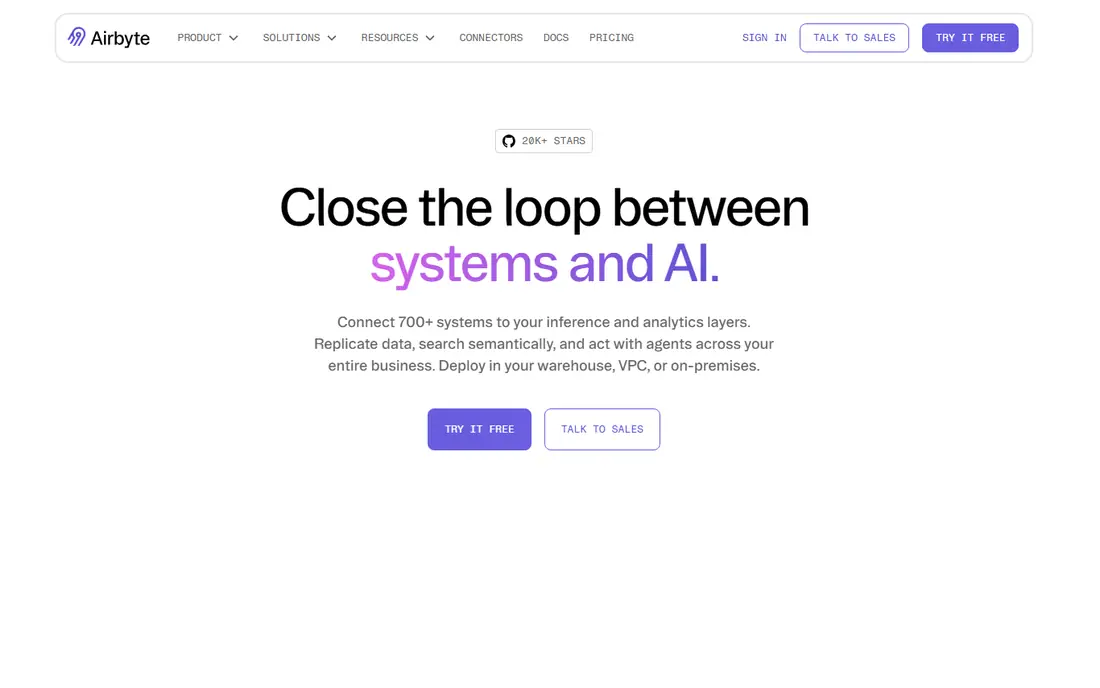
Airbyte is the most flexible Fivetran alternative for teams that want control. The open source Core edition can be self-hosted at no software cost, while Cloud Standard starts at $20 per month with a credit model for usage. Its connector library is broad, covering databases, SaaS apps, and files, and the community contributes new connectors regularly.
Self-hosting is not free in practice. It needs infrastructure, upgrades, and monitoring, which can cost more in engineering time than a managed plan. Cloud sync frequency on the entry plan is also hourly, not real-time. Choose Airbyte when open source control or a low managed entry price matters, and the team can handle transformation elsewhere.
What we like- Open source self-hosted option
- Large connector library
- Cloud plans start low
Watch out for- Self-hosting needs engineering time
- Transformation usually needs a separate tool such as dbt
#2Qlik Talend Cloud
Best for: enterprise pipelines with Stitch replication inside3.7/5 on
Capterra (3 reviews, checked Oct 2026)
Visit qlik.com
Starting priceSee website
Free planSee website

Qlik Talend Cloud is the current home of Stitch replication. Stitch is now part of Qlik, and new buyers are directed to Qlik Talend Cloud, which combines Stitch-style replication with Talend transformation and governed data management in one platform. For a team that liked Stitch simplicity but needs enterprise controls, that combination is the path forward.
The limit is weight. Qlik Talend Cloud is an enterprise platform with a sales-led buying process, so a small team that only needs a handful of pipelines may find it heavier and costlier than a simple replication tool. Pricing is not published as a single plan. Pick Qlik Talend Cloud when replication, transformation, and governance need to live in one enterprise platform.
What we like- Stitch replication now inside a governed enterprise platform
- Broad connector coverage
- Talend transformation tools in the same platform
Watch out for- Enterprise pricing and sales process
- Heavier than a simple replication tool for a tiny team
#3Hevo Data
Best for: no-code pipelines with flat pricing4.4/5 on
G2 (295 reviews, checked Oct 2026)
Visit hevo.io
Starting price$299 per month
Free planYes
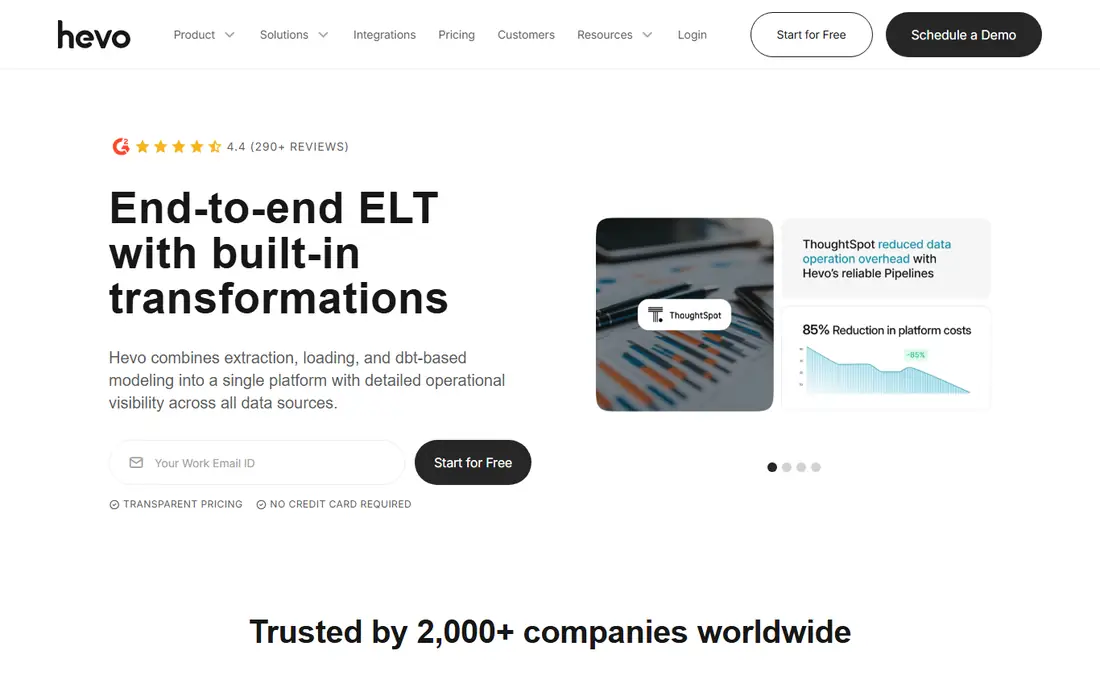
Hevo Data targets non-technical teams that want pipelines without writing code. Its free plan covers up to 1 million events per month, and the Starter paid plan covers a larger event volume at a flat monthly price. That event model is easier to forecast than row-based pricing for some workloads, since the team can estimate events from source activity.
The entry paid price is steep for a tiny team, at $299 per month, and events above quota are billed on top. Connector depth is also below Airbyte. Choose Hevo when a no-code team wants a predictable monthly number and can stay within its event quota.
What we like- No-code pipeline setup
- Free plan up to 1 million events
- Predictable event-based pricing
Watch out for- Entry paid plan is high for very small teams
- Event overages add cost above quota
#4Matillion
Best for: warehouse transformation at scale4.4/5 on
G2 (83 reviews, checked Oct 2026)
Visit matillion.com
Starting priceSee website
Free planFree trial
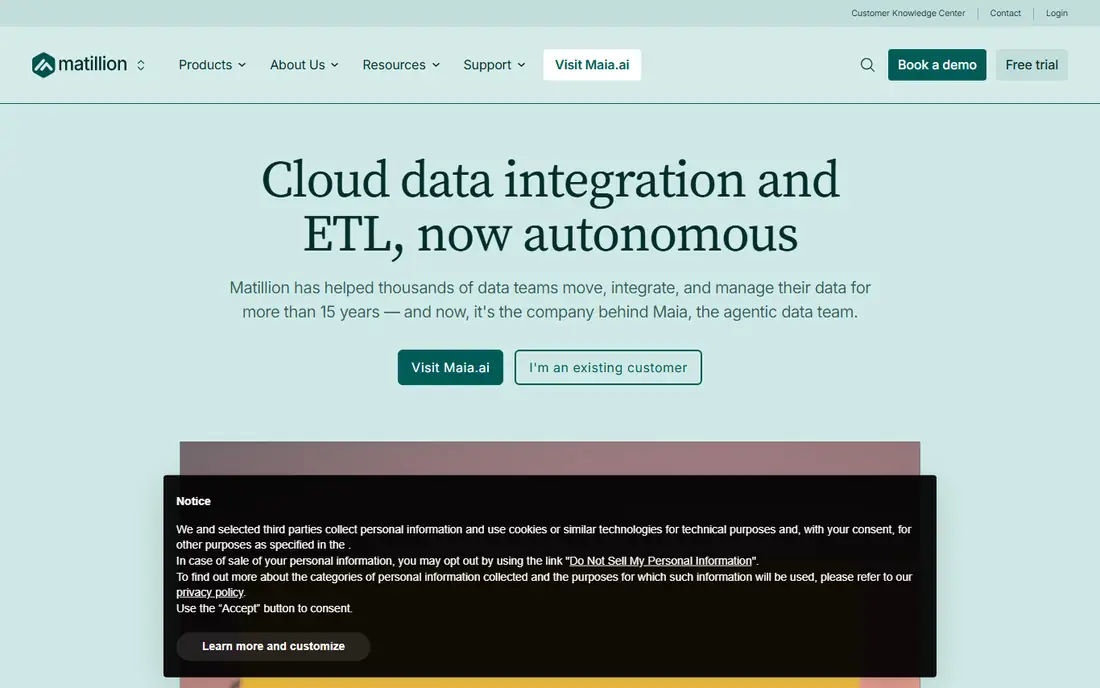
Matillion is a transformation-first platform, built for teams that do heavy work inside Snowflake, BigQuery, Databricks, or a similar warehouse. Its visual designer pushes work down into the warehouse, which keeps large transformations fast and avoids moving data through a separate engine. That design suits data teams with serious modelling needs.
Pricing is the main drawback for a buyer comparing options. It is billed in credits by task hours, warehouse compute is extra, and the credit price is not published, so a quote and a usage estimate are needed. Pick Matillion when transformation is the core job, not just moving rows.
What we like- Strong push-down transformation in the warehouse
- Visual pipeline design
- Handles large warehouse workloads
Watch out for- Pricing is not published and depends on usage
- Warehouse compute is extra
Starting priceSee website
Free planSee website
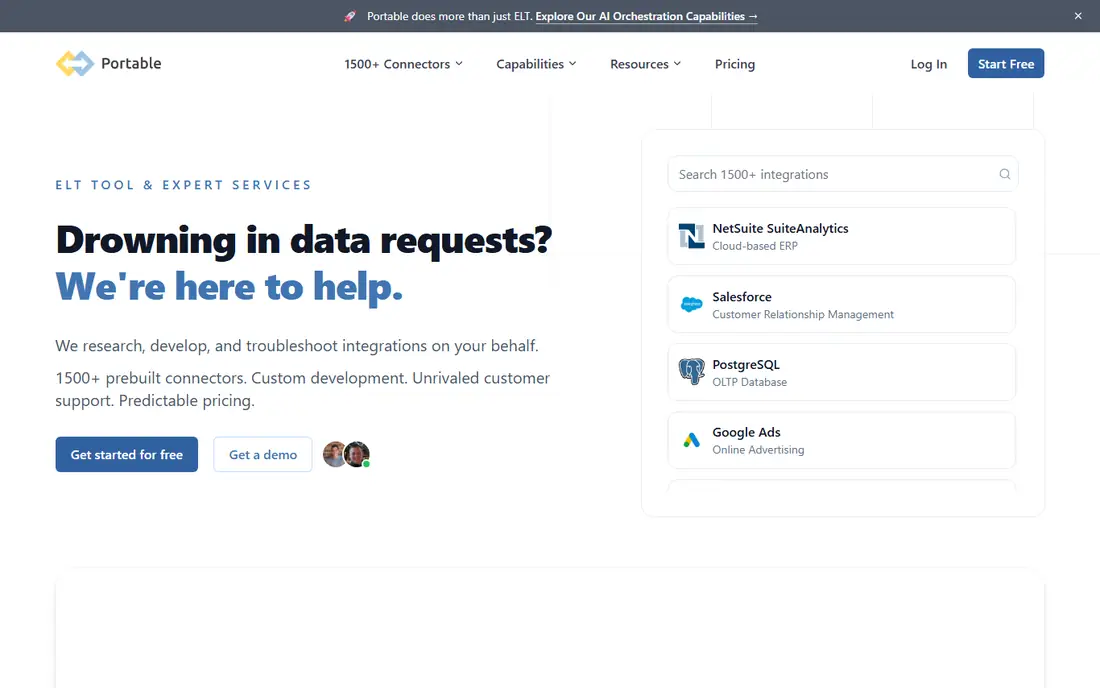
Portable is an ELT tool built around a large library of prebuilt connectors, more than 1,500 on its homepage, with predictable pricing for teams that want a stable monthly number. Pipelines move data from SaaS sources into a warehouse on a schedule, and the managed service removes the need to maintain connectors in-house.
The limit is transformation depth. Portable focuses on extraction and loading, so heavy modelling usually happens in the warehouse or in a separate tool. Pricing depends on the connectors and volume chosen, so a team should confirm the quote for its source list. Pick Portable when connector breadth and a predictable bill matter more than built-in transformation.
What we like- 1,500-plus prebuilt connectors
- Predictable pricing
- Managed ELT pipelines
Watch out for- Pricing depends on connector count and volume
- Transformation is lighter than Matillion
#6Integrate.io
Best for: fixed-price pipelines with transformation4.3/5 on
G2 (213 reviews, checked Oct 2026)
Visit integrate.io
Starting price$1,999 per month
Free planFree trial
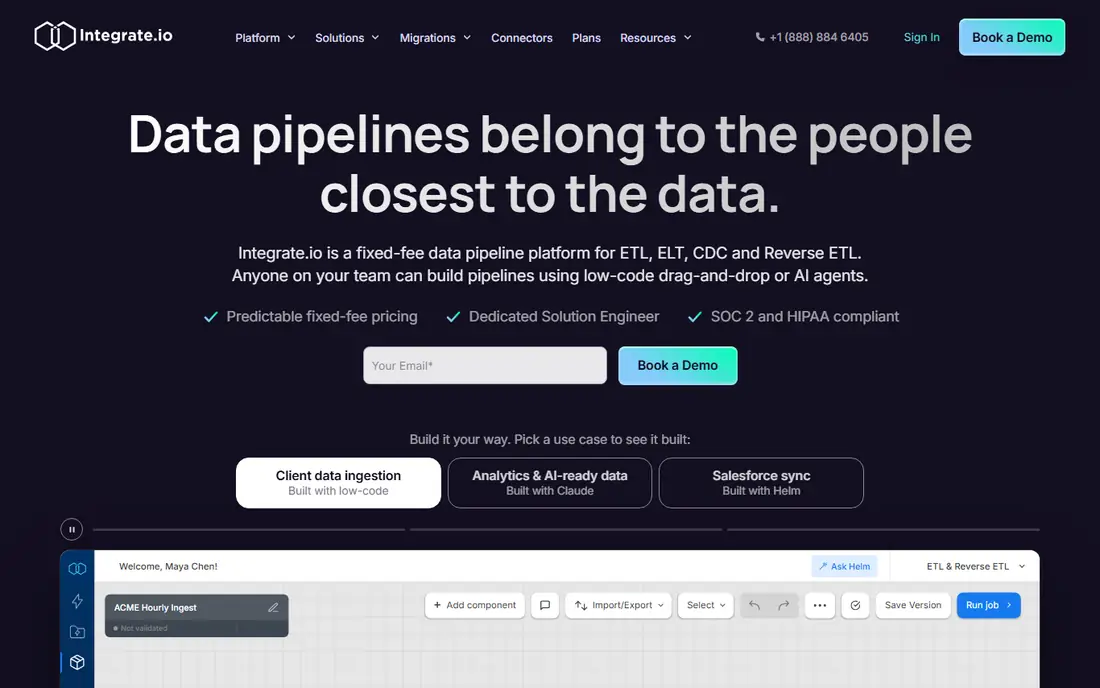
Integrate.io stands out for cost predictability. Its Core plan is $1,999 per month with unlimited data volume, pipelines, and connectors, and it transforms data during transit with a visual designer, SQL, and Python components. For a team past a few million rows a month, that flat price can be cheaper than row-based billing, and it removes the need to forecast row counts.
The entry price is the barrier. A small team with a few pipelines will find $1,999 per month hard to justify, and the platform is more than a simple replication tool needs. Pick Integrate.io when volume is high, transformation is needed in transit, and a fixed bill matters more than a low entry price.
What we like- Flat monthly price with unlimited volume
- Transformation during transit
- No per-row forecasting
Watch out for- High entry price for small teams
- Overkill for a handful of simple pipelines
#7Estuary
Best for: real-time streaming and CDC4.7/5 on
G2 (35 reviews, checked Oct 2026)
Visit estuary.dev
Starting priceFree
Free planYes
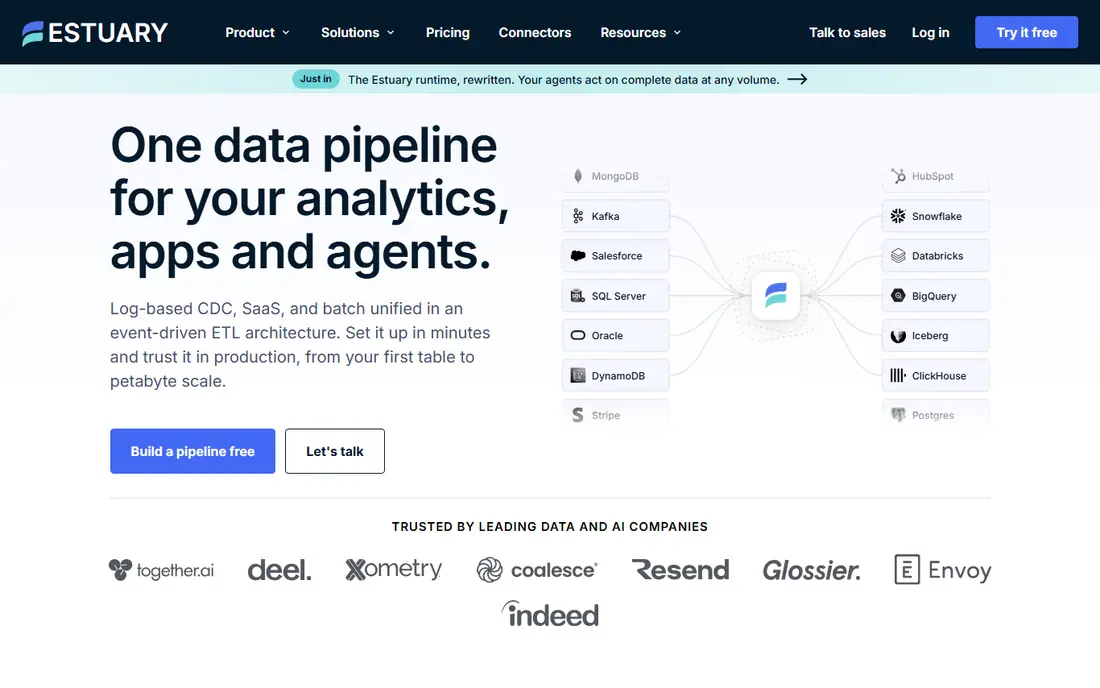
Estuary suits use cases where freshness matters, such as live dashboards, inventory, or fraud checks. Its free Developer plan covers up to 10 GB per month across two connector instances, and the Cloud plan charges $0.50 per GB plus $100 per connector instance per month. Captured data is stored in the team's own cloud storage, so adding a new destination does not require re-extracting from the source.
The billing detail to watch is double metering: the GB rate applies when data is captured and again when each materialisation reads it, so one destination roughly doubles the changed-data volume on the bill. Connector count is also lower than the largest platforms. Choose Estuary when real-time flow is the requirement, and model the GB math for every destination.
What we like- Free developer plan up to 10 GB per month
- Streaming and batch in one pipeline
- Clear per-GB plus per-connector pricing
Watch out for- GB meter applies at capture and again at materialisation
- Fewer connectors than Airbyte and Fivetran
#8Skyvia
Best for: simple cloud replication for small teams4.8/5 on
G2 (324 reviews, checked Oct 2026)
Visit skyvia.com
Starting priceSee website
Free planYes
Skyvia is a practical option for a small team that wants cloud-to-cloud replication without installing or managing infrastructure. Its no-code interface covers common sources and warehouses, and its free plan handles small jobs. For a team moving data between SaaS apps and a warehouse on a schedule, that simplicity is enough.
It is not the pick for very large volumes, real-time streaming, or deep transformation. Those jobs belong to Estuary, Matillion, or Integrate.io. Pick Skyvia when the pipeline count is small, the schedule is batch-based, and ease of setup matters more than scale.
What we like- No-code cloud replication
- Simple interface
- Free plan for small jobs
Watch out for- Less suited to very large or real-time workloads
- Transformation depth is below Matillion and Integrate.io
How we chose
We compared pricing pages, documentation, and public reviews on G2, Capterra, and Reddit, and we checked each tool against the jobs Fivetran users actually do: replicating SaaS and database sources into a warehouse, handling schema changes, and keeping data fresh. Tools made this list only when they offer managed pipelines today, with a free plan, trial, or published entry price. We left out pure ETL code libraries and tools that only move files, since they do not replace a managed connector platform.
Pricing models, explained simply
Row-based pricing, as in Fivetran, charges for rows that change each month. That model is simple to understand but hard to forecast when source activity spikes. Event-based pricing, as in Hevo, ties cost to events rather than rows, which suits event-heavy sources. Volume-based pricing, as in Estuary, ties cost to GB moved, which is easy to estimate from data size but needs care with multiple destinations. Flat pricing, as in Integrate.io, removes forecasting entirely but sets a high floor.
What to model before choosing
Estimate the cost driver for your own workload, not a generic example. Count monthly active rows, events, or GB, list every source and destination, and note the sync frequency needed. A tool that is cheap for a nightly batch job can be costly for a five-minute sync, and vice versa. Run a trial on real data for at least one full sync cycle before signing.
Transformation and orchestration
Decide where transformation lives. If the team already uses dbt, a replication-only tool plus dbt may be enough. If transformation needs to happen in transit or inside the pipeline tool, shortlist Matillion and Integrate.io. If orchestration across many steps matters, Matillion and Integrate.io deserve a closer look.
Frequently asked questions
What is the best free Fivetran alternative?
Airbyte Core is the strongest free option for teams that can self-host, since it has no software fee and a large connector library. Estuary Developer plan is the strongest free managed option, with up to 10 GB per month across two connectors. The better pick depends on whether the team can run infrastructure.
Is Airbyte cheaper than Fivetran?
It can be, especially at low volume, since Cloud Standard starts at $20 per month plus credits, while Fivetran pricing scales with monthly active rows. At high volume, the comparison depends on credit use, sync frequency, and transformation needs, so model both on real workload data.
Can I migrate pipelines from Fivetran easily?
Migration is usually straightforward for standard sources, since most tools here support the same databases, SaaS apps, and warehouses. Schema handling, sync frequency, and transformation logic may differ, so plan a parallel run where both pipelines load the same destination and compare row counts before cutting over.
Do these tools support real-time data?
Estuary is built for streaming and real-time use, while most other tools here are batch-based with sync intervals from minutes to hours. Fivetran itself offers frequent syncs on higher plans, so a team that needs sub-minute freshness should shortlist Estuary first and test latency on real sources.
Which Fivetran alternative is best for a small team?
Skyvia suits small teams with simple replication needs, while Airbyte Cloud suits a small team that wants a low entry price and a broad connector library. Hevo suits a no-code small team that can use its free plan or justify its Starter price.
Should I keep Fivetran instead of switching?
Staying makes sense when the connector library, managed maintenance, and sync reliability already justify the row-based price. Switching pays off when a different pricing model, open source control, real-time needs, or built-in transformation changes the cost or the workflow in a clear way.
Sources we checked (8)
- https://airbyte.com/pricing
- https://www.qlik.com
- https://hevo.io/pricing
- https://www.matillion.com
- https://portable.io
- https://www.integrate.io/pricing
- https://estuary.dev/pricing
- https://skyvia.com/pricing
Is your product missing or out of date?
We review this list regularly. Vendors can request a listing, send updated pricing or ask about featured placement.

Shihab Mia · Founder, Rankite
Shihab has 5+ years in B2B and SaaS SEO. He writes Rankite's software buying guides from pricing pages, documentation and public user reviews. More about Shihab.