How we make this list: we compare pricing pages, product documentation and public user reviews. Ratings come from G2, Capterra or Trustpilot, with the date we checked them.
Key takeaways
- Exabeam's New-Scale Fusion is quote-only, with older list data putting Fusion near $51,000 at 50 GB a day, and its strength is behavior analytics and insider threat timelines.
- Splunk Enterprise Security is the analytical ceiling for mature SOCs, with base platform near $80,000 a year for 100 GB a day plus Enterprise Security on top.
- Microsoft Sentinel is the value leader for Microsoft estates, at $4.30 per GB pay-as-you-go, with commitment tiers lowering the effective rate toward $2.05 per GB.
- Elastic Security suits engineering-led teams that want open rules-as-code and resource-based pricing from roughly $95 a month managed.
- CrowdStrike, Cortex XSIAM, QRadar, Securonix, and Google Security Operations cover endpoint-led, platform-consolidation, on-premises, behavior-led, and long-retention needs.
Quick comparison
Is your product missing or out of date?
We review this list regularly. Vendors can request a listing, send updated pricing or ask about featured placement.
The best Exabeam alternatives

#1Splunk Enterprise Security
Best for: Mature SOC analytical depth4.3/5 on
G2 (248 reviews, checked Oct 2026)
Visit splunk.com
Starting priceSee website
Free planNo

Splunk Enterprise Security is the analytical ceiling for mature security operations centers. Its SPL search language, app ecosystem, and pre-built content support complex detection, investigation, and threat hunting at scale, with cloud or self-hosted deployment. Teams with Splunk skills can express almost any detection as code and version it alongside other infrastructure.
The cost is the barrier: Enterprise Security is licensed on top of the base platform, which runs near $80,000 a year for 100 GB a day on Splunk Cloud, and some cost models estimate far higher annual totals depending on data mix and retention. Splunk also demands specialist staffing, upskilling, and continual tuning. For a mature SOC with Splunk expertise and a large budget, Splunk remains the benchmark. For a cost-conscious team, Sentinel or Elastic delivers more value.
What we like- Deepest analytical ceiling with SPL search language
- Huge app and content ecosystem
- Cloud or self-hosted deployment
Watch out for- Quote-only for Enterprise Security
- Base platform near $80,000 a year for 100 GB a day on Splunk Cloud, with estimates reaching $547,000 a year at 10 GB a day in some models
- Needs Splunk skills and tuning
Starting price$4.30 per GB
Free planNo
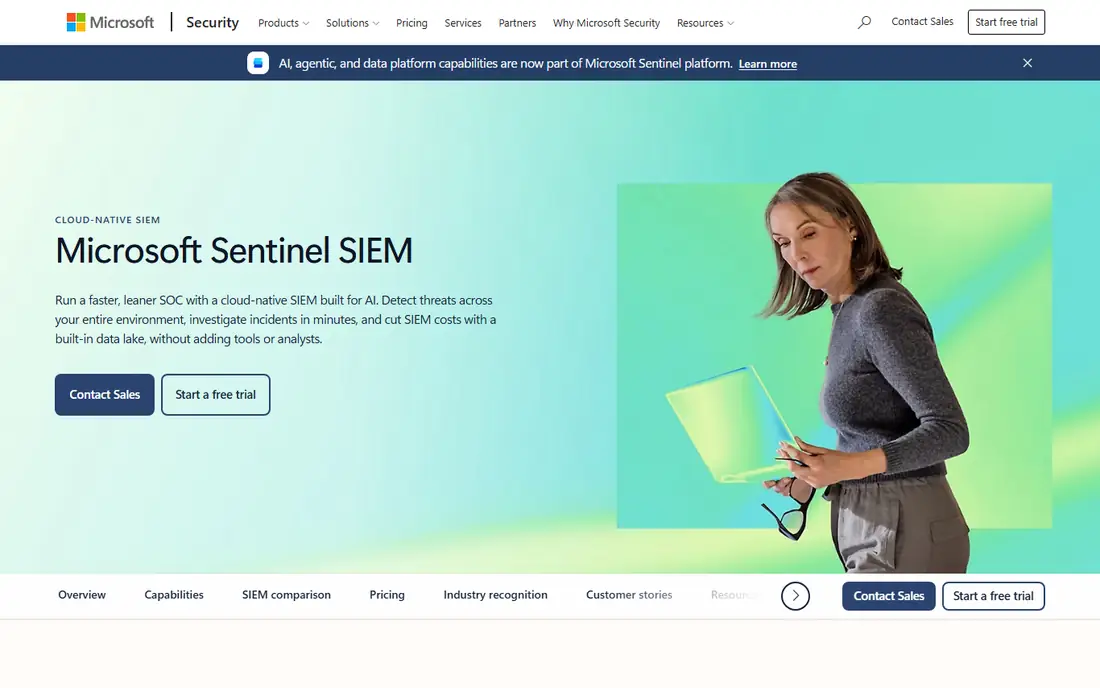
Microsoft Sentinel is the value leader for Microsoft estates. Its published pricing starts at $4.30 per GB pay-as-you-go in East US, with commitment tiers lowering the effective rate toward $2.05 per GB at the highest volumes, and Microsoft 365 and Azure source data ingestion is free. Copilot integration assists triage, and the platform's content hub provides pre-built detections for common threats.
The cost model favors Microsoft-heavy estates: a shop with 50 percent plus Microsoft source data sees far lower bills than one ingesting mostly third-party logs. Azure-centric design also means teams outside Microsoft need extra integration work. For a Microsoft 365 and Azure shop, Sentinel's combination of published pricing, free Microsoft data, and assisted triage is hard to beat.
What we like- Published pricing at $4.30 per GB pay-as-you-go in East US
- Commitment tiers lower the effective rate toward $2.05 per GB
- Microsoft 365 and Azure data ingestion is free
- Copilot-integrated assisted triage
Watch out for- Costs rise fast for non-Microsoft data at scale
- Azure-centric
- Needs Microsoft expertise for advanced tuning
Starting priceSee website
Free planYes
Elastic Security suits engineering-led teams that want full control. Detection rules are defined as code in YAML, version-controlled, code-reviewed, and shared on GitHub, and Kibana provides the most flexible visualization layer of any SIEM here. The Elastic Common Schema normalizes data across sources, simplifying integration. Managed cloud starts near $95 a month and scales with volume, with serverless ingest from $0.09 per GB and retention from $0.017 per GB-month.
The trade is tuning effort: out-of-the-box alert quality is not as strong as Sentinel's or Splunk's pre-built content, and teams without dedicated Elastic expertise often spend more time managing the platform than running security operations. For an engineering-strong team with existing ELK infrastructure, Elastic offers the lowest resource-based cost and the most control.
What we like- Open rules-as-code with YAML detections versioned on GitHub
- Flexible Kibana visualization
- Elastic Common Schema normalizes data
- Managed cloud from roughly $95 a month
- Serverless ingest from $0.09 per GB
Watch out for- Out-of-the-box alert quality trails Sentinel and Splunk without tuning
- Teams without Elastic expertise spend more time on platform management than operations

#4CrowdStrike Falcon Next-Gen SIEM
Best for: CrowdStrike endpoint customers4.5/5 on
G2 (44 reviews, checked Oct 2026)
Visit crowdstrike.com
Starting price$5.95 per GB
Free planNo
CrowdStrike Falcon Next-Gen SIEM consolidates endpoint detection and SIEM into one console. Falcon data is included, and Falcon Insight XDR customers get 10 GB a day free, with third-party data near $5.95 per GB on the AWS Marketplace pay-as-you-go listing and 13-month retention included. Charlotte AI assists triage and investigation.
The value tracks the estate: a Falcon shop gets a consolidated platform with included endpoint data, while a non-Falcon shop pays per GB for third-party logs and gets less of the consolidation benefit. For a CrowdStrike customer replacing a separate SIEM, Falcon Next-Gen SIEM is the natural consolidation path.
What we like- One console for endpoint and SIEM
- Falcon data included
- 10 GB a day free for Falcon Insight XDR customers
- Third-party data near $5.95 per GB pay-as-you-go
- Charlotte AI assistance
Watch out for- Third-party log costs add up outside Falcon estates
- Platform is endpoint-led, so non-Falcon shops get less value
- Quote-only for some tiers
Starting priceSee website
Free planNo
Cortex XSIAM aims to replace three platforms at once: SIEM, XDR, and SOAR. Its automation-first design reduces manual triage, and its integration with Palo Alto firewalls and endpoint products gives it deep network and endpoint context. For a Palo Alto shop, that consolidation removes several vendor boundaries at once.
Pricing is not published and requires a sales conversation, and replacing SIEM, XDR, and SOAR together is a major migration with retraining and detection rework. Outside Palo Alto estates, the consolidation value is thinner. For a Palo Alto customer planning a platform consolidation, XSIAM is the strategic alternative to Exabeam.
What we like- Replaces SIEM, XDR, and SOAR with one platform
- Automation-first design
- Strong for Palo Alto network estates
Watch out for- No published pricing, sales-only
- Platform replacement is a major migration
- Value is lower outside Palo Alto estates

#6
IBM QRadar SIEM
Best for: Regulated on-premises estates
Visit ibm.com
Starting priceSee website
Free planNo
IBM QRadar SIEM suits regulated, on-premises estates. Its offense correlation groups related events into offenses for analysts, with Watson-era AI assists, and its EPS and flow-based pricing model suits compliance-heavy shops that think in events per second rather than GB per day. On-premises deployment satisfies data residency and air-gap requirements that cloud SIEMs cannot.
Pricing is custom with no published figure, though list data shows $12,074.40 a year per 500 EPS unit, and platform direction questions follow IBM's QRadar business moves, so buyers should confirm the roadmap. For a regulated on-premises estate that needs offense correlation and local control, QRadar remains a credible Exabeam alternative.
What we like- Offense correlation with Watson-era assists
- On-premises deployment for regulated estates
- EPS and flow-based pricing suits compliance-heavy shops
Watch out for- Custom pricing with no published figure, though list data shows $12,074.40 a year per 500 EPS unit
- Platform direction questions after IBM's QRadar moves
- Needs specialist skills
Starting priceSee website
Free planNo
Securonix is the closest behavior-led rival to Exabeam. Its Unified Defense SIEM uses threat-chain analytics and identity-based detection to surface insider threats and compromised accounts, which mirrors Exabeam's behavior analytics strength. Deployment options include bringing your own Snowflake or AWS, or a hosted model, which suits data teams with existing cloud investments.
Pricing is quote-only with no published rate card, and the consumption model needs careful volume modeling before budgeting. The platform is enterprise-oriented, so smaller teams will find it heavy. For a large enterprise whose main SIEM need is insider threat and behavior analytics, Securonix is the most direct Exabeam replacement.
What we like- Threat-chain analytics and behavior-led detection closest to Exabeam's UEBA strength
- Identity-based consumption model
- BYO Snowflake or AWS or hosted deployment
Watch out for- Quote-only with no published rate card
- Consumption model needs careful volume modeling
- Enterprise orientation
Starting priceSee website
Free planNo
Google Security Operations, formerly Chronicle, suits hunt-heavy teams that need fast search over long retention. Its hot-year search speed lets analysts query a year of data quickly, and Gemini summaries speed up investigation narratives. Ingestion-based packages suit organizations with high log-to-employee ratios, and Google Cloud users get native integration.
Pricing is not published and requires a sales conversation, with list data putting costs near $1.95 to $4.60 per GB a year. The platform is Google Cloud-centric, so non-Google estates get less integration value. For a Google Cloud shop or a hunt-heavy SOC that values search speed and long retention, Google Security Operations is a strong Exabeam alternative.
What we like- Hot-year search speed for hunting
- Gemini summaries for investigations
- Ingestion-based packages
- Suits Google Cloud users and high log-to-employee ratios
Watch out for- No published pricing, contact sales only
- List data puts costs near $1.95 to $4.60 per GB a year
- Google Cloud-centric
How we chose
We compared each tool against what Exabeam actually sells: behavior analytics, insider threat timelines, and SIEM correlation, now under its New-Scale Fusion platform and its LogRhythm SIEM line. Pricing figures come from vendor pages, marketplace listings, and published cost comparisons checked in 2026, and anything we could not confirm is written as "See website". We favored actively maintained platforms that serve US SOC teams, and we flagged where a tool is quote-only, consumption-metered, or endpoint-led, since that decides the real cost and migration effort.
What to check before you pick
Price your logs before anyone prices their platform. Thirty days of real volume by source, growth rate, and mandated retention, modeled against each candidate's pricing unit, will show that the same estate can differ by multiples between consumption, EPS, and package models. Then test the analyst loop, not the demo: take one real historical incident and two of your noisiest alert types into a proof of concept, and time alert-to-narrative for a mid-level analyst. Ask every vendor about platform direction, since Exabeam, QRadar, and Splunk roadmaps all shifted recently, and budget the unglamorous rows: parser maintenance, tuning hours, and a named cost owner for any consumption meter. The right SIEM is the one your actual roster can run at 3 a.m.
Frequently asked questions
What is Exabeam?
Exabeam is a SIEM and behavior analytics vendor, now selling New-Scale Fusion in the cloud and the LogRhythm SIEM line for on-premises needs. Its strength is behavior analytics and insider threat timelines.
What does Exabeam cost?
Exabeam New-Scale Fusion is quote-only with no published rate. Older list data puts Fusion near $51,000 at 50 GB a day. Get a quote based on your actual log volume and retention.
Which Exabeam alternative is cheapest?
Microsoft Sentinel is cheapest for Microsoft estates, at $4.30 per GB pay-as-you-go with free Microsoft data ingestion. Elastic self-hosted is cheapest for engineering teams, with infrastructure-only costs.
Is Splunk or Sentinel better?
Splunk offers deeper analytical capability for mature SOCs with Splunk skills. Sentinel offers better value and assisted triage for Microsoft estates. The right choice tracks your estate's gravity and your team's skills.
What is UEBA?
UEBA, user and entity behavior analytics, baselines normal user and device behavior and flags deviations that suggest insider threats or compromised accounts. Exabeam and Securonix lead in this area.
Can I replace a SIEM with XDR?
Partly. XDR covers endpoint, network, and cloud telemetry well, but a SIEM still matters for broad log correlation, compliance retention, and custom detections across all sources. Many teams run both, with XDR feeding the SIEM.
Sources we checked (8)
- https://www.splunk.com/
- https://azure.microsoft.com/products/microsoft-sentinel
- https://www.elastic.co/security
- https://www.crowdstrike.com/
- https://www.paloaltonetworks.com/cortex
- https://www.ibm.com/qradar
- https://www.securonix.com/
- https://cloud.google.com/security/products/security-operations
Is your product missing or out of date?
We review this list regularly. Vendors can request a listing, send updated pricing or ask about featured placement.

Shihab Mia · Founder, Rankite
Shihab has 5+ years in B2B and SaaS SEO. He writes Rankite's software buying guides from pricing pages, documentation and public user reviews. More about Shihab.
 Microsoft Sentinel
 Elastic Security
 Palo Alto Cortex XSIAM
 Securonix Unified Defense SIEM
 Google Security Operations