How we make this list: we compare pricing pages, product documentation and public user reviews. Ratings come from G2, Capterra or Trustpilot, with the date we checked them.
Key takeaways
- Lansweeper and runZero are the most direct inventory replacements, with discovery-first approaches and visible pricing paths.
- Armis and Tanium suit large environments where unmanaged devices, OT, or real-time endpoint control matter most.
- JupiterOne and Wiz add relationship and cloud context that a flat inventory cannot show.
- ServiceNow fits organizations that want asset data inside ITSM and governance workflows rather than a standalone tool.
Quick comparison
| Tool | Best for | Starting price | Free plan |
|---|
 Armis | Unmanaged and OT asset exposure | See website | No |
 Lansweeper | Device-level asset intelligence | See website | Yes |
 Tanium | Real-time endpoint visibility | See website | No |
 JupiterOne | Graph-based asset relationships | See website | Free trial |
 ServiceNow | CMDB and ITSM governance | See website | No |
 Wiz | Cloud asset security graph | See website | Free trial |
 runZero | Exposure discovery without agents | See website | Yes |
 SAFE | Risk quantification on asset data | See website | No |
Is your product missing or out of date?
We review this list regularly. Vendors can request a listing, send updated pricing or ask about featured placement.
The best Axonius alternatives
Starting priceSee website
Free planNo
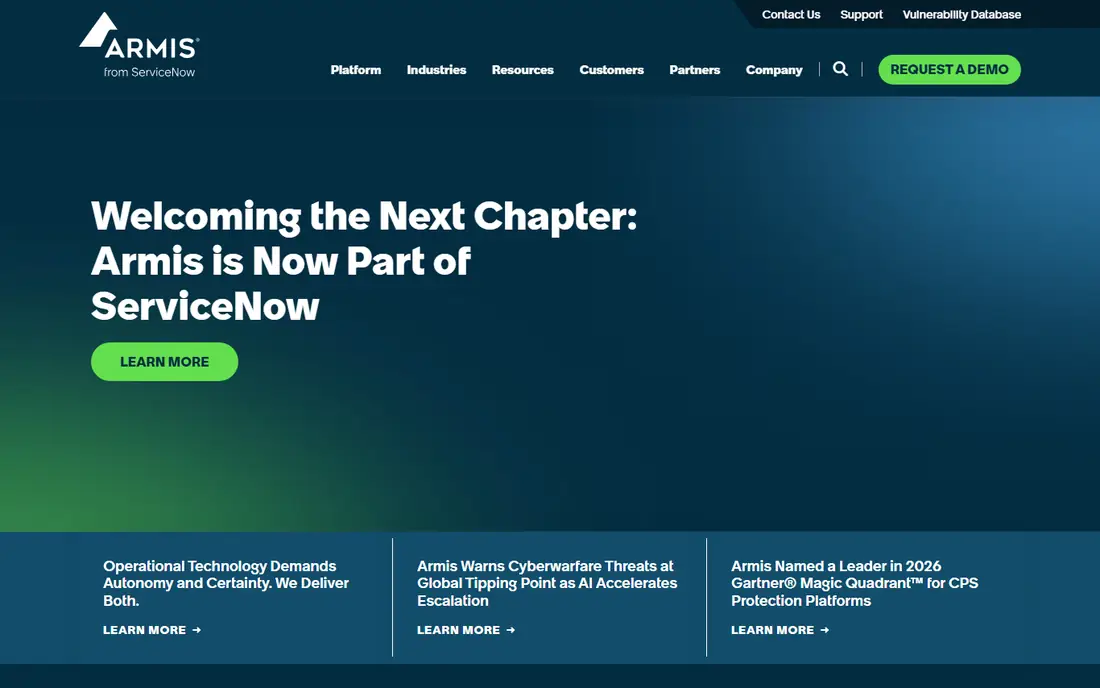
Armis is the strongest alternative when the assets you worry about are the ones no agent touches: medical devices, factory equipment, building systems, and shadow IoT. Its platform discovers and profiles those devices without agents, then ties them to vulnerability intelligence and exposure management. Its homepage notes recognition as a Leader in the 2026 Gartner Magic Quadrant for cyber-physical systems protection platforms.
One change buyers must note: the Armis homepage now carries a banner stating that Armis is part of ServiceNow. That may simplify life for ServiceNow customers and complicate it for buyers who wanted an independent vendor. Pricing is quote-based. For OT-heavy and health care environments, Armis remains the most credible Axonius replacement, but ask directly about the product roadmap under ServiceNow before signing.
What we like- Agentless discovery of IoT and OT
- Strong exposure management
- Recognized CPS leader
Watch out for- Enterprise pricing
- Homepage now notes Armis is part of ServiceNow
#2Lansweeper
Best for: Device-level asset intelligence4.4/5 on
G2 (69 reviews, checked Oct 2026)
Visit lansweeper.com
Starting priceSee website
Free planYes
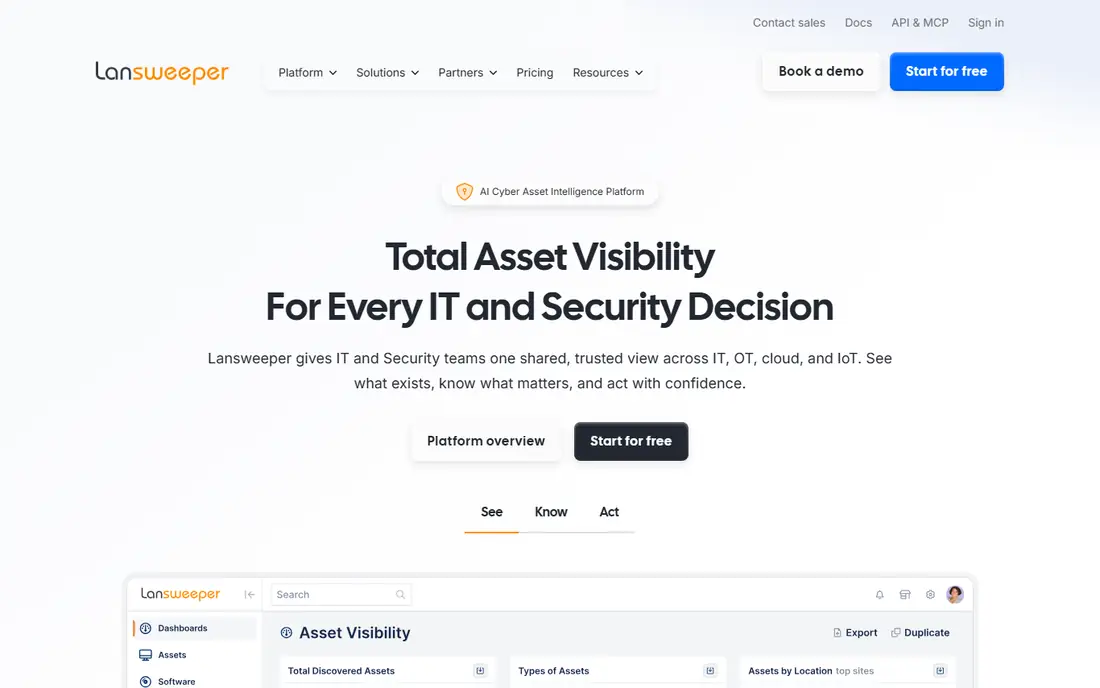
Lansweeper is the practical pick for teams that want a trustworthy inventory first and security workflows second. Its platform discovers assets across IT, OT, cloud, and IoT, normalizes duplicate records into one asset record, and enriches each asset with lifecycle, vulnerability, and risk context. The homepage reports more than 30,000 environments using it and offers a free start with no credit card required.
Where Lansweeper differs from Axonius is emphasis. Axonius aggregates data from hundreds of existing tools, while Lansweeper leans on its own discovery engine and device fingerprinting, matching devices against a library of more than 175 million devices. For software audits, license cleanup, and compliance reporting, that depth is an advantage. For automated policy enforcement across a large security stack, Axonius-style aggregation may still fit better.
What we like- Deep device and software inventory
- Free tier
- Trusted by 30,000-plus environments
Watch out for- Security enforcement is lighter than Axonius
- Enterprise pricing needs a quote
Starting priceSee website
Free planNo
Tanium answers a different question from Axonius: not just what exists, but what is true right now. Its platform queries every managed endpoint in seconds, so inventory, patch status, and compliance reflect the current moment rather than the last scan. Its newer Atlas layer adds AI agents that act on that live data with guardrails and sign-off, and it connects natively to ServiceNow, Microsoft, and Splunk.
The limit is coverage model. Tanium's strength depends on its agent, so devices that cannot run one, such as many OT and IoT assets, need a companion tool like Armis or Lansweeper. Pricing is enterprise and quote-based. For large endpoint estates where patching speed and compliance evidence matter, Tanium is one of the strongest platforms available, and its real-time model is a genuine step beyond scheduled scans.
What we like- Real-time data across every endpoint
- Patching and compliance in one platform
- Strong analyst standing
Watch out for- Agent-based, so unmanaged devices need other coverage
- Enterprise pricing
Starting priceSee website
Free planFree trial
JupiterOne replaces a flat inventory with a graph. Instead of listing assets, it maps the relationships between cloud resources, identities, code repositories, and users, so a finding carries context about what it can actually reach. Its homepage promises a view across assets and security data that exposes hidden risks in cloud, code, identity, and AI, all on one graph-native model.
That model is powerful for cloud-native teams and for security engineers who think in attack paths rather than spreadsheets. The trade-off is learning curve: getting full value means learning its query approach and modeling your environment carefully. Pricing is quote-based with a trial available. For organizations whose risk lives in the connections between things rather than in the things themselves, JupiterOne is the most distinctive alternative here.
What we like- Graph model shows how assets connect
- Strong cloud and code context
- Good for risk prioritization
Watch out for- Query language learning curve
- Smaller vendor than ServiceNow or Tanium
Starting priceSee website
Free planNo
ServiceNow is the governance pick. Its Configuration Management Database gives IT and security one system of record that feeds incident, change, problem, and service request workflows, so asset data directly drives action instead of sitting in a separate console. Its homepage lists recent Gartner and Forrester recognition across service management, automation, and vulnerability management.
The honest cost is platform weight. ServiceNow is a broad enterprise platform, and its asset capabilities arrive as part of a larger implementation with licensing to match. Teams that only need an inventory will find it heavy. But for organizations already running ServiceNow, adding asset discovery and CMDB governance there avoids a second vendor, and the Armis relationship now strengthens its unmanaged-device story as well.
What we like- CMDB at the center of ITSM
- Huge workflow ecosystem
- Armis now part of the family
Watch out for- Platform cost and implementation effort
- Asset discovery is one module among many
#6Wiz
Best for: Cloud asset security graph4.7/5 on
G2 (863 reviews, checked Oct 2026)
Visit wiz.io
Starting priceSee website
Free planFree trial
Wiz is the cloud-native answer to Axonius. It connects code, cloud, and runtime into a single security graph, so a cloud asset carries context about its code origin, its runtime exposure, and its exploitable risk. Its homepage reports trust from more than 65 percent of Fortune 100 companies, and customers report seeing information within an hour of connecting. Its AI agents simulate attack paths and investigate alerts, which moves the product beyond inventory into active risk reduction.
The limit is scope. Wiz is built for cloud and AI workloads, so a factory floor or a hospital full of unmanaged devices is outside its center. Pricing is quote-based with a trial path. For cloud-heavy organizations that want asset inventory tied directly to exploitable risk, Wiz is the strongest choice on this list.
What we like- Unified cloud and code security graph
- Trusted by most of the Fortune 100
- Fast time to value
Watch out for- Cloud-focused, so on-prem estates need other tools
- Enterprise pricing
Starting priceSee website
Free planYes
runZero is built for the blind spots other tools leave. Agents only see what they are installed on, and credential-based scans fail when credentials change, so runZero combines safe active scanning, passive discovery, API integrations, and fingerprinting to profile each asset against nearly 1,000 attributes. Its homepage cites a North Carolina schools program covering more than 1.3 million devices and a university that found 20 percent more assets than before.
One change to note: runZero's homepage now states it is a Dragos company, joining Dragos and NetRise. That may strengthen its OT story and raises the usual roadmap questions for buyers. A free tier exists for trying it. For teams whose core problem is unknown and unmanageable assets, especially in OT and IoT, runZero is the most focused alternative here.
What we like- Finds unmanaged and unknown assets
- Safe scanning for fragile devices
- Free tier
Watch out for- Now a Dragos company, so roadmap questions apply
- Remediation relies on other tools
Starting priceSee website
Free planNo
SAFE, formerly Balbix, is the risk-quantification pick. Its homepage now presents SAFE as an autonomous cyber risk management platform, with an AI workforce of more than 100 agents that ingests data across business context, attack surface, controls, and threat intelligence, then reasons about exposure and business impact. It reports trust from 10 percent of the Fortune 500 and recognition as a Leader in cyber risk quantification.
The distinction matters. SAFE is not a drop-in inventory replacement for Axonius; it is the layer that turns inventory and control data into board-level risk language and prioritized action. Teams that already have an inventory but cannot explain which gaps matter in dollars will get the most from it. Pricing is enterprise and quote-based. Buyers should confirm the Balbix-to-SAFE transition details for their contract, since the balbix.com homepage now serves SAFE content.
What we like- Turns asset and control data into financial risk terms
- AI agent workforce
- Strong analyst recognition
Watch out for- Risk platform, not a pure inventory tool
- Enterprise pricing
How we chose
We compared these tools on discovery coverage, inventory accuracy, cloud and OT fit, risk context, enforcement options, and pricing transparency. We checked each vendor's homepage to confirm the product exists today and matches its description, and we used public comparison guides where homepage pricing was not shown. We did not claim hands-on testing. Where a price could not be verified from the vendor, we wrote See website rather than guessing. Ownership changes at Armis, runZero, and SAFE are flagged in the text because they affect roadmaps.
What to verify in a trial
Start with coverage, not dashboards. Run each candidate against a segment of your network that includes unmanaged devices, cloud accounts, and a few forgotten systems, then count what it finds that your current inventory misses. Next, test data quality: duplicate records, stale assets, and missing ownership are the three inventory failures that poison every downstream workflow. Finally, test the action path. An inventory that cannot trigger a ticket, a patch job, or an isolation workflow is a report, not a security tool, and the gap between finding and fixing is where most Axonius replacements succeed or fail.
Frequently asked questions
What is CAASM?
Cyber asset attack surface management is the practice of continuously discovering every asset, including devices, cloud instances, identities, and software, and tying that inventory to security coverage and risk. Axonius helped define the category, and every tool on this list covers part of it with a different emphasis.
Which Axonius alternative is best for OT and IoT?
Armis leads for OT and IoT exposure, with runZero close behind for discovery of unknown devices. Lansweeper also covers OT and IoT in its inventory. Cloud-focused tools like Wiz are weaker here, so OT-heavy buyers should shortlist the first three.
Do I still need a vulnerability scanner with a CAASM tool?
Yes, in most cases. CAASM tools aggregate and contextualize findings, but they usually rely on scanners, endpoint tools, and cloud platforms for the underlying data. The value is a complete inventory plus coverage-gap analysis, not a replacement for scanning itself.
Is Armis still independent?
No. The Armis homepage now states that Armis is part of ServiceNow. Buyers should ask both vendors about product integration plans, contract terms, and support continuity before committing.
What happened to Balbix?
Balbix now presents as SAFE. The balbix.com homepage serves SAFE content describing an autonomous cyber risk management platform. Existing Balbix customers should confirm transition terms, and new buyers should evaluate SAFE as a risk platform rather than a pure inventory tool.
How much do these tools cost?
All eight are primarily quote-based at enterprise scale, except for free tiers at Lansweeper and runZero and a trial path at JupiterOne and Wiz. Request quotes on the same asset count and scope, since per-asset and per-endpoint pricing models make headline numbers hard to compare.
Sources we checked (8)
- https://www.armis.com
- https://www.lansweeper.com
- https://www.tanium.com
- https://jupiterone.com
- https://www.servicenow.com
- https://www.wiz.io
- https://www.runzero.com
- https://www.balbix.com
Is your product missing or out of date?
We review this list regularly. Vendors can request a listing, send updated pricing or ask about featured placement.

Shihab Mia · Founder, Rankite
Shihab has 5+ years in B2B and SaaS SEO. He writes Rankite's software buying guides from pricing pages, documentation and public user reviews. More about Shihab.