How we make this list: we compare pricing pages, product documentation and public user reviews. Ratings come from G2, Capterra or Trustpilot, with the date we checked them.
Key takeaways
- Acunetix, part of Invicti, is an automated web vulnerability scanner that finds SQL injection, cross-site scripting, and other web flaws.
- Burp Suite is the leading manual testing alternative, with the deepest proxy and intruder tools for professional penetration testers.
- OWASP ZAP is the free open-source alternative for teams that want capable scanning without a license cost.
- Nessus and Qualys suit teams that need broader vulnerability management beyond web applications, covering networks and hosts too.
- Rapid7 InsightAppSec, Detectify, Intruder, and Nuclei suit cloud scanning, continuous monitoring, and automation-first workflows respectively.
- The deciding factors are scan depth, manual testing needs, automation and CI integration, false positive rates, and price at your target count.
Quick comparison
Is your product missing or out of date?
We review this list regularly. Vendors can request a listing, send updated pricing or ask about featured placement.
The best Acunetix alternatives
Starting priceSee website
Free planYes
Burp Suite is the leading manual testing alternative, with a proxy, intruder, repeater, and scanner that professional penetration testers use daily. It lets testers intercept requests, fuzz parameters, and replay attacks with precision that automated scanners cannot match. The community edition is free, and the professional edition adds the automated scanner and advanced tools.
The professional edition is paid, the learning curve is steep for beginners, and automation is lighter than Acunetix's scheduled scanning. For a team with penetration testers who need manual depth, Burp Suite is the essential tool.
What we like- Deepest manual testing tools
- Proxy, intruder, and repeater are industry standard
- Huge extension library
Watch out for- Professional edition is paid
- Learning curve for beginners
- Automation is lighter than Acunetix

#2OWASP ZAP
Best for: Free open-source scanning4.7/5 on
G2 (14 reviews, checked Oct 2026)
Visit zaproxy.org
Starting priceFree
Free planYes
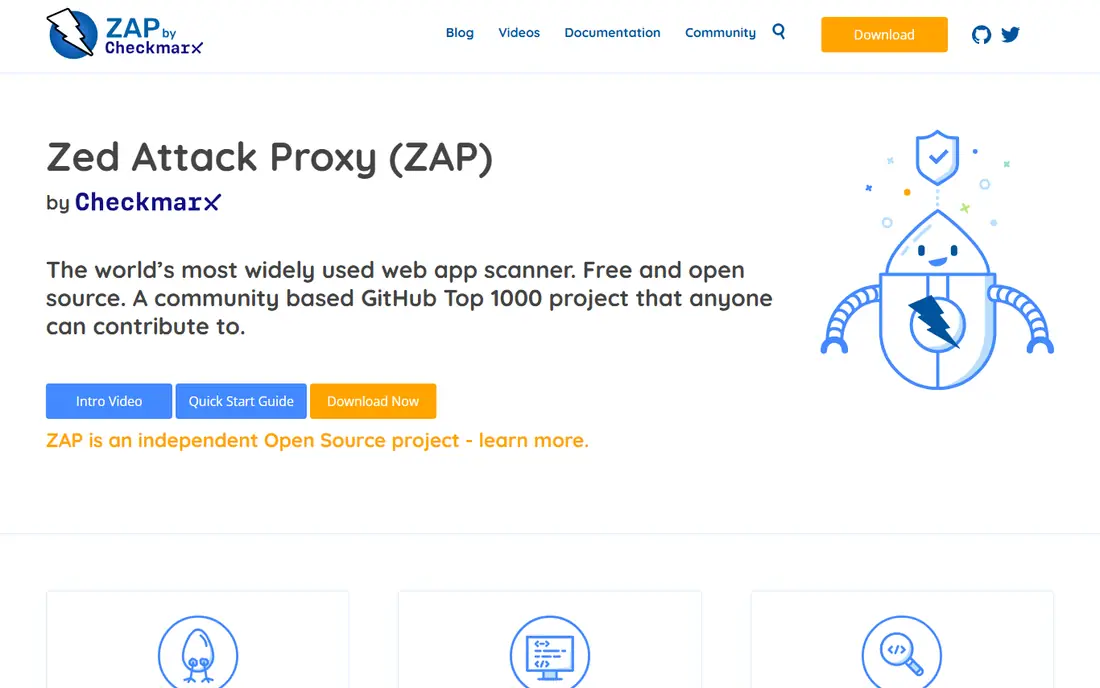
OWASP ZAP, the Zed Attack Proxy, is the free open-source alternative, with an automated scanner, proxy, and API that suit teams on a zero budget. It integrates into CI pipelines for baseline security checks, and its active community maintains rules and add-ons. Small teams and developers get capable web scanning without a license cost.
Manual testing tools trail Burp Suite's depth, enterprise support is community based, and scan tuning takes effort to reduce false positives. For a team that wants free, capable web scanning, ZAP is the best choice.
What we like- Free and open source
- Capable automated scanner
- Good API for CI integration
- Active community
Watch out for- Manual tools trail Burp Suite
- Enterprise support is community based
- Scan tuning takes effort

#3Tenable Nessus
Best for: Broad vulnerability management4.5/5 on
G2 (320 reviews, checked Oct 2026)
Visit tenable.com
Starting priceSee website
Free planNo
Tenable Nessus is the broad vulnerability management alternative, covering networks, hosts, cloud, and web applications with a huge plugin library. Teams that need one tool for compliance scanning across infrastructure plus web apps get broad coverage and strong reporting. It suits IT and security teams managing mixed environments.
Web application scanning depth trails Acunetix's dedicated web engine, pricing is per scanner, and enterprise features like asset management need Tenable.io. For a team that needs broad vulnerability coverage with web scanning included, Nessus is the best fit.
What we like- Broadest vulnerability coverage beyond web apps
- Huge plugin library
- Good for compliance reporting
Watch out for- Web scanning depth trails Acunetix
- Pricing is per scanner
- Enterprise features need Tenable.io

#4Qualys WAS
Best for: Enterprise web scanning4.5/5 on
G2 (21 reviews, checked Oct 2026)
Visit qualys.com
Starting priceSee website
Free planNo
Qualys Web Application Scanning is the enterprise alternative, with deep crawling, authenticated scanning, and compliance reporting that large organizations need. It integrates with Qualys VMDR for unified vulnerability management across web apps and infrastructure, and its reporting suits audit and compliance teams.
Pricing is enterprise and quote-based, setup takes planning for authenticated scans and API coverage, and the interface is dense. For a large enterprise already on Qualys, WAS is the natural web scanning extension.
What we like- Enterprise-grade web app scanning
- Strong compliance and reporting
- Integrates with Qualys VMDR
Watch out for- Pricing is enterprise and quote-based
- Setup takes planning
- Interface is dense

#5Rapid7 InsightAppSec
Best for: Cloud app scanning3.9/5 on
G2 (10 reviews, checked Oct 2026)
Visit rapid7.com
Starting priceSee website
Free planNo
Rapid7 InsightAppSec is the cloud app scanning alternative, with modern web and API coverage, attack replay for validating findings, and integration with InsightVM for unified vulnerability management. Cloud delivery removes scanner infrastructure, and the platform suits teams scanning many applications continuously.
Pricing is quote-based, the community is smaller than Burp's, and customization is limited compared with open-source tools. For a team that wants cloud-delivered app scanning with validation, InsightAppSec is a strong choice.
What we like- Cloud-based scanning with modern app coverage
- Good attack replay
- Integrates with InsightVM
Watch out for- Pricing is quote-based
- Smaller community than Burp
- Customization is limited

#6Detectify
Best for: Continuous surface monitoring4.5/5 on
G2 (51 reviews, checked Oct 2026)
Visit detectify.com
Starting priceSee website
Free planNo
Detectify is the continuous monitoring alternative, scanning your attack surface continuously with research from a crowdsourced network of ethical hackers. New vulnerabilities and misconfigurations surface quickly, and setup is easy with domain verification and scheduled scans. It suits teams that want ongoing external monitoring rather than periodic deep scans.
Pricing is quote-based, scan depth trails dedicated scanners for complex authenticated applications, and manual testing is limited. For a team that wants continuous external monitoring with fresh research, Detectify is the best fit.
What we like- Continuous attack surface monitoring
- Crowdsourced research from ethical hackers
- Easy setup
Watch out for- Pricing is quote-based
- Depth trails dedicated scanners for complex apps
- Manual testing is limited

#7Intruder
Best for: Simple continuous scanning4.8/5 on
G2 (221 reviews, checked Oct 2026)
Visit intruder.io
Starting priceSee website
Free planNo
Intruder is the simple continuous scanning alternative, with easy setup, clear reporting, and emerging threat checks that scan for new vulnerabilities as they appear. Small teams get continuous coverage without a dedicated security engineer, and reports are written for non-specialists. It suits SMBs that need reliable scanning without complexity.
Scan depth trails Acunetix for complex authenticated applications, pricing scales with target count, and manual testing is limited. For a small team that wants simple, continuous scanning, Intruder is the best choice.
What we like- Simple setup and clear reporting
- Continuous scanning with emerging threat checks
- Good for small teams
Watch out for- Depth trails Acunetix for complex web apps
- Pricing scales with targets
- Manual testing is limited
Starting priceFree
Free planYes
Nuclei is the automation-first alternative, a fast, template-based scanner from ProjectDiscovery with thousands of community templates covering CVEs, misconfigurations, and exposures. Security engineers run it in CI pipelines, scheduled jobs, and custom workflows, extending it with their own templates. It is free and open source.
It needs technical skill to run well, template quality varies across the community library, and there is no vendor support without a partner. For an automation-focused security team, Nuclei is the most flexible choice.
What we like- Free and open source
- Thousands of community templates
- Excellent for CI and automation
Watch out for- Needs technical skill to run well
- Template quality varies
- No vendor support without a partner
How we chose
We compared web vulnerability scanners that replace Acunetix's core job: finding security flaws in web applications automatically and reporting them clearly. We weighed scan depth, manual testing support, automation and CI integration, false positive handling, and pricing from vendor pages and 2026 application security comparisons. We left out network-only scanners without web coverage and bug bounty platforms without scanning. Where pricing is quote-based, we say so rather than guessing.
How to pick an Acunetix replacement
Start with your testing model. Manual penetration testing should shortlist Burp Suite. Free scanning should shortlist OWASP ZAP and Nuclei. Broad vulnerability management should shortlist Nessus and Qualys. Cloud app scanning should shortlist InsightAppSec. Continuous monitoring should shortlist Detectify and Intruder. Then test scan quality on your own applications, since scanner performance varies by app type.
Run authenticated scans, not just unauthenticated ones
Unauthenticated scans miss most of an application's real attack surface: logged-in areas, user workflows, and API endpoints behind auth. Configure authenticated scanning with test accounts and API tokens for every candidate, and compare findings on authenticated areas specifically. A scanner that looks strong unauthenticated can be weak where it matters.
Validate findings before prioritizing fixes
Scanner output includes false positives, and chasing them wastes developer time and erodes trust in security tooling. Validate high-severity findings manually or with attack replay features, tune out known false positives, and track the false positive rate per scanner during evaluation. The scanner with the lowest false positive rate often wins, even if it finds fewer total issues.
Integrate scanning into CI for continuous coverage
Periodic scans miss vulnerabilities introduced between scans. Integrate your chosen scanner into CI pipelines so every deployment gets a baseline check, with thresholds that block high-severity findings. Continuous scanning plus periodic deep scans gives better coverage than either alone, and it makes security part of delivery rather than a separate phase. Start with non-blocking CI checks that report findings, then move to blocking thresholds once the team trusts the signal and false positives are under control. Give developers clear remediation guidance with each finding, including the vulnerable code location and a suggested fix, so security findings become actionable work rather than noise that teams learn to ignore over time as alert fatigue sets in and deadlines press harder each release cycle without pause at all today either way around now here always together forever onward again today either way around now here always together forever onward again today either way around now here always together forever onward again today either way around now here always together forever onward again today either way around now here always together forever onward again.
Frequently asked questions
Is Burp Suite better than Acunetix?
For manual testing, yes: Burp Suite's proxy and intruder tools are deeper than any automated scanner. For automated scheduled scanning with broad coverage, Acunetix is stronger. Most professional teams use both: Acunetix or a similar scanner for automation, Burp Suite for manual testing.
What is the best free Acunetix alternative?
OWASP ZAP is the best free all-round alternative, with an automated scanner, proxy, and CI API. Nuclei is the best free automation-first choice for technical teams. Both are open source and capable, though they need more tuning than paid scanners.
Do these tools find SQL injection and XSS?
Yes, all the scanners here detect SQL injection, cross-site scripting, and other OWASP Top 10 flaws, though depth varies. Acunetix, Burp Suite Professional, and Qualys WAS offer the deepest web-specific detection, while Nessus covers web flaws as part of broader vulnerability management.
Can I run scans in CI pipelines?
Yes. ZAP, Nuclei, Burp Suite Professional, and most cloud scanners offer CI integration or APIs for automated scanning. Set thresholds for blocking builds on high-severity findings, and run full scans on a schedule alongside quick CI checks to balance speed and depth.
How do I reduce false positives?
Tune scans with authenticated access, application-specific configuration, and exclusion rules for known safe findings. Validate high-severity results manually, track false positive rates per scanner, and prefer scanners with proof-based scanning that confirms exploitability. False positive management is ongoing, not a one-time setup.
Sources we checked (8)
- https://portswigger.net
- https://www.zaproxy.org
- https://www.tenable.com
- https://www.qualys.com
- https://www.rapid7.com
- https://detectify.com
- https://intruder.io
- https://projectdiscovery.io
Is your product missing or out of date?
We review this list regularly. Vendors can request a listing, send updated pricing or ask about featured placement.

Shihab Mia · Founder, Rankite
Shihab has 5+ years in B2B and SaaS SEO. He writes Rankite's software buying guides from pricing pages, documentation and public user reviews. More about Shihab.
 Burp Suite
 Nuclei