How we make this list: we compare pricing pages, product documentation and public user reviews. Rankite is independent; if a vendor ever pays for a featured spot, that listing is clearly labeled Partner.
Key takeaways
- Veriff and Jumio lead identity verification with age verification as a core use case, serving global compliance needs.
- Yoti specializes in privacy-preserving age checks, including facial age estimation without ID documents.
- Persona and ID.me offer flexible verification workflows for US-focused businesses.
- Onfido (now part of Entrust), Veratad and GBG cover the enterprise, US age-restricted commerce and global data verification niches.
Quick comparison
| Tool | Best for | Starting price | Free plan |
|---|
 Veriff Veriff | global businesses needing reliable age verification | See website (custom quote) | No |
 Jumio Jumio | enterprises with strict compliance requirements | See website (custom quote) | No |
 Yoti Yoti | age checks without collecting ID documents | See website | Free tier |
 Persona Persona | businesses wanting customizable verification flows | See website | Free trial |
 ID.me ID.me | US-focused identity verification | See website | No |
 Onfido Onfido | AI-driven document and biometric verification | See website | No |
 Veratad Veratad | US age-restricted e-commerce compliance | See website | No |
 GBG GBG | global identity data verification at scale | See website | No |
Is your product missing or out of date?
We review this list regularly. Vendors can request a listing, send updated pricing or ask about featured placement.
The best age verification software
#1
Veriff
Best for: global businesses needing reliable age verification
Visit veriff.com
Starting priceSee website (custom quote)
Free planNo
Veriff verifies identities (and ages) from 230+ countries' documents with AI-powered fraud detection that catches spoofs and forgeries. The conversion optimization (guiding users through the verification flow) matters because every abandoned verification is lost revenue. Age-restricted businesses get compliance with minimal friction.
Pricing is custom and enterprise-oriented. Small businesses may find it heavy. For global platforms where age compliance is legally required, the coverage and accuracy justify the investment.
What we like- Excellent global document coverage
- Strong fraud detection
- Good conversion rates
Watch out for- Enterprise pricing
- No self-serve free tier
#2
Jumio
Best for: enterprises with strict compliance requirements
Visit jumio.com
Starting priceSee website (custom quote)
Free planNo
Jumio has verified identities for over a decade, with the compliance depth that banks, crypto platforms and regulated industries demand. The biometric verification (face match, liveness) is mature, and the age verification workflows satisfy regulators globally. The track record in high-stakes verification is the selling point.
The enterprise sales motion is slow, and pricing reflects the compliance premium. Startups may prefer more agile vendors. When regulators scrutinize your verification, Jumio's reputation helps.
What we like- Deep compliance expertise
- Strong biometrics
- Trusted by regulated industries
Watch out for- Enterprise pricing and process
- Less agile than newer vendors
#3
Yoti
Best for: age checks without collecting ID documents
Visit yoti.com
Starting priceSee website
Free planFree tier
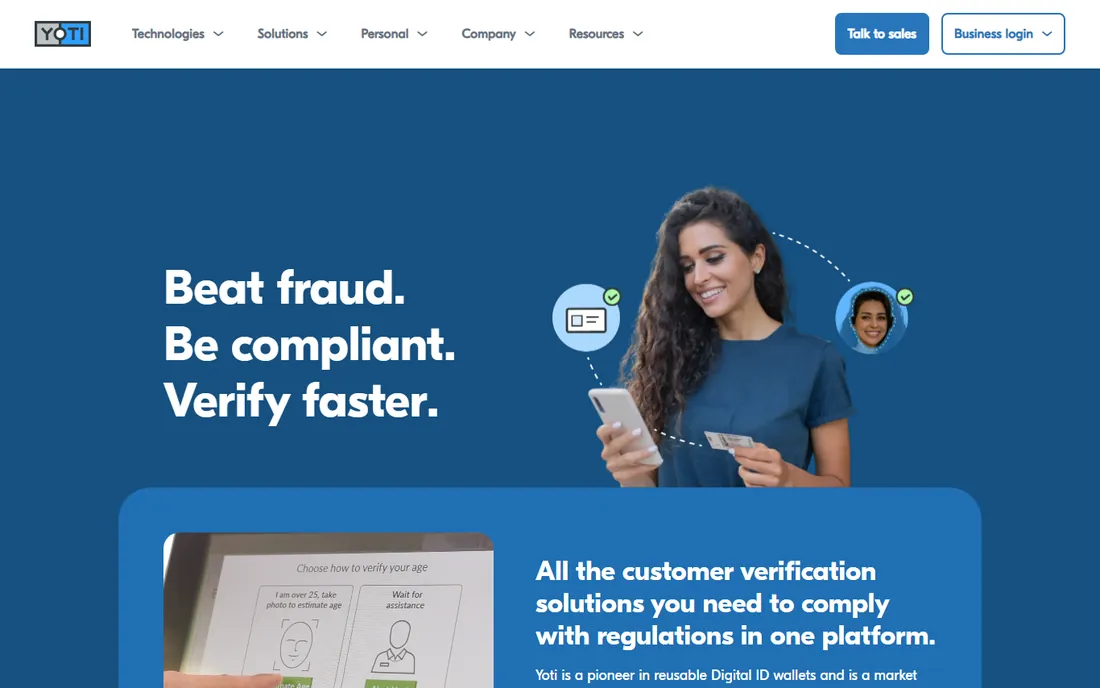
Yoti's facial age estimation checks age from a selfie without requiring ID documents: the AI estimates whether someone meets the age threshold. This privacy-preserving approach suits low-friction scenarios (content gating, retail) where full ID verification is overkill. The free tier enables testing.
Estimation is not identification: accuracy varies by demographics, and some regulators require document-based verification for high-risk categories. Check your jurisdiction's requirements. For privacy-conscious age gating, it is the most user-friendly option.
What we like- Facial age estimation (no ID needed)
- Privacy-focused
- Good for low-friction checks
Watch out for- Estimation accuracy varies
- Regulatory acceptance differs by jurisdiction
Starting priceSee website
Free planFree trial
Persona lets businesses build custom verification flows: combine document checks, selfies, database verifications and risk signals in workflows tuned to your risk tolerance. The no-code builder lets non-engineers design flows. Age verification becomes one configurable step among many.
Simple age-gate needs may find it excessive. Pricing is not published. For businesses with nuanced verification requirements that change by user segment or geography, the flexibility is unmatched.
What we like- Highly configurable workflows
- Good no-code builder
- Strong analytics
Watch out for- Pricing not published
- Complexity for simple needs
#5
ID.me
Best for: US-focused identity verification
Visit id.me
Starting priceSee website
Free planNo
ID.me verifies US identities for government services, healthcare and enterprises, with the document coverage and fraud prevention that high-assurance use cases demand. Age verification for US-restricted products (alcohol, tobacco, cannabis) benefits from the domestic focus.
International coverage is limited. The verification process is thorough, which some users find intrusive. For US businesses in regulated age-restricted commerce, the domestic specialization matters.
What we like- Strong US document coverage
- Trusted for government services
- Good fraud prevention
Watch out for- US-centric
- Verification can feel intrusive
#6
Onfido
Best for: AI-driven document and biometric verification
Visit onfido.com
Starting priceSee website
Free planNo
Onfido's AI verifies ID documents and matches faces with liveness detection, serving global businesses with solid accuracy. The Entrust acquisition brings enterprise identity resources and stability. Age verification workflows are well-developed.
The enterprise focus means less self-serve agility. Acquisition integrations always create some uncertainty. For businesses wanting AI-powered verification with enterprise backing, it remains strong.
What we like- Strong AI document verification
- Good global coverage
- Now part of Entrust
Watch out for- Enterprise focus
- Entrust acquisition integration ongoing
Starting priceSee website
Free planNo
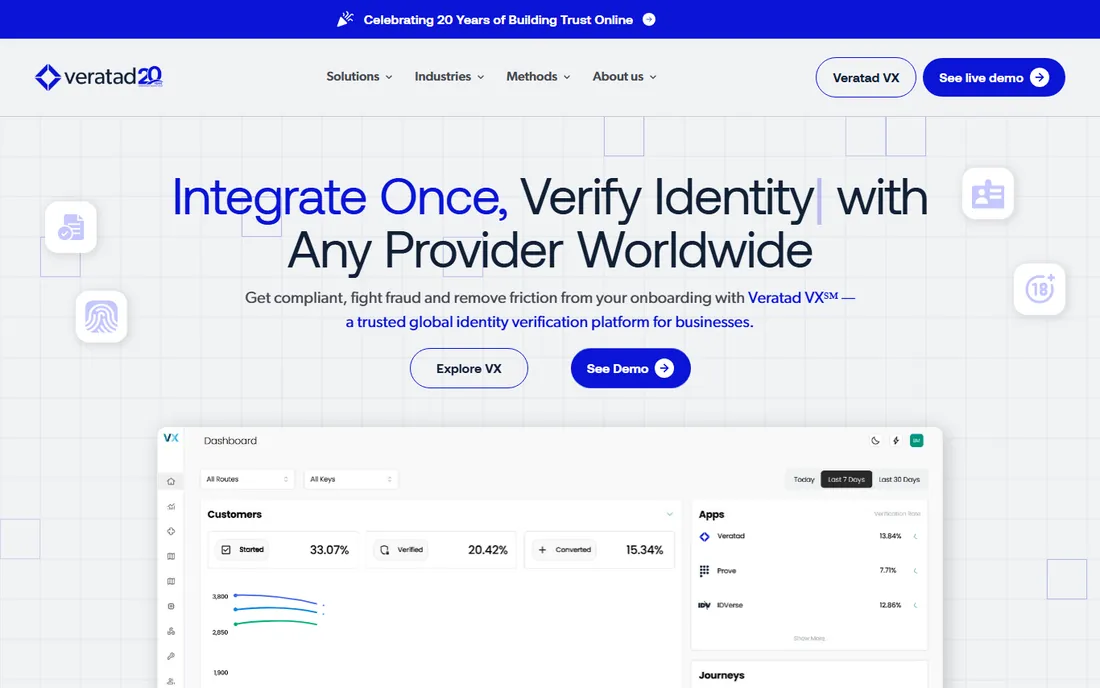
Veratad specializes in age verification for US e-commerce selling restricted products: alcohol delivery, tobacco, CBD and similar. The verification uses US data sources for fast, low-friction checks that satisfy state regulations. The compliance focus means the workflows match legal requirements precisely.
International businesses need other vendors. The scope is narrower than full identity platforms. For US age-restricted commerce, the specialization delivers exactly what regulators require.
What we like- Purpose-built for age-restricted commerce
- Good US data sources
- Compliance focus
Watch out for- US-centric
- Narrower than full identity platforms
Starting priceSee website
Free planNo
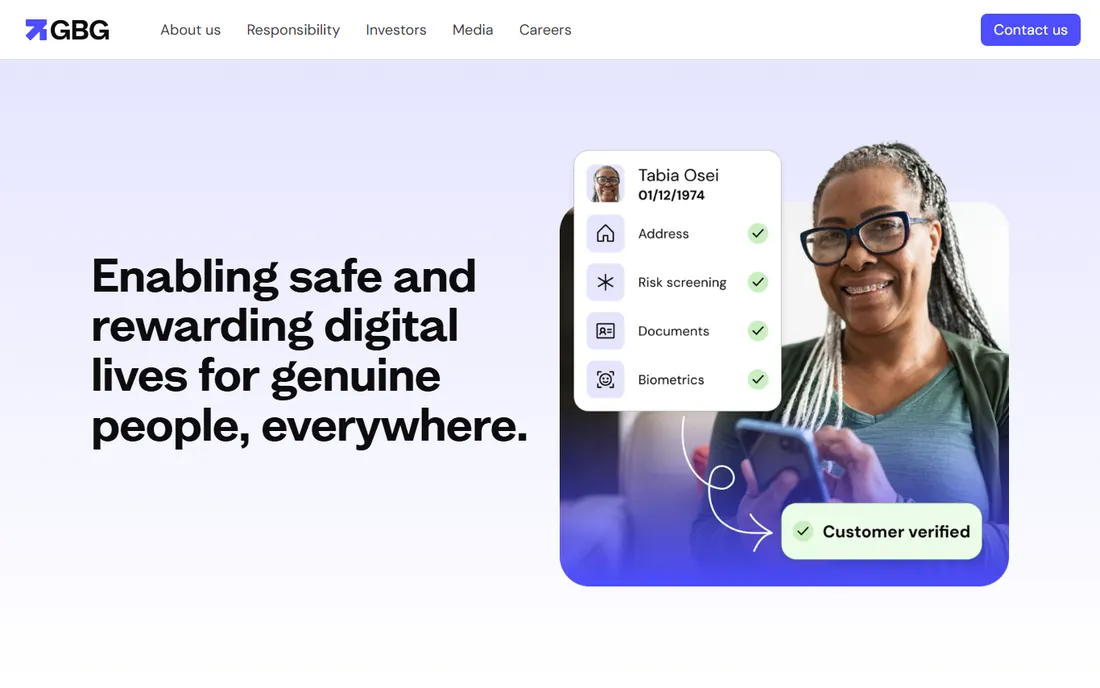
GBG verifies identities against global data sources: names, addresses, dates of birth matched across billions of records. For age verification at scale (batch checks, low-friction flows), data matching is fast and cost-effective. The enterprise track record is long.
Data-based verification lacks the assurance of document plus biometric checks. High-risk scenarios need stronger methods. For high-volume, lower-risk age verification, the data approach balances cost and compliance.
What we like- Massive global data coverage
- Good for batch verification
- Enterprise proven
Watch out for- Data-based (not biometric)
- Enterprise pricing
How we chose
We evaluated current age and identity verification platforms on accuracy, global coverage, privacy features, regulatory acceptance and integration ease, cross-checked against compliance practitioner feedback and 2026 comparisons. Every tool listed is actively maintained with a live homepage as of October 2026. We weighted the age-verification specific use case (not just general KYC) because the requirements differ. Pricing is quote-based across the category.
The regulatory wave driving adoption
Age verification is becoming legally mandatory across more categories and jurisdictions. US states are passing age verification laws for social media, app stores and adult content. The UK's Online Safety Act requires age checks for certain content. EU regulations are expanding. Alcohol, tobacco, cannabis and gambling all face tightening verification requirements.
This means age verification is shifting from best practice to legal obligation. The penalties for non-compliance are growing, and the "we didn't know the user's age" defense is disappearing. Businesses in affected categories should implement verification now, not when enforcement arrives. Choose vendors with the regulatory expertise to keep you compliant as laws evolve.
What to check before you sign
Start with your jurisdiction's specific requirements. Age verification laws vary enormously: what satisfies Texas may not satisfy the UK or California. Verify the vendor's solution meets your specific legal obligations, and get legal review of the compliance claim. Vendor marketing is not legal advice.
Then test the user experience ruthlessly. Every verification step loses users: measure the completion rate during trials with your actual audience. The best verification is the least verification that satisfies the law. Balance compliance against conversion explicitly.
Finally, verify data handling and privacy. Age verification processes sensitive personal data: check retention policies, data residency, and whether the vendor minimizes data collection. Privacy-preserving options (Yoti's estimation, data-based checks) reduce your liability. Your privacy policy must accurately describe the verification.
Do not forget the ongoing monitoring requirement. Age verification is not a one-time check: regulations increasingly require re-verification, and user circumstances change. Ask vendors about continuous monitoring capabilities and how they handle age changes (users who were underage becoming eligible). The compliance program needs to be living, not a checkbox at signup.
Frequently asked questions
What is age verification software?
Software that confirms users meet minimum age requirements for restricted products, content or services. Methods range from facial age estimation to ID document verification to database checks, with varying friction and assurance levels.
Is age verification legally required?
Increasingly, yes. US states, the UK and EU are passing laws requiring age verification for social media, adult content, app stores and age-restricted commerce. Requirements vary by jurisdiction and category. Consult legal counsel for your specific situation.
How accurate is facial age estimation?
Good enough for low-risk gating (accurate within a few years for most demographics), but not sufficient for high-assurance requirements. Accuracy varies by age group and demographics. Regulated categories typically require document-based verification.
Will age verification hurt conversion?
Some friction is inevitable, but good implementations minimize it. Measure completion rates and optimize the flow. The conversion cost of verification is usually less than the legal risk of non-compliance. Privacy-preserving methods (estimation, data checks) convert better than full ID verification.
How do I choose between document verification and age estimation?
Use document verification for high-risk categories (alcohol, gambling, financial services) and where regulators require it. Use age estimation or data checks for lower-risk gating (content, social features) where friction matters more. Many businesses layer both.
What data does age verification collect?
Varies by method: facial estimation may process a selfie without storing it; document verification collects ID images and personal data; database checks use name, address and date of birth. Minimize collection, verify retention policies, and disclose practices in your privacy policy.
How do I handle age verification for existing users?
Grandfathering existing users is legally risky in most jurisdictions: the law typically requires verifying all users, not just new ones. Plan a re-verification campaign with clear communication about why it is happening. Expect some churn; the compliance protection outweighs the user loss. Phase the rollout to manage support volume.
Should I build or buy age verification?
Buy. The AI models, document coverage, fraud detection and regulatory expertise require specialized investment. Building means maintaining document templates for hundreds of countries and keeping up with evolving regulations. The vendors amortize this across thousands of customers. Focus your engineering on your product, not on identity verification.
The vendor's regulatory update process deserves scrutiny during evaluation. Laws are changing rapidly: ask how the vendor tracks new requirements, how quickly they update verification flows for new jurisdictions, and whether they proactively notify customers of relevant legal changes. The best vendors function as compliance partners, not just software providers. This advisory value often justifies the enterprise pricing. When evaluating, ask for specific examples of how the vendor helped customers adapt to new regulations: the stories reveal whether the partnership is real or marketing. A vendor that cannot cite examples is selling software, not compliance confidence. The regulatory environment rewards vendors who invest in legal expertise alongside technology; prefer those who demonstrate both. Document your vendor selection rationale: when regulators ask why you chose a particular solution, a thoughtful evaluation record demonstrates good faith compliance effort. Keep records of the alternatives considered and the reasons for your choice. This documentation also helps future teams understand the compliance architecture when personnel change. Institutional knowledge about why systems are designed a certain way prevents well-meaning but risky modifications. The compliance decisions you document today protect the business long after the original team has moved on to other roles elsewhere.
Sources we checked (8)
- https://www.veriff.com
- https://www.jumio.com
- https://www.yoti.com
- https://www.withpersona.com
- https://www.id.me
- https://www.onfido.com
- https://www.veratad.com
- https://www.gbgplc.com
Is your product missing or out of date?
We review this list regularly. Vendors can request a listing, send updated pricing or ask about featured placement.

Shihab Mia · Founder, Rankite
Shihab has spent more than a decade helping SaaS and e-commerce brands grow through search. He writes Rankite's software buying guides from pricing pages, documentation and public user reviews. More about Shihab.