How we make this list: we compare pricing pages, product documentation and public user reviews. Ratings come from G2, Capterra or Trustpilot, with the date we checked them.
Key takeaways
- Detectify combines external attack surface monitoring with application scanning, and its alternatives split into EASM platforms, DAST scanners, and network scanners.
- Intruder is the best all-round replacement, with continuous scanning, cloud checks, DAST, and AI pentesting in one platform.
- Acunetix by Invicti is the best DAST pick, with proof-based scanning and 99.98 percent confirmation accuracy claimed.
- Tenable Nessus is the best network scanner pick, with the deepest plugin coverage and external attack surface scans.
- Escape is the best API pick, with business-logic-aware DAST and internal plus external coverage.
- Attaxion is the best coverage pick, with agentless exposure management and 97 percent more assets found claimed.
- Bright Security is the best AI coding pick, with validated security across the AI coding journey.
- StackHawk is the best developer pick, with agent skills that find, fix, and verify vulnerabilities before a pull request opens.
- Censys is the best internet intelligence pick, with exposure management built on its own internet map.
Quick comparison
Is your product missing or out of date?
We review this list regularly. Vendors can request a listing, send updated pricing or ask about featured placement.
The best Detectify alternatives

#1Intruder
Best for: All-round replacement4.8/5 on
G2 (221 reviews, checked Oct 2026)
Visit intruder.io
Starting priceSee website
Free planFree plan
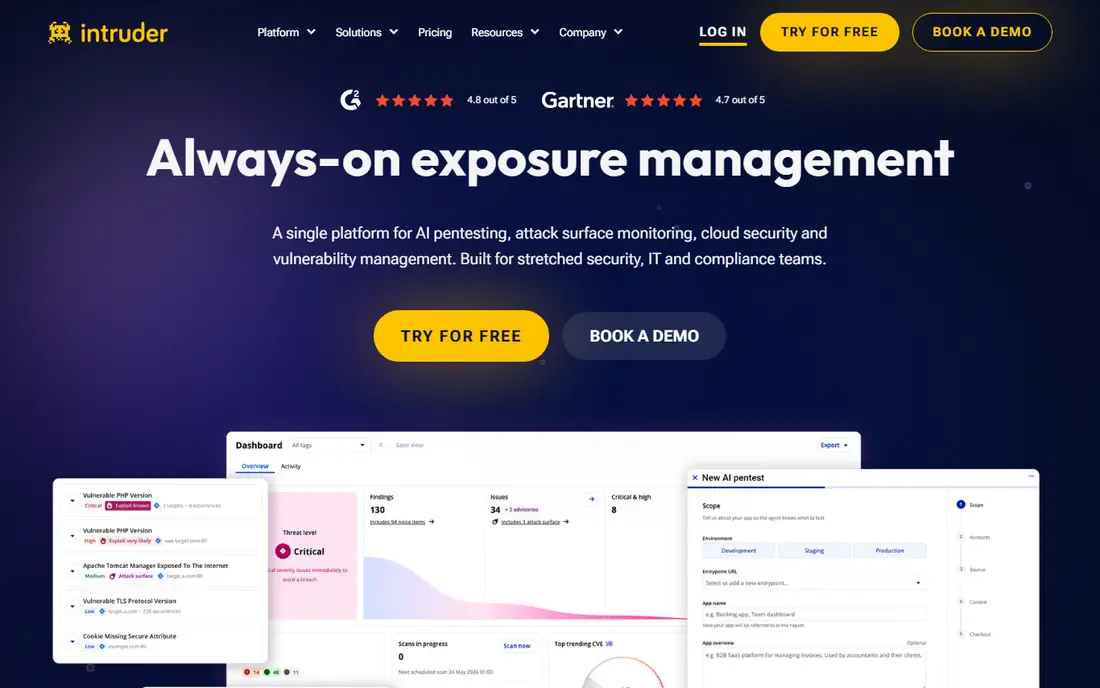
Intruder is the best all-round replacement. Its homepage describes stopping breaches before they start, with continuous scanning across your entire digital estate including infrastructure, apps, and cloud environments in a single platform. Features include real-time change detection that automatically scans new assets, emerging threat scans within hours of new critical vulnerabilities going public, prioritization by real-world exploit likelihood, continuous DAST for web apps, single-page apps, and underlying infrastructure including authenticated scanning behind login pages, agentless scanning across AWS, Azure, and Google Cloud, and same-day AI pentesting that finds complex multi-step vulnerabilities. Intruder integrates with 15 plus tools including AWS, Google Cloud, Okta, GitHub, Jira, Slack, and GitLab.
The trade-off is depth versus breadth. Intruder covers more surface than Detectify, but teams that want deep manual pentesting still need a separate service. For teams that want one platform for continuous scanning plus DAST plus cloud checks, Intruder is the best pick.
What we like- Continuous scanning across infrastructure, apps, and cloud
- DAST with 75 plus application checks
- AI pentesting on demand
- Real-time change detection
Watch out for- Enterprise features priced by quote
- AI pentesting is newer than traditional pentest services

#2Acunetix by Invicti
Best for: DAST accuracy4.1/5 on
G2 (105 reviews, checked Oct 2026)
Visit acunetix.com
Starting priceSee website
Free planFree trial
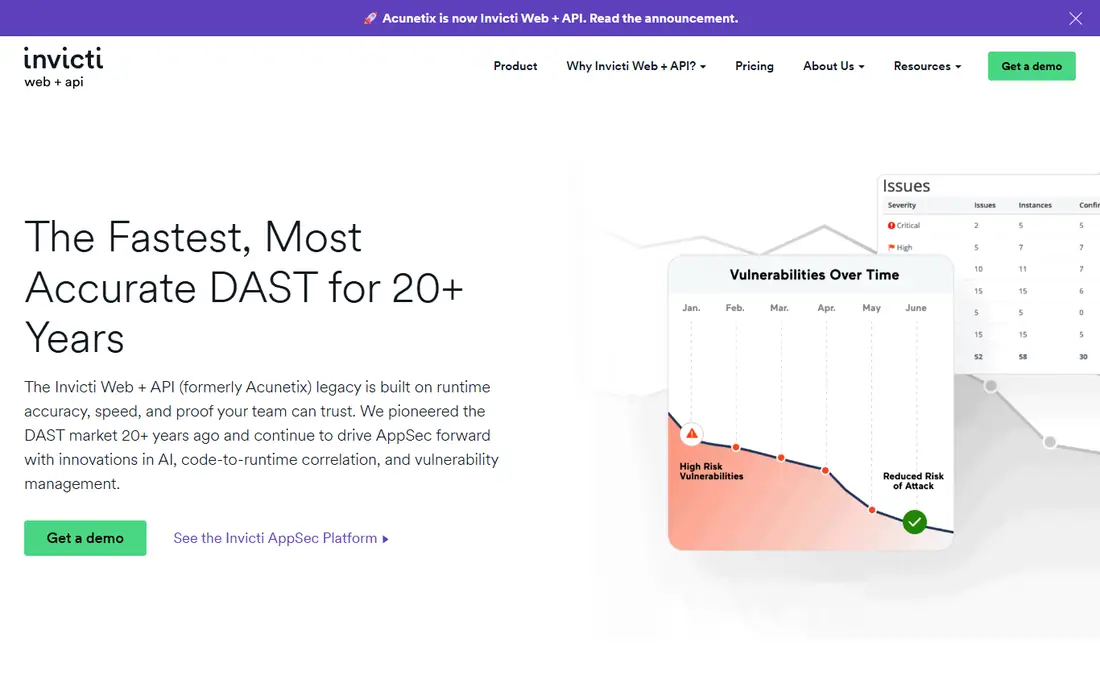
Acunetix by Invicti is the best DAST pick. Its homepage describes the fastest, most accurate DAST for 20 plus years, now branded Invicti Web plus API, with runtime accuracy, speed, and proof teams can trust. Features include comprehensive discovery of web apps, APIs, and shadow assets across code, traffic, and runtime, AI-driven risk scoring with 200 plus signals, proof-based prioritization using runtime reachability, exploitability, and business context, deep detection of 7,000 plus issues including OWASP Top 10, OWASP API Top 10, and business logic flaws, authenticated testing for role-based flows, and stateful API testing for REST, GraphQL, and SOAP. Acunetix claims 8x faster scanning than competitors, 99.98 percent confirmation accuracy, and 40 percent more vulnerabilities found.
The catch is scope. Acunetix is a DAST scanner, not a full external attack surface management platform, so asset discovery breadth is narrower than Detectify. For teams that want the most accurate web app scanning, Acunetix is the best pick.
What we like- 99.98 percent confirmation accuracy claimed
- 7,000 plus issues covered
- Authenticated testing with complex auth flows
- API surface coverage including shadow APIs
Watch out for- DAST focus, not full EASM
- Enterprise platform features on invicti.com, not acunetix.com

#3Tenable Nessus
Best for: Network scanning4.5/5 on
G2 (320 reviews, checked Oct 2026)
Visit tenable.com
Starting priceSee website
Free planFree tier
Tenable Nessus is the best network scanner pick. Its homepage describes the first tool in your cybersecurity toolbox, exposing and closing weaknesses across your constantly changing attack surface with the industry's most trusted vulnerability assessment solution. Features include unlimited vulnerability assessments, discovery of flaws, missing patches, and misconfigurations across OS, devices, and apps, prioritization with CVSS v4, EPSS, and VPR scoring, configuration and compliance audits, web application scans for 5 fully qualified domain names with the option to add more, and external attack surface scans. Nessus reports 117,000 plus CVEs, 319,000 plus plugins, 100 plus new plugins weekly, and over 4 million downloads worldwide.
The trade-off is web depth. Nessus is a network vulnerability scanner with web app and external surface features, not a dedicated web app scanner like Acunetix. For teams that want the industry-standard network scanner with attack surface coverage, Nessus is the best pick.
What we like- Deepest plugin coverage with 117,000 plus CVEs and 319,000 plus plugins
- External attack surface scans
- Web application scans for 5 FQDNs
- 450 plus templates
Watch out for- Network scanner first, web app scanner second
- Enterprise management needs Tenable One
Starting priceSee website
Free planNo
Escape is the best API pick. Its homepage describes an AI-powered offensive security platform that replaces legacy scanners and manual processes with AI agents that discover, test, and remediate directly in engineering workflows. Products include attack surface management that discovers and validates exposure of modern applications, APIs, and infrastructure from code to cloud, business-logic-aware DAST that tests workflows, access control, and multi-step processes with under 4 percent false positives claimed, and AI pentesting that finds complex multi-step attack chains with screenshots, execution logs, and attack path validation. Escape supports modern auth including OAuth, SSO, and multi-tenant setups, integrates with Wiz for unified risk views, and reports 229 percent detection increase and 3,900 percent coverage improvement over legacy solutions.
The catch is scope. Escape is API and web app focused, not a network scanner, so infrastructure scanning needs another tool. For API-first teams with complex auth, Escape is the best pick.
What we like- Business-logic-aware DAST
- Internal and external coverage from code and connectors
- Modern auth including OAuth, SSO, and multi-tenant
- AI pentesting with proof of exploitability
Watch out for- Enterprise pricing by quote
- API focus means less network scanning depth
Starting priceSee website
Free planFree trial
Attaxion is the best coverage pick. Its homepage describes agentless exposure management with the number one asset coverage claim, built for lean security teams to find all web-facing assets and continuously uncover and reduce cyber risks. Features include full attack surface coverage with 9 plus asset types tracked, automated web application security testing across the entire external surface, dynamic risk scoring, third-party risk identification and monitoring, M and A risk assessment, and compliance simplification by cataloging all external assets. Attaxion LiveSight adds NetFlow-enhanced visibility showing not just what is exposed, but who is actively communicating with your network in near real time. Attaxion reports 97 percent more total assets found and 3x as many unique assets found, with a 30-day free trial and setup in minutes.
The trade-off is maturity. Attaxion is a newer vendor than Tenable or Invicti, so long-term track record is thinner. For teams whose main problem is unknown or shadow assets, Attaxion is the best pick.
What we like- Agentless exposure management
- 97 percent more total assets found claimed
- NetFlow-enhanced visibility showing who communicates with your network
- Third-party risk and M and A use cases
Watch out for- Newer brand with less review history
- Pricing by asset count in comparison sources
Starting priceSee website
Free planNo
Bright Security is the best AI coding pick. Its homepage describes an agentic application security platform providing validated security for every phase of the AI coding journey, from the first line of AI-generated code to production-ready applications and APIs. Products include a STAR plugin for IDE-native scanning with plugins for Claude, Codex, and Copilot, a STAR fuzzer for desktop and non-HTTP applications, a STAR harness that scans every pull request in GitHub, GitLab, and Bitbucket and validates exploitability before merging, AI pentesting for multi-step, chained, and AI vulnerabilities, and enterprise AI DAST for web apps and APIs including shadow endpoints. Bright claims under 3 percent false positives on findings validated against your real environment, with verified exploitability, machine-readable signals, and validated remediation.
The catch is scope. Bright is built for developer workflows and AI-generated code, not for broad external attack surface inventory. For teams shipping AI-generated code fast, Bright is the best pick.
What we like- Validated security across the AI coding journey
- Under 3 percent false positives claimed
- IDE plugins, PR scanning, and MCP access
- AI pentesting for multi-step and AI vulnerabilities
Watch out for- Developer workflow focus, not full EASM
- Pricing by quote
Starting priceSee website
Free planFree trial
StackHawk is the best developer pick. Its homepage describes an AI coding agent security platform where your AI agent ships code and StackHawk ships it secure, integrating into the agent loop to test your running app, surface what is actually exploitable, and fix it before a pull request opens. Features include HawkScan skill for runtime security tests post-commit and pre-PR, StackHawk API skill for configuring scans and triage without security expertise, agent skills for Claude Code, Cursor, Codex, Antigravity, and GitHub Copilot, and a find, fix, verify loop where the agent remediates directly in the codebase using full source context and a rescan confirms the vulnerability is gone. StackHawk reports zero net new vulnerabilities shipped and fixes in minutes, not weeks or sprints.
The trade-off is audience. StackHawk is built for engineering teams using AI coding agents, not for security teams that want a traditional scanner dashboard. For developer-led teams that want security inside the coding loop, StackHawk is the best pick.
What we like- Agent skills for Claude Code, Cursor, Codex, Antigravity, and GitHub Copilot
- Find, fix, and verify before a pull request opens
- Runtime tests surfacing only exploitable issues
Watch out for- Developer tool, not a full EASM platform
- Newer agent-skill model may not fit traditional security teams
Starting priceSee website
Free planFree account
Censys is the best internet intelligence pick. Its homepage describes the authority for internet intelligence and insights, providing the most accurate exposure management, security operations, and threat intelligence. The platform is built on the world's most comprehensive and accurate map of the internet, delivering real-time visibility into IPs, ports and services, certificates, websites, and DNS, with solutions for SOC triage and investigations, adversary tracking, exposure management, and supplier intelligence. Censys reports adoption by 10 out of 10 top cybersecurity companies, 11 out of 15 top global banks, 9 out of 10 top global MSSPs, and 119 plus government organizations, with a free Censys account for search.
The catch is testing depth. Censys provides internet-wide visibility and exposure management, but does not run deep DAST payload testing like Acunetix or Escape. For teams that want the deepest internet-wide view of their exposure, Censys is the best pick.
What we like- Exposure management built on the world's most comprehensive internet map
- Real-time visibility into IPs, ports, services, certificates, websites, and DNS
- SOC triage and threat intelligence
Watch out for- Intelligence platform first, scanner second
- Enterprise pricing by quote
How we chose
We compared tools that replace Detectify across its two core jobs: external attack surface management and web application scanning. Each vendor homepage was opened to confirm the product exists today and matches its category, and we kept a mix of EASM platforms, DAST scanners, network scanners, and developer tools, since Detectify users range from small security teams to enterprise AppSec programs. We flagged the Acunetix rebrand: acunetix.com now presents as Invicti Web plus API, so buyers should confirm which edition they are evaluating. Pricing is written as See website where vendors price by quote or on pricing pages not shown on the homepage, and comparison-source figures are labeled as such.
Running scans without breaking production
Scanning your own assets is legal and expected, but scanning other people's assets is not. Only scan systems you own or have written permission to test, and confirm scope in writing before running any DAST or pentest tool against production. Start with staging or a low-traffic window, since aggressive scanning can trigger rate limits, fill logs, or degrade performance on fragile applications.
Triage by exploitability, not by count. A scanner that finds 500 issues is less useful than one that proves 10 are exploitable, so prioritize proof-based findings and fix internet-facing critical issues first. Finally, rescan after every fix: a patch that is not verified is a guess, and regression testing catches fixes that break or incompletely close a vulnerability.
Frequently asked questions
What is the closest alternative to Detectify?
Intruder is the closest all-round replacement, combining continuous scanning, cloud checks, DAST, and AI pentesting. For EASM coverage alone, Attaxion is the closest alternative, and for DAST alone, Acunetix by Invicti is the closest.
Which Detectify alternative is cheapest?
Nessus Essentials is free for small environments, Intruder offers a free plan for 5 targets in comparison sources, and Censys offers a free account for search. For paid plans, Attaxion starts from 1,290 dollars per year for 40 assets in comparison sources.
Do these tools replace manual penetration testing?
No. AI pentesting from Intruder, Escape, and Bright Security covers many common and multi-step issues, but manual testing still finds business logic and context-specific flaws that automation misses. Use automated tools continuously and manual testing for high-risk releases.
Which alternative is best for APIs?
Escape is the best API pick, with business-logic-aware DAST, GraphQL support, and modern auth. Bright Security and Acunetix also cover APIs, including shadow and undocumented endpoints.
Do I need both EASM and DAST?
Yes, for most teams. EASM finds what you own and what is exposed, while DAST tests whether those assets are actually exploitable. Tools like Intruder and Attaxion combine both, while Acunetix and Escape focus on DAST depth.
Can I scan my own website with these tools?
Yes, if you own the asset or have written permission. Never scan systems you do not own, and confirm scope before running tests against production.
Sources we checked (8)
- https://www.intruder.io
- https://www.acunetix.com
- https://www.tenable.com/products/nessus
- https://escape.tech
- https://attaxion.com
- https://brightsec.com
- https://www.stackhawk.com
- https://censys.com
Is your product missing or out of date?
We review this list regularly. Vendors can request a listing, send updated pricing or ask about featured placement.

Shihab Mia · Founder, Rankite
Shihab has 5+ years in B2B and SaaS SEO. He writes Rankite's software buying guides from pricing pages, documentation and public user reviews. More about Shihab.
 Escape
 Attaxion
 Bright Security
 StackHawk
 Censys