How we make this list: we compare pricing pages, product documentation and public user reviews. Ratings come from G2, Capterra or Trustpilot, with the date we checked them.
Key takeaways
- GitLab Ultimate and GitHub Advanced Security suit teams that want security built into the platform where code already lives.
- Snyk and Aikido fit developer-led teams that need fast feedback in pull requests without a heavy security process.
- Checkmarx One and Veracode suit enterprises with governed, compliance-driven application security programs.
- Aqua Security and Cycode cover cloud-native and code-to-cloud risks, from containers to pipelines and infrastructure code.
- The best DevSecOps service is the one developers actually fix findings from, so adoption matters as much as scan depth.
Quick comparison
| Tool | Best for | Starting price | Free plan |
|---|
 GitLab Ultimate | All-in-one cloud DevSecOps | See website | Yes |
 GitHub Advanced Security | GitHub-native cloud security | See website | Free trial |
 Snyk | Developer-first cloud AppSec | See website | Yes |
 Aikido Security | Unified code-to-cloud security | See website | Yes |
 Checkmarx One | Enterprise SAST and SCA | See website | No |
 Aqua Security | Container and cloud security | See website | Free trial |
 Veracode | Governed enterprise AppSec | See website | No |
 Mend.io | Open-source dependency security | See website | Yes |
 Cycode | Code-to-cloud posture platform | See website | Free trial |
Is your product missing or out of date?
We review this list regularly. Vendors can request a listing, send updated pricing or ask about featured placement.
The best devsecops services for cloud
Starting priceSee website
Free planYes
GitLab Ultimate gives cloud teams a single place for code, pipelines, and security scans. SAST, dependency scanning, container scanning, and dynamic testing run as pipeline jobs, and results appear in merge requests where developers already work. That placement helps fixes happen early, before code reaches production.
The trade-off is cost and scope. Ultimate is the top GitLab tier, and teams that only need basic CI may find it expensive. For teams already on GitLab or planning a move to one platform, the integrated security workflow is a strong reason to choose Ultimate over a patchwork of scanners.
What we like- Security scans built into CI pipelines
- SAST, SCA, DAST, and container scanning in one platform
- Merge request visibility
Watch out for- Ultimate pricing is per user and adds up at scale
- Smaller teams may not need the full platform
#2
GitHub Advanced Security
Best for: GitHub-native cloud security
Visit github.com
Starting priceSee website
Free planFree trial
GitHub Advanced Security brings code scanning, secret scanning, and dependency alerts into the GitHub workflow. Developers see findings in pull requests, and security teams get a central view across repositories. For teams already hosting code on GitHub and running Actions, the integration is hard to beat.
Pricing is per committer, which can grow quickly in large organizations. Teams outside GitHub will not get the same benefit, since the value depends on GitHub hosting and Actions. For GitHub-native cloud teams, it is the most natural DevSecOps layer to add first.
What we like- Code scanning and secret scanning inside GitHub
- Dependency review in pull requests
- Strong for GitHub Actions pipelines
Watch out for- Per-committer pricing
- Best value is tied to GitHub
Starting priceSee website
Free planYes
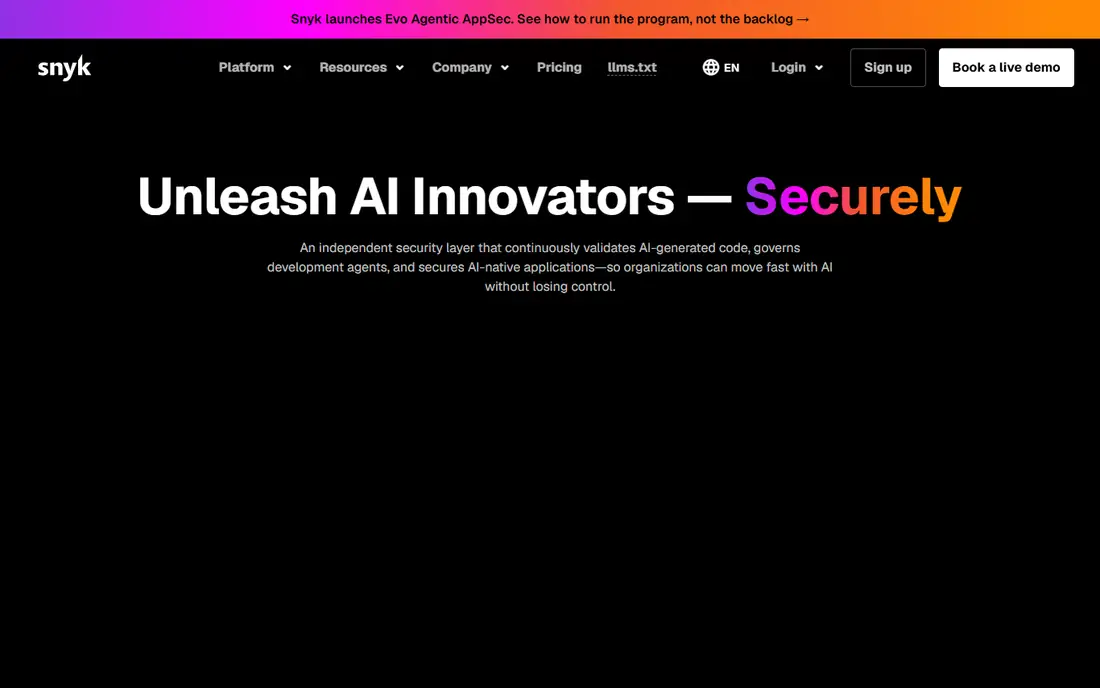
Snyk is built for developers, not only for security teams. It scans code, open-source dependencies, containers, and infrastructure as code, and it can open fix pull requests that developers can merge quickly. That workflow fits cloud teams that ship often and want security checks inside their normal review process.
Snyk covers several product areas, so pricing and setup can feel complex for new buyers. Alert volume is another risk: without tuning, teams can face many low-priority findings. With clear policies and prioritization, Snyk gives developer teams a fast, practical DevSecOps layer.
What we like- Fast feedback for code, dependencies, containers, and infrastructure code
- Fix pull requests
- Broad IDE and CI support
Watch out for- Multiple products can complicate pricing
- Large portfolios need tuning to avoid alert overload
Starting priceSee website
Free planYes
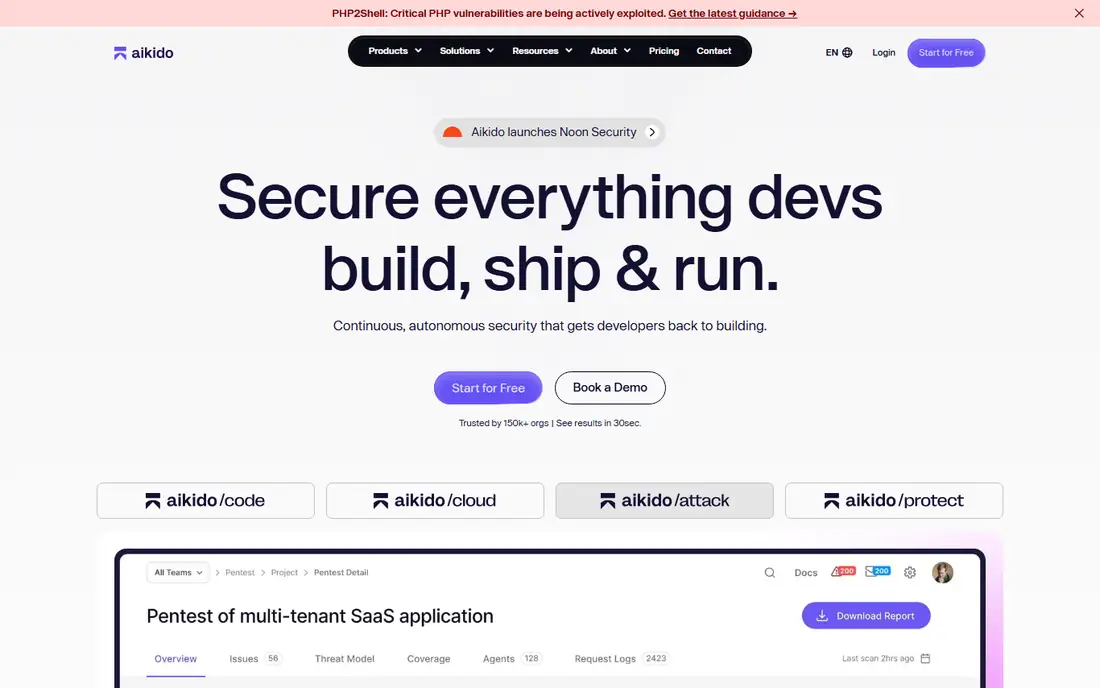
Aikido Security targets teams that want broad code-to-cloud coverage without buying several tools. It combines code scanning, dependency checks, container and cloud posture, and secrets detection, with AI-assisted fixes and pull request feedback. Smaller teams often find its pricing and setup easier than enterprise platforms.
Aikido is newer than long-standing rivals, so enterprises with complex compliance needs should test depth for their specific stacks. For startups and mid-size cloud teams that need one consolidated platform, Aikido offers a strong balance of coverage and usability.
What we like- Unified SAST, SCA, container, and cloud checks
- AI-assisted fixes
- Clear pricing for smaller teams
Watch out for- Newer than Snyk and Checkmarx
- Enterprise depth varies by use case
Starting priceSee website
Free planNo
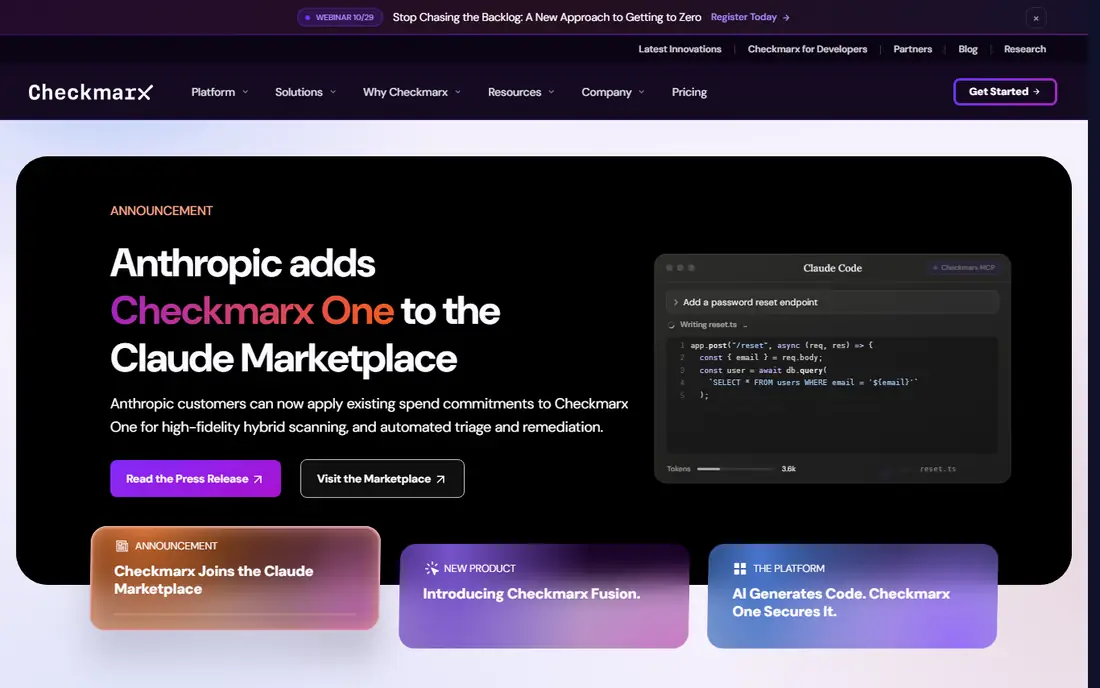
Checkmarx One is a long-standing enterprise application security platform, with deep static analysis and software composition analysis for large, complex codebases. It supports custom queries, policy enforcement, and detailed reporting for regulated industries. Teams with legacy code and strict compliance needs often choose it for depth.
Depth comes with effort. Checkmarx needs tuning to reduce false positives and to fit CI pipelines, and pricing is quote-based. Organizations with dedicated AppSec staff get the most from it. Smaller teams without that staff may prefer a simpler, developer-first tool.
What we like- Deep SAST and SCA for enterprise codebases
- Strong query customization
- Compliance and audit reporting
Watch out for- Quote-based pricing
- Tuning and staff time needed for best results
Starting priceSee website
Free planFree trial
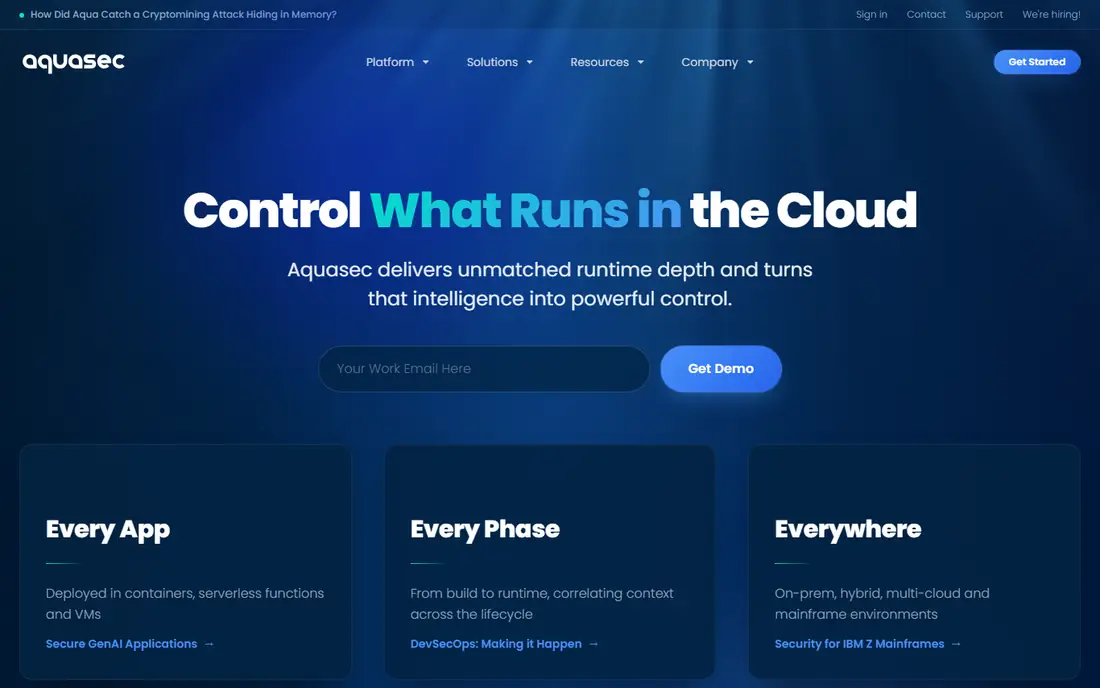
Aqua Security focuses on cloud-native workloads: containers, Kubernetes, and serverless functions, from build to runtime. It scans images and registries, checks Kubernetes posture, and adds runtime controls that block suspicious behavior in production. That full lifecycle view suits teams running many containers in the cloud.
Aqua is an enterprise platform, and smaller teams with a few containers may find it more than they need. Teams with large Kubernetes estates, regulated workloads, or strict runtime requirements will value its depth, especially where container security is a primary risk.
What we like- Strong container, Kubernetes, and cloud workload protection
- Runtime controls
- Registry and pipeline scanning
Watch out for- Enterprise focus
- Interface and setup can feel heavy for small teams
Starting priceSee website
Free planNo
Veracode suits enterprises that need governed application security with clear policies and audit trails. It offers static, dynamic, and dependency testing, with dashboards for security leaders and remediation guidance for developers. Managed service options help teams without a large internal AppSec staff.
The experience is more formal than developer-first tools, and pricing is quote-based. Teams that value speed and pull-request fixes above governance may prefer Snyk or Aikido. Enterprises in regulated sectors often accept the formality for the reporting and control Veracode provides.
What we like- Mature SAST, SCA, and DAST with policy controls
- Strong compliance reporting
- Managed services available
Watch out for- Quote-based pricing
- Developer experience is more formal than Snyk or Aikido
#8
Mend.io
Best for: Open-source dependency security
Visit mend.io
Starting priceSee website
Free planYes
Mend.io, formerly WhiteSource, focuses on open-source risk: vulnerabilities and license issues in dependencies. It scans large dependency trees, prioritizes exploitable issues, and suggests fixes, which helps teams with many third-party libraries. License reporting also helps legal and compliance teams.
Mend is strongest on dependencies, not as a single unified DevSecOps platform. Teams that need SAST, DAST, and cloud posture in one place may pair Mend with another tool. For organizations where open-source risk is the main concern, Mend offers focused depth.
What we like- Strong open-source dependency and license risk coverage
- Automated remediation
- Useful for large dependency trees
Watch out for- Broader DevSecOps coverage is less unified than Snyk or Aikido
- Pricing varies by scope
Starting priceSee website
Free planFree trial
Cycode takes a posture view of the whole software factory, linking code repositories, CI pipelines, infrastructure code, and cloud assets. That view helps security teams see which risks matter most, rather than treating every scanner finding as equal. Secrets detection, pipeline posture, and IaC checks add coverage beyond code scanning alone.
Cycode setup takes time, because it connects many systems to build that view. Smaller teams may prefer a simpler scanner first. For cloud teams with complex pipelines and many repositories, Cycode helps prioritize the risks that could actually lead to a breach.
What we like- Connects code, pipelines, and cloud posture
- Risk prioritization across the software factory
- Secrets and IaC checks
Watch out for- Platform scope needs setup time
- Pricing is quote-based for larger use
How we chose
We compared pricing pages, product documentation, and public reviews on G2, Capterra, and Reddit, and checked each service for cloud fit, scan types, pipeline integration, and developer workflow. We focused on services with current cloud DevSecOps offerings, not general monitoring alone, and we excluded discontinued products. We did not claim hands-on testing.
Rolling out DevSecOps without slowing releases
DevSecOps fails when security gates block work before developers trust the findings. A gradual rollout, with clear ownership and fixable alerts, works better than turning on every check at full severity on day one.
Start with new findings only
Block pipelines only on new, high-severity findings at first, and track older issues as technical debt with owners and deadlines. That approach stops new risk without punishing teams for a backlog they did not create. Over time, raise the bar as fix rates improve.
Put findings where developers work
Results in pull requests, IDEs, and existing chat tools get fixed faster than results in a separate security dashboard. Choose tools that integrate with your forge and CI system, and make fix guidance concrete, with file, line, and suggested change where possible.
Measure fix rate, not scan count
Track how many findings are fixed, how quickly, and which types recur. A tool that runs many scans but produces few fixes is not working, even if reports look impressive. Review those metrics monthly, tune noisy rules, and retire checks that developers consistently ignore for good reason.
Frequently asked questions
What is the best DevSecOps service for cloud?
GitLab Ultimate and GitHub Advanced Security are best for teams already on those platforms, while Snyk and Aikido suit developer-led cloud teams. Checkmarx and Veracode fit governed enterprises, and Aqua fits container-heavy cloud estates. The best choice depends on your forge, stack, and team size.
Do I need one platform or several DevSecOps tools?
One platform works well for small and mid-size teams, because it reduces integration work and alert sprawl. Larger teams often combine a forge-native platform with a specialist tool for containers, dependencies, or pipeline posture. Choose based on adoption: the tool developers fix findings from is the right core tool.
How much do DevSecOps services cost?
Costs range from free tiers for small projects to per-user or per-committer pricing for GitLab Ultimate and GitHub Advanced Security, and quote-based enterprise pricing for Checkmarx, Veracode, Aqua, and Cycode. Snyk and Aikido publish starter plans, with higher tiers for larger teams. Request a scoped quote based on developers, repositories, and cloud assets.
Can DevSecOps tools slow down CI pipelines?
Yes, if scans are poorly tuned or run on every commit without caching. Use incremental scans, cache results, and run deep scans on pull requests or nightly builds rather than on every push. Measure pipeline time before and after rollout, and tune rules that add time without finding real issues.
What is the difference between SAST, SCA, and DAST?
SAST scans source code for flaws without running the app, SCA checks open-source dependencies for vulnerabilities and license risk, and DAST tests a running app for exploitable issues. Most DevSecOps programs use SAST and SCA early, and add DAST for web apps and APIs before release.
Is DevSecOps only for large companies?
No, small cloud teams benefit from DevSecOps too, often with free or low-cost tiers from Snyk, Aikido, GitLab, and Mend. Start with code scanning, dependency checks, and secret scanning in your pipeline, then add container and cloud checks as your infrastructure grows.
Sources we checked (9)
- https://www.gitlab.com
- https://www.github.com
- https://www.snyk.com
- https://www.aikido.dev
- https://www.checkmarx.com
- https://www.aquasec.com
- https://www.veracode.com
- https://www.mend.io
- https://www.cycode.com
Is your product missing or out of date?
We review this list regularly. Vendors can request a listing, send updated pricing or ask about featured placement.

Shihab Mia · Founder, Rankite
Shihab has 5+ years in B2B and SaaS SEO. He writes Rankite's software buying guides from pricing pages, documentation and public user reviews. More about Shihab.