How we make this list: we compare pricing pages, product documentation and public user reviews. Rankite is independent; if a vendor ever pays for a featured spot, that listing is clearly labeled Partner.
Key takeaways
- Most enterprise WFM vendors publish no prices: NICE, Verint, Calabrio, Aspect, Genesys, Five9, Talkdesk and Playvox are all custom-quote, so budget for a sales process and a 30 to 60 day implementation.
- Assembled is the only standalone WFM here with a published starting price: $25 per user per month for its Workforce Management product, with no free trial.
- Already on Zendesk? The Workforce Engagement Bundle (WFM plus QA) costs $50 per agent per month paid yearly, on top of a Suite plan.
- Verint and Calabrio are now one company (the Thoma Bravo merger closed in 2025) with the Calabrio product line continuing, so expect bundled quotes that pair both WFM lines.
Quick comparison
| Tool | Best for | Starting price | Free plan |
|---|
 NICE WFM NICE WFM | Large call centers already running on NICE CXone | See website (custom quote, enterprise pricing) | No (no free trial advertised) |
 Verint WFM Verint WFM | Enterprises with complex governance, labor laws and back-office work | See website (custom quote, enterprise pricing) | No (no free trial advertised) |
 Calabrio Calabrio | Inbound contact centers that want WFM live fast | See website (custom quote) | No (no free trial advertised) |
 Aspect Aspect | Regulated industries that need on-premises or hybrid deployment | See website (custom quote, enterprise pricing) | No (no free trial advertised) |
 Genesys Cloud WFM Genesys Cloud WFM | Contact centers already running Genesys Cloud CX | See website (custom quote) | No (no free trial advertised) |
 Assembled Assembled | Support teams that want modern WFM with published pricing | $25/user/month (Workforce Management product) | No (no free trial advertised) |
 Playvox Playvox | Contact centers that want WFM tied to coaching and gamification | See website (custom quote) | No (no free trial advertised) |
 Five9 WEM Five9 WEM | Five9 Intelligent CX Platform customers | See website (custom quote) | No (no free trial advertised) |
 Talkdesk WFM Talkdesk WFM | Talkdesk customers modernizing their scheduling | See website (custom quote) | No (no free trial advertised) |
 Zendesk WFM Zendesk WFM | Support teams that live entirely inside Zendesk | $50/agent/month (Workforce Engagement Bundle, paid yearly, plus Suite plan) | No (14-day trial applies to base Suite plans) |
Is your product missing or out of date?
We review this list regularly. Vendors can request a listing, send updated pricing or ask about featured placement.
Staffing a call center is arithmetic until it is not. Forecast accuracy, shrinkage, adherence, multi-skill scheduling, BPO coordination and agent self-service all interact, and a spreadsheet collapses under the weight around 50 agents. These ten platforms cover the call-center WFM market from enterprise suites to transparently priced modern tools.
#1
NICE WFM
Best for: Large call centers already running on NICE CXone
Visit nice.com
Starting priceSee website (custom quote, enterprise pricing)
Free planNo (no free trial advertised)
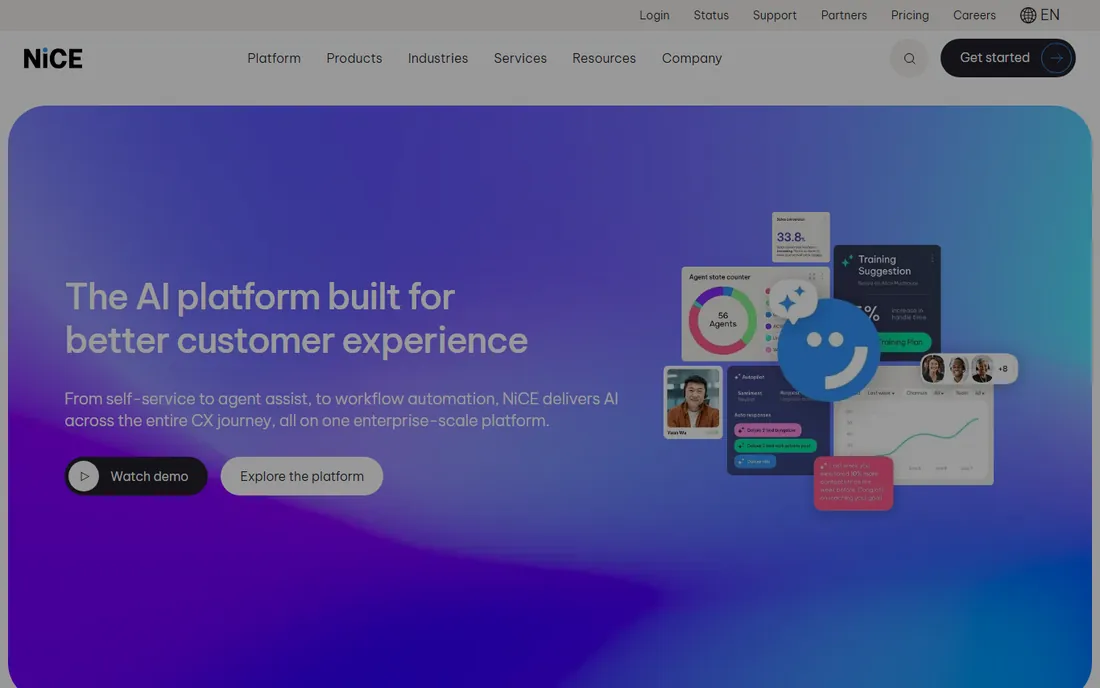
NICE Workforce Management sits inside the NICE CXone ecosystem, which is its main selling point. If your contact center already runs NICE for routing and recording, WFM inherits the same interaction data, so forecasts learn from real demand patterns instead of imported spreadsheets. The forecasting engine uses multiple models that adapt in real time, and the scheduling layer handles multi-skill agents, shift bidding, trading and preference-based rostering with policy-aware automation.
The honest catch is the buying process. There is no published price and no self-serve trial, so expect a sales cycle, a discovery phase and an implementation measured in months. Reviewers consistently say NICE suits 200-agent-and-up operations where the license cost is absorbed by scale. Smaller centers get quoted numbers that point them toward Calabrio or Assembled anyway. If you run NICE CXone already, this is the path of least resistance. If you do not, start elsewhere.
What we like- Deep AI forecasting with multi-model accuracy claims and continuous learning
- Schedule self-service with bidding, trading and preference-based rostering
- Real-time adherence and intraday management in the same suite
Watch out for- Enterprise pricing with no published numbers, so small centers are priced out early
- Implementations are long and consultant-heavy
- Reporting flexibility is weaker than dedicated BI
#2
Verint WFM
Best for: Enterprises with complex governance, labor laws and back-office work
Visit verint.com
Starting priceSee website (custom quote, enterprise pricing)
Free planNo (no free trial advertised)
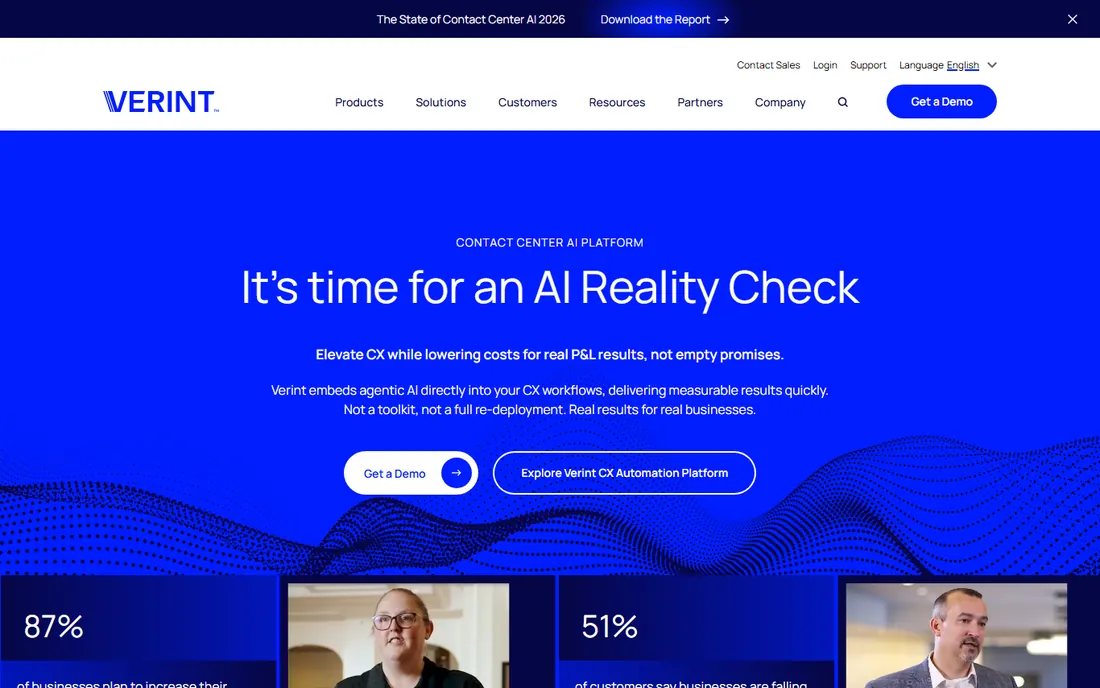
Verint has been the enterprise WFM standard for three decades, and the product shows that maturity. Forecasting covers voice, digital and back-office work, scheduling handles diverse labor rules and governance needs, and the TimeFlex Bot lets agents change schedules on the fly while the system protects coverage. The open-platform pitch is real: Verint runs on top of your existing CCaaS and CRM instead of forcing a migration.
Two things changed the calculus in 2025. Thoma Bravo took Verint private and merged it with Calabrio, so Verint now sells two WFM product lines: the deep enterprise Verint line and the easier-to-deploy Calabrio line. Ask your rep which one you are buying, because the price and implementation differ materially. The honest catch is scope: under 100 agents this is more product than you need, and the quote will reflect it. For large, regulated operations it remains the safe enterprise choice.
What we like- Strongest forecasting for complex operations with multi-skill and back-office coverage
- TimeFlex Bot gives agents unlimited self-service schedule changes
- Open platform that runs on your existing CCaaS without rip and replace
Watch out for- Custom pricing with long enterprise sales cycles
- The Verint-Calabrio merger creates product-line overlap that buyers must untangle
- Smaller teams find it overbuilt
Starting priceSee website (custom quote)
Free planNo (no free trial advertised)
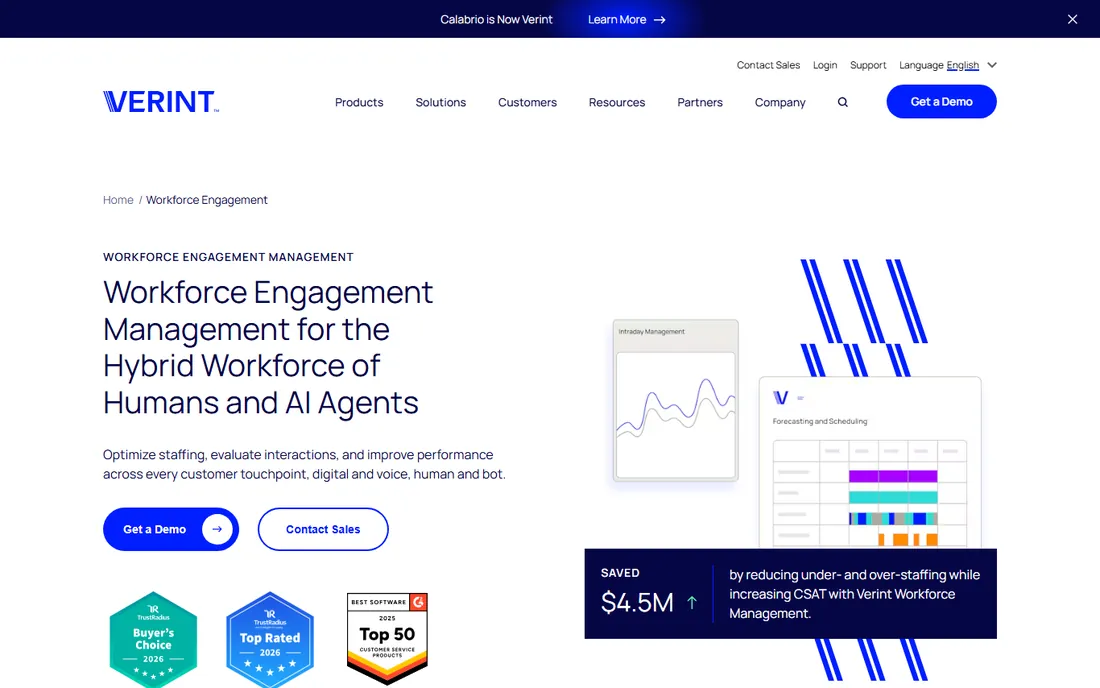
Calabrio earned its reputation by doing one thing well: inbound contact center WFM that goes live quickly. Forecasting, scheduling, adherence and agent self-service come in a clean interface that schedulers learn fast, and the deployment timeline is measured in weeks rather than the months the enterprise suites demand. It is the classic pick for 50 to 500 agent centers that want forecasting accuracy without an implementation army.
The honest catch is corporate. Calabrio is now part of Verint, and calabrio.com currently serves Verint-branded content while the Calabrio product line continues inside the portfolio. That means your long-term roadmap depends on Verint's platform strategy, not an independent Calabrio. In practice, existing Calabrio customers report continuity and support, and new buyers should simply confirm in writing that the Calabrio product line is the one quoted. If Verint quotes you both lines, Calabrio is the faster, simpler deployment.
What we like- Purpose-built for inbound centers with fast deployment and an easy learning curve
- Strong agent self-service and schedule flexibility
- The product line continues and is supported after the Verint merger
Watch out for- No published pricing
- Less depth for back-office and multi-site complexity than Verint's enterprise line
- Future roadmap now sits inside Verint's platform strategy
#4
Aspect
Best for: Regulated industries that need on-premises or hybrid deployment
Visit aspect.com
Starting priceSee website (custom quote, enterprise pricing)
Free planNo (no free trial advertised)
Aspect is the reborn legacy brand of Alvaria, and it carries the oldest WFM lineage in the business: the company introduced the industry's first workforce management solution in 1973. The modern product keeps that forecasting depth while offering something the cloud-only vendors cannot: true deployment choice. Banks, insurers, healthcare systems and government operations that need data residency or on-premises control can run Aspect the way their compliance teams require.
The honest catch is the rebrand trail. Documentation and reviews mix "Alvaria WFM", "Aspect Workforce" and "Alvaria Workforce Enterprise Suite", which confuses buyers researching the product's history. The current product is Aspect Workforce, sold at aspect.com. Pricing is enterprise and quote-based, and the sales cycle reflects that. If you need on-premises WFM, this is one of very few real options. If you are a 60-agent SaaS support team, the modern tools below fit better.
What we like- Full deployment choice: on-premises, hosted, private cloud or public cloud
- Deep forecasting with multi-model accuracy and real-time adherence
- PCI DSS, SOC 2 Type 2 and ISO 27001 compliance posture for financial services and healthcare
Watch out for- Enterprise pricing with no published numbers
- The Alvaria to Aspect rebrand creates naming confusion in older documentation
- Overkill for sub-100-agent teams
#5
Genesys Cloud WFM
Best for: Contact centers already running Genesys Cloud CX
Visit genesys.com
Starting priceSee website (custom quote)
Free planNo (no free trial advertised)

Genesys Cloud WFM only makes sense in one situation: you already run Genesys Cloud CX. In that setup it is strong, because workforce management reads directly from the platform's routing, skills and media data instead of syncing with a third party. Forecasting and scheduling cover inbound voice, chat, callbacks, email and messaging, with multi-skill support and real-time adherence.
The honest catch is that there is no way to buy it separately. This is a platform module, not a standalone product, so the "price" is your Genesys Cloud license. Teams evaluating Genesys Cloud against alternatives should price the WFM capability into the total contract rather than treating it as free. Forecast configuration has real limits (route groups, forecast windows, supported media types) that your WFM admin must understand before go-live. If you are on Genesys, use it. If you are shopping for WFM alone, the standalone vendors below are the comparison set.
What we like- Native WFM inside the Genesys Cloud platform, so forecasting and scheduling inherit real interaction data
- Supports voice, chat, callbacks, email and messaging
- Strong AI roadmap with agentic workforce orchestration
Watch out for- No standalone offering, so you buy the whole Genesys Cloud platform
- Forecasting limits on route groups and forecast windows require careful configuration
- Pricing is opaque
#6
Assembled
Best for: Support teams that want modern WFM with published pricing
Visit assembled.com
Starting price$25/user/month (Workforce Management product)
Free planNo (no free trial advertised)
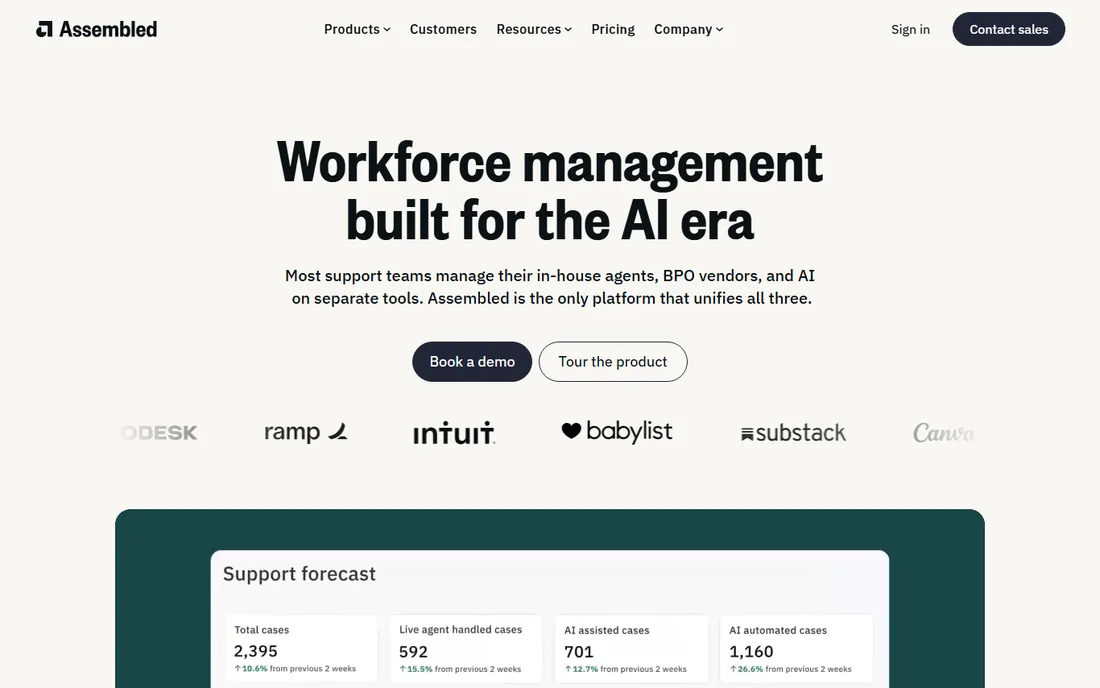
Assembled is the modern answer to legacy WFM. It built forecasting, scheduling and real-time management for the way support teams actually work: omnichannel, partly outsourced, increasingly AI-assisted. The forecasting models work out of the box and the staffing timeline gives managers a visual, bulk-editable view of coverage. It is the rare WFM vendor that publishes pricing: the Workforce Management product starts at $25 per user per month.
The honest catch is that $25 per user is the starting point for the WFM module, and the full orchestration suite with AI agents and copilot costs more. Reporting customization is shallower than what BI-driven enterprises expect, and some reviewers note scheduling flexibility limits for unusual shift structures. For SaaS, ecommerce and fintech support teams between 25 and 500 agents, Assembled is the most buyer-friendly option on this list: transparent price, fast setup, modern interface.
What we like- Published starting price of $25 per user per month for WFM
- ML-based forecasting and AI-powered scheduling that work out of the box
- Unifies human agents, BPO vendors and AI agents in one staffing view
Watch out for- No free trial and no free plan
- Reporting depth lags dedicated BI for complex operations
- Integrations beyond the support stack are thinner than enterprise suites
#7
Playvox
Best for: Contact centers that want WFM tied to coaching and gamification
Visit playvox.com
Starting priceSee website (custom quote)
Free planNo (no free trial advertised)
Playvox sells workforce engagement, not just workforce management. Forecasting, scheduling, adherence and reporting sit alongside quality scoring, coaching workflows and gamification, all aimed at keeping agents motivated. The integration list is its strongest card: Salesforce, Zendesk, Amazon Connect, Kustomer, Slack and more, which is why digital-native brands picked it early.
The honest catch is pricing opacity and scale. There is no published price, and the buying motion is sales-led, which puts it in the same bracket as the enterprise tools despite its mid-market positioning. Teams that are voice-heavy should demo the telephony side carefully, because Playvox's roots are in digital channels. For support-led companies that already use Zendesk or Salesforce and want WFM plus agent engagement in one place, it deserves a demo slot.
What we like- WFM, quality management, coaching and gamification in one agent-engagement suite
- Deep integrations with Salesforce, Zendesk, Amazon Connect, Kustomer and Slack
- Purpose-built for digital-first support teams
Watch out for- No published pricing and no self-serve signup
- The platform skews digital channels, with voice as the weaker side
- Smaller vendors face an uncertain roadmap against giants
#8
Five9 WEM
Best for: Five9 Intelligent CX Platform customers
Visit five9.com
Starting priceSee website (custom quote)
Free planNo (no free trial advertised)
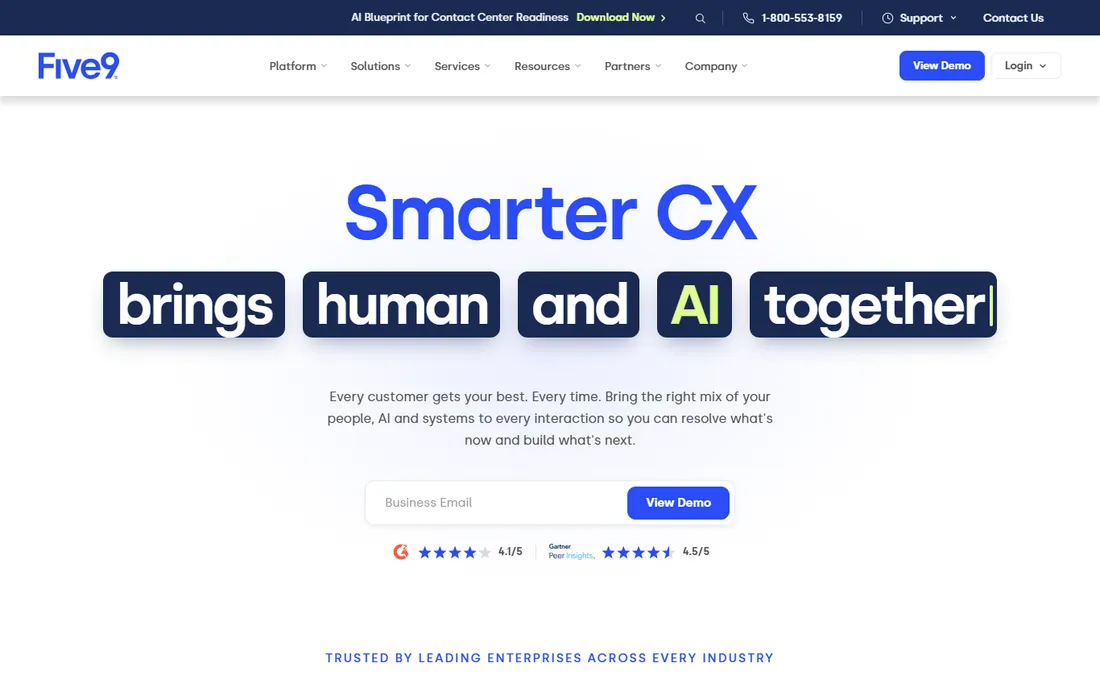
Five9's workforce engagement management is the platform-native option for its 3,000-plus customers. Forecasting, scheduling, adherence and agent engagement run on the same data as Five9's routing and analytics, which removes the integration tax entirely. The product has earned analyst recognition, including Metrigy's MetriStar for WEM excellence, for driving agent performance and productivity.
The honest catch is the same as Genesys: this is a platform module, not a standalone purchase. If you are already on Five9, the WEM suite is the natural choice and the demo is easy. If you are choosing a contact center platform and WFM is a decision factor, price Five9's WEM against Genesys Cloud WFM and NICE CXone as part of the platform comparison, not as a standalone WFM shootout. Switching platforms later means re-buying WFM too.
What we like- AI-powered workforce engagement management native to the Five9 platform
- Earned Metrigy's MetriStar recognition for WEM
- Tight coupling with Five9 routing, analytics and AI
Watch out for- Only available to Five9 customers
- No published pricing for the WEM module
- Buying WFM locks you further into the Five9 stack
#9
Talkdesk WFM
Best for: Talkdesk customers modernizing their scheduling
Visit talkdesk.com
Starting priceSee website (custom quote)
Free planNo (no free trial advertised)
Talkdesk's workforce management offering targets its own installed base: contact centers on Talkdesk that want forecasting and scheduling without bolting on a third party. The module covers the core WFM loop (forecast, schedule, intraday, adherence) with agent self-service, and it inherits Talkdesk's AI investment, which is now the company's main identity.
The honest catch is maturity. Talkdesk's WFM is younger than NICE's, Verint's or Aspect's, and its forecasting depth for complex multi-skill, multi-site operations is less proven. Pricing is not published separately; it is negotiated inside the Talkdesk contract. For existing Talkdesk customers, the convenience argument is strong: one vendor, one contract, native data. For standalone WFM buyers, the specialists above have deeper forecasting engines and longer track records.
What we like- WFM built for the Talkdesk platform with AI-driven forecasting and scheduling
- Strong agent self-service and real-time adherence
- Benefits from Talkdesk's agentic AI roadmap
Watch out for- Platform-only, no standalone option
- Pricing is bundled into the Talkdesk contract
- Newer WFM capability than the specialist vendors, with a shorter track record
#10
Zendesk WFM
Best for: Support teams that live entirely inside Zendesk
Visit zendesk.com
Starting price$50/agent/month (Workforce Engagement Bundle, paid yearly, plus Suite plan)
Free planNo (14-day trial applies to base Suite plans)
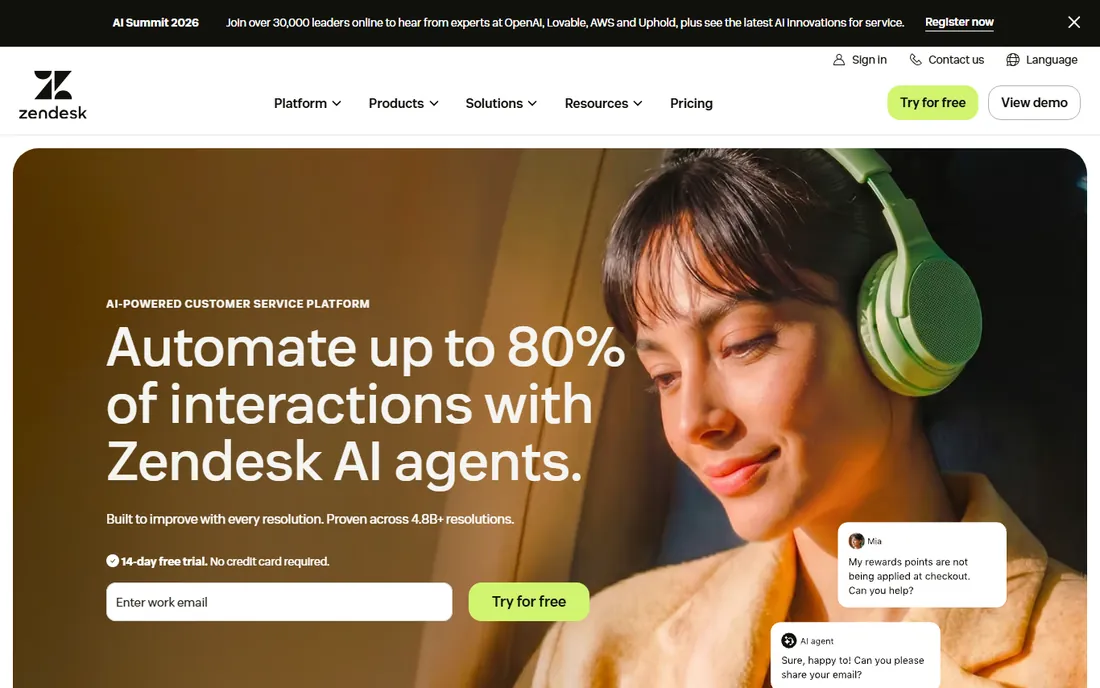
Zendesk Workforce Management is the convenience pick for the 22,000-plus service teams on Zendesk. Forecasting, auto-scheduling, real-time adherence and agent self-service run inside the agent workspace on native ticket, voice and chat data. There is no data pipeline to build and no second login for agents, which is why small-to-mid-sized Zendesk shops adopt it quickly.
The honest catch is the pricing structure. Zendesk sells WFM inside the Workforce Engagement Bundle at $50 per agent per month paid yearly, and that price applies to all licensed seats, not only the agents you schedule. Add that to a Suite plan (Team starts at $19 per agent per month annually) and the all-in number climbs fast past 50 agents. Forecasting flexibility and reporting depth also trail the specialists, so complex operations outgrow it. If you run Zendesk and your scheduling needs are straightforward, this is the fastest path. If you need deep WFM, pair Zendesk with Assembled instead.
What we like- Native WFM inside the Zendesk agent workspace, no integration needed
- AI-driven forecasting on native ticket, voice and chat data
- Fast time to value for existing Zendesk customers
Watch out for- Only works inside the Zendesk ecosystem
- The bundle price applies to all licensed seats, not just scheduled agents, which raises the bill at scale
- Forecasting flexibility and reporting depth lag specialists
The two questions that decide your shortlist
First: are you already on a contact center platform? If you run NICE CXone, Genesys Cloud, Five9 or Talkdesk, the platform-native WFM is almost always the right answer. It inherits your routing and interaction data, removes an integration, and is negotiated inside a contract you already pay. Standalone WFM only beats it when your scheduling complexity exceeds what the platform module handles.
Second: how complex is your operation? Under 100 agents with mostly digital channels, Assembled or Zendesk WFM will be live faster and cheaper than an enterprise suite. Past 200 agents, with multi-skill routing, BPOs, back-office work or regulated labor rules, the enterprise vendors (NICE, Verint, Aspect) earn their fees. The 100 to 200 agent range is the contested middle, where Calabrio, Playvox and Assembled all compete, and where a proper demo with your real data separates the finalists.
What the quotes actually look like
Every enterprise vendor on this list quotes custom, so the price you pay depends on agent count, modules, term length and negotiation. A few structural facts help you read the quotes. Assembled is the only standalone with a published starting price: $25 per user per month for Workforce Management. Zendesk publishes its add-on price: $50 per agent per month for the Workforce Engagement Bundle, paid yearly, on top of your Suite plan.
The quote-based vendors typically price per named agent or per concurrent seat, with annual contracts and volume tiers. Professional services (implementation, integration, training) are often quoted separately and can add 20 to 40 percent to the first-year cost. Multi-year terms bring discounts of 15 to 25 percent at the mid-market level. Always ask whether the quote includes all seats or only scheduled agents, whether the add-on requires a base platform license, and what the renewal uplift clause says. The cheapest year-one quote is rarely the cheapest three-year deal.
How we chose
We started with the categories buyers search: workforce management software, call center WFM, contact center workforce management and WFM for support teams. For each candidate we opened the vendor's own homepage to confirm the product exists and checked the vendor's pricing page for published prices. We compared features, forecasting and scheduling depth, integrations and company-size fit against public reviews on G2, Capterra and SelectHub, plus practitioner discussion. Where a price could not be verified on the vendor's page we wrote "See website" rather than guessing. We excluded discontinued products and general HR tools that lack call-center scheduling.
Frequently asked questions
What is workforce management software for call centers?
It forecasts contact volume, builds agent schedules to meet service goals, tracks real-time adherence and manages time off, shift swaps and intraday changes. The goal is simple: the right agents, with the right skills, in the right channels, at the right time, without overstaffing.
How much does call center WFM software cost?
Standalone tools with published pricing start around $25 per user per month (Assembled). Zendesk's WFM bundle is $50 per agent per month on top of a Suite plan. Enterprise suites (NICE, Verint, Aspect, Genesys, Five9, Talkdesk, Playvox, Calabrio) are custom-quoted, typically per agent per year with volume tiers and separate implementation fees.
Do I need WFM if my contact center platform has it built in?
Usually not as a separate purchase. Platform-native WFM (NICE, Genesys Cloud, Five9, Talkdesk) inherits your routing data and removes an integration. Buy standalone WFM when your scheduling complexity, BPO coordination or back-office work exceeds what the platform module handles.
What happened to Calabrio and Verint?
Thoma Bravo took Verint private in 2025 and merged it with its portfolio company Calabrio. The combined company operates under the Verint name, while the Calabrio product line continues as part of the portfolio. Buyers should confirm which product line is quoted, because Verint's enterprise line and Calabrio's faster-deploying line differ in price and implementation.
Can WFM software manage BPO vendors and AI agents too?
The modern tools can. Assembled unifies in-house agents, BPO vendors and AI agents in one staffing view, and most enterprise suites now model AI capacity alongside human schedules. If outsourcing or AI deflection is part of your strategy, make BPO and AI capacity planning a demo requirement.
How long does WFM implementation take?
Standalone and platform-native tools typically go live in 2 to 6 weeks. Enterprise suites (NICE, Verint, Aspect) usually need 2 to 6 months with professional services, longer for multi-site or regulated deployments. Data quality is the usual bottleneck: forecasts are only as good as your historical volume data.
Sources we checked (15)
- https://www.nice.com
- https://verint.com/
- https://www.calabrio.com
- https://www.aspect.com
- https://genesys.com/
- https://www.assembled.com/
- https://www.assembled.com/pricing
- https://playvox.com/
- https://five9.com/
- https://talkdesk.com/
- https://www.zendesk.com
- https://www.zendesk.com/pricing/contact-center/
- https://www.g2.com/categories/workforce-management
- https://www.capterra.com/workforce-management-software/
- https://www.selecthub.com/workforce-management-software/assembled-vs-zendesk-workforce-management/
Is your product missing or out of date?
We review this list regularly. Vendors can request a listing, send updated pricing or ask about featured placement.

Shihab Mia · Founder, Rankite
Shihab has spent more than a decade helping SaaS and e-commerce brands grow through search. He writes Rankite's software buying guides from pricing pages, documentation and public user reviews. More about Shihab.