How we make this list: we compare pricing pages, product documentation and public user reviews. Rankite is independent; if a vendor ever pays for a featured spot, that listing is clearly labeled Partner.
Key takeaways
- BambooHR is the default recommendation for US small businesses outgrowing spreadsheets, with HR, applicant tracking, and payroll in one place, but pricing is quote-only.
- Zoho People is the cheapest credible HRIS on this list at $1.50 per user per month, and a natural pick for businesses already using Zoho apps.
- Gusto is the pick when payroll is the real problem, pairing full-service payroll and tax filing with enough HR to cover the basics.
- CharlieHR, Breathe HR, Personio, and Factorial are stronger choices for UK and European small businesses, where local compliance matters more than US feature depth.
- Most small businesses do not need the deepest platform. Pick the tool that covers hiring, time off, onboarding, and employee records well, and ignore the rest until you are bigger.
Quick comparison
| Tool | Best for | Starting price | Free plan |
|---|
 BambooHR BambooHR | US small businesses outgrowing spreadsheets | See website (custom quote, based on employee count) | No |
 Zoho People Zoho People | Small teams that want the cheapest credible HRIS | $1.50/user/month (Essential HR plan) | Free trial (30 days) |
 Gusto Gusto | US small businesses where payroll is the real headache | See website (published tiered pricing on vendor site) | No |
 Factorial Factorial | European and international small businesses | See website (custom quote) | No |
 HiBob HiBob | Growing companies that treat culture as a feature | See website (custom quote) | No |
 GoCo GoCo | Small businesses that want HR plus benefits administration | See website (published plans on vendor site) | No |
 Eddy Eddy | Small businesses buying HR software for the first time | See website (custom quote) | No |
 CharlieHR CharlieHR | UK small businesses that want HR without the fuss | See website (published per-user pricing on vendor site) | No |
 Personio Personio | European SMBs that need compliance depth | See website (custom quote) | No |
 Breathe HR Breathe HR | UK micro-businesses that want the simplest possible HRIS | See website (published per-employee pricing on vendor site) | No |
Is your product missing or out of date?
We review this list regularly. Vendors can request a listing, send updated pricing or ask about featured placement.
Nobody hires an HR manager at ten employees
The first HR software purchase happens for a practical reason. Time-off requests live in Slack threads. Offer letters are a Word template. Somewhere there is a spreadsheet of start dates, and nobody is sure it is current. The best human resources software for small business solves exactly this: employee records, time off, onboarding, and hiring in one place, without the enterprise weight or the enterprise price.
The ten tools below split along a few useful lines. BambooHR, Zoho People, GoCo, and Eddy are classic HRIS platforms for small US teams. Gusto comes at HR from the payroll side. HiBob aims at slightly larger companies that care about culture and engagement. Factorial, Personio, CharlieHR, and Breathe HR serve the UK and European markets, where compliance and local payroll rules change the equation. Find your situation first, then pick.
Starting priceSee website (custom quote, based on employee count)
Free planNo
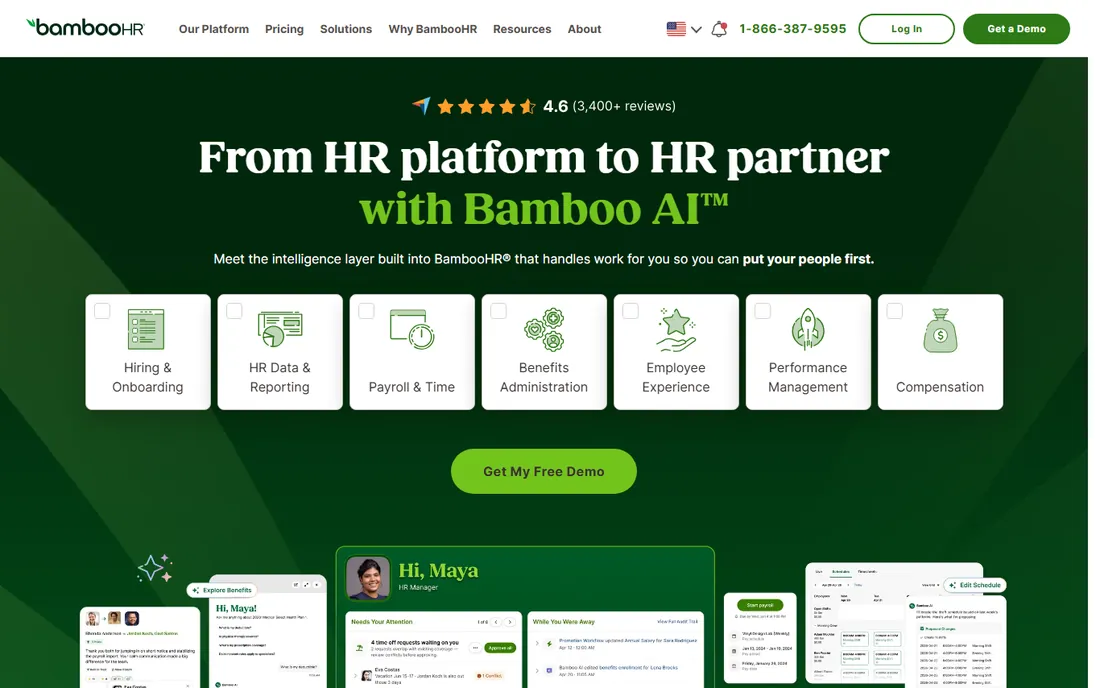
BambooHR is the name most small business owners hear first, and for good reason. The platform covers the full HR lifecycle: hiring and onboarding through its applicant tracking system, employee records and automated reporting, time tracking, benefits enrollment, performance management, and compensation planning. Payroll is available as an add-on that shares data with the HR system, which removes the double entry that plagues small teams.
The vendor reports more than 30,000 customers, which makes it one of the most widely adopted HR platforms for small and midsize businesses in the US. The tradeoff is transparency: pricing varies by employee count and features, and the company publishes no numbers, so budget-conscious buyers should get the quote early and compare it against per-user alternatives like Zoho People before committing.
What we like- All-in-one HR, applicant tracking, payroll add-on, and benefits in one platform
- More than 150 pre-built integrations
- In-house support team with strong reputation
Watch out for- No published pricing, everything runs through sales
- Payroll is a separate add-on rather than built in
- Overkill and overpriced for teams under ten people
#2
Zoho People
Best for: Small teams that want the cheapest credible HRIS
Visit zoho.com
Starting price$1.50/user/month (Essential HR plan)
Free planFree trial (30 days)
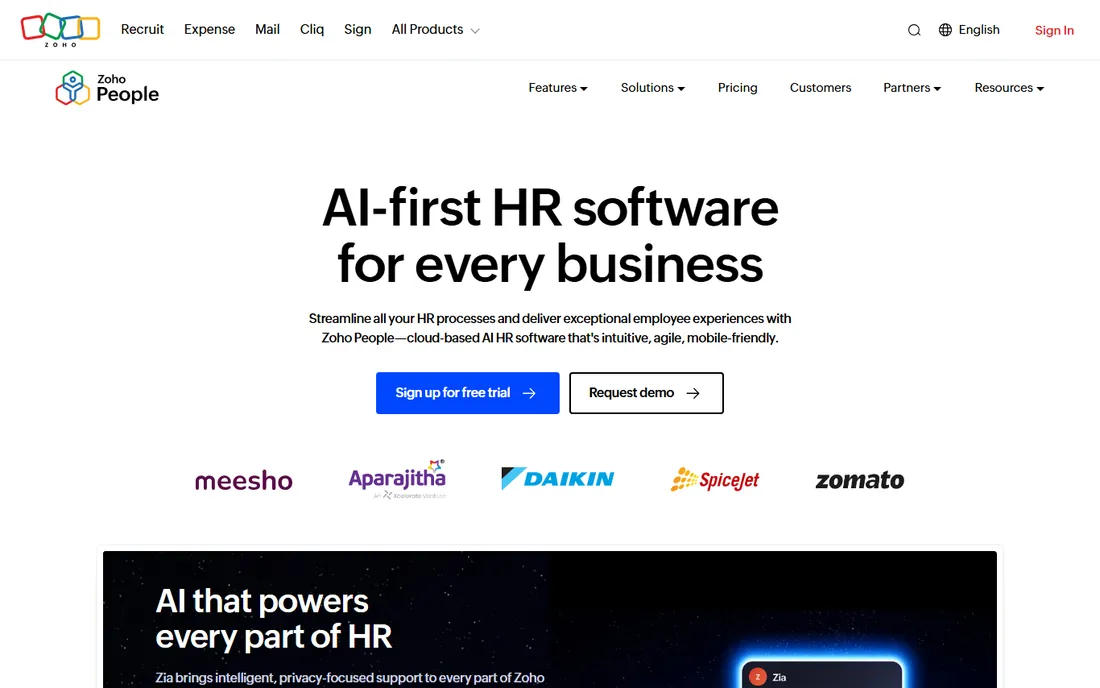
Zoho People is the value play in small business HR software. The Essential HR plan starts at $1.50 per user per month, which means a 20-person company pays around thirty dollars a month for core HR, onboarding, and time-off management. Higher tiers add attendance, shift scheduling, performance management, and analytics at still-modest per-user rates. The vendor offers a 30-day free trial on all plans.
The product covers the essentials well: employee database, leave management, document management, performance appraisals, and an HR helpdesk. Businesses already running Zoho CRM, Books, or Projects get the most value, since the shared ecosystem removes integration work. It is less polished than the leaders, but at this price the tradeoff is easy to justify.
What we like- Per-user pricing among the lowest in the category
- 30-day free trial with no credit card required
- Deep integration with the wider Zoho suite
Watch out for- Interface feels dated next to BambooHR and HiBob
- US payroll runs through integrations rather than natively
- Support can be slower than dedicated HRIS vendors
#3
Gusto
Best for: US small businesses where payroll is the real headache
Visit gusto.com
Starting priceSee website (published tiered pricing on vendor site)
Free planNo
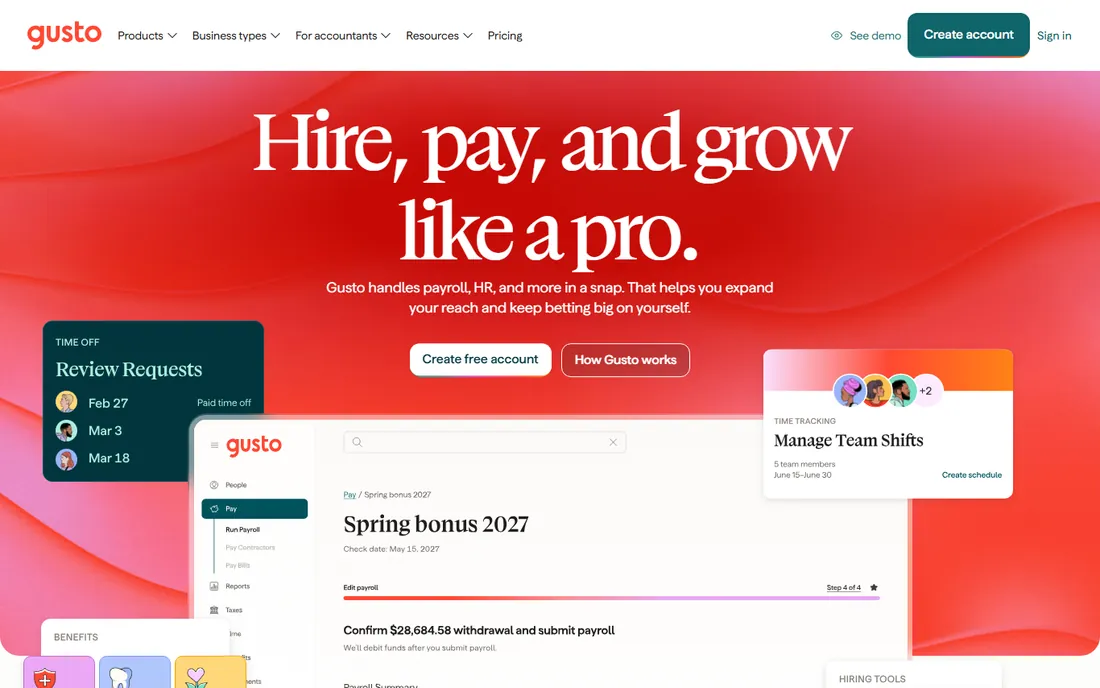
Gusto approaches HR from the payroll side, and for many small businesses that is exactly right. Full-service payroll with automatic tax calculations and filings removes the scariest part of employing people, and the platform layers on benefits administration, onboarding, time tracking, and employee self-service. Contractor payments are straightforward, which matters for small teams that mix employees and freelancers.
The honest catch is scope. If your main problems are recruiting, performance management, and HR analytics, Gusto is thinner than the dedicated HRIS tools on this list. But if payroll compliance keeps you up at night and you want enough HR to stay organized, Gusto is the most complete payroll-first option for US small businesses.
What we like- Full-service payroll with automatic tax filing in all 50 states
- Benefits administration and contractor payments included
- Famously simple setup for non-HR people
Watch out for- Payroll is US-only
- The most useful HR features sit in higher tiers
- HR depth lags behind dedicated HRIS platforms like BambooHR
Starting priceSee website (custom quote)
Free planNo
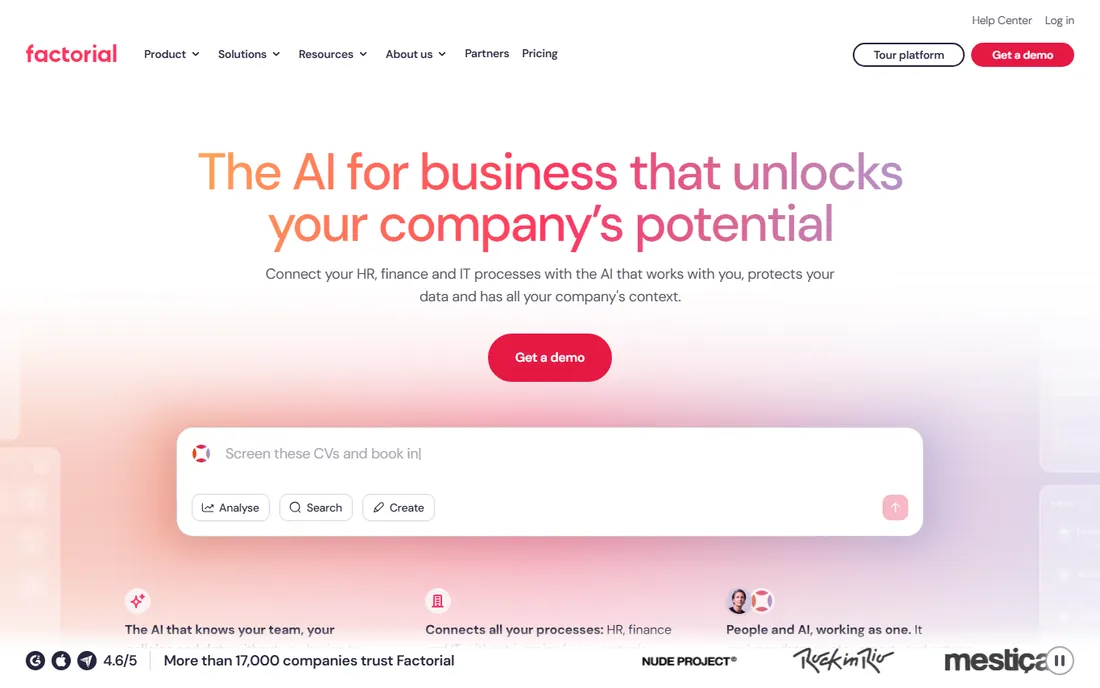
Factorial is the European answer to BambooHR: an all-in-one HR platform built for small and midsize businesses, with particular strength in markets like Spain, France, Germany, and Italy. The platform covers time off, attendance, shift planning, applicant tracking, document management, performance reviews, and expense management, with workflows adapted to local labor regulations.
For a US-only business, the case is weaker, since the product's differentiators are European compliance and localization. But for businesses hiring across Europe, or European companies that want one HR system as they grow, Factorial is one of the most complete options at the small business price point.
What we like- All-in-one HR, applicant tracking, time off, and shift management
- Strong presence across Europe with localized compliance
- Document management and e-signature built in
Watch out for- US feature depth and support lag behind its European offering
- Quote-based pricing makes comparison shopping harder
- Smaller integration marketplace than US rivals
#5
HiBob
Best for: Growing companies that treat culture as a feature
Visit hibob.com
Starting priceSee website (custom quote)
Free planNo
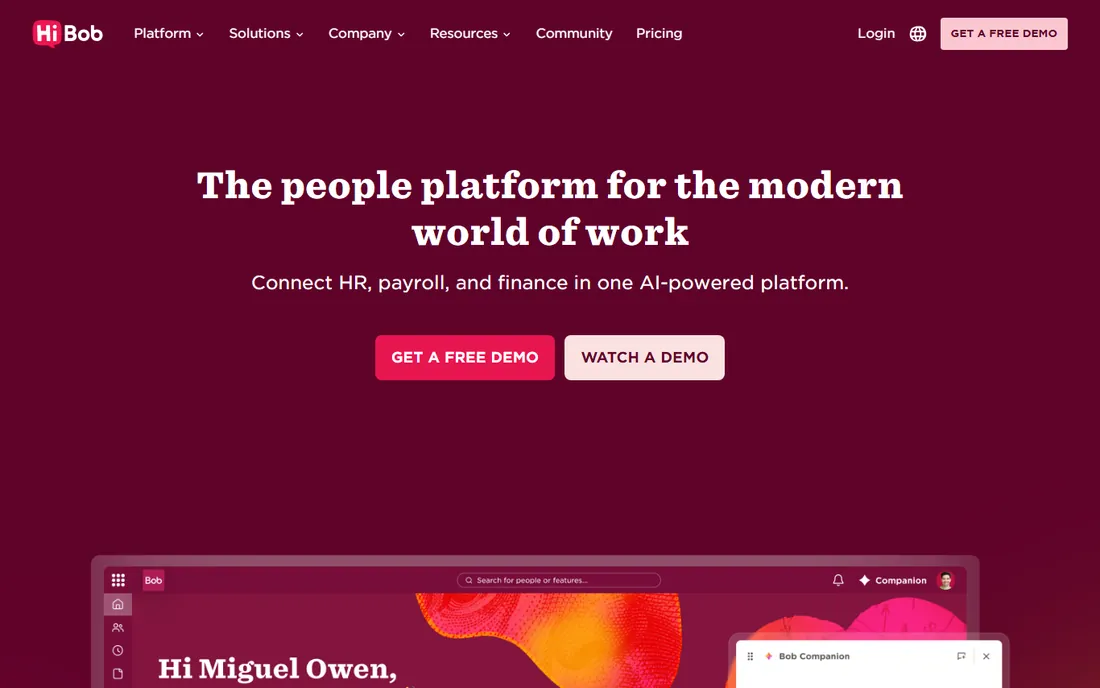
HiBob, sold as "Bob," is the HRIS for companies that have outgrown basic record-keeping and want HR software that shapes how the company works. The platform is known for its modern design, engagement surveys, performance management, and culture tools like shout-outs and clubs. It positions itself for fast-growing, often distributed companies where employee experience is a hiring advantage.
Small businesses at the ten-to-twenty-person stage may find HiBob more than they need, and the quote-based pricing reflects its mid-market ambitions. But for a 50-person company that has tried a cheaper HRIS and found employees ignoring it, HiBob's engagement-first approach is a genuine differentiator.
What we like- Modern, engaging interface employees actually use
- Strong culture, engagement, and performance tools
- Solid integration catalog
Watch out for- Quote-only pricing with no public numbers
- Best suited to companies of 50-plus employees
- Onboarding and ATS features are lighter than HR-first rivals
#6
GoCo
Best for: Small businesses that want HR plus benefits administration
Visit goco.io
Starting priceSee website (published plans on vendor site)
Free planNo
GoCo is an all-in-one HR platform aimed squarely at small US businesses, combining employee records, onboarding workflows, time-off tracking, document management, and benefits administration. The pitch is simplicity: one system for the HR tasks that eat a founder's week, with workflows that guide employees through enrollment and onboarding without hand-holding.
The platform integrates with payroll providers rather than running payroll itself, so businesses that want payroll and HR under one roof should look at Gusto or BambooHR instead. For teams that already have payroll handled and need the HR side done well, GoCo is a focused, affordable-feeling option.
What we like- Core HR, onboarding, time off, and benefits admin in one place
- Employee self-service portal reduces HR admin
- Syncs with popular payroll providers
Watch out for- No public starting price on the main pricing page
- Benefits workflows are US-centric
- Smaller company with a narrower integration ecosystem
#7
Eddy
Best for: Small businesses buying HR software for the first time
Visit eddy.com
Starting priceSee website (custom quote)
Free planNo
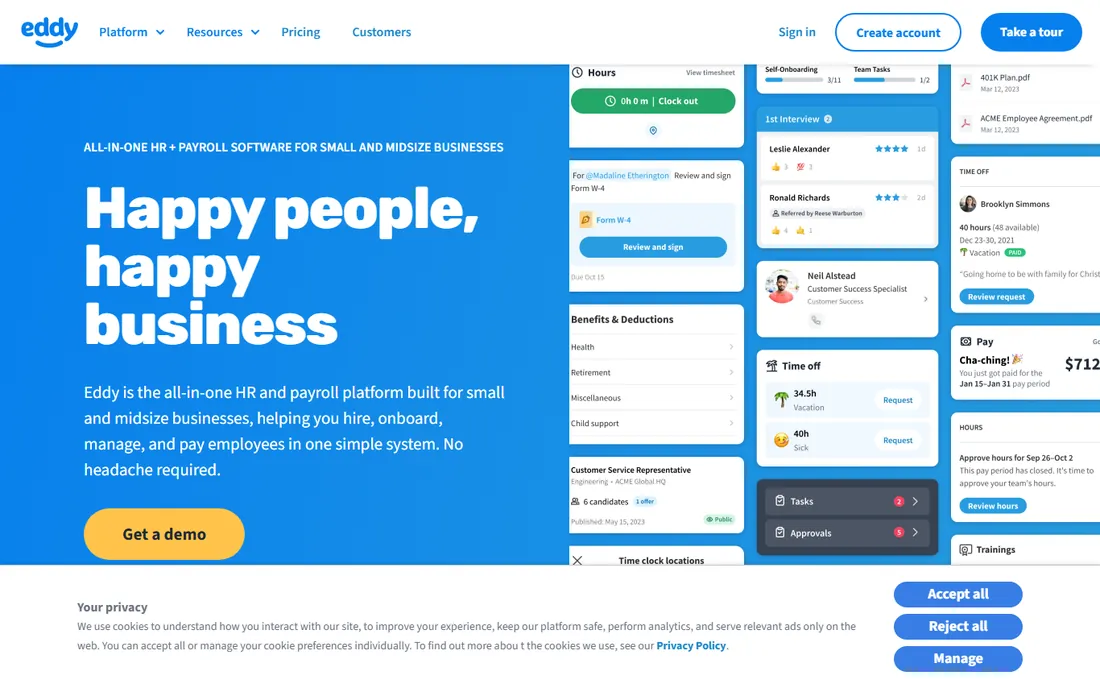
Eddy is built for the exact moment this article addresses: the small business buying its first HR system. The platform bundles applicant tracking, onboarding checklists, employee records, time-off management, and training into one interface designed for people who have never run HR software before. Implementation is deliberately simple, which matters when there is no HR department to manage the rollout.
The tradeoff is ceiling. A 200-person company will outgrow Eddy, and businesses that need advanced analytics, compensation planning, or global compliance should start higher up the list. But for a 15-to-50-person business that wants to stop running HR on spreadsheets, Eddy's focus is a strength, not a limitation.
What we like- Hiring, onboarding, people management, and training in one simple platform
- Built specifically for small businesses, not scaled-down enterprise software
- Straightforward implementation
Watch out for- No published pricing
- Feature depth is thinner than BambooHR or HiBob
- US-focused, limited international support
Starting priceSee website (published per-user pricing on vendor site)
Free planNo
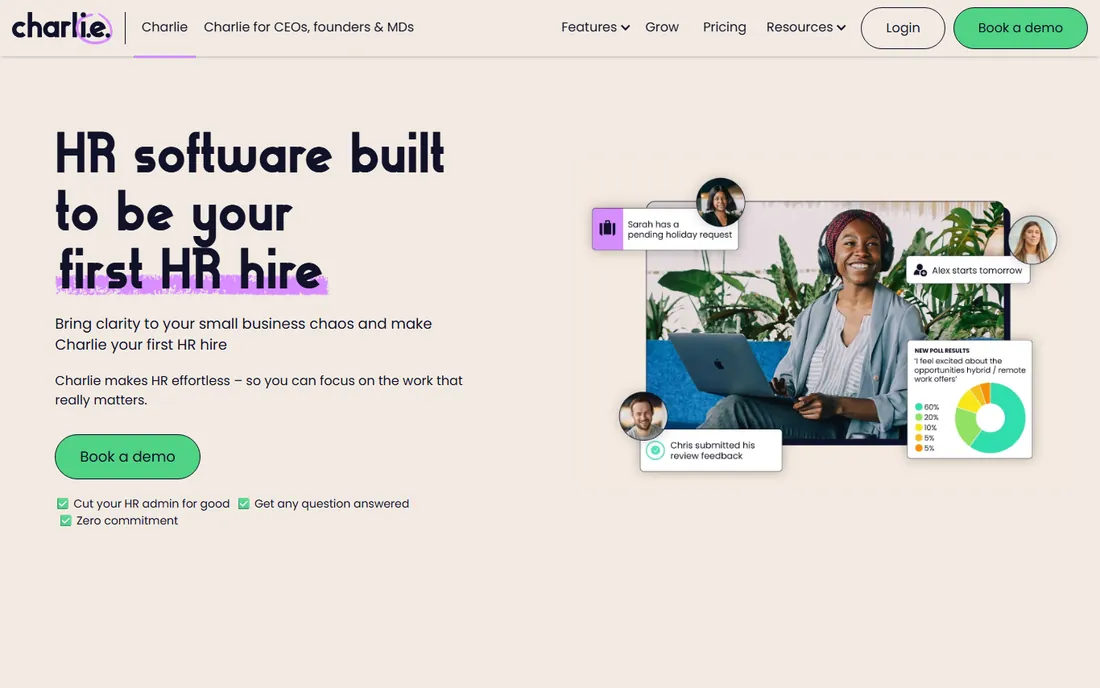
CharlieHR is the UK small business HR tool: straightforward, affordable, and built around British employment practices. Time off, onboarding, employee records, performance reviews, and engagement tools come in a clean package with per-user pricing published on the vendor's site. It is the kind of software a 20-person London startup adopts in an afternoon and keeps for years.
The deliberate narrowness is the point. CharlieHR does not try to be a global HRIS, and US buyers should look elsewhere. For UK small businesses that find BambooHR overpriced and Personio oversized, CharlieHR hits the sweet spot of price, simplicity, and local compliance.
What we like- Designed for UK employment law and compliance
- Clean, simple interface
- Per-user pricing that stays affordable for small teams
Watch out for- UK-focused, limited value for US businesses
- Feature set is deliberately narrow
- Advanced reporting is basic compared with larger platforms
Starting priceSee website (custom quote)
Free planNo
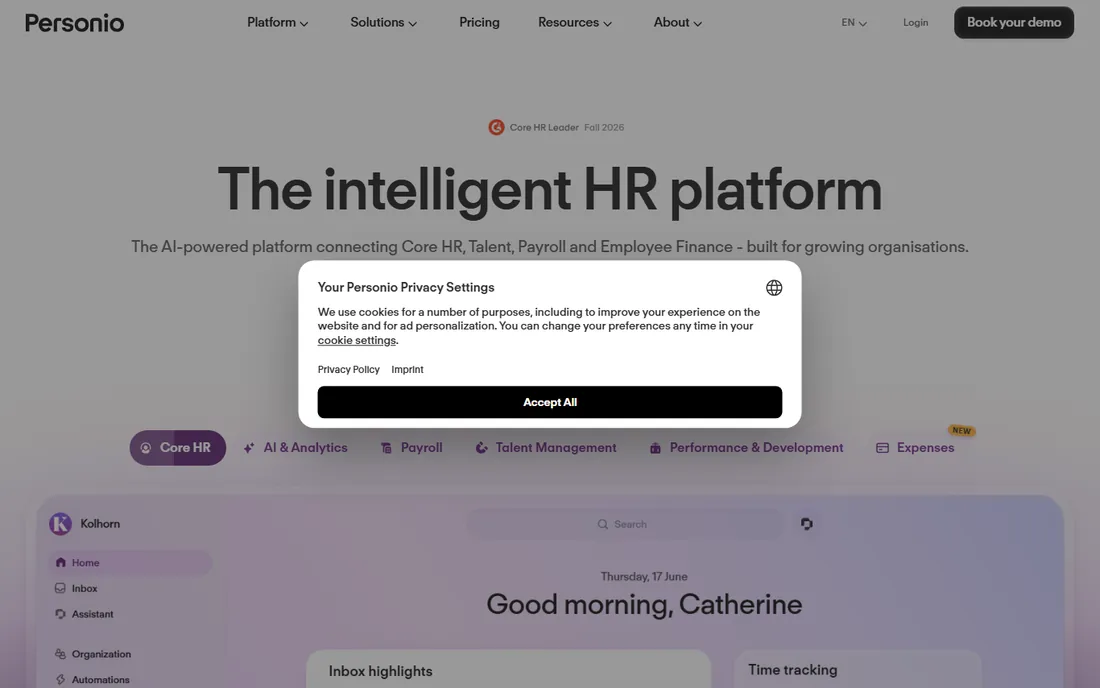
Personio is the heavyweight European HRIS, serving small and midsize businesses across the continent with recruiting, core HR, time tracking, payroll preparation, and performance management. Its strength is compliance depth: the platform handles the regulatory complexity of multiple European countries, which is exactly what growing European companies struggle with.
For a ten-person startup, Personio is too much software. For a 100-person company hiring across three countries, it is one of the few platforms that handles the complexity without enterprise pricing. The quote-based pricing and structured implementation reflect its ambitions: this is HR infrastructure, not a quick app purchase.
What we like- Deep coverage of European labor law and compliance
- Recruiting, HR, and payroll workflows in one platform
- Scales from ten to thousands of employees
Watch out for- Quote-only pricing
- Implementation is a real project
- More complex than small teams need at the start
#10
Breathe HR
Best for: UK micro-businesses that want the simplest possible HRIS
Visit breathehr.com
Starting priceSee website (published per-employee pricing on vendor site)
Free planNo
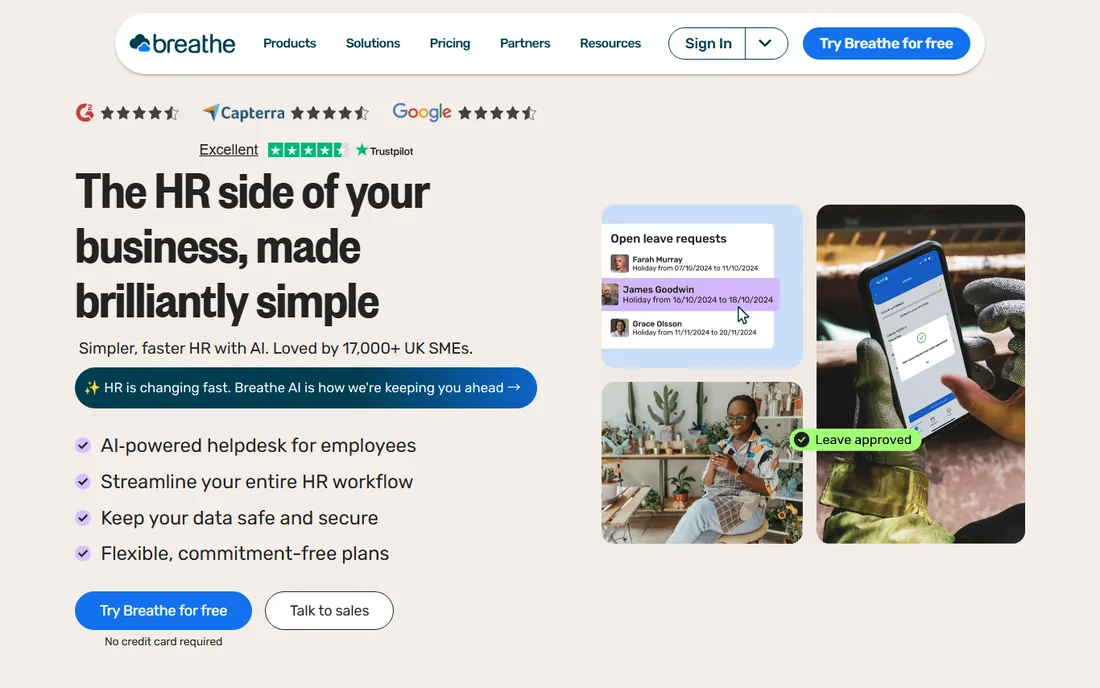
Breathe HR is the simplest tool on this list, and it knows it. Aimed at UK businesses with a handful to a few dozen employees, it covers employee records, holiday tracking, sick leave, and document storage with minimal setup. There is no implementation project and barely a learning curve: most teams are running within a day.
The simplicity caps its lifespan. Companies that need performance management, recruiting, or analytics will outgrow Breathe quickly. But for a micro-business that needs to stop tracking holidays on a whiteboard, Breathe HR is the lowest-friction credible option in the UK market.
What we like- Extremely simple to set up and use
- UK-focused with local compliance
- Affordable per-employee pricing for very small teams
Watch out for- Feature set is basic
- Limited integrations
- Not suitable for companies outgrowing startup stage
What small businesses actually need from HR software
Strip away the marketing and the purchase comes down to five jobs. Employee records: one reliable source of who works here, their role, salary, and documents. Time off: requests, approvals, and balances without a spreadsheet. Onboarding: checklists and paperwork that run themselves for each new hire. Hiring: a place to post jobs and track applicants, even a simple one. Compliance: the local tax, leave, and reporting rules handled correctly.
Match the tool to your actual pain
If payroll compliance is the pain, start with Gusto. If it is chaos across hiring, onboarding, and records, start with BambooHR, Zoho People, or Eddy. If you are in the UK or Europe, start with the regional tools: CharlieHR, Breathe HR, Personio, or Factorial. Buying the deepest platform when your problem is time-off tracking is how small businesses end up paying for software nobody uses.
Count the real cost, not the headline price
Per-user pricing looks cheap until you multiply it. A $8 per-user tool for 50 employees costs $400 a month, while a flat-fee platform may cost less at that size. Check minimums, implementation fees, and whether payroll and benefits are included or add-ons. Zoho People's $1.50 per user is genuinely cheap; quote-based tools deserve a written quote before you compare.
Plan for the person who runs it
Most small businesses have no HR department. The person running the software will be the founder, the office manager, or the first operations hire. Weight ease of use and support quality heavily, because the best-featured platform fails if the person administering it dreads opening it.
The pricing trap that catches small businesses
HR software pricing is designed to confuse, and small businesses fall into the same traps repeatedly. The first trap is the per-user quote that excludes payroll, benefits admin, and implementation, then doubles once everything is added. Always ask for the all-in number for your headcount, in writing.
The second trap is buying for the company you hope to become. A 15-person business does not need multi-country compliance, advanced analytics, or a 90-day implementation. It needs records, time off, and onboarding working by next month. Start simple; the migration to a bigger platform later is a known, solvable problem.
The third trap is the free plan that is not really a plan. Free tiers in HR software are rare and usually limited to tiny teams or basic features. A 30-day trial, like Zoho People's, is for evaluation, not for running the business. Budget for the paid tier from the start and treat the trial as a test drive.
Frequently asked questions
How much does HR software for small business cost?
It ranges widely. Per-user tools like Zoho People start around $1.50 per user per month, while all-in-one US platforms typically land between $5 and $15 per user per month once payroll and add-ons are included. Quote-based platforms like BambooHR, HiBob, and Personio vary by headcount and modules. Always get the all-in quote for your team size.
Do I need HR software if I only have ten employees?
Probably yes, once spreadsheets start breaking. At around ten to fifteen employees, time-off tracking, onboarding paperwork, and employee records become error-prone enough that a simple HRIS pays for itself in saved admin time. You do not need an enterprise platform; a simple tool like Eddy, Breathe HR, or Zoho People is enough.
Is free HR software worth using?
Free tiers exist but are limited, and most small businesses outgrow them quickly. A better approach is a cheap per-user plan or a free trial to evaluate properly. HR data is sensitive and compliance matters, so prioritize a vendor with real support over saving a few dollars a month.
Should payroll be included in my HR software?
It depends on your biggest pain. If payroll and tax filing are the problem, a payroll-first tool like Gusto is the efficient choice. If HR organization is the problem and payroll already works, a dedicated HRIS that integrates with your payroll provider avoids paying twice for the same thing.
What is the difference between an HRIS and a PEO?
An HRIS is software you run yourself: it organizes records, time off, hiring, and onboarding. A PEO (professional employer organization) is a service that becomes a co-employer and handles payroll, benefits, and compliance for you. Small businesses that want software choose an HRIS; those that want to outsource HR entirely choose a PEO.
How long does it take to set up HR software for a small business?
Simple tools like Breathe HR or CharlieHR can be running in a day. Mid-size platforms like BambooHR or Eddy typically take two to six weeks including data import and training. Larger implementations like Personio or HiBob can take two to three months. Ask the vendor for a timeline based on a company your size.
How we chose
We started with the HR platforms small businesses actually buy, based on review volume on G2, Capterra, and Software Advice, then verified each product is live and actively sold in 2026. We checked vendor pricing pages for published numbers and marked everything else as quote-based rather than repeating directory estimates. We weighted small-business fit over feature depth: ease of setup, per-user cost, and whether the product was designed for small teams rather than scaled down from enterprise software. We did not test these products hands-on; this is a research comparison.
Sources we checked (10)
- https://www.bamboohr.com
- https://www.zoho.com/people
- https://gusto.com
- https://www.factorialhr.com
- https://www.hibob.com
- https://www.goco.io
- https://eddy.com
- https://www.charliehr.com
- https://www.personio.com
- https://www.breathehr.com
Is your product missing or out of date?
We review this list regularly. Vendors can request a listing, send updated pricing or ask about featured placement.

Shihab Mia · Founder, Rankite
Shihab has spent more than a decade helping SaaS and e-commerce brands grow through search. He writes Rankite's software buying guides from pricing pages, documentation and public user reviews. More about Shihab.