How we make this list: we compare pricing pages, product documentation and public user reviews. Ratings come from G2, Capterra or Trustpilot, with the date we checked them.
Key takeaways
- Bright Data and Oxylabs lead for enterprise scale, with the largest proxy networks and compliance credentials.
- Apify stands out for its marketplace of thousands of ready-made scrapers, while ScrapingBee and ScraperAPI suit developers who want one simple endpoint.
- Octoparse is the best no-code pick for non-developers, and Scrapy remains free and unmatched for Python teams that want full control.
- Credit and request pricing varies so much that you should price your actual workload, not the headline plan, before committing.
Quick comparison
| Tool | Best for | Starting price | Free plan |
|---|
 Bright Data | Enterprise scale and reliability | Pay as you go from $1.50 per 1,000 records | Yes |
 Oxylabs | Enterprise compliance and coverage | $49 per month | Free trial |
 Apify | Ready-made scrapers marketplace | $29 per month | Yes |
 ScrapingBee | Simple API for developers | $49 per month | Free trial |
 ZenRows | Anti-bot bypass | $69 per month | Free trial |
 ScraperAPI | Beginner-friendly scraping API | $49 per month | Free trial |
 Octoparse | No-code visual scraping | See website | Yes |
 Scrapy | Free Python scraping framework | Free | Yes |
Is your product missing or out of date?
We review this list regularly. Vendors can request a listing, send updated pricing or ask about featured placement.
#1Bright Data
Best for: Enterprise scale and reliability4.6/5 on
G2 (272 reviews, checked Oct 2026)
Visit brightdata.com
Starting pricePay as you go from $1.50 per 1,000 records
Free planYes
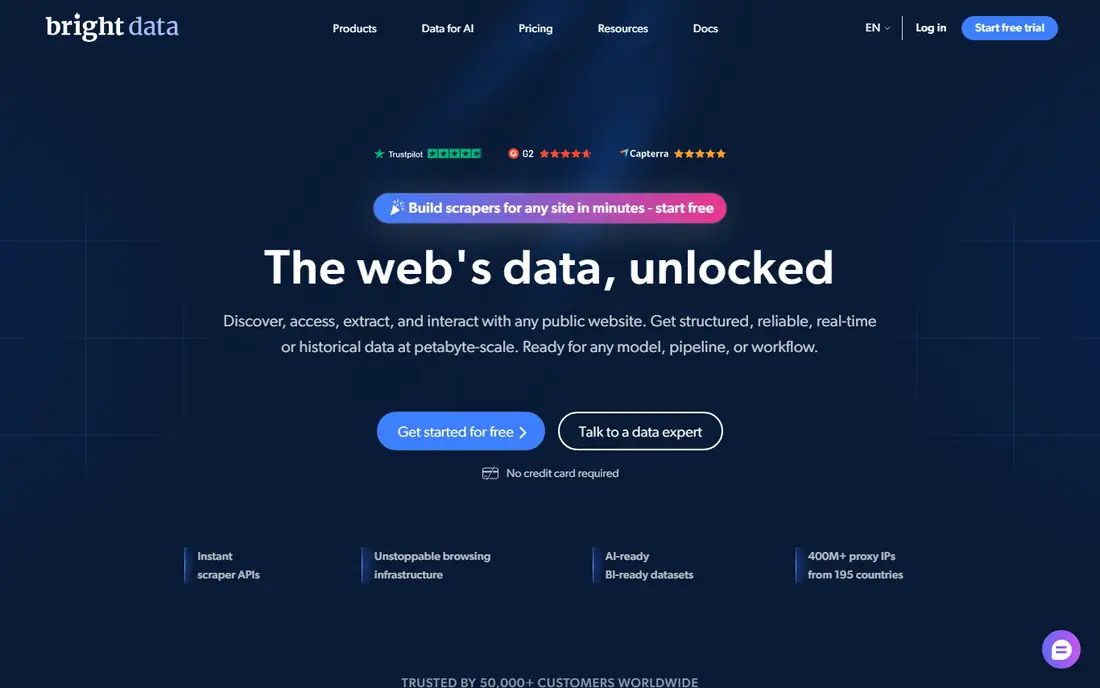
Bright Data, formerly Luminati, is the enterprise standard for web data collection. Its proxy network spans 195 countries, and its Web Scraper API offers pre-built, site-specific scrapers alongside raw proxy infrastructure, so teams can choose between managed collection and building their own. A pay-as-you-go option starting at $1.50 per 1,000 records lets smaller teams try it without a large subscription.
The honest catch is cost at volume. Bright Data charges per successful request regardless of page difficulty, so simple pages cost the same as hard ones, and independent cost comparisons put it among the pricier options for large easy workloads. For teams where reliability and coverage matter more than the lowest per-page price, it remains the benchmark.
What we like- Largest proxy network in this comparison
- Pre-built scrapers for many popular sites
- Pay-as-you-go option
Watch out for- Per-request pricing gets expensive on easy pages
- Platform complexity for small teams
#2Oxylabs
Best for: Enterprise compliance and coverage4.5/5 on
G2 (420 reviews, checked Oct 2026)
Visit oxylabs.io
Starting price$49 per month
Free planFree trial
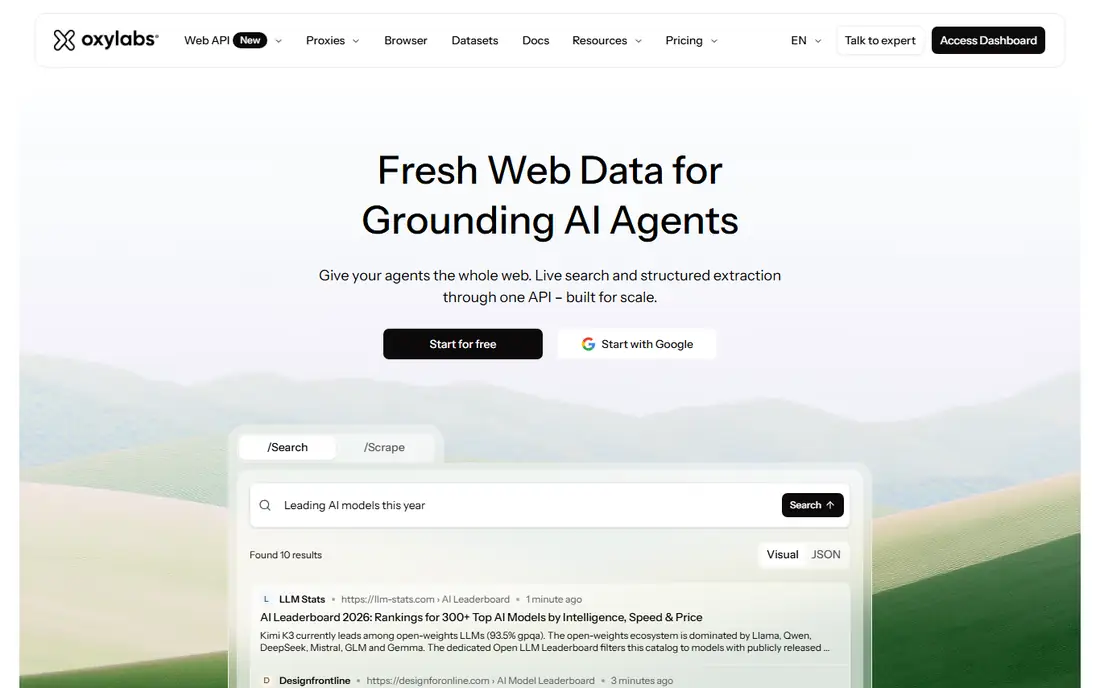
Oxylabs pairs a large proxy network with a strong compliance story, which matters for enterprises that need procurement and legal teams to sign off. Its Web Scraper API returns structured data from target URLs, while its proxy products and datasets cover teams that want to build their own pipelines. Entry pricing for the scraper API starts at $49 per month, with a free trial available.
The honest catch is unit cost. Independent workload comparisons found Oxylabs pricier per page than ScrapingBee or Zyte for straightforward jobs, partly because its unblocking products bill by traffic. For organizations that prioritize compliance, support, and coverage over the lowest possible price, that premium buys real assurance.
What we like- 177M+ IP proxy pool
- SOC 2 and ISO 27001 compliance
- Web Scraper API with structured output
Watch out for- Higher cost per page than budget APIs in independent tests
- Enterprise sales process for large deals
#3Apify
Best for: Ready-made scrapers marketplace4.7/5 on
G2 (669 reviews, checked Oct 2026)
Visit apify.com
Starting price$29 per month
Free planYes
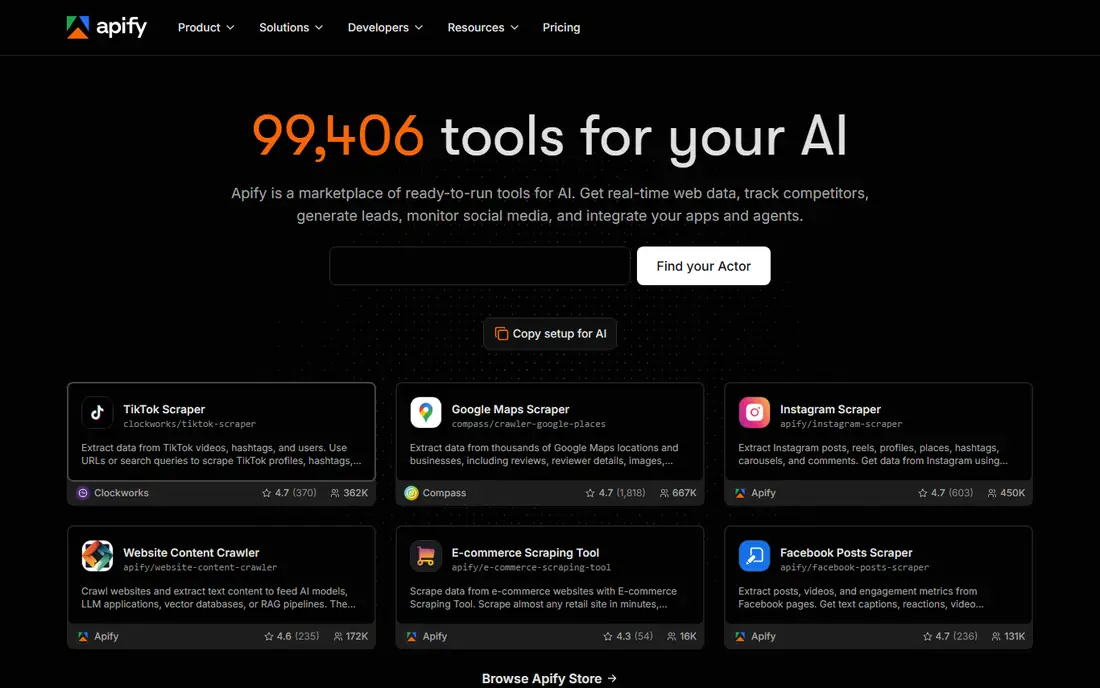
Apify is a cloud platform where you run scrapers called Actors, and its marketplace holds thousands of ready-made ones for sites such as Google Maps, Instagram, and major ecommerce stores. That library is the main reason to choose it: for common targets, you may never write a scraper at all. Plans start at $29 per month plus pay-as-you-go compute, and a free tier includes platform credit.
The honest catch is billing. Compute units cover processing time rather than pages, so costs depend on how your Actor runs, and independent comparisons found Apify expensive for very large simple workloads. For teams that value ready-made scrapers, scheduling, and integrations with tools like Zapier and Airbyte, it is still one of the most productive platforms available.
What we like- Thousands of pre-built Actors for popular sites
- Free tier with platform credit
- Strong scheduling and integrations
Watch out for- Billed by compute units, which is harder to predict
- Per-request costs can exceed simple APIs at scale
Starting price$49 per month
Free planFree trial
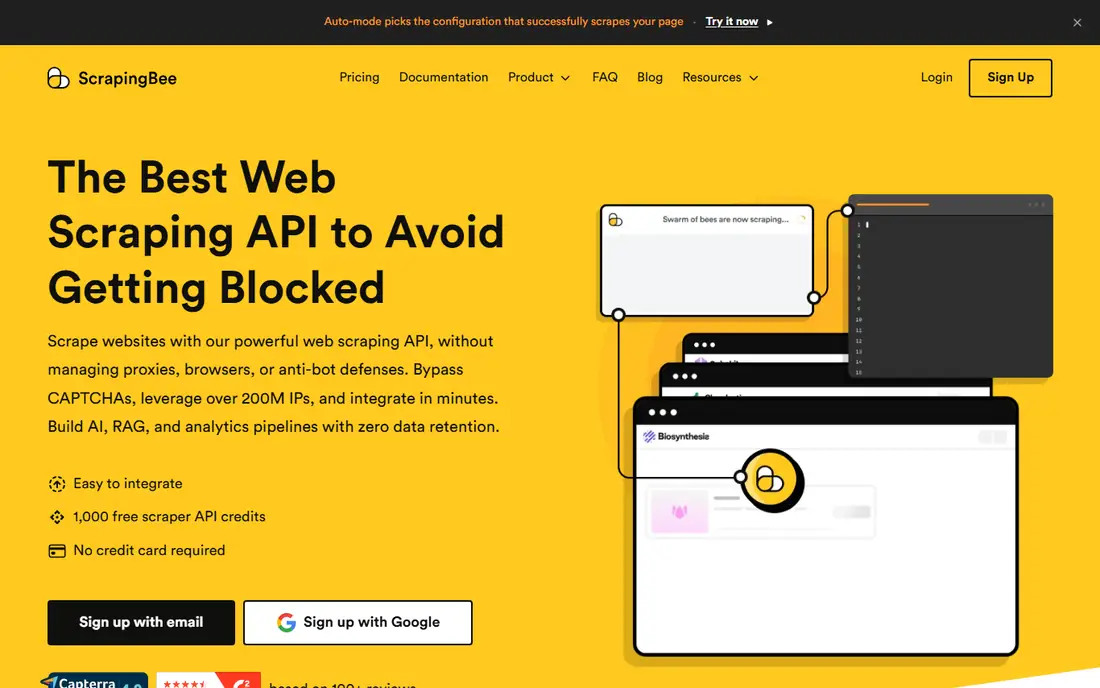
ScrapingBee appeals to developers who want web scraping to feel like any other API call. Send a URL, get HTML or extracted data back, with proxy rotation, headless Chrome rendering, and CAPTCHA handling managed behind the scenes. Plans start at $49 per month for 250,000 credits, and a trial offers 1,000 credits to test with.
The honest catch is credit weighting. Rendering JavaScript costs five credits per request by default, so a rendering-heavy workload burns through a plan faster than the headline credit count suggests. Turn rendering off for static pages to keep costs down. For developers who want a clean, well-documented API without managing infrastructure, ScrapingBee is a strong default.
What we like- Single endpoint with proxies, rendering, and CAPTCHA handling
- Clear credit system
- SOC 2 Type II compliant
Watch out for- JavaScript rendering costs extra credits
- Credit math needs attention on heavy pages
Starting price$69 per month
Free planFree trial
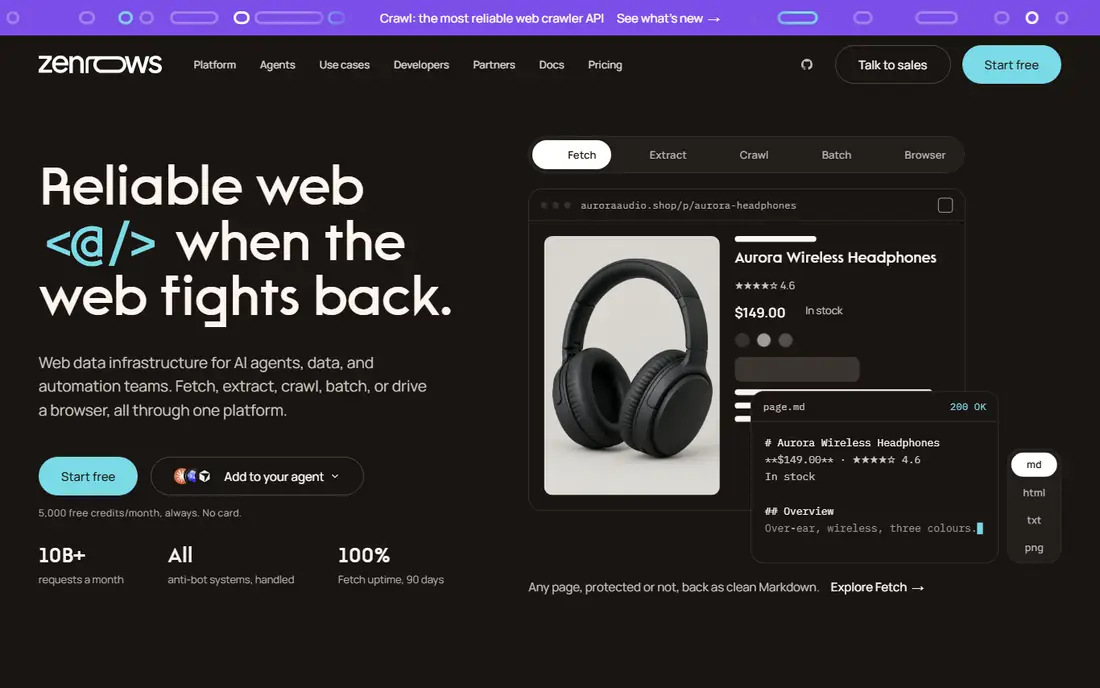
ZenRows focuses on the hardest part of scraping: getting past anti-bot systems. Its API combines residential proxies, headless browser rendering, and automatic retries, and it reports high success rates on protected sites. Plans start at $69 per month, and a trial includes 1,000 API credits.
The honest catch is price positioning. At $69 per month, ZenRows costs more than the budget APIs, and its value shows mainly on sites that block simpler tools. For straightforward, unprotected pages, a cheaper API does the same job. For teams whose targets actively fight scraping, ZenRows earns its premium.
What we like- Strong anti-bot bypass and auto-retry
- 55M+ IP pool
- Simple API with premium proxy modes
Watch out for- Higher entry price than ScrapingBee or ScraperAPI
- Credit costs rise on hard targets
#6ScraperAPI
Best for: Beginner-friendly scraping API4.3/5 on
G2 (15 reviews, checked Oct 2026)
Visit scraperapi.com
Starting price$49 per month
Free planFree trial
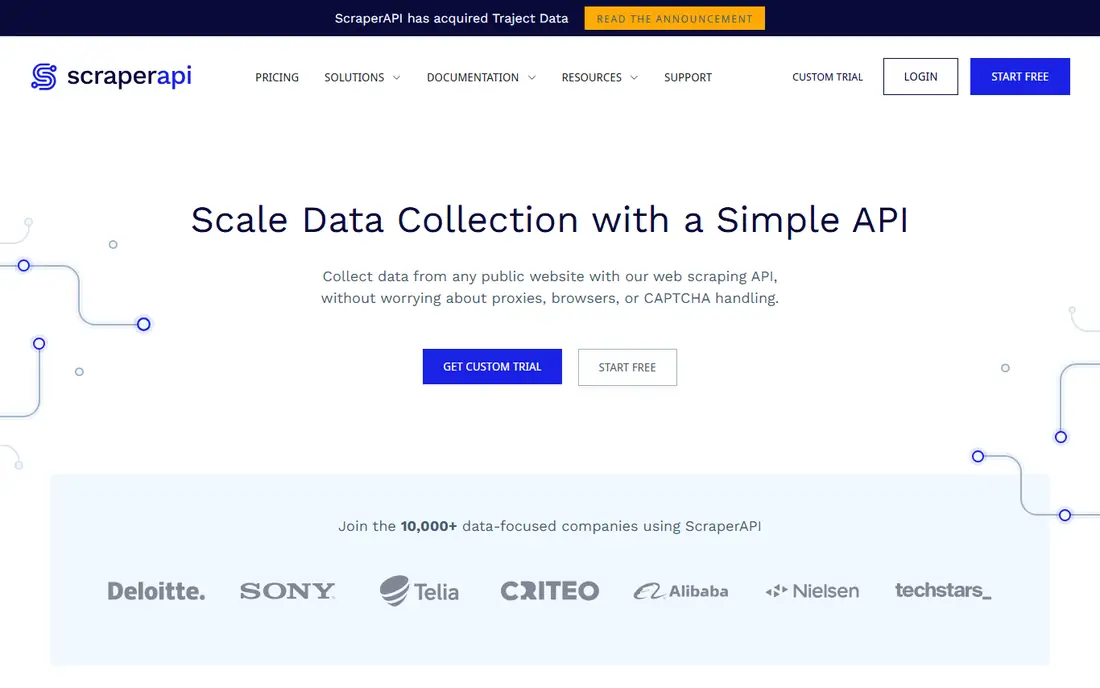
ScraperAPI keeps the model as simple as possible: one endpoint, with proxy rotation, headless rendering, and geotargeting handled automatically. Plans start at $49 per month for 100,000 credits, and a 7-day trial includes 5,000 credits. Its documentation covers many languages, which helps teams get a first scraper running quickly.
The honest catch is performance variance. Some independent tests recorded lower success rates for ScraperAPI than for ScrapingBee or ZenRows, though results depend heavily on target sites. For beginners and simple projects, its simplicity outweighs that gap. For the hardest targets, test it against ZenRows or Bright Data before committing.
What we like- Very simple single-endpoint design
- Handles proxies, rendering, and CAPTCHAs
- Good documentation
Watch out for- Lower success rates than leaders in some independent tests
- Fewer advanced extraction features
#7Octoparse
Best for: No-code visual scraping4.8/5 on
G2 (52 reviews, checked Oct 2026)
Visit octoparse.com
Starting priceSee website
Free planYes
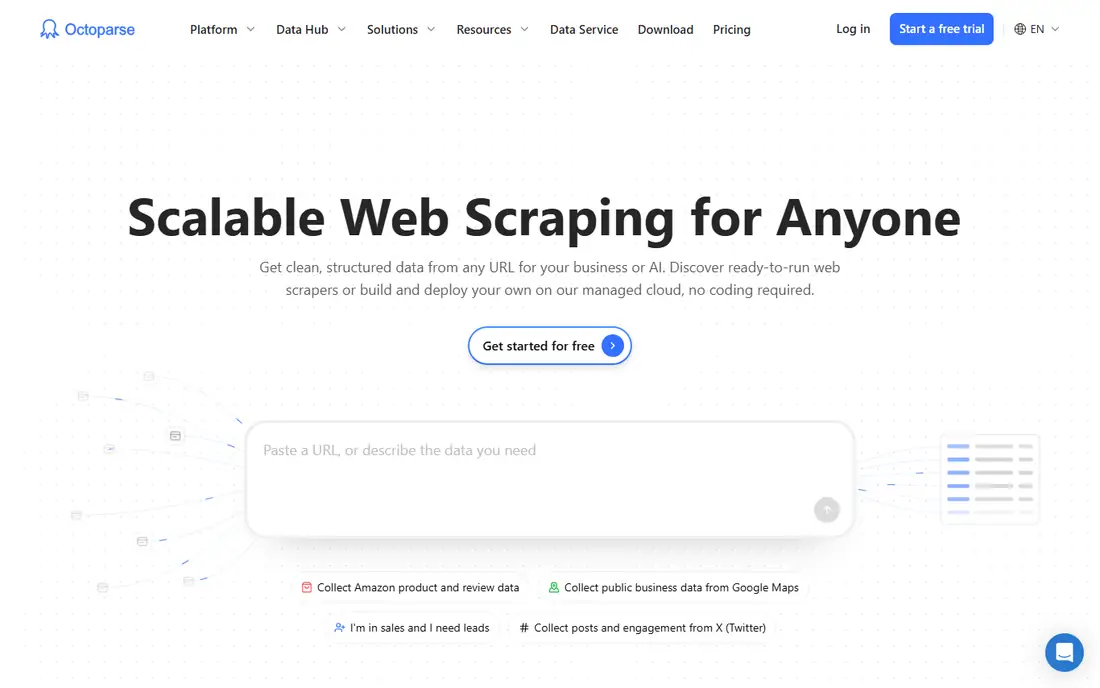
Octoparse is the pick for people who do not code. Its visual builder lets you click page elements to define what to extract, with AI-assisted field detection, templates for popular sites, and cloud scheduling for recurring jobs. A free tier covers small projects, while paid plans add cloud runs, faster speeds, and larger capacity.
The honest catch is the gap between free and paid. Serious recurring jobs need a paid plan, and published entry prices for Octoparse vary across sources, so confirm the current rate on its pricing page. For marketers, researchers, and journalists who need data without writing code, Octoparse remains the most approachable tool here.
What we like- Visual point-and-click builder
- Cloud scheduling and auto-detection
- Free tier for small jobs
Watch out for- Desktop and cloud versions differ in features
- Paid plans are a step up from the free tier
Starting priceFree
Free planYes
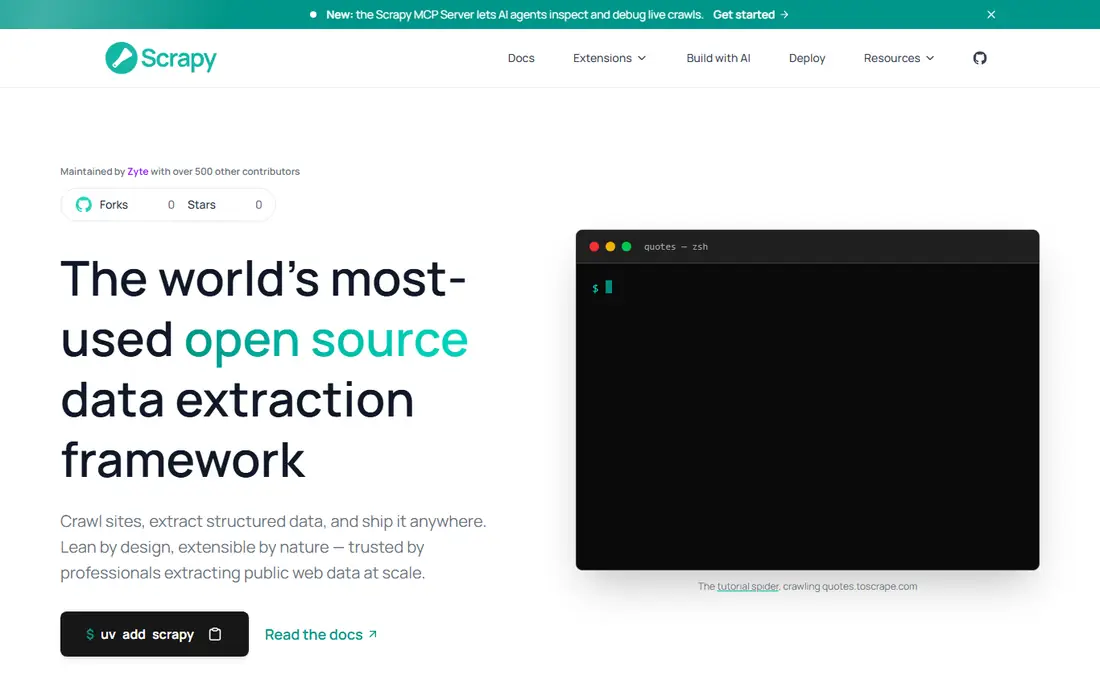
Scrapy is the open source framework behind a large share of professional scraping work. It handles crawling, extraction with CSS and XPath selectors, and export pipelines, and its asynchronous engine scales from a laptop to millions of pages. Maintained by Zyte with hundreds of contributors, it remains actively developed, with a September 2026 release adding remote control and monitoring features.
The honest catch is that Scrapy is a framework, not a service. You manage proxies, JavaScript rendering, CAPTCHA handling, and deployment yourself, and those costs add up in engineering time and proxy bills. For Python teams that want maximum control and zero license fees, nothing else here matches it.
What we like- Free and open source
- Fast asynchronous crawling
- Huge extension ecosystem and 15 years of maintenance
Watch out for- Requires Python skills
- Proxies, rendering, and anti-ban tooling are your responsibility
How we chose
We compared tools that collect web data at real scale, drawing on vendor pricing pages, documentation, and independent cost comparisons that priced identical workloads across APIs. We included enterprise platforms, developer APIs, a no-code builder, and an open source framework, since buyers range from solo researchers to large data teams. Where sources disagreed on a price, we used the most recent figure or marked it as unconfirmed rather than presenting a guess as fact.
Scraping legally and responsibly
Scraping sits in a legal gray area that depends on what you collect and how you use it. Only collect publicly available data, respect robots.txt and terms of service where they apply, and avoid personal data, copyrighted content behind paywalls, and anything that requires bypassing authentication you do not own. Several vendors on this list publish compliance documentation and acceptable-use policies; read them before starting a project.
Rate limits and identification matter too. Aggressive crawling can overload small sites, so set polite crawl rates, identify your scraper honestly, and cache results rather than re-requesting the same pages. If a site offers an official API, use it first. Scraping is a fallback for data that is public but not otherwise accessible, not a way around a paywall or a login.
Price your real workload before you buy
Credit systems make headline plans misleading. One vendor's credit may equal one plain request, while another charges five credits for a rendered page or bills by gigabytes of traffic. Run the same 10,000-page job on two or three tools during their trials, record the actual spend, and compare that number, not the plan price. For ongoing jobs, also check how failed requests are billed, since some vendors charge only for successes and others do not.
Frequently asked questions
What is the best web scraping tool overall?
Bright Data leads for enterprise scale and reliability, while Apify leads for ready-made scrapers and Scrapy leads for free, full-control Python work. The right choice depends on your budget, coding skills, and whether your targets use anti-bot protection.
Is web scraping legal?
Scraping publicly available data is generally permitted in many jurisdictions, but rules vary, and scraping personal data, copyrighted material, or data behind logins carries legal risk. Respect robots.txt, terms of service, and privacy laws, and get legal advice before scraping at commercial scale.
Do I need to know how to code to scrape websites?
No. Octoparse offers a visual builder for non-developers, and Apify's marketplace provides ready-made scrapers for popular sites. Developers who want control can use APIs like ScrapingBee or frameworks like Scrapy, but coding is not required to start.
How much do web scraping tools cost?
Entry plans for APIs start around $29 to $69 per month, while enterprise platforms price by usage or quote. Open source Scrapy is free, but you still pay for proxies and engineering time. Real costs depend on page volume, JavaScript rendering, and anti-bot difficulty.
What is the difference between a scraping API and a scraping platform?
A scraping API, such as ScrapingBee or ScraperAPI, takes a URL and returns data through one endpoint. A platform, such as Apify or Bright Data, adds scheduling, a marketplace of pre-built scrapers, datasets, and infrastructure management. APIs suit developers with one job; platforms suit teams with many ongoing jobs.
Why do some sites block scrapers?
Sites use anti-bot systems to protect their infrastructure, prevent content theft, and control how their data is used. Tools with residential proxies, browser rendering, and retry logic bypass some of these defenses, but no tool succeeds on every site, and targets change their defenses over time.
Sources we checked (11)
- https://brightdata.com
- https://oxylabs.io
- https://apify.com
- https://www.scrapingbee.com
- https://www.zenrows.com
- https://www.scraperapi.com
- https://www.octoparse.com
- https://scrapy.org
- https://scrapetools.scaleturn.com/index.html
- https://dev.to/minnerfun/what-500000-pages-a-month-costs-on-8-scraping-apis-32m
- https://www.marketerrakib.com/best-web-scraping-apis/
Is your product missing or out of date?
We review this list regularly. Vendors can request a listing, send updated pricing or ask about featured placement.

Shihab Mia · Founder, Rankite
Shihab has 5+ years in B2B and SaaS SEO. He writes Rankite's software buying guides from pricing pages, documentation and public user reviews. More about Shihab.