How we make this list: we compare pricing pages, product documentation and public user reviews. Rankite is independent; if a vendor ever pays for a featured spot, that listing is clearly labeled Partner.
Key takeaways
- Start free where you can: UptimeRobot gives you 50 monitors free, StatusCake gives you 10, and New Relic offers its full platform free with no credit card.
- Oh Dear is the only tool here with a published starting price on its homepage: 15 euros a month for up to 2 sites, every check included.
- Datadog and New Relic are full observability platforms, not just uptime checkers: buy them when you need logs, APM and infrastructure in one place.
- Pingdom, Uptrends and Site24x7 sell the middle ground: synthetic transaction monitoring and real-user data without the complexity of a full observability suite.
The best web monitoring software
Your site goes down at 2 AM. Who finds out first: you, or your angriest customer on social media? That question is the entire business case for web monitoring software. These tools watch your site from the outside, checking that it loads, that the checkout works, that the certificate has not expired, and they wake someone up when it does not.
The nine below span the range. Simple uptime checkers ping your pages on a schedule and alert you when they stop answering. Synthetic monitors go further, running scripted transactions like logins and checkouts in real browsers. Real user monitoring watches actual visitors. And the observability platforms fold all of it into logs, traces and infrastructure metrics. Match the tool to what keeps you up at night.

#1
Pingdom
Best for: Teams that want proven uptime, page speed and transaction monitoring from one vendor
Visit pingdom.com
Starting priceSee website (paid plans; 30-day trial)
Free planFree trial (30 days, fully functional)
Pingdom is the name most teams reach for first, and it earned that position over a decade of reliable uptime monitoring. The platform covers the three layers that matter: synthetic checks that simulate visitors, page speed analysis that shows why pages are slow, and real user monitoring that reports how actual visitors experience the site. Transaction monitoring scripts multi-step flows like registration and checkout, which is where simple ping tools fall short.
The catch is the buying process. There is no free tier and no published price on the homepage, just a fully functional 30-day trial and a sales conversation. For a team that wants one mature vendor for uptime plus performance, Pingdom is the safe pick. For a team that wants to start free today, look at UptimeRobot or StatusCake first.
What we like- Long-established monitor with uptime checks from 100-plus global locations
- Combines synthetic monitoring, page speed analysis and real user monitoring
- Transaction monitoring that scripts logins, checkouts and other flows
Watch out for- No free plan, only the 30-day trial
- Pricing is not published on the homepage, so you talk to sales

#2
UptimeRobot
Best for: Anyone who wants serious uptime monitoring starting at zero cost
Visit uptimerobot.com
Starting priceSee website (free plan; paid Solo, Team and Enterprise tiers)
Free planYes (50 monitors free)
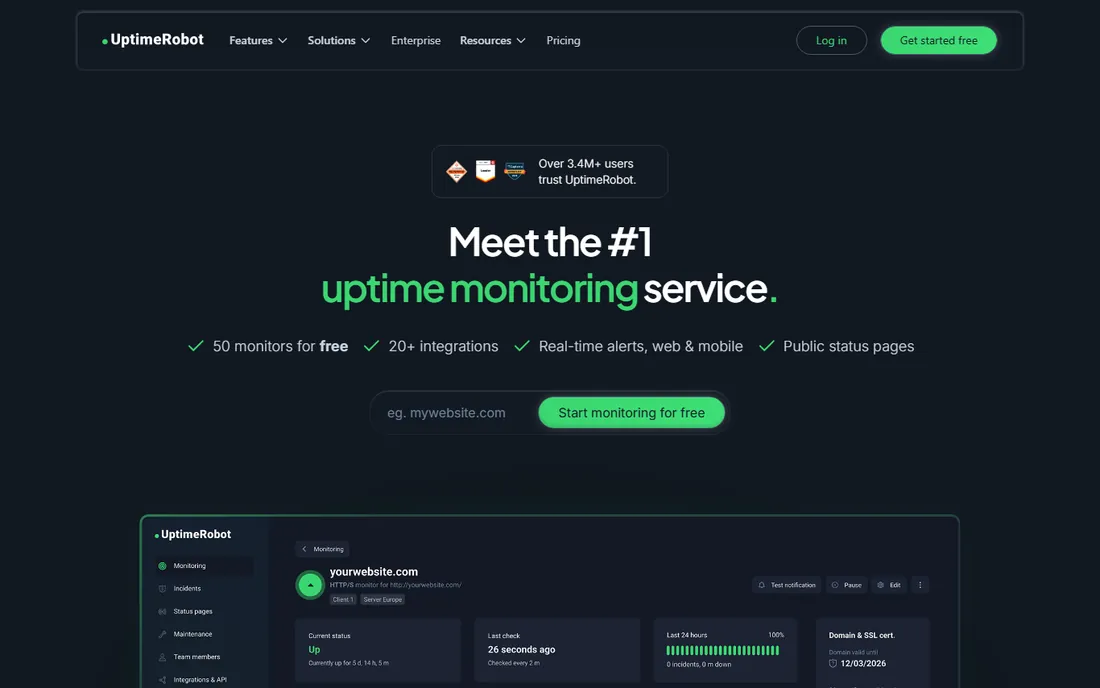
UptimeRobot is the free tier that ate the low end of this market. Fifty monitors, SSL and domain expiry checks, cron job monitoring and public status pages, all free, with setup the homepage says takes 30 seconds. Paid tiers tighten check intervals to 60 seconds on Solo and Team and 30 seconds on Enterprise, and add the incident management features growing teams need.
The honest limit is the 5-minute free interval. For a portfolio site or a side project that is plenty; for a checkout page doing real revenue, five minutes of undetected downtime is expensive, and you should pay for faster checks. But as a starting point, or as the second monitor watching your primary monitor, nothing beats free.
What we like- 50 monitors free with no credit card, the most generous free tier here
- Monitors HTTP, ping, ports, keywords, SSL, DNS and cron jobs
- Status pages and 20-plus integrations included
Watch out for- Free checks run every 5 minutes, which is slow for critical services
- Advanced incident management and 30-second checks need paid tiers

#3
Datadog
Best for: Engineering teams that want monitoring, logs and APM in one observability platform
Visit datadoghq.com
Starting priceSee website (usage-based pricing)
Free planSee website
Datadog is not really a website monitoring tool; it is the observability platform that happens to include excellent synthetic and real user monitoring. If your team already runs Datadog for infrastructure or APM, adding browser tests and API checks is natural: the same dashboards, the same alerts, the same incident workflow. The AI features that investigate incidents and suggest fixes are genuinely useful at scale.
The catch is cost and complexity. Datadog prices by usage across many dimensions, and bills surprise teams that do not watch them. A small team that just wants to know when the site is down should not buy Datadog for that. Buy it when you need the whole observability stack and web monitoring is one slice of it.
What we like- Full-stack observability: synthetic monitoring, real user monitoring, APM, logs, infrastructure and security in one platform
- AI agents that investigate and remediate issues
- 800-plus integrations
Watch out for- Usage-based pricing gets expensive fast and is hard to predict
- Overkill if all you need is uptime checks and a status page

#4
New Relic
Best for: Teams that want Datadog-class observability with a free entry point
Visit newrelic.com
Starting priceSee website (usage-based pricing)
Free planYes (free tier; full platform access, no credit card required)
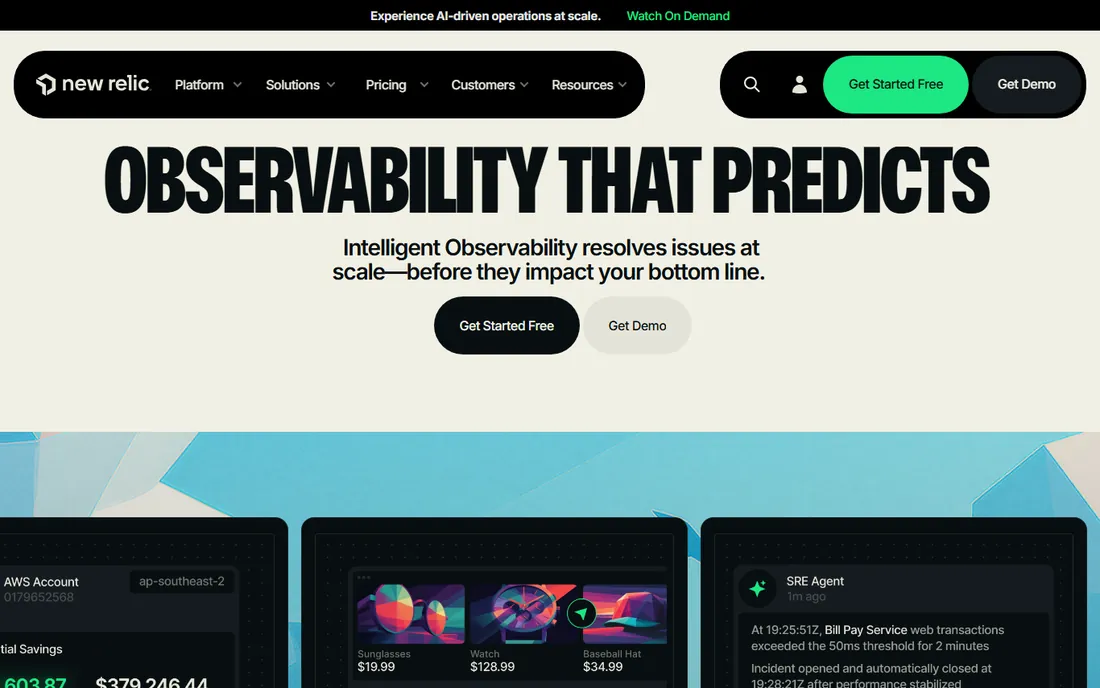
New Relic is Datadog's closest rival and the friendlier on-ramp: the homepage offers the full platform free with no credit card required, which lets a team run real synthetic checks, APM and log management before spending anything. The monitoring itself is strong across the board, from browser-based transaction tests to infrastructure metrics.
The same warning applies as with Datadog. This is a platform, not a tool, and the usage-based pricing needs active management to stay predictable. But if you want enterprise-grade observability and want to start free, New Relic's free tier is the best deal in this category. Small teams can run production monitoring here for a long time before paying.
What we like- Free tier gives access to the full platform with no credit card, per the homepage
- Covers APM, infrastructure, logs, synthetic and real user monitoring
- Strong AI-assisted incident resolution
Watch out for- Like Datadog, the pricing model rewards careful usage management
- The breadth of the platform is more than a small team needs

#5
StatusCake
Best for: Small businesses that want uptime, page speed, SSL and domain monitoring free
Visit statuscake.com
Starting priceSee website (free plan; paid Superior, Business and Enterprise tiers)
Free planYes (10 uptime monitors free)
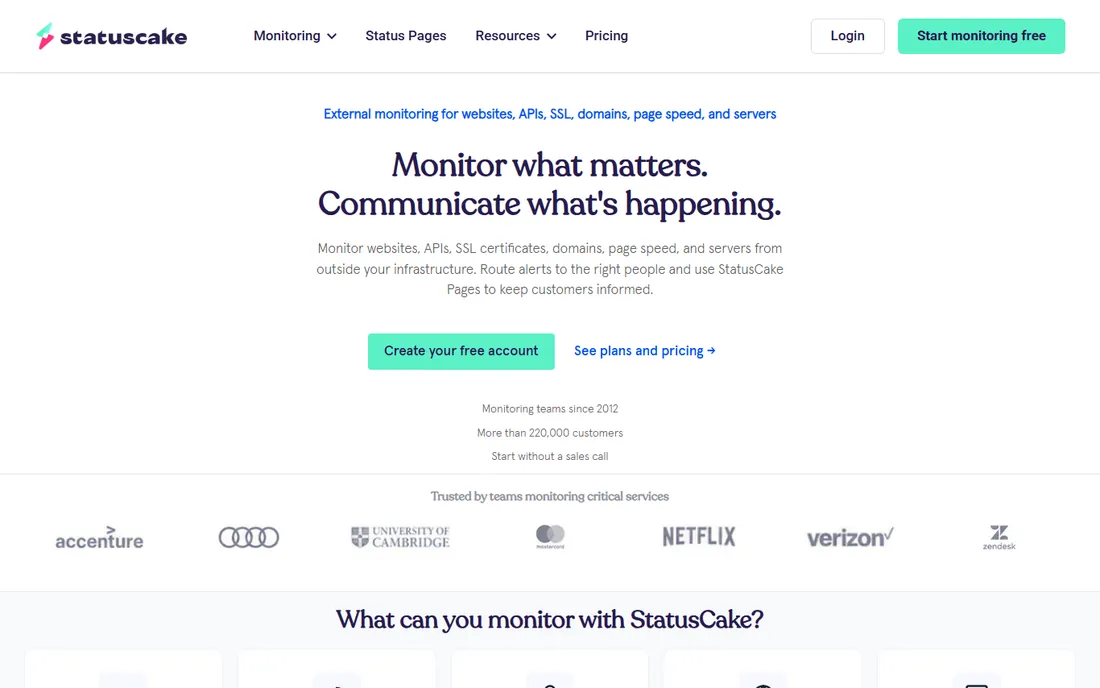
StatusCake has been doing this since 2012, and its free plan is the pragmatic middle between UptimeRobot's generosity and Pingdom's trial-only model: 10 uptime monitors at 5-minute intervals, plus one page speed, one domain and one SSL monitor. That covers a small business's whole web presence at zero cost. Paid tiers scale to hundreds of monitors with 30-second checks.
The tradeoff is polish. StatusCake works reliably but looks its age, and you will need to click through to plans for pricing. For a small business or agency that wants set-and-forget monitoring with a free tier that covers the essentials, it is a solid, unglamorous choice.
What we like- Free plan includes 10 uptime monitors plus page speed, domain and SSL monitors
- Paid tiers offer 30-second checks from 30 countries
- No sales call needed to start
Watch out for- Paid plan prices are not on the homepage
- The interface and reporting feel dated next to newer rivals

#6
Site24x7
Best for: IT teams that want website monitoring inside a full infrastructure suite
Visit site24x7.com
Starting priceSee website
Free planSee website
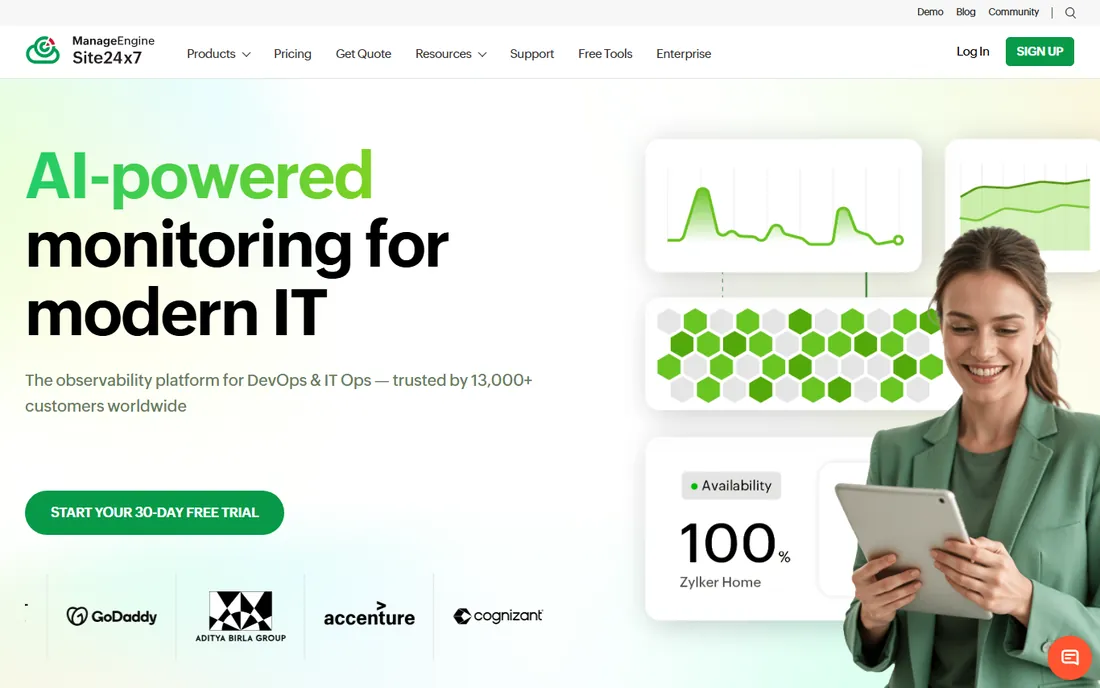
Site24x7, from the ManageEngine family, is the all-in-one play for IT operations teams. Website monitoring sits alongside server, network, cloud and application monitoring, so a team that already watches infrastructure can add web checks without a new vendor. The website side is capable: uptime from global locations, multi-step transaction recording in real browsers, and real user monitoring segmented by geography and device.
The catch is opacity on pricing and a product built for IT generalists rather than web specialists. Teams that live in DevOps tooling may find the interface old-school. But for an IT department standardizing on one monitoring vendor, Site24x7's breadth is the argument: one console, one bill, everything watched.
What we like- All-in-one scope: website, server, cloud, network, APM, real user monitoring and log management
- Website monitoring includes synthetic transactions in real browsers
- Status pages for customer communication
Watch out for- No pricing or free-plan details on the homepage
- The breadth means a busier interface than single-purpose monitors

#7
Better Stack
Best for: Modern teams that want uptime monitoring, status pages and logging at a fair price
Visit betterstack.com
Starting priceSee website (free plan; predictable paid pricing)
Free planYes (free plan)
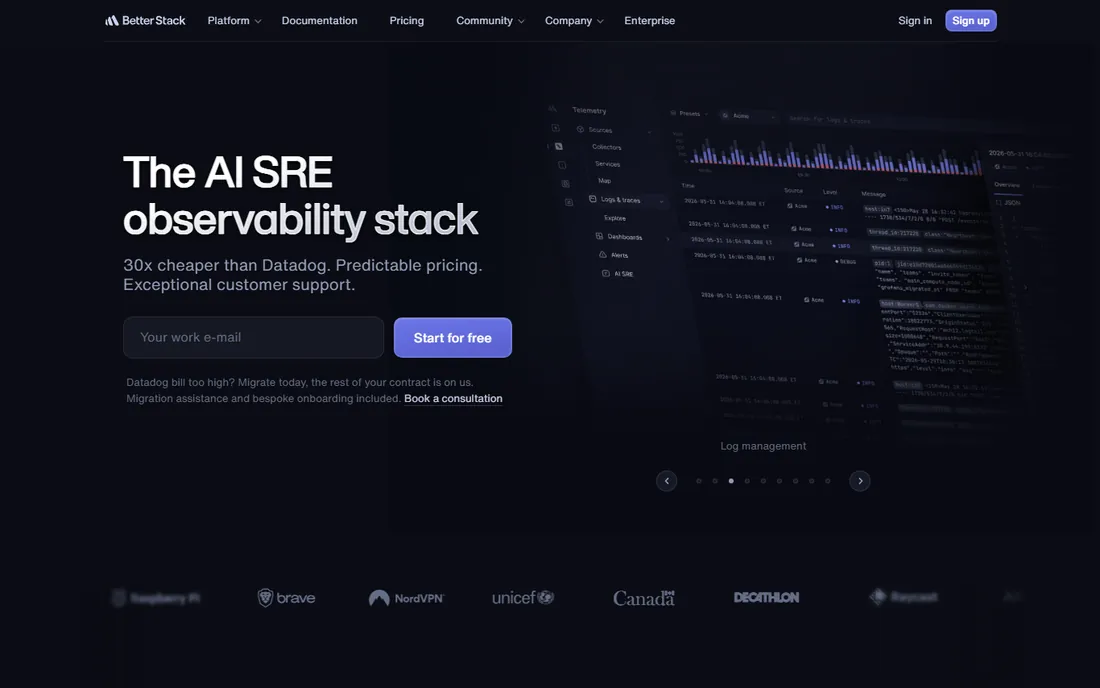
Better Stack is the modern challenger built by people annoyed at observability bills. It bundles uptime monitoring, on-call alerting, status pages and log management with an interface that feels current, and its homepage leans hard on predictable pricing versus Datadog's usage meter. The free plan is genuinely generous: customers report custom domains on status pages without paying.
The honest caveat is maturity. The integration ecosystem is smaller than Datadog's or New Relic's, and very large enterprises will want proof of scale. For startups and mid-size teams that want modern tooling without the pricing anxiety, Better Stack is the most interesting new option here.
What we like- Generous free plan with custom domains on status pages, per customer reports on the homepage
- Combines uptime monitoring, incident management, status pages and logs
- Positions on predictable pricing against Datadog's meter
Watch out for- Younger and smaller than the incumbents, so the integration catalog is thinner
- The Datadog-cost-comparison marketing invites scrutiny of real bills

#8
Oh Dear
Best for: Agencies and freelancers managing many client sites
Visit ohdear.app
Starting price15 euros/month (up to 2 sites; every check included)
Free planFree trial (10 days, no credit card)
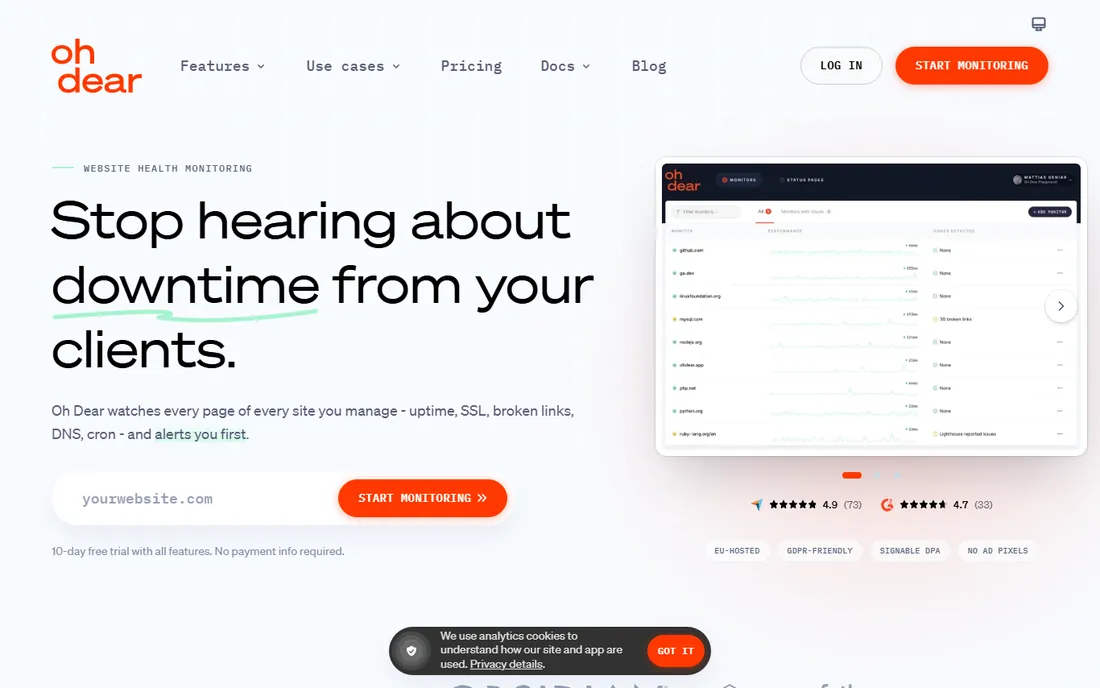
Oh Dear is built for people who manage other people's websites. The pitch is refreshingly direct: one price per site count, every check switched on, no tiers, no per-client fees. Beyond uptime it watches the things that embarrass agencies: broken links, mixed content, expiring certificates, DNS changes, failed cron jobs and Lighthouse performance, with checks every minute and monthly reports clients can read.
The catch is that there is no free tier, only a 10-day trial, and the per-site pricing means a 50-site agency pays real money. For freelancers and small agencies, though, the client reporting alone justifies it: the monthly report shows the client what they pay for. If you manage sites for clients, start your trial here.
What we like- Published, simple pricing: 15 euros a month covers up to 2 sites with every check included, no feature tiers
- Monitors uptime, SSL, DNS, cron, broken links and Lighthouse scores
- Client-ready monthly reports and per-client status pages
Watch out for- No free plan beyond the 10-day trial
- Priced per site, so large portfolios add up

#9
Uptrends
Best for: Businesses that need realistic synthetic monitoring from real user locations
Visit uptrends.com
Starting priceSee website (30-day free trial)
Free planFree trial (30 days, no credit card)
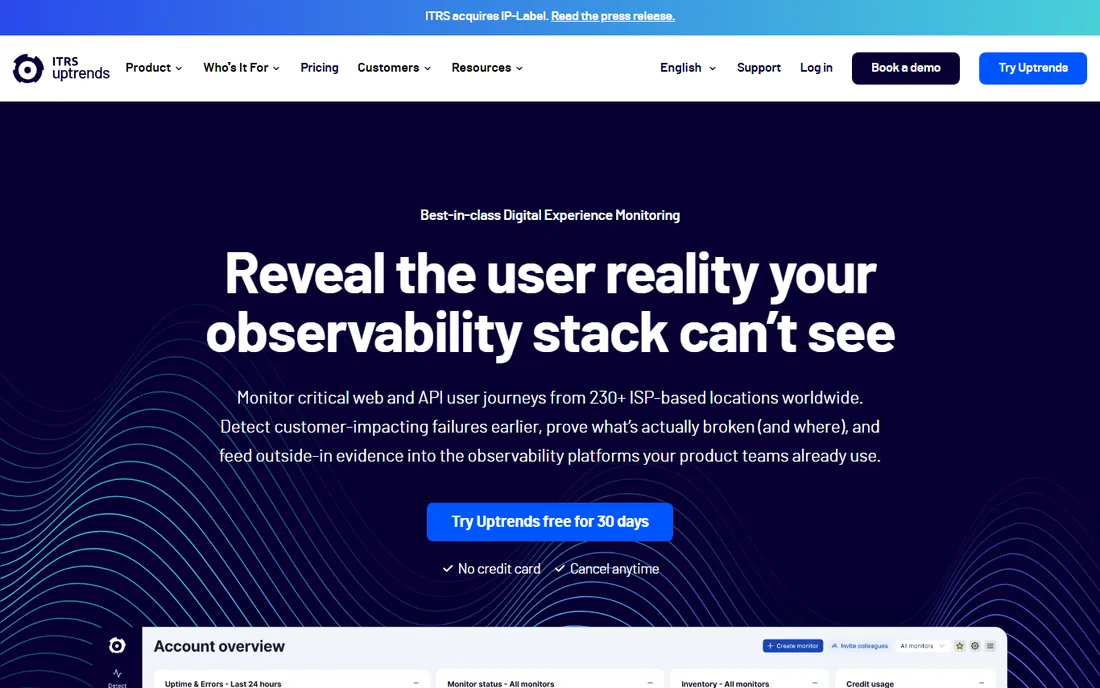
Uptrends' distinctive idea is where its checks run: not from cloud data centers but from 230-plus ISP-based checkpoints that follow the real end-user path. Cloud checks miss regional ISP issues and corporate network problems; Uptrends is built to catch them. Transaction monitoring handles the hard cases, multi-step journeys behind SSO and MFA logins, with a low-code editor.
The tradeoff is accessibility. There is no free tier, pricing is not published, and the product clearly targets mid-market and enterprise buyers. For a business where regional performance differences cost money, the checkpoint network is worth the sales call. For simple uptime needs, the free tools above are enough.
What we like- 230-plus ISP-based checkpoints for realistic outside-in monitoring, a genuine differentiator
- Transaction monitoring that handles SSO and MFA flows
- Low-code setup with Terraform support for monitor management
Watch out for- No free plan beyond the trial and no published pricing
- The enterprise positioning shows in the sales-led buying process
How we chose
We started with the searches buyers run: web monitoring software, website monitoring service, and uptime monitoring tools. For each candidate we opened the vendor's own homepage, confirmed the product is live and genuinely monitors websites (not just infrastructure or APM), and checked public reviews on G2 and Capterra plus practitioner discussion on Reddit. Prices and free plans come only from vendor pages: where a homepage published no price, we wrote "See website" rather than repeating third-party numbers.
Quick comparison
| Tool | Best for | Starting price | Free plan |
|---|
| Pingdom | Teams that want proven uptime, page speed and transaction monitoring from one vendor | See website (paid plans; 30-day trial) | Free trial (30 days, fully functional) |
| UptimeRobot | Anyone who wants serious uptime monitoring starting at zero cost | See website (free plan; paid Solo, Team and Enterprise tiers) | Yes (50 monitors free) |
| Datadog | Engineering teams that want monitoring, logs and APM in one observability platform | See website (usage-based pricing) | See website |
| New Relic | Teams that want Datadog-class observability with a free entry point | See website (usage-based pricing) | Yes (free tier; full platform access, no credit card required) |
| StatusCake | Small businesses that want uptime, page speed, SSL and domain monitoring free | See website (free plan; paid Superior, Business and Enterprise tiers) | Yes (10 uptime monitors free) |
| Site24x7 | IT teams that want website monitoring inside a full infrastructure suite | See website | See website |
| Better Stack | Modern teams that want uptime monitoring, status pages and logging at a fair price | See website (free plan; predictable paid pricing) | Yes (free plan) |
| Oh Dear | Agencies and freelancers managing many client sites | 15 euros/month (up to 2 sites; every check included) | Free trial (10 days, no credit card) |
| Uptrends | Businesses that need realistic synthetic monitoring from real user locations | See website (30-day free trial) | Free trial (30 days, no credit card) |
Is your product missing or out of date?
We review this list regularly. Vendors can request a listing, send updated pricing or ask about featured placement.
Uptime checks vs. synthetic monitoring vs. RUM: buy the right kind
These are three different products wearing one category name, and buying the wrong kind is the most common mistake. Uptime checks ping a URL on a schedule and tell you when it stops answering. Every tool here does this, and the free tiers of UptimeRobot and StatusCake do it well enough for most sites.
Synthetic monitoring goes further: scripted browsers run transactions like login, search and checkout on a schedule, catching broken flows that still return HTTP 200. Pingdom, Uptrends, Site24x7 and Oh Dear sell this as their core value, and it is what you need when the site being "up" is not the same as the site working.
Real user monitoring watches actual visitors instead of scripts, showing real load times by geography, device and browser. Datadog, New Relic, Pingdom and Site24x7 include it. The rule: start with uptime checks for everything, add synthetic monitoring for revenue-critical flows, and add RUM when you need to know how real users experience the site rather than how your scripts do.
How often and from where: the two settings that matter
Two settings decide whether your monitoring actually protects you: check frequency and check location. A 5-minute interval, standard on free plans, means up to five minutes of downtime before anyone knows. Paid tiers offer 1-minute or 30-second checks. For a brochure site, 5 minutes is fine. For a checkout page, pay for faster.
Location matters just as much. A check from one data center tells you the site is up from that data center. Regional outages, DNS issues and CDN problems only show up with geographic spread, which is why Uptrends built its ISP checkpoint network and why StatusCake offers 30 countries on paid tiers. Whatever tool you pick, run checks from at least two regions far apart, and set up alerts that reach a human: email alone at 2 AM helps no one.
Frequently asked questions
What is the difference between uptime monitoring and synthetic monitoring?
Uptime monitoring checks that a URL responds. Synthetic monitoring runs scripted user journeys, like logging in or completing a purchase, in a real browser on a schedule. Uptime tells you the server answers; synthetic tells you the site works. Use uptime for everything and synthetic for the flows that make money.
How much does website monitoring cost?
It ranges from free to five figures a month. UptimeRobot and StatusCake cover basic monitoring free; Oh Dear publishes 15 euros a month for 2 sites; Pingdom, Uptrends and Site24x7 quote by scale; Datadog and New Relic price on usage across the whole observability platform. Most small businesses pay nothing or under 50 a month.
Can I trust a free monitoring tool for a business site?
For basic uptime, yes, with one caveat: check the interval. Free tiers typically check every 5 minutes, which leaves a detection gap. If five minutes of downtime costs you real money, pay for 1-minute checks. Also consider a second free monitor as backup: two free tools in different networks beat one paid tool with a single point of failure.
How fast should my checks run?
Match the interval to the cost of downtime. Brochure sites: 5 minutes is fine. Lead generation and content: 1 to 5 minutes. Checkout, SaaS apps and anything transactional: 1 minute or faster. Faster checks cost more and create more alert noise, so tune sensitivity and use maintenance windows for planned work.
Do I need a status page too?
If anyone besides you cares whether the site is up, yes. UptimeRobot, StatusCake, Better Stack, Site24x7 and Oh Dear all include status pages, and a public page cuts "is it down?" support tickets during incidents. Agencies should treat per-client status pages, like Oh Dear's, as a selling point, not a cost.
When should I move from an uptime checker to Datadog or New Relic?
When the question changes from "is the site up?" to "why is it slow, and which deploy caused it?" That needs APM, logs and infrastructure metrics correlated with the frontend, which is what the observability platforms sell. Until then, a dedicated monitoring tool is cheaper, simpler and faster to run.
Sources we checked (9)
- https://pingdom.com/
- https://uptimerobot.com/
- https://datadoghq.com/
- https://newrelic.com
- https://www.statuscake.com
- https://site24x7.com/
- https://betterstack.com
- https://ohdear.app
- https://www.uptrends.com
Is your product missing or out of date?
We review this list regularly. Vendors can request a listing, send updated pricing or ask about featured placement.

Shihab Mia · Founder, Rankite
Shihab has spent more than a decade helping SaaS and e-commerce brands grow through search. He writes Rankite's software buying guides from pricing pages, documentation and public user reviews. More about Shihab.