How we make this list: we compare pricing pages, product documentation and public user reviews. Rankite is independent; if a vendor ever pays for a featured spot, that listing is clearly labeled Partner.
Key takeaways
- Octopus Deploy ($45/month Cloud, with a free tier) is the most approachable commercial deployment platform, especially after acquiring Codefresh.
- Argo CD and Flux are free, open-source GitOps tools; managed control planes (Akuity from $495/month) add enterprise features.
- Spinnaker and Jenkins are free and battle-tested for complex pipelines, but both need real operational investment.
- Harness sells modern CD with AI features on a modular platform; Azure DevOps ($6/user/month) bundles deployment with the Microsoft toolchain.
- GitLab ($29/user/month Premium) puts deployment inside a complete DevOps platform, which simplifies tooling at the cost of flexibility.
Quick comparison
| Tool | Best for | Starting price | Free plan |
|---|
 Octopus Deploy Octopus Deploy | Teams that want deployment done reliably without drama | $0 (free tier, 10 projects/10 targets); Cloud from $45 per month | Yes |
 Argo CD Argo CD | Kubernetes teams practicing GitOps | $0 (open source, Apache 2.0) | Yes |
 Flux Flux | Minimalist GitOps inside your clusters | $0 (open source, Apache 2.0) | Yes |
 Harness Harness | Enterprises modernizing CD with AI assistance | See website | Free trial |
 Spinnaker Spinnaker | Multi-cloud continuous delivery at scale | $0 (open source) | Yes |
 GitLab GitLab | One platform from code to production | $0 (free tier); Premium $29 per user per month | Yes |
 Jenkins Jenkins | Free, infinitely extensible automation | $0 (open source) | Yes |
 Azure DevOps Azure DevOps | Microsoft-centric teams deploying to Azure | $6 per user per month | Free tier |
Is your product missing or out of date?
We review this list regularly. Vendors can request a listing, send updated pricing or ask about featured placement.
The best deployment software
#1
Octopus Deploy
Best for: Teams that want deployment done reliably without drama
Visit octopus.com
Starting price$0 (free tier, 10 projects/10 targets); Cloud from $45 per month
Free planYes
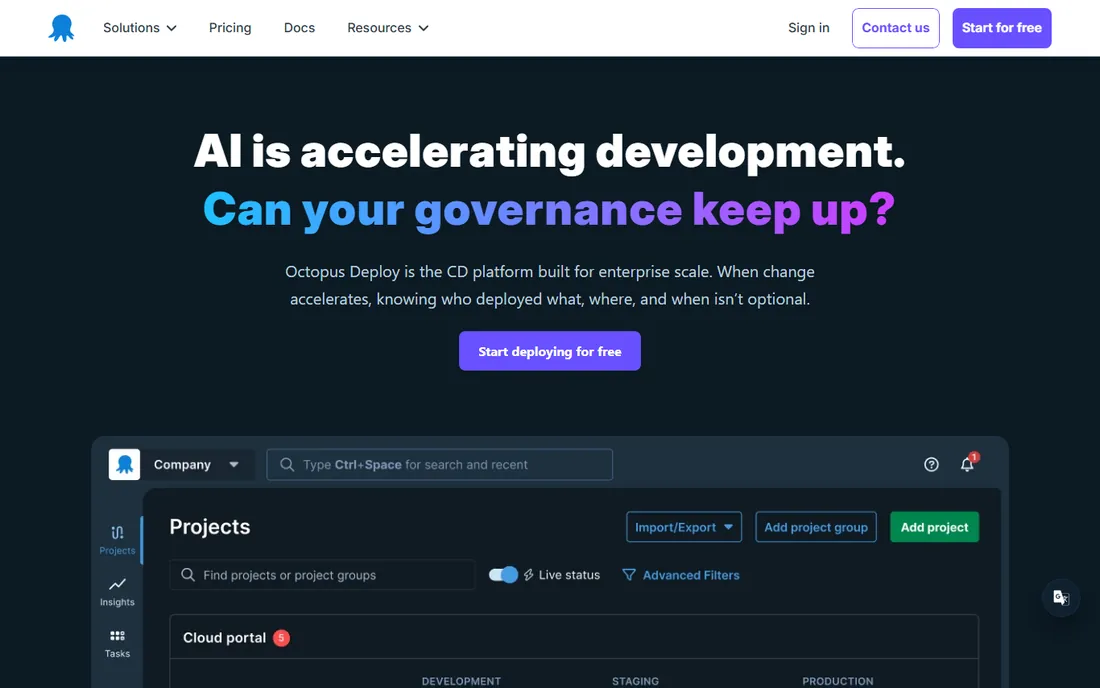
Octopus Deploy has spent a decade refining one job: repeatable, reliable deployments. Its runbook automation, environment promotion and deployment targets model handles complex release processes (database migrations, multi-step rollouts) better than pipeline tools that treat deployment as a CI afterthought. Cloud starts at $45 per month, with a free tier covering 10 projects, 10 targets and 10 users; self-hosted Server is also available.
The 2026 acquisition of Codefresh added GitOps and Argo capabilities to the platform, broadening its Kubernetes story. Pricing scales per deployment target, so large infrastructures cost more, but the model is transparent.
It fits teams that deploy complex applications and want the release process modeled properly, not scripted.
What we like- Excellent deployment modeling
- Free tier for small teams
- Acquired Codefresh for GitOps
Watch out for- Per-target pricing scales with infrastructure
- Less Kubernetes-native than Argo CD
Starting price$0 (open source, Apache 2.0)
Free planYes
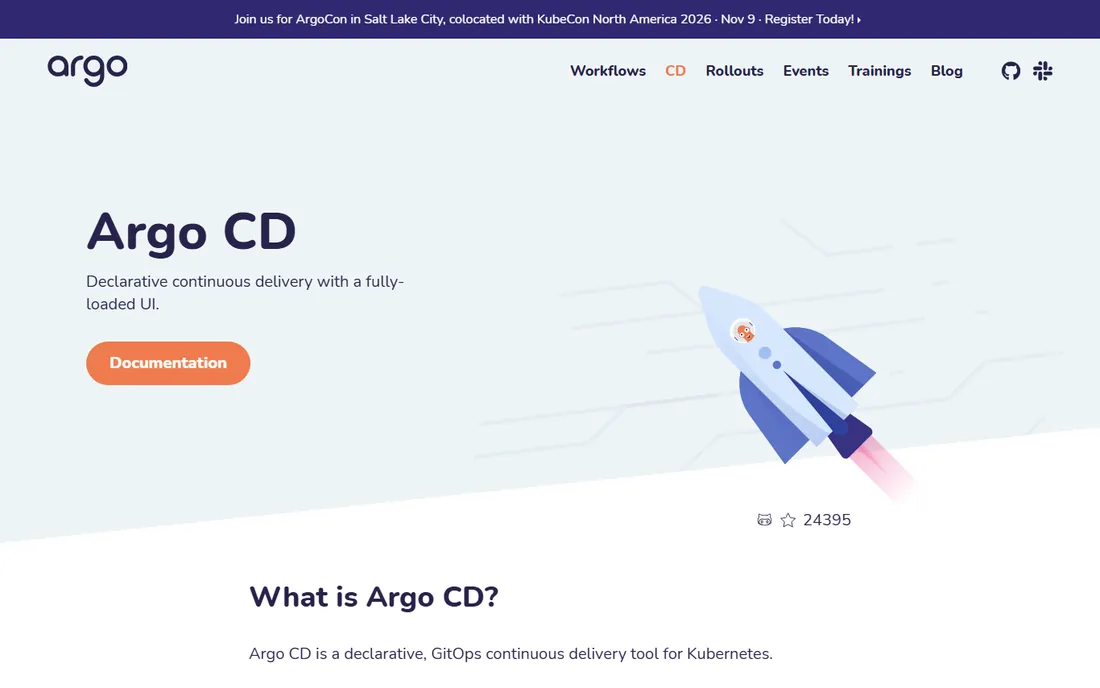
Argo CD is the standard GitOps operator for Kubernetes: declare the desired state in Git, and Argo CD keeps your clusters synced to it, with a UI for visualizing application state and history. It is free, open source (Apache 2.0), CNCF-graduated, and the most starred GitOps project in the ecosystem.
The cost is operational: you run the controllers, manage upgrades and handle multi-cluster RBAC yourself. Managed options exist: Akuity (founded by Argo co-creators) publishes its Pro control plane at $495 per month including Argo CD and Kargo instances. For most Kubernetes teams, self-hosted Argo CD is the default starting point.
Choose it when your deployments target Kubernetes and you want Git as the source of truth.
What we like- Free and CNCF-graduated
- Declarative GitOps model
- Huge community
Watch out for- You operate it yourself
- Enterprise features need managed platforms
Starting price$0 (open source, Apache 2.0)
Free planYes
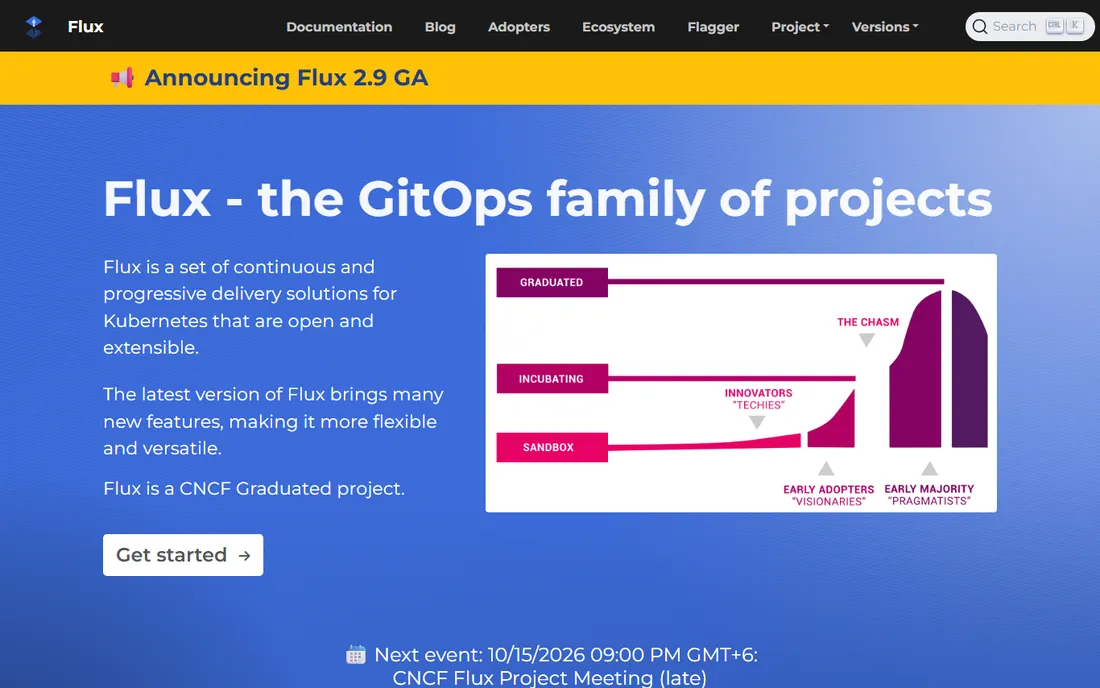
Flux takes a lighter approach than Argo CD: in-cluster controllers reconcile your Git state with no central server, managed primarily through CLI. It is free, open source and CNCF-hosted, and it composes well with progressive delivery tools like Flagger.
The tradeoff is experience: less visual UI, more YAML and CLI, a smaller community. ControlPlane (which employs the maintainers) sells support and hardened builds rather than a hosted service, so you are buying assurance around software you run yourself.
It suits teams that prefer minimal, composable GitOps primitives over a full control plane.
What we like- Lightweight in-cluster controllers
- CNCF project
- Composable with other tools
Watch out for- CLI-driven, less visual than Argo CD
- Smaller community
#4
Harness
Best for: Enterprises modernizing CD with AI assistance
Visit harness.io
Starting priceSee website
Free planFree trial
Harness is the modern commercial CD platform: fast pipeline authoring, AI features for deployment verification and rollback decisions, and a modular platform spanning CI, CD, feature flags and cloud cost management. It targets enterprises replacing Jenkins or legacy release tools.
Pricing is quote-based with a free trial; the modular structure means you license what you use. The platform's breadth is both strength and risk: teams that want just CD may find the upsell distracting. But for organizations standardizing their software delivery stack, the integrated modules compound.
It fits enterprises that want a modern, AI-assisted alternative to self-managed pipelines.
What we like- Modern pipeline UX
- AI-assisted deployments
- Modular platform (CI, CD, feature flags)
Watch out for- Quote-based pricing
- Platform breadth can overwhelm
- Newer than the incumbents
Starting price$0 (open source)
Free planYes
Spinnaker, originally from Netflix, remains the open-source choice for sophisticated multi-cloud deployment strategies: canary analysis, red/black deployments and pipeline orchestration across AWS, GCP, Azure and Kubernetes. It is free and proven at enormous scale.
Operating it is the job: Spinnaker is famously heavy, with many microservices to run and a complex initial setup. The community is smaller than at its peak, though still active. Teams adopt it when their deployment strategy (not just their tooling) needs to be sophisticated.
Choose it when you need advanced deployment strategies across multiple clouds and have platform engineers to run it.
What we like- Free
- Proven multi-cloud deployment strategies
- Canary and red/black built in
Watch out for- Heavy to operate
- Complex setup
- Community smaller than its peak
Starting price$0 (free tier); Premium $29 per user per month
Free planYes
GitLab puts deployment inside a complete DevOps platform: repositories, CI, CD, environments, review apps and monitoring in one interface. The free tier covers basic CD; Premium at $29 per user per month adds advanced deployment features. For teams tired of integrating five tools, the single-platform story is compelling. Small teams should weigh that convenience against the cost of running everything through one vendor.
The tradeoff is depth: dedicated tools (Octopus for release modeling, Argo CD for GitOps) go deeper in their niches. GitLab's CD is good, not exceptional. But the integration dividend (one permission model, one audit trail, one bill) is real.
It suits teams that value a unified toolchain over best-of-breed components.
What we like- Complete DevOps lifecycle in one tool
- Auto DevOps
- Environments and review apps
Watch out for- Jack-of-all-trades depth
- Premium needed for advanced CD features
Starting price$0 (open source)
Free planYes
Jenkins is the free workhorse of automation: thousands of plugins, runs on any infrastructure, and a knowledge base covering every edge case. Countless deployment pipelines still run on Jenkins, and for teams with existing investment, it keeps working.
The costs are maintenance, security patching and plugin sprawl: Jenkins needs care and feeding, its UX shows its age, and plugin compatibility issues are a rite of passage. New teams usually pick modern alternatives; existing Jenkins shops keep it running because migration is expensive.
It fits teams with Jenkins expertise and infrastructure already in place, or anyone needing free automation with maximum flexibility.
What we like- Free
- Thousands of plugins
- Runs anywhere
- Massive knowledge base
Watch out for- You maintain everything
- Plugin sprawl
- Dated UX
- Security patching burden
Starting price$6 per user per month
Free planFree tier
Azure DevOps bundles deployment pipelines with boards, repos and artifacts at $6 per user per month, with a free tier for individuals and small teams. For Microsoft shops deploying to Azure, the integration (service connections, managed identity, Azure-native tasks) makes it the path of least resistance.
Outside the Microsoft ecosystem the appeal fades, and the Pipelines UX feels dated next to Harness or GitLab. But the price is hard to argue with, and the bundled boards and repos replace several other subscriptions.
Choose it when your stack is Microsoft and Azure and you want deployment bundled cheaply.
What we like- Cheap per-user pricing
- Tight Azure integration
- Boards, repos and pipelines together
Watch out for- Weaker outside the Microsoft ecosystem
- Pipelines UX lags newer tools
GitOps vs pipelines: which model fits
Traditional pipeline tools (Jenkins, Octopus, Harness) push changes through stages: build, test, deploy. GitOps tools (Argo CD, Flux) pull: the cluster continuously reconciles toward the state declared in Git. GitOps gives you auditability (every change is a commit) and drift correction for free, but it fits Kubernetes best. Pipeline tools handle everything else: VMs, databases, serverless, multi-step release orchestration. Many organizations run both: GitOps for Kubernetes workloads, pipelines for the rest.
Whichever model you choose, nail the rollback story before you optimize the deploy story. Every tool here can roll back; the question is how fast and how safely. Test it in staging: deploy a bad build, measure time-to-recovery, and check whether the rollback itself is a reviewed, auditable action or a panicked button press. Teams that practice rollbacks deploy more often, because the cost of a bad deploy drops to minutes. Deployment frequency is a function of rollback confidence.
How we chose
We listed active deployment platforms across all four approaches (commercial CD, GitOps, pipeline automation, DevOps suites) with real 2026 adoption. Pricing comes from vendor pricing pages as verified in September 2026; open-source tools are honestly listed as free with their operational costs described. We weighted release modeling depth, Kubernetes support, ease of operation and pricing transparency. No hands-on testing was performed.
Frequently asked questions
What is the difference between CI and CD?
Continuous integration (CI) builds and tests code on every change. Continuous deployment/delivery (CD) moves tested code to production safely. These tools focus on the CD half; most also integrate with CI systems.
Is Argo CD really free?
Yes: Apache 2.0 open source, free forever. You pay in operational effort (running it) or in managed control planes like Akuity ($495/month Pro) if you want enterprise features without the ops burden.
Which deployment tool is best for Kubernetes?
Argo CD for GitOps-style declarative deployments, Flux for lighter in-cluster GitOps, Octopus Deploy (post-Codefresh) for modeled releases to Kubernetes alongside other targets.
How much does deployment software cost?
From $0 (Argo CD, Flux, Spinnaker, Jenkins) to $45/month (Octopus Cloud) to $29/user/month (GitLab Premium) to quote-based (Harness). Azure DevOps at $6/user/month is the cheapest commercial bundle.
What is GitOps?
An operational model where Git is the single source of truth for infrastructure and application state, and automated operators (Argo CD, Flux) keep live systems synced to it. Every change is a reviewable commit.
Do I need a deployment tool if I have CI?
CI gets code built and tested; something must still promote it through environments safely with approvals, rollbacks and audit trails. That is the deployment tool's job, and spreadsheets-plus-scripts stop scaling quickly.
How do database migrations fit into deployment?
Carefully. Application deploys are reversible; schema changes often are not. The reliable pattern is expand-then-contract: deploy code that works with both old and new schema, migrate, then deploy code that uses the new schema. Octopus Deploy models this well; GitOps tools need the migration step orchestrated alongside the sync.
Sources we checked (4)
- https://devtoollab.com/blog/best-gitops-tools
- https://www.saasworthy.com/product/octopus-deploy/pricing
- https://slashdot.org/software/comparison/Azure-DevOps-vs-Octopus-Deploy/
- https://github.com/ishandutta2007/awesome-internal-developer-platform/blob/HEAD/README.md
Is your product missing or out of date?
We review this list regularly. Vendors can request a listing, send updated pricing or ask about featured placement.

Shihab Mia · Founder, Rankite
Shihab has spent more than a decade helping SaaS and e-commerce brands grow through search. He writes Rankite's software buying guides from pricing pages, documentation and public user reviews. More about Shihab.