How we make this list: we compare pricing pages, product documentation and public user reviews. Rankite is independent; if a vendor ever pays for a featured spot, that listing is clearly labeled Partner.
Key takeaways
- Affinity remains the standard deal-flow CRM for venture firms, with published plans starting at $2,000 per user per year.
- Attio and Visible.vc give emerging managers serious capability at low cost, including free tiers.
- Carta covers cap tables, fund administration and, since the Tactyc acquisition, reserve modeling in one place.
- If LP reporting is the bottleneck, Juniper Square and Fundwave deserve the first look.
- Most firms need two or three tools, not one: a CRM for deal flow, something for portfolio data, and a reporting or admin layer.
Quick comparison
| Tool | Best for | Starting price | Free plan |
|---|
 Affinity Affinity | Deal flow CRM with relationship intelligence | $2,000 per user/year (Essential, billed annually) | No |
 Carta Carta | Cap tables, fund administration and valuations | See website | No |
 Attio Attio | Flexible, low-cost CRM for small investment teams | See website | Yes |
 Visible.vc Visible.vc | Portfolio reporting and investor updates | See website | Yes |
 Standard Metrics Standard Metrics | Standardized KPI collection across the portfolio | See website | Yes |
 Zapflow Zapflow | Deal flow and portfolio tracking for European teams | See website | No |
 Fundwave Fundwave | Fund administration and LP reporting for growing firms | See website | No |
 Edda Edda | All-in-one deal flow, portfolio and LP reporting | See website | No |
 Juniper Square Juniper Square | LP portals and polished investor reporting | See website | No |
Is your product missing or out of date?
We review this list regularly. Vendors can request a listing, send updated pricing or ask about featured placement.
The best VC software
Starting price$2,000 per user/year (Essential, billed annually)
Free planNo

Affinity is the name you hear most when venture partners talk about their stack, and the reason is simple: it captures activity automatically. Every email, meeting and introduction across the firm flows into the CRM without anyone logging it, which solves the classic problem of partner inboxes holding all the relationship value. The relationship intelligence layer scores how warm each connection is, so sourcing a warm intro to a founder becomes a search instead of a favor to ask around for.
The published pricing page lists three tiers: Essential at $2,000 per user per year, Scale at $2,300 and Advanced at $2,700, with a custom Enterprise tier above. That puts Affinity firmly in the "pay for it if deal flow pays for it" category. Smaller funds often balk at the entry cost, and the enrichment from PitchBook, Dealroom and Crunchbase plus workflow automations only arrive on Advanced. For firms that live or die on sourcing and network effects, though, the automatic capture alone usually justifies the spend. The catch is adoption: the tool only shines if every partner connects their inbox, and some partners never will.
What we like- Automatic email and calendar capture means no manual data entry
- Relationship scoring shows the warmest path to any contact
- Built specifically for private capital workflows
Watch out for- Entry price is steep for solo GPs
- Advanced enrichment and automation sit on higher tiers
- Annual contracts only on published plans
#2
Carta
Best for: Cap tables, fund administration and valuations
Visit carta.com
Starting priceSee website
Free planNo
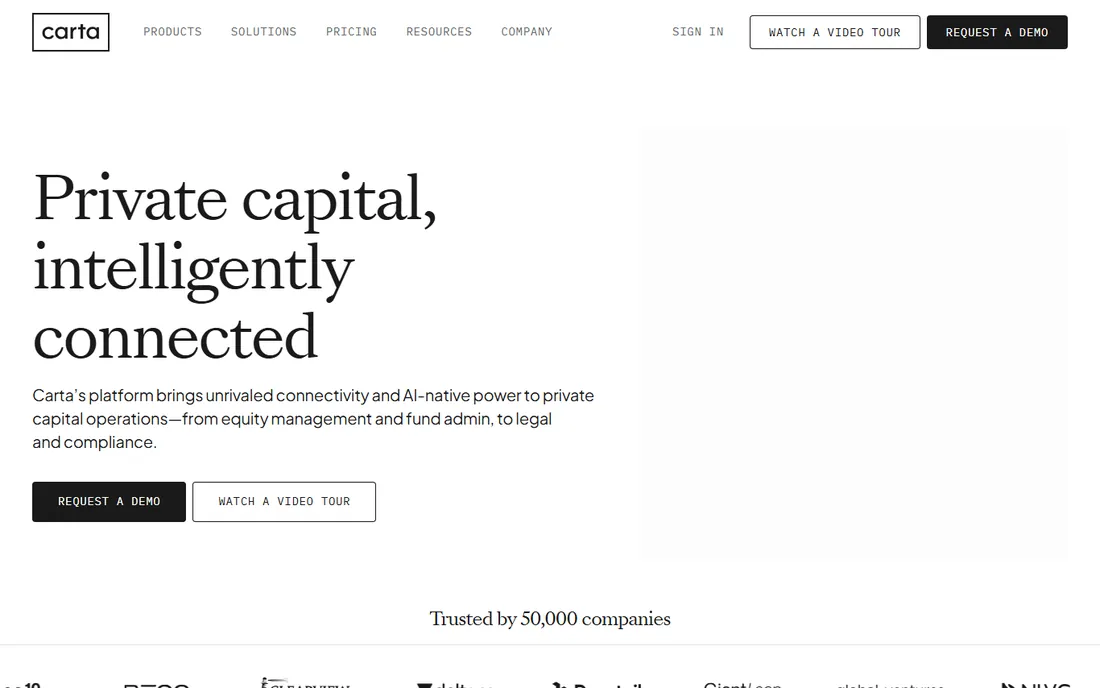
Carta started as eShares, a cap table tool for startups, and grew into the operating system for private-market equity. For a VC firm it connects portfolio company cap tables, valuations and fund administration in one place, so LP reporting draws on live data instead of quarter-end spreadsheets. The acquisition of Tactyc added portfolio construction and follow-on reserve modeling, closing one of the gaps firms used to fill with a separate tool.
Pricing is quote-based and depends on assets, fund count and complexity, so budget at least a conversation with sales before planning around a number. Carta works best once a firm has real scale: multiple funds, dozens of portfolio companies, regular LP reporting cycles. Solo emerging managers often find it heavyweight and expensive for what they need in year one. Where it earns its keep is audit season and fundraising, when clean, consistent records across funds save weeks of partner and back-office time.
What we like- Live cap table data connected to fund operations
- Supports companies and investors on one platform
- Now includes Tactyc's reserve modeling after the acquisition
Watch out for- Pricing is opaque and varies widely by fund size
- Can feel overbuilt for very small funds
- Migrating historical records takes real effort
#3
Attio
Best for: Flexible, low-cost CRM for small investment teams
Visit attio.com
Starting priceSee website
Free planYes
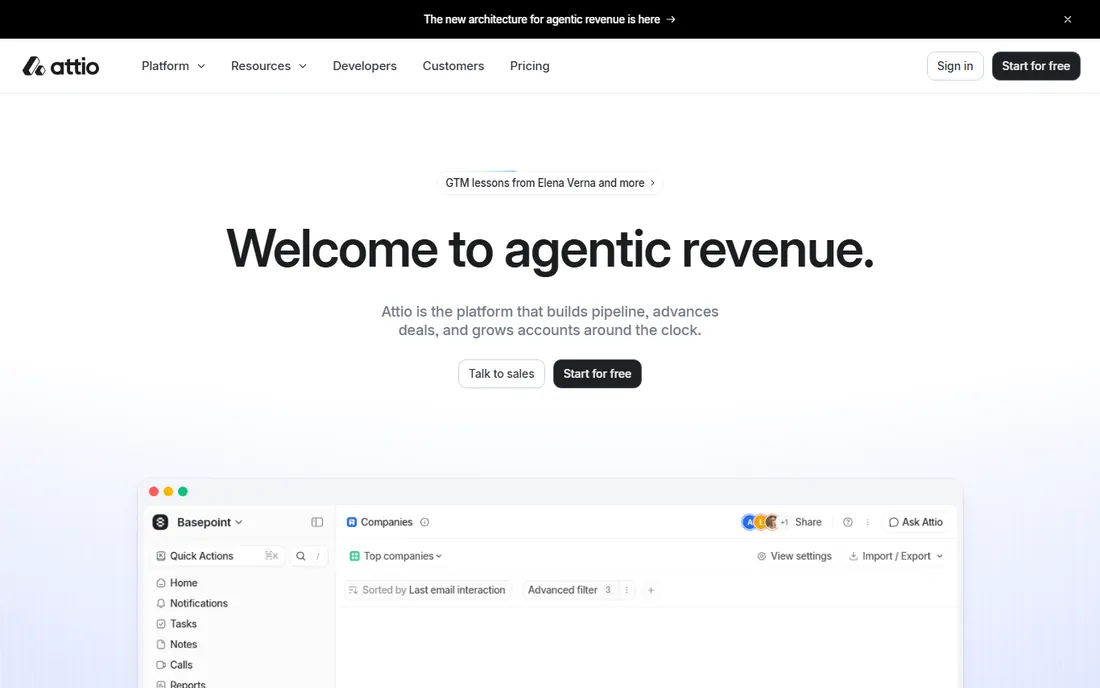
Attio is a general CRM that venture teams keep adopting because it is flexible, fast and far cheaper than the VC-native options. You can model deals, companies, founders and co-investors however you like, build pipeline views in minutes, and sync email without an implementation project. For an emerging manager running a lean operation, the free tier covers the basics and paid plans stay modest.
The tradeoff is that Attio does not think like an investor. There is no built-in fund structure, no LP reporting, no portfolio KPI collection. Relationship strength is something you model yourself rather than something the system infers. Teams that outgrow it usually move to Affinity or add a portfolio tool like Visible.vc alongside it. As a first CRM for a new fund, though, it is hard to beat: you get organized deal flow this week instead of after a quarter of onboarding.
What we like- Generous free tier for getting started
- Highly customizable objects and views
- Modern interface the team will actually open
Watch out for- Not built specifically for venture workflows
- Relationship intelligence is weaker than Affinity
- Reporting for LPs needs workarounds
#4
Visible.vc
Best for: Portfolio reporting and investor updates
Visit visible.vc
Starting priceSee website
Free planYes
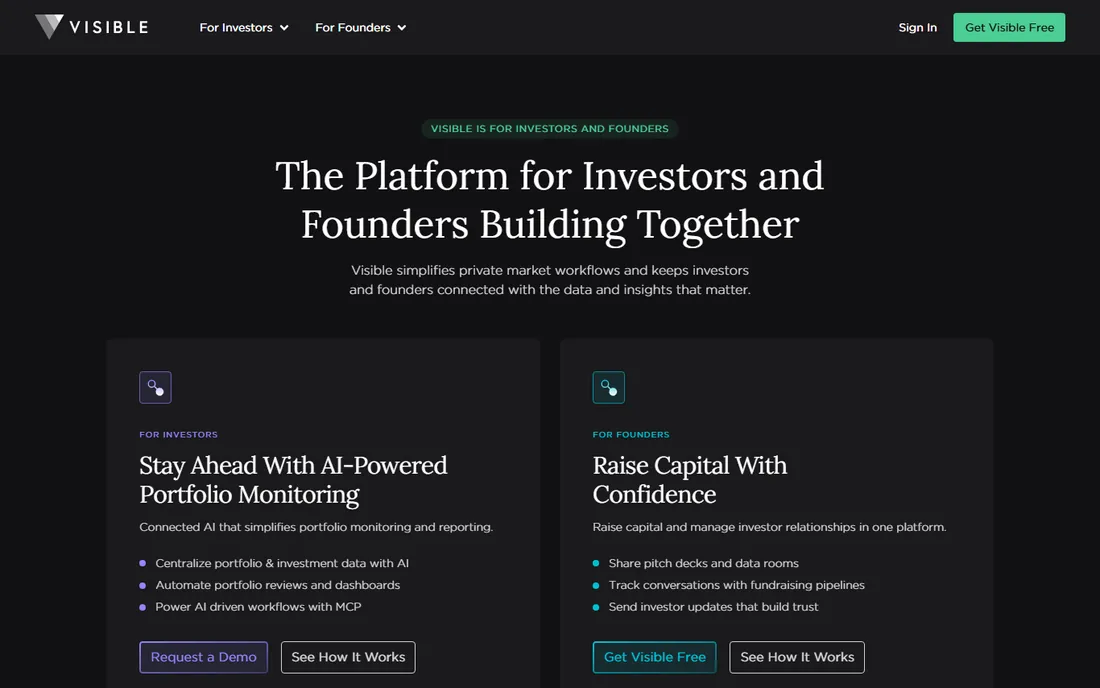
Visible.vc solves the most annoying recurring job in venture: getting data out of portfolio companies. Instead of chasing founders over email each quarter, you send structured update requests and the platform collects KPIs, commentary and files in a consistent format. Those updates feed dashboards you can share with LPs, which turns a reporting chore into an investor-relations asset.
The free tier is genuinely useful for a small portfolio, which makes Visible an easy first purchase for emerging managers. It does not try to be a CRM, so pair it with Affinity or Attio rather than replacing them. The honest weakness is founder compliance: the tool is only as good as the founders who fill in the templates, and busy founders still need nudging. Firms that set the expectation at term-sheet stage ("we do updates through Visible") get far more value than firms that introduce it after the fact.
What we like- Free tier covers basic portfolio updates
- Structured KPI requests founders actually answer
- Doubles as an LP update channel
Watch out for- Not a deal-flow CRM
- Limited customization on lower tiers
- Best value requires the annual plan
Starting priceSee website
Free planYes
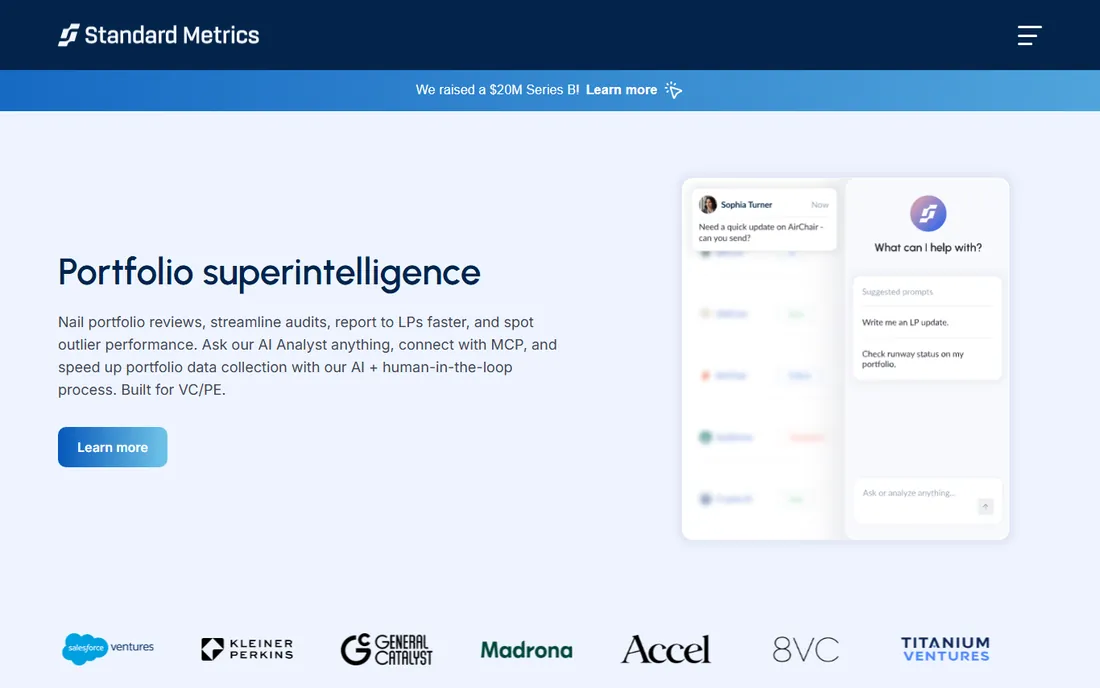
Standard Metrics takes the Visible.vc idea one step further: not just collecting updates, but standardizing them so every company reports the same KPIs the same way. That comparability matters when a partner wants to benchmark burn multiples or growth rates across twenty companies without normalizing spreadsheets by hand. Integrations with accounting and analytics tools reduce the manual entry founders hate.
It is a younger company than most names on this list, so expect a narrower feature set and a product that is still expanding. LP reporting exists but is not the strength; firms that need polished investor portals usually pair it with something else. For data-driven firms that want a clean, comparable dataset across the portfolio, the standardized approach is the selling point. Pricing is not published, so talk to sales, but the free tier lets a small fund test the workflow before committing.
What we like- Consistent metrics make portfolio companies comparable
- Integrations pull data automatically
- Free tier for small funds
Watch out for- Narrower feature set than full portfolio platforms
- Newer vendor with a shorter track record
- LP-facing reporting is basic
#6
Zapflow
Best for: Deal flow and portfolio tracking for European teams
Visit zapflow.com
Starting priceSee website
Free planNo
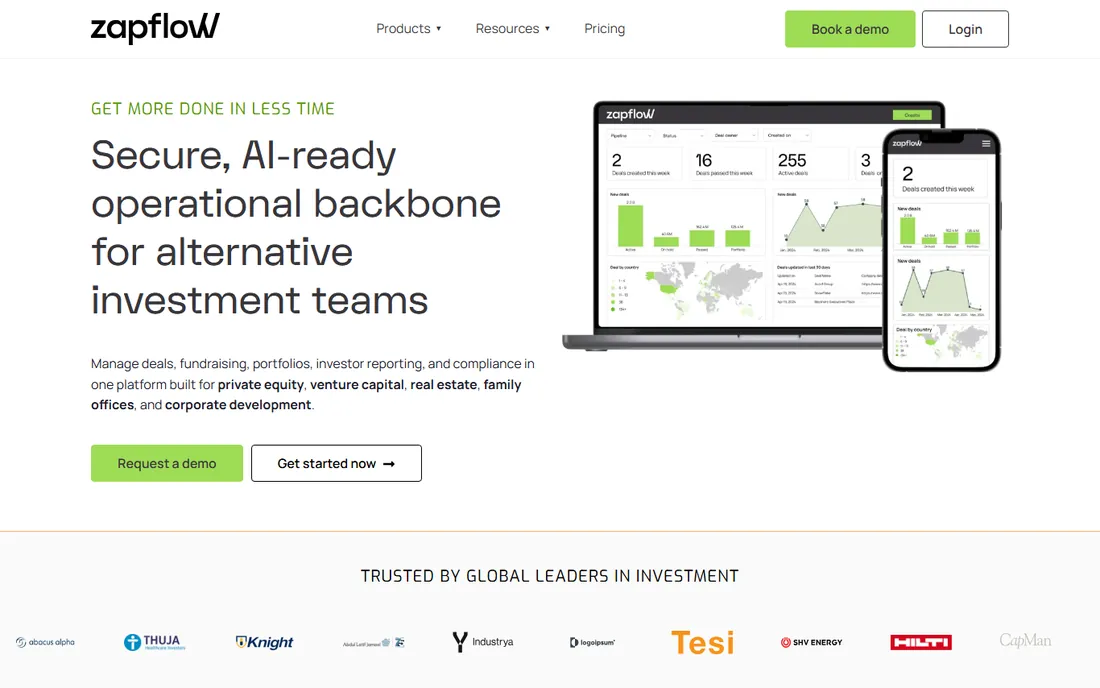
Zapflow is a Helsinki-based platform built specifically for venture capital and private equity teams, and it shows in the workflow coverage: deal sourcing, pipeline management, fundraising and portfolio tracking live in one system. European firms in particular have adopted it as an alternative to stitching together a US CRM with spreadsheets. The interface is straightforward and the onboarding is geared toward investment teams rather than generic sales users.
The downsides are the usual ones for a regional specialist. The integration ecosystem is thinner than Affinity's or Salesforce's, and pricing is not published, so you will go through a sales process. US-based firms may find fewer peers to compare notes with. If your firm is in Europe and wants one system for the front office instead of three, Zapflow deserves a demo. If you are a US emerging manager, the domestic options usually fit better.
What we like- Built for professional investors from the ground up
- Covers deal flow, fundraising and portfolio in one tool
- Strong presence with European VC and PE firms
Watch out for- Smaller user community than US-centric rivals
- Pricing not published
- Fewer third-party integrations
#7
Fundwave
Best for: Fund administration and LP reporting for growing firms
Visit fundwave.com
Starting priceSee website
Free planNo
Fundwave covers the back office: fund accounting, portfolio performance tracking, capital calls and distributions, and the LP portal where investors see their statements. It is positioned for firms that have outgrown spreadsheets but do not want the cost or complexity of an Allvue implementation. Multi-fund support and investor lifecycle management come standard rather than as expensive modules.
It is not a deal-flow tool, so the front office still needs a CRM. Implementation quality depends heavily on the state of your historical records; messy data in means a painful migration. Compared with Juniper Square, Fundwave tends to be the pick for firms that want deeper fund administration, while Juniper Square leads on the investor experience. Either way, get a reference call with a fund at your stage before signing.
What we like- Combines fund admin, portfolio monitoring and investor relations
- Handles multi-fund structures
- Pricing aimed below the enterprise incumbents
Watch out for- Not a sourcing or deal-flow tool
- Implementation needs clean historical data
- Smaller vendor than Allvue or Juniper Square
#8
Edda
Best for: All-in-one deal flow, portfolio and LP reporting
Visit edda.co
Starting priceSee website
Free planNo
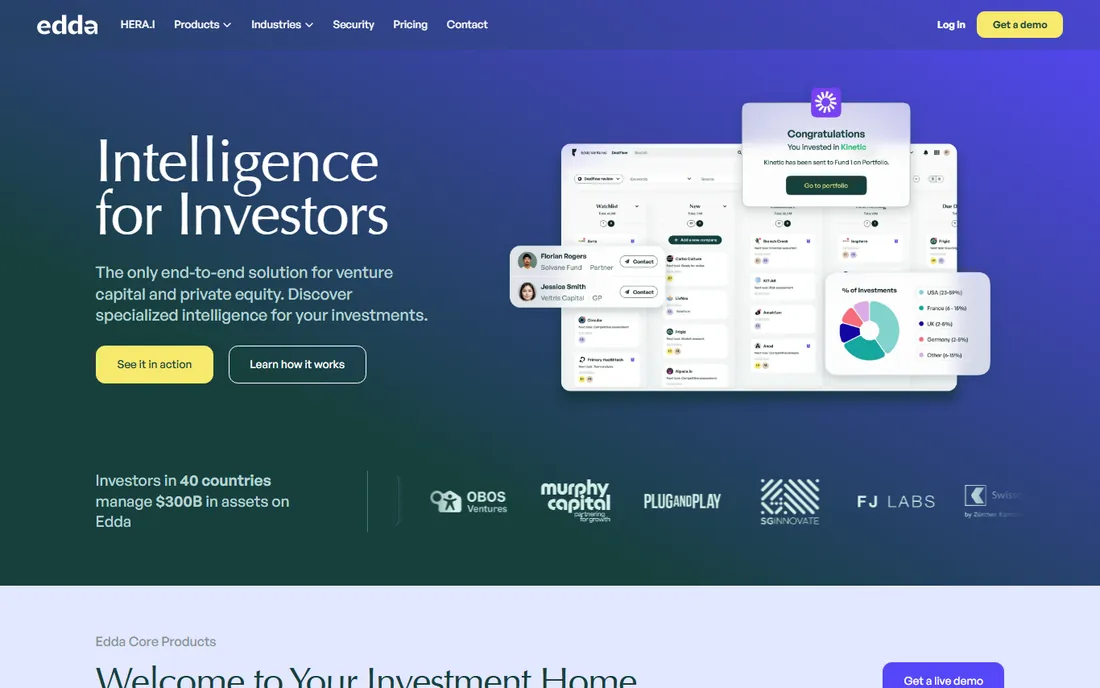
Edda pitches itself as the whole VC workflow in one platform: deal flow, portfolio monitoring, team collaboration and LP reporting without bolting tools together. For firms tired of maintaining a CRM plus a portfolio tool plus a reporting tool, the consolidation argument is appealing. Deal memos, IC discussions and portfolio data live alongside each other, which makes institutional memory a feature instead of a shared drive.
The risk of any all-in-one is that each module is merely good rather than best in class. Firms with strong opinions about their CRM rarely give it up, and Edda's ecosystem of integrations is still growing. Pricing is quote-based. It fits best for firms standardizing their stack for the first time or second funds that want a clean start. Ask for a trial with your real pipeline data; a slideware demo will not reveal whether the portfolio module handles your reporting format.
What we like- Single workspace from sourcing to LP reporting
- Collaborative deal notes and decision records
- Designed for VC and PE teams specifically
Watch out for- Pricing not published
- Less mature ecosystem than best-of-breed combos
- Data migration from existing tools takes planning
Starting priceSee website
Free planNo
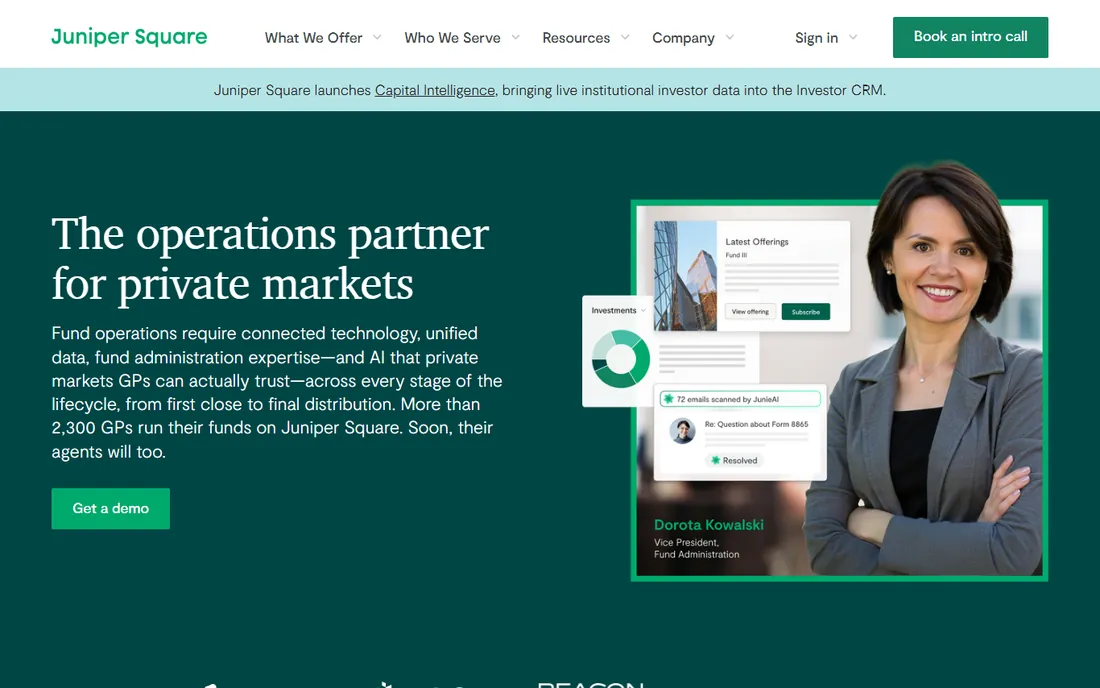
Juniper Square is the highest-rated option in the LP reporting category for a reason: the investor portal is genuinely good, and good matters when your LPs are institutions comparing your reporting to every other manager they back. Fundraising workflows, subscription documents, capital account statements and performance reporting all run through it, with the audit trail compliance teams want.
The price reflects the enterprise positioning. Emerging managers running a first $20 million fund will find it hard to justify; the value appears when LP count and reporting complexity grow. It is also a sales-led purchase with implementation involved, not a self-serve signup. If LP experience is your differentiator or your bottleneck, start here. If your problem is deal flow, spend the money on a CRM instead.
What we like- Investor portal LPs consistently praise
- Handles fundraising, onboarding and reporting
- Strong compliance and audit features
Watch out for- Enterprise pricing beyond most emerging managers
- Overkill if you only need basic reporting
- Sales-led buying process
How we chose
We built this list from vendor pricing pages, product documentation, public reviews on G2 and Capterra, and practitioner discussions on Reddit and in VC operations communities. Every tool here exists today and serves investment firms as a real customer segment. We checked current pricing pages and noted where pricing is quote-based rather than published. We excluded generic CRMs without meaningful private-capital adoption and tools that have been acquired into larger platforms, like Tactyc, which now lives inside Carta.
What actually matters when picking VC software
Start from the bottleneck, not the category. If partners lose track of founders and intros, buy the CRM first. If the pain is quarterly reporting season, buy the portfolio and LP reporting layer first. Most firms end up with two or three tools: something for deal flow, something for portfolio data, and something for fund administration or LP reporting.
Price these tools against the cost of the work they replace. A partner spending ten hours a quarter assembling LP updates is spending real money; a $2,000-per-user CRM that removes manual logging pays for itself at one fund. But do not buy enterprise software for a two-person fund. Emerging managers should bias toward tools with free tiers, Visible.vc and Attio and Standard Metrics all offer one, and upgrade when the portfolio grows past what spreadsheets and elbow grease can handle.
Check three practical things before signing. First, data export: can you get your full history out in a usable format if you leave. Second, permissions: can you restrict who sees which fund's data, because you will need that by fund two. Third, the inbox question: does every partner actually connect their email, because relationship intelligence tools are worthless on partial data. A trial with real pipeline data answers all three better than any demo.
Mistakes emerging managers make with VC software
The most common mistake is buying the full stack on day one. A first-time fund with six portfolio companies does not need fund administration software; it needs a CRM and a way to collect updates. The second mistake is the reverse: running everything in spreadsheets until the portfolio hits thirty companies, at which point migration is a quarter-long project. Add tools when the pain is weekly, not when a vendor says you are ready.
Another frequent error is choosing tools for the LPs you want rather than the firm you are. Juniper Square impresses institutional LPs, but if your LPs are high-net-worth individuals getting a quarterly PDF, the money is better spent on sourcing. Finally, never let one partner's preference decide without a trial. The person who loves a tool in a demo is rarely the associate who will live in it. Give the actual users two weeks with real data before committing to an annual contract.
Frequently asked questions
What is VC software?
VC software is the set of tools venture capital firms use to manage deal flow, track portfolio companies, report to limited partners and run fund operations. It includes CRMs built for investors, portfolio monitoring platforms, cap table and fund administration systems, and LP reporting portals. Most firms use two or three tools together rather than a single platform.
How much does VC software cost?
It ranges widely. Emerging-manager-friendly tools like Attio and Visible.vc have free tiers, Affinity publishes plans from $2,000 per user per year, and enterprise fund administration and LP reporting platforms are quote-based and can run into five figures annually. Budget for the stack, not just one tool, and expect annual contracts on the serious platforms.
Do I need VC-specific software or will a normal CRM work?
A normal CRM like Attio or HubSpot works fine for deal tracking at small scale. VC-specific tools earn their keep with relationship intelligence, fund structures, portfolio KPI collection and LP reporting that generic CRMs do not have. Start generic if you are small; move to purpose-built tools when reporting season becomes painful.
What happened to Tactyc?
Tactyc, the portfolio construction and reserve modeling tool, was acquired by Carta, and its product now redirects into Carta's fund forecasting offering. If you were evaluating Tactyc, talk to Carta about the combined product or look at standalone modeling alternatives.
Can a solo GP run on free tools?
Yes, for a while. A free CRM tier plus Visible.vc's free tier covers deal tracking and portfolio updates for a small portfolio. The usual trigger to pay is LP reporting expectations or a portfolio large enough that manual collection breaks down, often around fifteen to twenty companies.
How long does implementation take?
A CRM like Affinity or Attio can be running in days if partners connect their inboxes promptly. Fund administration and LP reporting platforms typically take four to twelve weeks including data migration. The migration, not the software, is what takes the time, so clean up historical records before you start.
Sources we checked (10)
- https://www.affinity.co/
- https://affinity.co/product/affinity-pricing
- https://carta.com/
- https://attio.com/
- https://visible.vc/
- https://standardmetrics.io/
- https://www.zapflow.com/
- https://fundwave.com/
- https://edda.co/
- https://www.junipersquare.com/
Is your product missing or out of date?
We review this list regularly. Vendors can request a listing, send updated pricing or ask about featured placement.

Shihab Mia · Founder, Rankite
Shihab has spent more than a decade helping SaaS and e-commerce brands grow through search. He writes Rankite's software buying guides from pricing pages, documentation and public user reviews. More about Shihab.