How we make this list: we compare pricing pages, product documentation and public user reviews. Rankite is independent; if a vendor ever pays for a featured spot, that listing is clearly labeled Partner.
Key takeaways
- CLO 3D ($50/month or $450/year for individuals) is the only tool here with transparent self-serve pricing and a free trial, making it the default starting point for 3D garment design.
- Browzwear (browzwear.com) is the enterprise 3D platform for brands: its site reports customers cutting physical samples by 50 to 80 percent with its connected design-to-production workflow.
- NedGraphics (nedgraphics.com) and Pointcarre (pointcarre.com) are the specialist textile CAD tools for prints, jacquard, dobby, knits and carpet, both quote-based.
- Optitex (optitex.com) covers 2D/3D patternmaking and nesting for production, while PatternSmith from Autometrix (autometrix.com) targets pattern creation for cutting workflows.
How to evaluate textile design software
Textile design software splits into two worlds, and buying the wrong one is expensive. 3D garment tools (CLO 3D, Browzwear) simulate how fabric drapes on a body, which cuts physical sampling. Textile CAD tools (NedGraphics, Pointcarre) design the fabric itself: weaves, prints, knits, carpet constructions and colorways. Pattern tools (Optitex, PatternSmith) turn designs into graded, nested, production-ready patterns.
Start with the fabric question. If you design prints or woven structures, you need textile CAD with real weave simulation and color separation, not a 3D draping tool. If you develop garments and want fewer physical samples, you need 3D simulation with accurate fabric physics. Many companies end up with one of each.
Then check the unglamorous requirements. File compatibility with your mills, printers and PLM system matters more than feature lists: ask which formats the software reads and writes, and whether your suppliers already use it. Training is the hidden cost in this category. Every vendor here sells training and support because the software is genuinely complex; budget for onboarding time, not just the license. Finally, get pricing in writing. Only CLO 3D publishes prices; the rest are quote-based, and quotes in textile CAD traditionally run into the thousands per seat per year.
The best textile design software
Browzwear reports that brands using its platform cut physical samples by 50 to 80 percent. That single stat explains why the best textile design software has become a budget line instead of a nice-to-have: every physical sample costs money and weeks, and the software that removes samples pays for itself. These seven tools cover the real market, from a $50-per-month 3D garment designer to enterprise CAD for mills and manufacturers.

#1
CLO 3D
Best for: Individual designers and brands starting with 3D garment design
Visit clo3d.com
Starting price$50/month ($450/year) for individuals
Free planFree trial available
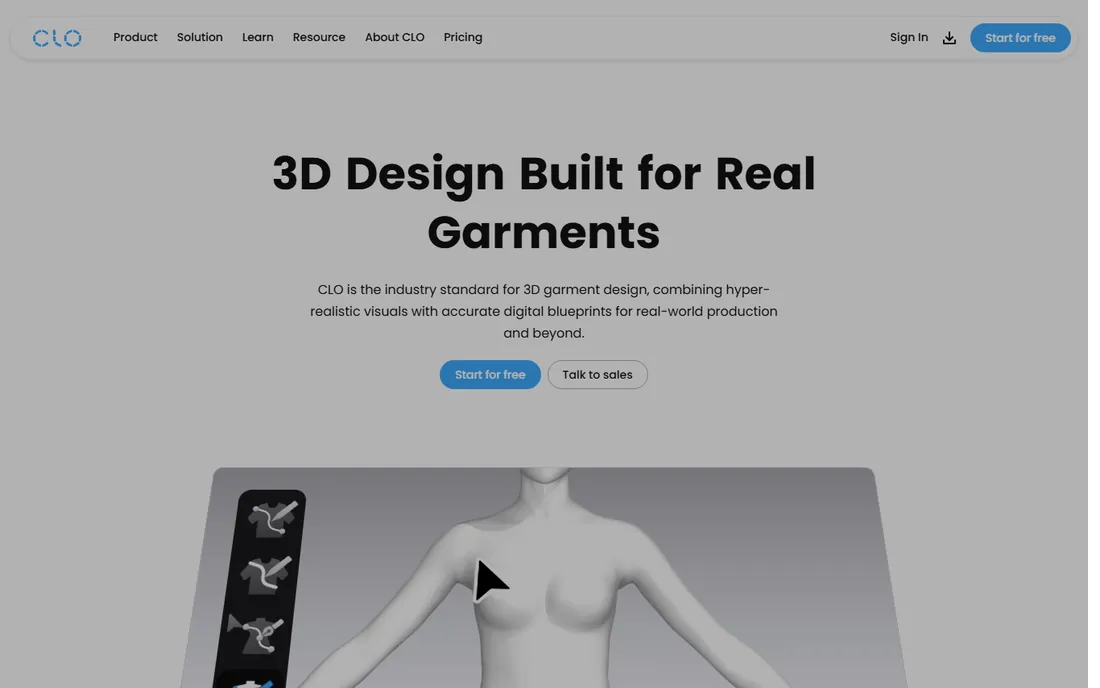
CLO 3D is the industry standard for 3D garment design and the easiest buying decision on this list, because it is the only one with public prices. Individuals pay $50 per month or $450 per year, students pay half, and a free trial lets you test the simulation before committing. The software pairs 2D pattern drafting with 3D draping on customizable avatars, so a pattern change updates the virtual garment instantly, and the asset library of 2,000-plus garments, fabrics, trims and accessories speeds up early concepts.
The workflow value is the sample reduction: designers validate fit, proportion and colorways digitally, then send production-ready specs to factories from the same 3D asset. CLO also pushes into AI-assisted ideation and digital product content for e-commerce. The catches are hardware and training: cloth simulation rewards a strong GPU, and beginners without patternmaking background face a real learning curve. For freelancers and small brands, though, nothing else in textile software is this accessible at this price.
What we like- Transparent published pricing with a 50 percent student discount ($25/month)
- True-to-life fabric simulation with 2D pattern and 3D drape in one tool
- 2,000-plus official assets including garments, fabrics and avatars
- Works on Mac and Windows
Watch out for- Business and academic licenses are custom-quoted with no published prices
- Realistic simulation needs a capable computer
- Learning curve is real for patternmaking newcomers

#2
Browzwear
Best for: Fashion brands and manufacturers digitizing product development end to end
Visit browzwear.com
Starting priceSee website (quote-based)
Free planNo
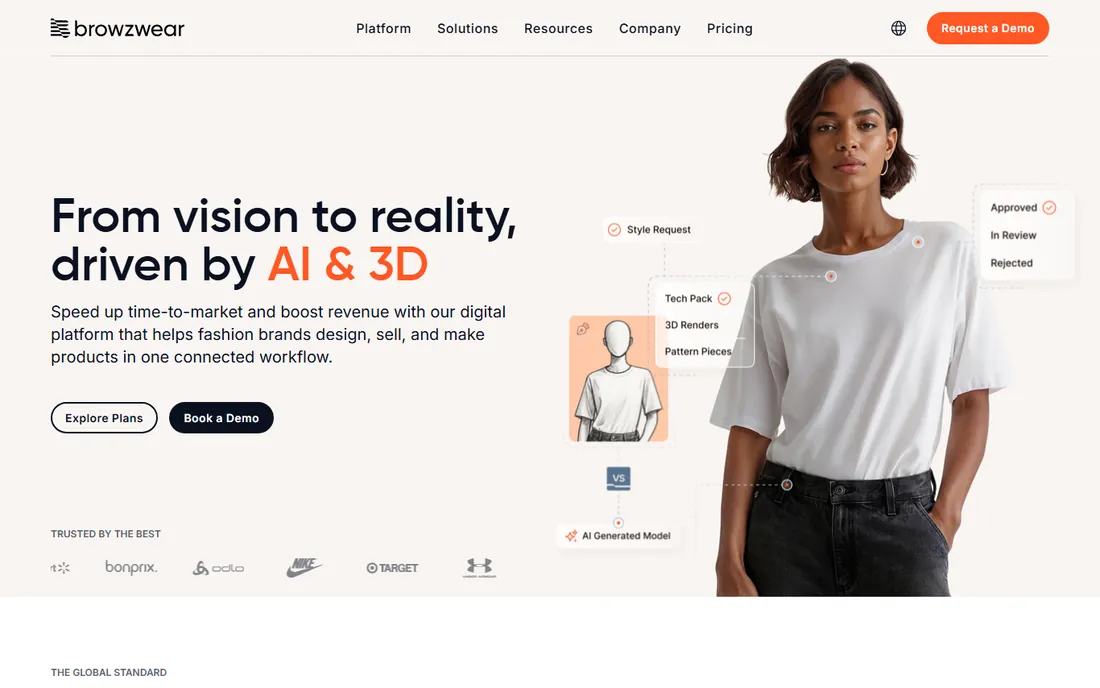
Browzwear is the enterprise answer to the sample problem. Where CLO 3D sells a design tool, Browzwear sells a platform: VStitcher builds the digital garment with physics-based simulation and real fabric data, AI models validate fit across the size range, Stylezone lets buyers and vendors collaborate and approve on the same asset, and integrations push tech packs and e-commerce assets into PLM, ERP and factory systems. The vendor's homepage cites 1,000-plus fashion companies, 10 million-plus digital garments created, and 50 to 80 percent fewer physical samples.
That breadth is also the cost. Pricing is quote-based and aimed at teams, implementation involves onboarding across departments, and a solo designer will find it heavy. But for a brand or full-package manufacturer where sampling delays cost real money, the connected workflow is the point: nothing gets lost between design, approval and production because everyone works from the same digital asset. Talk to their team with your product categories and volumes ready.
What we like- Connected platform from sketch to factory floor, not just a design tool
- Physics-based 3D simulation with real fabric data in VStitcher
- AI fit validation across size runs
- Collaboration tools that align buyers, designers and vendors on one 3D asset
Watch out for- Quote-based pricing with no public figures
- Enterprise-oriented, so overkill and overpriced for solo designers
- Implementation is a project, not a download

#3
NedGraphics
Best for: Textile designers creating prints, weaves, knits and carpet constructions
Visit nedgraphics.com
Starting priceSee website (quote-based)
Free planNo
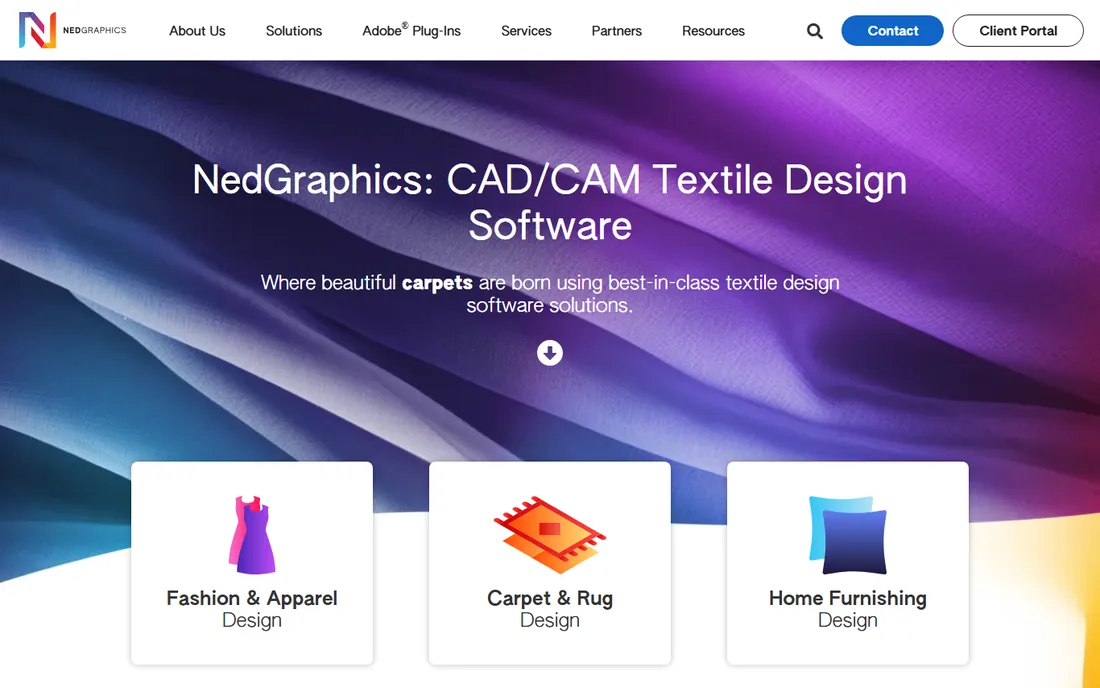
NedGraphics is the specialist's CAD: software made for designing the fabric itself rather than the garment. The product family covers printed fabrics (design, color and simulate), jacquard and dobby weaves (develop, recolor and simulate complex constructions), knits, tuft and carpet, plus a Creative app for fashion and interiors work. The Adobe plug-ins are a smart touch, letting designers who live in Photoshop and Illustrator add professional textile tools without leaving their workflow.
Color is a genuine strength: calibration and management tools aim to make what you see on screen match what the mill prints or weaves, and the vendor cites 15,000-plus designs created per year on its platform. Pricing is quote-based and modular, so define which applications you need before engaging sales. For print studios, converters and carpet manufacturers, this is the category leader; for garment-only designers, CLO 3D or Browzwear fit better.
What we like- Purpose-built modules for prints, jacquard, dobby, knits, tuft and carpet
- Adobe plug-ins bring textile tools into Photoshop and Illustrator
- Color management and calibration for production accuracy
- Long-established vendor with 500-plus clients worldwide
Watch out for- Quote-based pricing
- Modular lineup means the final price depends on which apps you bundle
- Windows-centric heritage in a mixed-OS design world

#4
Pointcarre
Best for: Textile professionals who want one CAD application for weaving, printing, knitting and tufting
Visit pointcarre.com
Starting priceSee website (quote-based)
Free planNo
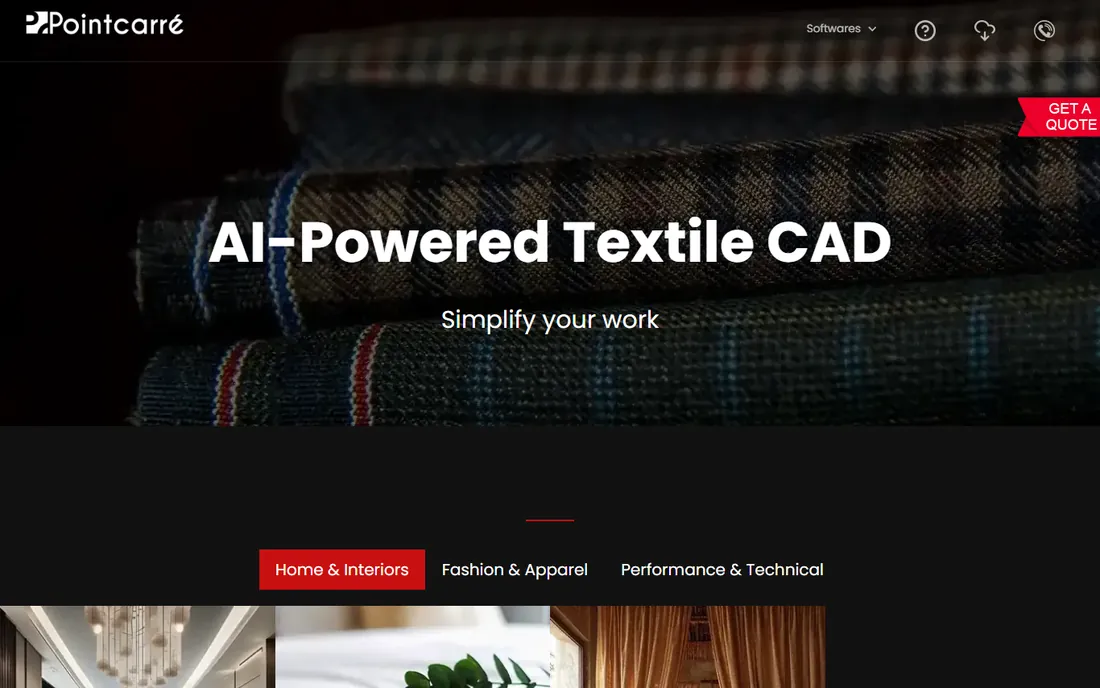
Pointcarre's pitch is simplicity: one application for the whole textile design path, where moving from print to weave does not mean switching modules or software. The company has spent over 40 years in textile CAD, and the current product adds built-in AI assistance, professional color libraries at no extra cost, and a native Mac version that looks and works exactly like the PC version, a real differentiator in a Windows-heavy category.
The all-in-one design cuts both ways. Designers who work across disciplines save time and license complexity; specialists who live in jacquard or carpet may find NedGraphics deeper in their niche. Pricing is quote-based, and the vendor emphasizes no hidden costs against competitors with low entry prices and expensive upgrades. If your studio handles prints one week and weaves the next, the unified workflow is worth a demo.
What we like- Single integrated application covering print, weave, knit and tuft, no module-hopping
- Native on both Mac and PC with an identical interface
- 40-plus years in textile CAD
- Built-in AI features and free professional color libraries
Watch out for- Quote-based pricing with no public figures
- Smaller vendor than NedGraphics, so check support coverage in your region
- The all-in-one approach means depth trade-offs in any single discipline

#5
Optitex
Best for: Apparel and industrial manufacturers needing 2D/3D patternmaking and nesting
Visit optitex.com
Starting priceSee website (quote-based)
Free planNo
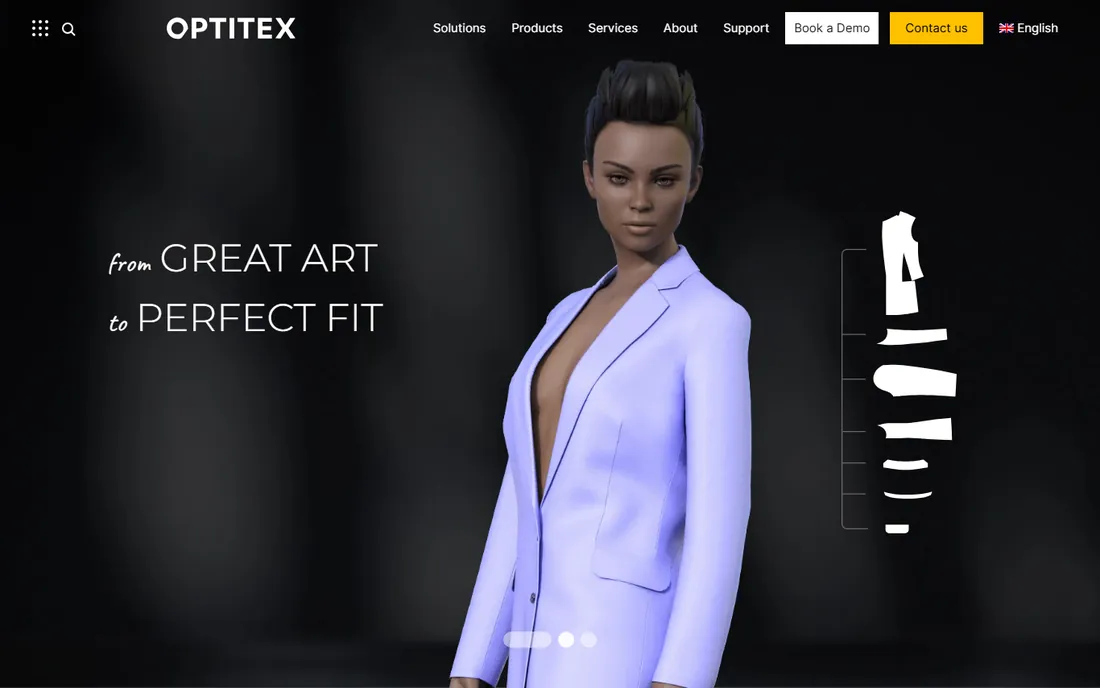
Optitex sits at the production end of textile design software. Its strength is the pattern room: 2D patternmaking with functional grading, automatic nesting for marker efficiency and early costing, and 3D draping to validate fit, all interoperable with standard industry formats. The customer base tells the story: fashion brands alongside automotive, upholstery and industrial manufacturers who cut real materials and care about yield.
This is not the tool for designing the print or presenting the collection. It is the tool that turns approved designs into graded, nested, factory-ready patterns with minimal fabric waste. Pricing is quote-based and enterprise-shaped, so it suits manufacturers and larger brands rather than freelancers. If your bottleneck is the pattern room and marker efficiency, Optitex belongs on the shortlist; if your bottleneck is design and sampling, look at CLO 3D or Browzwear first.
What we like- Interoperable 2D/3D portfolio with strong patternmaking, grading and nesting
- Automatic nesting for early costing
- Open to standard software and hardware formats
- Customer list spans fashion, automotive and upholstery
Watch out for- Quote-based enterprise pricing
- PC-focused
- The 3D visualization is production-oriented rather than presentation-grade

#6
PatternSmith
Best for: Manufacturers pairing pattern creation with automated cutting
Visit autometrix.com
Starting priceSee website (quote-based)
Free planNo
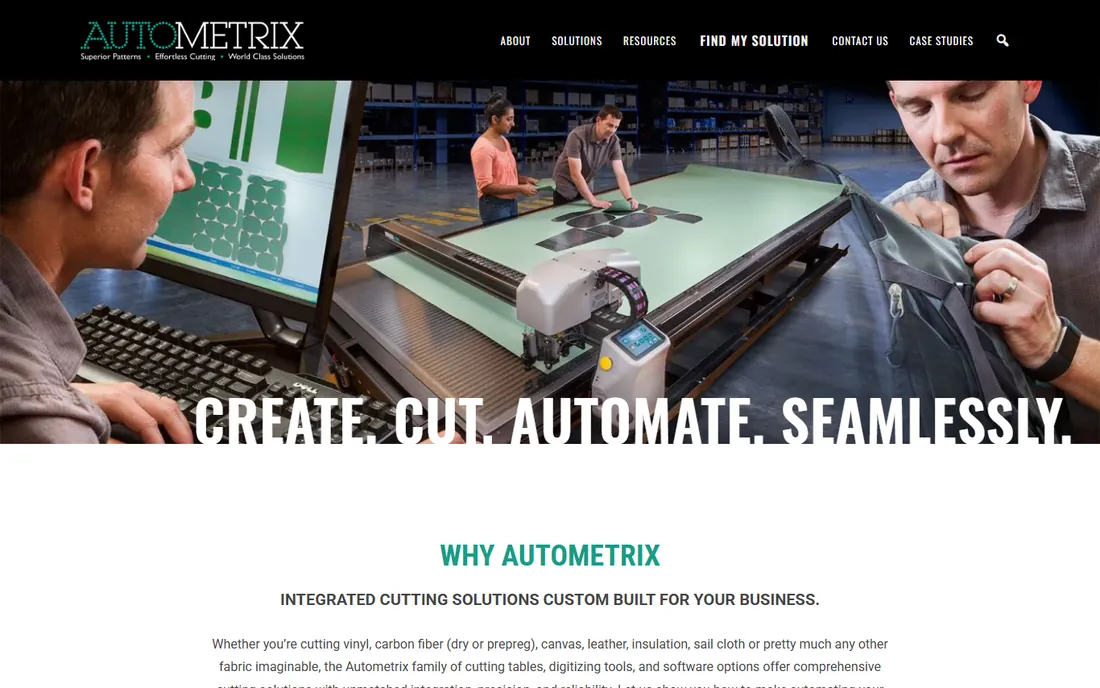
PatternSmith is Autometrix's pattern creation software, and its context matters: Autometrix builds CNC cutting tables and digitizing systems, so PatternSmith is designed to feed production cutting, not just to look good on screen. It serves manufacturers working with vinyl, canvas, leather, carbon fiber, insulation, sailcloth and industrial textiles, where the pattern's job is to become a cut part with minimal waste and maximum precision.
For a cut-and-sew operation, awning maker, marine fabricator or composites shop, the integrated story is compelling: patterns designed in PatternSmith flow to Autometrix cutting tables with matched precision, backed by one vendor's support. For fashion design or print development, it is the wrong category entirely. Pricing is quote-based and tied to the production setup. Evaluate it when the cutting table is part of the purchase, not as a standalone design tool.
What we like- Pattern creation software from a CNC cutting systems manufacturer, so design and cutting stay integrated
- Handles vinyl, canvas, leather, sailcloth and industrial fabrics
- Cutting tables, digitizing tools and software from one vendor
- US-based support and service network
Watch out for- Quote-based pricing
- Cutting-hardware focus means it is overkill for pure design work
- Narrower fit for fashion apparel than the garment-focused tools

#7
Tukatech
Best for: Apparel manufacturers and brands that want pattern, 3D, nesting and cutting in one connected system
Visit tukatech.com
Starting priceFrom $19/month (TUKAcad subscription, per the vendor's site)
Free planNo
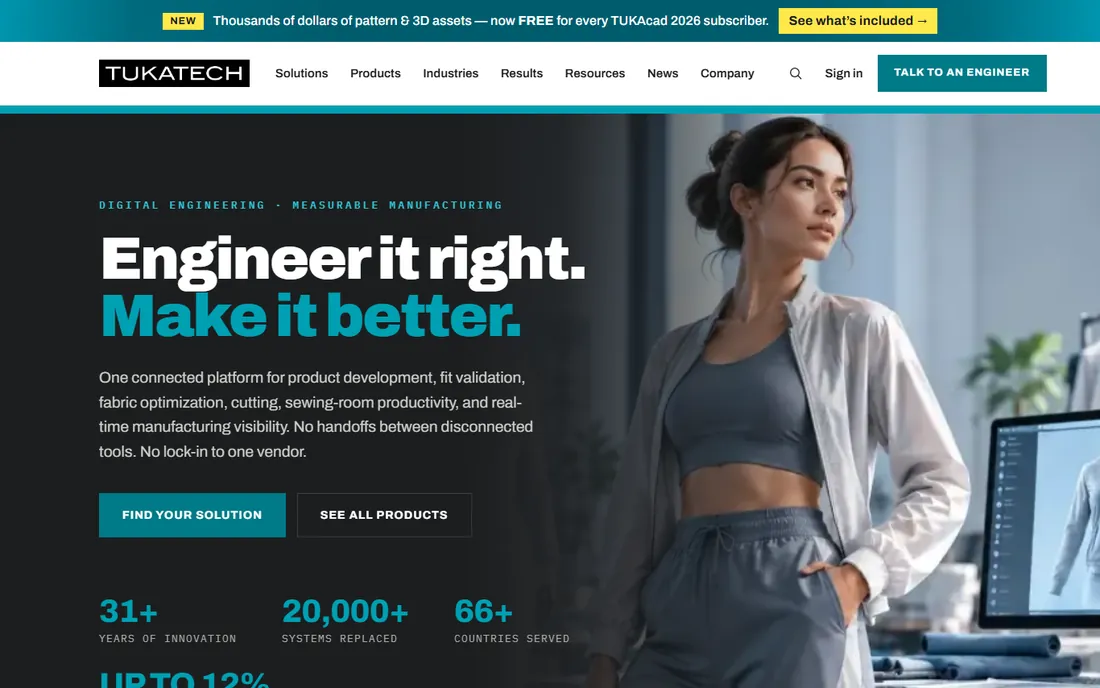
Tukatech is the apparel industry's veteran CAD vendor, with 31-plus years behind it and more than 20,000 installations in 66-plus countries. The platform covers the whole pre-production chain: TUKAcad for pattern making and grading, TUKA APM for generating patterns automatically from measurement specs, TUKA3D for virtual fit, SMARTmark for marker making and nesting, and TUKAcloud as a web-based digital sample room. Because Tukatech also builds cutting tables, the pattern-to-cut path stays inside one vendor's system, backed by consulting, training and a working microfactory at their Innovation Center.
The entry point is unusually accessible for this category: the vendor's site says you can start a TUKAcad subscription from $19 per month. The rest of the platform is consultative and quote-based, which fits manufacturers buying an engineered workflow rather than a download. If your operation already cuts fabric and your bottleneck spans pattern, nesting and the cutting room, Tukatech belongs on the shortlist; if you only need 3D design and sampling, CLO 3D or Browzwear are the simpler buys.
What we like- 31-plus years in apparel CAD with 20,000-plus installations across 66-plus countries
- TUKAcad pattern making and grading plus TUKA APM automatic pattern generation from measurement specs
- TUKA3D virtual fit, SMARTmark nesting and TUKAcloud web-based digital sample room
- Cutting tables and software from the same vendor
- Training, consulting and a working microfactory at the Innovation Center
Watch out for- The $19 entry covers TUKAcad only
- Pricing for the wider platform is consultative, so budget the full system before committing
- Implementation is a project with onboarding, not a quick download
Quick comparison
| Tool | Best for | Starting price | Free plan |
|---|
| CLO 3D | Individual designers and brands starting with 3D garment design | $50/month ($450/year) for individuals | Free trial available |
| Browzwear | Fashion brands and manufacturers digitizing product development end to end | See website (quote-based) | No |
| NedGraphics | Textile designers creating prints, weaves, knits and carpet constructions | See website (quote-based) | No |
| Pointcarre | Textile professionals who want one CAD application for weaving, printing, knitting and tufting | See website (quote-based) | No |
| Optitex | Apparel and industrial manufacturers needing 2D/3D patternmaking and nesting | See website (quote-based) | No |
| PatternSmith | Manufacturers pairing pattern creation with automated cutting | See website (quote-based) | No |
| Tukatech | Apparel manufacturers and brands that want pattern, 3D, nesting and cutting in one connected system | From $19/month (TUKAcad subscription, per the vendor's site) | No |
Is your product missing or out of date?
We review this list regularly. Vendors can request a listing, send updated pricing or ask about featured placement.
The hidden costs of textile CAD
The license quote is the smallest number in the first year. Training is the real cost: textile CAD and 3D garment software are genuinely complex, every vendor on this list sells training and support, and a designer needs weeks to become productive. Budget onboarding time per seat, and ask vendors what training is included before signing.
Hardware comes next. 3D cloth simulation rewards strong GPUs and plenty of RAM; skimping on workstations wastes the software investment. Then integration: connecting the design tool to your PLM, ERP, printers or cutting tables takes IT time and sometimes paid connectors. Finally, the quote structure: with five of seven vendors quote-based, get the full first-year cost in writing, including support, upgrades and additional seats, and ask what renewals typically cost. The cheapest quote with the most exclusions is rarely the cheapest year.
How we chose
We started with the categories buyers search: textile design software, fabric design software and textile CAD software. For each candidate we opened the vendor's own site, checked prices against the vendor's pricing pages and public reviews on G2, Capterra and practitioner discussion on Reddit, and compared design disciplines covered, file compatibility, production integration and company-size fit. Where a price could not be verified on the vendor's page we wrote "See website" rather than guessing. One listed name did not survive verification: TexPro is now a market intelligence platform, not design software, so we replaced it with Optitex.
Frequently asked questions
What is the best textile design software for beginners?
CLO 3D. It is the only tool here with public pricing ($50/month), a free trial, student discounts and a large tutorial community. Start there for 3D garment design; add NedGraphics or Pointcarre later if you need dedicated fabric CAD.
What is the difference between CLO 3D and Browzwear?
Both do 3D garment design, but CLO 3D sells a self-serve design tool for individuals and brands, while Browzwear sells an enterprise platform connecting design, fit validation, collaboration and production. CLO 3D publishes prices; Browzwear is quote-based and aimed at teams.
How much does textile design software cost?
CLO 3D costs $50 per month or $450 per year for individuals. Tukatech lists TUKAcad subscriptions from $19/month; everything else here is quote-based, and textile CAD seats traditionally run into the thousands per year. Always get the full first-year cost, including training and support, in writing.
Do I need textile CAD or 3D fashion software?
If you design the fabric itself (prints, weaves, knits, carpet), you need textile CAD like NedGraphics or Pointcarre. If you design garments and want to cut physical sampling, you need 3D software like CLO 3D or Browzwear. Many companies use one of each.
Can textile design software replace physical samples?
It reduces them substantially rather than replacing them. Browzwear reports customers cutting physical samples by 50 to 80 percent. Final production sign-off still usually involves a physical garment or strike-off, but far fewer rounds of them.
Does textile design software work on Mac?
CLO 3D and Pointcarre run natively on Mac. Browzwear, NedGraphics, Optitex and PatternSmith are Windows-oriented; check each vendor's current system requirements, since web and cloud components are changing this picture.
Sources we checked (7)
- https://clo3d.com/
- https://browzwear.com/
- https://nedgraphics.com/
- https://pointcarre.com/
- https://optitex.com/
- https://autometrix.com/
- https://tukatech.com/
Is your product missing or out of date?
We review this list regularly. Vendors can request a listing, send updated pricing or ask about featured placement.

Shihab Mia · Founder, Rankite
Shihab has spent more than a decade helping SaaS and e-commerce brands grow through search. He writes Rankite's software buying guides from pricing pages, documentation and public user reviews. More about Shihab.