How we make this list: we compare pricing pages, product documentation and public user reviews. Rankite is independent; if a vendor ever pays for a featured spot, that listing is clearly labeled Partner.
Key takeaways
- Holistiplan leads modern tax planning with automated reports that turn tax returns into planning opportunities.
- Corvee, now part of Instead, combines tax planning with strategy recommendations for advisory firms.
- TaxPlanIQ helps firms productize tax planning as a service with client-facing deliverables.
- Bloomberg Tax, Lacerte, CCH, and UltraTax planning modules serve firms that want planning inside their existing tax ecosystem.
- Drake Tax Planner covers basic planning needs for value-conscious firms.
Quick comparison
Is your product missing or out of date?
We review this list regularly. Vendors can request a listing, send updated pricing or ask about featured placement.
The best tax planning software for accountants
Starting priceSee website
Free planFree trial
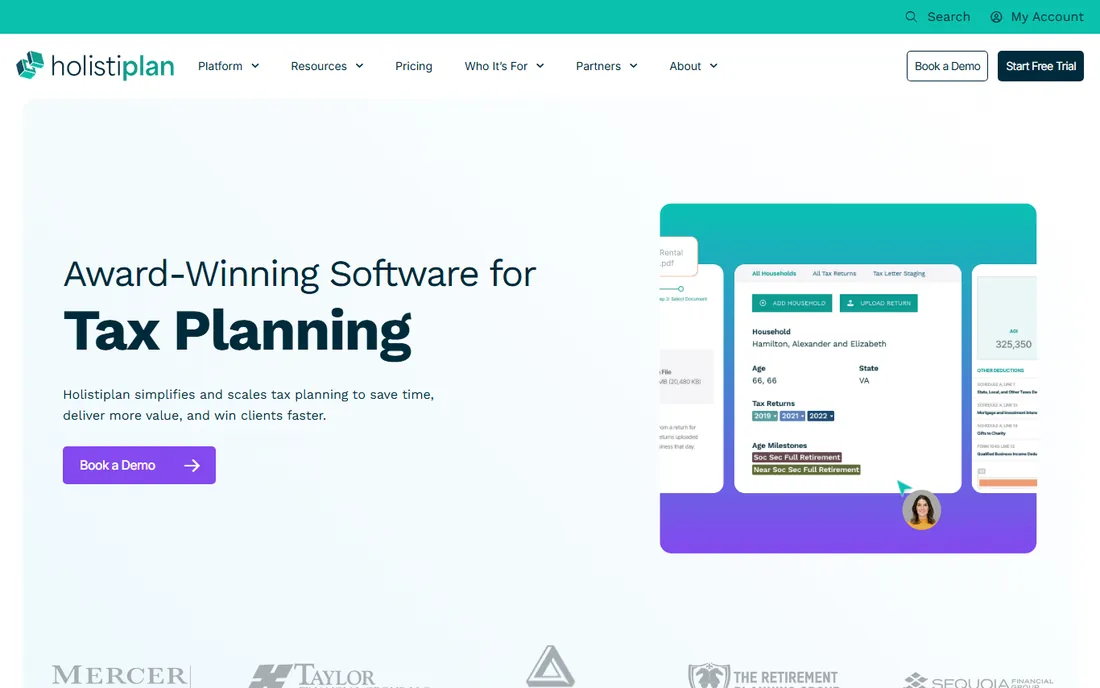
Holistiplan reads a client's tax return and generates a branded planning report highlighting opportunities: Roth conversion windows, missed deductions, estimated payment issues. Advisors who struggled to start tax planning conversations get a systematic process. The reports look professional enough to present directly.
It identifies opportunities rather than modeling complex multi-year strategies; deep planning still needs professional systems. But for firms adding advisory services, Holistiplan's automation turns every tax return into a planning engagement. The ROI case writes itself when one report generates a planning fee.
What we like- Turns returns into planning reports automatically
- Client-friendly output
- Fast adoption
Watch out for- Planning depth less than pro systems
- Per-return pricing adds up
Starting priceSee website
Free planFree trial
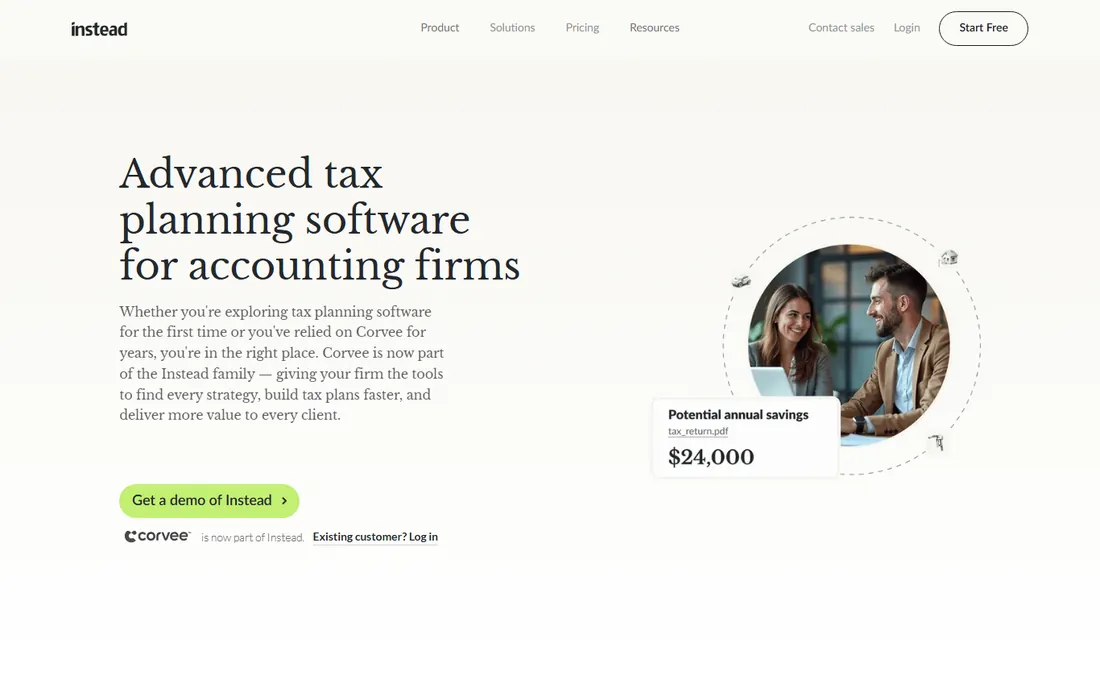
Corvee built a tax planning platform around its strategy engine: analyze the client's situation and get recommended tax-saving strategies with quantified benefits. Firms use it to shift from compliance to advisory, presenting strategies clients can act on. Instead acquired Corvee, combining it with tax preparation.
The acquisition means buyers should ask about the combined roadmap and how Corvee fits Instead's platform. But the core product addresses the real advisory challenge: finding strategies systematically rather than relying on partner memory. Firms building tax advisory practices get a genuine head start.
What we like- Strategy engine suggests tax-saving moves
- Good for advisory growth
- Modern interface
Watch out for- Acquired by Instead (roadmap questions)
- Pricing is premium
Starting priceSee website
Free planFree trial

TaxPlanIQ helps firms sell tax planning as a defined service rather than ad-hoc advice. Structured workflows, client questionnaires, and deliverable templates turn planning into a repeatable offering with clear pricing. Firms transitioning to advisory models get the operational playbook, not just software.
The feature set is narrower than comprehensive planning systems; it excels at delivery rather than deep calculation. But many firms fail at advisory because they cannot operationalize it, not because they lack technical knowledge. TaxPlanIQ solves the operational problem directly.
What we like- Systematizes planning delivery
- Client-facing reports
- Practice growth focus
Watch out for- Narrower feature set
- Best for firms committed to advisory
Starting priceSee website
Free planNo

Bloomberg Tax's planning tools, descended from the BNA Income Tax Planner, offer the deepest multi-year tax projections in the industry, backed by the tax research library professionals trust. Complex scenarios with changing legislation model accurately. Large firms and specialists rely on its calculation rigor.
Pricing and complexity target serious practices. Solo accountants will find it excessive. But when planning involves intricate provisions, AMT interactions, or state overlays, Bloomberg's depth justifies the cost. It is the reference standard for calculation-heavy planning.
What we like- BNA Income Tax Planner depth
- Unmatched tax research
- Trusted calculations
Watch out for- Enterprise pricing
- Complexity
Starting priceSee website
Free planNo
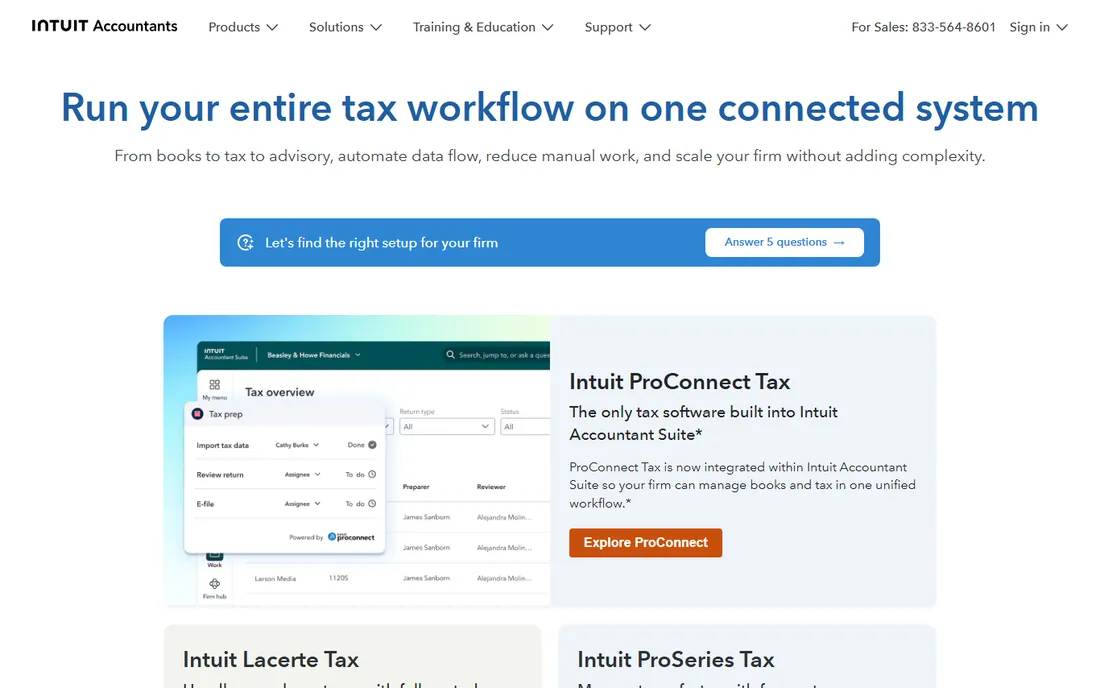
Lacerte's Tax Planner extends the firm's return data into multi-year projections without re-entry. Firms already preparing returns in Lacerte get planning capability with zero data migration. The interface matches what staff already know.
It is a calculator more than an advisory platform: projections without the client-facing reports and strategy workflows modern advisory firms want. But for compliance-oriented firms adding basic planning, the integration advantage is decisive. The data is already there; the planner just uses it.
What we like- Integrates with Lacerte returns
- Familiar interface
- Solid projections
Watch out for- Desktop-based
- Less advisory-focused
Starting priceSee website
Free planNo

CCH's planning module serves firms in the ProSystem fx ecosystem with multi-year projections linked to return data and CCH tax research. Large firms value the workflow integration: planning engagements managed alongside compliance work in one system.
Smaller firms find the enterprise orientation heavy. But Wolters Kluwer shops get planning that shares data with the tax engine and draws on CCH's research depth. For firms committed to the ecosystem, it is the natural planning extension.
What we like- Integrates with ProSystem fx
- Strong calculations
- Research links
Watch out for- Enterprise orientation
- Learning curve
Starting priceSee website
Free planNo
UltraTax's planning tools project from the return data firms already maintain, with the diagnostic rigor Thomson Reuters users expect. Multi-year scenarios, what-if analysis, and integration with the CS suite's practice management cover the planning workflow end to end.
The premium pricing and suite commitment suit larger firms. But Thomson Reuters practices get planning without new data entry or staff retraining, which removes the two biggest barriers to offering planning services. The marginal cost of adding planning is low; the marginal revenue is not.
What we like- Shares UltraTax data
- Strong diagnostics
- CS integration
Watch out for- Premium pricing
- Suite commitment
Starting priceSee website
Free planFree trial
Drake Tax includes planning worksheets that handle fundamental projections: multi-year comparisons, what-if scenarios, and estimated payment calculations. Firms already using Drake get planning capability at no extra cost, which is the entire value proposition.
It will not match Holistiplan's reports or Bloomberg's depth. But many small firms need basic planning competence, not advisory empires. Drake's planner covers the fundamentals honestly at a price that respects small-firm budgets.
What we like- Included with Drake Tax
- Affordable
- Covers planning basics
Watch out for- Less sophisticated than specialists
- Basic reports
From compliance to advisory
Tax planning software enables a business model shift, not just a feature. Firms that productize planning charge for strategy instead of competing on return-preparation price. The software matters less than the packaging: defined deliverables, clear pricing, and systematic delivery.
Start with existing clients. Run last year's returns through a planning tool, identify the opportunities, and present findings. The conversion rate from "we found you $8,000 in savings" to an ongoing planning engagement funds the software many times over. The tools here remove the technical barriers; the firm must remove the business-model ones.
What to verify in a trial
Run a real client's multi-year scenario, not the demo data. Check that state calculations match your expectations, that the reports read well to non-accountants, and that data flows from your tax software without re-entry. Ask about update frequency: tax law changes must reach the planning engine promptly, or projections mislead.
Evaluate the client deliverable as a client would. The best planning insights fail if the report confuses the recipient. And confirm the pricing model at your volume: per-return fees that look small multiply across a full client base.
Frequently asked questions
What is tax planning software?
Tax planning software helps accountants project clients' future tax liabilities and identify strategies to reduce them: Roth conversions, timing of income and deductions, entity selection, and estimated payments. It ranges from multi-year calculators to advisory platforms with client-facing reports.
How is tax planning different from tax preparation?
Preparation reports what happened last year; planning shapes what happens next year. Preparation is compliance; planning is advisory. Firms use planning software to offer higher-value services beyond return preparation, often at premium fees.
How much does tax planning software cost?
Modern advisory tools typically charge per user or per return monthly, in the tens to low hundreds. Enterprise planning systems from Bloomberg, CCH, and Thomson Reuters cost more, often bundled with broader suites. Many firms find one planning engagement covers the annual software cost.
Can tax planning software replace a CPA's judgment?
No. Software calculates and organizes; the CPA interprets, strategizes, and takes responsibility. The best tools amplify professional judgment by handling computation and presentation. Clients pay for the judgment, which is why advisory fees exceed software costs.
Which tax planning tool integrates with my tax software?
Match the ecosystem: Lacerte Tax Planner for Lacerte, CCH planning for ProSystem fx, UltraTax planning for the CS suite, Drake's planner for Drake Tax. Holistiplan, Corvee, and TaxPlanIQ work across tax platforms by importing return data.
Packaging planning as a service
The firms that profit from tax planning productize it: defined scope, fixed pricing, and clear deliverables. Typical packages range from annual planning reviews for individuals to quarterly strategy engagements for businesses. Price on value, not hours: a plan that saves a client $20,000 supports a $2,500 fee easily.
Structure the offering in tiers. A basic tier covers annual projections and estimated payments. A middle tier adds entity analysis and multi-year modeling. A premium tier includes quarterly reviews and implementation support. The software handles computation; the package handles positioning. Market it proactively: run last year's returns through the planning tool, identify the savings, and present findings to existing clients. The conversion conversation practically runs itself when the numbers are real.
The year-end planning checklist
Year-end is tax planning's Super Bowl, and checklists prevent dropped balls. Start with income timing: can clients defer income or accelerate deductions into the current year? Review capital gains positions for harvesting opportunities, both gains to offset losses and losses to offset gains. Check retirement contributions against limits, including catch-ups for older clients.
Business clients need entity and equipment reviews: Section 179 versus bonus depreciation decisions, reasonable compensation checks for S-corps, and estimated payment true-ups. Charitable strategies deserve attention while there is still time: bunching donations, donor-advised funds, and qualified charitable distributions from IRAs. Run every planning client through the same checklist systematically; the software calculates, but the checklist ensures nothing gets missed in the year-end rush.
How we chose
We focused on accountants adding or deepening tax planning services: calculation depth, client deliverables, and ecosystem fit. We verified each vendor's current site, accounting for Corvee's acquisition by Instead, and compared pricing models and integration options. We covered modern advisory platforms and legacy planning systems. No vendor paid for placement, and we did not claim hands-on testing.
When should tax planning start each year?
Year-round for business clients, with intensity building in the fourth quarter. Mid-year reviews catch estimated payment problems while there is time to fix them. October through December is the action window: harvesting, retirement contributions, and timing decisions must happen before year-end. January through March is for documenting what was done and planning the new year. Firms that only think about planning in December leave money on the table.
Sources we checked (8)
- https://www.holistiplan.com
- https://www.instead.com/corvee
- https://www.taxplaniq.com
- https://pro.bloombergtax.com
- https://accountants.intuit.com
- https://www.wolterskluwer.com
- https://tax.thomsonreuters.com
- https://www.drakesoftware.com
Is your product missing or out of date?
We review this list regularly. Vendors can request a listing, send updated pricing or ask about featured placement.

Shihab Mia · Founder, Rankite
Shihab has spent more than a decade helping SaaS and e-commerce brands grow through search. He writes Rankite's software buying guides from pricing pages, documentation and public user reviews. More about Shihab.
 Holistiplan
 Corvee
 TaxPlanIQ
 Bloomberg Tax
 Lacerte Tax Planner
 CCH ProSystem fx Planning
 UltraTax CS Planning
 Drake Tax Planner