How we make this list: we compare pricing pages, product documentation and public user reviews. Rankite is independent; if a vendor ever pays for a featured spot, that listing is clearly labeled Partner.

Key takeaways
- Stripe Billing (0.7% of billing volume, pay-as-you-go) is the cheapest flexible option for technical teams already on Stripe, and it gained usage-billing muscle with Stripe's acquisition of Metronome in early 2026.
- Chargebee's Flow plan (0.80% of billing volume, no base fee) wins on depth for complex pricing models that mix seats, usage and contracts.
- Merchant of record platforms like Paddle and Lemon Squeezy (5% + $0.50 per transaction) cost more per sale but absorb global tax compliance entirely.
- Flat-fee tools like ChargeOver ($115/month Starter) and Maxio ($599/month Grow) protect margins as you scale, since the platform fee stops growing with revenue.
- Zoho Billing (Standard $20/organization/month) is the budget pick for straightforward recurring billing inside the Zoho ecosystem.
Quick comparison
| Tool | Best for | Starting price | Free plan |
|---|
 Stripe Billing Stripe Billing | Technical SaaS teams that already process payments with Stripe | 0.7% of billing volume (pay-as-you-go) | No |
 Chargebee Chargebee | SaaS companies whose pricing models outgrew basic billing | 0.80% of billing volume, no base fee (Flow pay-as-you-go) | Free trial |
 Recurly Recurly | Subscription businesses obsessed with payment recovery | $249 per month + 0.9% of billing volume (first $40K/month free) | Free trial (90 days) |
 Paddle Paddle | SaaS companies selling globally without a tax team | 5% + $0.50 per transaction (Starter, no monthly fee) | No |
 Maxio Maxio | Finance-led companies facing audits, raises or complex contracts | $599 per month (Grow, up to $100K monthly billings) | No |
 Zoho Billing Zoho Billing | Small businesses that want straightforward billing inside Zoho | $20 per organization/month (Standard, monthly billing) | Free trial (14 days) |
 Zuora Zuora | Enterprises with quote-to-cash complexity across entities and regions | See website | No |
 FastSpring FastSpring | Digital product companies that want full MoR without building checkout | See website | No |
 ChargeOver ChargeOver | Service businesses that want flat fees instead of revenue percentages | $115 per month (Starter, up to 100 customers) | Free trial |
 Lemon Squeezy Lemon Squeezy | Indie SaaS and digital products on Stripe infrastructure | 5% + $0.50 per transaction | No |
Is your product missing or out of date?
We review this list regularly. Vendors can request a listing, send updated pricing or ask about featured placement.
The best subscription management software
The interesting change this year is not whether software is a subscription, but how the subscription is metered. The classic per-seat model is under pressure because it stops matching how value gets created: when one person can oversee work that used to take a team, charging per human seat feels arbitrary. Usage-based and hybrid billing have gained the most ground, with outcome-based pricing emerging as the frontier. The billing platforms are following the money, investing in metering and dynamic pricing capabilities because their customers now need to bill in those shapes.
That pressure produced one of the year's most telling deals: Stripe acquired Metronome, the usage-billing platform behind major AI companies, in early 2026. The message is that subscription management is no longer just recurring invoices; it is metering, rating and entitling consumption. Buyers are also scrutinizing cancellation and exit terms more carefully, as dark patterns in subscription flows now carry real legal risk.
The core buying decision splits three ways. Percentage-of-revenue platforms scale their fee with your sales. Flat-fee platforms cost the same whether you bill $50K or $5M a month. Merchant-of-record platforms take a bigger cut but become the legal seller, absorbing global tax liability. Each model below names which trade it makes.
#1
Stripe Billing
Best for: Technical SaaS teams that already process payments with Stripe
Visit stripe.com
Starting price0.7% of billing volume (pay-as-you-go)
Free planNo
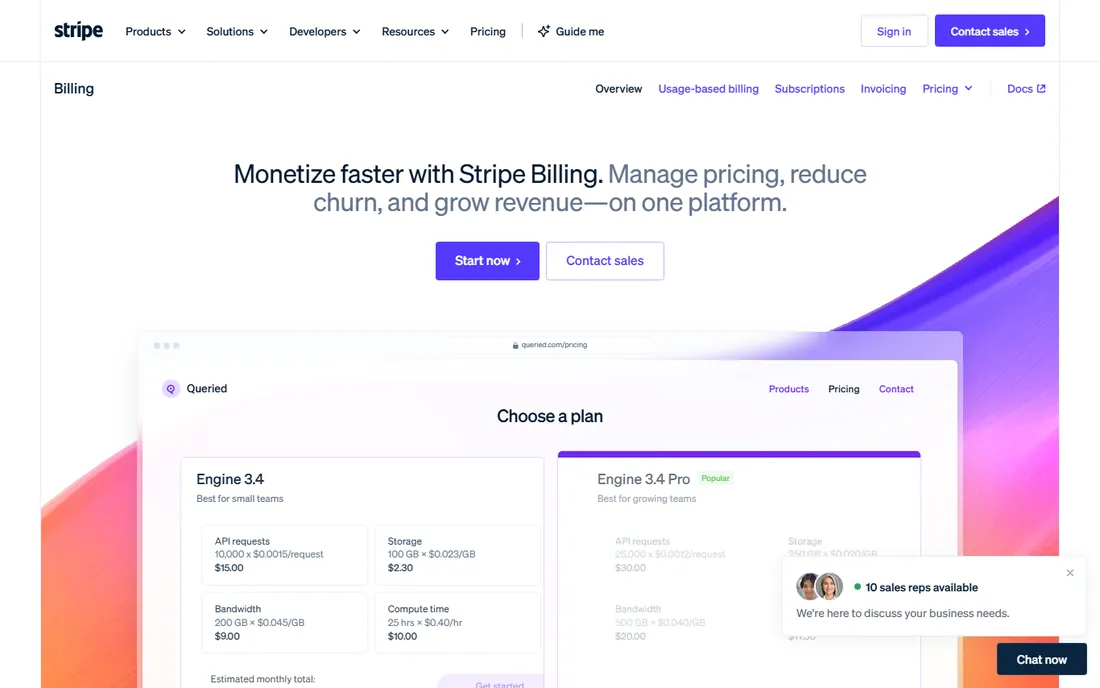
Stripe Billing is the recurring-billing layer on top of the processor most SaaS companies already use, which is its entire argument: no second vendor, no gateway handoff, one integration. It handles fixed, tiered and metered pricing, trials, coupons, proration and a customer self-service portal. The pay-as-you-go rate is 0.7% of billing volume with no monthly fee, on top of standard processing, and monthly plans start at $620 on a one-year contract covering up to $100K in monthly volume, then 0.67% above that.
The Metronome acquisition is the 2026 headline: Stripe now owns serious usage-billing infrastructure, which positions it for the metering-heavy pricing models the market is moving toward. The honest limits stay the same. Stripe Billing is not a merchant of record, so your company remains responsible for tax registration and filing; Stripe Tax calculates and tracks thresholds but does not file for you. If you already process with Stripe and have engineering capacity, it is usually the cheapest flexible choice.
What we like- Deepest API and metering flexibility
- Annual plans cap costs above $100K monthly volume
- Native usage-based billing after the Metronome acquisition
Watch out for- No merchant-of-record coverage, you stay the seller
- Tax handling needs Stripe Tax on top
- Usually requires engineering to implement well
#2
Chargebee
Best for: SaaS companies whose pricing models outgrew basic billing
Visit chargebee.com
Starting price0.80% of billing volume, no base fee (Flow pay-as-you-go)
Free planFree trial
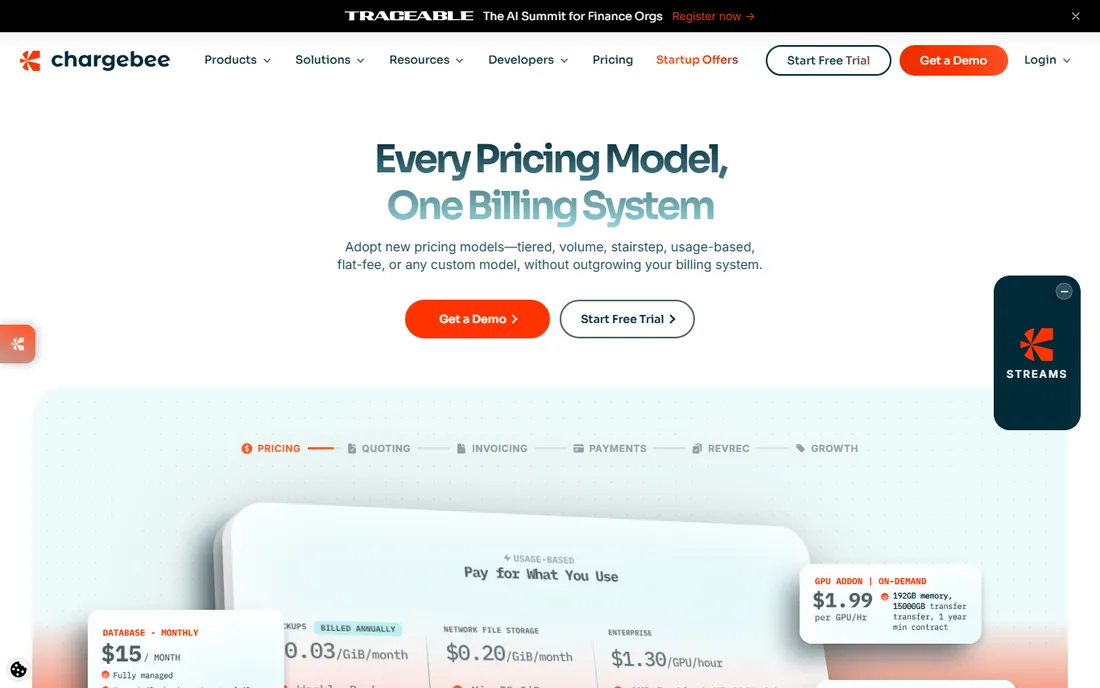
Chargebee sits deliberately between Stripe Billing's simplicity and Zuora's enterprise weight, serving mid-market SaaS whose pricing got too complex for a payment processor. It orchestrates the full subscription lifecycle: trials, proration, plan changes, usage metering, hybrid models, dunning and ASC 606-compliant revenue recognition. Current self-serve pricing is the Flow plan: 0.80% of monthly billing with no platform fee, or $99 a month plus 0.65% on the commit variant, both including 100M usage events monthly and 40+ gateways.
The case for Chargebee is billing depth. If your model combines per-seat charges, usage metering and negotiated enterprise contracts, few platforms handle that combination as thoroughly. The case against it is the meter: the percentage never stops growing with revenue, and the products around billing are priced separately. A startup program offers free billing to the first $1M cumulative for qualifying companies. Choose it when pricing complexity is the constraint, not the fee.
What we like- Deepest billing logic for hybrid seat-plus-usage models
- 30+ payment gateways
- Strong dunning and revenue recognition options
Watch out for- Percentage fee grows with you
- Advanced rev-rec and multi-entity need Enterprise
- Add-on products priced separately
#3
Recurly
Best for: Subscription businesses obsessed with payment recovery
Visit recurly.com
Starting price$249 per month + 0.9% of billing volume (first $40K/month free)
Free planFree trial (90 days)

Recurly rebuilt its pricing in August 2026 and now publishes an entry point, which changed how buyers evaluate it. The Starter plan runs $249 a month plus 0.9% of billing volume, with the first $40,000 of billings each month included at no charge, plus a 90-day trial. All-Access starts under 1% of volume but requires $1M in billing volume and an annual commitment. The honest structure: Recurly's entry plan withholds the advanced recovery tooling it is famous for, which is the reason most buyers look at it.
That tooling is the pitch. Machine-learning-powered intelligent retries and multiple dunning campaigns live on the higher tiers, and they exist because involuntary churn from failed cards is a real revenue leak. Below $40K a month the 0.9% never fires, so you pay the flat $249. Pick Recurly when failed-payment recovery is a line item you want to optimize, not when you need the deepest pricing logic.
What we like- Strong dunning and intelligent retry tooling
- Published entry pricing since the 2026 restructure
- Solid Shopify integration
Watch out for- Best recovery tooling is plan-gated above Starter
- Starter's $249 base is steep at low volumes
- Processing fees are separate
#4
Paddle
Best for: SaaS companies selling globally without a tax team
Visit paddle.com
Starting price5% + $0.50 per transaction (Starter, no monthly fee)
Free planNo
Paddle is not a billing tool with payments attached; it is your merchant of record. Paddle becomes the legal seller of your product, collects and remits sales tax, VAT and GST across 200+ countries, handles chargebacks and fraud disputes, and issues compliant invoices. For a small SaaS team, that removes the entire global tax apparatus, which is why solo founders and indie developers adopt it early.
The price of that removal is the fee: 5% plus $0.50 per transaction on the Starter plan, with no monthly fee, which bundles processing, tax compliance, fraud cover and support. Against Stripe plus a separate tax solution, Paddle is cheaper than it looks once you price the accountant or TaxJar alternative. At scale the math flips, and growth businesses negotiate custom rates.
What we like- Merchant of record absorbs VAT, GST and sales tax liability
- Handles chargebacks and fraud
- ProfitWell analytics baked in
Watch out for- 5% fee is expensive at scale versus processor-plus-billing
- Weaker fit for physical goods
- Currency conversion adds margin
#5
Maxio
Best for: Finance-led companies facing audits, raises or complex contracts
Visit maxio.com
Starting price$599 per month (Grow, up to $100K monthly billings)
Free planNo
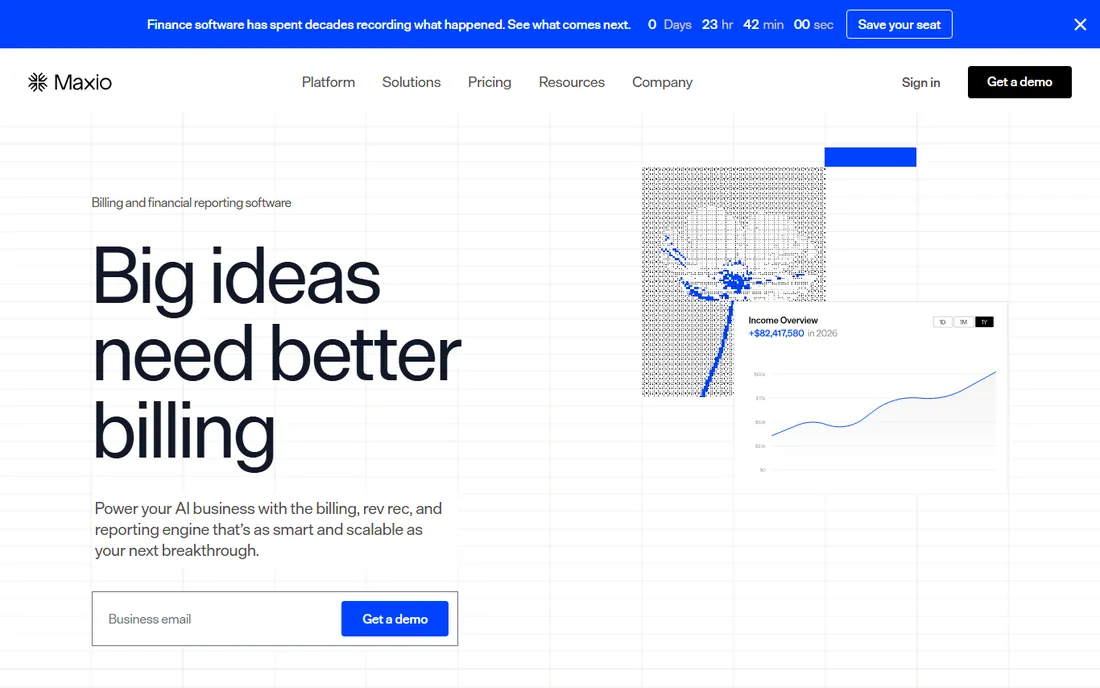
Maxio was formed when Chargify and SaaSOptics merged, and it shows in the product: billing on one side, finance-grade revenue recognition on the other. The Grow plan is $599 a month for up to $100K in monthly billings; above that, the quote-only Scale plan adds advanced revenue management, metering, expense amortization and multi-entity support. The platform is built for the moment finance takes ownership of billing: an audit, a fundraise, a shift to negotiated enterprise contracts.
That focus is also the boundary. Maxio's entry plan withholds the rev-rec depth it is famous for, and monthly billing costs extra on top of the standard annual commitment. Pick Maxio when the finance team owns the decision and audit readiness is the requirement. For operator-led startups, Chargebee or Stripe Billing cost less and move faster.
What we like- Audit-ready ASC 606 revenue recognition is core, not an add-on
- Expense amortization and multi-entity on Scale
- Strong for sales-led contracts
Watch out for- $599 base is steep for early startups
- Advanced features are Scale-only
- Annual payment is standard, monthly billing is an add-on
#6
Zoho Billing
Best for: Small businesses that want straightforward billing inside Zoho
Visit zoho.com
Starting price$20 per organization/month (Standard, monthly billing)
Free planFree trial (14 days)
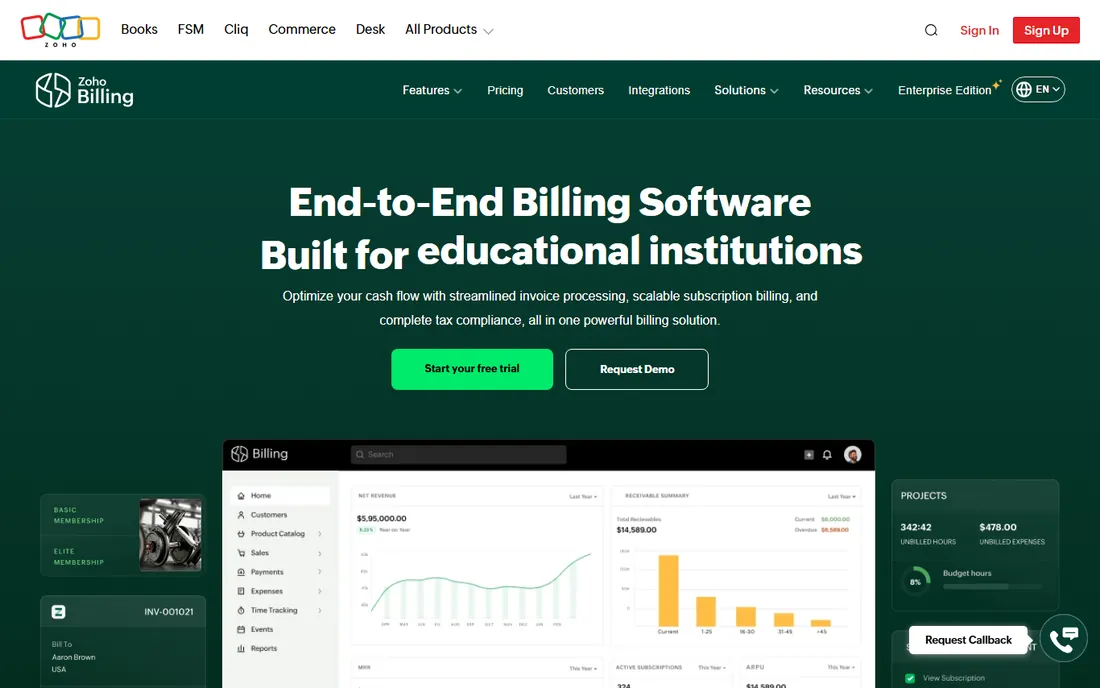
Zoho Billing is the budget conscience of this list. The Standard plan is $20 per organization per month ($15 annual) for up to 100 customers, Professional is $50 ($39 annual) for 500 customers and adds subscriptions, coupons and multi-currency, and Premium is $100 ($79 annual) for 1,000 customers with metered billing, dunning and subscription metrics. There is no percentage of revenue at any tier, which makes the math simple at every scale.
The product is honest about its lane: straightforward recurring billing, invoices, hosted payment pages and a customer portal, inside the Zoho suite it integrates with natively. Usage-based billing and serious dunning live on Premium. If you run Zoho Books, Zoho CRM or Zoho Desk and your billing is uncomplicated, this is the least you can pay for a credible system.
What we like- Very low entry price with no percentage of revenue
- Deep Zoho ecosystem integration
- Subscriptions, coupons and hosted pages on Professional
Watch out for- Pricing caps customers per tier
- Metered billing and dunning only on Premium
- Smaller third-party ecosystem than Stripe or Chargebee
#7
Zuora
Best for: Enterprises with quote-to-cash complexity across entities and regions
Visit zuora.com
Starting priceSee website
Free planNo
Zuora is the enterprise standard for subscription billing, and it prices like one. The platform covers the full quote-to-cash lifecycle: CPQ, billing, payments, revenue recognition and subscription analytics, with the multi-entity, multi-currency and contract complexity that global enterprises require. Pricing is entirely custom, negotiated on volume, entities and modules, with enterprise onboarding as a matter of course.
Nobody buys Zuora for simplicity. Implementation is a professional-services engagement, and the total cost of ownership includes modules, implementation and support that all scale with complexity. For a company doing eight or nine figures of recurring revenue with negotiated contracts across regions, that depth is the point; the platform is built to survive procurement, legal and audit scrutiny. Below that scale, Chargebee or Maxio deliver most of the capability at a fraction of the cost and friction.
What we like- Deepest enterprise billing, CPQ and revenue recognition suite
- Multi-entity and multi-currency at scale
- Long track record with large subscription businesses
Watch out for- Quote-only pricing with enterprise sales cycles
- Implementation is a project, not a signup
- Overkill for anything under eight figures
#8
FastSpring
Best for: Digital product companies that want full MoR without building checkout
Visit fastspring.com
Starting priceSee website
Free planNo

FastSpring is the older merchant-of-record name in digital commerce, serving software, SaaS and digital product companies that want someone else to own global tax compliance. Like Paddle, it acts as the seller of record, handles VAT and sales tax, manages fraud and chargebacks, and provides localized checkout across markets. The heritage is checkout and digital goods rather than pure subscription depth, which shows in how the product is shaped.
Pricing is quote-based with no published rate card, which makes it harder to evaluate than Paddle's flat 5% plus $0.50. FastSpring tends to fit companies whose sales are transactional with subscriptions attached, rather than subscription-first SaaS. It belongs in the shortlist next to Paddle, with the final call coming down to the negotiated rate.
What we like- Full merchant-of-record coverage like Paddle
- Localized checkout and global tax handling
- Long history with software and digital goods
Watch out for- Quote-based pricing, no published rate card
- Less subscription depth than Paddle
- Checkout-first heritage shows in complex billing
#9
ChargeOver
Best for: Service businesses that want flat fees instead of revenue percentages
Visit chargeover.com
Starting price$115 per month (Starter, up to 100 customers)
Free planFree trial
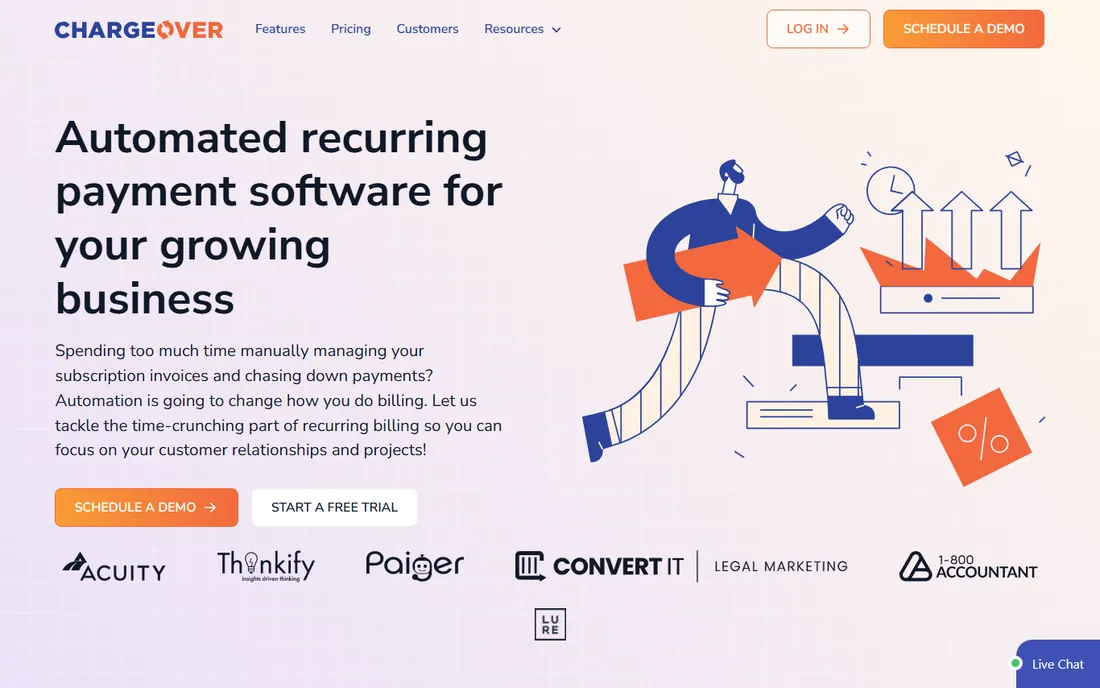
ChargeOver's entire pitch fits in one sentence: your billing platform should not get a raise every time you grow. Pricing is flat monthly by customer count rather than a percentage of revenue, so signing a bigger contract never moves your bill. The Starter tier runs $115 a month for up to 100 active customers with API access and accounting integrations; Growth at $229 adds white labeling, quoting, MRR reporting and more. At $2M in ARR, ChargeOver positions its flat fee against roughly $16,000 a year for Recurly's percentage model.
The product covers the recurring-billing essentials: subscriptions, usage, invoicing, dunning and revenue recognition reporting, with 50+ payment gateways. It lacks the deep pricing-logic sophistication of Chargebee. For service businesses and B2B SaaS where revenue per customer is high and the billing logic is simple, the flat-fee math is hard to beat.
What we like- Flat pricing never grows with revenue
- Strong dunning automation
- Native QuickBooks, Xero, HubSpot and Salesforce integrations
Watch out for- Prices by customer count, so growth steps the bill up
- Smaller integration catalog
- Less subscription-logic depth than Chargebee
Starting price5% + $0.50 per transaction
Free planNo
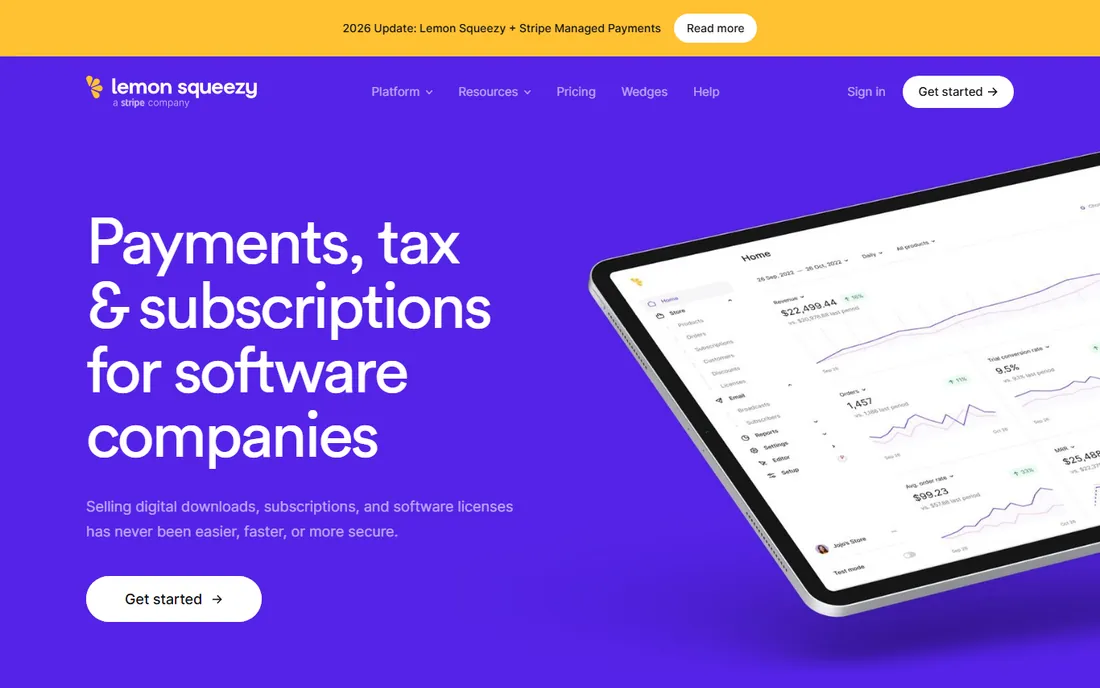
Lemon Squeezy is the indie-friendly merchant of record that Stripe acquired in July 2024 and is now folding toward its own managed-payments offering. It handles global tax, fraud and payouts for software and digital products, with a flat base of 5% plus $0.50 per transaction. The simplicity appeals to solo founders: one fee, no monthly minimum, no tax registration.
Read the surcharges before comparing it to Paddle. Roughly 1.5% for non-US cards, about 1.5% for PayPal and 0.5% on subscriptions all stack on the base, which narrows the gap with Paddle's all-in fee. The acquisition also makes the product's independent future uncertain; Stripe's own merchant-of-record product, launched in February 2026, is the likely destination.
What we like- Merchant of record on familiar Stripe rails
- Simple flat fee structure
- Abandoned-cart recovery built in
Watch out for- Surcharges stack on top (non-US cards, PayPal, subscriptions)
- Acquired by Stripe in 2024 and being folded into its MoR offering
- Less billing depth than Paddle
How to choose without overpaying
Start with the fee model, because it decides your cost at scale. Percentage-of-revenue platforms (Stripe Billing, Chargebee, Recurly) are cheap to start and expensive at volume; flat-fee platforms (ChargeOver, Maxio, Zoho) cost the same at $50K and $5M a month. Merchant-of-record platforms (Paddle, FastSpring, Lemon Squeezy) take the biggest cut but absorb tax liability, chargeback risk and compliance work. Model your actual billing volume, not your plan tier, and include gateway processing, which is separate on every non-MoR platform here.
Then check the meter your own pricing needs. If you bill usage, seats and contracts in combination, you need real metering and rating depth, which points at Chargebee or Stripe Billing. If finance needs audit-ready revenue recognition, Maxio or Zuora. If you sell globally with no tax team, a merchant of record. And read the exit terms: how payment tokens migrate and how long contracts lock you. Billing platforms are sticky by design.
What we checked to build this list
No lab testing sits behind this list, so it makes no hands-on claims. We compared each vendor's published pricing page against recent third-party pricing reviews, checked feature lists against official product documentation, and cross-checked buyer sentiment on G2, Capterra and Reddit. Prices reflect published plans as verified in recent reviews through October 2026, and quote-only vendors are labeled as such. Chargebee's pricing changed during 2026 from tiered plans to the current Flow model, so older articles quoting Starter and Performance tiers are out of date. Tool counts reflect platforms that serve small and mid-size US businesses, with enterprise entries included only where they define the category.
The hidden cost is never the plan fee
The platform fee is the smallest number in subscription billing. Payment processing sits on top of every non-MoR platform: roughly 2.9% plus $0.30 per US card transaction, more for international cards and currency conversion. Tax tools cost extra unless you are on a merchant of record. Revenue recognition modules, dunning add-ons, implementation fees and premium support all arrive separately. A $99-a-month plan can easily carry a true cost ten times that once processing and add-ons land. Price the whole stack at your actual volume, and remember that the cheapest plan is the one whose fee structure matches how your revenue grows.
Frequently asked questions
What is the difference between subscription billing software and a merchant of record?
Subscription billing software like Stripe Billing or Chargebee manages your recurring invoices, proration and dunning, but your company remains the seller and owns tax compliance. A merchant of record like Paddle or FastSpring becomes the legal seller: it collects and remits VAT and sales tax, handles chargebacks and takes the regulatory risk. MoR costs more per transaction, typically around 5%, but removes the need for tax registration and filing across countries.
How much does subscription management software cost?
It depends on the fee model. Percentage-of-revenue platforms charge 0.7 to 0.9% of billing volume with no or low base fees, so a company billing $100K a month pays $700 to $900 plus processing. Flat-fee platforms range from $20 a month (Zoho Billing) to $599 (Maxio Grow). Merchant-of-record platforms take about 5% plus $0.50 per transaction, which bundles processing and tax compliance. Always add payment processing, roughly 2.9% plus $0.30, on top of non-MoR platforms.
Do I need revenue recognition (ASC 606) support?
If you sell annual contracts, multi-element deals or usage with minimums, yes. ASC 606 requires recognizing revenue as obligations are fulfilled, not when cash arrives. Maxio builds audit-ready rev-rec into the platform; Chargebee sells it as an add-on; Zuora covers it at enterprise depth. An audit or fundraise is when companies discover they needed it a year earlier.
Can I switch subscription platforms later?
Yes, but it is one of the more painful migrations in SaaS. Payment tokens must transfer vault-to-vault so subscribers are not interrupted, proration logic needs to map to the new system, and dunning rules have to be rebuilt. Run both systems in parallel for at least one billing cycle before cutting over. The switching cost is a real part of the price, so pick carefully the first time.
What is usage-based billing and do I need it?
Usage-based billing charges customers for what they consume, API calls, seats used, compute hours, instead of a flat fee. Hybrid models combine a base subscription with usage on top. The trend accelerated in 2026 as AI products made per-seat pricing feel arbitrary. If your costs scale with customer usage, metering aligns price with value. If usage is unpredictable, add guardrails like caps, alerts and prepaid credits, because customers hate surprise bills more than high ones.
Should a small SaaS use Paddle or Stripe Billing?
Use Paddle if you sell internationally and have no tax or finance team, because the merchant-of-record model removes global compliance entirely. Use Stripe Billing if you have engineering capacity and want lower fees at scale, since 0.7% of billing volume beats 5% per transaction once revenue grows. The crossover point depends on your average transaction size and where your customers live, so model both at your actual numbers.
Sources we checked (19)
- https://stripe.com/pricing
- https://www.chargebee.com/pricing/
- https://recurly.com/pricing/
- https://www.paddle.com/pricing
- https://www.maxio.com/pricing/
- https://www.zoho.com/billing/pricing/
- https://www.zuora.com/pricing/
- https://fastspring.com/pricing/
- https://chargeover.com/pricing/
- https://www.lemonsqueezy.com/pricing
- https://baremetrics.com/blog/stripe-vs-chargebee-features-pricing-reviews-and-more?hs_amp=true
- https://baremetrics.com/blog/recurly-vs-chargify-features-pricing-reviews-and-more
- https://www.inflowpay.com/blog/chargebee-review
- https://www.g2.com/products/chargeover/pricing
- https://whop.com/blog/subscription-billing-software/
- https://agent.mue.app/articles/best-merchant-of-record-paddle-lemon-squeezy-polar-stripe
- https://www.business-software.com/blog/subscription-billing-the-future-of-business/
- https://blog.mean.ceo/saas-pricing-strategies-trends-october-2026/
- https://medium.com/@techmarketinsights/subscription-billing-management-market-trends-2026-7090cad17d5e
Is your product missing or out of date?
We review this list regularly. Vendors can request a listing, send updated pricing or ask about featured placement.

Shihab Mia · Founder, Rankite
Shihab has spent more than a decade helping SaaS and e-commerce brands grow through search. He writes Rankite's software buying guides from pricing pages, documentation and public user reviews. More about Shihab.