How we make this list: we compare pricing pages, product documentation and public user reviews. Rankite is independent; if a vendor ever pays for a featured spot, that listing is clearly labeled Partner.
Key takeaways
- OneSignal and Ably offer the most generous free tiers if push notifications are your main channel.
- Courier and Knock suit teams that want one API and a visual workflow builder across email, SMS and push.
- Novu is the pick for teams that want open-source infrastructure they can self-host.
- Enterprise buyers with compliance requirements should shortlist Fyno, while early-stage products can start free and pay per send.
Quick comparison
| Tool | Best for | Starting price | Free plan |
|---|
 OneSignal OneSignal | mobile apps needing free unlimited push | Free; Growth from $9/month | Yes (unlimited mobile push) |
 Courier Courier | teams wanting one API for email, SMS and push | Free 10,000 sends/month, then $0.005 per send | Yes |
 Knock Knock | product teams wanting notification workflows without code | From $250/month (Starter) | Yes (10,000 messages/month) |
 Novu Novu | teams wanting open-source, self-hostable infrastructure | Free (10,000 events/month); self-host free | Yes |
 SuprSend SuprSend | multi-channel notifications with template management | Free 10,000 notifications/month; Essentials from $110/month | Yes |
 MagicBell MagicBell | in-app notification inboxes and feeds | Free Builder (1,000 deliveries); Startup from $249/month | Yes |
 Pusher Beams Pusher Beams | push for apps already using Pusher realtime | Free sandbox (1,000 subscribers); Startup from $29/month | Yes |
 Ably Ably | realtime apps needing push plus pub/sub messaging | Free (6M messages, 200 connections); Standard from $29/month | Yes |
 Fyno Fyno | enterprises needing compliant notification infrastructure | From $3,000/year (Starter) | Free trial (14 days) |
Is your product missing or out of date?
We review this list regularly. Vendors can request a listing, send updated pricing or ask about featured placement.
The best software for managing notifications
Starting priceFree; Growth from $9/month
Free planYes (unlimited mobile push)
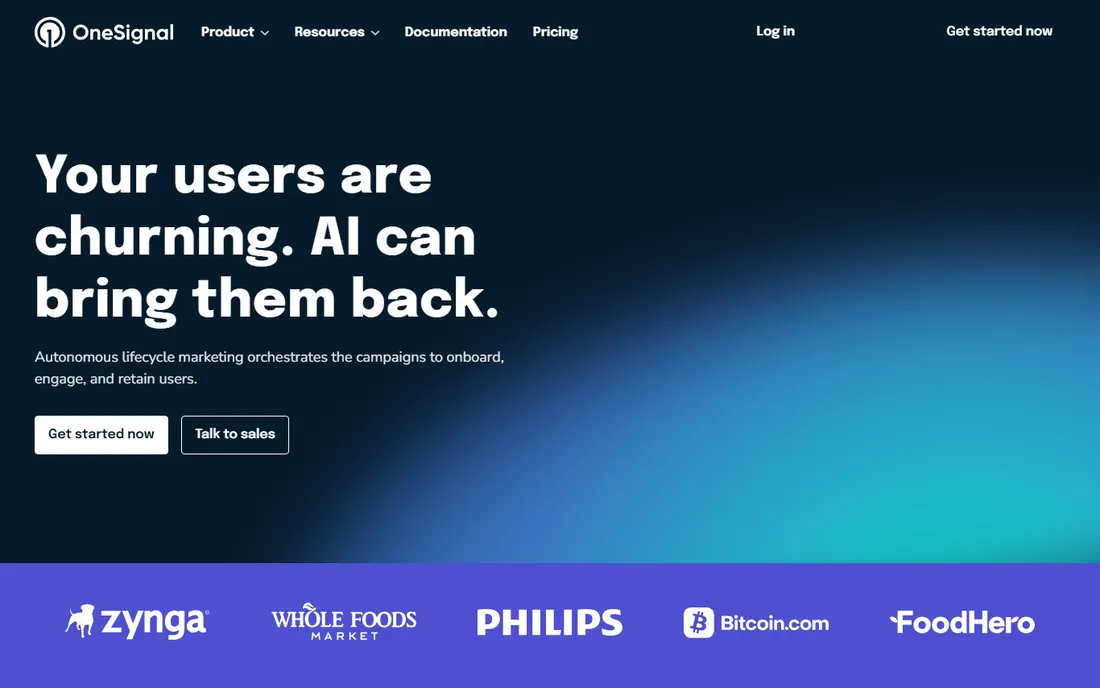
OneSignal is the free-tier leader in push notifications, and that pricing has made it the default choice for mobile-first products. The free plan covers unlimited mobile push with segmentation, scheduling and basic analytics, which is genuinely enough for many apps to run on indefinitely. Setup is a well-documented SDK integration on iOS and Android.
The catch appears when you grow into web push, email and SMS, where the paid plans and per-message costs start to matter. Advanced features like data export and dedicated support sit behind higher tiers. If your product lives or dies on mobile push and you want to start free, OneSignal is still the easiest yes in this category.
What we like- Generous free tier for mobile push
- Easy-to-integrate SDKs
- Strong audience segmentation
Watch out for- Advanced features and extra channels cost more
- Support is limited on the free tier
Starting priceFree 10,000 sends/month, then $0.005 per send
Free planYes
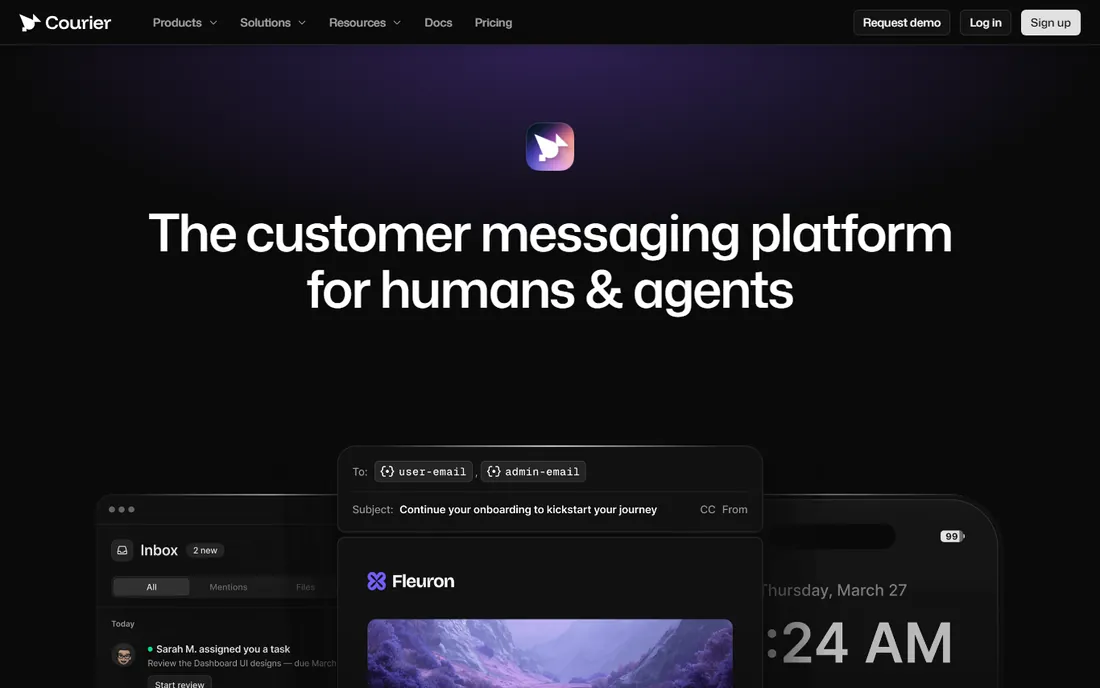
Courier takes the opposite approach to the push specialists: one API for every channel, with templates and routing handled in a visual designer. Developers send a single request and Courier decides whether the message goes by email, SMS or push based on the rules you configure. The free tier covers 10,000 sends a month, and after that you pay half a cent per send.
That simplicity is the appeal and the limit. Teams that send millions of messages may find pure per-send pricing expensive compared to negotiated enterprise deals, and the routing logic has a learning curve. For product teams that want to stop writing channel-specific code, Courier removes a whole category of work.
What we like- Single API across all channels
- Visual template designer
- Pay-per-use pricing scales cleanly
Watch out for- Per-send costs add up at high volume
- Routing rules take time to learn
#3
Knock
Best for: product teams wanting notification workflows without code
Visit knock.app
Starting priceFrom $250/month (Starter)
Free planYes (10,000 messages/month)
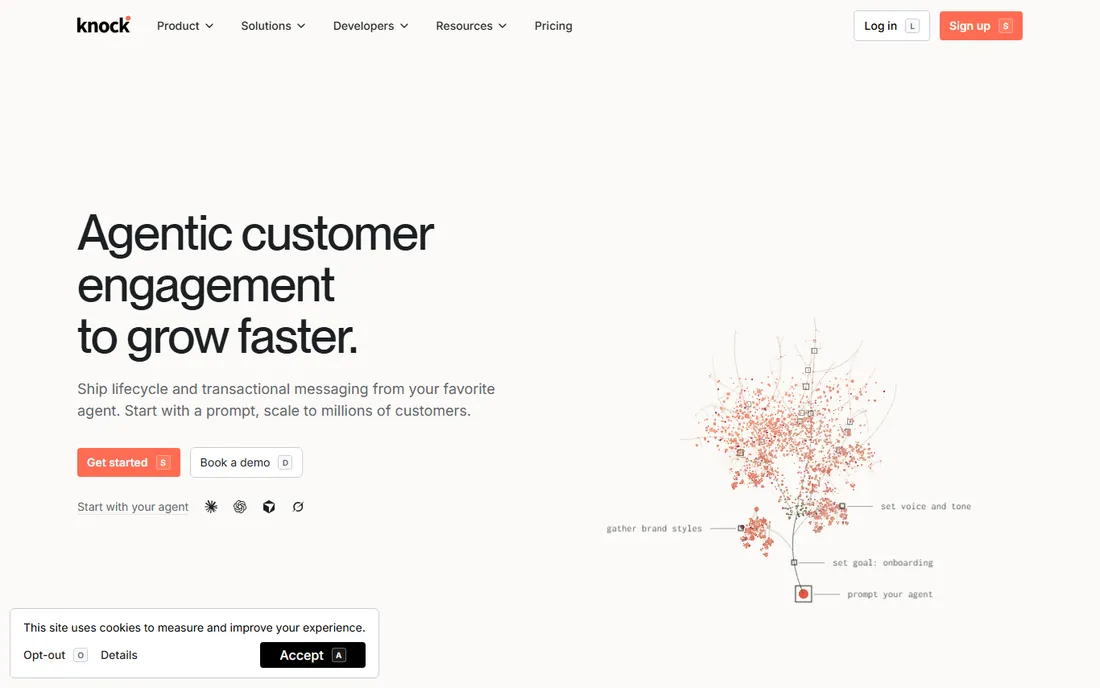
Knock is built for product teams that want notification logic out of their codebase and into a system non-engineers can touch. Workflows, delays, batching and user preferences are configured in a dashboard, while developers integrate once through the API. The free tier includes 10,000 messages a month, which covers development and small launches.
The honest weakness is the price jump. Starter at $250 a month is a real commitment for a startup, and teams that only need basic push will pay for workflow power they never use. If your notifications involve multi-step sequences, quiet hours and per-user channel preferences, Knock earns its price quickly.
What we like- No-code workflow builder
- Preference management built in
- Excellent documentation
Watch out for- $250 entry price is steep for small teams
- Overkill for simple push needs
#4
Novu
Best for: teams wanting open-source, self-hostable infrastructure
Visit novu.co
Starting priceFree (10,000 events/month); self-host free
Free planYes
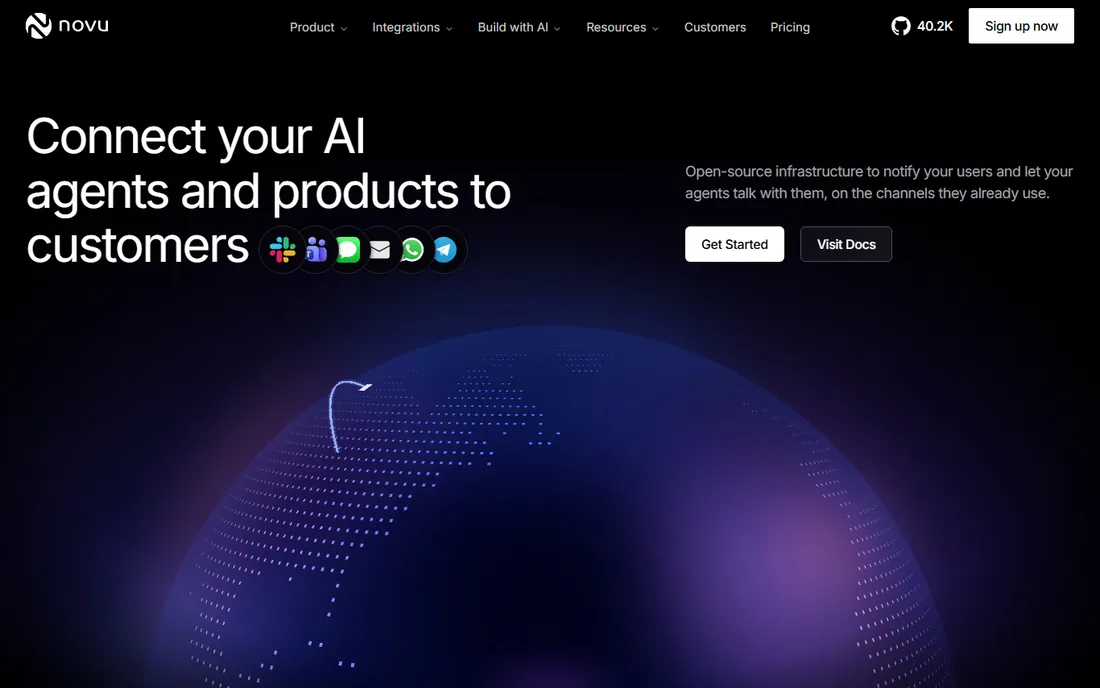
Novu appeals to teams that want to own their notification infrastructure, because the whole platform is open source. You can run it on your own servers with no vendor lock-in, or use the managed cloud with a free tier of 10,000 events a month. The API abstracts the underlying providers, so switching email or SMS vendors does not mean rewriting code.
Self-hosting is the trade-off. You gain data control and avoid per-message fees, but you take on deployment, scaling and maintenance. Teams with strict data residency requirements or strong DevOps capacity will find that trade worthwhile. Everyone else should price the managed cloud before assuming self-hosted is cheaper.
What we like- Fully open source
- Can self-host for full data control
- Unified API across providers
Watch out for- Self-hosting is operational work
- Managed cloud costs more above the free tier
#5
SuprSend
Best for: multi-channel notifications with template management
Visit suprsend.com
Starting priceFree 10,000 notifications/month; Essentials from $110/month
Free planYes
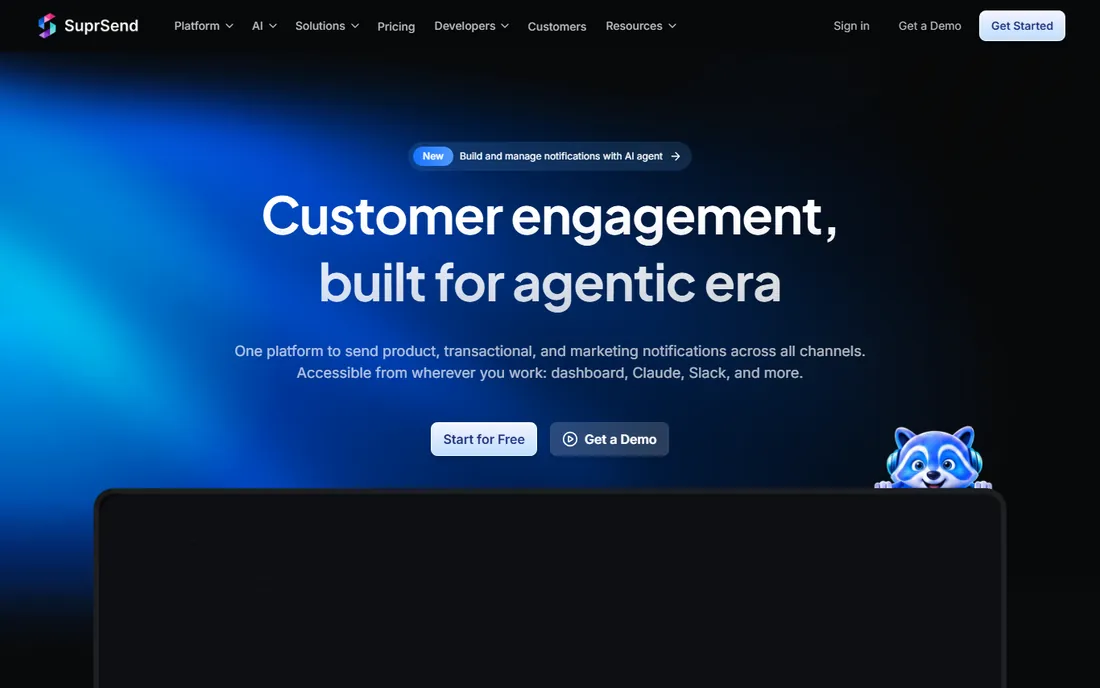
SuprSend focuses on the unglamorous middle of notifications: templates, user preferences and delivery tracking across channels. The workflow builder handles the logic of when and how to reach each user, and the analytics show what actually got delivered and opened. The free tier covers 10,000 notifications a month, with Essentials starting at $110.
It is a smaller company than OneSignal or Courier, which means fewer third-party integrations and less community content. The paid entry price is also higher than pure usage-based alternatives. For teams that want a tidy, modern notification system without enterprise complexity, SuprSend is a strong mid-market choice.
What we like- Clean template and preference system
- Good delivery analytics
- Fair free tier
Watch out for- Smaller ecosystem than the biggest rivals
- $110 starting price for paid plans
Starting priceFree Builder (1,000 deliveries); Startup from $249/month
Free planYes
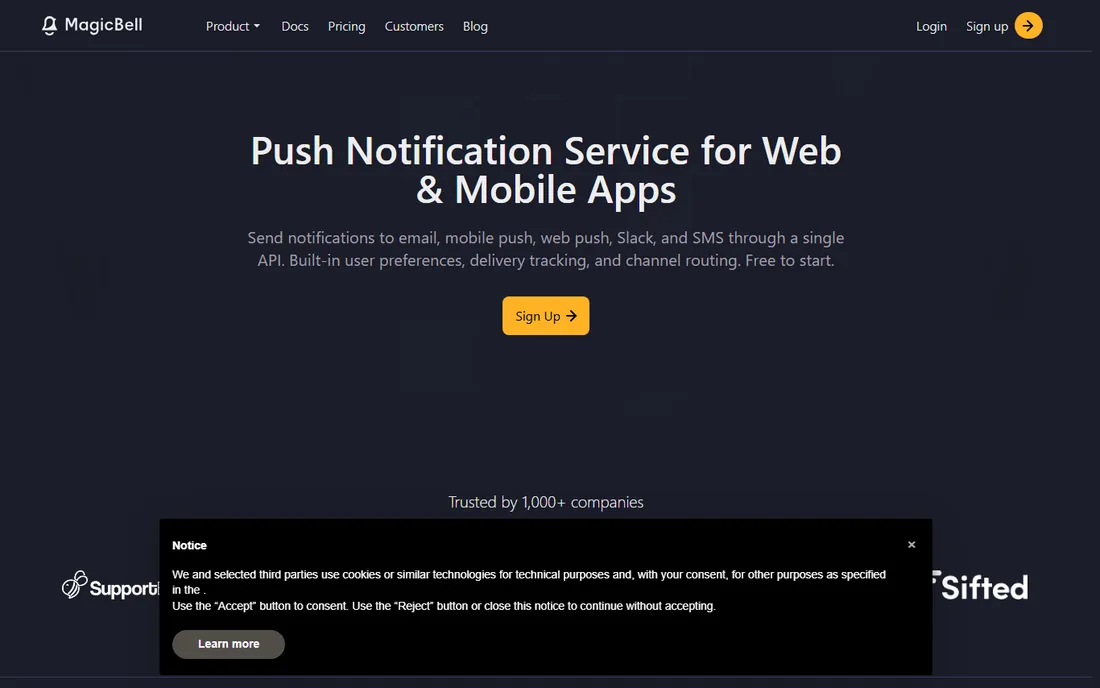
MagicBell does one thing well: the in-app notification inbox, feed and badge counts your product probably needs. Instead of building the bell icon, the unread counts and the preference screen yourself, you drop in their components and connect the API. The Builder plan is free up to 1,000 deliveries, which covers prototyping.
The pricing is the honest catch. Startup starts at $249 a month, which is a lot for what is essentially one UI pattern done well. And MagicBell is not a full multi-channel platform; email and SMS are not its strength. If the in-app notification center is the specific thing you keep postponing, MagicBell buys you back months of frontend work.
What we like- Drop-in inbox and feed components
- Badge counts and preferences handled
- Solid API
Watch out for- Expensive starting price
- Focused on in-app, not full multi-channel
#7
Pusher Beams
Best for: push for apps already using Pusher realtime
Visit pusher.com
Starting priceFree sandbox (1,000 subscribers); Startup from $29/month
Free planYes
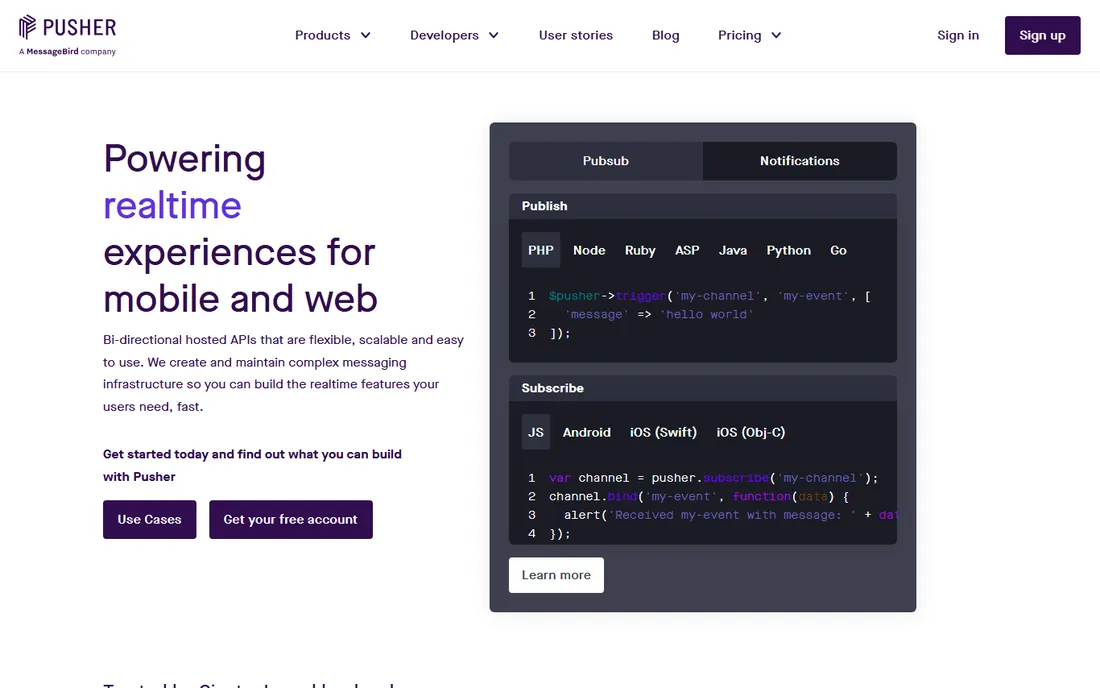
Pusher Beams is the push specialist from the company behind the realtime messaging platform. If your app already uses Pusher Channels for live updates, Beams is the natural companion: targeted push to segments, interests and individual devices, with the same reliable delivery infrastructure. The sandbox is free for 1,000 subscribers, and Startup starts at $29 a month.
Beams is deliberately narrow. It does push notifications and not much else, so teams that need email and SMS orchestration will need another tool. Billing is also separate from Pusher Channels, which can surprise teams expecting one invoice. For Pusher shops that just need push done right, it is the path of least resistance.
What we like- Integrates with Pusher Channels
- Reliable delivery infrastructure
- Simple pricing
Watch out for- Push-only focus
- Beams billing is separate from Channels
#8
Ably
Best for: realtime apps needing push plus pub/sub messaging
Visit ably.com
Starting priceFree (6M messages, 200 connections); Standard from $29/month
Free planYes
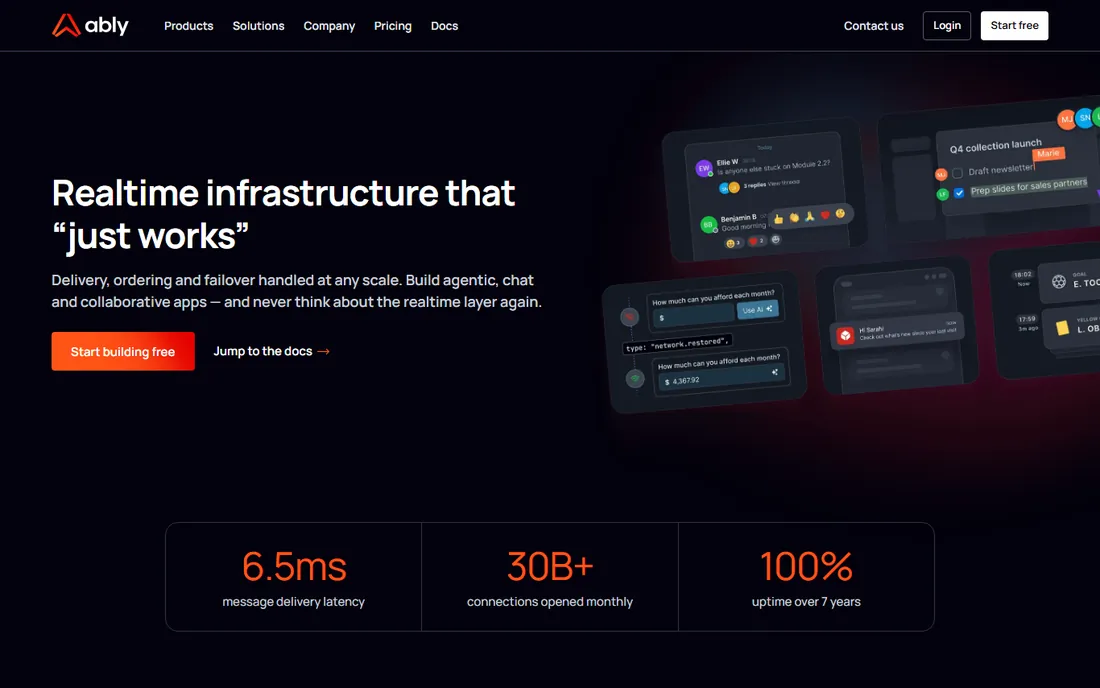
Ably is a realtime infrastructure platform where push notifications ride on top of a much larger pub/sub system. The free tier is strikingly generous: 6 million messages and 200 concurrent connections a month. That makes it attractive for realtime apps, chat features and live dashboards that also need to send push.
The trade-off is focus. Ably gives you the pipes, not the notification workflows: there is no built-in preference center or template designer comparable to Knock or SuprSend. The usage-based pricing also takes study to forecast. If your product is realtime at its core and push is one output among many, Ably is excellent infrastructure. If you want notification product features, look elsewhere.
What we like- Huge free message allowance
- Global edge network
- Strong uptime SLAs
Watch out for- Pricing model is complex
- Notification-specific tooling is thinner
#9
Fyno
Best for: enterprises needing compliant notification infrastructure
Visit fyno.io
Starting priceFrom $3,000/year (Starter)
Free planFree trial (14 days)
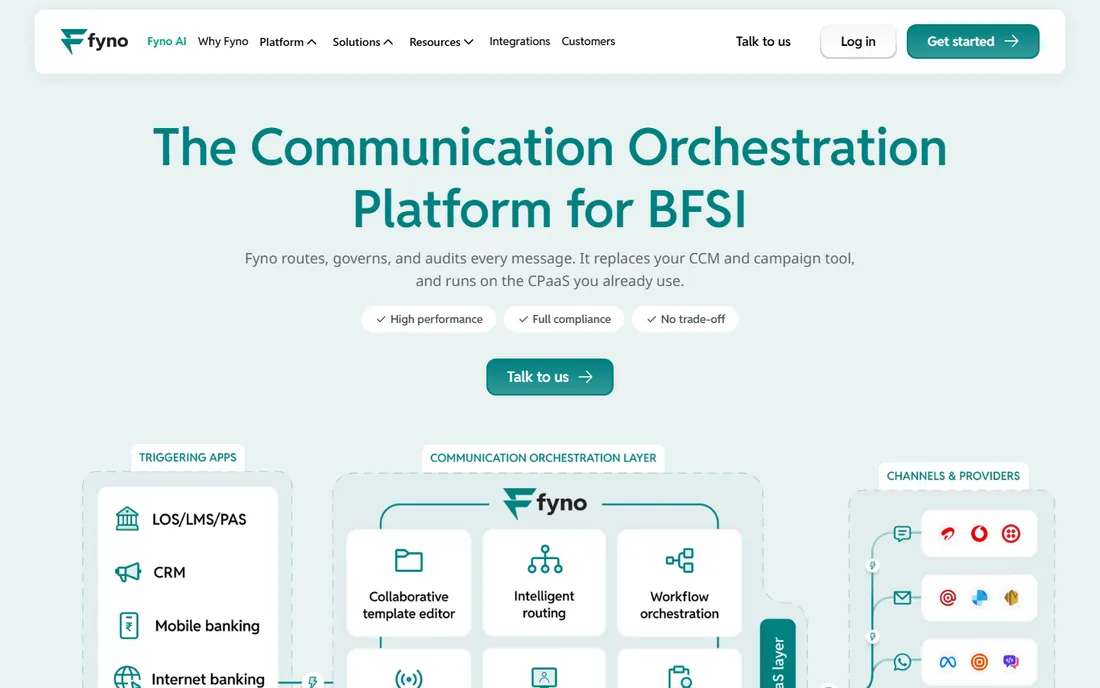
Fyno sells to enterprises and banks that need notifications with compliance, audit trails and on-premise options. The platform orchestrates email, SMS, push and WhatsApp with delivery tracking, failover routing and the kind of logging that regulated industries require. Pricing starts at $3,000 a year with a 14-day free trial.
Everything about the buying experience says enterprise: sales conversations, annual contracts and implementation support. Startups will find it too heavy and too expensive. For organizations where a missed notification is a compliance incident, Fyno is built for exactly that pressure.
What we like- Compliance and audit features
- Multi-channel orchestration
- Dedicated support
Watch out for- Enterprise pricing and sales process
- Too heavy for startups
Start with channels, not features. If you only need mobile push, OneSignal or Pusher Beams will be simpler and cheaper than a full orchestration platform. If you need email, SMS and push with user preferences, shortlist Courier, Knock or SuprSend. Realtime products should look at Ably, and regulated industries at Fyno.
Do the volume math
Free tiers look similar until you read the units: messages, sends, events and deliveries are not the same thing. Map your actual monthly volume, including the growth you expect in a year, and price the paid tier you will land on. Per-send pricing like Courier's $0.005 is cheap at 50,000 sends and painful at 5 million.
Check preference management
Users now expect to choose which notifications they get and on which channel. Some tools include a preference center; others leave it to you. If your product sends more than transactional alerts, this feature saves real engineering time.
Ask about deliverability
For email and SMS, delivery rates depend on the underlying providers and your sender reputation. Ask vendors which providers they use, whether dedicated IPs or numbers are available, and what delivery analytics you get. A pretty dashboard means little if messages land in spam.
Build vs buy: when notification infrastructure pays off
Building notification logic in-house feels free until you count the maintenance. Every new channel, every preference toggle and every deliverability problem becomes engineering work that never ends. Buying makes sense once notifications are part of your product rather than an afterthought: roughly, when more than one engineer spends time on them each month. The free tiers on this list mean the buy decision costs nothing to test. Start free, measure the engineering time you save, and upgrade when the volume math says so.
Frequently asked questions
What is notification infrastructure?
It is software that sits between your application and the channels your users are on: push, email, SMS, in-app and chat apps. Instead of writing channel-specific code, you send one request and the platform handles templates, routing, preferences and delivery tracking.
How much does it cost to send push notifications?
Mobile push itself is nearly free at the transport level, which is why OneSignal offers unlimited mobile push on its free plan. Costs appear with volume on other channels: SMS typically costs fractions of a cent to a few cents per message, and platforms add their own per-send or per-user fees.
Do these tools replace Firebase Cloud Messaging?
Not exactly. Firebase Cloud Messaging is the transport that delivers push to Android devices; most of these tools use FCM and Apple Push Notification service under the hood. What they add is the layer above: templates, segmentation, scheduling, preferences and analytics.
Can I self-host notification infrastructure?
Yes, with Novu. It is open source and can run on your own infrastructure, which suits teams with data residency requirements or strong DevOps capacity. The trade-off is that you take on deployment, scaling and maintenance yourself.
What is the difference between transactional and marketing notifications?
Transactional notifications are triggered by user actions: order confirmations, password resets, delivery updates. Marketing notifications are promotional: campaigns, offers, re-engagement. Most tools on this list handle both, but pricing and deliverability rules differ by type.
How do user notification preferences work?
Good notification platforms include a preference center where users choose which topics they receive and on which channels. Tools like Knock, SuprSend and MagicBell handle this natively. Without one, every unsubscribe request becomes custom code.
How we chose
We did not test these products hands-on. We compared vendor pricing pages, documentation, feature lists and public reviews on G2, Capterra and Reddit, weighting free tier generosity, channel coverage, template and preference tooling, and fit for different team sizes. Every tool listed exists today and publishes its pricing or free tier terms publicly.
Sources we checked (5)
- https://knock.app/pricing
- https://www.suprsend.com/pricing
- https://www.magicbell.com/pricing
- https://fyno.io/ratecard
- https://novu.co/?ref=producthunt
Is your product missing or out of date?
We review this list regularly. Vendors can request a listing, send updated pricing or ask about featured placement.

Shihab Mia · Founder, Rankite
Shihab has spent more than a decade helping SaaS and e-commerce brands grow through search. He writes Rankite's software buying guides from pricing pages, documentation and public user reviews. More about Shihab.